Natascia Andrenacci, Maria Pia Valenti, Valentina Conti, Matteo Gizzi, Francesca Fucile (2025). A survey of charging infrastructure users in Italy. In: Human Factors in Design, Engineering, and Computing. AHFE Open Access, vol. 199, pp. 1992–1999. https://doi.org/10.54941/ahfe1007010
Analyzing charging behavior is crucial for effective planning of charging infrastructure, selecting optimal charging management strategies, and implementing policies that promote electric mobility. This study focuses on the charging habits of electric vehicle (EV) drivers in urban and extra-urban areas of Italy based on a revealed preference survey. The survey explores the socio-demographic profile of respondents, revealing a higher representation of middle-aged males among EV owners. It also investigates user preferences related to charging, including power levels, battery status, and typical charging times. Furthermore, the survey considers the factors influencing the decision to purchase an EV, as well as the challenges faced with charging infrastructure and suggestions for improving the overall charging experience. The survey reveals that over half of non-EV owners plan to purchase one, though high costs and limited range remain major concerns. The key motivations for switching to an EV are saving on operating costs and reducing environmental impact. The survey also identifies common issues with public charging, such as stations being unavailable or disconnected through apps, and calls for improvements like more charging points, better interoperability, and standardized payment systemsThe survey results are essential for optimizing charging infrastructure and enhancing user acceptance of electric vehicles.
Electric mobility is one of the major strategic challenges for Italy’s future, but its adoption is proceeding at a slower pace than expected. The Italian government’s latest policy document, the PNIEC, estimates 6.6 million electric vehicles on the road by 2030, but leading analysts predict only about 4 million will be realistic based on current trends (Motus-E and Strategy, 2024). On the other hand, thanks to private investments already amounting to around €1.8 billion, the availability of public charging infrastructure on the peninsula is growing rapidly: from around 23,000 charging points in June 2021 to almost 68,000 in June 2025, with an average annual increase of 31% and a strong push for the installation of fast and ultra-fast stations, which have increased by an average of 77% per year (MASE, 2025).
A Survey of Charging Infrastructure Users in Italy 1993
Limited access to public charging stations is recognized as a significant barrier to consumers’ willingness to purchase their first electric vehicle (EV) (Lazuardy et al., 2024; Singh et al., 2024; Pamidimukkala et al., 2023). Although a robust public charging infrastructure is essential for supporting vehicle electrification, the policymakers are often unaware of the impact of a poor public charging experience on EV adoption and usage (Singh et al., 2024; LaMonaca and Ryan, 2022). Issues such as unreliable public chargers, especially during long-distance travel, in areas with low charger density, or for users without home charging, can leave EV owners stranded. These challenges may impede a swift and sustainable transition to electric vehicles (Fabianek and Madlener, 2023). While charging network operators are actively assessing the charging experience, their findings and evaluation metrics are often considered proprietary. This lack of transparency contributes to a gap in research in this area (Singh et al., 2024).
Many EV owners currently report a poor public charging experience, as a significant number of public fast charging stations are often unusable. Issues related to operational continuity and maintenance have been identified as primary concerns (Rempel et al., 2022).
User experience (UX) in EV charging emphasizes the importance of creating a seamless, convenient, and intuitive process from arrival to departure at charging stations. It prioritizes ease of use, reliability, and transparency to reduce stress and enhance user satisfaction. A positive charging experience is essential for promoting the widespread adoption of electric vehicles. Key elements of a good charging UX include intuitive interfaces that provide clear information, a variety of simple payment options, real-time updates on station availability and charging progress, and reliable charging speeds (Li et al., 2024; Fabianek and Madlener, 2023). These features are vital for building consumer confidence and encouraging EV adoption. The current study aims to identify the main issues faced by users of public charging stations in Italy and advocates for improvements based on these findings.
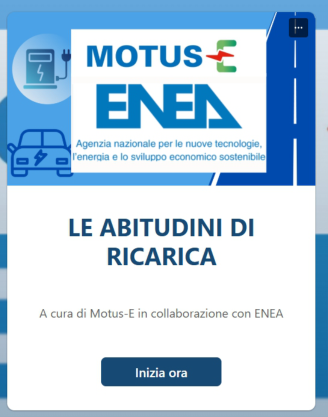
RESEARCH METHODOLOGY AND SAMPLE DEMOGRAPHICS This study focuses on the charging habits of EV drivers in urban and extra- urban areas of Italy. It is based on a revealed preferences survey conducted by MOTUS-E, an Italian association comprising automotive supply chain operators, academics, and advocacy groups, in collaboration with ENEA. The questionnaire was distributed among the members of the association and on the social media channels of the companies involved. The questionnaire was administered as a web form (figure 1).
The survey collected data across various parameters, including vehicle technology (BEV or PHEV), ownership type (private or company car), and primary usage environment (urban or suburban).
The questionnaire was structured into three main sections:
A demographic section to define respondent characteristics.
A charging habits section to explore preferences across three key areas: home charging (if available), workplace charging (if available), and public charging.
A section surveyed the most common issues encountered at public charging stations and gathered suggestions for improving the user experience.
Figure 1: Welcome page of the survey web form.
The survey variables comprise the following category variables
Gender.
Age.
Electric vehicle type/category.
Average daily mileage.
Battery size.
Availability of home charging.
Availability of workplace charging.
Education level.
Employment sector.
Area of residence.
The choice variables for each charge location included the following:
Preferred State of Charge (SOC) at the start of a charging session.
Preferred SOC at the end of a charging session.
Duration of the charging session (for public charging only).
Preferred time slots for start charging.
The survey also addresses factors influencing the decision to purchase an electric vehicle, common challenges related to charging infrastructure, issues related to service discontinuities, and suggestions for enhancing the charging experience.
A total of 1,056 responses were collected, of which 1,000 were from EV users, and 56 from non-EV users. Of the former, 95% were battery electric vehicle (BEV) users and the remaining 5% were plug-in hybrid electric vehicle
A Survey of Charging Infrastructure Users in Italy 1995
(PHEV) users. This result was achieved through targeted distribution of the questionnaire to BEV users.
Demographically, 94% of respondents were men, 5% were women, and 1% chose not to respond. The most represented age group was 45–54 (29%), followed by 55–64 (28%). Additionally, 52% of the respondents held a bachelor’s degree or higher. The geographical distribution of the sample is concentrated mainly in Northern Italy, with 30% of respondents residing in Lombardy and 14% in Lazio.
While the sample distribution does not perfectly align with the general demographic representation, it does reflect a higher prevalence of middle- aged males among electric vehicle owners and users in Italy. Additionally, it emphasizes the varying levels of electric mobility across different social and cultural contexts, revealing a two-speed Italy regarding both infrastructure and the adoption of new technologies.
RESULTS
Focusing on the 56 respondents who currently do not use EVs, 52% are considering the purchase of a fully electric vehicle in the near future, while 16% intend to acquire a plug-in hybrid vehicle. Conversely, 32% of respondents have indicated that they have no immediate plans to invest in an electric vehicle. The primary obstacle to purchasing an electric car is the high initial cost, a concern highlighted by 36% of potential buyers. Additionally, 15% of respondents expressed apprehension regarding the limited range of electric vehicles.
Conversely, when asking the EV owners, several compelling motivations are driving the transition. The foremost incentive is the potential for significant savings on operating costs, as EVs typically require less maintenance and offer lower fuel expenses. Furthermore, many consumers are motivated by a desire to lessen their environmental impact, given that electric vehicles produce fewer greenhouse gas emissions compared to traditional gasoline-powered vehicles.
The convenience of home charging infrastructure also plays a vital role, as it facilitates accessible overnight charging. Indeed, among EV users investigated, 74% have access to domestic charge facilities. Moreover, 59.01% of respondents said they would not purchase an electric car if it were not possible to charge at home. Women are less likely to use/purchase an electric car if it is not possible to charge at home. Finally, enhanced comfort and driving experience, including quieter operation and smoother acceleration, are key factors driving the preference for electric mobility.
The EV charging landscape faces various inconveniences that can impact user experience and hinder the adoption of this sustainable technology. The main public charging-related issues reported by respondents are listed in Table 1, grouped by category. Each respondent could provide up to four free-text answers.
Table 1: Main public charge problems reported by respondents.
Table available in the original PDF paper.
Percentage Public Charge Issues No. of Answers
383 20.5%
Disconnected/unavailable infrastructure 579 31.0% Interoperability/lack of credit card payment 419 22.4% Parking space occupied by a combustion engine or not charging EV
11 0.6%
None 195 10.4% Connectivity of the app 193 10.3% Hardware issues (stations, cables) 82 4.4% High costs 8 0.4% Poor layout, poor maintenance of charging stations, lack of security, Other Below, we highlight the most frequently encountered issues reported by charging infrastructure users.
1. Infrastructure Connectivity and Availability: EV users often face challenges with connectivity to charging infrastructure through apps. Infrastructure appears free when it’s occupied or out of order, or vice versa. Issues such as sparse geographical distribution of charging stations can leave users without options, particularly on long journeys or in rural areas. 2. Interoperability Issues: Integration between mobility service providers and charging infrastructure is often inadequate. Users may face incompatibility issues at specific stations and limited payment options, restricting access to charging services. 3. Financial Concerns: The high costs of using public charging stations can be comparable to traditional fuel prices, raising doubts about the economic benefits of electric vehicles for potential users. 4. Problems with the Application: Charging apps often experience technical issues, including disconnections or unavailable payments. 5. Hardware Issues: Malfunctioning hardware at charging stations, such as broken units and cables, frustrates users and erodes trust in the charging infrastructure. 6. Parking Challenges: Parking issues often arise when non-electric vehicles or electric vehicles not in charge occupy charge parking lot. 7. Quality of Charging Stations: The condition and layout of charging stations significantly affect user experience. Poor design, lack of maintenance, and safety concerns can deter users from utilizing public charging options. 8. Additional Concerns: Various other challenges exist in the EV infrastructure that affect user experiences and warrant further discussion for improvement, such as unreachable or inadequate customer service.
As for the users’ suggestions, five categories have been identified. The quantitative breakdown of suggestions for each category, calculated from a total of 514 responses, is reported in Table 2.
A Survey of Charging Infrastructure Users in Italy 1997
Table 2: Suggestions for each category, calculated from a total of 165 responses.
Table available in the original PDF paper.
Percentage
Suggestions Category No. of Answers
55 27.9%
Costs 92 46.7% Distribution and Availability of Charging Stations Interoperability 24 12.2% Other 26 13.2%
The key recommendations regarding electric vehicle charging infrastructure per category are summarized as follows:
1. Costs: Users have expressed concerns about the complexity of tariffs. They are calling for greater transparency, clearer pricing structures, and an end to the “price jungle.” There is also a demand for more effective incentives. 2. Charging Station Distribution and Availability: The main critical issues involve the scarcity of charging points, their uneven distribution, particularly in rural and peripheral areas, and their frequent inoperability. 3. Interoperability: This category reflects user frustration with charging management. Suggestions include increasing standardization, reducing the number of apps and cards needed, and introducing simpler and more unified payment systems. 4. Other: This category covers a variety of suggestions. The most frequent topics include the need for faster charging, better customer service, protecting charging stations from vandalism, and providing real-time updates on the status of charging stations.
Overall, the results indicate that users’ greatest concern lies not in technology or cost, but rather in the fundamental logistics of charging. The lack of widespread and reliable charging infrastructure is the primary barrier to the full adoption of electric vehicles. While cost and interoperability issues are important, they are secondary, emphasizing that the main priority is to make charging a simpler and more accessible experience.
CONCLUSION
We investigated the preferences of actual and potential EV users in Italy. While EVs initial cost and limited range are the main obstacles to their adoption, the main motivations for transitioning to electric mobility are, in order of importance: savings on operating costs, reduction of environmental impact, availability of home charging, and improved driving comfort and habitability.
In terms of service issues, 34% of EV users reported that the most common problem is charging stations being disconnected or unavailable through an app. This is followed by concerns about interoperability and credit card payment issues (22%), parking space occupied by a combustion engine or
not charging EV (20%), and app-related issues (19%). Notably, 10% of respondents indicated that they have never experienced any problems with public charging.
User suggestions highlight several key areas for improvement in charging infrastructure. Almost half of the respondents complain about charging costs. About 28% of respondents called for more charging points, particularly in rural areas and smaller cities, along with better maintenance and strategic placement near services and highways.
Additionally, 12% expressed the need for greater interoperability, advocating for a unified system (card/app) for all public and private charging stations, and a universal connector for all vehicles.
A standard payment system was emphasized, allowing for common methods like credit and debit cards. Respondents also noted the need to simplify charging fees and improve clarity around subscriptions and discounts.
Further suggestions included a single app for real-time information on charging station availability, faster charging options, and better customer service to address issues quickly. Increased security at charging stations was also recommended to prevent vandalism.
The findings of the paper can be confirmed by the fact that Italy lags other major European countries in EV sales and overall market penetration, although the market is experiencing growth. In early 2025, there was a significant year-on-year increase in registrations, yet the overall market share of EVs remained low compared to the European average during the first months of the year (European Alternative Fuels Observatory, 2025).
Despite Italy having one public charging point for every six electric vehicles—a favorable ratio compared to major global markets—there are significant regional disparities that must be addressed. More than half of the charging stations are in the northern part of the country, leaving the southern regions and islands significantly behind.
Despite the rapid increase in the number of high-power charging points, their usage rates remain low due to an outdated vehicle fleet. Consequently, the cost of ultra-fast charging in Italy is among the highest in Europe, making operating an electric vehicle less appealing for some users. Furthermore, Italy has the highest medium-voltage electricity costs for charging compared to other major European markets, presenting an ongoing challenge.
Rising energy prices, inflation, and the resulting decrease in citizens’ purchasing power require serious consideration. For electric mobility to succeed, it must be accessible, economically sustainable, and offer concrete benefits to those who adopt this new technology.
Additionally, the lack of coordination among institutions, local authorities, and industry players remains a significant challenge. Without clear communication and a unified vision, there is a risk of wasting resources, hindering investments, and impeding the development of a widespread, efficient, and interconnected public charging infrastructure. This infrastructure is crucial for meeting the needs of citizens, businesses, and travelers.
A Survey of Charging Infrastructure Users in Italy 1999
REFERENCES
European Alternative Fuels Observatory. 2025. “Italy’s €600 Million EV Incentive Push: Can It Revive the New Car Market?” European Alternative Fuels Observatory, August 19. https:// alternative-fuels-observatory.ec.europa.eu/general-information/news/ italys-eu600-million-ev-incentive-push-can-it-revive-new-car-market#: ∼: text=Italy%20has%20one%20of%20the%20lowest%20battery%2Delectric, in%20June%2C%20highlighting%20the%20urgency%20for%20action. Fabianek, Paul, and Reinhard Madlener. 2023. “Multi-Criteria Assessment of the User Experience at E-Vehicle Charging Stations in Germany.” Transportation Research Part D: Transport and Environment 121 (August): 103782. https:// doi.org/10.1016/j.trd.2023.103782. LaMonaca, Sarah, and Lisa Ryan. 2022. “The State of Play in Electric Vehicle
Charging Services – A Review of Infrastructure Provision, Players, and Policies.” Renewable and Sustainable Energy Reviews 154 (February): 111733. https:// doi.org/10.1016/j.rser.2021.111733. Lazuardy, Ardhy, Rahmat Nurcahyo, Ellia Kristiningrum, et al. 2024. “Technological, Environmental, Economic, and Regulation Barriers to Electric Vehicle Adoption: Evidence from Indonesia.” World Electric Vehicle Journal 15 (9): 422. https://doi.org/10.3390/wevj15090422. Li, Chengsi, Shu Zhang, Weijie Ling, Liquan Zhao, and Younghwan Pan. 2024.
“Enhancing User Experience in Electric Vehicle Charging Applications (EVCA): A Comprehensive Analysis in the Chinese Context.” Journal of the Knowledge Economy 15 (4): 18495–530. https://doi.org/10.1007/s13132-024-01881-5. MASE. 2025. “Investimento 4.3 - Installazione Di Infrastrutture Di Ricarica Elettrica.” MASE. Gov. It, June 18. https://www.mase.gov.it/portale/investimento- 4.3-installazione-di-infrastrutture-di-ricarica-elettrica. Motus-E, and Strategy&. 2024. Il Futuro Della Mobilità Elettrica in Italia @2035. Pwc. https://www.motus-e.org/wp-content/uploads/2024/09/ 2024.10.01_Strategy_Motus-E_Report-IdR%402035_vFinal.pdf. Pamidimukkala, Apurva, Sharareh Kermanshachi, Jay Michael Rosenberger, and
Greg Hladik. 2023. “Evaluation of Barriers to Electric Vehicle Adoption: A Study of Technological, Environmental, Financial, and Infrastructure Factors.” Transportation Research Interdisciplinary Perspectives 22 (November): 100962. https://doi.org/10.1016/j.trip.2023.100962. Rempel, David, Carleen Cullen, Mary Matteson Bryan, and Gustavo Vianna Cezar.
2022. “Reliability of Open Public Electric Vehicle Direct Current Fast Chargers.” SSRN Electronic Journal, ahead of print. https://doi.org/10.2139/ssrn.4077554. Singh, Rubina, Daniel Malarkey, and Don MacKenzie. 2024. “A Review of the Customer Experience at Public Charging Stations and Its Effects on Electric Vehicle Purchase and Use.” Findings, ahead of print, September 24. https://doi.org/ 10.32866/001c.122904.
LISTED IN THE AHFE DIGITAL BOOKSTORE CATALOGUE
Explore the complete digital volume
Human Factors in Design, Engineering, and Computing
Read this individual research paper free through the original publisher, or explore the full digital proceedings book.
ISBN 978-1-964867-75-5
Explore this ISBN in the AHFE Bookstore ↗Listed in the July 2026 bookstore catalogue; search by ISBN to confirm current availability · Digital book purchase optional