Sarah Mansbridge, Mark Burgess, Margaret Harris (2021). Electric Vehicle Drivers Overcome Range Anxiety Prior to Their First Trip. In: Advances in Human Aspects of Transportation: Part II. AHFE Open Access, vol. 16. https://doi.org/10.54941/ahfe100684
Consumers’ concerns over the drive range of an electric vehicle (EV) are widely acknowledged as the key reason for the non-acceptance of EVs. Yet to-date, the underpinnings of the phenomenon ‘range anxiety’ remain under researched and poorly understood. Pre-trial interview data were analysed from drivers in the United Kingdom BMW MINI E trial in order to explore the psychosocial factors drivers experience vis-à-vis range and to understand how drivers perceive and mentally construct range. Results revealed a four-stage process of cognition, whereby drivers’ preconceptions of the EV range precipitated anticipatory concerns regarding running out of charge, leading to one of four strategies that directly guided their intended behaviour, in a manner that enabled them to avoid experiencing range anxiety. The results are discussed in relation to challenging drivers’ pre-trial mind-sets, in order to change the way in which the range is perceived.
A key feature of the internal combustion engine (ICE) vehicle is the notion of mobility and the freedom and independence this encapsulates (Jensen, 1999). Limitations of the approximate 100 mile battery capacity of the modern day electric vehicle (EV) poses obvious challenges to both usability and mobility. Therefore, it is not surprising that concerns regarding the EV drive range are widely acknowledged as the key reason for the non- acceptance of EVs (Beggs, Cardell, & Hausman, 1981; Bunch, Bradley, Golob, Kitamura, & Occhiuzzo, 1993; Carley, Krause, Lane, & Graham, 2013; Chéron, & Zins, 1997; Dagsvik, Wennemo, Wetterwald, & Aaberge, 2002).
Since first being reported in the press in 1997, concerns over the EV range have escalated into the phenomenon now commonly known as ‘range anxiety’ (Neilsson, 2011). Range anxiety is defined as an individual’s ‘concern of not reaching their destination while travelling in an EV’ (Neilsson, 2011). It must be noted that range anxiety not only relates to the limited battery range, but also to the difficulties of recharging (i.e., limited availability of public charging points and relatively lengthy charge times, that render an EV unusable for the period of recharging).
Despite perceptions of EV range being reported as the main barrier to the successful uptake of EVs, what is notably lacking is a deep understanding of range anxiety from a psychosocial perspective. Indeed to-date, the underpinnings of ‘range anxiety’ remain poorly understood. Previous research has largely ignored perceptions of the range and focused instead on the battery capacity required to make the EV range acceptable to the consumer. This research
(taken from both non-EV and EV users) shows the 100+ mile EV range to be sufficient to satisfy the mobility requirements of a large market segment (Carroll, Walsh, Burgess, Harris, Mansbridge, King, & Bunce, 2013; Pearre, Kempton, Guensler and Elango, 2011;Turrentine, Garas, Lentz, & Woodjack, 2011). However, despite the reported goodness of fit between mobility needs and resources, this research also demonstrates the existence of a ‘range paradox’ or gap between what consumers consider as being adequate and acceptable drive ranges for an EV (Carroll et al., 2013; Cocron, Bühler, Neumann, Franke, Krems, Schwalm, & Keinath, 2011; Eggers, & Eggers, 2011; Franke, & Krems, 2013a; Franke, Cocron, Buhler, Neumann, & Krems, 2012; Neumann, Cocron, Franke, & Krems, 2010;Tamor, Gearhart, & Soto, 2013; Vilimek, Keinath, & Schwalm, 2012). Thus, this research has largely found that drivers state they require the battery capacity to increase to approximately 200 – 300 miles before they would be willing to invest in an EV (Carroll et al., 2013; Daziano, & Chiew, 2013; Kurani, Turrentine, & Sperling, 1996).
Not only has previous research found ‘range anxiety’ to be detrimental to the general acceptance of EVs, it also shows that range has a lasting negative affect on drivers’ interactions with the energy resources of the battery. Drivers’ concerns regarding the range cause them to be overcautious in their judgements of whether the EV would successfully reach their destination (Carroll, & Walsh, 2010). Thus, a common finding from this literature is that drivers are failing to utilize the full amount of battery power available to them (Carroll et al., 2013; Cocron et al., 2011; Franke & Krems, 2013b; Franke et al., 2012). This suggests that direct experience of the EV range alone is not enough to overcome range as a psychological barrier in the mind of the EV user.
The above research principally concludes that an increased battery capacity (with associated increases in battery cost and size), growth of public charging points and faster charging times are required for EVs to appeal to the mass consumer market. However, this research (and the recommendations it proposes) masks, rather than addresses, the underlying psychological issues that result in range anxiety. Therefore, it is important to obtain a deeper understanding of the underpinnings of range anxiety from a psychosocial perspective, as this is undoubtedly delaying the adoption of EVs by the mainstream consumer market. Evidently the quest to determine how to make the EV drive range acceptable has presently ignored the perceived personal relevance of range from the consumers’ perspective. In other words it is important to understand consumers’ perceptions of the EV range, as this ultimately guides their emotional reactions and cognitive structures (mental representations), and directly affects their overt behaviour with the EV.
This is a particularly salient issue in relation to the EV drive range, where individuals have to psychologically adjust to having a limited range vehicle of approximately 100 miles (in comparison to the +400 mile range of the ICE vehicle), a charge time of 4 – 10 hours (in comparison to a refuelling time of 5 – 10 minutes) and a public charging infrastructure in the early stages of development.
Aim of study The present study aims to explore the psychosocial factors drivers experience vis-à-vis range in order to understand how drivers perceive and mentally construct the EV range, in order to understand range as a psychological barrier.
METHOD
Background to present study Participants in this study were enrolled in a field trial that was both part of the wider International BMW MINI E field trial (involving trials in the United States, Germany, United Kingdom, France, Japan and China) and was also part of the United Kingdom Technology Strategy Board Ultra-Low Carbon Vehicle Demonstrator Programme (involving low-emission vehicles from 18 manufacturers). These programmes supported research, development and assessment of EV technologies, with an aim of providing a sustained real-world test of everyday usage. Throughout the trials, analytic research data were collected from both the cars (through on-board data loggers) and the drivers (through questionnaires and interviews). The focus of analyses for this study is the drivers’ pre-trial interview data.
The UK MINI E Trial took place in the South-East region of the country between December 2009 and March 2011. The study was divided into two separate phases lasting 6-months (phase one from December 2009 to June 2010 and phase two from September 2010 to March 2011). The MINI E trials incorporated drivers in both a private and fleet setting. Twenty electric MINIs were available for members of the public to lease for the 6-month trial period. A further 20 MINI E vehicles were distributed among members of the public sector organizations that were part of the MINI E consortium. The public sector organizations that formed the MINI E consortium included the South East England Development Agency (SEEDA), Scottish and Southern Energy (SSE), Oxford City Council and Oxfordshire County Council and enabled the testing of the MINI E within a fleet environment.
Participants Participants were 30 drivers of the BMW MINI E (20 private users; 10 corporate users) in the TSB ULCV Demonstrator Programme Trial. There were 21 men and 9 women of 21 – 62 years of age (Mean = 44.73). All but one of these participants had access to at least one ICE vehicle for the duration of their trial, and none had had any prior experience with an EV. Private drivers applied to participate in the trial either through online or newspaper applications. To be eligible to be included in the trial, applicants had to (1) pay a monthly lease fee of £330, (2) reside within a geographical triangle running from Andover, Oxford and West London, (3) have a private garage or parking space that would enable the installation of a 240V charging unit, and (4) indicate that they drove 300 miles per month. Successful applicants had their MINI E for a period of six months.
Corporate users were recruited through one of the aforementioned public sector organizations. Corporate users had sole access to an electric BMW MINI E for the duration of the trial and had to fulfill the same criteria as private users (with the exception of being exempt from having to pay the monthly leasing fee).
Drivers’ average journey length Prior to EV exposure drivers were asked what their average journey length was in a typical week. 16 of the 30 drivers (14 private users; 2 corporate users) reported their average journey length as not exceeding 20 miles (round trip). The remaining 14 drivers (6 private users; 8 corporate users) reported having longer average journey lengths of 50 miles or over (round trip). Note these drivers either had a routine daily round trip of at least 50 miles, or regularly had to undertake business trips greater than 50 miles (i.e., corporate users who were required to cover a relatively large geographical area as part of their work remit).
Characteristics of the MINI E The MINI E was a two-seat conversion of a MINI Cooper with a range of around 100 miles, depending upon driving style and driving conditions (Vilimek et al., 2012). It was powered by a 204hp electric motor and a 35kWh Lithium- Ion battery. The battery took 4 hours to charge at 32 Amps and 10 hours to charge at 13 Amps.
Procedure and interview schedule During the trial, participants were interviewed at (1) pre-trial, (2) immediately after they had first driven the car at a technical instruction event, and (3) 1 week after integrating the MINI E into their everyday life. Longer term adaptation was assessed through interviews at (4) 3 months into the trial, and (5) at the end of the trial. Here we focus on the pre-trial interview data. These interviews were one-to-one and took 45-90 minutes to complete. The interview schedule dealt with all aspects of the drivers’ expectations and experiences. For the current study we were interested in drivers’ reports of their expectations and experiences. For the current study we were interested in drivers’ reports of their preconceptions of the drive range and their expectations of adapting to the drive range. Although participants may have given such information spontaneously (and this information was included in our analysis), interview questions were also designed specifically to address these issues (e.g. How will you deal with the range?). The interviewers prompted participants to give concrete examples in response to each question. Also, in accordance with Wengraf’s (2001) suggestions for optimal narrative-based interviewing, the interviewer encouraged each participant to elaborate on their initial response with follow-up narrative-inducing probes. These probes were extemporized and were rooted in statements which the participant had made that the interviewer wanted to know more about (e.g. You said you think you will have to preplan your journeys more with the MINI E. Can you please tell me more about that?). This technique leads to additional narrative data and allows the interviewer to explore Human Aspects of Transportation II (2021)
emerging areas of interest in ‘real time’ (Smith & Eatough, 2007) while also maintaining a sense of participant agency (Parker, 2005) and recognizing the participant as an ‘experiential expert’ who is capable of steering the direction of the interview through accounts of their personal experiences (Smith & Osborn, 2008).
Data analysis The 30 participant transcripts were analyzed according to the Thematic Analysis (TA) guidelines provided by Braun and Clarke (2006). The initial stages involved reading and re-reading interview transcripts to become familiar with the breadth and depth of information pertaining to drivers’ comments regarding range. The analysis was conducted in an inductive ‘bottom-up’ way with earl readings aiming to identify patterns and meanings in the data without drawing upon pre-existing frameworks for coding or theory development. This ideographic emphasis ensured that eventual themes were grounded in the participants’ data and not driven by researchers’ preconceptions.
RESULTS
Overview of results Results revealed a four-stage process of cognition whereby drivers’ preconceptions of the limited range precipitated anticipatory concerns regarding running out of charge, leading to one of four strategies that directly guided their intended behavior in a manner that enabled them to avoid experiencing range anxiety.
Preconceptions of the limited range
Strategies to safeguard against a break-down situation occurring
Anticipatory concerns of running out of charge
Intended behavior that was risk- avoidant Evoke Leading Guiding
Figure1. Overview of four-stage process of cognition: drivers' preconceptions of the range evoke anticipatory concerns leading to strategies that guide their intended behavior.
Figure available in the original PDF paper.
Preconceptions Prior to EV exposure, drivers saw EVs as short range vehicles, ideally suited for usage within a relatively small geographical area. Indeed, the majority of drivers (70%) were acceptant of the range and had already discounted undertaking journeys in the MINI E that exceeded its capabilities on a single charge. Only a small proportion of the drivers (30%) were open to exploring the range and had not entirely discarded travelling to destinations they felt were beyond the range. Therefore, none of the drivers anticipated the range to be a cause for concern on a daily basis, with the expectation that the range would be sufficient for their routine activities. However, prior to EV exposure, drivers’ preconceptions of range estimates were principally based on hypothetical information and lacked real-world experience. Thus, drivers did not know with certainty how far they could travel on a single charge.
Anticipatory concerns The limited range emerged as a critical issue for drivers in relation to exceptional, long, journeys. Indeed, 17 of the 30 drivers (56%) specifically referred to exceptional journeys believed to be beyond the limitations of the range, such as “popping to the coast”, “driving up to Scotland at Christmastime” or “visiting family in Cambridge and Norfolk.” Therefore, drivers did not feel the MINI E would satisfy all their potential travel demands, or be a viable transport option for covering a large geographical area.
Drivers’ lack of certainty as to how far they would be able to go on a single charge was also found to be a cause for concern. Drivers perceived the range as more unpredictable to estimate with a battery than with a tank of fuel. They expected range to be affected by multiple factors (e.g., on-board heater and outside temperature). Drivers with longer average journey lengths (50 miles or above) were significantly more likely than drivers with shorter average journey lengths (20 miles or under) to express such concerns (Fisher’s Exact, p=.046).
The present limited availability of public charging points, coupled with lengthy charge times were frequently mentioned in conjunction with the EV range as causing drivers’ anticipatory concerns over the range (reported by 70% and 67% of drivers respectively). The present charging difficulties reinforced drivers’ views of EVs as being acceptable for usage within the confines of the range only.
In sum, drivers’ anticipatory concerns in relation to the EV range were found to originate from their ultimate fear of running out of charge and being stranded.
Strategies Drivers constructed a variety of cognitive strategies that effectively enhanced their perceived control over the range and regulated their fear of a breakdown situation occurring. In the first instance, drivers set a ‘comfort range’ (i.e., distance they felt confident in travelling in the MINI E). 23 of the 30 drivers (77%) reported their ‘comfort range’ as being less than the distance they felt the MINI E was capable of achieving under optimal conditions. Thus, the vast majority of drivers imposed an energy reserve prior to their first trip in the MINI E.
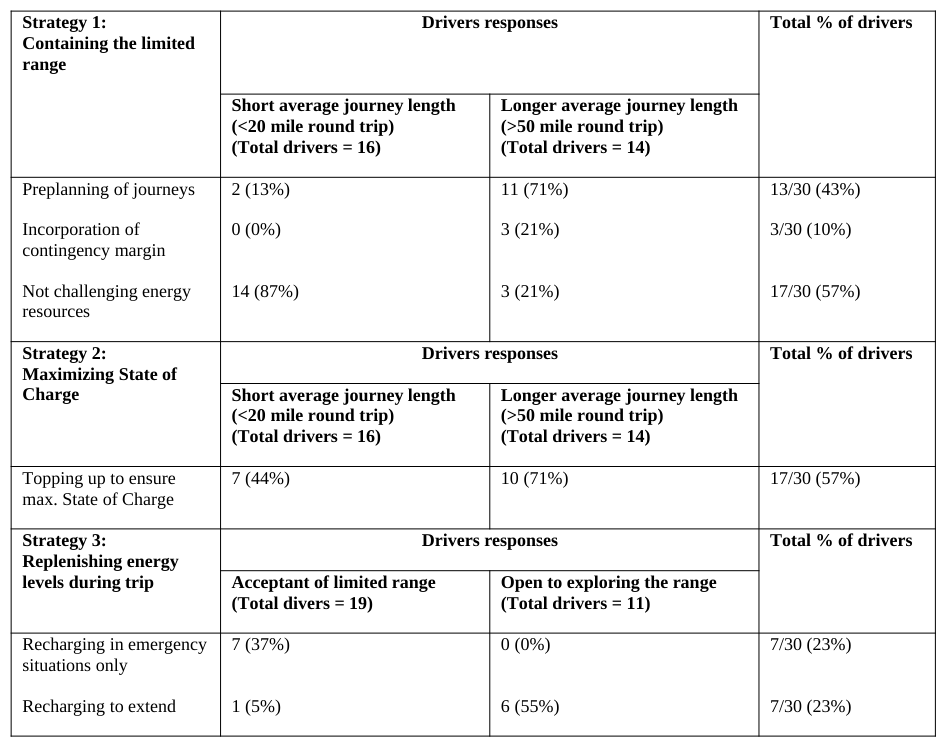
The establishment of a ‘comfort range’ was associated with the construction of strategies to prevent energy resources being problematic within the limits of that ‘comfort range’. Drivers’ strategies for managing the battery capacity fell into 4 broad categories: containing, maximizing, replenishing and conserving energy resources. Table 1 provides an overview of drivers’ strategies.
Table 1: Overview of drivers' strategies to manage energy resources within the limits of the range Drivers responses Total % of drivers Strategy 1: Containing the limited range
Containing the limited range: All drivers conceived of ways in which to effectively contain their use of the MINI E within their comfort range. 13 of the 30 drivers (43%) referred to making a direct assessment through pre-planning journeys to ensure energy resources would be sufficient to complete the trip successfully. 3 of these 13 drivers also explicitly mentioned incorporating a contingency margin (or safety buffer) around the perceived edge of the range to accommodate variations in the rate of battery depletion. 11 of these 13 drivers had longer than average journey lengths (50 miles or over).
The remaining 17 drivers (57%) did not report expecting to make such calculated assessments in order to manage energy resources. Instead, these drivers foresaw the MINI E as principally (or exclusively) being used as the household’s short commuter vehicle, and therefore was not (or infrequently) anticipated to be used in situations that would be remotely challenging to the range. 14 of these 17 drivers had short average journey lengths (20 miles or under).
The above analysis indicates that none of the drivers anticipated making a journey in the MINI E without first of all having carried out some assessment to ensure the energy resources would be sufficient.
Maximizing State of Charge:17of the 30 drivers (57%) mentioned maximizing the State of Charge by charging on a routine basis (e.g., every night) or keeping energy resources topped up (regardless of the remaining State of Charge) in order to prevent the range from being an issue. These drivers anticipated starting their journeys with maximum battery power which increased their confidence in being able to cope with any unforeseen trips that may arise.
Replenishing energy resources during trip: 14 of the 30 drivers (47%) referred to the possibility of replenishing energy resources during a trip (primarily through the use of the 13A charger). 7 of the 14 drivers envisaged using such strategies in emergency situations only (e.g., if they had miscalculated the distance of a trip rather than increasing the distance it was possible to travel in the MINI E). All of these 7 drivers were found to be acceptant of the limited range (i.e., had dismissed the possibility of undertaking longer distance journeys in the vehicle).
In contrast, the remaining 7 drivers contemplated situations in which they could potentially recharge to extend the use of the MINI E beyond that of a single charge. 6 of these 7 drivers were found to be open to exploring the range (i.e., had not completely dismissed the possibility of undertaking longer journeys in the MINI E).
Conserving battery power: 8 of the 30 drivers (27%) referred to two strategies believed to effectively reduce the rate at which battery power was drained. In the first instance, 2 of the 8 drivers (25%) considered selecting different routes (e.g. to work) in order to conserve the State of Charge as much as possible In the second case, 6 of the 8 drivers (75%) felt they would adopt (or maintain) a conservative style of driving (e.g. steadier and smoother) in an attempt to prolong the battery life. 4 of the 6 drivers had a longer average journey length (50 miles or above).
Drivers principally anticipated avoiding using the MINI E if a particular journey exceeded the range limits, envisaging reverting to using their conventional vehicle(s).
Intended Behavior
Drivers’ strategies were essentially defense mechanisms to the potential threat of running out of charge and being stranded. This manifested in drivers’ intended behavior being conservative (or risk-avoidant). Indeed, drivers principally envisaged using the MINI E whenever possible, there and back, on a single charge. Thus, it was never drivers’ intention to use the MINI E in isolation, but always in conjunction with the other vehicle(s) in the household. The integration of the MINI E into a multicar household meant that drivers did not anticipate any difficulties in adapting to the limited range. Indeed, drivers anticipated having to make very few (if any) behavioral changes, and consequently expected their daily routines to continue without any fundamental changes.
DISCUSSION
The main finding from this study is that drivers of the BMW MINI E had established a priori strategies for coping with range, enabling them to avoid experiencing range anxiety prior to EV exposure. Drivers with longer average journey lengths (50 miles or above) were more likely to anticipate having to preplan journeys to the point of destination, building in contingency margins to accommodate variations in the rate of battery depletion, and attempting to reduce the rate at which battery power depleted (i.e., by making adjustments to driving style). In contrast, drivers with short average journey lengths (20 miles or under) were less likely to construct such strategies to manage the energy resources of the battery. This is likely attributable to drivers with short average journey lengths anticipating their daily activities to be well within the limits of the battery capacity, therefore precluding the need for them to put any further strategies in place to safeguard against running out of battery power.
The above findings suggest that even at pre-trial drivers already had internal representations of how they anticipated dealing with the EV range. It also provides some evidence that drivers with longer average journey lengths had begun to develop a deeper (more complex) way of thinking in terms of their future interaction with the energy resources of the battery than had drivers with shorter average journey lengths. This may indicate that drivers principally anticipated having to make behavioral changes when travelling on a lower State of Charge only.
Drivers established an energy reserve, or safety buffer, even before they had got into their EV. Even at this point, the majority of drivers had established a ‘comfort range’ that was less than the optimum distance they believed the MINI E to be capable of achieving. This suggests that drivers were not confident in utilizing the full amount of battery power available to them. This is of importance as it lends support that instead of attempting to overcome range anxiety through additional battery capacity (with associated increases in battery cost and size), future research should explore ways of encouraging new consumers to use a greater proportion of the current battery capacity. One potential way of achieving this would be through driver training designed to get new consumers to push the limits of the range and to alter, or even challenge, their pre-trial mindset.
In summary, this study demonstrates the importance of research into explicating drivers’ pre-trial beliefs and mental constructions the range.
CONCLUSIONS
Drivers of the BMW MINI E had established a priori strategies for coping with range, enabling them to avoid experiencing range anxiety prior to EV exposure.
REFERENCES
Beggs, S., Cardell, S., & Hausman, J. (1981). Assessing the potential demand for electric cars. Journal of Economics, 17, 1–19. Braun, V. & Clarke, V. (2006). Using thematic analysis in psychology. Qualitative Research in Psychology, 3, 77–101. Bunch, D.S., Bradley, M., Golob, T.F., Kitamura, R., & Occhiuzzo, G.P. (1993). Demand for clean-fuel vehicles in California: a discrete-choice stated preference pilot project. Transportation Research Part A, 27, 237–253. Carley, S., Krause, R.M., Lane, B.W., Graham, J.D. (2013). Intent to purchase a plug-in electric vehicle: A survey of early impressions in large US cites. Transportation Research Part D, 18, 39–45. Carroll, S., & Walsh, C. (2010). The Smart move trial: description and initial results. London: Cenex. Retrieved from http://www.cenex.co.uk/LinkClick.aspx?fileticket=yUKaRDJtWg%3D&tabid=60. Chéron, E., & Zins, M. (1997). Electric vehicle purchasing intentions: The concern over battery charge duration. Transportation Research A, 31, 235-243. Cocron, P., Bühler, F., Neumann, I., Franke, T., Krems, J. F., Schwalm, M., & Keinath, A. (2011). Methods of evaluating electric
vehicles from a user’s perspective – the MINI E field trial in Berlin. Germany. IET Intelligent Transport Systems, 5(2), 127–133. Dagsvik, S., Wennemo, T., Wetterwald, D.G., Aaberge, R. (2002), Potential demand for alternative fuel vehicles, Transportation Research Part B, 36, 361–384. Daziano, R.A., & Chiew, E. (2013). On the effect of the prior of Bayes estimators of the willingness to pay for electric-vehicle driving range. Transportation research Part D, 21, 7–13. Eggers, F., & Eggers, F. (2011). Where have all the flowers gone? Forecasting green trends in the automobile industry with a choice-based conjoint adoption model. Technological Forecasting & Social Change, 78, 51–62. Franke, T., & Krems, J.F. (2013a). What drives range preferences in electric vehicle users? Transport Policy, 30, 56-62. Franke, T., & Krems, J. F. (2013b). Understanding charging behaviour of electric vehicle users. Transportation Research Part F,
21, 75-89. Franke, T., Cocron, P., Bühler, F., Neumann, I., & Krems, J.F. (2012). Adapting to the range of an electric vehicle – the relation of experience to subjectively available mobility resources. Proceedings of the European Conference on Human Centred Design for Intelligent Transport Systems, June 14-15, Valencia, Spain. Jensen, M. (1999). Passion and heart in transport – a social analysis on transport behaviour. Transport Policy, 6, 19–33. Kurani, K., Turrentine, T. & Sperling, D. (1996). Testing Electric Vehicle Demand in ‘Hybrid Households’ using a Reflexive Survey. Transportation Research Part D, 1(2), 131–150. Neilsson, M. (2012). Electric vehicle: The Phenomenon of Range Anxiety. Retrieved from http://www.elvire.eu/IMG/pdf/The_phenomenon_of_range_anxiety_ELVIRE.pdf. Neumann, I., Cocron, P., Franke, T. & Krems, J.F. (2010). Electric Vehicles as a solution for green driving in the future? A field
study examining the user acceptance of electric vehicles. Proceedings of the European Conference on Human Interface Design for Intelligent Transport Systems, April 29-30, Berlin, Germany. Parker, I. (2005). Qualitative psychology : Introducing radical research. Maidenhead : Open University Press. Pearre, N., Kempton, W., Guensler, R.L. & Elango, V.V. (2011). Electric vehicles: how much range is required for a day’s driving? Transportation Research Part C, 19, 1171-84. Smith, J.A., & Eatough, V. (2007). Interpretative phenomenological analysis. In A. Coyle & E. Lyons (Eds.), Analysing qualitative data in psychology: A practical and comparative guide (pp. 35-50). London: Sage. Smith, J.A., & Osborn, M. (2008). Interpretative phenomenological analysis. In J. A. Smith (Ed.), Qualitative psychology: A practical guide to research methods, 2nd ed. London: Sage. Tamor, M., A., Gearhart, C., & Soto, C. (2013). A statistical approach to estimating acceptance of electric vehicles and electrification of personal transport. Transportation Research Part C, 26, 125 – 134. Turrentine, T., Garas, D., Lentz, A. & Woodjack, J. (2011). The UC Davis MINI E consumer study. Institute of Transportation Studies, University of California, Davis, Research Report UCD-ITS-RR-11-05. Vilimek, R., Keinath, A., & Schwalm, M. (2012). The MINI E field study: Similarities and differences in international everyday driving. Proceedings of the 4th International Conference on Applied Human Factors and Ergonomics, July 21-25, San Francisco, CA. Wengraf, T. (2001). Qualitative research interviewing: Biographic narrative and semi-structured methods. London: Sage.
LISTED IN THE AHFE DIGITAL BOOKSTORE CATALOGUE
Explore the complete digital volume
Advances in Human Aspects of Transportation: Part II
Read this individual research paper free through the original publisher, or explore the full digital proceedings book.
ISBN 978-1-4951-2098-5
Explore this ISBN in the AHFE Bookstore ↗Listed in the July 2026 bookstore catalogue; search by ISBN to confirm current availability · Digital book purchase optional