Sarah Kusumastuti, Tom Kolkman, Julia Lo, Simone Borsci (2026). Development of Human Factors toolkit to inform behavioural and cognitive research in the railway domain. In: Advances in Human Factors of Transportation. AHFE Open Access, vol. 224, pp. 408–416. https://doi.org/10.54941/ahfe1007869
The application of automated systems in rail operations should account for its impact on train (traffic) operators. The introduction of automation is expected to transform the duties and responsibilities of operators, or more generally, the job description itself. The role of behaviour and cognition research is essential in supporting the shift toward more advanced interactive technologies, helping to maximize their benefits while mitigating potential human factors issues in its adoption. We synthesised information from academic literature on human factors research in railways and developed a toolkit that identifies a set of human factors constructs that were commonly measured by practitioners in the railway domain, particularly in human-in-the-loop (HITL) simulations. We then conducted 3 rounds of feedback consisting of a workshop and 2 survey rounds with a total of 23 responses from human factors experts We identified 8 main constructs that are commonly measured in behavioural rail simulation studies: task performance, workload, communication, situation awareness, attention (including vigilance and attention allocation), user experience and usability, fatigue/sleepiness, and trust in automation. Additionally, we also compiled 63 objective and subjective methods for measuring the constructs, We provide descriptions and examples of how each method was utilised in research in the toolkit.
Behavioural and cognitive research is at the core of human factors research. It is an essential tool in testing hypothesis and assumptions about how we interact with interfaces and systems. In a complex system such as transport, the margin of error of a design that could not properly account for human factors is the difference between life and death (Read et al., 2017). For every technological shift arriving in the transport system, there is potential for changes in the way the system is interacting with operators, passengers, and its surroundings. One example is the transition of metro systems from Grade of Automation (GoA) level 1 to 2, which transforms the work of a train driver into a more supervisory role instead of an active operator, which has Received February 6, 2026; Revised April 3, 2026; Accepted April 21, 2026; Available online July 20, 2026
Development of Human Factors Toolkit to Inform Behavioural and Cognitive Research 409 consequences in the cognitive processes involved in the job such as decreased workload which may lead to errors induced by boredom or inattention (Hunter & McDermid, 2022).
There have been some examples of compiling human factors methods and research practices in the transport domain, for example in road transport, maritime transport (Wu et al., 2022) and aviation (Skybrary, n.d.). We aim to extend this body of knowledge by providing an inventory for human factors research methods and practices used in the railway domain that can help human factors practitioners to share a common methodological vision. While this toolkit is initially developed with a focus on human-in-the-loop simulation studies, the content of the toolkit are applicable to a wide variety of human factors studies that involve collecting behavioural or physiological data.
Our main goal is to map the key human factors measurements in the railway domain, specifically when rail operators are involved as subjects. This includes compiling the methods/tools utilized to empirically measure aspects of human factors. This paper describes the synthesis of the toolkit (Kusumastuti et al., 2025b) from data extraction through multiple iterations of expert review.
METHODS
The human factors toolkit is essentially a compilation of essential constructs measured in human factors studies in rail and automation as well as methods, instruments, and measurement techniques that were utilised in those studies.
The formation of the toolkit involves a literature review for the initial synthesis of the toolkit followed by multiple phases of expert reviews based on the Delphi method (Linstone & Turoff, 1975). There are three main phases in the production of the toolkit and each phase produces a version of the human factors toolkit that becomes a basis for review for the next phase. The review phases are (1) literature review phase (2) workshop and follow up survey phase (3) dissemination survey phase Phase 1: Literature Review
As a part of a literature review on human factors research in rail and automation (Kusumastuti et al., 2025a) we identified human factors constructs that were measured in behavioural studies involving rail human factors. These constructs were identified and compiled by two independent reviewers with expertise in human factors and psychological measurement. This list of constructs (also referred to as aspects) were then reviewed by two additional senior experts in human factors to further adjust the clarity and accuracy of the content of the toolkit.
Phase 2: Workshop and Follow Up Survey Human factors experts from the European research program for the rail sector, Europe’s Rail, were involved in the initial expert review phase by
participating in a workshop discussing the validity of constructs compiled from the literature review and further input on how the toolkit could be developed. Following the workshop, a survey asking for further evaluation and feedback, as well as suggestions on how to enrich the toolkit, was sent to a group of experts consisting of both workshop participants and additional human factors experts. The responses from the feedback survey were anonymized.
We utilized a likert scale for the respondents to evaluate the relevance, usefulness, and sufficiency of information presented in the toolkit. The questions are as follows: (1) Relevance: To what extent do you agree that evaluating [aspect] is relevant in HITL simulations within the railway context? (1–7) (2) Usefulness: How would you rate the usefulness of the table and description we provided on [aspect]? (1–5) (3) Sufficiency: To what extent do you agree that we have listed all main methods for measuring [aspect]? (1–7) (4) Terminology: Do you have any suggestions for alternative or additional terminology or concepts related to [aspect]? (5) Suggestions: (a) Do you have suggestions on other methods that can be used to measure [aspect]? (If yes, Please explain below, and please ensure that you provide sufficient details and references for the measurement you are proposing, allowing us to incorporate it into the toolkit) (b) What changes would you like to suggest in order to improve the presentation and/or content of the information we presented on [aspect]?
Phase 3: Dissemination Survey In the second review phase, we solicited evaluation and feedback from participants of a European rail human factors conference in February 2025. As part of a scheduled talk, we presented an overview of the 2nd version of our toolkit and provided a link to the full toolkit document, as well as a survey asking to evaluate the toolkit. Participants of the conference consist of human factors experts in transportation from academia and industry.
The questions presented on the survey are as follows: (1) Suggestions: Do you have any suggestions for additional constructs? If yes, please explain below and Do you have any suggestions for additional measurements for existing constructs? If yes, please explain below (2) Usefulness: How useful do you think is this human factors toolkit for HITL rail research? (Not at all useful [1] – extremely useful [5]) (3) Utility: Please indicate your agreement to the following statements (strongly disagree [1]) - strongly agree [5]): (a) the HITL toolkit can help harmonize the practice in rail research domain (b) the HITL toolkit can improve the replicability of research results (c) the HITL toolkit can improve the comparability of research results
RESULTS
A summary of the result of each phase is outlined in Table 1. The table oulines the number of participants involved in the development of the toolkit during the phase as well as the content of the toolkit
Table 1: Toolkit review participants and content at each phase.
Table available in the original PDF paper.
Phase Participants Toolkit Content Literature review 4 human factors experts (2 extractors and 2 reviewers) 10 constructs, 39 methods/ measurements
Workshop and follow up survey
8 constructs+ 2 sub constructs, 59 methods/measurements
8 workshop participants and 7 survey respondents from 12 survey recipients
8 constructs+2 sub constructs, 63 methods/measurements
Dissemination survey 4 complete responses from around 40 attendants of the presentation
Phase 1: Literature Review An initial list of constructs and measure were extracted from a list of behavioural studies on human factors in railways. The list consists of 10 human factors related constructs and 39 methods used to measure them were extracted from the literature. The list of constructs and their definitions based on this initial phase is as follows:
1. Task Performance 2. Workload 3. Communication 4. Situation Awareness 5. Attention Allocation 6. User experience and usability 7. Fatigue 8. Responsiveness 9. Vigilance 10. Trust in Automation The first version of the toolkit document that contains the construct definition and various objective and subjective methods to measure them.
Phase 2: Workshop and Follow Up Survey Workshop
There were 8 experts who attended the workshop both in person and on-line as part as Europe’s Rail project meeting. In the workshop, the list of constructs was validated, and it was agreed that the workshop participants will present more thorough feedback through a questionnaire after reviewing the full document.
The first version of the toolkit document and feedback questionnaire was sent to all participants of the workshop and an addition of 4 human factors and/or railway experts that did not attend to workshop but was part of the project. There were 7 full responses received from 12 surveys sent.
Survey Results A summary of the results of the rating scale questions of the survey is as follows:
Relevance: Performance is noted to be the most relevant with a mean of 6.9 out of 7 and responsiveness is evaluated to be the least relevant (5.3/7)
Usefulness: The information on fatigue is judged to be most useful (4.2/5) and communication to be least useful (3/5).
Sufficiency: The information on fatigue and attention allocation is judged to be most sufficient (both 5.1/7) and performance to be the least sufficient (4.3/7).
As a result of feedback from this phase, we made 3 major changes to the main construct list. First, the construct responsiveness is absorbed into task performance as it was agreed to be a measure of performance. Secondly, the constructs attention allocation and vigilance were merged into a single construct called attention where the two become subconstructs. Finally, the construct fatigue was renamed to fatigue & sleepiness. The list of constructs and their definitions based on this initial phase is as follows:
1. Task Performance 2. User experience and usability 3. Situation Awareness 4. Workload 5. Fatigue and sleepiness 6. Attention (vigilance and attention allocation) 7. Communication 8. Trust in Automation Additionally, 20 more methods or measurements were added to the toolkit across all 8 constructs. A version of the toolkit consisting of 8 constructs and 59 measures was then published to be evaluated at the next review phase.
Phase 3: Dissemination Survey The second version of the toolkit was presented as part of a talk at the 6th German Conference on Rail Human Factors in Berlin, Germany. During the talk, a link to the toolkit document produced from phase 2 and feedback survey was presented to all attendants of the talk and was available up until a week after the conference. In total 4 full responses was collected from the talk attendants.
A summary of the results of the rating scale questions of the survey are as follows:
Usefulness: The average usefulness rating of the toolkit is judged to be 4 out of a scale of 5
Utility: For statement (a) the mean response is 3/5, statement (b): 2.75/5, and statement (c): 4.25/5
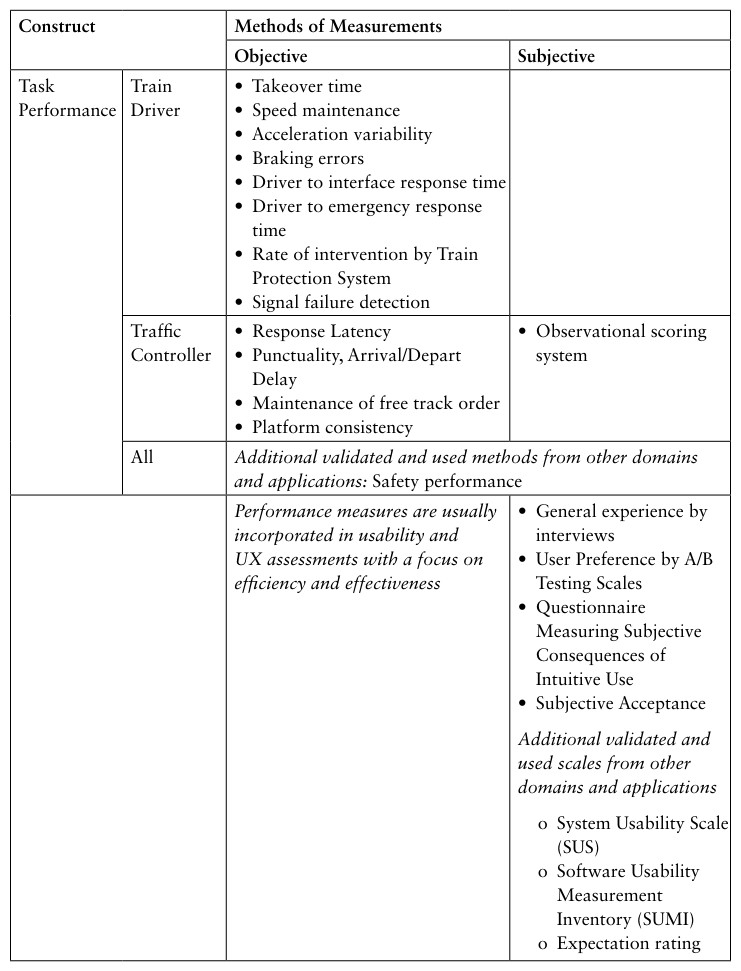
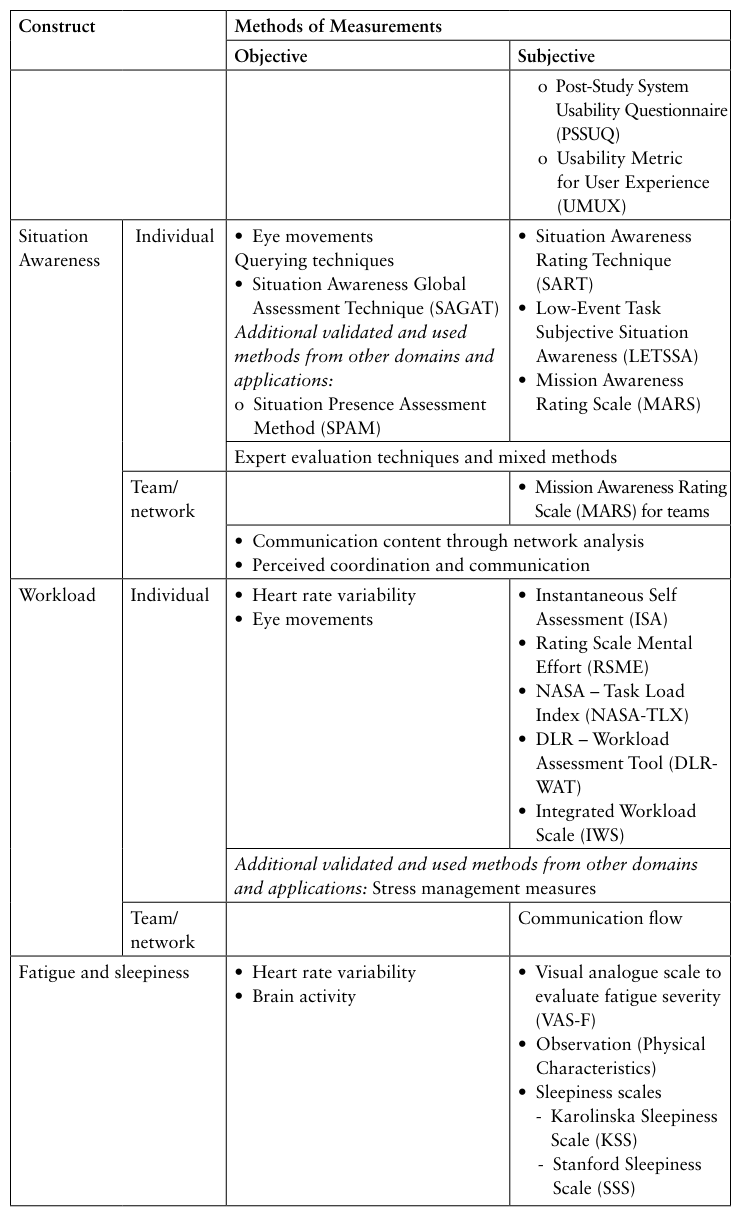
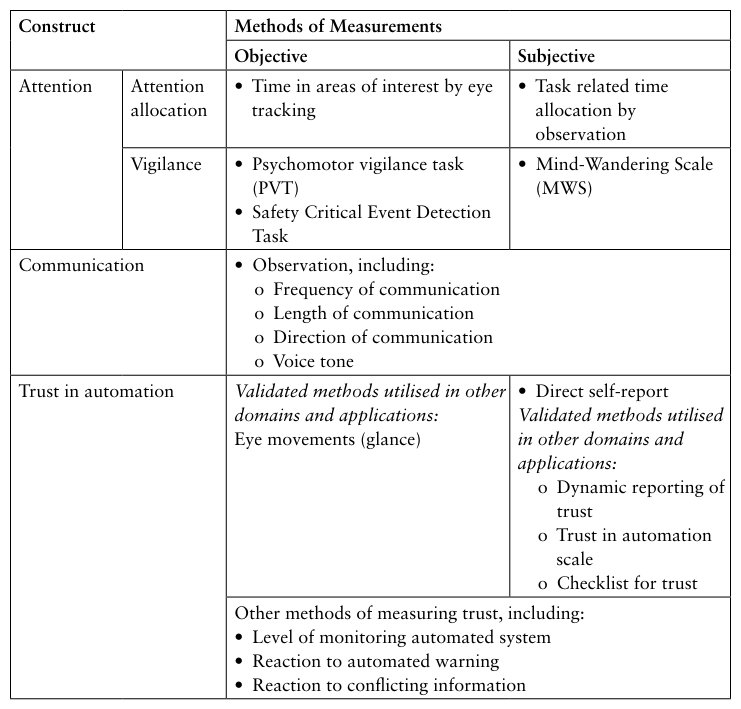
Development of Human Factors Toolkit to Inform Behavioural and Cognitive Research 413 Two measures were added to the toolkit based on the feedback: safety measures under task performance and stress management measures under workload. Additionally, workload and situation awareness now make distinction between individual and team measures. After the changes were made, a third and final version of the toolkit was published (Kusumastuti et al., 2025b). Table 2 outlines the list of constructs and measures compiled in the final version. The toolkit document provides a more detailed explanation on the measurement validity and how it has been used by other studies.
Table 2: List of constructs and measures included in the final version of toolkit.Table 2: Continued.Table 2: Continued.
CONCLUSION
This paper illustrates the development of a toolkit for human factors research in railways, consisting of relevant constructs that can be measured in behavioural studies involving rail workers, particularly those utilising HITL simulations. The toolkit compiles measures, methods, and techniques for human factors research that has gone through multiple validation stages by human factors and/or rail experts.
Compared to other domains like aviation and road transport, the railway sector still has a gap in terms of the availability of literature examining human factors constructs (Papadimitriou, 2020). We hope that this toolkit can function as a valuable inventory of knowledge and resources, aiding HF researchers and railway practitioners in understanding and designing applied cognitive and behavioural experiments in rail human factors.
ACKNOWLEDGMENT
This project has received funding from the Europe’s Rail Joint Undertaking under the European Union’s Horizon 2022 research and innovation program under grant agreement No. 101101973 (FP1 - MOTIONAL).
REFERENCES
Hunter, J., & McDermid, J. (2022). Investigating Human Error Within GoA-2 Metro Lines. Reliability, Safety, and Security of Railway Systems. Modelling, Analysis, Verification, and Certification: 4th International Conference, RSSRail 2022, Paris, France, June 1–2, 2022, Proceedings, 179–191. https://doi.org/10.1007/978-3- 031-05814-1_13 Kusumastuti, S. A., Kolkman, T. H. J., Lo, J. C., & Borsci, S. (2025a). Charting
the landscape of rail human factors and automation: A systematic scoping review. Transportation Research Interdisciplinary Perspectives, 30, 101350. https:// doi.org/10.1016/j.trip.2025.101350 Kusumastuti, S. A., Kolkman, T. H. J., Lo, J. C., & Borsci, S. (2025b). Human factors toolkit in railways V.3 (September 2025). OSF. https://osf.io/5rw24 Linstone, H. A., & Turoff, M. (Eds.). (1975). The delphi method (Vol. 1975,
pp. 3–12). Reading, MA: Addison-Wesley. Papadimitriou, E., Schneider, C., Tello, J. A., Damen, W., Vrouenraets, M. L., & Ten Broeke, A. (2020). Transport safety and human factors in the era of automation: What can transport modes learn from each other?. Accident analysis & prevention, 144, 105656. Read, G. J. M., Beanland, V., Lenné, M. G., Stanton, N. A., & Salmon, P. M.
(2017). Integrating Human Factors Methods and Systems Thinking for Transport Analysis and Design. CRC Press. Skybrary. (n.d.) Human Factors Methods. Retrieved February 2, 2026, from https:// skybrary.aero/human-factors-methods Wu, B., Yip, T. L., Yan, X., & Guedes Soares, C. (2022). Review of techniques
and challenges of human and organizational factors analysis in maritime transportation. Reliability Engineering & System Safety, 219, 108249. https:// doi.org/10.1016/j.ress.2021.108249
LISTED IN THE AHFE DIGITAL BOOKSTORE CATALOGUE
Explore the complete digital volume
Advances in Human Factors of Transportation
Read this individual research paper free through the original publisher, or explore the full digital proceedings book.
ISBN 979-8-950676-00-0
Explore this ISBN in the AHFE Bookstore ↗Listed in the July 2026 bookstore catalogue; search by ISBN to confirm current availability · Digital book purchase optional