Yuan Gao, Ziqi Wang, Yong Li, Yueheng Ma (2026). Structured Functional Training Enhances Motor Skill Acquisition and Functional Health in Adolescent Athletes: A Randomized Controlled Trial. In: Human Factors in Sports, Preventive Medicine and Innovative Agonology. AHFE Open Access, vol. 226, pp. 72–79. https://doi.org/10.54941/ahfe1007825
Adolescence is one of the stages of development where rapid neuromuscular growth and increased neuroplasticity occur. This is a stage at which training organization can play critical roles in the acquisition of motor skills, coordination of movement, and long-term functionality. Although the results of strength-based training programs are frequently reported in training studies on adolescents, there have been less studies that examine the role of integrative training methods on the efficiency of motor learning and functional adaptation specifically. In the present study, the impact of a systematic functional training program on motor skill-related performance and functional health indicators in young volleyball players were examined. It has been a randomized controlled trial involving 52 male adolescent athletes aged 13 + 2 years who were randomly assigned to the functional training group (FTG n = 26) and traditional resistance training group (TRTG n = 26). After the 12 weeks intervention (3 times a week, 20 in each group) 40 subjects were able to complete the protocol. The functional program aimed at multi-jointed and multi-planar exercises that were based on their tasks with dynamic balance and core stability and sport-specific jump coordinate. Measurement tools included: standing reach height, approach reach height, agility (half-meter square test), standing long jump, sprint speed and endurance performance. Both FTG (P = 0.025; d = 0.74) and AP-R (P = 0.034; d = 0.69) increased significantly indicating better vertical coordination and intermuscular synchronism. Agility performance had moderate effect size (d = 0.58) meaning that it did not statistically differ (P = 0.075). The TRTG experienced excellent increase in agility (P = 0.028, d = -0.72) but no change in vertical performance. Comparison of post-intervention measurements across groups demonstrated no significant differences (all P> 0.05). Integrative and task-oriented characteristic of structured functional training, under the concept of motor learning, has the potential to develop sensorimotor integration and coordinated movement pattern formation during adolescence. Improvements in dynamic balance and coordinated force generation can also be seen as an advantage of joint stability and neuromuscular efficiency, which are aspects of functional health and decreasing the risk of injury. These findings suggest that training structure is a key element in predicting the results of motor learning and provide a foundation to consider other time-based training models that aim at optimizing the development of skills and functional capabilities in the youth population.
Youthfulness is a significant physiological and psychological turning point that has been acknowledged as a sensitive time of motor development and brain reorganization (Aoki et al., 2017; Lloyd et al., 2015). In the pubertal growth spurt, the Central Nervous System (CNS) has increased synaptic plasticity and environmental responsiveness because of changing hormonal profiles, particularly higher levels of growth hormone and testosterone, and increased rate of neural myelination (Tumkur Anil Kumar et al., 2021). The
Structured Functional Training Enhances Motor Skill Acquisition 73 biological window has unprecedented potential to improve the quality of neuromuscular control but it also has its own peculiarities. The fast increase in biomechanical levers (limb lengths) can be too quick relative to the CNS recalibration of motor programs, which commonly causes a temporary state of adolescent awkwardness or motor discoordination. The structure, intensity and specificity of training interventions have a strong and possibly long-lasting effect on long term functional outcomes and athletic trajectories against this volatile developmental backdrop.
Physical performance improvement is also one of the major goals in the field of youth athletic development. Resistance Training (TRT) has traditionally been considered as the gold standard to develop muscle strength, power, and overall physical literacy (Behm et al., 2008; Faigenbaum and Myer, 2010). TRT can effectively promote muscle fibre hypertrophy and enhance motor unit recruitment with external loads being used in a controlled setting. However, once examined using the Motor Learning Theory perspective, the shortcomings of TRT become more obvious. TRT is mostly focused on individual muscles and linear, mono-planar patterns of movement, usually restricted to the sagittal plane. These very structured and repeated stimulus are likely to cause what scientists refer to as a transfer deficit. Although an athlete may exhibit substantial strength improvements in a laboratory or gym environment, these improvements do not always carry over to the higher degrees of freedom (DoF), non-linear, and chaotic requirements of competitive sport that demand smooth coordination between several joints and planes of movement.
On the other hand, Functional Training (FT) has become a holistic paradigm shifting the emphasis on muscles to movement patterns. FT focuses on kinetic chain integration, core stabilization, and multi-planar neuromuscular coordination. By adding exercises which are representative of real-life athletic movements, such as acceleration, deceleration, and rotational power, FT was developed to improve the Transfer of Training (ToT) effect (Crawford et al., 2018; Pereira et al., 2025; Xiao et al., 2025). In terms of motor learning, successful skill acquisition goes beyond raw muscular strength; it requires sophisticated timing, anticipatory postural modifications, and flexibility. As per the theory of dynamic systems, motor control comes out as a result of the interaction among the organism, the environment, and the task. FT will help achieve this through the introduction of strategic task variation and stochastic perturbation. These challenges prompt the adolescent CNS to search in greater state-of-space and find best, strong motor solutions, hence enhance the economy of movement and decrease the chance of injury (Lloyd et al., 2015; Wan et al., 2025).
Although the theoretical interconnection between functional training and motor learning principles can be very convincing, there is still a significant lack of empirical studies on their interactions in adolescent groups, although recent systematic reviews have shown that functional training has a positive effect on adolescent physical fitness (Liu et al., 2025). The majority of available literature is based on physiological indicators (e.g., maximal strength) as opposed to neural control strategies and movement quality. This paper will thus seek to address this gap by reinvestigating the impact of training in the
context of motor learning, exploring how functional interventions promote neural adaptation and promote a smooth transition of physical capabilities to sporting performance in young athletes.
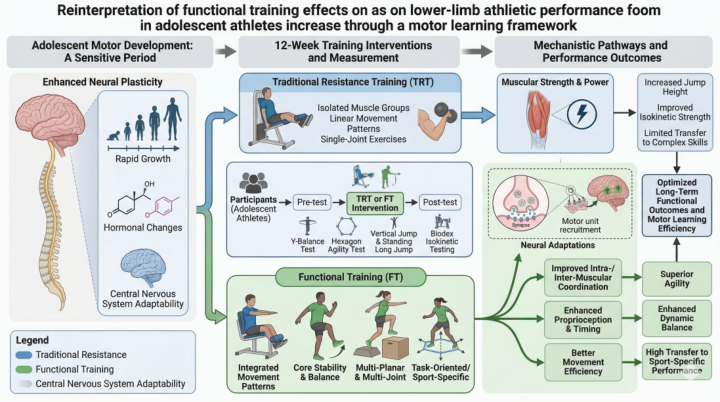
The conceptual synthesis of these parts, including adolescent neural plasticity and TRT and FT divergent pathways, is represented by the conceptual framework shown in Figure 1. The model, as shown, explains how functional interventions can make use of the CNS flexibility of the vulnerable period to overcome the transfer deficit of conventional approaches, finally leading to the optimization of motor learning efficiency via particular mechanistic mechanisms such as improved inter-muscular coordination or better proprioception.
Figure 1: Functional training framework for motor learning in adolescent athletes.
METHOD
A randomized controlled trial approach was used to determine the impact of structured functional training on motor skills learning and functional health among adolescent athletes. Fifty-two male adolescent volleyball players (13 +2) who had at least two years of formal training experience were selected and randomly divided into functional training group (FTG, n = 26), or traditional resistance training group (TRTG, n = 26).
The intervention was 12 weeks long, and each group attended three training sessions per week. Every session had standard warm-up phase, main training phase and cool-down period, which provided safety and uniformity among participants (Fernandez-Fernandez et al., 2020). In the course of the intervention, 12 participants dropped out because of causes unrelated to the training process, leaving 40 participants (20 per group) who completed the study protocol.
Structured Functional Training Enhances Motor Skill Acquisition 75 The functional training programme was developed according to the concept of motor learning and neuromuscular adaptation (Granacher et al., 2018; Lloyd et al., 2015). It focused on multi-joint and multi-planar motions that were quite similar to sport-specific actions (Pereira et al., 2025; Xiao et al., 2025). The exercises were dynamic in nature with regards to balance, core stability and coordinated movements of both upper and lower extremities. Also, the intervention included task variability and increasing complexity which was meant to promote sensorimotor integration and adaptive motor learning.
Alternatively, the conventional resistance training group did conventional strength training exercises such as squats, deadlifts, and lower-limb resistance motions. The main aim of these exercises was to enhance muscular strength by means of controlled repetitive and linear movement patterns.
Every participant was evaluated before and after the intervention in standard conditions. The outcome variables were standing reach height, approach reach height, agility (half-meter square test), standing long jump, sprint speed, and endurance performance. All the tests were repeated two times and the highest value was used in the analysis.
The statistical analysis was done with the help of the SPSS software. Data was presented in form of means plus or minus standard deviations (Mean +/SD). Within-group differences were tested using paired-sample t-tests, whereas between-group comparisons were tested by independent-sample t-tests. The statistical significance was determined at P < 0.05.
RESULTS
After the 12 weeks intervention, all groups have demonstrated improvement in a number of performance variables; nonetheless, the adaptations occurred in different ways in each group.
The functional training group showed important changes in the measure of standing reach height (P = 0.025; d = 0.74) and approach reach height (P = 0.034; d = 0.69), suggesting better vertical coordination and intermuscular synchronization (Granacher et al., 2018; Liao et al., 2021).
The functional training group saw an improvement in their agility performance with a moderate effect size (d = 0.58) though the difference was not statistically significant (P = 0.075). It indicates that functional training can be used to improve movement efficiency and coordination.
Conversely, the conventional resistance training group showed a statistically significant change in agility (P = 0.028; d = −0.72) but there was no statistically significant change in the vertical performance measures.
The comparison of groups was conducted after the intervention and it was found that there were no statistically significant differences between the groups on all variables (all P > 0.05) but there were different adaptation patterns of the two training modalities.
Table 1: Comparison of effect sizes for performance improvements.
Table available in the original PDF paper.
DISCUSSION
The main aim of the randomized controlled trial was to re-explain the effects of training interventions under the motor learning perspective. These results confirm the initial assumption that organized functional training has a strong positive impact on motor learning in adolescent athletes. In particular, the functional training group (FTG) showed significant changes in the vertical metrics of performance such as standing reach height (d = 0.74) and approach reach height (d = 0.69). According to the motor learning point of view, they are not simply the result of muscular hypertrophy but improved neuromuscular coordination and better intermuscular synchronization. Functional training, by its nature, requires an ongoing and dynamic interaction between sensory input and motor output due to the emphasis on integrated, multi-joint and multi-planar patterns of movement. It is an active facilitator of the sensorimotor integration process, which is the underlying condition to the successful motor learning and development of complex and coordinated movement patterns (Lloyd et al., 2015; Tumkur Anil Kumar et al., 2021). Therefore, the measured increments in vertical performance are clearly indicative of optimized force transfer and coordinated activities of various muscles groups instead of isolated force generation (Silva et al., 2019; Bashir et al., 2022; Bobula et al., 2024). Curiously, the adaptation patterns were very different in the two modalities under consideration in the context of agility performance. Although the FTG showed a modest effect size (d = 0.58) on agility, which could imply a beneficial effect on movement flexibility and economy, this shift did not reach statistical significance (P = 0.075). On the other hand, the traditional resistance training group (TRTG) had better and statistically significant changes in agility (P = 0.028; d = −0.72). Such discrepancy can be explained by the concept of specificity (Suarez et al., 2019). Due to their repetitive, linear and highly organized nature, conventional resistance exercises might be more similar to the specific biomechanical requirements of conventional agility tests. The current result highlights the fact that whereas functional training is helpful in promoting more general neural adjustment
Structured Functional Training Enhances Motor Skill Acquisition 77 and movement economy, traditional approaches are strongly effective in particular organized physical activities (Khazaei et al., 2023). This could also account for the small gains seen in sprint and endurance measures because it has been reported before that various forms of training induce different adaptations in sprint and jump measures in young athletes (Lloyd et al., 2016; Haugen et al., 2019). In addition to the obvious performance improvement, the significance of these results is paramount in the context of functional health. Adolescence is an especially vulnerable stage of motor development where there is fast physical maturation, hormones are fluctuating, and central nervous system flexibility is high. Nevertheless, such a fast growth may also make young athletes more susceptible to neuromuscular imbalance (Faigenbaum and Myer, 2010). Through focusing on dynamic balance, core stability, and coordination of joints, organized functional training reduces these risks and therefore it has a direct role to play in injury prevention and joint stability in the long run (Granacher et al., 2018; Liao et al., 2021). These results emphasize the necessity of incorporating the principles of functional training to youth athletic development programs to improve performance as well as long-term functional health (Wan et al., 2025).
CONCLUSION
To sum up, this paper has shown that structured functional training is a very efficient, task-based intervention that can be used to improve motor skill acquisition and functional health in adolescents who play sports. Functional training maximizes motor learning results at a vital time interval by requiring constant sensorimotor integration and encouraging the growth of multi- plane, coordinated movements. However, as evidenced by the significant increases in agility recorded in the traditional resistance training cohort, it is confirmed that traditional strength training is still a useful intervention mode when it comes to particular aspects of performance. Hence, sports scientists and coaches ought to think about implementing a synergistic strategy. Integrating both the neuromuscular and motor learning advantages of structured functional training together with particular performance adaptations of traditional resistance training could offer a more complete, time related model towards maximizing holistic athletic development and functional longevity in youth populations (Lloyd et al., 2015; Wan et al., 2025).
ACKNOWLEDGMENT
The authors wish to convey their heartfelt thanks to the 52 male adolescent volleyball players who took part in this work. Our gratitude is also given to Loughborough University, Manchester University, and Luoyang Vocational College of Culture and Tourism that offered all the needed facilities as well as institutional support to perform the 12-week randomized controlled trial.
REFERENCES
Aoki, C., Romeo, R.D. and Smith, S.S. (2017) ‘Adolescence as a critical period for developmental plasticity’, Brain Research, 1654, pp. 85–86. Bashir, M., Soh, K.G., Samsudin, S., Akbar, S., Luo, S. and Sunardi, J. (2022) ‘Effects
of functional training on sprinting, jumping, and functional movement in athletes: A systematic review’, Frontiers in Physiology, 13, 1045870. Behm, D.G., Faigenbaum, A.D., Falk, B. and Klentrou, P. (2008) ‘Canadian Society for Exercise Physiology position paper: Resistance training in children and adolescents’, Applied Physiology, Nutrition, and Metabolism, 33(3), pp. 547–561. Bobula, G., Piech, J., Płonka, A., Król, P., Czarny, W., Pinto, R. et al. (2024) ‘Evaluation
of lower extremities power, movement, position and effectiveness in volleyball’, Applied Sciences, 14(21), 10065. Crawford, D.A., Drake, N.B., Carper, M.J., DeBlauw, J. and Heinrich, K.M. (2018) ‘Are changes in physical work capacity induced by high-intensity functional training related to changes in associated physiologic measures?’, Sports, 6(2), 26. Faigenbaum, A.D. and Myer, G.D. (2010) ‘Resistance training among young athletes:
Safety, efficacy and injury prevention effects’, British Journal of Sports Medicine, 44(1), pp. 56–63. Fernandez-Fernandez, J., García-Tormo, V., Santos-Rosa, F.J., Teixeira, A.S., Nakamura, F.Y. and Granacher, U. (2020) ‘The effect of a neuromuscular vs. dynamic warm-up on physical performance in young tennis players’, Journal of Strength and Conditioning Research, 34(10), pp. 2776–2784. Granacher, U., Puta, C., Gabriel, H.H.W., Behm, D.G. and Arampatzis, A. (2018)
‘Neuromuscular training and adaptations in youth athletes’, Frontiers in Physiology, 9, 1264. Haugen, T., Seiler, S., Sandbakk, Ø. and Tønnessen, E. (2019) ‘The training and development of elite sprint performance: An integration of scientific and best practice literature’, Sports Medicine - Open, 5(1), 44. Khazaei, L., Parnow, A. and Amani-Shalamzari, S. (2023) ‘Comparing the effects
of traditional resistance training and functional training on the bio-motor capacities of female elite taekwondo athletes’, BMC Sports Science, Medicine and Rehabilitation, 15, 139. Liao, T., Duhig, S.J., Du, G., Luo, B. and Wang, Y.T. (2021) ‘The effect of a functional strength training intervention on movement quality and physical fitness in adolescents’, Perceptual and Motor Skills, 129(1), pp. 176–194. Liu, X., Zhang, Y., Chen, H. et al. (2025) ‘Effects of functional training on physical
fitness in adolescents: a systematic review’, Frontiers in Public Health, 13, Article 1596381. Lloyd, R.S., Oliver, J.L., Faigenbaum, A.D., Howard, R., De Ste Croix, M.B.A., Williams, C.A. et al. (2015) ‘Long-term athletic development, Part 1: A pathway for all youth’, Journal of Strength and Conditioning Research, 29(5), pp. 1439– 1450. Lloyd, R.S., Radnor, J.M., De Ste Croix, M.B.A., Cronin, J.B. and Oliver, J.L. (2016)
‘Changes in sprint and jump performances after traditional, plyometric, and combined resistance training in male youth athletes’, Journal of Strength and Conditioning Research, 30(5), pp. 1239–1247. Pereira, H.V., Teixeira, D.S., Fisher, J., Fleck, S.J., Helms, E., Ide, B.N. et al. (2025) ‘International consensus on the definition of functional training: modified e-Delphi method’, Journal of Sports Sciences, 43(7), pp. 767–775.
Structured Functional Training Enhances Motor Skill Acquisition 79 Silva, A.F., Clemente, F.M., Lima, R., Nikolaidis, P.T., Rosemann, T. and Knechtle,
B. (2019) ‘The effect of plyometric training in volleyball players: A systematic review’, International Journal of Environmental Research and Public Health, 16(16), 2960. Suarez, D.G., Wagle, J.P., Cunanan, A.J., Sausaman, R.W. and Stone, M.H. (2019) ‘Dynamic correspondence of resistance training to sport: a brief review’, Strength and Conditioning Journal, 41(4), pp. 80–88. Tumkur Anil Kumar, N., Oliver, J.L., Lloyd, R.S., Pedley, J.S. and Radnor, J.M. (2021)
‘The influence of growth, maturation and resistance training on neuromuscular adaptations: a narrative review’, Sports, 9(5), 59. Wan, K., Dai, Z., Wong, P., Ho, R.S. and Tam, B.T. (2025) ‘Comparing the effects of integrative neuromuscular training and traditional training in youth athletes: A systematic review and meta-analysis’, Sports Medicine - Open, 11, 15. Xiao, W., Bu, T., Zhang, J., Cai, H., Zhu, W., Bai, X. et al. (2025) ‘Effects of functional
training on physical and technical performance among athletes: A systematic review’, BMC Sports Science, Medicine and Rehabilitation, 17, 2.
LISTED IN THE AHFE DIGITAL BOOKSTORE CATALOGUE
Explore the complete digital volume
Human Factors in Sports, Preventive Medicine and Innovative Agonology
Read this individual research paper free through the original publisher, or explore the full digital proceedings book.
ISBN 979-8-950676-02-4
Explore this ISBN in the AHFE Bookstore ↗Listed in the July 2026 bookstore catalogue; search by ISBN to confirm current availability · Digital book purchase optional