Fuyong Liu, Xun Gao, Yong Li, Wanying Cheng (2022). Optimization Strategy of Community Public Living Space Based on Emotional Interaction. In: Human Interaction & Emerging Technologies (IHIET 2022): Artificial Intelligence & Future Applications. AHFE Open Access, vol. 68, pp. 105–112. https://doi.org/10.54941/ahfe1002719
As the most closely connected space in daily life, community public living space is the material carrier for residents to carry out various activities. The rapid development of community leads to the weakening of community public life, which leads to a series of problems. Community public living space has the characteristics of mixing, stage and transition. It is mainly manifested in the alienation and fission of social space such as community neighborhood space, psychological space, cultural space and public space. Grasp the perceptual characteristics of residents' life and the perceptual order of community space, guide residents' perceptual actions with vivid perceptual space, then release the elasticity, activity and viscosity of space, and establish a multi space governance community, so as to realize the integration and unity of community spatial structure and social structure production.Combining with the current community development trend and related research progress, this paper tries to build the concept of community public living space based on emotional interaction. Taking Guangzhou, Nanjing, Xi 'an and other urban communities as examples, the social users were investigated from different angles such as children's playground, epidemic prevention at home, and emotional interaction of community environment. Investigate the pain points and demands of community public living space at present, dig out the essential reasons behind them, and provide relevant data support for the later design optimization of community public living space. The gradual integration of public life and public space will meet the living needs of community residents, promote the integration of urban community space resources, stimulate the development vitality of existing communities and innovate new lifestyles.
The research on public living space in China mostly stays at the overall level of structural composition, lacking of the research on the specific relationship between various elements in living space and how to use it in actual planning. With the continuous development of society, the development of public living space must adapt to this rhythm, and it is necessary to constantly innovate theoretical and practical means, thoroughly study the theory of community public living space construction, and improve the quality of national life.
ANALYSIS OF THE PRESENT SITUATION OF COMMUNITY SPACE Community is not only the public space of community residents, but also the public space belonging to the city and society. Communities in some focus
areas also shoulder the tasks of cultural and historical inheritance and archi- tectural style protection. At present, when material civilization and spiritual civilization are more and more developed, people’s imagination of a better life is diverse. To promote people-centered community governance and even social governance, it is necessary to coordinate the multi-interest relationship (Li X, 2018).
The first is to coordinate the relationship between people. Community governance should be people-centered, and people’s demands and opinions should be listened to. Community governance should build a mechanism of equal dialogue, so that community residents and the public can fully express their opinions and demands. Build a long-term dynamic mechanism through multi-party opinion expression and information screening, and con- stantly consolidate, improve and maintain the results of community space governance.
The second is to coordinate the relationship between space and space. No matter how clear the property rights are, as the community has direct con- tact with residents, it is inevitable that the public space will be privatized. In the governance of community space, it is necessary to fully rely on the auto- nomy of community residents, stimulate residents’ autonomy, form informal institutional constraints among individuals, and promote the interaction and integration of public and private spaces.
The third is to coordinate the relationship between space and people. As a space unit closely related to people’s activities, community is easily influ- enced by people. People-centered community space must be a multi-party cooperative relationship. Under the cooperation of many parties, the public has formed a set of informal institutional rules that conform to the logic of region and culture through autonomy (Zhang Y-L, 2021).
OPTIMIZATION IDEA OF COMMUNITY PUBLIC SPACE UNDER INTERACTION Community living space is not only a material place to provide public space and public service facilities, but also a bearing space for residents’ daily life behaviors. How to improve the existing community public space, how to make urban community resources meet the increasingly rich public life, and how to manage specific residents’ daily life behaviors and social activities have become urgent issues to be considered in the construction of community public living space at present, and will guide the future community public space planning and organization mode.
Under the guidance of people-oriented public life demand, the develo- pment trend of urban communities in China is manifested in three aspects: optimizing the layout of community space, paying attention to the constru- ction of community facilities and improving the demand for public services. There is a dialectical relationship between public life and public space. The continuous enrichment of community life promotes the emergence of a new public space structure, and the new space form also promotes new public life (Liu L-J, 2022). A basic function of community public living space is to pro- mote social communication between people, organize community residents’
Optimization Strategy of Community Public Living Space Based on Emotional Interaction 107
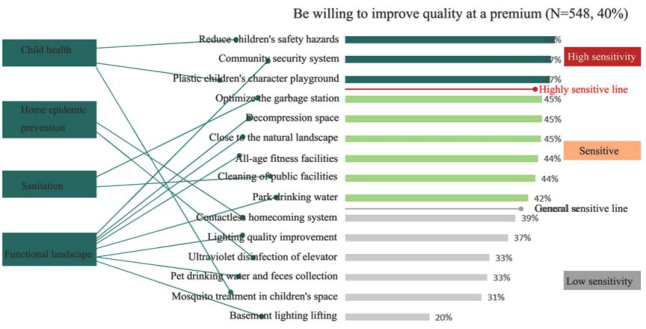
Figure 1: Community public space facilities ranking.
activities through the overall public space construction, promote the emerge- nce of public spaces such as squares, green spaces and streets, share public resources in the community, and strengthen the interaction between neighbo- ring communities. Therefore, as far as the development of community public life and public space is concerned, community public living space must be based on the public life of community residents (Li H, 2009).
OPTIMIZATION STRATEHY OF COMMUNITY PUBLIC SPACE UNDER INTERACTION According to the organization mode of community public space and follo- wing the planning idea of guiding people’s behavior, it not only meets the diverse living needs of residents, but also improves the quality of community public living space and stimulates the vitality of the whole community.
Community Common Demand for Space Public facilities include infrastructure and service facilities to meet the daily needs of residents. Public facilities are related to the comfort of community living, and facilities such as sports venues and medical service stations are directly related to the safety and health of residents. From the service object and experience, it has the functional characteristics of publicity and conve- nience. The public space of the community connects the city, the community and the residential units, interweaves horizontally and vertically into a com- munity road network, which can realize the transfer of community personnel and materials. It is the core element of the space that connects and intersects, and has circulation. As shown in Figure 1.
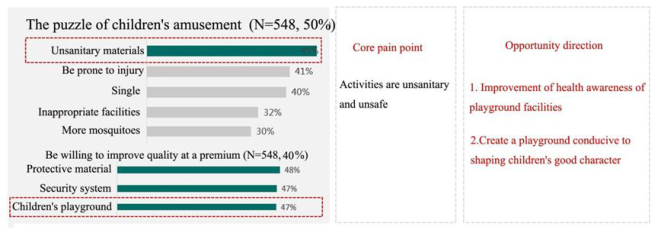
Children’s Playground The cleanliness and sanitation of activities and facilities in community living space and environmental protection of materials are the primary concerns
Figure 2: Children’s playground concerns.
of children’s parents. At present, because the community planning of com- munity public living space is unreasonable, it can’t fully meet the lifestyle of residents, and activities and facilities are generally unsafe and unsanitary. In the eyes of parents, only by shaping good character and releasing children’s nature can children really grow up healthily. Therefore, keeping the children’s activity areas clean and safe with materials is the basic guarantee for children to play healthily in community public spaces. As shown in Figure 2.
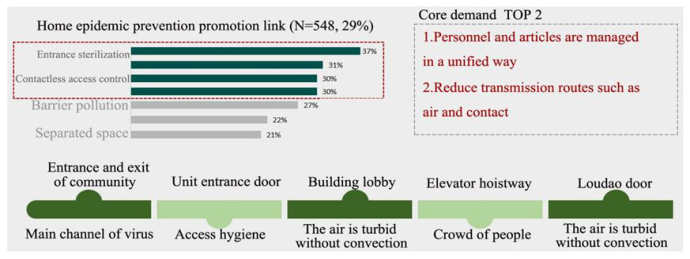
Home Epidemic Prevention During the epidemic prevention and control period, the emergency facilities used for community control were simple and simple, and some communities lacked corresponding functional facilities. Setting up temporary tent sentry box at the entrance of the community, manually checking and recording residents’ health conditions, poor facilities and lack of safety protection mea- sures, have certain infection risks for staff and residents. Secondly, roads and doors are closed to reduce the number of entrances, and people and vehicles are concentrated in one place, which is easy to cause travel gathering (Qian Z-L, 2020). The closed form is rough, which has an impact on the beautiful environment of the community and its later recovery (Zhang Y, 2021).
In terms of public health, in order to achieve the purpose of improving public health, we can take sanitary measures for drinking water, food, hou- sing and other aspects to improve the quality of urban living space, so as to prevent and reduce diseases (Wu Z-Q, 2010). In the process of combining public health with architecture, modern urban planning emphasizes the long- term and overall planning of the factors that affect urban public health, such as drainage, transportation, residence, green space and service facilities (Wei Y-P, 2003).
In the construction of human settlements, from passively accepting the natural environment, to actively adjusting ourselves to conform to the natu- ral environment, to transforming the natural environment into resources that people can use with the help of natural laws and tools (Ye Q-M, 2016). In the process of disaster prevention, mitigation, adaptation and utilization, the coping strategies show various changes such as rigid resistance, flexible resolution and ingenious utilization (Fan G-J, 2010).
Optimization Strategy of Community Public Living Space Based on Emotional Interaction 109
Figure 3: Home epidemic prevention appeal.
Community Health Environment (Garbage Sorting) Garbage sorting is the foundation of a healthy community, and the realiza- tion of non-contact and recycling of garbage sorting in community public space is the highlight of improving community public space. According to user research, sort out user preferences and concerns.
User preference type: Type A, garbage disposal is the foundation of a healthy community. It is considered that this is the foundation of a heal- thy community. Centralized treatment can reduce the spread of bacteria and viruses.
Type b, customers pay attention to recycling, health and environmental protection of waste, which is more convenient and environmentally friendly, and can truly recycle and reuse waste.
Type C, non-touch and inductive processing methods are popular with customers, such as intelligent classification, which will be more attractive and can reduce manpower. Non-touch hand washing is very convenient, and I like garbage cans that are opened by induction.
Garbage disposal scheme of community deodorized sterile garbage col- lection station: Garbage station layout and removal line: garbage transfer station layout, location, handling methods and internal removal mana- gement. Intelligent garbage disposal facilities: AI garbage sorting robot, contact-free garbage can point, pedal/induction faucet, deodorizer, etc. Con- figuration of garbage dropping point module: classified collection, canopy, enclosure, design standard of hand washing platform module, etc.
Analysis of Differences This paper makes a horizontal and vertical comparative analysis from different angles of different age groups and different regions.
Intergenerational Differences and Regional Differences The research object of this paper is the post-90s generation who pay attention to water quality, environment and pet-loving, the post-80s generation who focus on children, and the post-70s generation who go home and exercise. Through the comparative analysis of the needs of different groups of people from different angles.
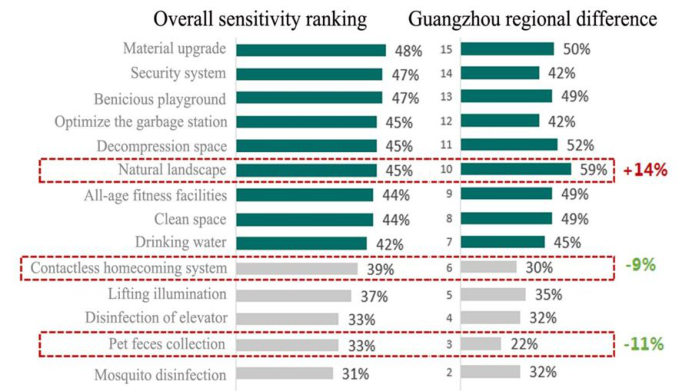
Figure 4: Spatial sensitivity ranking of regional communities in Guangzhou.
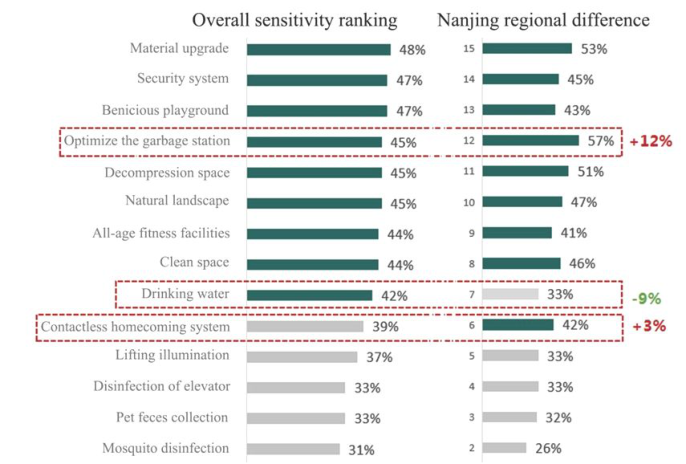
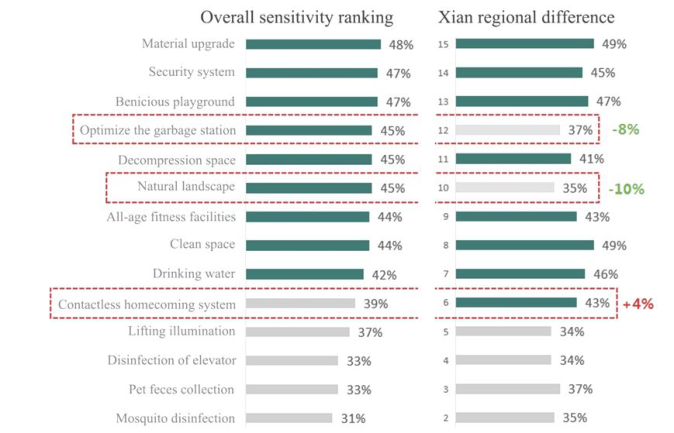
According to the existing community situation, this paper selects Guang- zhou, Nanjing, Xi ‘an and other first-tier cities with different geographical locations to carry out comparative analysis. The data obtained are shown in the following figure.
Guangzhou has a high sensitivity to nature-friendly ecological landscape. Because of its humid climate, Guangzhou is prone to mildew and bacteria. Guangzhou has a high sensitivity to mildew and bacteria, but a low sensi- tivity to pet management and contactless homecoming system. As shown in Figure 4.
Nanjing area has a high sensitivity to the anti-bacteria and mite removal system on the ground, garbage sorting and non-contact homecoming system, but a low sensitivity to the direct drinking water in the park. As shown in Figure 5.
Xi’an is located in the northwest of China, and there is no humid climate. Therefore, there is no mildew and antibacterial problem in Guangzhou and Nanjing. However, the sensitivity of Xi ‘an area to touchless homecoming system is relatively high, and the sensitivity to community natural ecological landscape and garbage disposal is relatively low. As shown in Figure 6.
CONCLUSION
In this paper, the pain points and needs of customers are obtained through quantitative research, and then the essential reasons behind the community public living space are discovered through symposium, which provides rele- vant data support for the design optimization of community public living space in the later period. Grasping the perceptual characteristics of residents’ life and the perceptual order of community space, guiding residents’ perce- ptual actions with vivid perceptual space, then releasing the elasticity and activity of space, establishing a multi-space governance community, and gra- dually integrating public life and public space will meet the various living
Optimization Strategy of Community Public Living Space Based on Emotional Interaction 111
Figure 5: Spatial sensitivity ranking of regional communities in Nanjing.Figure 6: Spatial sensitivity ranking of regional communities in Xi’an.
needs of community residents, promote the integration of urban community space resources, stimulate the development vitality of existing communities, and create a new way of life.
ACKNOWLEDGMENT
We express our gratitude to all participants for their contribution to the study. In addition, some related research contents of this paper draw lesson from the
master’s thesis of Li Xu, a classmate of Soochow University, and I would like to express my thanks together. This paper is supported by The Guangdong Province Philosophy and Social Science Planning Discipline Co-construction Project (Grant No. GD20XYS37).
REFERENCES
Fan G-J. Study on Broadacre city [J]. Shanxi Architecture, 2010, 36 (26): 20–21. Li H. Understanding Le Corbusier: After the Chinese Translation of Urbanism [J].
Urban Planning Forum, 2009, (03): 115–119. Li X. Concept and Application of the Construction of Community Public Living Space System [D]. Soochow University, 2018. Liu L-J. The Feature and Form of Public Space of Contemporary Japanese Museums
[J]. Huazhong Architecture, 2022, 40 (02): 6–11. Qian Z-L, Wang Z, Qiu Z. Construction System and Strategy of “Safety and Health Unit”in Urban and Rural Areas: Based on a Response Mechanism of “Prevention- Adaption-Utilization” for Coping with Plagues and Disasters [J]. City Planning Review, 2020, 44 (03): 25–30. Wei Y-P, Zhao M. Idealism and Rationalism in Urban Planning-Thoughts on the
Discussion of “Recent Construction Planning” [J]. City Planning, 2003, (08): 49–55. Wu Z-Q, Li D-H. Principles of Urban Planning (4th Edition) [M]. Beijing: China Building Industry Press, 2010: 563–564. Ye Q-M. Broadacre City (Part 1) [J]. Urban Planning International, 2016, 31 (6):
39+119. Zhang Y, Wang Z, Qian Z-L. Research on the Suitability Renewal of Existing Urban Community Space under the Concept of Safety and Health in the Post-epidemic Era [J]. Architecture & Culture, 2021, (12): 106–108. Zhang Y-L. People-centered Promoting Community Space Governance [N]. China
Read this individual research paper free through the original publisher, or explore the full digital proceedings book.
ISBN 978-1-958651-44-5
Explore this ISBN in the AHFE Bookstore ↗Listed in the July 2026 bookstore catalogue; search by ISBN to confirm current availability · Digital book purchase optional