Karolína Šablaturová, Pavla Nikelová, Lucie Kocůrková, Denisa Charvátová (2026). Evaluation of working posture using the Xsens inertial system in production in accordance with Czech legislation. In: Safety Management and Human Factors. AHFE Open Access, vol. 227, pp. 36–46. https://doi.org/10.54941/ahfe1007915
Musculoskeletal disorders represent a significant health and economic problem in the workplace, especially in industrial production involving a high proportion of repetitive upper limb movements. However, existing assessments of working postures based on observation and manual recording are often subjective and time-consuming. The aim of this study was to verify the usability of the Xsens inertial measurement system for the objective assessment of upper body working positions in real production line conditions and to assess its compatibility with the requirements of Czech legislation, specifically Government Regulation No. 361/2007 Coll. The data obtained on the joint angles of the arms, spine, and head were subsequently processed in MATLAB and converted to time exposures per shift. The results showed that the hygienic limits for working positions were not exceeded in most of the segments evaluated. For the upper limbs, a significant predominance of time spent in an acceptable arm position (<40°) was recorded, specifically 136 minutes for the right upper limb and 128 minutes for the left upper limb during a work shift. At the same time, it was found that evaluating the head based solely on flexion does not provide a sufficiently comprehensive picture of the actual load on the cervical spine, as lateral tilts, rotations, and extensions also occur during work activities. The study confirms that inertial measurement systems are a suitable tool for refining ergonomic assessment and can serve as an effective supplement to existing legislative and observational methods.
Musculoskeletal disorders (MSDs) have long been among the most common work-related health problems in Europe and contribute significantly to incapacity for work, employee absenteeism, and productivity losses. The most common MSDs include back pain among industrial workers (60% of all reported cases) (Govaerts et al., 2021; Bevan, 2015). In 2024, a total of 5,240 occupational diseases were recognized in the Czech Republic. COVID-19 infection accounts for a large proportion of this. After deducting COVID-19 infections, 490 occupational diseases remain. Of this number, occupational diseases caused by physical factors are the most numerous Received February 19, 2026; Revised April 5, 2026; Accepted April 21, 2026; Available online July 20, 2026
Evaluation of Working Posture Using the Xsens Inertial System in Production 37 group, accounting for 318 cases in 2024 (SZÚ, 2025). One of the key risk factors for the development of MSDs is inappropriate working positions, the systematic assessment of which is important for prevention (Martins et al., 2024). Ergonomic risk assessment (ERA) plays a key role in the prevention of musculoskeletal disorders by identifying these risk factors and providing a basis for targeted controls (Nestorova & Mircheva, 2018).
In the Czech labor law environment, the assessment of working positions is regulated by Government Regulation No. 361/2007 Coll., which lays down conditions for occupational health and safety (hereinafter referred to as the Government Regulation). This Government Regulation sets limit values for joint angles and their maximum permissible duration during a shift and distinguishes between categories of acceptable, conditionally acceptable, and unacceptable work postures (Government of the Czech Republic, 2007). Based on the limits thus determined, work is classified into categories according to Decree No. 432/2003 Coll., which sets out the conditions for classification into categories. The categories determine the degree of risk involved and are classified in ascending order from 1 to 4 (1 - no risk, 4 - high risk). This legislative framework is important for the implementation of ergonomic risks in the Czech environment. In practice, ergonomic risk assessment is usually based on observational methods, including checklists and posture assessment tools such as RULA, REBA, and OWAS, which can be time-consuming and subject to observer bias, especially for dynamic tasks.
The development of digital technologies in recent years has opened up new possibilities for objective and detailed assessment of ergonomic risks. Wearable inertial measurement units (IMUs), including the Xsens system, enable detailed, accurate motion capture in real working conditions and provide continuous time records of joint angles (Donisi et al., 2022). These systems can complement traditional observation- and scoring-based methods used in ERA by reducing subjectivity and capturing the temporal characteristics of work postures that are difficult to assess visually. Several studies (Carnazzo et al., 2024; Simon et al., 2024) have demonstrated the applicability of IMU-based motion capture for ergonomic assessment in the workplace and highlighted its potential to increase the accuracy and consistency of posture-related risk assessments. While IMU-based motion capture is increasingly used in international ergonomic research, its application in the Czech environment is still limited due to a rigid legislative framework. The use of IMU-based systems in Czech workplaces can be found in student theses, conference papers, or project reports, such as those from VUBP (Research Institute for Occupational Safety (VÚBP) 2021). However, systematic verification of IMU data directly mapped to legislatively defined categories of work positions has not yet been sufficiently developed.
The aim of this pilot study is to verify the possibility of using the Xsens system to evaluate the working position of the upper body in production in relation to the requirements of Government Regulation 361/2007 Coll. At the same time, a data processing workflow is presented that converts time series of joint angles into time exposures per shift in categories of working positions defined by legislation.
METHODOLOGY
The ergonomic risk assessment (ERA) was performed using a combination of existing Czech legislation (according to Government Regulation No. 361/2007 Coll.) and wearable inertial motion capture technology (Xsens) at a selected workplace and workstation. The same work activity is evaluated by an expert for comparison. The methodology used is described in detail in the following sections.
Description of Xsens Xsens is an inertial motion capture system that uses a set of seventeen miniature IMU sensors placed on the body to accurately track human movement (Breznik et al., 2025). The placement of these sensors during measurement is shown in Figure 1. Only ten of them were used for the purposes of this study. Recent studies confirm its wide application in various fields, from rehabilitation and sports training to clinical movement assessment and workplace ergonomics (Roggio et al., 2021; Herzog et al., 2024)). The main principle of Xsens is to capture movement using sensors on key parts of the body, which enable highly accurate measurement of the kinematic and dynamic parameters of movement (Herzog et al., 2024).
Given the nature of the workplace under study, where work is performed mainly using the upper body, a simplified system configuration involving the torso and upper limbs was used for the measurements. Sensors on the lower limbs were not included in the measurements, which reduced the volume of irrelevant data and increased the clarity of the subsequent evaluation. The sensors were placed on anatomically defined points specified by the manufacturer, specifically on the forehead, shoulders, above the elbow (arm), forearm, wrist, and lumbar region of the back. Before starting the measurement, a standard calibration (N pose + walk) was performed. The calibration was performed while standing with a short walk forward and backward, after which the measurement was immediately started during work activity.
Figure 1: Illustration of sensor placement on the body.
Figure available in the original PDF paper.
Work Activities The evaluated subject was a woman (production operator) performing repetitive assembly tasks in a workplace with limited working space (approx.
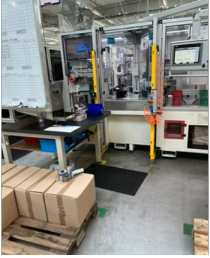
Evaluation of Working Posture Using the Xsens Inertial System in Production 39 2 m²) during a standard eight-hour shift. The activities were predominantly dynamic in nature and took place in cycles. The cycle included removing components, inserting seals, assembling with a cap, inserting the assembly into a hand press, and pressing it by pushing the control lever with the right hand at shoulder level. The finished assembly was then removed and inserted into a testing device, where the cycle was started. This completed the production cycle for one component. The length of one cycle lasted an average of 10 seconds. For a better understanding, the workplace is shown in Figure 2.
Figure 2: Workplace.
Data Processing The measured joint angle data was exported by the Xsens measurement system in cxs format and then imported into MATLAB software, where it was further processed. Based on the visualization of the measured subject’s movement in the Xsens software, the time interval corresponding to the actual work activity was identified. Data outside this interval was removed so that the analysis included only the period relevant to the ergonomic assessment.
In the next step, the joint angles that are assessed under Czech legislation according to Gov. Regulation No. 361/2007 Coll. were selected, specifically arm flexion (right and left), spine flexion, and head flexion. For each of these joint angles, limit values corresponding to the categories of working positions defined by the above-mentioned government regulation were set in the MATLAB software.
Subsequently, for each signal sample, the measured joint angle value was compared with these limit values, on the basis of which the individual samples were classified into the appropriate categories of working positions. The number of samples in each category was then converted to time duration by multiplying by the sampling period; the sampling frequency of the measurement was 60 Hz. This procedure yielded the times spent in each working position, which could then be compared with the hygiene limits set by the legislation.
A video recording of the work process was used to convert the time exposures to an eight-hour shift. The analyzed section, lasting 50 seconds,
shows that the worker completed 5 pieces during this interval, with the IMU recording corresponding to the sum of five consecutive work cycles. The times in the individual categories were therefore first normalized to one piece and then converted to an eight-hour shift by multiplying by the standard workplace output, i.e., 792 pieces per 8 hours/shift. The standard output was taken from the workplace’s internal standard.
The hygienic limits for working positions were set in accordance with Annex No. 5 to Government Regulation No. 361/2007 Coll., which defines the limit values for angles for individual parts of the body and the maximum permissible duration of their duration during an average eight-hour work shift. Based on these limits, working positions were divided into three categories: acceptable position (AP), conditionally acceptable position (CAP), and unacceptable position (NP). An overview of hygiene limits is provided in Table 1.
Table 1: Description of work categories by angle and time (361/2007).
Table available in the original PDF paper.
EVALUATION OF WORKING POSITIONS Body part Units AP = 1. JC* CAP = 2.JC* NP = 3.JC*
Torso and upper limbs Flexion range < 40° 40 - 60° > 60° Time ≤ 100 min 100 - 160 min ≥ 30 min
Head and neck Flexion range < 25° 25 - 40° > 40° Time ≤ 100 min 101 - 160 min ≥ 30 min
JC – Job category
RESULTS
The results of joint angle measurements using Xsens during work activities are shown in the graphs below. These graphs show the time courses of selected joint angles (arm, spine, and head flexion) for one of the measured workers. The measured data was then processed in MATLAB using a median filter to smooth the signal and reduce interference noise without significantly affecting the overall movement trend. The graphical representation provides a clear overview of the change in the monitored angles over time and puts the reader in the context of the results obtained.
The first and second graphs show arm flexion over time. The X-axis shows the recording time in seconds, and the Y-axis shows the corresponding angle in degrees. The black curve represents the filtered signal obtained from the Xsens system’s IMU sensors, processed in the MATLAB environment. The colored zones define the individual angle ranges. The green area represents neutral and ergonomically favorable arm positions (0–40°). The orange area represents a conditionally acceptable arm position (40–60°), which may already represent a greater physical strain. The red area (> 60°) represents an unacceptable working position of arm flexion, in which health limits are exceeded and there is a risk of occupational disease.
Graph 1: Graphical representation of the left arm.
Graph 2: Graphical representation of right arm.
Graphs 1 and 2 show that during the monitored activity, there are repeated movements between acceptable and conditionally acceptable positions, with the right arm briefly exceeding the 60° limit. This type of visualization allows for a clear overview of the dynamics of working positions and quantifies the time spent in each category.
The time spent in unacceptable positions, i.e. > 60° and conditionally acceptable position (40-60°) is negligible from a legislative point of view. The time spent in an acceptable position (< 40°) is 136 minutes for the right upper limb and 128 minutes for the left upper limb per shift for this activity.
Graph No. 3 shows changes in the angle of spine flexion during the monitored activity. The entire record ranges from approximately –2° to 9°, indicating that the worker worked mainly in a slight forward bend. Negative values represent the backward tilt of the torso relative to the 0° axis, or neutral position.
Unlike the graph for the right and left upper arms, graph no. 3 shows that the movement of the spine during the measurement was only in an ergonomically acceptable working position. The visualization thus confirms that there were no significant deviations from the neutral position of the torso during the entire monitored activity.
Graph 3: Graphical representation of spine.
The last graph shows the time course of head flexion angle during work activity. As in the previous graphs, the black curve represents the processed signal obtained from the IMU processed in the MATLAB environment. The time course of the head angle shows significant variability and often exceeds negative values, which correspond to head extension. The evaluation of head flexion alone does not provide a complete picture of the actual load on the cervical spine, as multi-axis and combined head movements occur during work activities.
Graph 4: Graphical representation of head.
Based on the evaluated data, it was possible to determine the time during which the worker was in individual joint angle ranges. In the MATLAB environment, the times spent in acceptable, conditionally acceptable, and unacceptable positions during a single work cycle were automatically calculated. These values provide a quantitative supplement to the graphical visualization and allow for a more comprehensive assessment of the overall load on the measured worker. An overview of the resulting time values for the individual body parts evaluated is provided in Table No. 2.
Table 2: Overview of the resulting time values for individual body parts.
Table available in the original PDF paper.
Part of the body Flexion angle [°] Time at angle [sec] per cycle Total Time Per Shift [min] Head <25 6,5 86
25 - 40 4,2 55
> 40 0 0 Part of the body Flexion angle [°] Time at angle [sec] per cycle Total Time Per Shift [min]
Spine <20 10,7 141
20 - 60 0 0
> 60 0 0 Left upper limb <40 9,7 128
40 - 60 0,8 11
> 60 0 0 <40 10,3 136
Right upper limb
40 - 60 0,4 5
> 60 0 0
Comparison With an Expert For comparison purposes, an analysis of the same workplace and the same entity was performed by a specialist trained in assessing working positions. The specialist assessed the workplace using the legislative framework. The results are shown in Table 3 below.
Table 3: Overview of the resulting time values for individual body parts.
Table available in the original PDF paper.
Part of the body Flexion angle [°] Time at angle [sec] per cycle Total Time Per Shift [min] Head 25 - 40 0 136 Spine None observed 0 0
Left upper limb None observed 0 0 Right upper limb 40 - 60 0 6,6
DISCUSSION
This pilot study verified the usability of kinematic data from the Xsens inertial system for time exposure to working positions in accordance with the requirements of Government Regulation 361/2007 Coll. The results show that the health limits were not exceeded during work activities. Exposure of the upper limbs in conditionally acceptable positions was low (LUL 11 min, RUL5 min per shift). A significant result was exposure in an acceptable position (< 40°) for the right upper limb for 136 min and for the left upper limb for 128 min per shift, which still does not exceed the health limits set by Czech legislation. The same situation was found in the measurement of spine and head movements. The worker performed the activity in an acceptable position throughout the shift.
When analyzing the results of the head segment, significant variability in the time course of angles and a frequent occurrence of values around 0° and possibly negative values were found. This phenomenon can be
explained by the fact that the evaluation focused only on head flexion in the sagittal plane. During actual work, there were frequent lateral tilts, rotations, or combinations of these movements that were not captured. It is therefore clear that the flexion parameter alone may not be sufficient for an unambiguous interpretation of the results in relation to hygiene limits. Since Czech legislation for the head area also takes into account lateral tilting and rotation of the head, it is necessary to evaluate all relevant planes of movement and assign them to the appropriate categories according to the limits specified in the legislation.
From the point of view of interpreting the results in relation to Czech legislation, it is important to mention that the method made it possible to evaluate not only the occurrence of risky positions, but also their duration, thus objectively supporting the decision to classify them into categories according to hygiene limits.
A comparison of IMU measurements with those of a trained expert showed a difference in the range of identified exposure intervals. The expert was only able to capture a limited part of the angular deviations, especially in situations where the working position was not easily visible. An example is the phase of the work cycle when the operator turns towards the test station. In this situation, the right upper limb was often covered, which made it impossible to accurately visually assess the angles. However, this situation did not pose a limitation for the Xsens system, as the measurement was performed independently of the camera’s field of view. In addition, Xsens also captured short-term angular deviations that could have been overlooked or considered insignificant by the expert during the assessment.
These differences do not indicate a discrepancy between the methods, but rather point to their different principles. While expert evaluation is based on experience and intuition for estimating angles, the IMU system allows for continuous and quantitative analysis of the entire body during work activities. An important aspect from the perspective of Czech legislation is that IMU not only allows for the identification of risky positions, but also accurately determines their duration, which is a key parameter for determining the category of work.
At the same time, it is necessary to take into account the practical aspects of implementation. Experience from this study has shown that the use of the Xsens system generates a large volume of data, the interpretation of which is not easy without supporting software. Therefore, it was necessary to use the MATLAB environment for processing, which made it possible to filter out noise, define the time windows of actual work activity, and subsequently categorize individual positions. In contrast, the expert evaluation was significantly less time-consuming. Similarly, the financial and material costs associated with the acquisition and use of the IMU system can also be considered. These factors must be taken into account during the decision- making process.
The findings are consistent with professional articles that emphasize the benefits of motion capture systems for increasing the objectivity and transferability of ergonomic analyses in industrial environments (Breznik
Evaluation of Working Posture Using the Xsens Inertial System in Production 45 et al., 2025; Vujica Herzog et al., 2024; Lind et al., 2023). Similarly, they emphasize that the use of motion capture systems in industrial practice increases the accuracy of ergonomic analyses and helps to implement more effective measures to protect employee health (Vujica Herzog et al., 2024). At the same time, the literature points to the need to standardize procedures for data collection, processing, and interpretation, which may be a challenge for further application in the Czech legislative context.
The main limitations include the evaluation of only one worker and the focus on selected segments (head, torso, and arms), which limits the resulting values. In follow-up research, it is certainly appropriate to increase the number of subjects and activities, supplement all levels of assessment, and make comparisons with observational methods (e.g., RULA) or a larger group of experts performing the assessment (according to Czech legislation) in order to objectively assess the compliance and added value of the approach in the Czech legislative context.
CONCLUSION
The main objective of this study was to pilot test the usability of the Xsens system for evaluating the working position of the upper body in manufacturing and to process the obtained data and convert it into exposure metrics comparable with NV No. 361/2007 Coll. The objective was achieved by measuring in real conditions on an assembly line and demonstrating the work procedure. The results support the usability of the IMU approach in the Czech legislative context, but also show the need for standardization and partial automation of data processing and multi-axis head assessment. Future work should include a larger sample of workers, verify compliance with other methods, and simplify the sequence of steps for practical use.
ACKNOWLEDGMENT
This contribution was prepared and financed as part of the Technical University of Ostrava, Faculty of Safety Engineering SP 2025/052.
REFERENCES
Bevan, S. (2015) ‘Economic impact of musculoskeletal disorders (MSDs) on work in Europe’, Best Practice & Research Clinical Rheumatology, 29(3), pp. 356–373. doi:10.1016/j.berh.2015.08.002. Breznik, M. et al. (2025) ‘Evaluation of the EAWS ergonomic analysis on the
assembly line: Xsens vs. manual expert method—A case study’, Sensors, 25(15), 4564. doi:10.3390/s25154564. Carnazzo, C., Spada, S., Lamacchia, S., Manuri, F., Sanna, A. and Cavatorta, M.P.
(2024) ‘Virtual reality in ergonomics by wearable devices: Experiences from the automotive sector’, Journal of Workplace Learning, 36(7), pp. 621–635. doi:10.1108/JWL-03-2024-0064. Donisi, L., Cesarelli, G., Pisani, N., Ponsiglione, A.M., Ricciardi, C. and Capodaglio, E. (2022) ‘Wearable sensors and artificial intelligence for physical ergonomics: A systematic review of literature’, Diagnostics, 12(12), 3048. doi:10.3390/ diagnostics12123048.
Govaerts, R., Tassignon, B., Ghillebert, J., Serrien, B., De Bock, S., Ampe, T., El Makrini, I., Vanderborght, B., Meeusen, R. and De Pauw, K. (2021) ‘Prevalence and incidence of work-related musculoskeletal disorders in secondary industries of 21st century Europe: A systematic review and meta-analysis’, BMC Musculoskeletal Disorders, 22(1), 751. doi:10.1186/s12891-021-04615-9. Government of the Czech Republic (2007) Government Regulation No. 361/2007
Coll., laying down conditions for occupational health and safety [online]. Available at: https://www.zakonyprolidi.cz/cs/2007-361 (Accessed: 5 January 2026). Lind, C.M., Abtahi, F. and Forsman, M. (2023) ‘Wearable motion capture devices for the prevention of work-related musculoskeletal disorders in ergonomics—An overview of current applications, challenges, and future opportunities’, Sensors, 23(9), 4259. doi:10.3390/s23094259. Martins, D.R., Cerqueira, S.M. and Santos, C.P. (2024) ‘Combining inertial-based
ergonomic assessment with biofeedback for posture correction: A narrative review’, Computers & Industrial Engineering, 190, 110037. doi:10.1016/j. cie.2024.110037. Nestorova, V. and Mircheva, I. (2018) ‘Work-related musculoskeletal disorders (WMSDs): Risk factors, diagnosis and prevention’, Scripta Scientifica Salutis Publicae, 4, pp. 15–21. Research Institute for Occupational Safety (VÚBP) (2021) Summary research report
on work progress and achieved results, 2020–2021 (summary). Research task No. 04-2020-VÚBP. Prague: VÚBP. Roggio, F., Ravalli, S., Maugeri, G., Bianco, A., Palma, A., Di Rosa, M. and Musumeci, G. (2021) ‘Technological advancements in the analysis of human motion and posture management through digital devices’, World Journal of Orthopedics, 12(7), pp. 467–484. doi:10.5312/wjo.v12.i7.467. Simon, S., Dully, J., Dindorf, C., Bartaguiz, E., Walle, O., Roschlock-Sachs, I. and
Fröhlich, M. (2024) ‘Inertial motion capturing in ergonomic workplace analysis: Assessing the correlation between RULA, upper-body posture deviations and musculoskeletal discomfort’, Safety, 10, 16. doi:10.3390/safety10010016. State Health Institute (2025) NzP Report 2024 [online]. Available at: https://szu.gov.
cz/wp-content/uploads/2025/06/Hlaseni-NzP-2024.pdf (Accessed: 18 December 2025). Vujica Herzog, N. et al. (2024) ‘Enhancing workplace safety and ergonomics with motion capture systems: Present state and a case study’, Advances in Production Engineering & Management, 19(3), pp. 333–346. doi:10.14743/apem2024.3.510.
LISTED IN THE AHFE DIGITAL BOOKSTORE CATALOGUE
Explore the complete digital volume
Safety Management and Human Factors
Read this individual research paper free through the original publisher, or explore the full digital proceedings book.
ISBN 979-8-950676-03-1
Explore this ISBN in the AHFE Bookstore ↗Listed in the July 2026 bookstore catalogue; search by ISBN to confirm current availability · Digital book purchase optional