Adriana Savescu, Isabelle Urmes, Gilles Reno, Olivier Remy, Olivier Morel, Kévin Desbrosses (2022). Collaborative Robotics: The Analysis of the Influence of the Tool and the Characteristics of the Task on the Upper Limbs Joint Angles and Task Precision. In: Human Factors and Systems Interaction. AHFE Open Access, vol. 52, pp. 403–410. https://doi.org/10.54941/ahfe1002182
Publisher statistics will load when you open Metrics.
AHFE OPEN ACCESS OPEN ACCESS CONFERENCE PROCEEDINGS PAPER
Collaborative Robotics: The Analysis of the Influence of the Tool and the Characteristics of the Task on the Upper Limbs Joint Angles and Task Precision
Industrial challenges described in the Industry 4.0 projects are focused on the importance of the human in a collaboration with the system and particularly with a robot. In this case, the collaborative robotics situation is analysed. By understanding the constraints and the capabilities of workers, the robot-human collaboration can be designed in accordance with the companies need. Moreover, collaborative robotics, and in particular restrained free physical assistance robot (Cobot), is presented as a possible solution in order to reduce work related musculoskeletal disorders. Scientific literature on this field is very limited and in field solutions have not yet been deployed on a large scale. In this context, the aim of this contribution was to analyse joint angles of the upper limbs and the precision of the task with regard with the tool (traditional grinding tool or cobot) and different characteristics of the task (required force level and movement direction) during industrial grinding. Five professional grinders were asked to perform grinding tasks, on the horizontal plane and two levels of force (F1 = 35N, F2 = 70N). The height of the fixing device of the workpiece was adjustable (to take into account the anthropometry of the subject). The task was exerted at a given speed (10 mm/s). A force plate was used to collect the forces applied by the participants during the experiment and a real time visual feedback (led light) was given to the participant to inform him about the exerted force level. This experiment was carried out under two conditions: manually (traditional grinding using a manual grinding wheel) and assisted by a Cobot. The inter-segmental angles were estimated using a magneto-inertial sensors system. To identify links between the mean of each joint angle of the upper arm (8 degrees of freedom: flexion/extension, abduction/adduction and rotation of the shoulder, flexion/extension and rotation of the elbow, flexion/extension, abduction/adduction and rotation of the hand) and the level of the exerted force and the used tool (traditional grinding tool and cobot), a linear mixed model was performed. The results showed that the tool has a significant influence on the flexion/extension and the rotation of the left shoulder, the rotation of the left and right wrist, the flexion of the left wrist and the rotation of the left elbow. No significant influence of the exerted force was identified. Moreover, there was no interaction between the used tool and the exerted force. These results show that the analysis of the task is of greater importance in the design the tool, for instance the cobot. In conclusion, it is necessary to consider the role of humans as earlier as possible in the design of a tool in order to create the best functional devices.
Industrial challenges described in the Industry 4.0 projects are focused on the importance of the human in a collaboration with the system and particularly with a robot (Alliance Industrie du Futur 2018). By understanding the con- straints and the capabilities of workers, the robot-human collaboration can be designed in accordance with the companies’ need]. Moreover, collabora- tive robotics, and in particular restrained free physical assistance robot (in this contribution called Cobot), is presented as a possible solution in order to reduce work related musculoskeletal disorders (MSD) (Peshkin et al. 1999). The challenge now is to establish a flexible manufacturing environment for the future, in which workers and robots are combined in a new configuration called a collaborative robot situation. This new work situation must respond to the exigencies of the companies in terms of global performance including
production (quantity and quality) and occupational safety and health. Cobot designers are aware of these demands and tools development must enable the combination between the precision and the robustness of the robot with the sensitivity and dexterity of the worker (Krüger et al. 2009). Scientific litera- ture on this field, in particular concerning restrained free physical assistance robot, is very limited (Maurice et al. 2013; Maurice et al. 2017). In field solu- tions have not yet been deployed on a large scale (Atain-Kouadio et al. 2015). In this context, the aim of this contribution was to analyze joint angles of the upper limbs and the precision of the task with regard with the tool (traditio- nal grinding tool or cobot), and different characteristics of the task (required force level and movement direction) during industrial grinding tasks.
Method
Participants Five right-handed men, without back or shoulder pathologies at the time of recording of the data, volunteered to participate in this study (age: 49.2 years (± 6.2), experience as a professional grinder: 17 years (± 4)). Their usual work tasks mainly consisted in manual grinding using powered grin- ding machines (traditional grinding tool). They were trained to use the cobot by the company that designed it. All the participants used the cobot in real work situations during grinding tasks. Before the beginning of the study, they had given their written consent after receiving detailed information on the objectives, protocol and possible risks of the experimentation. The experi- mental protocol received approval from a national ethics committee (CPP: 2019-02-015b).
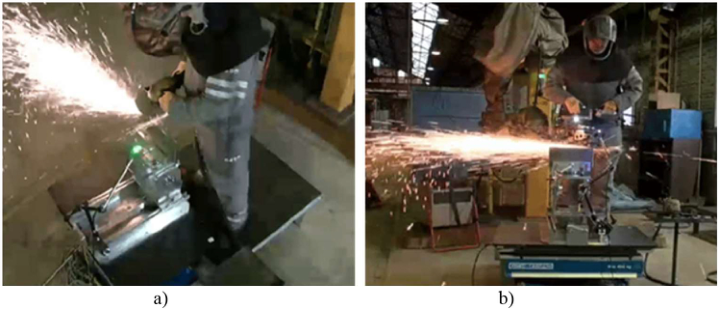
Description of the Tools In order to respond to the aim of the study, two different tools were used: a traditional grinding tool and a cobot. The traditional grinding tool con- sisted in a pneumatic grinder equipped with a grinding disc (diameter 230 mm) (Fig. 1, a). The cobot consisted of a poly-articulated arm with 7 axes of movement, driven by servomotors (COBOT 7A15, RB3D, Moneteau, Fra- nce). This robot includes a 6D force sensor able of measuring force and moment in all directions. This information is used to increase the force exer- ted by the user on the handled terminal device. The same terminal includes a device that allows the reduction of vibrations transmitted to users. The end of the distal arm of the cobot is equipped with means for attaching a pneu- matic grinder to it with the same characteristics as the traditional grinding tool. The user no longer handled the traditional grinder directly but rather via the device on the end of the cobot arm (Fig. 1, b).
Experimental Setup Inspired from real work environment, the volunteers workers were asked to perform grinding tasks, on horizontal plane, in four different directions of movement (from the right to the left - RL, from the left to the right - LR, from the bottom to the top - BT and from the top to the bottom - TB). They were
Collaborative Robotics: The Analysis of the Influence 405
Figure 1: Experimental setup using different types of tool: a) traditional grinding tool and b) cobot.
asked to exert two levels of force (F1 = 35N (tolerance zone [33N-38N]), F2 = 70N (tolerance zone [63N-77N])) during 30s grinding task. The hei- ght of the device for fastening the workpiece was adjustable (to take into account the anthropometry of the subject). The task was exerted at a prede- termined speed (10 mm/s). Participants were given real time visual feedback (LED) to inform them about the exerted force level in comparison with the requested force level: green (requested force level), blue (below the requested force level) and red (above the requested force level). The experiment was carried out using two different tools: a traditional grinding tool and a cobot. Experimental conditions were realized in a random order. Before data recor- ding, each professional had a familiarization period. This period included all the experimental conditions and all the participants had the same period. In addition, subjective evaluation was recorded and the recording data starts when the participant estimate he “was ready to start”.
Collected Data and Analysis Data were collected by measuring: the resultant force exerted by the user and recorded between the tool and the workpiece (force plate BP600900- 1000, AMTI, USA) and the estimated bilateral upper limb joint angles (Magneto-Inertial Measurement Units – MIMUs, XSENS, Netherlands): bila- teral flexion/extension (F/E), abduction/adduction (Abd/Add), axial rotation (Rot) of the shoulder, flexion/extension (F/E), axial rotation (Rot) of the elbow and flexion/extension (F/E), abduction/adduction (Abd/Add), axial rotation (Rot) of the wrist
The means (± standard deviations (SD)) for each joint angle were pro- cessed for each trial. The precision of the task was considered as being the percentage of time that the recorded force was in the tolerance zone of the required force level during each trial. Data were analyzed using a mixed linear model including the trial as a random effect (total of trials n = 164) and the tool (cobot, traditional), the force level (F1, F2) and the direction of the move- ment (LR, RL, TB, BT) as a fixed effect. Residual normality was verified and a 5% significance level adopted (p < 0.05).
Table 1. Main effect of the tool, the force and the direction of the movement on joint angle: p values (significant effect: p<0.05 in bold).
Table available in the original PDF paper.
Joint Angle Tool Force Direction Right Shoulder Adb/Add 0.139 0.628 0.150 Right Shoulder F/E 0.000 0.154 0.000 Right Shoulder Axial rotation 0.020 0.676 0.000 Left Shoulder Adb/Add 0.878 0.755 0.000 Left Shoulder F/E 0.002 0.790 0.000 Left Shoulder Axial rotation 0.007 0.333 0.000 Right Elbow F/E 0.075 0.936 0.412 Right Elbow Axial rotation 0.184 0.596 0.765 Left Elbow F/E 0.120 0.939 0.052 Left Elbow Axial rotation 0.000 0.996 0.074 Right Wrist Adb/Add 0.000 0.934 0.002 Right Wrist F/E 0.001 0.855 0.489 Right Wrist Axial rotation 0.001 0.718 0.020 Left Wrist Adb/Add 0.838 0.869 0.017 Left Wrist F/E 0.002 0.940 0.302 Left Wrist Axial rotation 0.000 0.654 0.691
RESULTS
The results are presented as the effect of the tool, the force and the direction as well as their interactions on the joint angles of the upper arms and on the precision of the task.
Joint Angles The results show that the tool had a significant effect on the left and right wrist’s joint angle (except for the left wrist abduction/adduction angle p = 0.838), on the left elbow axial rotation end on the left and right shoulder’s joint angles (except for right (p = 0.139) and left (p = 0.878) abduction/adduction angle)(Table 1).
At the same time, the level of the force had no significant effect on the joint angles of the right or left upper arm (0.154<p<0.996).
The direction of the movement had a significant effect on the bilateral shoulders joint angles (except for the Right Shoulder Abduction/Adduction angle) Right Wrist Abduction/Adduction, Right Wrist Axial rotation and Left Wrist Abduction/Adduction angles.
Moreover, the results show there was no significant interaction between the different parameters (tool-force, tool-direction, force-direction or tool- force-direction).
Precision In this study, for each trial, the precision was considered as being the percen- tage of time the recorded force level was in the tolerance zone of the requested force.
The results indicated that the tool (p = 0.000), the force (p = 0.004) and the direction (p = 0.000) had a significant effect on the precision.
Collaborative Robotics: The Analysis of the Influence 407
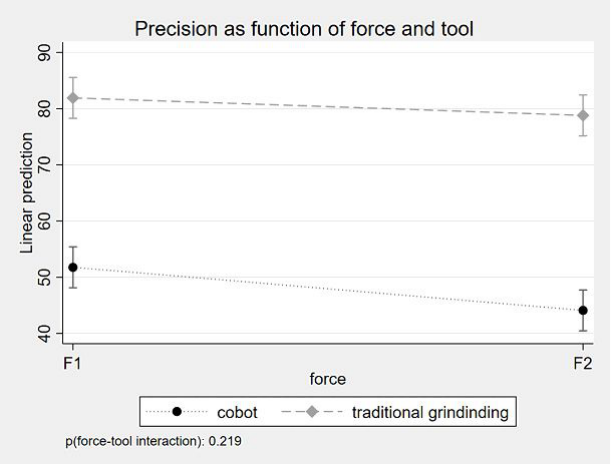
Figure 2: The linear prediction of the precision as function of the force level (F1 = 35N, F2 = 70N) and the used tool (cobot (round point) or traditional grinding (diamond point)).Table 2. The precision presented as function of the force (F1, F2) and the tool (cobot, traditional) (significant effect: p<0.05 in bold).
Table available in the original PDF paper.
p (Cobot Vs Traditional)
Force
Cobot Precision (%) [Confidence Interval]
Traditional Precision (%) [Confidence Interval]
PPPPPPP P Tool
51.8 [48.1;55.4] 81.9 [78.3;85.5] 0.000
F1 (35N, tolerance zone [33N-38N])
44.1 [40.5;47.7] 78.8 [75.2;82.4] 0.000
F2 (70N, tolerance zone [63N-77N]) p (F1 vs F2) 0.003 0.232
Equation reproduced from the original PDF.
The additional analysis shows that the precision was higher for F1 than for F2 (this difference is significant only for the cobot p = 0.003) (Table 2). Moreover, the precision was significantly higher when using the traditio- nal grinding tool (81.9% for F1 and 78.8% for F2) compared to the cobot (51.8% for F1 and 44.1 for F2) (Table 2).
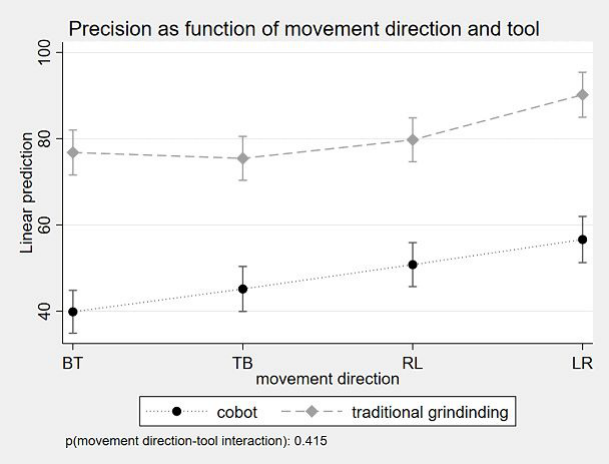
As for the force, no interaction was identified between the tool and the direction of the movement (p = 0.415) (Fig. 3).
The direction of the movement had similar effect for both tools: the pre- cision was significantly higher for LR (left to the right) direction than for
Figure 3: The linear prediction of the precision as function of the direction (from bottom to top - BT and from top to bottom – TB, from right to left - RL, from left to right - LR,) and the used tool (cobot (round point) or traditional grinding (diamond point)).Table 3. The precision presented as function of the direction (BT, TB, RL, LR) and the tool (cobot, traditional), (significant effect: p<0.05 in bold).
the RL (right to the left) than for TB (top to bottom) than for BT (bottom to top) for both tools (Table 3). Moreover, the precision was significantly higher when using the traditional tool than when using the cobot for all directions.
DISCUSSION
The results showed that the cobot had a significant influence on some of the bilateral upper limb joint angles. These results are in line with existing literature regarding collaborative robots (Maurice et al. 2013) or exoskele- tons (Theurel et al. 2018; Sylla et al. 2014). The cobot had no significant influence on some other joint angles and these results could be explained by
Collaborative Robotics: The Analysis of the Influence 409
the controlled experimental situation (controlled height of the workpiece and movement speed) which may be different in actual work environment. More- over, these results may be explained by the intention of the professionals to follow the same working gesture as traditional grinding. In previous studies it was already identified that professionals tend to follow the same postures in assisted welding (Erden et al. 2011).
In addition, the results showed that the characteristics of the task (move- ment direction and force) can have different influence on the estimated joint angles. Indeed, the direction of the movement had an influence on the estimated joint angles but not the exerted force. As for exoskeletons, the characteristics of the task is an important parameter that must be taken into account when choosing to use a cobot (Sylla et al. 2014). In the analy- zed experimental setup the precision when using the cobot was significantly lower than using traditional grinding. These considerations are necessary from occupational safety and health point of view but also from quality con- siderations. Indeed, the results showed that the characteristics of the task (force and movement direction) and the tool had a significant influence on the precision (quality). The precision was higher when the grinding task was performed from the left to the right. This can be explained by the relation between the direction of the task and the direction of movement of the grin- der disc, in this case in the same direction. At the same time, the precision was significantly lower when using the cobot than when using the traditio- nal grinding. These results are in line with the study analyzing drilling tasks using an exoskeleton (Kim et al. 2018). It was identified that drilling task completion time decreased by nearly 20% with the exoskeleton vest and the number of errors increased. At the same time, the present study results are in contrast with those previously reported considering a welding robot (Erden et al. 2011). This study demonstrated that the performance of welding was better with a robot-assisted welding than traditional welding. This situation appeared when welding was performed by novice workers in traditional wel- ding. This difference of results between the presented study and this previous study can be explained by the experience of the workers in traditional grin- ding (in our study experienced workers) and the variability of their strategies, namely postures (Schoose et al. 2022).
CONCLUSION
In conclusion, the cobot had a significant influence on user postures and task precision. Moreover, the characteristics of the task were of great importance on the user postures and on the precision. These results highlight the impor- tance of understanding the various characteristics of the task intended for cobot use when speculating on their potential effectiveness on occupational safety and health. The companies must be aware when they decide to intro- duce a cobot and make a preliminary analysis of the work situation in order to choose the best possible technical solution in line with global performa- nce including production (quantity and quality) and occupational safety and health.
REFERENCES
Alliance Industrie du Futur: Industry of the Future Technology Guide - Issues and Overview of Solutions. 188p, http://www.industriedufutur.org/content/uploads /2018/03/AIF_IndustryOfTheFutureTechnologyGuide_EN.pdf, (2018) Atain Kouadio, J-J, Sghaier, A., Picot, D. : Les robots d’assistance physique: foncti-
onnement, utilisation en industrie et enjeux santé et sécurité au travail. Paper presented at the 50th International Conference of the Société d’Ergonomie de Langue Française, Paris, France, Proceedings (2015). Erden, M. S., & Mari´c, B.: Assisting manual welding with robot. Robotics and Computer-Integrated Manufacturing, 27(4), 818–828 (2011) doi: http://dx.doi .org/10.1016/j.rcim.2011.01.003 Kim, S., Nussbaum, M. A., Mokhlespour Esfahani, M. I., Alemi, M. M.,
Alabdulkarim, S., & Rashedi, E. (2018). Assessing the influence of a pas- sive, upper extremity exoskeletal vest for tasks requiring arm elevation: Part I – “Expected” effects on discomfort, shoulder muscle activity, and work task performance. Applied Ergonomics, 70, 315–322. (2018) doi: https://doi.org/10.1016/j.apergo.2018.02.025 Krüger, J., Lien, T.K. & Verl, A.: Cooperation of human and machines in assembly lines. CIRP Annals - Manufacturing Technology, 58(2): pp. 628-646, (2009). Maurice, P., Measson, Y., Padois, V., Bidaud, P. : Assessment of physical expo-
sure to musculoskeletal risks in collaborative robotics using dynamic simulation Romansy 19 – Robot Design, Dynamics and Control ,Vol. 544, pp. 325–332, (2013): Springer Vienna. Maurice, P., Padois, V., Measson, Y, Bidaud, P. : Human-oriented design of collaborative robots. International Journal of Industrial Ergonomics, 57, 88–102., (2017), http://dx.doi.org/10.1016/j.ergon.2016.11.011 Peshkin, M. & Colgate, J. E.: Cobots. Industrial Robot: An International Journal,
26(5), 335–341. doi:10.1108/01439919910283722, (1999). Schoose, C., Cuny-Guerrier, A., Caroly, S., Claudon, L., & A. Savescu: Evolution of the biomechanical dimension of the professional gestures of grinders when using a collaborative robot, Journal of Occupational Safety and Ergonomics, in peer review process (2022) Sylla, N., Bonnet, V., Colledani, F., & Fraisse P.: Ergonomic contribution of
ABLE exoskeleton in automotive industry. International Journal of Industrial Ergonomics, 44(4): pp. 475–481, (2014). Theurel, J., Desbrosses, K., Roux T. & Savescu A.: Physiological consequences of using an upper limb exoskeleton during manual handling tasks Applied Ergonomics, 67: pp. 211–217, (2018).
LISTED IN THE AHFE DIGITAL BOOKSTORE CATALOGUE
Explore the complete digital volume
Human Factors and Systems Interaction
Read this individual research paper free through the original publisher, or explore the full digital proceedings book.
ISBN 978-1-958651-28-5
Explore this ISBN in the AHFE Bookstore ↗Listed in the July 2026 bookstore catalogue; search by ISBN to confirm current availability · Digital book purchase optional