Gabin Personeni, Daniil Danilovskii, Adriana Savescu (2026). Virtual Reality for Safe Integration of Collaborative Robots. In: Human Interaction and Emerging Technologies (IHIET-FS 2026): Future Systems and Design Applications. AHFE Open Access, vol. 235, pp. 273–281. https://doi.org/10.54941/ahfe1007281
Industry 4.0, the ongoing transformation of production systems and work organization through the integration of digital technologies, creates new health and safety challenges in the workplace. In particular, collaborative robotics offers increased flexibility in workstation design, permitting a robot and an operator to share a task or a workspace. However, this proximity with the robot exposes the operator to physical risks in a way that requires new means of prevention. In this context, digital technologies of Industry 4.0, such as simulation and Virtual Reality (VR) offers promising opportunities for early-stage, human-centered, rapid, iterative workstation design by involving operators in the design process of their future workstation when adaptations are still easy to implement. However, we have identified limitations of current robotic simulation tools with respect to integrating safety concerns or human-robot interaction, and of VR that has limited validity, i.e., ability to accurately reflect the activity of the operator in the real workstation. To further assess and address these limitations, a VR application was developed using ROS 2 and Unity. It enables the execution of the robot program within a virtual environment and in interaction with the workpieces and human operator, so that it can later be seamlessly deployed on the real robot. In this article, we present a proof of concept of how VR can be used in the collaborative robot integration process. A preliminary validation step and user feedback suggests differences between the real and virtual task with respect to execution time and mental load, but with good validity with regard to postures. An experimental protocol for more robust validation is proposed.
Industry 4.0 is a transformation of production systems and work organization through the integration of digital technologies. This paradigm shift is built upon technologies such as artificial intelligence, big data, mixed reality and collaborative robotics. These technologies aim to increase the autonomy and flexibility of production systems at reduced cost. In this context, collaborative robotics applications allow for workspaces and task to be shared between a human operator and a robot, leveraging the capacities of both for production. These robots can be integrated into traditionally human workspace and potentially relieve operators from repetitive or physically demanding tasks (Montini et al., 2024).
However, while collaborative robots are often considered adaptable for integration into existing workstations, they introduce new workplace safety challenges as robots and human operators work together or in close proximity. To address these risks, several strategies can be implemented, relying on either maintaining separation between the operator and robot while in motion (e.g. using physical protectors or protective devices that stop the robot upon intrusion into its workspace such as safety light curtains or laser scanners; refer to ISO 10218), or using power and force limitation (PFL; refer to ISO/TS 15066) to minimize the energy of a potential collision and prevent harm to the operator. Yet, the complexity of designing functional human-robot interaction, combined with the need to select and implement the required safety measures, poses an ongoing challenge that the digital simulations tools of Industry 4.0 early in design process. In this context, Virtual Reality (VR) offers promising opportunities for early-stage, human- centered, rapid, iterative workstation design by involving operators in the design process of their future workstations when adaptations are still easy to implement. Furthermore, VR offers a safe environment to address health and safety concerns early in the design process, without exposing the operator to the real risks (Badia et al., 2022). VR can also be of interest to assess and reduce the risk of musculoskeletal disorders (Singh, 2025), especially when combined with the flexibility provided by the collaborative robot.
Nonetheless, the simulation tools provided by robot manufacturers are mainly intended to design programs and trajectories for the robot, which is often considered on its own or within a Computer-Aided Design (CAD) environment. Two main limitations of existing simulation tools were identified: 1. it only allows to simulate the robot on its own or within its cell, but without the human operator, 2. it sometimes lacks emulation of safety features. These limitations are critical in collaborative robotics applications, where the choice of preventive measures to design safe and efficient human-robot interactions is a central and ongoing challenge (Haghighi et al., 2025).
Beyond the limitations of robotic simulation tools, the use of VR in workstation design raises the question of its validity with respect to the future workstation. In review of the literature (Personeni and Savescu, 2023), it was identified that VR itself is a tool that the operator needs to be familiarized with, and adds a layer of complexity to the real task itself. In order to assess the validity of VR for safe collaborative robot workstation design, the aim of this paper is to present the development of an interactive virtual reproduction of a real collaborative robotics application. A robot simulation was connected to this application, in order to reproduce the real robot behavior and the interactions with a human operator in VR. A preliminary validation step and user feedback will be discussed.
METHODS
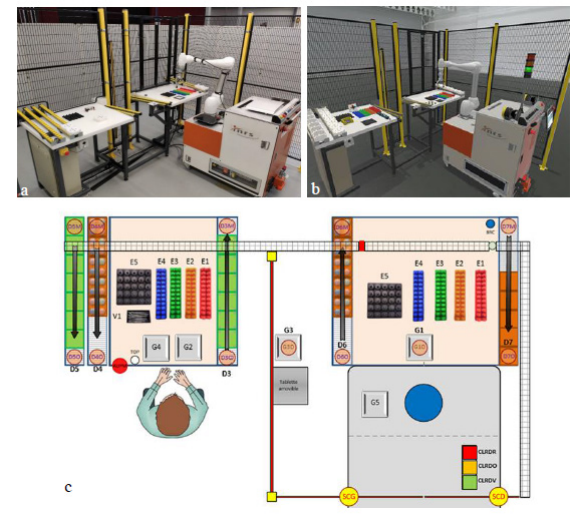
The study was built around a flexible workcell designed to be operated by an human operator and a collaborative robot (Tihay and Sghaïer, 2021). The cell, pictured in Figure 1 is composed of two workstations: a left workstation
Virtual Reality for Safe Integration of Collaborative Robots 275 table for the human operator and the right workstation table for the robot. The robot is a Doosan M1013 collaborative robot equipped with an OnRobot RG6 gripper.
Figure 1: Collaborative cell – a. real cell, b. the cell in the virtual environment, c. design plan of the overall cell (E1 through E5 designates the different types of gears, D3 through D7 are the roller conveyors for base pieces, covers and completed workpieces. The position of the robot is marked by a blue circle).
Several situations of human-robot collaboration have been implemented along the appropriate preventive measures. The areas of the workstation where no interaction with the robot is required are closed off using fixed protective fences to protect bystanders. Between the operator and the robot, a safety light curtain can be activated in order to stop the robot when the operator reaches into its workspace. This light curtain can be deactivated for collaborative tasks, in which case safety is ensured using PFL with a speed limit of 210 mm/s.
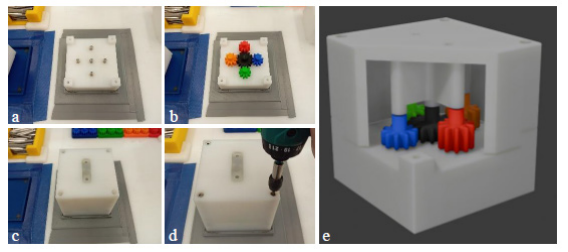
In this cell, the robot and operator must assemble a workpiece composed of a base piece on which 5 different gears must be placed in a specific arrangement (from smallest to tallest clockwise) before bolting a cover on it using an electric screwdriver. Gears and bolts are placed on the worktop, while base and cover pieces are delivered via gravity roller conveyors. The assembly operations are illustrated in Figure 2. It must be noticed that, in order to perform proper assembly, the peripheral gears must be positioned in the correct order and the cover must be placed in the correct orientation. The completed workpieces can then be evacuated using an output roller conveyor in each workstation.
Figure 2: Assembly steps – a. the operator places the base piece on the table, b. the operator places the 5 gears of different sizes on the base piece in the correct positions, c. the operator places the cover on the base piece in the correct orientation to fit with the different gear sizes, d. the operator bolts the cover to the base piece using an electric screwdriver. Image e presents a cut-out view of the assembly which illustrates how the cover fits with the different gear heights.
Sensors placed in the cell (represented as orange circles on Figure 1c) allow the robot to be aware of its environment, for instance, know if workpieces are available in the conveyors or if output conveyors are full. The gripper also functions as a sensor that can detect when a workpiece is gripped.
We designed three scenarios, in which the robot and operator perform this task with varying degrees of human-robot collaboration, from simple proximity to direct collaborative work on the same workpiece:
1. In the first scenario, the light curtain is active, and the operator and robot both perform the task simultaneously and independently. This represents a situation where the operator works in proximity of the robot, but with no intended interaction. The operator assembles the workpiece as illustrated in Figure 2. 2. In the second scenario, the robot places the four peripheral gears on the base, and places it on the central fixture between the two workstations (marked G3 on Figure 1c). The operator takes the piece and finishes the assembly, while the robot places the gears on the next base (next piece assembly). 3. In the third scenario, the robot is supplied with bases on which the four peripheral gears are already placed. It brings the base piece to the operator who can press a button to signal the robot to release the piece into their hand. The operator places the central gear, cover and bolts, gives the assembly to the robot and tighten the bolts while the robot is holding the workpiece.
RESULTS
In order to properly simulate this workstation and its tasks, we established the following requirements for the simulation: a. The behavior and trajectories of the robot must be simulated accurately; b. Both the operator and robot need to physically interact with the
workpieces in the simulated workstation;
Virtual Reality for Safe Integration of Collaborative Robots 277 c. The simulated robot must receive inputs from the sensors in the simulated
workstation; d. Safety functions and protective devices must be simulated.
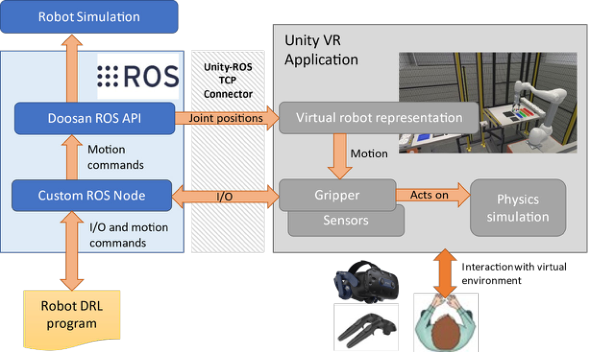
To fulfill these requirements, ROS 2 (Robot Operating System) can be used to simulate the robot itself, Unity to enable the physical interactions of the operator and robot with their environment, and a communication layer between the two that allow to forward inputs of the simulated sensors and protective devices to the robot simulation (Figure 3).
Figure 3: Architecture of the VR application with an interactive collaborative robot.
Robotic Simulation Robotic simulation was implemented with ROS 2, an open-source framework that allows controlling and simulating a wide range of robots (Macenski et al., 2022). ROS uses a decentralized architecture where independent ROS nodes communicate via topics (continuous data streams, e.g., broadcasting a robot’s state) or services (callable endpoints to perform calculations or execute an action). Robot manufacturers can contribute packages with remote control and simulation application programming interface (API) for their robots. Furthermore, several 3D engines with VR support have been developing bridges to ROS, such as the Unity ROS TCP Connector (Unity Technologies, 2022). These bridges let a VR application act as a ROS node, allowing communication with other ROS nodes, query their services and topics, and expose its own services.
The Doosan M1013 collaborative robot can be programmed using the Doosan Robot Language (DRL) which uses a Python-like syntax. We built a ROS 2 package written in Python (designated as the Custom ROS Node on Figure 3) enabling execution of the real robot program and acting as a middleware between the DRL program and the Doosan ROS API that handles simulation of the robot. It interfaces the DRL commands with the appropriate ROS 2 services that handles motion of the robot and routes input/
output signals to the VR application, as illustrated in Figure 3. In particular, the interactions between the robot program and operator through simulated buttons, proximity sensors, and the robot gripper sensors. Furthermore, safety devices and functions, such as light curtains, PFL (power and force limiting), and reduced-speed zones, were implemented in the virtual environment.
Virtual Environment The virtual workstation was developed in Unity using CAD models of the real cell and includes physics simulation to support realistic interaction between the robot, the operator and the environment (such as workpieces, sensors, etc.).
The operator is equipped with an HTC Vive wireless headset and controllers, allowing them to see and interact with the virtual environment. Using the trigger button on either controller, the operator can grasp touched workpieces and perform the assembly. The face buttons of the controller are used to control the electric screwdriver, as they are actioned with the thumb like the buttons of the real tool. The simulated assembly process leaves the operator free to make mistakes that would be possible in the real situation (e.g., wrong gear placement), and leverages the Unity physics engine to handle collision between workpieces.
As described in Figure 3, the VR application receives the real-time joint positions of the simulated robot from ROS 2. Furthermore, we simulated the behavior of the gripper within Unity. Indeed, the opening and closing of the gripper affects and is affected directly by the workpieces through the physics simulation. In particular, while the two fingers of the gripper collide with the same workpiece, it is attached to the gripper and its closing width is clamped. Our simulated gripper is programmable like the real one: the opening width can be controlled by digital inputs from the DRL program, and the gripper state can be monitored using its digital outputs. Thus, its inputs and outputs (I/O) interface transparently with the DRL program through our custom ROS node.
Finally, sensors, protective devices and safety functions are simulated using Unity’s physics simulation. The functional sensors can detect the presence or absence of workpieces, while the safety light curtain can detect any intrusion in the robot workspace, triggering a safety stop. The PFL function is simulated by detecting collisions between the operator and the robot.
Motion Capture The execution of the task is captured using three cameras to perform a biomechanical ergonomic assessment using the Rapid Upper Limb Assessment (RULA) scale (McAtamney and Corlett, 1993). The Python OpenCV library was used for the calibration of the cameras in order to obtain their projection matrices and to capture the video feeds. Subsequently, we used Mediapipe (Lugaresi et al., 2019), a computer vision framework built on machine learning, to process each video stream separately to pinpoint estimated joint centers as image coordinates on each frame. Using the projection matrices of each camera, image coordinates from a set of time-congruent frames were
Virtual Reality for Safe Integration of Collaborative Robots 279 triangulated to obtain joint centers coordinates in 3D. These coordinates could then be used to compute human joint angles and the associated RULA score frame-by-frame.
Furthermore, the camera system is calibrated with respect to a fixed point of the robotic cell, allowing to locate the operator relative to the robot and workstation. In the virtual situation, a visual calibration pattern is fixed to VR trackers to align the coordinates system of the real cameras and virtual environment.
Experimental Plan In the proposed experimental plan, participants will perform the assembly task in real and virtual conditions in each of the three collaboration scenarios. They are asked to self-report their mental load at 5 minutes-intervals during the task, using the Instantaneous Self-Assessment scale (Jordan and Brennen, 1992), and after the task using the NASA-TLX questionnaire (Hart and Staveland, 1988). In the virtual condition, they also report the emergence of cybersickness using the Virtual Reality Symptoms Questionnaire (Kim et al., 2018). Performance on the task will also be evaluated, by considering the duration of each assembly by the operator and the number of errors. This will allow to compare mental load and effective performance in real and virtual situations.
The functional adequacy of safety measures will also be compared between the two situations, by recording the number of times a safety stop is induced by an action of the participant. We note that, as the design of the workstation is compliant with safety standards, the implemented safety measures are adequate with respect to operator safety, but may not be optimal towards good performance on the different tasks.
The posture of participants will be recorded through each step of the tasks, and a comparative RULA evaluation will be conducted to assess whether the postures differ between the real and virtual situation, and if this difference has an impact with regard to musculoskeletal disorders prevention.
The position of participants relative to the robot, along with its trajectories, will be recorded to allow to assess which body parts are exposed to a collision risk with the robot, and either confirm the preliminary risk analysis or be used to adjust power and force limits accordingly.
DISCUSSION
The presented setup proposes a complete simulation of collaborative robotics application with human-robot interaction in VR. Moreover, safety functions and protective devices were also simulated. This technical implementation allows to analyze safety considerations in collaborative robotics applications.
A preliminary qualitative validation step, based on user feedback, revealed several key insights into the usability of the proposed VR system and collaborative workstation design. This preliminary evaluation revealed task performance disparities between real and virtual conditions, with slower task execution in the virtual condition. Participants also reported higher mental load and physical effort while performing the task in the virtual environment. Consistently with a
review of the literature (Personeni and Savescu, 2023), this suggests an additional difficulty introduced by the VR interface itself rather than the task. Furthermore, some interactions were noticeably more difficult in VR, for instance when the operator could rely on tactile feedback in the real situation.
However, it was found that the safety functions and devices choices and placements were a priori functionally adequate in both conditions, allowing participants to perform the task with few interruptions. While this assessment is only complimentary to compliance with safety standards, it shows that the chosen safety measures are compatible with the task.
Furthermore, a first biomechanical ergonomic assessment using RULA shown similar results across different human-robot collaboration scenarios in both real and virtual environments. This assessment suggests a low risk of musculoskeletal disorder (RULA score of 4), which warrants further investigation and suggests the workstation could be better adjusted.
The studied workstation does not require the operator to move in a large area. This limits motion while in VR, which, combined with short sessions, reduces the prevalence of cybersickness. Our preliminary evaluation of the system did not show any occurrence of cybersickness, even among user with no prior experience of VR. This permits greater inclusion of participants and could be conducive to better operator feedback.
Overall, the proposed experimental setup is suitable to assess the validity of VR for the integration of collaborative robots. It allows to accurately simulate the robot, permits the interaction of the operator and the robot in the virtual environment and has limited risk with respect to unergonomic postures and cybersickness. Further investigation following the proposed experimental plan will be able to assess whether VR is an effective decision-making tool to validate collaborative cells designs with respect to performance, mental load, biomechanical ergonomics, and safety measures implementation.
CONCLUSION
The use of VR can help address issues early in the design phases by including the operator in the design process. It remains complementary to a preliminary risk analysis and compliance with established safety standards. In the later stages of the integration, a function and risk assessment of the real workstation also remain necessary to move past the limitations of VR. Nevertheless, the rapid evolution of collaborative robotics and digitalization of industry calls for sustained efforts to continuously develop and validate simulation tools that accurately reflect increasingly complex emerging work situations while taking into account the human component.
ACKNOWLEDGMENT
The authors would like to acknowledge the contribution of Adel Sghaïer and David Tihay, for the design of the collaborative workstation and their guidance in implementing its simulation.
REFERENCES
Badia, Sergi Bermúdez i, Silva, Paula Alexandra, Branco, Diogo, Pinto, Ana, Carvalho, Carla, Menezes, Paulo, Almeida, Jorge, Pilacinski, Artur. (2022) Virtual Reality for Safe Testing and Development in Collaborative Robotics: Challenges and Perspectives. Electronics 11. https://doi.org/10.3390/electronics11111726 Haghighi, Aida, Cheraghi, Morteza, Pocachard, Jérôme, Botta-Genoulaz, Valérie,
Jocelyn, Sabrina, Pourzarei, Hamidreza. (2025) A comprehensive review and bibliometric analysis on collaborative robotics for industry: safety emerging as a core focus. Frontiers in Robotics and AI Volume 12-2025. https://doi.org/10.3389/ frobt.2025.1605682 Hart, Sandra G., Staveland, Lowell E. (1988) Development of NASA-TLX (Task Load Index): Results of Empirical and Theoretical Research, in: Hancock, P.A., Meshkati, N. (Eds.), Human Mental Workload, Advances in Psychology. North-Holland, pp. 139–183. https://doi.org/https://doi.org/10.1016/S0166-4115(08)62386-9 ISO. (2025) ISO 10218:2025 Robotics — Safety requirements. International
Organization for Standardization. ISO. (2016) ISO/TS 15066:2016 Robots and robotic devices — Collaborative robots.
International Organization for Standardization. Jordan, CS, Brennen, SD. (1992) Instantaneous self-assessment of workload technique (ISA). Defence Research Agency, Portsmouth. Kim, Hyun K., Park, Jaehyun, Choi, Yeongcheol, Choe, Mungyeong. (2018) Virtual
reality sickness questionnaire (VRSQ): Motion sickness measurement index in a virtual reality environment. Applied Ergonomics 69, 66–73. https://doi.org/https:// doi.org/10.1016/j.apergo.2017.12.016 Lugaresi, Camillo, Tang, Jiuqiang, Nash, Hadon, McClanahan, Chris, Uboweja, Esha, Hays, Michael, Zhang, Fan, Chang, Chuo-Ling, Yong, Ming Guang, Lee, Juhyun, others. (2019) Mediapipe: A framework for building perception pipelines. arXiv preprint arXiv:1906.08172. Macenski, Steven, Foote, Tully, Gerkey, Brian, Lalancette, Chris, Woodall, William.
(2022) Robot Operating System 2: Design, architecture, and uses in the wild. Science Robotics 7, eabm6074. https://doi.org/10.1126/scirobotics.abm6074 McAtamney, Lynn, Corlett, E Nigel. (1993) RULA: a survey method for the investigation of work-related upper limb disorders. Applied ergonomics 24, 91–99. Montini, Elias, Daniele, Fabio, Agbomemewa, Lorenzo, Confalonieri, Matteo, Cutrona,
Vincenzo, Bettoni, Andrea, Rocco, Paolo, Ferrario, Andrea. (2024) Collaborative Robotics: A Survey From Literature and Practitioners Perspectives. Journal of Intelligent & Robotic Systems 110, 117. https://doi.org/10.1007/s10846-024-02141-z Personeni, Gabin, Savescu, Adriana. (2023) Ecological validity of virtual reality simulations in workstation health and safety assessment. Frontiers in Virtual Reality Volume 4-2023. https://doi.org/10.3389/frvir.2023.1058790 Singh, Ashish Kumar. (2025) VR/AR in ergonomics and workspace design: A dual-
perspective analysis of applications and implications. Applied ergonomics 129, 104612. Tihay, David, Sghaïer, Adel. (2021) Lessons learned from the integration of a collaborative robotics application. Presented at the Proceedings of the 10th International Conference on Safety of Industrial Automated Systems SIAS. Unity Technologies. (2022) ROS-TCP-Connector: ROS2 Integration for Unity.
Human Interaction and Emerging Technologies (IHIET-FS 2026): Future Systems and Design Applications
Read this individual research paper free through the original publisher, or explore the full digital proceedings book.
ISBN 979-8-950676-11-6
Explore this ISBN in the AHFE Bookstore ↗Listed in the July 2026 bookstore catalogue; search by ISBN to confirm current availability · Digital book purchase optional