Rosaria Califano, Antonio Cannavacciuolo, Antonio D'Auria, Alessandro Naddeo (2026). From Tradition to Ergonomics: Assessing Work-Related Musculoskeletal Risk in Pizza Makers. In: Social and Occupational Ergonomics. AHFE Open Access, vol. 228, pp. 156–165. https://doi.org/10.54941/ahfe1007946
Work-related musculoskeletal disorders (WMSDs) represent one of the most prevalent occupational health problems worldwide and constitute a leading cause of reduced work ability, absenteeism, and early retirement across a wide range of industrial sectors (Andersen et al., 2021; EU-OSHA, 2019, n.d.; Greggi et al., 2024; Punnett and Wegman, 2004). WMSDs typically arise from prolonged exposure to biomechanical risk factors such as repetitive movements, awkward and static postures, forceful exertions, and insufficient recovery times (Buckle and Jason Devereux, 2002; da Costa and Vieira, 2010; Oakman et al., n.d.). These risk factors often act synergistically, increasing cumulative musculoskeletal load and accelerating the onset of pain and functional impairment. Although WMSDs have traditionally been associated with manufacturing, construction, and healthcare, growing Received January 29, 2026; Revised April 16, 2026; Accepted May 4, 2026; Available online July 20, 2026
From Tradition to Ergonomics: Assessing Work-Related Musculoskeletal Risk 157 evidence shows that service-sector occupations—particularly those involving food preparation—are similarly affected (Abebaw et al., 2024; Ariyanto et al., 2021; Chen et al., 2024; Yates and Brown, 2025). Workers in the food service and food manufacturing sectors are frequently exposed to manual material handling, constrained workspaces, high work pace, prolonged standing, and repetitive upper limb activities (Kim et al., 2025; Kumari, 2018a; Leong et al., 2024; Nenonen, 2013; Rao and R, 2025). Epidemiological studies consistently report a high prevalence of musculoskeletal symptoms in the neck, shoulders, lower back, and upper limbs among kitchen and food-processing workers, with prevalence rates comparable to those observed in industrial settings (Abdelsalam et al., 2023; Govaerts et al., 2021; Yates and Brown, 2025). These findings highlight the need for systematic ergonomic assessments in food-related occupations that have historically received limited attention. Within the food service sector, pizza making represents a distinctive and understudied occupational context. Pizza making is a globally widespread activity that combines artisanal tradition with highly repetitive manual tasks. Among these, dough stretching is a core operation performed continuously during the workday, often at production rates exceeding 30 pizzas per hour. This task typically requires sustained trunk flexion, neck inclination, shoulder abduction, and repetitive wrist and forearm movements—postural and biomechanical conditions that are well-recognized risk factors for WMSDs (Afshari et al., 2019; David, 2005; McAtamney and Nigel Corlett, 1993; Placci and Cerbai, n.d.; Roveshti et al., 2023). Studies on bakers and similar professions indicate elevated rates of upper limb, neck, and back disorders, suggesting that pizza makers may face comparable or greater ergonomic risks due to the speed and repetitiveness of their work (Afshari et al., 2019; Joudakinia et al., 2020; Roveshti et al., 2023). Nevertheless, despite the global diffusion of pizza production, the ergonomic characteristics of pizza makers’ tasks and workstations—particularly during dough stretching—remain poorly documented in the scientific literature. Ergonomics aims to optimize the interaction between workers and their work environment by adapting tasks, tools, and workstations to human capabilities and limitations. An ergonomically designed workplace not only contributes to injury prevention but also enhances productivity, work quality, and long-term occupational sustainability (Dul et al., 2012; Joudakinia et al., 2020). In standing work involving repetitive upper limb tasks, inadequate workstation height, limited adjustability, and poor anthropometric matching have been shown to significantly increase musculoskeletal load and perceived discomfort (Kumari, 2018a; Markova et al., 2025; Pheasant and Haslegrave, 2018; Rao, 2020). In this context, traditional ergonomic assessment tools such as the Rapid Upper Limb Assessment (RULA) and the Rapid Entire Body Assessment (REBA) have proven effective in identifying postural risk factors in food preparation and industrial tasks (Markova et al., 2025; Rao, 2020). However, their systematic application to pizza making activities remains scarce. In many traditional and semi-industrial pizzerias, workstations are designed primarily according to functional, spatial, or hygienic constraints rather than ergonomic principles. Fixed-height workbenches, limited space for movement, and reduced opportunities for posture variation may disproportionately affect workers with non-average anthropometric characteristics, such as very short
or very tall individuals (Kumari, 2018b; Pheasant and Haslegrave, 2018). Recent ergonomic frameworks advocate for human-centric design not only to reduce injury risk but also to enhance productivity, sustainability, and long-term occupational health in both manufacturing and service sectors. Although ergonomic solutions such as adjustable-height tables, anti-fatigue mats, and task rotation strategies are well documented in the literature, their adoption in small and medium-sized food service enterprises is often limited by economic constraints, lack of standardization, and resistance to changes in traditional work practices (John et al., 2025; Markkanen et al., 2021; Mohd Fazi Hamizatun et al., 2017). Against this background, the present study aims to provide a systematic ergonomic assessment of professional pizza makers during the dough-stretching task. By integrating subjective discomfort questionnaires, observational analysis, digital human modelling, and Rapid Upper Limb Assessment (RULA), the study seeks to (i) identify critical postures and phases of the task associated with elevated ergonomic risk, (ii) quantify musculoskeletal risk levels, and (iii) explore the relationship between anthropometric characteristics and perceived discomfort. The results are intended to support evidence-based ergonomic interventions aimed at reducing WMSDs and improving working conditions in the pizza-making profession.
MATERIALS AND METHODS
Participants A statistical sample of twenty-five male professional pizza makers were recruited to participate in the experiment. The subjects were informed of the nature of the tests and voluntarily agreed to participate by signing the consent form, in accordance with ethical standards of the University of Salerno. None had a history of musculoskeletal diseases. Personal and job data are reported in Tables 1, 2.
Table 1: Demographic and anthropometric data of the participants (N = 25). Data are presented as mean ± standard deviation.
Table available in the original PDF paper.
Data Value Age [year] 40.68 ± 9.6 Body mass [kg] 78.68 ± 8.7
Height [cm] 177.16 ± 7.3 Arm Length (left) [cm] 30.68 ± 2.92 Arm Length (right) [cm] 29.92 ± 3.03
Table 2. Job profile of the participants (N = 25).
Table available in the original PDF paper.
Less Than 5 From 5 to 10 Over 10 Working years 5 6 14 Less than 10 From 10 to 20 Over 20
Pizzas prepared in an hour 3 13 9
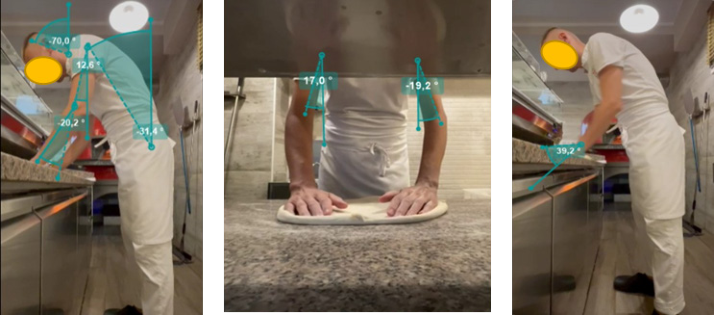
POSTURAL DATA ACQUISITION For the experimental setup, three video cameras (frontal, lateral, and overhead perspectives) were placed to acquire pizza makers’ postures. Participants were not instructed to modify their working technique, ensuring natural execution of the task. The videos were processed using Kinovea® software version 0.9.5-x64. In Figure 1, an example of angular detection is shown.
Figure 1: Angular detection through Kinovea®.
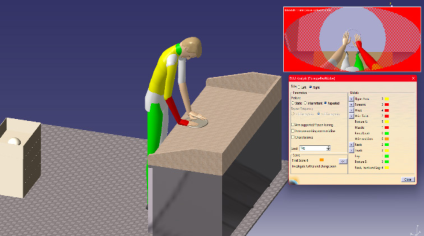
SIMULATION SOFTWARE AND ERGONOMIC EVALUATION Workstations were digitally reconstructed in CATIA® V5R16 based on in-situ dimensional measurements. A customised mannequin reflecting the anthropometry of each participant was created in DELMIA® V5R16. In the virtual environment, based on the angular detection through Kinovea®, the most critical postures of each pizza maker were simulated. The simulations were set to exactly reproduce the movements based on the recorded ones, which were taken from the video. For each participant, the RULA analysis was carried out (Figure 2). The Rapid Upper Limb Assessment (RULA) method was applied to evaluate postural risk, focusing on arm flexion, forearm flexion, shoulder abduction, wrist flexion/extension, neck flexion, and trunk inclination.
Figure 2: Virtual pizza maker’s workplace and RULA analysis using DELMIA®.
QUESTIONNAIRE The questionnaire measured perceived postural discomfort (overall and localized) on a 10-point scale (1 = minimal discomfort, 10 = maximum discomfort). For the Body Part Discomfort Score, the human body was divided into 11 regions. Each participant was asked to rate discomfort in the following areas: neck, shoulders, arms, forearms, wrists, back (thoracic region), and back (lumbar region). The questionnaire also included an item assessing the workers’ perception of workstation suitability. All tests were conducted after four hours of work, to ensure the same scenario in terms of participants’ fatigue and stress.
RESULTS
Descriptive statistics and correlation analyses were performed using SPSS® (release 26). Spearman’s rho coefficients were calculated to investigate relationships among anthropometric variables, RULA scores, and perceived discomfort across different body regions. The RULA assessment yielded scores predominantly between 5 and 6, indicating medium-to-high ergonomic risk levels and the need for corrective interventions. Analysis of body-segment scores identified the wrists (right and left) and the neck as the most critical areas, with average RULA scores of 4.2 and 5.1, respectively. Questionnaire results showed a median Overall Discomfort score of 6. The body regions most affected by discomfort were the lower back (mean score 7.6), neck (6.8), wrists (6.5), and shoulders (5.4). Strong positive correlations were observed between the overall RULA score and Overall Discomfort (ρ = 0.451), supporting the association between postural risk and perceived musculoskeletal strain. Correlation analysis revealed a positive association between Overall Discomfort and participant height (ρ = 0.408), indicating that discomfort patterns varied with stature. Specifically, shorter individuals reported higher discomfort in the shoulders and upper back, whereas taller individuals experienced greater discomfort in the lower back and neck. A stratification by height percentile further confirmed that the upper and lower back, wrists, and neck were the body regions most exposed to stress
From Tradition to Ergonomics: Assessing Work-Related Musculoskeletal Risk 161 (Table 3). Across all height percentiles, the neck and lower back consistently emerged as the most critical areas. Back discomfort increased markedly in the higher height percentiles (50–100%), while shoulder discomfort was more pronounced in the lowest percentile (0–25%) and then tended to stabilize.
Table 3: Discomfort average scores.
Table available in the original PDF paper.
Equations and mathematical formulas are available in the original paper PDF.
ERGONOMIC-DRIVEN REDESIGN One of the most relevant findings, with direct implications for workstation redesign, was the relationship between workers’ height percentile and perceived discomfort. Taller pizza makers reported significantly higher levels of discomfort in the lower back and neck, attributable to the need to adopt excessive trunk and cervical flexion when working at fixed-height benches. This evidence suggests that a non-adjustable work surface represents a critical ergonomic constraint, particularly for individuals in higher stature percentiles. On this basis, a potential corrective strategy was explored by modifying the height of the workbench in relation to the pizza maker’s stature, with the aim of promoting more neutral postures during dough stretching.
To determine the required height adjustments, a target work-surface height was calculated for each stature-percentile class as the class mean standing elbow height minus 122 mm, in line with the recommended criterion for tasks involving downward pressure (Pheasant and Haslegrave, 2018). Based on this criterion, the workbench height was therefore increased according to percentile class, ranging from 7 cm for the 0 to 25% percentile class to 18 cm for the 75 to 100% percentile class. The redesign was implemented exclusively within the DELMIA® environment, as real-world modification of the existing workbench was not feasible in the observed settings. Under the adjusted-height condition, the most critical postures previously identified were re-examined and the corresponding RULA scores were recalculated. The results, summarized in Table 4, indicate a clear improvement: the mean RULA grand score for the whole sample decreased by approximately 35%, from 5.7 to 3.7. In parallel, mean neck flexion was reduced by approximately 43% and mean trunk flexion by approximately 26% across the sample. These
reductions are consistent with the mechanical effect of a higher workbench, which decreases the need for forward trunk inclination while preserving task visibility during dough stretching.
Table 4: RULA score (Overall and local) for the entire sample, and percentiles ranges.
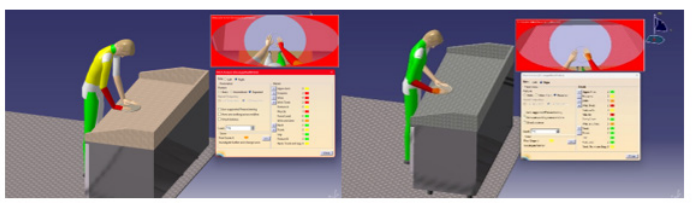
Figure 3: (left) worker in real condition (right) worker in the height-adjusted condition.
Figure 3 shows, in DELMIA®, the comparison between the posture adopted by the worker in the real condition (on the left) and that observed under the height-adjusted workbench condition (on the right).
CONCLUSION
This study provides a systematic ergonomic assessment of the dough- stretching task performed by professional pizza makers, combining observational analysis, digital human modelling, RULA evaluation, and perceived discomfort questionnaires. The results indicate medium-to-high ergonomic risk levels, with the lower back, neck, and upper limbs identified as the most critical body regions, reflecting prolonged non-neutral postures and repetitive upper limb movements.
A significant relationship between anthropometric characteristics, particularly stature, and postural risk was observed. Fixed-height workbenches were found to inadequately accommodate the full anthropometric range of workers, leading to increased trunk and neck flexion in taller individuals. The virtual redesign of the workstation, based on stature-dependent adjustment of workbench height, resulted in a marked reduction of RULA scores and critical joint angles, demonstrating the potential effectiveness of targeted ergonomic design interventions.
From Tradition to Ergonomics: Assessing Work-Related Musculoskeletal Risk 163 Overall, the findings highlight the need to integrate ergonomic and anthropometric criteria into the design of workstations for repetitive artisanal tasks, supporting musculoskeletal risk reduction and improved occupational sustainability.
LIMITATIONS AND FUTURE DEVELOPMENT Future work will focus on the experimental validation of the proposed ergonomic redesign in real working environments, particularly through the implementation of height-adjustable workbenches. Further studies may integrate objective biomechanical measurements, such as surface electromyography, to achieve a more detailed quantification of muscular load. Extending the analysis to larger and more heterogeneous samples, as well as to additional tasks within the pizza-making process, would support the development of sector-specific ergonomic guidelines for artisanal food production. The methodological framework adopted in this study may also be applied to other traditional food-service activities characterized by high repetitiveness and constrained workspaces.
ACKNOWLEDGMENT
The authors gratefully acknowledge the professional pizza makers who participated in this study.
REFERENCES
Abdelsalam A, Wassif GO, Eldin WS, et al. (2023) Frequency and risk factors of musculoskeletal disorders among kitchen workers. Journal of the Egyptian Public Health Association 98(1): 3. Abebaw T, Destaw B, Yenealem DG, et al. (2024) Work-related musculoskeletal
disorders: prevalence, associated factors, and impact on quality of life among kitchen workers in hospitality industry, Bahir Dar City, Northwest Ethiopia, 2023. Frontiers in Public Health Volume 12-2024. Afshari D, Dianat I, Joudaknia L, et al. (2019) Long-Term Assessment of Upper Arm Posture and Motion and Their Association with Discomfort Perceived Symptoms among Bakery Workers. Andersen L, Vinstrup J, Sundstrup E, et al. (2021) Combined ergonomic exposures
and development of musculoskeletal pain in the general working population: A prospective cohort study. Scandinavian Journal of Work, Environment & Health 47. Ariyanto J, Palutturi S, Russeng S, et al. (2021) Control of the Risk of Musculoskeletal Disorders in the Food Industry: Systematic Review.: 4254–4261. Buckle PW and Jason Devereux J (2002) The nature of work-related neck and upper
limb musculoskeletal disorders. Applied Ergonomics 33(3): 207–217. Chen H, Anton N, Holden R, et al. (2024) Kitchen ergonomics in health and healthcare: A rapid scoping review. Human Factors in Healthcare 5: 100069. da Costa BR and Vieira ER (2010) Risk factors for work-related musculoskeletal
disorders: A systematic review of recent longitudinal studies. American Journal of Industrial Medicine 53(3). John Wiley & Sons, Ltd: 285–323. David GC (2005) Ergonomic methods for assessing exposure to risk factors for work-related musculoskeletal disorders. Occupational Medicine 55(3): 190–199.
Dul J, Bruder R, Buckle P, et al. (2012) A Strategy for Human Factors/Ergonomics: Developing the Discipline and Profession. Ergonomics 55: 377–395. EU-OSHA, 2019. Govaerts R, Tassignon B, Ghillebert J, et al. (2021) Prevalence and incidence of
work-related musculoskeletal disorders in secondary industries of 21st century Europe: A systematic review and meta-analysis. BMC Musculoskeletal Disorders 22(1): 751. Greggi C, Visconti VV, Albanese M, et al. (2024) Work-Related Musculoskeletal Disorders: A Systematic Review and Meta-Analysis. Journal of Clinical Medicine 13(13). John B, David O, Ok E, et al. (2025) Food service workers and ergonomic exposures
in New York restaurants. Epub ahead of print 7 September 2025. Joudakinia L, Afshari D, Saki A, et al. (2020) Evaluation of biomechanical risk factors for neck and back disorders in traditional bakers during a work-day: Implications for ergonomics intervention. Archives of Environmental & Occupational Health 76(2). Routledge: 86–93. Kim JW, Lee DK and Jeong BY (2025) Comparison of Exposure Time to Hazards
Between Pain Complainants and Non-Complainants Among Food Manufacturing Production Workers, and Factors Influencing Musculoskeletal Pain. Applied Sciences 15(8). Kumari A (2018a) An Ergonomic Approach for Modifying the Workstation Design of Food Processing Enterprises. Journal of Ergonomics 08. Kumari A (2018b) An Ergonomic Approach for Modifying the Workstation Design
of Food Processing Enterprises. Journal of Ergonomics 08. Leong K, Ng QX, Gan W, et al. (2024) Epidemiology of work-related injuries, musculoskeletal disorders and dermatitis among hospital food service workers in a tertiary hospital in Asia. Journal of Occupational Medicine and Toxicology 19. Markkanen Pia, Peters Susan E, Grant Michael, et al. (2021) Development and
application of an innovative instrument to assess work environment factors for injury prevention in the food service industry. WORK 68(3). SAGE Publications: 641–651. Markova V, Petrova Z and Valcheva-Georgieva I (2025) Assessing Musculoskeletal Health Risks in Standing Occupations. Engineering Proceedings 104(1). McAtamney L and Nigel Corlett E (1993) RULA: A survey method for the
investigation of work-related upper limb disorders. Applied Ergonomics 24(2): 91–99. Mohd Fazi Hamizatun, Nik Mohamed Nik Mohd Zuki, Ab Rashid Mohd Fadzil Faisae, et al. (2017) Ergonomics study for workers at food production industry. MATEC Web Conf. 90: 1003. Nenonen N (2013) Analysing factors related to slipping, stumbling, and falling
accidents at work: Application of data mining methods to Finnish occupational accidents and diseases statistics database. Applied Ergonomics 44(2): 215–224. Oakman J, Neupane S, Proper KI, et al. (n.d.) Workplace interventions to improve work ability: A systematic review and meta-analysis of their effectiveness. Scandinavian Journal of Work, Environment & Health (2): 134–146. Pheasant S and Haslegrave C (2018) Bodyspace: Anthropometry, Ergonomics and
the Design of Work. Placci M and Cerbai M (n.d.) Modelli semplificati di analisi delle sorgenti di rischio e del sovraccarico biomeccanico nel settore artigiano: esperienze applicative nei pasticceri, pastai e pizzaioli. Punnett L and Wegman DH (2004) Work-related musculoskeletal disorders:
The epidemiologic evidence and the debate. Journal of Electromyography and Kinesiology 14(1): 13–23.
From Tradition to Ergonomics: Assessing Work-Related Musculoskeletal Risk 165 Rao R (2020) Ergonomic assessment of musculoskeletal discomfort among chefs in
commercial kitchens. 6: 371–379. Rao S and R V (2025) Work-Related Musculoskeletal Disorders in Food Packing Workers: A Review of Prevalence and Workplace Factors. RGUHS Journal of Physiotherapy 5. Roveshti Mehran Maleki, Pouya Amin Babaei, Pirposhteh Elham Akhlaghi, et al.
(2023) Work-related musculoskeletal disorders and related risk factors among bakers: A systematic review. WORK 77(2). SAGE Publications: 463–476. Yates KAB and Brown SHM (2025) Prevalence of musculoskeletal discomfort, occupational working factors, and work demands amongst food service kitchen workers in Ontario Canada. Discover Public Health 22(1): 151.
LISTED IN THE AHFE DIGITAL BOOKSTORE CATALOGUE
Explore the complete digital volume
Social and Occupational Ergonomics
Read this individual research paper free through the original publisher, or explore the full digital proceedings book.
ISBN 979-8-950676-04-8
Explore this ISBN in the AHFE Bookstore ↗Listed in the July 2026 bookstore catalogue; search by ISBN to confirm current availability · Digital book purchase optional