Alessandro Naddeo, Nicola Cappetti, Mariarosaria Vallone, Rosaria Califano (2020). New Trend Line of Research About Comfort Evaluation: Proposal of a Framework for Weighing and Evaluating Contributes Coming From Cognitive, Postural And Physiologic Comfort Perceptions. In: Advances in Social and Organizational Factors. AHFE Open Access, vol. 9. https://doi.org/10.54941/ahfe100363
Publisher statistics will load when you open Metrics.
AHFE OPEN ACCESS OPEN ACCESS CONFERENCE PROCEEDINGS PAPER
New Trend Line of Research About Comfort Evaluation: Proposal of a Framework for Weighing and Evaluating Contributes Coming From Cognitive, Postural And Physiologic Comfort Perceptions
In HMI design, several parameters have to be correctly evaluated in order to guarantee a good level of safety and well-being of users (humans) and to avoid health problems like muscular-skeletal diseases. ISO Standards give us a good reference on Ergonomics and Comfort: ISO 11228 regulation deals with several parameters for evaluating Postural Ergonomics in manual loads’ push/pull, in manual loads’ lifting and carrying and in repetitive actions. Those parameters can be synthesized in a “Postural Load Index” that represents the Ergonomics level of examined posture. Nothing has be done, by ISO, in order to give a method/criterion for evaluating comfort performances of products and workplaces. More than 100.000 scientific papers dealing with comfort and discomfort can be easily found in main scientific databases and most of these speak about relationship between environmental factors (like temperature, humidity, applied forces etc.) and perceived comfort/discomfort. Several papers follow the assumption that there is a relationship between self-reported discomfort and musculoskeletal injuries and that those injuries affect the perceived comfort; however, the theories relating comfort to products/processes and products/processes’ design characteristics are rather underdeveloped. One of the most recent and interesting paper about comfort perception and its evaluation is the Vink-Hallbeck (2012) one in which the Moes’ comfort perception model (2005) has been developed and improved. In our paper, a simplified model of comfort perception, that seems to work well with the Vink-Hallbeck one, has been proposed and takes into account four aspects that strongly affect the global comfort perception: (B) – User Biomechanics/Posture, (P) - Physiologic factor, (E) – Environment contribute, (C) – Cognitive factor. Each of these aspects can be split in sub-aspects that have to be taken into account in order to be evaluated and correlated to subjective comfort perception. This paper want to explain all those sub-aspects, analyze the state of the art about their evaluation and propose an easy-to-use framework for weighing and evaluating contributes coming from cognitive, postural and physiologic comfort perceptions (no environment’s factors have been studied) to the global comfort perception.
What are new trend lines of research about comfort evaluation and about the objective and predictive techniques for quantifying and qualifying the comfort perception by human? As we will explain in next paragraphs, researchers are attempting to give answers to this question but in a wide literature overview, it is possible to highlight many partial aspects that have been studied very well. Just a few researchers (Moes 2005 and Vink-Hallbeck 2012) have studied the problem of comfort perception and evaluation under a wider point of view. Nevertheless, some aspects seems to be not still taken into account! In this paper, we try to extend the Vink-Hallbeck model in order to build a comfort perception/evaluation matrix in which four kinds of comfort, related to different humans’ perception, have been studied and linked to the whole working environment’s characteristics.
STATE OF THE ART ABOUT COMFORT/DISCOMFORT PERCEPTION MODELING AND EVALUATION One of the most studied aspect of comfort perception is the one due to postural configuration (Naddeo and Memoli, 2009). The existing literature proposes many different methods for an ergonomics evaluation by assuming that postural comfort is related to musculoskeletal disease; the most common and well-known evaluation methods are the following:
1. RULA - Rapid Upper Limb Assessment (Lynn McAtamney and E. Nigel Corlet, 1993); 2. REBA - Rapid Entire Body Assessment (Sue Hignett and Lynn McAtamney, 2000); 3. LUBA - Loading of the Upper Body Assessment (Dohyung Kee, Waldermar Karwowski, 2001).
These methods are based on the measurement of anthropometric parameters. Generally, the “Comfort” can be defined as the “level of well-being” perceived by humans in a working environment; this level is extremely difficult to detect and measure because it is affected by individual judgments that can be analyzed using quantitative and qualitative methods. Some methods, such as the “Rating of Perceived Exertion” (Borg, 1982), have been developed to “measure” postural comfort under exertion conditions, but this approach seems insufficient for decoding the whole perception. Looking at scientific literature from the past 30 years, it is possible to identify more than 100,000 scientific papers dealing with comfort and discomfort; the majority discuss the relationship between environmental factors (temperature, humidity, applied forces, etc.) that can affect the perceived comfort or discomfort (Tilley A. R., 2001). Several papers follow the assumption that there is a relationship between self-reported discomfort and musculoskeletal injuries, with these injuries affecting the perceived comfort (Holzreiter S. H. and Köhle M. E., 1993). However, the theories linking comfort to products and product design characteristics are rather underdeveloped; the rare papers explaining the concept of comfort include Helander and Zhang, 1997, De Looze et al., 2003, Kuijt-Evers et al., 2004 and Moes, 2005. Five main topics have been identified as the ones address the relationship between the subjective perception of comfort or discomfort and the factors of product, process, interaction, environment, and user characteristics:
Figure 1. Models of comfort and discomfort perception
Figure available in the original PDF paper.
1. Sensory input (De Korte, 2012 and Vink et al., 2012); 2. Activities during the measurement that influence comfort (Groenesteijn et al., Ellgast et al., 2012); 3. Different bodily regions (Franz et al., 2012, Kong et al., 2012); 4. Effect of the product contour on the comfort experience (D’oria et al. 2010; Kamp, 2012; Noro et al. 2012); 5. Physical loading (Kee and Lee, 2012; Naddeo and Memoli, 2009; Zenk et al., 2012; Di Pardo et al. 2008).
Considering these factors, Vink & Hallbeck (2012) provide an interesting schematization of the mechanism of comfort/discomfort perception based on Moes’ (2005) model represented in Fig.1A. In this model, the process that causes a discomfort experience is represented as five phases: interaction (I), effect in the internal body (E), perceived effects (P), appreciation of the effects (A), and discomfort (D). Moes developed a model of comfort perception applying it to seat comfort. He highlighted that perception process is “dependent on the person, the object in work-space (seat), the purpose and why this object is used.” In particular he schematizes the process describing that if a person uses a seat with a specific purpose, interaction (I) arises. For example, the interaction may involve the pressure distribution of the contact area between the subject and seat. An interaction results in internal body effects (E), such as tissue deformation or the compression of nerves and blood vessels. These effects can be perceived (P) and interpreted as pain for instance. The next phase is the appreciation (A) of the perception. If these factors are not appreciated, it can lead to feelings of discomfort (D).
Moes’ model, modified by Vink and Hallbeck, is depicted in Fig.1B: The interaction (I) with an environment is caused by the contact (also non-physical contact, like a signal in the study of De Korte et al., 2012 between the human and the product and its usage). This can result in internal human body effects (H), such as tactile sensations, body posture change, and muscle activation. The perceived effects (P) are influenced by the human body effects, but also by expectations (E). These are interpreted as “comfortable” (C) or “you feel nothing” (N), or they can lead to “feelings of discomfort” (D) (Vink and Hallbeck 2012).
In this work, we try to expand and detail the Vink-Hallbeck model in order to take into account other new aspects of the problem. Most part of scientific works deal with relations explained in the Vink-Hallbeck model, but there are also papers that treated the influence of the environment and the effects of the devices used for the comfort evaluation. All these factors need to be studied with a higher precision in order to deploy the macro-voices of Vink- Hallbeck model and to define a fusion rule for all the aspects that affects the comfort perception.
PROPOSAL OF A WIDER MODEL FOR COMFORT/DISCOMFORT PERCEPTION A wider model that seems to work well and include the Vink-Hallbeck one can be easily explained in the following figure:
Figure 2. New proposal for comfort perception model
Figure available in the original PDF paper.
In this model, the Environment is represented by the logic sum of five main aspects that contributes to HMI description and classification:
1. Person (Pe): represent the whole body geometric and personal characteristics of human involved in tasks;
2. Product (Pr): represent all geometric and non-geometric characteristics that describe the element that come in contact with the human body during task execution (shape, materials, colour, surfaces’ treatment and so on…);
3. Task/Usage (T): represent all the task or the use that humans can do during HMI experience (kind of contact, timing, kind of interaction);
4. Working environment (We): represent the set of parameters that characterizes the working environment, both under climate and under layout point of view (temperature, humidity, lighting, working seat, kind of workspace);
5. Satisfaction/Gratification level (Gl): represent the set of work characteristics that contributes the satisfaction/dissatisfaction of worker (job position in organization chart, working shifts, gratification, salary and so on) and is widely related to the general environment.
The Vink/Hallbeck model (2012) is integrated with a relation that directly connects the Working environment with the expectation through the coding of several pre-conceptual aspects due to not only the same working environment but also to the cultural/experience background of the analyzed worker. An aspect that cannot be underestimated because it is always present when a comfort/discomfort evaluation is performed also integrates this model: the perception modification due to experimental devices needed to evaluate comfort. These “devices” can modify most of contributes to the formation of the comfort/discomfort perception.
For example, a HMD (Head mounted display) used for VR (Virtual Reality) application in HMI evaluation can modify the Postural Comfort Perception (Interaction – I); the use of markers/sensors on the naked body to perform pressure/temperature/movement data acquisition can change the Physiological Comfort Perception (Human Body effect – H); the use of questionnaire can annoy the workers and directly modify his Cognitive Comfort perception (Perceived effects – P).
COMFORT CONTRIBUTES FUSION RULE Vink-Hallbeck framework, such as modified by Naddeo and Cappetti (NC-Model of perception), is able to synthetize the concept through which we explain that comfort and discomfort are the measure of the degree of appreciation linked to expectation and due to the perception of the interaction level (I) between person (H) and Environment (Env).
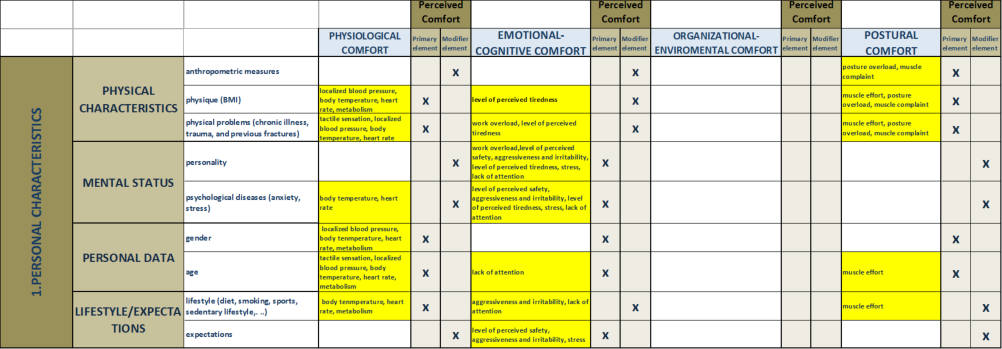
Our work starts from the definition of the wider number of elements that can be linked to Environment’s aspect and their classification through two main axioms: The first axiom asserts that “Each element involved in HMI experience can contribute to one or more kinds among four types of comfort: Postural, Cognitive, Physiologic and Environmental (Naddeo, 2013). An excellent example of what asserted can be found in the following figure in which the influence on comfort and on body effects is deployed for personal characteristics (Pe) of the user/person:
This macro-schematization of comfort/discomfort experience allows individuating the most part of the elements that contributes to comfort/discomfort experience and to classify them in terms of Human body effects related to four types of comfort/discomfort perception.
The second axiom asserts that “Each element involved in HMI experience can be classified as primary element or as modifier element”: a primary element is defined as an element that directly contributes to the formation of the comfort/discomfort perception (such as anthropometric measures for the postural Comfort – Cappetti et al., 2013); a modifier element is defined as an element that can modify a previously formed perception (such as time of sitting in physiologic Comfort).
The primary elements are the ones that weigh on the real interaction ability of a person while the secondary elements (modifier) weigh on the perception ability and are related to person and environment characteristics. The expectation acts on a person and can sensibly influence the level of threshold between comfort and discomfort.
Figure 3. Deployment of comfort-framework for Personal Characteristics
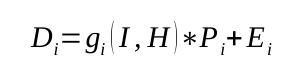
Thanks to the axioms and the NC-Model, Comfort (C) and Discomfort (D) can be represented by these formulas: Ci=f i( I ,H )∗Pi−Ei
Equation reproduced from the original PDF.
Immediately it can be highlighted that the Comfort rule is different by the Discomfort one (the first is not the Social and Organizational Factors (2020) negation of the second)
The extended form of formulas can be written by taking into account that modifiers (function mod) can be used as a scale-factor for perceptions: Ci( P)=mod ( P)∗mC ( H )−E=¿
Equation available in the original PDF paper.
Equation reproduced from the original PDF.
Both mC and mD can be written as general function; in references, a lot of studies about the functional links between one or few parameters/characteristics have been conducted but it can be found that several aspects are not taken into accounts. For example, some of them are:
Systematic definition of all primary and secondary aspects in Pe, Pr, T, We and Gl;
The interaction analysis between the aspects that affect the perception;
The standardization of comfort-evaluation scale in order to have just one uniform and rational scale to measure the four different types of comfort perception.
The first of these open issues is extensively treated in the following paragraph.
FRAMEWORK FOR COMFORT/DISCOMFORT CODING The NC-Model has been deployed and detailed. For each kind of interaction (I), one or more human body effects (H) have been found through a wide research within the ergonomic/comfort bibliography. Our research work took life while looking for the most important factors that are related to the comfort and discomfort aspects, including ones that the ergonomic/comfort bibliography had never taken up.
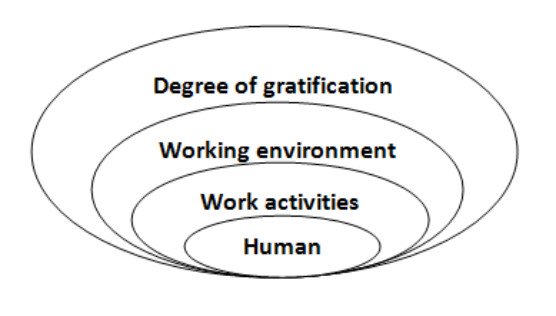
Figure 4. The world of comfort/discomfort evaluation In order to list and classify those factors we proceeded gradually.
The main step allowed codifying and understanding the domain in which we have to define the comfort/discomfort perception. Comfort domain can be defined as the whole experience that gives to human a degree/level of gratification and this level can be affected both by comfort/discomfort experience and by working environment’s intrinsic characteristics.
This comfort experience has to be done in a working environment in which the interaction (I) is performed. In working environment, human’s experience consists of the human body that react in properly mode while making a work activity (task/usage) with products and while perceiving (P) an effect.
Accordingly to the fig.4, we have identified five classes, in the world of comfort evaluation, whose characteristics affect the interactions: Class “Human” that contains the characteristics of the individual; these characteristics identify all those features and information that are proper of the individual and that can affect the comfort perception.
Class “Product” and Class “Task” that are useful to describe the Work Activity; Characteristics of the work activities identify the parameters of tasks and products that humans have to interface which.
Class “Environment” in which these activities are performed; Characteristics of working environment stand for all those aspects that are related with the environment, the thermal, visual and acoustic wellness and layout of workspaces.
Class “Degree of Gratification”, that describe the intrinsic characteristics that affect the whole comfort experience and are related to the content of the work, the relationships between colleagues and the job-position in the organization chart.
These classes exactly correspond to the five aspects that contribute to HMI experience: Pe, Pr, T, We and Gl. The framework has the purpose to explain the connections among the interactions (I) with human body effects (H), in order to evaluate how and if these effects are perceived(P) and how and if they affect the four identified kind of comfort/discomfort perception: postural, cognitive, environmental and physiological.
All data have been organized in a big comfort-matrix that is divided in 5 sections represented in fig. 3, 5, 6, 7 and 8. Most of matrix rows have been defined through the literary study.
Figure 5. Deployment of comfort-framework for Work/Task Characteristics Perceived
Figure available in the original PDF paper.
Figure 6. Deployment of comfort-framework for Working Environment Characteristics
Figure available in the original PDF paper.
Figure 7. Deployment of comfort-framework for Level of Gratification
Figure available in the original PDF paper.
Figure 8. Deployment of comfort-framework for Evaluation devices
Figure available in the original PDF paper.
The first class of factors is related to the human’s characteristics i.e. physical characteristics, mental state, personal data, lifestyle and expectations. It has been verified that human’s characteristics influence physiological, cognitive and postural comfort while there is not a correlation between the human’s characteristics and the quality of the work environment. Each subclass of human’s characteristics has been deployed in order to consider it in all own aspects. Particularly, the physical characteristics are related to anthropometric measures (Thariq et al., 2010), physique and physical problems/disease. The mental state takes into account the human personality (Nimbarte et al., 2012) and the psychological diseases. The personal data are related to age and gender. In the matrix, it has been also considered the lifestyle such as sport playing, eating habits and personal expectations.
The second class of factors is related to the work’s characteristics. If the comfort is the result of the interaction between man and the activity that he does, it is not possible not to consider the work’s characteristics and the environment ones. These factors concern aspects related to the work-station/seat characteristics, the type of activity and the objects’ element with which user has to interfaces himself for the task’s execution. For the work-station/seat, both the posture that man has to take in order to do the task and the kind of individual safety equipment have been considered. Both aspects affect the comfort perception: for example, in Alessandro Apostolico et al., 2013, has been demonstrated that posture configuration can strongly influence the level of comfort perceived. Another aspect of the work’s characteristics that influences the comfort is the type of task that man has to do. Because of the comfort- matrix has to be applied for any type of work, we have listed the key features that define a generic work activity and influence the perceived comfort. Some aspects that we have considered are: level of precision required (Reuben S Escorpizo et al., 2007), time maintaining of the posture (Dohyung Kee et al., 2001) and work shifts (Anjali Nag et. al, 2004). The last aspect is related to the objects/tools that are used for the task’s execution. It has been demonstrated that the shapes of the objects (L.F.M. Kuijt-Evers et al., 2004) or their careful positioning in the workspace (Rolf P. Ellegast et al., 2012) can facilitate the user to execute the task. The result can be an increase of the level of comfort.
The third class of factors that has to be considered is related to the characteristics of the work environment. If we consider that a person has to stay in a specific place for several hours, we have to consider that a pleasant environment may significantly affect the person’s well-being. The work environment is composed of: visual, olfactory, acoustic and thermal well-being, wellbeing associated to the workspace and wellbeing associated to the state of maintenance of the environment. The visual comfort is related both to the conditions of lighting inside the environment and to the colors used. For example in (Eliza Szczepanska-Rosiak et al., 2013), the evaluation of the visual comfort have been made considering the lighting conditions, both the artificial and the natural one, the workspace colors and the effects of light-reflection on the walls. The perceived comfort is, obviously, associated also to the worker’s satisfaction for the air quality. For this reasons the indoor air quality and the odors have to be considered such as elements that can affect the whole comfort perception. Noises and vibrations have been considered when talking about the acoustic wellbeing: unwanted noises and vibrations, in fact, are huge distractions and can cause stress conditions in the workplace.
Another aspect that influences the worker’s comfort is the thermal condition: in (F.R.D’Ambrosio et al., 2004). The thermal aspect is treated as the consequence of influence of factors humidity, temperature and thermal-resistance of the clothes. The last two aspects we found in literature are the space, interpreted both as workspace in (Cascioli et al., 2011) and as plant/office layout, and the state of maintenance of the environment. If the worker is obliged to work in a small area, to do forced movements and to stay in a dirty or in a messy place his level of comfort strongly decreases.
The last class of factors that has to be considered is related to the degree of gratification. A job, or in general an activity, can be more or less satisfying in relation both to the content and to the context of the work. The content of the work includes several factors i.e. the level of recognition, the direct responsibility of the work and the possibility to grow up (Lars Goran Wallgren et al., 2007). A work can have a degree of content too high or too low and it can be the cause of the absence of incentive and the decrease of the level of comfort. In the context of the work, for example, the relationships with the colleagues and managers or the rigidity of the norms and procedures have been considered.
The interaction that individual has with these classes of factors causes effects on worker and contributes to the Social and Organizational Factors (2020) development of a comfort perception. The effects are several for each type of comfort among postural, cognitive, physiological and environmental. The comfort matrix explain and deploy each kind of class and describes the relationships among causes (Interactions) and effects (Body effects) for each kind of perceived comfort. Some matrix-reading example are in the following examples:
In matrix, you can find that the most important in the postural comfort are muscular effort and postural overload and the factor “time of postural keeping with/without load” that belongs to the second class, causes and affects both effects. It is obvious that if a person remains in a position for long time the muscles are stressed and the posture becomes uncomfortable. The most important effects on the physiological comfort are body temperature, pulse rate and tactile sensation, for example, these effects have a different impact in function of the “lifestyle”. Aggressiveness, nervousness degree of tiredness, stress and distractions have effects on the cognitive comfort and are mainly related to the characteristics of the working environment and degree of gratification. The main effect related to the environment comfort is the level of safety that depends by the organization of the layout and the keeping of the environment.
SEAT COMFORT EXAMPLE Simply using the whole comfort matrix, we have individuated all factors that affect office-Seat comfort and we have created a sub-matrix (in Fig.9) in which all the aspects, that have to be studied, have been highlighted.
Using the previously defined fusion rules, we can easily individuate the aspects, the methods and the literature about issues that characterize the seat comfort problem.
CONCLUSIONS AND FUTURE DEVELOPMENTS In HMI design, several parameters have to be correctly evaluated in order to guarantee a good level of safety and well-being of users (humans) and to avoid health problems like muscular-skeletal or psychological diseases.
Several papers follow the assumption that there is a relationship between self-reported discomfort and musculoskeletal injuries and that those injuries affect the perceived comfort and more than 100.000 scientific papers dealing with comfort and discomfort can be easily found in main scientific databases and most of these speak about relationship between environmental and perceived comfort/discomfort. However the theories relating comfort to products/processes and products/processes’ design characteristics are rather underdeveloped.
In addition, experimental devices are needed for improving methods and for making numerical/experimental correlations. The accuracy and the easiness are the most important characteristics that those methods/devices may have; the integration of those evaluation methods in a DHM software for ergonomic/comfort application can strongly enhance the product/process prototyping in CAD/CAE environment and can give to designers a powerful instruments to preventively evaluate the comfort level of a HMI.
Starting our work from literature analysis, a classification of all the elements that seems to be important in global comfort evaluation has been done; types of human sensation and perception have been classified and linked to the human body effects.
Two axioms have been set out:
“Each element involved in HMI experience can contribute to one or more kinds among four types of comfort: Postural, Cognitive, Physiologic and Environmental”, so the Vink-Hallbeck model can be concurrently applied in four aspects that strongly affect the global comfort perception: (Bi) – User Biomechanics/Posture, (Ph) - Physiologic factor, (En) – Environment contribute, (Co) – Cognitive factor.
“Each element involved in HMI experience can be classified as a primary element or as modifier element”: a primary element is defined as an element that directly contributes to the formation of the comfort/discomfort perception; a modifier element is defined as an element that can modify a previously formed perception.
Figure 9. Seat comfort evaluation sub-matrix
Figure available in the original PDF paper.
The proposed NC-Model of perception and the Comfort framework can help researchers to evaluate what can be the trend line of their research and how and in what direction they have to concentrate their efforts to better improve the results and contribute to study the missing aspects of problems.
An example of application of the framework to the seat-comfort problem has been presented and allowed to highlight missing and open problems in Seat comfort evaluation.
The comfort-matrix analysis allow highlighting that there are some aspects of comfort/discomfort perception evaluation that are under-studied or missing. In examined papers, authors cannot identify a homogeneous comfort rating scale so highlighting an emerging difficult in synthesis of a comfort rating system for the global comfort. No one, since now, have distinguished the comfort parameters between primary and modifier classes.
The proposed framework allows to better organize studies about comfort evaluation and to face problems both in global and in particular way. Furthermore, the elements in the proposed framework suggest us, as a trend-line, to detect towards which the comfort studies needs to be directed. Up to us, the most important and urgent for which researchers have to develop methods are:
Postural Comfort evaluation: Significance of rest posture and of human joints’ neutral position, gravitational effect, arms support (like headrest, armrest or other rest surfaces), postural equilibrium (weight distribution and operative spatial conditions), handhold type, repetitive actions’ frequency, Posture- keeping time, Muscular fatigue, tools to measures human joints’ angles both in static then in dynamic postures.
Cognitive Comfort Evaluation: Devices to evaluate HMI tactile interaction without altering it during Social and Organizational Factors (2020) measurement operation, devices/methods to evaluate HMI visual interaction during operation-time, methods for allowing users/workers to describe and analyze their own sensations during operation/use time without affecting their perception, a method to integrate the other three senses in the evaluation (hearing, taste and olfaction).
Physiologic Comfort evaluation: devices to measure HMI temperature without altering it during measurement operation, devices to measure HMI pressure without altering it during measurement operation, devices to measure HMI transpiration (water-vapor migration) without altering it during measurement operation, a method to correlate the previously described parameters each other, a method to correlate parameters values and their combination to an accepted level of comfort, a method for taking into account physiologic condition vs. elapsed time (prolonged postures).
REFERENCES
Apostolico, A. Cappetti, N. D’Oria, C. Naddeo, A. Sestri, M. (2013), “Postural comfort evaluation: experimental identification of Range of Rest Posture for human articular joints”, International Journal on Interactive Design and Manufacturing, Pag.1-14 ISSN: 1955-2513. Borg, G. Psychophysical Bases of Perceived Exertion. Medicine and Science in Sports and Exercise (14), 1982, 377-381. Cascioli, V. Heusch, A.I. McCarthy, P.W. (2011), “Does prolonged sitting with limited legroom affect the flexibility of a healthy
subject and their perception of discomfort?”, International Journal of Industrial Ergonomics, Volume 41, No.5. Choobineh, A. Hosseini, M. Lahmi, M. Sharifian, S. Hosseini, A.H., (2004), “Weaving posture analyzing system (WEPAS): introduction and validation”, International Journal of Industrial Ergonomics, Volume 34, No.2. D’Oria C., Naddeo A., Cappetti N., Pappalardo M., 2010. Postural analysis in HMI design: an extension of OCRA standard to
evaluate discomfort level. Journal of Achievements in Materials and Manufacturing Engineering, 39, 60-70, ISSN 1734- 8412. D'ambrosio alfano, F.R. Liotti, F. (2004), “La qualità degli ambienti confinati non industriali: il discomfort termoigrometrico”, Giornale Italiano di Medicina del Lavoro ed Ergonomia, Volume XXVI, No.4. De Korte, E.M., Huysmans, M.A., De Jong, A.M., Van de Ven, J.G.M., Ruijsendaal M., 2012. Effects of four types of non-
obtrusive feedback on computer behavior, task performance and comfort. Applied ergonomics, 43, 344-353, doi: 10.1016/j.apergo.2011.06.010. De Looze, M.P., Kuijt-Evers, L.F.M., Van Dien, J.H., 2003. Sitting comfort and discomfort and the relationships with objective measures. Ergonomics, 46, 985-997, doi: 10.1080/0014013031000121977.Fogliatto, F.S. Guimaraes, L.B.M (2004), “User- oriented method for selecting workstation components”, International Journal of Industrial Ergonomics, Volume 33, No. 2. Dempsey, P.G. McGorry, R.W. O’Brien, N.V. (2004), “The effects of work height, workpiece orientation, gender, and
screwdriver type on productivity and wrist deviation”, International Journal of Industrial Ergonomics, Volume 33, No.4. Di Pardo, M., Riccio, A., Sessa, F., Naddeo, A., & Talamo, L. (2008). Methodology development for ergonomic analysis of work-cells in virtual environment. SAE Technical Papers, Ellegast, R.P. Kraft, K. Groenesteijn, L. Krause, F. Berger, H. Vink, P. (2012), “Comparison of four specific dynamic office
chairs with a conventional office chair: impact upon muscle activation, physical activity and posture” , Volume 43, No.2. Escorpizo, R.S. Moore, A.E. (2007), “Quantifying precision and speed effects on muscle loading and rest in an occupational hand transfer task”, International Journal of Industrial Ergonomics, Volume 37, No.1. Franz, M.M., Durta, A., Zenk, R., Desmet, P.M.A., 2012. Comfort effects of a new car headrest with neck support. Applied
ergonomics, 43, 336-343, doi: 10.1016/j.apergo.2011.06.009. Groenesteijn, L., Ellegast, R.P., Keller, K., Krause, F., Berger, H., De Looze, M.P., 2012. Office task effects on comfort and body dynamics in five dynamic office chairs. Applied ergonomics, 43, 320-328, doi: 10.1016/j.apergo.2011.06.007. Helander, M.G. Zhang, L. (1997), “Field studies of comfort and discomfort in sitting”, Ergonomics, Volume 40, No.9. Hignett Sue, McAtamney Lynn, “Rapid Entire Body Assessment (REBA)”, Applied Ergonomics 31 (2000), pagg. 201-205. Holzreiter S. H., Köhle M. E. 1993. Assessment of gait patterns using neural networks. J. Biomech., 26 (6), 645–651, doi:
10.1016/0021-9290(93)90028-D. Kamp I., 2012. The influence of car seat design on its character experience. Applied Ergonomics, 43, 329-335, doi: 10.1016/j.apergo.2011.06.008. Kee, D. Karwowski, W. (2001), “LUBA: an assessment technique for postural loading on the upper body based on joint motion
discomfort and maximum holding time”, Applied Ergonomics, Volume 32, No.1. Kee, D., Lee, I., 2012. Relationships between subjective and objective measures in assessing postural stresses. Applied Ergonomics, 43, 277-282, doi: 10.1016/j.apergo.2011.06.002. Kong, Y.K. Kim, D.M. Lee, K.S. Jung, M.C. (2012), “Comparison of comfort, discomfort, and continuum ratings of force levels
and hand regions during gripping exertions”, Applied Ergonomics, Volume 43, No.2. Kuijt-Evers, L.F.M. Groenesteijn, L. de Looze, M.P. Vink, P. (2004), “Identifying factors of comfort in using hand tools”, Applied Ergonomics, Volume 35, No. 5. Kyung, G. Nussbaum, M.A. (2008), “Driver sitting comfort and discomfort (part II): Relationships with and prediction from interface pressure”, International Journal of Industrial Ergonomics, Volume 38, No. 5-6. Maeda, S. Mansfield, N.J. Shibata, N. (2008), “Evaluation of subjective responses to whole-body vibration exposure: Effect of frequency content”, International Journal of Industrial Ergonomics, Volume 38, No.5-6. McAtamney Lynn and Corlet E. Nigel, “RULA: a survey method for the investigation of work-related upper limb disorders”,
Applied Ergonomics 24(2) (1993), pagg. 91-99. Mehta, C.R. Gite, L.P. Pharade, S.C. Majumder, J. Pandey, M.M. (2008), “Review of anthropometric considerations for tractor seat design”, International Journal of Industrial Ergonomics, Volume 38, No. 5-6. Miki, M. Ikegami, H. Emi, A. Yoshii, T. Azuma, Y. Yoshida, K. (2013), “A Lighting Control System to Optimize Brightness
Distribution on Working Places”, Applied Computational Intelligence and Informatics, pp. 23 – 28. Moes, N.C.C.M.: Analysis of sitting discomfort, a review. In: Bust, P.D., McCabe, P.T. (eds.) Contemporary Ergonomics 2005, pp. 200–204. Taylor & Francis, London (2005) Morag, I. Shinar, D. Saat, K. Osbar, A. (2005), “Trackball modification based on ergonomic evaluation: a case study in the
sociology of ergonomics in Israel”, International Journal of Industrial Ergonomics, Volume 35, No.6. Naddeo A. (2013) Virtual Comfort Evaluation as a New Paradigm of Health and Safety In Industrial Engineering. Ind Eng Manage 2: e119. doi: 10.4172/2169-0316.1000e119 Naddeo, A., Memoli, S.: Postural comfort inside a car: development of an innovative model to evaluate the discomfort level.
SAE Int. J. Passeng. Cars Mech. Syst. 2(1), 1065–1070 (2009) Naddeo, A., Cappetti, N., Califano, R., & Vallone, M. (2013). Manual assembly workstation redesign based on a new quantitative method for postural comfort evaluation, Applied Mechanics and Materials 459 PP. 368 - 379 Nag, A. Nag, P.K. (2004), “Do the workstress factors of women telephone operators change with the shift schedules?”,
International Journal of Industrial Ergonomics, Volume 37, No.2. Nimbarte, A.D. Al Hassan, M.J. Guffey, S.E. Myers, W.R. (2012), “Influence of psychosocial stress and personality type on the biomechanical loading of neck and shoulder muscles”, International Journal of Industrial Ergonomics, Volume 42, No. 5. Noro, K., Naruse, T., Lueder, R., Nao, N., Kozawa, M., 2012. Application of Zen sitting principles to microscopic surgery
seating. Applied Ergonomics, 43, 308-319, doi: 10.1016/j.apergo.2011.06.006. Santos, J. Sarriegi, J.M. Serrano, N. Torres, J.M. (2007), “Using ergonomic software in non-repetitive manufacturing processes: A case study ”, International Journal of Industrial Ergonomics, Volume 37, No.3. Siefert, A. Pankoke, S. Wolfel, H.-P. (2008), “Virtual optimisation of car passenger seats: Simulation of static and dynamic
effects on drivers’ seating comfort”, International Journal of Industrial Ergonomics, Volume 38, No.5-6. Szczepanska-Rosiak, E. Heim, D. Gorko, M. (2013), “Visual comfort under real and theoretical, overcast and clear sky conditions”, 13th Conference of International Building Performance Simulation Association, Chambéry, France, August 26-28. Thariq, M.G.M. Munasinghe, H.P. Abeysekara, J.D. (2010), “Designing chairs with mounted desktop for university students:
Ergonomics and comfort”, International Journal of Industrial Ergonomics, Volume 40, No. 1. Tilley A. R., 2001. The Measure of Man and Woman: Human Factors in Design. South Pasadena (US): Henry Dreyfuss Associates., ISBN-13: 978-0471099550. Vink, P., Bazley, C., Kamp, I., Blok, M., 2012. Possibilities to improve the aircraft interior comfort experience. Applied
Ergonomics, 43, 354-359, doi: 10.1016/j.apergo.2011.06.011. Vink, P., Hallbeck, S.: Editorial: comfort and discomfort studies demonstrate the need for a new model. Appl. Ergon. 43, 271– 276 (2012) Wallgren, L.G. Hanse, J.J. (2007), “Job characteristics, motivators and stress among information technology consultants: A
structural equation modeling approach”, International Journal of Industrial Ergonomics, Volume 37,No.1. Zander, J.E. King, P.M. Ezenwa, B.N. (2004), “Influence of flooring conditions on lower leg volume following prolonged standing”, International Journal of Industrial Ergonomics, Volume 34, No.4. Zenk, R., Franz, M., Bubb, H., Vink, P., 2012. Spine loading in automotive seating. Applied Ergonomics, 43, 290-295, doi:
10.1016/j.apergo.2011.06.004.
LISTED IN THE AHFE DIGITAL BOOKSTORE CATALOGUE
Explore the complete digital volume
Advances in Social and Organizational Factors
Read this individual research paper free through the original publisher, or explore the full digital proceedings book.
ISBN 978-1-4951-2102-9
Explore this ISBN in the AHFE Bookstore ↗Listed in the July 2026 bookstore catalogue; search by ISBN to confirm current availability · Digital book purchase optional