Fred J Schoeffler (2026). How are the Nov. 1, 1966 Loop Fire Fatalities Tied Into the Overall Fire Shelter Movement Concealing the Truths About Other Fatal and Near-Fatal Fires?. In: Safety Management and Human Factors. AHFE Open Access, vol. 227, pp. 57–65. https://doi.org/10.54941/ahfe1007917
Publisher statistics will load when you open Metrics.
AHFE OPEN ACCESS OPEN ACCESS CONFERENCE PROCEEDINGS PAPER
How are the Nov. 1, 1966 Loop Fire Fatalities Tied Into the Overall Fire Shelter Movement Concealing the Truths About Other Fatal and Near-Fatal Fires?
This paper examines a controversial issue regarding wildland firefighting fire shelter technology progress, studying institutional responses to [FF] fatalities, or equipment support over careful safety reform. The 1966 to 2013 seven major incidents include Nov. 1, 1966, Loop Fire claiming twelve El Cariso Hot Shots. The main thesis explores if the fire shelter, first introduced in the 1960s, became rooted in a general pattern where post-incident investigations diminished causal factors beyond shelter deployment failures. Chronologically studying the Loop Fire (1966, CA), Battlement Creek Fire (1976, CO), Lake Mountain Fire and Butte Fire (1985, ID), Dude Fire (1990, AZ), South Canyon Fire (1994, CO), and Yarnell Hill Fire (2013, AZ), research identifies chronic official investigative reports and institutional policy responses. Using human factors analysis to assess each incident through decision-making routes, situational awareness, communication breakdowns, training (in)adequacy, equipment limits, and organizational culture. Specific notice is given to case-by-case fire shelter performance depicted in official findings versus independent analyses, whether shelter development emphasis dwarfed general issues including lacking Escape Route planning and fire behavior prediction failures. Whether focusing investigative fire shelter deployment conclusions protected institutional decision-making from deeper examination. The case study examines the prescribed safety protocols gap and actual field conditions, analyzing post-incident recommendations root causes versus verifying existing equipment-focused standards. The Yarnell Hill Fire is an up-to-date anchor point, forty-seven years after the Loop Fire, allowing whether previous tragedies examinations lessons were amply added into training, policy, and operational procedures. Exploring if the fire shelter safety protocols may have created a risk compensation phenomenon, potentially influencing tactical decisions providing perceived protection potentially unreliable under extreme conditions. Evaluates if equipment design, including shelter deployment requirements adequately accounts for physiological and psychological stress, reduced motor function under duress, and cognitive load during life-threatening situations. This human factors investigation avoids rejecting fire shelter technology's legitimate protective capabilities questioning whether institutional equipment adequacy emphasis barred more thorough preventable causal factors examination. It is impossible to prevent fatalities in all work groups; all we can do is reduce them based on honest investigations and causal human factors. Proposing a framework for more all-inclusive incident analysis weighing equipment evaluation with organizational culture review, training efficacy, and systemic risk management advances. Knowing potential institutional wildland firefighter safety investigations biases remains critical for reducing future tragedies and honoring those who perished.
The paper evaluates if equipment design, including shelter deployment requirements adequately accounts for physiological and psychological stress, reduced motor function under duress, and cognitive load during life- threatening situations. This human factors investigation avoids rejecting fire shelter technology’s legitimate protective capabilities questioning whether institutional equipment adequacy emphasis barred more thorough preventable causal factors examination. It is impossible to prevent fatalities in all work groups; all we can do is reduce them based on honest investigations and causal human factors. Proposing a framework for all-inclusive incident analysis weighing equipment evaluation with organizational culture review, training efficacy, and systemic risk management advances. Knowing potential institutional wildland firefighter safety investigations biases remains critical for reducing future tragedies and honoring those who perished.
This paper focuses on how the November 1966 Loop Fire (CA) and the fatal and near-fatal wildland fires that follow are tied into the overall fire shelter movement, allegedly, not covering the respective Serious Accident Investigation Team, and Serious Accident Investigation Reports (SAIT-SAIR) which are tied into the alleged overall fire shelter movement, including the 1978 Battlement Creek Fire (CO), 1985 Lake Mountain (ID), 1985 Butte Fire (ID), 1990 Dude Fire (AZ), 1994 South Canyon Fire (CO), the paper covers the view of a retired USFS Hot Shot Crew Superintendent turned to wildland fire human factors, fire weather, fire behaviour, fatal and near-fatal wildland fires viewpoint. Little-known, obscuring shelter deployments and one near entrapment occurred on the Hourglass 3 (CO, 1994), and the infamous 2013 Yarnell Hill Fire (Karels, 2014). All of which are included in the Wildland Fire Lessons Learned Center (WLF LLC, 2025) Incident Reviews. Allegdedly, “The [WLF LLC] actively promotes a learning culture to enhance and sustain safe and effective work practices in the wildland fire community. The center provides opportunities and resources to foster collaboration among all fire professionals, facilitates their networks, provides access to state-of-the-art learning tools, and links learning to training.” However, this author takes umbrage with that statement because the contradictory facts bear otherwise. As early as the deadly 1949 Mann Gulch Fire (ID, 1949), the expert author confidently argues that these investigations are summarily predetermined with the “conclusion” first, and then the “facts” to prove the arguments.
RULES OF ENGAGEMENT – ENTRAPMENT AVOIDANCE PRINCIPLES Viewing the Ten Standard Fire Orders and Rules of Engagement and Entrapment Avoidance principles, citing former USFS Fire Director’s viewpoints. In 2002, Jerry Williams, authored an article for Fire Management Today (FMT, 2002) addressing the value of the Fire Orders. What follows is based on remarks made by him at the Natl. Fire and Aviation Management Meeting (2002), in Scottsdale, AZ. “Firm Rules of Engagement - The Ten Standard Firefighting Orders … cannot be simple guidelines, and they cannot be ‘bargained.’ They are the result of hard-learned lessons. Compromising one or more of them is a common denominator of all tragedy fires. On the Dude, South Canyon, and Thirtymile Fires, Fire Orders were ignored, overlooked, or otherwise compromised. The Fire Orders mean little after we
How are the Nov. 1, 1966, Loop Fire Fatalities Tied into the Overall Fire Shelter 59 are in trouble. That is why we must routinely observe them and rely on them before we get into trouble.
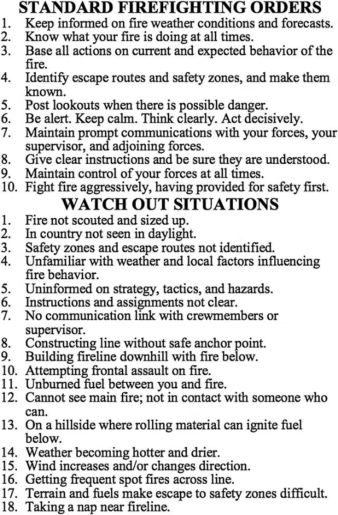
“We know that no fire shelter can ensure survival all of the time under all circumstances. Entrapment avoidance must be our primary emphasis and our measure of professional operational success. Fire Orders must become a shared obligation, where the leader’s situational awareness depends on participation by the entire crew and where the crew’s participation is tempered with respect for the leader’s responsibility. We must not adhere to the Fire Orders for fear of punishment. We must embrace the Fire Orders because we owe it to one another. The fire orders must become a shared obligation, where the leader’s situational awareness depends on participation by the entire crew and where the crew’s participation is tempered with respect for the leader’s responsibility. Borrowing from the aviation community’s model of Cockpit/Crew Resource Management (CRM) we must focus on fire line operations more than what is right than on who is right”. Figure 1 illustrates wildland firefighting Fire Orders & Watch Out Situations’.
Figure 1: Wildland firefighting Fire Orders and Watch Out Situations (NWCG, 2014).
WILDLAND FIRE WEATHER, WILDLAND FIRE BEHAVIOR, HUMAN FACTORS INVESTIGATIONS It is most unfortunate that so many in the wildland firefighting culture have strayed far and wide from William’s sage counsel. His germane wildland fire information and these valued lessons learned that he offered in 2002 were clearly available to all FFs and WFs engaged in wildland firefighting in 2013, including the Granite Mountain Hot Shots (GMHS). Apparently, all others on the YH Fire that day followed his sage advice. Literally, tens of thousands of FFs and WFs engaged in wildland firefighting effectively and safely utilize them every single fire season. This is factual, and far from hindsight bias!
60 Schoeffler There are specific rules to fight fires. The fire always signals its intentions - ALWAYS! The fire is an inanimate entity; however, it always tells you what it’s going to do and where it’s going to go. It follows the scientific principles of Fluid Dynamics, so it flows like water. (USDA, USFS, 2023). We also hear about all the alleged wildfires where FFs and WFs followed all the Rules of Engagement, and they were still burned over, deployed fire shelters, or died. Really? First off, if someone deploys their fire shelter, then someone really screwed up, because the fire signals to us what it is going to do every single time. All we and/or our lookout(s) must do is pay attention and act accordingly. The author argues and challenges readers to search the Wildland Fire Lessons Learned Center (WLF LLC, 2025) Incident Reviews and provide the name of one fire where a FF or WF followed all the Rules and was burned over, deployed a fire shelter, or died. You will find none! We also hear about all the alleged wildfires where FFs and WFs followed all the Rules of Engagement, and they were still burned over, deployed fire shelters, or died. Really?” First off, if someone deploys their fire shelter, then someone really screwed up, because the fire signals to us what it is going to do every single time. All we and/or our lookout(s) must do is pay attention and act accordingly. The author challenges reader to search the WLF LLC (2025) and provide the name of one fire where a FF or WF followed all the tried-and-trued Rules of Engagement and acknowledged and heeded the Entrapment Avoidance Principles and was burned over, deployed a fire shelter, or died. You will find none! It is this author’s professional opinion that when you hear that FFs and WFs were “forced to deploy their fire shelters,” they failed to recognize the changing wildland fire weather and fire behavior. Worst of all, those who allegedly “willingly gave their lives” were more accurately taken from them by their own alleged carelessness, the Normalization of Deviance (Accord, 2025) and/or Groupthink (Wilcut, Bell, Vaughan, 2014) (Johnson, 2000), and/ or their alleged inept, inexperienced, and/or dangerous supervisors! Commonly accepted and referred to the semi-official vernacular Watch Out No. 19 Death From Above, e.g. Overhead, Gravity issues, Power lines, Aircraft, Aerial Ignition, etc. established by the USFS Payson Hot Shots in 1985.
Throughout history, the concept of truth and perception has been a central theme in philosophy, science, and art, often leading individuals and societies to grapple with the notion that their understanding of reality may not be as straightforward as it appears. This struggle is exemplified by famous figures and movements that have challenged conventional wisdom and revealed uncomfortable truths, often leading to profound shifts in understanding and belief.” (Stanford, 2006). “Naked Truths-there are no easy answers. One thing we can be sure of is that moments of learning are short-lived. A perfect example comes from battlefields. “In the chaos of the battlefield, there is the tendency of all ranks to combine and recast the story of their achievements into a shape which shall satisfy the susceptibilities of national and regimental vainglory. … On the actual day of battle, naked truths may be picked up for the asking; by the following morning they have already begun to get into their uniforms...” If all goes well on the staff ride, we’ll be able to recapture enough of the actual day of the tragedy to learn some naked truths. In doing so, hopefully we’ll get scared enough to have the lessons stick, but not so scared that we miss details. In those details lie the truths that belie the simplistic conclusion,” (FMT, Weick, 2002). Therefore, it is imperative to investigate and interview affected participants and/or victims early, earnestly, honestly, and thoroughly for best results.
FIRE SHELTER ADVANCES AND HISTORY Considering the National Wildfire Coordinating Group (NWCG) definitions, that will aid in grasping the issues at hand: “Burnover: A situation where personnel or equipment is caught in an advancing flame front. Entrapment: A situation where personnel are unexpectedly caught in a fire behavior-related, life-threatening position where planned escape routes or safety zones are absent, inadequate, or compromised. An entrapment may or may not include deployment of a fire shelter for its intended purpose. These situations may or may not result in injury. They include “near misses.’ Entrapment Avoidance: A process used to improve the safety of personnel on the fireline, which emphasizes tools and tactics available to prevent being trapped in a burnover situation. This process includes appropriate decision making through risk management, application of LCES, use of pre-established trigger points, and recognition of suitable escape routes and safety zones. Fire Shelter: An aluminized tent offering protection by means of reflecting radiant heat and providing a volume of breathable air in a fire entrapment situation. Fire shelters should only be used in life threatening situations, as a last resort. Fire Shelter Deployment: The removing of a fire shelter from its case and using it as protection against fire.” Last Resort: Emphasizes that a fire shelter is a final option for survival. Survival Zone: A natural or cleared area of sufficient size and location to protect fire personnel from known hazards while inside a fire shelter. Examples include rockslides, road beds, clearings, knobs, wide ridges, benches, dozer lines, wet areas, cleared areas in light fuels, and previously burned areas. These are all areas where you expect no flame contact or prolonged heat and smoke” (NWCG, 2025).
Consider this clearly old-fashioned evidence: “The Prarie got on fire and went with Such Violence & Speed as to Catch a man & woman & burn them to Death, Several escaped. among other a Small boy who was Saved by getting under a green Buffalow skin….They say the grass was not burnt where the boy sat.”
William Clark, from the Journals of the Lewis and Clark Expedition, 1804, often quoted during fire shelter training for firefighters (Streever, 2013). “To many Americans, the news from Arizona seems foreign, darkly surreal: Nineteen elite firefighters [Granite Mountain HS] gone, killed in a single incident, burned to death despite taking refuge under their fire shelters” Fire shelters sometimes fail through delamination. The glue that holds the foil to the underlying fabric vaporizes. In some cases, the vaporized glue has ignited, creating a fireball inside the shelter. But this is a newer shelter. The glue should not vaporize. The Yarnell Fire investigation will uncover turning points that contributed to the deaths in Arizona—turning points in planning, in weather forecasting, in communications, in establishing routes of retreat. With luck, the investigation will reinvigorate fire shelter research, inspiring further improvements in a device that has evolved over many decades, a device that, inevitably, will offer a last chance to a small number of future firefighters as their position is burned over.
“A greater number of these burned over firefighters, armed with superior shelters, will survive. Their survival will be the truest of tributes to the 19 men who put their last hopes into something that they knew, going in, would provide them nothing more and nothing less than a final chance to escape from the most desperate of situations” (Streever, 2013). According to the author’s and others’ professional opinions, there will never be an “approved” fire shelter designed and
62 Schoeffler produced that will be light enough to carry on the fire-lines to withstand the deadly, horrific temperatures those men endured and eventually succumbed to. To be sure, the only conceivable man-made structure that undoubtedly could have and would have saved the GMHS’ lives that day would have been a literal steel shipping container made of the notable and fairly well-known durable aircraft cockpit voice and flight data recorders Black Box material (Pilot Institute, 2022).
“Key evidence that could explain why the [GMHS] moved from a safe location into a treacherous box canyon where 19 men died on June 30, 2013 was in the possession of the Office of the Maricopa County Medical Examiner but was not provided to the state-contracted investigation into the tragedy, autopsy records recently obtained by Investigative MEDIA show.” (Dougherty, 2015). The GMHS autopsy reports are linked within the article (viewer discretion is strongly advised). In the Hot Shots and other highly experienced WF world, it is common knowledge that if you have to deploy your fire shelter or rely on air support to “save you” then you have really failed! Moreover, this author holds that these autopsy reports should be required reading for the mandatory annual FF/WF RT-130 Refresher Training to reveal the possible likely results of the legally declared “inherently dangerous” wildland firefighting, failing to know, acknowledge, heed, and utilize the proven Rules of Engagement and Entrapment Avoidance Principles.
COMMENTS, CRITICISMS, SUGGESTIONS AND SOLUTIONS Irving Janis introduced the “theory of groupthink” in his classic study Victims of Groupthink in 1972. He attempted to determine why groups, often consisting of individuals with exceptional intellect and talent, made irrational decisions. He concluded that groups often experienced groupthink, a mode of thinking that people engage in when they are deeply involved in a cohesive group, when the members striving for unanimity override their motivation to realistically appraise alternative courses of action. His major proposition was groups that displayed groupthink symptoms were more likely to produce poor decision outcomes. His initial works sparked an explosion of research into how group behaviors, biases, and pressures affect group decision- making. Groupthink has become a widely studied and accepted phenomenon. Groupthink is a widely utilized theory in social psychology, organizational theory, group decision-making sciences, and management fields. Research into the phenomenon of groupthink is a pertinent area of study that involves understanding how group processes influence the making of decisions. This includes the analysis of the conditions under which miscalculations; faulty information processing, inadequate surveys of alternatives, and other potentially avoided errors are most probable. Groupthink is preventable and recommends giving Leaders’s Intent first, and then asking for comments and suggestions from the group rather than voicing his opinion or solution initially, which he feels leads to Groupthink because of the tendency of others to rely on the Leader’s choice and/or judgement based on experience, position, rank, etc. (Johnson, 2000).
Another solution is the highly effective and highly successful Israeli Defense Force (IDF) “Tenth Man Rule,” also referred to as being “The Devil’s Advocate.” (Meyer, 2025) suggesting that, if nine people in a group of ten agree on an issue, the tenth member must take a contrarian viewpoint assuming the other nine are wrong. Another effective solution, scientifically
How are the Nov. 1, 1966, Loop Fire Fatalities Tied into the Overall Fire Shelter 63 the corroborated Women’s Intuition based on positive avalanche avoidance cases (Sola et al., 2002). “Never use past success to redefine acceptable performance. Consider risk decision options after in-depth analysis and objective assessment of scenario-driven probability and severity. Require systems to be proven safe and effective to operate to a formally acceptable risk level, rather than the opposite. Prevent groupthink; know and avoid its symptoms. Appoint people to represent opposing views or ask everyone to voice their opinion before discussion.” (Wilcut, Bell, Vaughan, 2014). From the fictional movie world, there are these gems: “Discover the true heroism of wildland firefighters in ‘Only the Brave’. Learn about fire shelter deployment and the bravery it requires” (Tik Tok, 2025). The GMHS made a public decision to stay in place when ordered to go to Yarnell to assist. And then discussed and made micro-public decisions on their discrete Crew Net channel to leave the black (“discussing our options.”) (Schoeffler et al., 2023 YHFR)
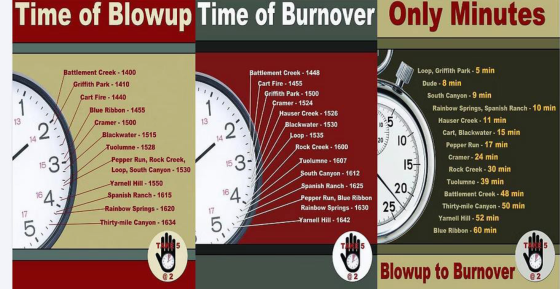
Also from the “official” Fire Shelter Deployment world, we have the Wild Fire Deployment Story Fire Safety Training Annual Refresher (WFSTAR), NWCG, Missoula Technology Development Center (MTDC) video series: “Fire Shelter Deployments: Stories and Common Insights” is a program developed by the [USFS] National Technology and Development Program in Missoula. It will help you understand what you may experience in a fire shelter deployment.” Loop, Battlement Creek, South Canyon, Yarnell Hill Fire Blowup Time, Burnover, and Blowup to Burnover images showing in Figure 2.
Figure 2: Loop, Battlement Creek, South Canyon, Yarnell Hill Fire Blowup Time, Burnover, and Blowup to Burnover images (NWCG, 2014).
The GMHS made a public decision to stay in place when ordered to go to Yarnell to assist. And then micro-public decisions on their discrete Crew Net channel to leave the black (“discussing our options.” ) (Schoeffler et al., 2023 YHFR). The authors also utilized their respective WLF LLC alleged “factual investigations and/or reports” (1) “The New Generation Fire Shelter “The fire shelter has been required equipment for wildland firefighters since 1977. Since that time, shelters have saved the lives of more than 300 firefighters and have prevented hundreds of serious injuries” (2) Panther Fire Deployment Story (CA, KNF, 2008) (3) Little Venus Case Study (2006, SHF, WY) (4) Highway 31 Fire Deployment Story (FDS) Several more FDS to
64 Schoeffler follow. “You’ve got nowhere to go. Your..- the last resort is your only resort, and that’s your shelter. … There was no other option- that was the only option. There’s not really much to debate then” (SC, South Carolina Forestry Commission, 2009) (5) Alabaugh Fire DS - DIVS left his vehicle with only his PPE without any fire shelter and radio and had to deploy with another WF) (SD, Black Hills NF, 2007) (6) Holloway Fire DS (NV, 2012, Zuni HS filler deployed shelter) (7) Indians Fire DS (CA, LPNF, 2008) At approximately 1615 hours while supporting a firing operation Engine 71 was involved in a localized fire blowup. A cyclonic fire wind event caused four Crew members to be overcome by the fire. The radiant heat caused burns to the WFs. Engine WFs deploy shelters (8) Mudd Fire DS (NV, BLM, 2006) Two BLM WFs left their Engine due to a flat tire. They received minor burns while deploying their fire shelters. (9) Devils Creek Fire Entrapment (Miles City Field Office near Jordan, MT, 2021). Three Engines and a Hand Crew resources were engaged in suppression actions on the Devils Creek Fire. A thunderstorm several miles west of the fire area caused a wind shift and strong outflow winds. The increased rapid spread of the fire front trapped multiple resources in the path of the Fire. There were no shelter deployments. The Engines were gathering up WFs from the increasing heat and hot embers as fire behavior increased. The Engines had to stop several times to extinguish flames on their web gear on top of the Engines. Screaming and yelling was heard on the radio. Five WFs were badly burned. The WLF LLC report shows several burnt and/or scorched fire shirts, gloves, pants, and web gear. One WF stated “Everybody on this District was burned that night.” The report also noted:
“Always wear PPE (including gloves) when working on the fireline”, as conditions can change rapidly, and put firefighters in jeopardy of burn injuries. Consider using a shroud to protect the head, neck, and face from heat when working on the fireline. Undergarments should be made of flame-resistant fabric or of the highest percentage of natural fiber available (cotton, wool, or silk). Avoid wearing synthetic materials, as they can melt and drip at temperatures that firefighters may be exposed to during an entrapment or burnover.”
CONCLUSION
Obviously, we are more effective when we put the right resources in the right place(s) at the right time. The reports and various argument provided in this paper, indicates that there were more than likely WFs wearing synthetic undergarments based on other alleged “factual” investigations. Former USFS Smokejumper and wildland fire Investigator Dr. Ted Putnam refused to sign the fatal 1994 (CO) South Canyon Fire SAIR because he “found it inaccurate and incomplete, ignoring too many pertinent human factors. Historically, wildland fire fatality investigations focus on external factors like fire behavior, fuels, weather, and equipment. Human and organizational failures are seldom discussed. When individual [FFs] and support personnel are singled out, it’s often to fix blame in the same way we blame fire behavior or fuels. This is wrong-headed and dangerous, because it ignores an underlying cause of [FF] deaths - the difficulty individuals have to consistently make good decisions under stress.” Stanton (1996).
ACKNOWLEDGMENT
The author would like to acknowledge the six deceased El Cariso HS, five Morman Lake HS, AZ Dept. of Corrections Asst. Crew Leader and six Perryville Inmate Crewmembers, and the YH Fire “two local residents, avid hikers who are familiar with the area” Joy A. Collura and Sonny Tex Gilligan, the 19 deceased young GMHS, Dr. Ted Putnam, WantsToKnowTheTruth, Scott Briggs (Into the Black), inspiring our writing for healing and complete lessons learned for their inadvertent contributions to this research.
Disclaimer: This paper represents the opinions of the author(s), and is the product of their expert opinion and research. It is not meant to represent the position or opinions of the conference or its members, nor the official position of any staff members. The views and opinions expressed in this research are solely of the author(s) and do not reflect the views or positions of any entities, organizations, publisher, reviewers, state or media.
REFERENCES
Accord, C. 2025. When Cutting Corners Becomes the Norm: How Normalizing Deviance Can Lead to Disaster. Workplace Safety Div, Directorate of Analysis and Prevention, U.S. Army Combat Readiness Center, Alabama. Colorado Fire Camp (CFC) Accessed 2026. Report of the Fire Safety Review Team
March 1967. A Plan to Further Reduce the Chances of Men Being Burned While Fighting Fires. Protective Shelters. Dougherty, J. 2015. InvestigativeMEDIA. Key evidence in [YH] Fire tragedy never provided to official investigators. Fire Management Today (FMT) (2002) Dude Fire Staff Ride 62, pp. 31–25. Johnson, P. 2000. Effects of Groupthink on Tactical Decision-Making. Advanced
Military Studies. p. 50. Karels, J; Dudley, M. 2013. Yarnell Hill Serious Accident Investigation Report (SAIT- SAIR). Arizona State Forestry Division. 116 p. Meyer, C. 2025. The Tenth Man Rule: How to Take Devil’s Advocacy to a New
Level. Mind Collection. Schoeffler, Honda, Collura. 2023.Why Were Vital Human Factors Influencing the June 30, 2013, YH Fire GMHS Fatalities Never Revealed? Yarnell Fill Fire Revelations (YHFR) website. Sola, M., Reese, T., Kulbacka, K. (2002) Human Interactions and Decision-making
in Recreational Avalanche Environments. Worchester Polytechnic Institute. p. 31. Stanford Encyclopedia of Philosophy (2006) Weick, K. 2002. Fire Management Today (FMT). Streever, B. 2013. Nineteen Fire Shelters and Nineteen Deaths. Zocollo. Pilot
Institute. 2022. online. Tik Tok. 2025. Fire Shelter Deployment, Only the Brave. U.S. Dept. of Agriculture (USDA) U.S. Forest Service (USFS) Rocky Mtn. Research Station (Nov.-Dec. 2023), 64, Understanding Wildfire as a Dynamic System: A new comprehensive book on wildland fire behavior. Wilcut, Bell, Vaughan, 2014. The Cost of Silence: Normalization of Deviance and
Groupthink. p. 7. Wildfire Safety Training Annual Refresher (WFSTAR) videos. NWCG, USFS Stanton, B. 2014. 20 Years After the South Canyon Fire. Magic Valley. Wildland Fire Lessons Learned Center (LLC) Incident Reviews (WLF LLC, 2025)
Read this individual research paper free through the original publisher, or explore the full digital proceedings book.
ISBN 979-8-950676-03-1
Explore this ISBN in the AHFE Bookstore ↗Listed in the July 2026 bookstore catalogue; search by ISBN to confirm current availability · Digital book purchase optional