Dennis Baki (2026). One Platform, Six Funding Domains: A Module-Level Comparison of Public Support for AI-Assisted Sales Systems in Germany and Ireland. In: Human Interaction and Emerging Technologies (IHIET 2026). AHFE Open Access, vol. 236, pp. 653–664. https://doi.org/10.54941/ahfe1008204
Small and medium-sized enterprises face structural barriers to advanced sales and customer-interaction technology: conversation intelligence, dialling, attribution and coaching have been sold as separate specialist products whose entry pricing does not scale down with team size. This paper examines how a modular platform built on a single data model changes that position, and how public innovation funding in two European Union member states applies to the components of such a system. An operational European sales platform serves as the case, drawing on anonymised and aggregated deployment observations. The analysis shows a capability leap for small teams, treats the human-interaction dimension as central, a real-time assistant introduces an affected party who cannot see the system, and derives design constraints from recording law, data-protection law and the Artificial Intelligence Act. The principal contribution is a module-level eligibility analysis mapping platform modules against instruments in Germany and Ireland across six public funding domains. Eligibility attaches to activities and expenditure, not to software labels: recurring licence fees fall outside research incentives, whereas conceptual design, transferable qualification and genuine in-house development can each qualify. Priced through this map, the instruments can plausibly carry a third to a half of a small firm’s first-year adoption cost. The two states differ in institutional logic, one subsidises external expertise, the other also provides expertise publicly. Funding architecture emerges as a design parameter of artificial intelligence adoption in smaller firms.
Most of the firms examined are owner-managed small and medium-sized enterprises: businesses in which the decision-maker carries the commercial risk personally, without the buffer of a board committee. In Germany they are called the “Mittelstand”; in Ireland, policy language speaks of the indigenous SME sector. Such firms train apprentices when large employers cut intake, keep production in small towns, and are often family-owned market leaders in places that receive little public attention (Simon, 2009). And yet they are, with remarkable consistency, the last to receive any given generation of business technology.
654 Dennis Bakir
The reason is not adequately explained by conservatism, which is the explanation usually offered. It is also arithmetic. Specialist software for sales and customer interaction has historically been sold as separate products, each with a floor price that does not fall in proportion to team size. A three-person firm pays a minimum licence for the coaching tool, the attribution tool and the dialler, and then pays again to integrate and maintain them. Per head, the smallest organisations can pay the most and receive the least reliable result, because every interface between two vendors is a point at which the process can break (OECD, 2021; Vial, 2019).
This paper starts from the position that closing the resulting capability gap quickly and cheaply is a legitimate public interest. Two mechanisms bear on it. The first is architectural: modular platforms on a single data model can reduce both the licence floor and the integration burden, although modularity does not remove all dependencies (Sanchez and Mahoney, 1996; Schilling, 2000; Yoo, Henfridsson and Lyytinen, 2010). The second is fiscal: public innovation support contains instruments applicable to several stages of such an adoption project, provided the project is decomposed correctly (Edler and Fagerberg, 2017). This second mechanism remains, in our experience, largely unknown to the firms it exists for.
The paper describes the platform, sets out what modularisation changes, examines interaction design under European legal constraints, and then presents the module-level funding analysis and the two-state comparison, before limitations and conclusion.
Disclosure. The author represents the Irish company Grenzenlos Limited (https://www.grenzenlos.ie), which conceived the platform analysed here, holds its intellectual property and contributes the technical development, training concept and sales methodology around it. The platform is operated by Strattons Oakmont LLC and is commercially available as Dealmaker CRM (https://www.deal- maker.ch). No external funding was received for this study. The analysis is descriptive and constitutes neither tax nor legal advice. The commercial relationship is a potential conflict of interest; product-specific observations are accordingly reported as case observations, not as independently validated causal effects.
Method and scope. The study uses an exploratory comparative single-case design: platform design artefacts, anonymised and aggregated operational observations, and a structured review of legislation and programme documentation current to 4 August 2026. The unit of analysis for eligibility is the activity and expenditure associated with a module. It uses no individual-level performance data and makes no causal claims about productivity or adoption outcomes.
THE PLATFORM AS AN OBJECT OF STUDY This is not a systems engineering paper; the architecture is described only as far as the argument requires.
The platform under study, commercially deployed as Dealmaker CRM, is a modern sales system organised around one principle: a single relational data model through which a prospect passes from first advertising contact to signed order, every module reading from and writing to that same model. One authentication context, one contractual relationship, no inter-vendor synchronisation layer,
One Platform, Six Funding Domains 655
although internal dependencies and single-provider risks remain. Nine functional clusters are integrated in this model: pipeline and contact management; staged telephony from click-to-dial to progressive dialling; conversational assistance with scripted steps, objection responses and affective cues; AI role-play training; server- side marketing attribution; messaging; voice-agent integration; referral and reputation handling; and appointment booking. A tenth capability, recorded and electronically signed contracting within the call itself, follows from having telephony, document handling and identity in one system.
Two design properties matter for what follows. The persistence layer was built for per-tenant isolation with EU and Swiss data residency from the outset, not as a compliance retrofit; this determines which of the interaction designs discussed below are available at all. And modules are independently activatable and independently priced, which makes the module-level funding comparison practicable: public instruments attach to activities and expenditure, and modules help to separate work packages and cost items.
THE CAPABILITY LEAP Consider a three-person sales team. A market scan undertaken for this case in the third quarter of 2026, based on publicly advertised list prices, placed a comparable functional scope (customer relationship management, dialling, conversation intelligence, voice agent, attribution, plus external implementation) in the region of two and a half to three thousand euro per month, spread across nine or more contracts and as many logins, before setup fees. The same scope delivered as modules on one platform sits materially below that figure. The absolute numbers matter less than the shape of the curve. In the separated model, cost per seat rises as team size falls, because floor prices dominate. In the modular model, cost per seat is roughly constant. For a firm of three, the difference is not a discount. It is the difference between having the capability and not having it. Integration risk is reduced rather than eliminated, onboarding shortens, and server-side attribution— historically an enterprise feature—becomes affordable.
A substantial share of work in a small sales operation is not selling: it is looking things up, typing things in, remembering callbacks, and reconstructing after the fact what was agreed. An integrated system can absorb much of it: lead enrichment runs continuously, a disclosed voice agent can handle first-line qualification outside opening hours, data capture becomes a by-product of the guided conversation, and pipeline analysis becomes continuous. The point is not headcount reduction. In the deployments observed, the intended effect has been the opposite: the same people can spend a higher proportion of their time on the judgement calls—whether a prospect is a fit, the objection that is not in the script, when to walk away, the last ten per cent—that create the margin. A controlled productivity study has yet to test these observations.
Automation of this kind is only defensible if the division of labour is explicit (Amershi et al., 2019; Jarrahi, 2018). Three classes of decision stay with the person: the system proposes responses but never speaks for the seller in a live conversation; it blocks stage transitions on missing data but does not itself classify outcomes; it recommends next actions while the sequencing of a relationship
656 Dennis Bakir
remains a human judgement. Where a voice agent acts autonomously, its output enters the pipeline as an unconfirmed proposal and is reviewed before it acquires commercial consequence—a deliberate governance trade-off, and depending on context a legal requirement rather than a preference.
INTERACTION DESIGN UNDER LEGAL CONSTRAINTS The third party in the conversation
Much human–computer interaction research on conversational assistance concentrates on the person operating the system. Real-time sales assistance has an unusual property: the other substantially affected person is the one not operating it. The customer cannot see the screen, may not know that anything is displayed at all, and has no interface through which to express a preference (Amershi et al., 2019). Designing for that person cannot be solved by a privacy policy. It has to be solved in the first fifteen seconds of the call, by a human being under time pressure whose commercial incentive points the other way.
We refer to the resulting design as the consent gate: a deliberately strict state in the call flow, before recording, transcription or analysis begins, in which the seller obtains and records an explicit statement from the counterparty. Dependent capabilities stay inactive until that statement exists; refusal is a supported state, not an error state. Consent is not claimed to be the only possible lawful basis under the GDPR; the appropriate basis depends on purpose and context (Data Protection Commission, 2026; European Parliament and Council, 2016).
Two jurisdictions, two thresholds In Germany, § 201 of the Criminal Code prohibits recording the non-publicly spoken word of another person without authorisation, and the provision can bind a participant in the conversation; the criminal-law issue is separate from GDPR duties and is not cured by a data-protection notice (Strafgesetzbuch (Germany), § 201). Ireland’s Interception of Postal Packets and Telecommunications Messages (Regulation) Act 1993 is directed primarily at interception, but recording still requires a valid data-protection basis, prior information, purpose limitation and defined retention (Interception of Postal Packets and Telecommunications Messages (Regulation) Act, 1993; Data Protection Commission, 2026). The design consequence is that recording behaviour must be a jurisdictionally governed property of the tenant, not a preference of the individual user. The German requirement provides a defensible strict default; any relaxation requires a documented legal basis for the relevant market.
Emotion inference: the sharpest constraint As an additional layer, the Artificial Intelligence Act (EU AI Act) has strengthened this position more than many vendors appear to have registered. Article 5(1)(f) has, since 2 February 2025, prohibited systems that infer emotions of a natural person
One Platform, Six Funding Domains 657
in the workplace, with narrow exceptions; the Act defines emotion recognition via biometric data, and Commission guidance distinguishes such inference from systems that merely process conversational content (European Parliament and Council, 2024; European Commission, 2025). For sales assistance the asymmetry is sharp. Inferring the emotional state of the seller falls within the workplace prohibition. For the customer, the context of use must be assessed, and where biometric emotion recognition falls within Annex III it may be classified as high risk—requirements that apply from 2 December 2027 under Regulation (EU) 2026/1744, in force since 27 July 2026, while the transparency duty in Article 50(3) has applied since 2 August 2026 (European Parliament and Council, 2024; European Parliament and Council, 2026). Affective analysis of the seller must therefore be capable of being switched off entirely; analysis of the customer should remain disabled unless its classification and transparency obligations have been assessed.
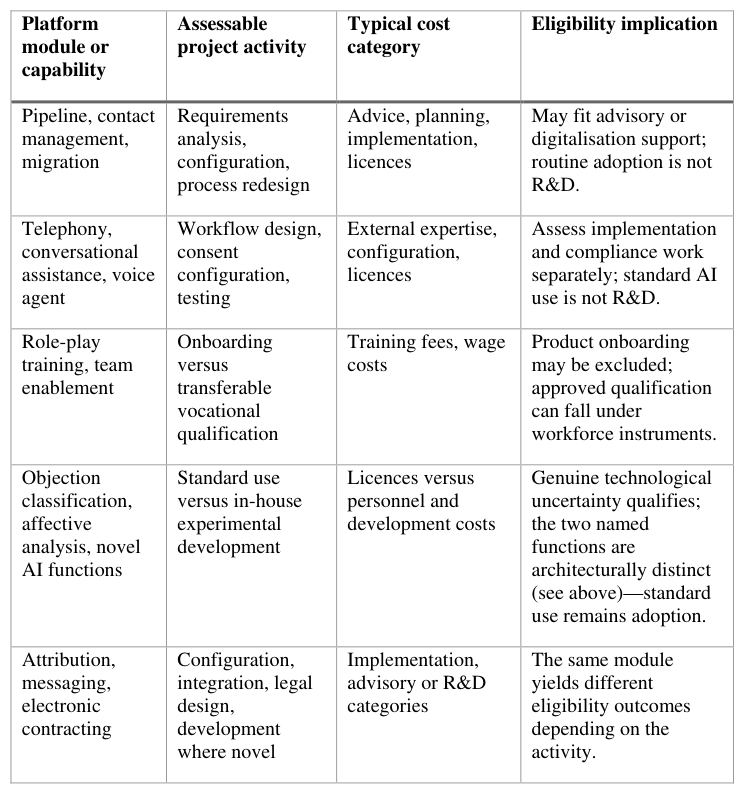
The most useful design finding follows from this. Detecting that an objection has been raised, on the basis of what the counterparty actually said, is semantic classification of conversational content; estimating from voice characteristics that the counterparty is becoming irritated is something else. The two are frequently sold under the same marketing heading but can sit on different sides of the regulatory definition. A system that separates them architecturally can offer objection detection and response support in a materially lower-risk configuration (European Parliament and Council, 2024; European Commission, 2025).
Undisclosed transcription and undisclosed agents Two market practices are difficult to defend: silent transcription—a transcript is still processing of personal data, whatever the storage medium—and the undisclosed synthetic voice, which Article 50(1) addresses by requiring that persons be informed when interacting with an AI system (European Parliament and Council, 2016; European Parliament and Council, 2024). Disclosure can have a commercial cost: case observations suggest that some counterparties decline or become guarded, an effect yet to be quantified under controlled conditions. The argument for disclosure is not performance-neutrality; it is that undisclosed processing transfers legal and reputational risk onto a customer poorly placed to carry it. What remains after these constraints is substantial: script adherence with mandatory data fields, objection detection with response support as a form of organisational memory, and post-call summarisation. None of this requires knowing how the customer feels. It requires knowing what the customer said, and responding well.
MODULE-LEVEL FUNDING ELIGIBILITY Firms approaching such a project ask a question with a defect built into it: is there funding—a real grant or subsidy—for the integration and use of a CRM system? Support instruments do not attach to software labels but to eligible activities, expenditure and applicants, and one adoption project contains categorically different activities addressed by different instruments (Edler and Fagerberg, 2017).
658 Dennis Bakir
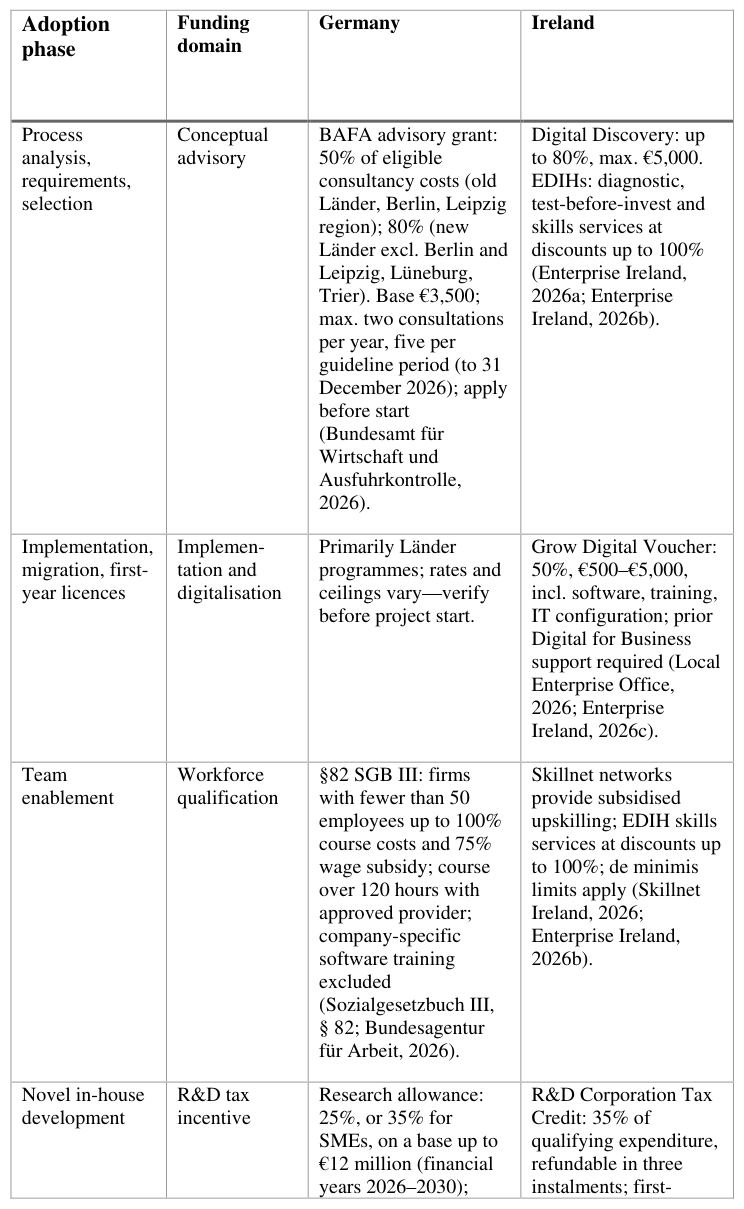
Six domains are relevant. Table 1 links the platform’s modules to separately assessable activities; Table 2 maps those activities onto support domains across the two jurisdictions.
Table 1. From platform modules to separately assessable activities.
One Platform, Six Funding Domains 659
Table 2. Activity-level mapping of adoption phases to funding domains, Germany and Ireland.
660 Dennis Bakir
What the map is worth
Table 2 is not an annex to the argument; it is the argument. Read row by row, it states which activity of an adoption project can be supported, under which domain—and the amounts are not symbolic. Three effects follow, each expressible in euro.
The first is access to external expertise the firm would probably not have bought at market rates. Germany reimburses 50 to 80 per cent of an eligible consultancy invoice on a base of €3,500, worth €1,750 to €2,800 per consultation; Ireland provides or discounts advisory through public structures—Digital Discovery up to €5,000, EDIH services at up to 100 per cent. Either way, the first euro of public money buys diagnosis rather than software.
The second is access to the technology itself at reduced own investment. Implementation instruments co-pay eligible software, configuration and training: the Grow Digital Voucher covers 50 per cent of such costs up to €5,000; Länder programmes play the analogous role with varying ceilings—the one row where no euro figure can be stated without naming a specific programme, an imprecision that belongs to the programmes, not to the map.
The third effect is the least discussed: the state co-finances the risk of the change itself. A §82 SGB III qualification can carry 100 per cent of course costs and up to 75 per cent of wages; the Irish R&D credit of 35 per cent is refundable in cash even without tax liability; subsidised loans from KfW or Microfinance Ireland do not
One Platform, Six Funding Domains 661
reduce cost but protect liquidity while the project runs. For an owner who carries commercial risk personally, a grant that halves the exposed capital changes the go- or-no-go calculation itself.
As an illustrative composite: advisory support (€1,750–5,000), an implementation voucher (€5,000), a funded qualification place (low four figures) and, where genuine development occurs, a research incentive of 25 to 35 per cent on a modest €40,000 effort (€10,000–14,000) sum to €10,000–25,000 against a first-year adoption budget of €15,000–25,000. Not every firm qualifies for every instrument, and state-aid ceilings and stacking rules apply; the plausible share of co-financing nonetheless lies between a third and a half of the project—which is why decomposition can decide whether some projects happen at all.
The recurring licence problem One boundary deserves emphasis, because this field is often mis-sold. Recurring licence fees for standard software often do not qualify under either country’s research incentive merely because the software uses artificial intelligence: deploying a market-available system is usually the application of known technology, whereas both incentives require the resolution of scientific or technological uncertainty (Forschungszulagengesetz, 2025; Revenue Commissioners, 2026). What can qualify is the adopting firm’s own development of functionality whose feasibility was genuinely open at the outset, with the platform licence remaining separate from that development claim. The rule of thumb is short: research incentives attach to uncertainty a firm systematically resolves, not to technology it simply purchases.
Interaction between the two systems Can the same development expenditure be claimed in both states? It cannot: the Irish credit is unavailable where the expenditure qualifies for a tax deduction in another country, German rules likewise bar cumulation, and a duplicate claim creates recovery risk in two jurisdictions at once (Revenue Commissioners, 2026; Forschungszulagengesetz, 2025). The legitimate position is the reverse. A firm with genuine operations in both states may use each system for distinct activities actually carried out there—enablement in Dublin, development work in Germany. Where one state lacks an instrument for a given domain, or a budget-dependent programme is temporarily closed, as ZIM currently illustrates, the other may offer a functional alternative. This requires real establishment, staff and activity: a portfolio question, not a paper restructuring exercise.
TWO STATE LOGICS The comparison in Table 2 shows a difference more interesting than any single rate. Germany typically subsidises the purchase of external expertise or documented expenditure: a share of an eligible consultancy invoice, eligible
662 Dennis Bakir
software and implementation costs, qualifying research expenditure (Bundesamt für Wirtschaft und Ausfuhrkontrolle, 2026; Forschungszulagengesetz, 2025). Ireland, to a greater degree in this domain, also provides expertise directly or through heavily discounted public structures: Local Enterprise Offices, Enterprise Ireland advisory and voucher formats, and four European Digital Innovation Hubs with discounts of up to 100 per cent, whose second phase (2026–2029) was funded in December 2025 (Department of Enterprise, Tourism and Employment, 2025; Enterprise Ireland, 2026b). The Irish state is therefore not only a co-payer but, in several instruments, an organiser or provider of expertise.
The consequence for firms crossing the border in either direction is underappreciated. A German firm arriving in Ireland searches for a grant application and concludes that nothing is available, because it is looking for the wrong object. An Irish firm entering Germany does not think to ask whether the state will co-fund a consultant, because in its home system consultants are not what the state pays for. Both underuse the support available to them because the institutional grammar differs from the one they learned. A further asymmetry matters: the German research allowance and the Irish credit are statutory tax instruments, whereas many grant programmes remain budget-dependent, as the ZIM suspension demonstrates. For a firm building a multi-year adoption plan, the distinction between entitlement and budget may matter more than the headline percentage.
LIMITATIONS This is a single-case study combining platform design artefacts, anonymised and aggregated observations, and official sources current to 4 August 2026. It is not an independent product evaluation; the deployment base is concentrated in German- language business-to-business selling with considered purchases, and the capability observations do not generalise beyond it without further evidence. The interaction-design findings are qualitative: the observation that disclosure may reduce immediate engagement is an observation rather than a measurement, and the controlled study needed to size the effect has yet to be run. The funding analysis is a snapshot, and the euro figures above are illustrative magnitudes drawn from the mapped instruments, not entitlements; the structural findings—that eligibility attaches to activities and expenditure, that the two states combine instruments differently, and that tax instruments behave differently from budget-dependent grants—should outlast the specific figures. Two jurisdictions are not Europe, and whether the two-logic distinction generalises to the other twenty-five member states is an open question. We invite collaboration to test the interaction design under other conditions, to extend the comparison, or to run that controlled study; anonymised and aggregated deployment data can be made available to academic partners under appropriate agreement.
One Platform, Six Funding Domains 663
CONCLUSION
Two claims have been advanced. The first is architectural: modular platforms on a single data model can lower the cost floor that has kept advanced interaction technology out of small firms, and for a firm of three or twelve the result can be access to a class of capability previously difficult to justify.
The second is institutional, and it is the more precise one. The question is never whether funding exists for a CRM system; it is which activity of the adoption project qualifies under which domain. Table 2 answers that question for two states and six domains: conceptual design qualifies as advisory, implementation and first- year licences as digitalisation, team enablement as workforce qualification, genuinely novel functionality as research, academic cooperation as collaborative research, and rollout as subsidised finance. Priced through that map, public instruments can plausibly carry a third to a half of a small firm’s first-year adoption cost—on the order of €10,000 to €25,000 against typical budgets of €15,000 to €25,000—and they co-finance the risk and liquidity exposure of the change itself. Decomposition is therefore not paperwork; for a firm of this size it can decide whether the project proceeds. Funding architecture is not a downstream financing detail but a design parameter of adoption itself, and it belongs in the human-factors conversation about which firms can use these systems, under what conditions and with which safeguards.
Acknowledgment
The author would like to thank the SME practitioners and sales professionals whose operational feedback informed the case description and helped refine the activity-level analysis presented in this paper. Their contributions were considered exclusively in anonymised and aggregated form. Responsibility for the interpretation of the findings and for any remaining errors rests solely with the author.
REFERENCES
Amershi, S., Weld, D., Vorvoreanu, M., Fourney, A., Nushi, B., Collisson, P., Suh, J., Iqbal, S., Bennett, P.N., Inkpen, K., Teevan, J., Kikin-Gil, R. and Horvitz, E. (2019). Guidelines for human–AI interaction. Proceedings of the 2019 CHI Conference on Human Factors in Computing Systems, Paper 3, 1–13. Bundesamt für Wirtschaft und Ausfuhrkontrolle (2026). Förderung von Unternehmensberatungen für KMU (Förderung unternehmerischen Know-hows). Bundesagentur für Arbeit (2026). Förderung der beruflichen Weiterbildung Beschäftigter. Bundesministerium für Wirtschaft und Energie (2026). Zentrales Innovationsprogramm
Mittelstand: Befristeter Antragsstopp ab 7. Juli 2026. Data Protection Commission (2026). Guidance on Legal Bases for Processing Personal Data. Department of Enterprise, Tourism and Employment (2025). €23 Million to Extend
Digitalisation Services for SMEs: European Digital Innovation Hubs, Phase 2 (2026– 2029). Edler, J. and Fagerberg, J. (2017). Innovation Policy: What, Why, and How. Oxford Review of Economic Policy, 33(1), 2–23.
664 Dennis Bakir
Enterprise Ireland (2026a). Access Advice: Digital Discovery. Enterprise Ireland (2026b). European Digital Innovation Hubs. Enterprise Ireland (2026c). Digital Transition Fund. Enterprise Ireland (2026d). Innovation Voucher. European Commission (2025). Guidelines on Prohibited Artificial Intelligence Practices Established by Regulation (EU) 2024/1689. European Parliament and Council (2016). Regulation (EU) 2016/679 (General Data
Protection Regulation). Official Journal of the European Union, L 119. European Parliament and Council (2024). Regulation (EU) 2024/1689 laying down harmonised rules on artificial intelligence (Artificial Intelligence Act). Official Journal of the European Union, L series. European Parliament and Council (2026). Regulation (EU) 2026/1744 amending
Regulation (EU) 2024/1689 (Digital Omnibus on Artificial Intelligence). Official Journal of the European Union, 24 July 2026. Forschungszulagengesetz (FZulG) of 14 December 2019, as amended by the Growth Opportunities Act and the Act on an Immediate Tax Investment Programme (2025). Interception of Postal Packets and Telecommunications Messages (Regulation) Act 1993
(Ireland). InterTradeIreland (2026). Innovation Boost: Funding and Support. Jarrahi, M.H. (2018). Artificial Intelligence and the Future of Work: Human–AI Symbiosis in Organizational Decision Making. Business Horizons, 61(4), 577–586. KfW (2026). ERP-Förderkredit Innovation. Local Enterprise Office (2026). Grow Digital Voucher. Microfinance Ireland (2026). Loan Packages. OECD (2021). The Digital Transformation of SMEs. Paris. Revenue Commissioners (2026). Research and Development Corporation Tax Credit: Tax
and Duty Manual, Part 29-02-03. Sanchez, R. and Mahoney, J.T. (1996). Modularity, Flexibility, and Knowledge Management in Product and Organization Design. Strategic Management Journal, 17(S2), 63–76. Schilling, M.A. (2000). Toward a General Modular Systems Theory and Its Application to
Interfirm Product Modularity. Academy of Management Review, 25(2), 312–334. Simon, H. (2009). Hidden Champions of the Twenty-First Century: Success Strategies of Unknown World Market Leaders. London: Springer. Skillnet Ireland (2026). Skillnet Business Networks. Sozialgesetzbuch III, § 82 (Förderung der beruflichen Weiterbildung Beschäftigter). Strafgesetzbuch (Germany), § 201 (Verletzung der Vertraulichkeit des Wortes). Vial, G. (2019). Understanding Digital Transformation: A Review and a Research Agenda.
Journal of Strategic Information Systems, 28(2), 118–144. Yoo, Y., Henfridsson, O. and Lyytinen, K. (2010). The New Organizing Logic of Digital Innovation: An Agenda for Information Systems Research. Information Systems Research, 21(4), 724–735.
SEARCH THE AHFE DIGITAL BOOKSTORE BY ISBN
Explore the complete digital volume
Human Interaction and Emerging Technologies (IHIET 2026)
Read this individual research paper free through the original publisher, or explore the full digital proceedings book.