Xinran Hu, Xingzhou Guo, Yunfeng Chen, Jiansong Zhang (2026). Impact of Body Mass Index, Tenure Length, and Age on Physical Exertion of Transportation Maintenance Workers During Simulated Asphalt Shoveling. In: Human Factors in Design, Engineering, and Computing. AHFE Open Access, vol. 238, pp. 1183–1193. https://doi.org/10.54941/ahfe1008348
Shoveling is the most frequent pushing/pulling task at the Indiana Department of Transportation and is associated with work-related musculoskeletal disorders (WMSDs), particularly of the lower back and shoulders. Physical overexertion is a well-established risk factor for WMSDs, and individual factors (e.g., body mass index (BMI), tenure, and age) may influence exertion. However, few studies have quantified physical exertion during shoveling or examined how individual factors influence it. This study examined the effects of BMI, job tenure, and age on physical exertion among 20 maintenance workers during simulated asphalt shoveling. Perceived physical exertion was assessed with the Borg 6–20 Rating of Perceived Exertion scale, and muscle activation was assessed with surface electromyography normalized to maximum voluntary contraction (%MVC) of the medial deltoid, biceps brachii, brachioradialis, and lumbar erector spinae. ANOVA with post-hoc tests was used to compare physical exertion across BMI, tenure, and age groups. Workers with obesity reported higher perceived exertion than overweight workers in the biceps brachii (p=0.045) and brachioradialis (p<0.001), and higher lumbar erector spinae activation than normal-weight (p=0.002) and overweight workers (p<0.001). Workers with 0–2 years of tenure showed higher biceps brachii perceived exertion (p=0.024) and lumbar erector spinae activation (p=0.006), whereas those with over 2 years showed higher brachioradialis activation (p=0.005). Workers aged 30–39 reported higher perceived exertion than those aged 50–59 in all four muscles, while age had no significant effect on %MVC. This study contributes to knowledge on worker groups at higher overexertion risk during shoveling, supporting demographic-specific fatigue management.
Shoveling, a physically demanding activity, has been associated with many work-related musculoskeletal disorders (WMSDs), such as injuries to shoulders, arms, back, palms, and legs (Lewinson et al., 2014; Adeyemi et al., 2020; Thamsuwan et al., 2020). For example, in a study of sand shoveling workers, shoulder pain and low back pain were the most common complaints, together accounting for 43% of all reported pains (Adeyemi et al., 2020). Specifically,
in the transportation industry in Indiana, repetitive shoveling is the most frequent pulling/pushing activity (Guo et al., 2022). Based on data shared by the Indiana Department of Transportation (INDOT), shoveling ranks second among transportation maintenance tasks in total labor hours (over 542,000 hours). One major contributing factor to WMSDs is physical overexertion, and the resulting muscle fatigue experienced by workers during repetitive or prolonged tasks (Anwer et al., 2021; Bangaru et al., 2022; Antwi-Afari et al., 2023b). Hence, there is a great need to quantify physical exertion in shoveling activities. In addition, transportation and material moving occupations had the highest work-related fatalities nationally in 2023 (1,495) (BLS, 2024) and 2022 (1,620) (BLS, 2023), highlighting the urgent need to improve safety in the transportation field. Overall, this study focuses on quantifying physical exertion in shoveling activities among workers in the transportation field.
Previous research has mainly focused on shoveling-related WMSDs and the ergonomic design of shoveling tools to reduce physical fatigue. However, few studies have directly quantified both perceived and objective muscle exertion during shoveling activities. The Borg Rating of Perceived Exertion (RPE) scale is one of the most common methods to measure perceived exertion (Borg, 1982; Umer et al., 2020), whereas surface electromyography (sEMG) normalized to maximum voluntary contraction (%MVC) objectively quantifies localized muscle activation and has been used to monitor construction workers (Bangaru et al., 2022). Combining the two measures enables a comparison between workers’ perceive efforts and their actual muscular load, particularly in the shoulder, arm, and lower back muscles commonly affected by shoveling-related WMSDs. Existing studies have also shown that workers’ demographic characteristics, such as age, body mass index (BMI), experience, and height, can affect physical fatigue, exertion, and WMSD risk (Lim et al., 2005; Ekpenyong and Inyang, 2014; Wolkiewicz et al., 2018; Adeyemi et al., 2020). However, most existing studies that examined how fatigue varied with demographic factors have been conducted either in the general public (Engberg et al., 2017; Yoon et al., 2023), or in specific occupation groups, such as healthcare workers (Vitale et al., 2023), and manufacturing workers (Lambay et al., 2022). Few studies have explored how demographic factors influence perceived and objective muscle exertion during shoveling among transportation maintenance workers, despite shoveling being a high-risk task in the transportation industry.
To address these research gaps, this study aims to evaluate physical exertion during simulated asphalt shoveling in the transportation industry, specifically examining differences across workers’ BMI categories, tenure length, and age. The objectives include assessing perceived exertion and muscle activation of the medial deltoid (MD), biceps brachii (BB), brachioradialis (BR), and lumbar erector spinae (LES) during shoveling and analyzing how demographic factors (i.e., BMI, tenure, and age) influence physical exertion. Perceived exertion was assessed using the Borg 6–20 RPE scale, and muscle activation was measured using sEMG sensors and expressed as %MVC. The findings could help identify which worker groups face a higher overexertion risk during shoveling and should be prioritized for ergonomic interventions in the transportation field.
METHOD
This study measured perceived exertion and muscle activation during simulated asphalt shoveling. Twenty-six transportation maintenance workers (24 males and 2 females) were recruited. After data from six participants were excluded due to sensor malfunctions or significant environmental interference, 20 participants were included in the analysis, with a mean age ± standard deviation of 36.30 ± 9.8 years, BMI of 29.45 ± 4.8 kg/m², and tenure of 4.15 ± 4.38 years. Based on the National Institutes of Health BMI categories (normal weight: 18.5–24.9; overweight: 25–29.9; obesity: ≥ 30) (Weir and Jan, 2022), 3 participants were classified as normal weight, 7 as overweight, and 10 as obese. Adeyemi et al. (2020) suggested that workers with over 2 years of sand shoveling experience may become accustomed to work-related physical discomfort; accordingly, participants were divided into 0–2 years (50%) and over 2 years (50%) of tenure. Participants were categorized into 10-year age groups: 20–29 (30%), 30–39 (35%), 40–49 (25%), and 50–59 (10%) years. The study was approved by the Purdue University Institutional Review Board (IRB-2022–168), and informed consent was obtained from each participant.
Data were collected on site from October 3 to 17, 2022. Based on onsite observation (Guo et al., 2023), each shoveling trial consisted of shoveling gravel (used to simulate asphalt as recommended by INDOT maintenance supervisors) from the ground to a skid-steer loader for 3 minutes followed by 1 minute of site cleaning. Before the first trial, each participant performed maximum voluntary contraction (MVC) tests for each target muscle. Each participant completed four trials, one under each of four conditions (a regular shovel, a back exoskeleton with a regular shovel, a shovel with an ergonomic handle, and a back exoskeleton with an ergonomic-handle shovel), using a balanced Latin square design with 15-minute rests between trials. The effects of these interventions on ergonomic risk were reported in Hu et al. (2024); the present study used data from the same experiment to examine demographic differences in physical exertion.
After each trial, participants rated their perceived exertion in the left and right MD, BB, BR, and LES muscles using the Borg RPE scale (Umer et al., 2020; Antwi-Afari et al., 2023a), which ranges from 6 (“No exertion”) to 20 (“Maximal exertion”) (Borg, 1982; Aryal et al., 2017). Left- and right-side ratings were averaged for each muscle. Meanwhile, sEMG sensors placed on the same muscles recorded muscle activity at 1,024 Hz during each shoveling trial, with collection paused during rest periods. The final sample size of 20 participants is comparable to those used in similar studies from literature, such as 12 participants (Aryal et al., 2017), 10 participants (Umer et al., 2020; Antwi-Afari et al., 2021; Antwi-Afari et al., 2023a), and 23 participants (Arias et al., 2022). Using the iMotions software, raw EMG signals were band-pass filtered (0.5–250 Hz), notch filtered (30 and 50 Hz), and smoothed using a root mean square (RMS) algorithm with a 150-ms window and 10% overlap. The peak RMS value from each muscle’s MVC test was used as the reference, and EMG amplitude was normalized to this reference and expressed as %MVC. Because all participants completed all four conditions in a counterbalanced order, RPE and %MVC values were averaged across the four trials for each participant. Between-group comparisons of mean
RPE and %MVC values were conducted using one-way analysis of variance (ANOVA) and Bonferroni post-hoc analyses (significance level α = 0.05) to examine whether physical exertion during shoveling differed across BMI, tenure, and age groups.
RESULTS AND DISCUSSION
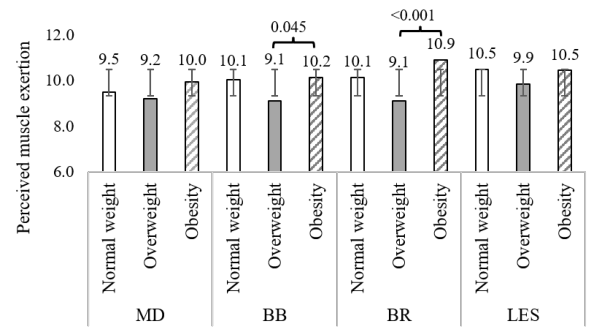
Figure 1 illustrates the perceived exertion in the four muscles across three BMI categories. According to the 6–20 Borg RPE scale, mean perceived exertion ratings were mostly below 11 (range 7.7–11.3 across all groups), indicating that participants perceived light or even negligible muscle exertion during shoveling. However, this result should be interpreted with caution. Each trial lasted only about 3 minutes, whereas shoveling in practice is prolonged and repetitive, and muscle activation still ranged from approximately 26% to 42% MVC across muscles and groups (Figures 4-6). Moreover, in field settings, Adeyemi et al. (2020) reported that most sand shoveling workers with shoulder or low back pain rated their pain as moderate or severe. In addition, across all four muscles, workers with obesity reported the highest or equally high levels of muscle exertion, while overweight workers experienced the lowest muscle exertion. Additionally, ANOVA results show that obese workers reported significantly higher exertion in the BB (p = 0.045) and BR (p < 0.001) muscles than overweight workers. However, no significant differences were observed in the perceived exertion of the MD and LES muscles among participants with normal weight, overweight, and obesity.
Figure 1: Perceived muscle exertion across BMI categories.
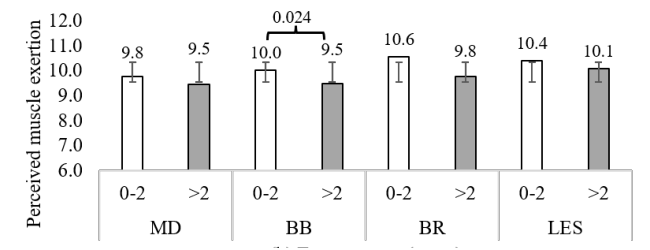
Figure 2 compares perceived muscle exertion between participants with 0–2 years and more than 2 years of work experience. Participants with over 2 years of working experience generally reported lower perceived muscle exertion than those with 0–2 years of experience. Specifically, workers with no more than 2 years of experience reported perceived exertion scores of 9.8 in the MD muscle, 10.0 in the BB muscle, 10.6 in the BR muscle,
Impact of Body Mass Index, Tenure Length, and Age on Physical 1187 and 10.4 in the LES muscle. In contrast, those with more than 2 years of experience reported exertion scores of 9.5, 9.5, 9.8, and 10.1 in the MD, BB, BR, and LES muscles, respectively. ANOVA results show that workers with more than 2 years of experience reported significantly less exertion in the BB muscle (p = 0.024), while no significant differences were observed in the other muscle groups between the different tenure lengths. This is consistent with previous findings that more experienced workers may become accustomed to work-related physical discomfort (Adeyemi et al., 2020) or have adopted more efficient handling techniques that reduce effort (Goubault et al., 2022).
Figure 2: Perceived muscle exertion across tenure groups.
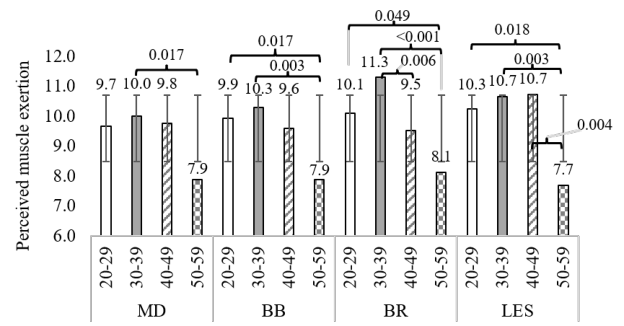
Figure 3 illustrates the differences in perceived muscle exertion during shoveling across four age groups, as determined by post-hoc analyses comparing each pair of age groups. The age group 30–39 reported the highest levels of perceived exertion in the MD, BB, and BR muscles and, together with the 40–49 age group, in the LES muscle. Conversely, the age group 50–59 demonstrated the lowest perceived exertion. A statistically significant difference was observed, with the 30–39 age group experiencing higher exertion in all muscles compared to the 50–59 age group, and notably higher exertion in the BR muscles compared to the 40–49 age group. Additionally, the 20–29 age group exhibited moderate exertion levels, which were similar to those of the 30–39 age group but significantly higher in the BB, BR, and LES muscles than the 50–59 age group. Compared to the 50–59 age group, the 40–49 age group had significantly higher perceived exertion only in the LES muscle. These findings suggest that perceived muscle exertion was lower among older workers, particularly in the 50–59 age group. Older workers may be more accustomed to the physical demands of shoveling; however, because %MVC did not differ across age groups (Figure 6), this lower perceived exertion may not reflect a lower muscular load. In contrast, younger workers, despite usually having higher physical capacity, may have less experience and thus perceive the same relative muscular load as more effortful (Kenny et al., 2008).
Figure 3: Perceived muscle exertion across age groups.
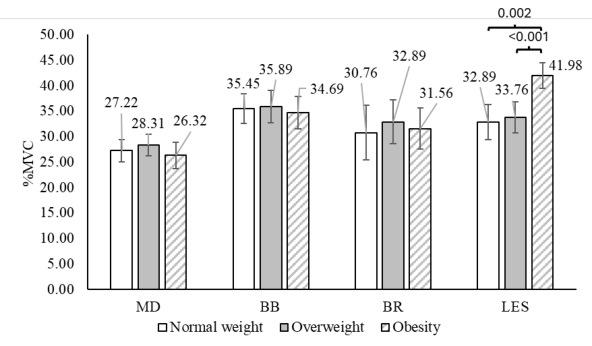
Figure 4 illustrates difference in %MVC during shoveling among workers across BMI categories. The data analysis showed no significant differences in the MD, BB, and BR muscles among the workers when categorized by BMI. Across BMI categories, mean activation ranged from 26.32% to 28.31% MVC in the MD, 34.69% to 35.89% in the BB, and 30.76% to 32.89% in the BR. However, a significant difference was noted in the LES muscle’s %MVC among worker in different BMI categories. Specifically, workers with obesity (41.98%) showed significantly higher LES activation than both normal-weight (32.89%, p = 0.002) and overweight workers (33.76%, p<0.001). Together with the perceived exertion results, these findings suggest that higher BMI may contribute to greater physical exertion during shoveling. This may be because excess body fat makes individuals more prone to physical fatigue (Lim et al., 2005), and because shoveling involves repeated trunk flexion that stresses the lower back, a load that may be greater for workers with higher body mass (Lewinson et al., 2014; Wolkiewicz et al., 2018).
Figure 4: Muscle activation (%MVC) across BMI categories.
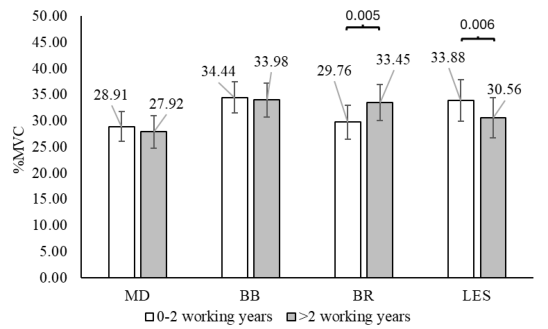
Figure 5 illustrates differences in %MVC during shoveling between tenure groups. There were no significant differences in the %MVC of the MD and BB muscles between tenure groups. For instance, the %MVC of the MD muscle was 28.91% in workers with 0–2 years of tenure, compared to 27.92% in those with over 2 years of working experience. Similarly, the BB muscle showed an activation level of 34.44% MVC in the 0–2-year tenure workers and 33.98% in those with over 2 years of experience. In contrast, the BR and LES muscles displayed significant %MVC differences between the two tenure groups. Specifically, workers with over 2 years of tenure showed significantly higher BR activation (33.45% vs. 29.76%, p = 0.005) but significantly lower LES activation (30.56% vs. 33.88%, p = 0.006) than workers with 0–2 years of tenure. This opposite pattern suggests that tenure may be associated with a redistribution of muscular load rather than a uniform change in exertion. Experienced workers may have developed shoveling techniques that rely more on the arms and grip to control and lift the shovel and less on the trunk (Plamondon et al., 2014), thereby reducing the demand on the lower back while increasing forearm loading. In contrast, less experienced workers may rely more on the trunk, which could place them at greater risk of lower back fatigue, a body region commonly affected by shoveling-related WMSDs (Adeyemi et al., 2020). Notably, the higher BR activation among experienced workers was not accompanied by higher perceived BR exertion (Figure 2), which is consistent with the suggestion that experienced workers may become accustomed to physical discomfort (Adeyemi et al., 2020) and may underestimate localized forearm loading. These findings indicate that training for less experienced workers could emphasize techniques that reduce trunk loading, while interventions for experienced workers could target forearm and grip demands.
Figure 5: Muscle activation (%MVC) across tenure groups.
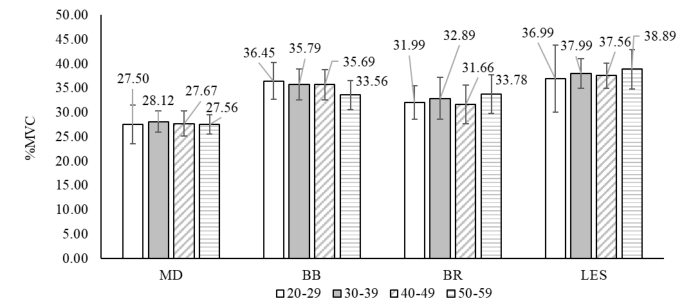
Figure 6 shows the %MVC during shoveling among workers in different age groups. No significant differences in %MVC were found among age groups for any muscle. Across age groups, mean activation ranged from 27.50% to 28.12% MVC in the MD, 33.56% to 36.45% in the BB, 31.66%
to 33.78% in the BR, and 36.99% to 38.89% in the LES. Because %MVC is normalized to each worker’s own maximum voluntary contraction, these results suggest that shoveling imposed a similar relative muscular demand across age groups, regardless of possible age-related differences in muscle strength. However, age-related differences were found in perceived exertion (Figure 3) but not in %MVC. In particular, workers aged 50–59 reported the lowest perceived exertion in all four muscles (7.7–8.1), while showing the numerically highest activation level in the BR (33.78%) and LES (38.89%) muscles. This mismatch suggests that the lower perceived exertion of older workers may be attributed more to differences in how exertion is perceived and reported than to a lower muscular load; for example, older workers may be more accustomed to the physical demands of shoveling or may underreport discomfort. Consequently, relying solely on self-reported exertion could underestimate the physical load experienced by older workers, highlighting the importance of considering both perceived and objective measures when assessing ergonomic risk. Because the 50–59 age group included only a few participants, this pattern should be confirmed with a larger sample.
Figure 6: Muscle activation (%MVC) across age groups.
CONCLUSION
This study examined how BMI, tenure length, and age influence perceived exertion and muscle activation during simulated asphalt shoveling among transportation maintenance workers, using the Borg RPE scale and sEMG. The main findings are as follows: First, shoveling in the transportation industry was perceived as requiring relatively light effort, although muscle activation reached approximately 26–42% MVC, indicating that the actual muscular load was not negligible and that perceived exertion alone may underestimate the physical demands of shoveling. Second, obesity was associated with greater physical exertion: obese workers reported higher perceived exertion in the BB and BR than overweight workers and showed higher LES activation than both normal-weight and overweight workers. Third, workers with more than 2 years of tenure reported lower perceived exertion, particularly in the BB, and showed lower LES but higher BR activation than less experienced workers. Fourth, workers aged 30–39 reported higher perceived exertion than those
Impact of Body Mass Index, Tenure Length, and Age on Physical 1191 aged 50–59 in all four muscles, while workers aged 20–29 reported higher perceived exertion than those aged 50–59 in the BB, BR, and LES. The %MVC did not differ across age groups, indicating a mismatch between perceived and objective exertion among older workers.
These findings enrich existing knowledge on how demographic characteristics affect physical exertion during shoveling and identify workers groups at higher overexertion risk and should be prioritized for ergonomic interventions, such as interventions to reduce lower back loading among workers with obesity or 0–2 years of tenure and to reduce forearm loading among workers with more than 2 years of tenure. The following limitations of this study are acknowledged. First, although the sample size was comparable to that of similar studies, a larger sample would improve the generalizability of the findings. In addition, the 50–59 age group included only a few participants, so findings related to this group should be interpreted with caution. Second, other individual differences, such as physical strength and body posture, may also influence physical exertion. Third, RPE and %MVC were averaged across four shoveling conditions that included exoskeleton and ergonomic-handle interventions; although these conditions were counterbalanced and applied equally to all participants, potential interactions between the interventions and demographic factors were not examined. Future research could examine additional individual characteristics and explore why certain groups, such as overweight and older workers, reported lower perceived exertion.
ACKNOWLEDGMENT
This work was supported in part by the Joint Transportation Research Program administered by the Indiana Department of Transportation and Purdue University. The contents of this paper reflect the views of the authors, who are responsible for the facts and the accuracy of the data presented herein, and do not necessarily reflect the official views or policies of the sponsoring organizations. These contents do not constitute a standard, specification, or regulation. The authors would like to thank Barry Partridge and Michael Lane for their help and support.
2020. Sand shovelling and related injuries among sand mine workers in Nigeria. Scientific African, 8, e00313. Antwi-Afari, M.F., Anwer, S., Umer, W., Mi, H.-Y., Yu, Y., Moon, S. & Hossain, M.U., 2023a. Machine learning-based identification and classification of physical fatigue levels: A novel method based on a wearable insole device. International Journal of Industrial Ergonomics, 93, 103404. Antwi-Afari, M.F., Li, H., Anwer, S., Li, D., Yu, Y., Mi, H.-Y. & Wuni, I.Y., 2021.
Assessment of a passive exoskeleton system on spinal biomechanics and subjective responses during manual repetitive handling tasks among construction workers. Safety Science, 142, 105382.
Antwi-Afari, M.F., Li, H., Chan, A.H.S., Seo, J., Anwer, S., Mi, H.-Y., Wu, Z. & Wong, A.Y.L., 2023b. A science mapping-based review of work-related musculoskeletal disorders among construction workers. Journal of Safety Research, 85, 114–128. Anwer, S., Li, H., Antwi-Afari, M.F. & Wong, A.Y.L., 2021. Associations between
physical or psychosocial risk factors and work-related musculoskeletal disorders in construction workers based on literature in the last 20 years: A systematic review. International Journal of Industrial Ergonomics, 83, 103113. Arias, O., Koenig, G. & Choi, S.D., 2022. Musculoskeletal Acute and Chronic Pain Surveyed among Construction Workers in Wisconsin, United States: A Pilot Study. Sustainability, 14, 13279. Aryal, A., Ghahramani, A. & Becerik-Gerber, B., 2017. Monitoring fatigue in construction
workers using physiological measurements. Automation in Construction, 82, 154–165. Bangaru, S.S., Wang, C. & Aghazadeh, F., 2022. Automated and Continuous Fatigue Monitoring in Construction Workers Using Forearm EMG and IMU Wearable Sensors and Recurrent Neural Network. Sensors, 22, 9729. BLS, 2023. National Census of Fatal Occupational Injuries in 2022 [online]. https://
www.bls.gov/news.release/archives/cfoi_12192023.pdf [Accessed October 16, 2026]. BLS, 2024. National Census of Fatal Occupational Injuries in 2023 [online]. https:// www.bls.gov/news.release/pdf/cfoi.pdf [Accessed October 16, 2026]. Borg, G.A.V., 1982. Psychophysical bases of perceived exertion. Medicine & Science
in Sports & Exercise, 14, 377. Ekpenyong, C.E. & Inyang, U.C., 2014. Associations Between Worker Characteristics, Workplace Factors, and Work-Related Musculoskeletal Disorders: A Cross- Sectional Study of Male Construction Workers in Nigeria. International Journal of Occupational Safety and Ergonomics, 20, 447–462. Engberg, I., Segerstedt, J., Waller, G., Wennberg, P. & Eliasson, M., 2017. Fatigue in
the general population- associations to age, sex, socioeconomic status, physical activity, sitting time and self-rated health: The northern Sweden MONICA study 2014. BMC Public Health, 17, 654. Goubault, E., Martinez, R., Assila, N., Monga-Dubreuil, É., Dowling-Medley, J., Dal Maso, F. & Begon, M., 2022. Effect of Expertise on Shoulder and Upper Limb Kinematics, Electromyography, and Estimated Muscle Forces During a Lifting Task. Human Factors: The Journal of the Human Factors and Ergonomics Society, 64, 800–819. Guo, X., Chen, Y. & Zhang, J., 2022. Exploration of Ergonomic Injuries and Risky
Activities among Transportation Maintenance Workers. International Conference on Transportation and Development 2022. USA: ASCE Library, 129–137. Guo, X., Chen, Y. & Zhang, J., 2023. Applied Ergonomics. West Lafayette, IN, FHWA/IN/JTRP-2023/13. Hu, X., Guo, X., Chen, Y. & Zhang, J., 2024. Video-based Ergonomic Risk
Assessment among Transportation Maintenance Workers in Shoveling. In T.Z. Ahram & W. Karwowski (eds.) AHFE (2024) International Conference. USA: Human Factors in Design, Engineering, and Computing. Kenny, G.P., Yardley, J.E., Martineau, L. & Jay, O., 2008. Physical work capacity in older adults: Implications for the aging worker. American Journal of Industrial Medicine, 51, 610–625. Lambay, A., Liu, Y., Ji, Z. & Morgan, P., 2022. Effects of Demographic Factors for
Fatigue Detection in Manufacturing. IFAC-PapersOnLine, 55, 528–533. Lewinson, R.T., Rouhi, G. & Robertson, D.G.E., 2014. Influence of snow shovel shaft configuration on lumbosacral biomechanics during a load-lifting task. Applied Ergonomics, 45, 234–238.
Impact of Body Mass Index, Tenure Length, and Age on Physical 1193 Lim, W., Hong, S., Nelesen, R. & Dimsdale, J.E., 2005. The Association of Obesity,
Cytokine Levels, and Depressive Symptoms With Diverse Measures of Fatigue in Healthy Subjects. Archives of Internal Medicine, 165, 910–915. Plamondon, A., Delisle, A., Bellefeuille, S., Denis, D., Gagnon, D. & Larivière, C.,
2014. Lifting strategies of expert and novice workers during a repetitive palletizing task. Applied Ergonomics, 45, 471–481. Thamsuwan, O., Milosavljevic, S., Srinivasan, D. & Trask, C., 2020. Potential exoskeleton uses for reducing low back muscular activity during farm tasks. American Journal of Industrial Medicine, 63, 1017–1028. Umer, W., Li, H., Yantao, Y., Antwi-Afari, M.F., Anwer, S. & Luo, X., 2020. Physical
exertion modeling for construction tasks using combined cardiorespiratory and thermoregulatory measures. Automation in Construction, 112, 103079. Vitale, E., Lupo, R., Lezzi, A., Artioli, G., Zacchino, S., Valenzano, L. & Conte, L.,
2023. Which socio-demographic characteristics impact on the fatigue conditions in nurses: an Italian investigatory study. Acta Biomed, 94, e2023175. Weir, C.B. & Jan, A., 2022. BMI Classification Percentile And Cut Off Points: StatPearls Publishing, Treasure Island (FL). Wolkiewicz, C., Collins, K., Aqlan, F. & Meanazel, O.T.A., 2018. Ergonomic
Assessment of Snow Shovels Using Digital Human Modeling. Proceedings of the International Conference on Industrial Engineering and Operations Management Washington DC, USA. Yoon, J.H., Park, N.H., Kang, Y.E., Ahn, Y.C., Lee, E.J. & Son, C.G., 2023. The demographic features of fatigue in the general population worldwide: a systematic review and meta-analysis. Front Public Health, 11, 1192121.
SEARCH THE AHFE DIGITAL BOOKSTORE BY ISBN
Explore the complete digital volume
Human Factors in Design, Engineering, and Computing
Read this individual research paper free through the original publisher, or explore the full digital proceedings book.