Erman Çakıt (2026). Integrating Ergonomics, Lean Manufacturing, and Work Study to Improve Overall System Performance Within Industry 5.0. In: Human Factors in Design, Engineering, and Computing. AHFE Open Access, vol. 238, pp. 2412–2421. https://doi.org/10.54941/ahfe1008466
This paper develops a conceptual framework for integrating ergonomics, lean manufacturing, and work-study methods within an Industry 5.0-oriented work system. Although these approaches address related aspects of work-system performance, they commonly use different measures, analytical perspectives, and improvement routines. The resulting separation can make it difficult to evaluate productivity, operational flow, and worker-related outcomes simultaneously. The proposed framework addresses this integration problem by defining four operational integration points: process observation, value-stream mapping, standard-work documentation, and the Plan-Do-Check-Act (PDCA) cycle. At each point, ergonomic exposure, lean flow and waste information, and work-study method and time measurements are retained as distinct evidence types and incorporated into a shared improvement output. The resulting framework comprises a unified observation record, an exposure-and-flow-augmented value-stream map, an integrated standard-work sheet, and a joint improvement log with multidimensional acceptance criteria. The paper does not claim empirical effectiveness; rather, it establishes a conceptual architecture and specifies measurable outcomes for future field validation. The proposed validation should assess productivity, quality, ergonomic exposure, and worker-related outcomes before and after implementation and compare the results with conventional improvement practices. This provides a basis for testing whether integrated improvement can achieve operational gains without transferring costs to worker health or workload.
Industry 5.0 is about people, about sustainability and about resilience which requires new ways of thinking about how manufacturing systems are designed and operated (Ivanov, 2023). Traditional productivity models, in which human operators were seen as a cost to be reduced, are being turned on their head. In an Industry 5.0 context, humans are assets whose skill, wellbeing and engagement underpin performance rather than undermine it (Barata and Kayser, 2023; Leng et al., 2022). Ergonomics, work study and lean manufacturing all look at the same entity; the work system; but they measure it in different terms, they optimise for different outcomes, and in
Integrating Ergonomics, Lean Manufacturing, and Work Study 2413 most places are owned by different functions. Ergonomics is an enabler of sustainable work, and Industry 5.0 makes the cost of separation between these approaches visible since none can deliver the human-centric mandate on its own.
Three observations motivate the integration:
Attempting to lean without considering ergonomics can have the effect of increasing the amount of work. Takt-driven line balancing, standardised work and the elimination of waste eliminate idle time; in the case where the time that is eliminated is also recovery time, the same measures that increase throughput also increase exposure of the musculoskeletal system.
Ergonomics cannot provide quantities in the absence of work study;
although risk assessment methods deal with posture and load, it is the frequency, duration and cycle structure which determine cumulative exposure and these come from work measurement. If the quantities are not available, the ergonomic argument remains qualitative and can therefore be outweighted by a productivity case that has been costed.
Neither can be carried out well without Lean’s improvement infrastructure. Lean provides what ergonomics has always lacked, namely a standing routine (comprising kaizen events, standard work, visual management, and layered audits) by means of which a design change becomes permanent instead of remaining a report.
Existing research has established important connections between ergonomics and lean manufacturing, including integrated ergonomic assessment in lean production environments and the development of productivity and wellbeing indicators for human–robot workstations (Bittencourt et al., 2023; Colim et al., 2021; Brito et al., 2019; Cirjaliu and Draghici, 2016; Arezes et al., 2015; Grabowska et al., 2022). However, these approaches do not necessarily specify how work-study measurements of task sequence, method, frequency, and standard time can be systematically integrated with ergonomic exposure and lean flow information within the same improvement process.
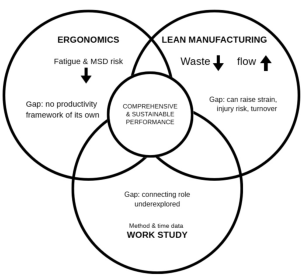
Figure 1: Each discipline’s competence and its characteristic gap.
2414 Çakıt The contribution of the present study is therefore not the general proposition that ergonomics, lean manufacturing, and work study should be considered together. Rather, it is the specification of an operational integration architecture that defines where and how evidence from the three domains is combined.
A conceptual framework is shown in Figure 1 which combines ergonomics, lean manufacturing, and work study in order to attain both comprehensive and sustainable performance. While ergonomics mainly aims at reducing fatigue and the risk of musculoskeletal disorders (MSD), its impact on productivity is not always dealt with by means of a specific productivity framework. Lean manufacturing stresses the need to reduce waste and improve flow, but its application can lead to greater strain on workers, a higher risk of injury, or increased turnover if human factors are not adequately taken into account. Work study offers data on methods and time that can link human factors with improvements in productivity, even though this role of linking is still not well explored. It is therefore possible for the three approaches to supplement one another in the areas where they overlap, and having them integrated at the centre enables a more holistic approach that takes into consideration both worker well-being and operational efficiency as well as sustainable performance.
THE THREE TRADITIONS IN BRIEF Ergonomics/HFE: The research field studies human behavior when they engage with different systems while the professional field uses this understanding to develop systems and their components and workplace designs which enhance human health and system efficiency (Karwowski and Zhang, 2021). Three levels of application: micro (workplace, work tool, human machine interaction); meso (line, cell, shift pattern); macro (organisation, work system).
Work study: Two synchronised parts. The research process studies work methods through documentation and analysis to develop improved approaches which show how long skilled employees need to finish their duties while achieving target productivity and taking required breaks (Groover and Groover, 2007). The system depends on its quantitative base which shows how other traditions spend their time through frequency and duration and cycle structure and standard time.
Lean manufacturing: A production system depends on customer value definitions to remove waste elements from the value stream while workers keep their standard work routines and use pull systems and visual controls and maintain continuous improvement practices (Gupta and Jain, 2013).
What Industry 5.0 adds: The evaluation system lacks established standards because it merges human-centricity and sustainability and resilience through a combination of related technologies which include cobots and exoskeletons and digital human modeling and wearable sensors and XR training and AI decision support systems. The human-centric objective receives support or encounters opposition through various elements which demonstrate their effects based on how their associated tasks get developed.
Table 1: The limits of single-discipline improvement.
No built-in productivity framework; efforts stay disconnected from operational objectives
Fitting workstations, tasks and environments to human physical and cognitive abilities Lean manufacturing Eliminating waste, improving flow, maximising customer value along the value stream Value stream mapping, 5S, kaizen, standardised work, pull systems
Effective, well-diffused tools for waste reduction and flow improvement
Constant efficiency drive can unintentionally raise physical and mental strain, injury risk and turnover Strong analytical basis for task content and duration
Work study Analysing how tasks are performed (method study) and how long they take (time study)
Process charts, motion study, time study, predetermined motion-time systems, work sampling
Connecting role between ergonomics and lean remains largely underexplored in current practice and research
Table 1 restates the diagnosis in the abstract as a structured comparison: what each discipline is built to do, and precisely where that competence runs out. The table presents a detailed comparison between ergonomics/human factors and lean manufacturing and work study through their fundamental areas of concentration and their main instruments and their individual advantages and disadvantages. Ergonomics works to fit human body and mind abilities into workplace stations and assignments and surrounding spaces by using assessment tools which include RULA and REBA and the NIOSH lifting equation and anthropometric design and workload evaluation methods. The system provides direct benefits to workers by lowering their risk of developing musculoskeletal disorders and reducing their fatigue levels but it lacks a built-in system for monitoring productivity and it operates without any connection to operational goals. Lean manufacturing centers its operations on waste elimination and flow enhancement and customer value optimization through tools which include value stream mapping and 5S and kaizen and standardized work and pull systems. The methods help organizations improve their operational flow but their focus on efficiency could lead to increased worker fatigue and higher chances of workplace accidents and staff departures. The research method of work study uses method and time study to study work methods and measure task completion times through various tools which include process charts and motion study and time study and predetermined motion-time systems and work sampling. The system achieves its strongest performance through its ability to analyze
2416 Çakıt work assignments and duration requirements but scientists have yet to investigate its potential to link ergonomic concepts with lean manufacturing principles.
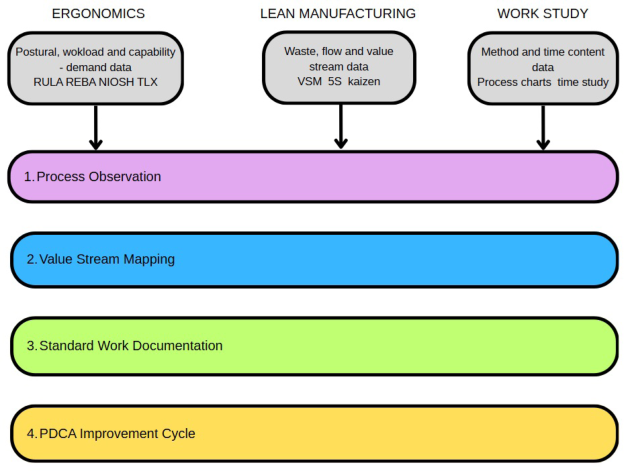
THE INTEGRATION FRAMEWORK: FOUR SHARED POINTS The proposed framework in Figure 2 introduces four explicit integration points: (1) a shared process-observation record, (2) an exposure-and-flow- augmented value-stream map, (3) an integrated standard-work sheet, and (4) a joint PDCA improvement log with multidimensional acceptance criteria. At each point, ergonomic exposure, operational flow/waste, and work-method/time information are retained as distinct evidence types but evaluated within the same improvement activity.
Figure 2: The integration framework.
This structure is intended to reduce the risk that productivity improvements are assessed independently of worker exposure or that ergonomic improvements are evaluated without quantifying their operational implications. The framework therefore provides a testable architecture for human-centred continuous improvement rather than claiming that integration itself has already been demonstrated to improve performance. Table 2 shows how ergonomics and lean and work study systems combine into one improvement system which functions as a single system instead of operating as three separate programs. The system consists of four main integration points which include process observation and value stream mapping and standard work documentation and the PDCA cycle. The system shows what each discipline offers to every integration point. The main goal of this project
Integrating Ergonomics, Lean Manufacturing, and Work Study 2417 involves developing a shared document which unites employee security data with their physical work requirements and operational performance data and time and method measurement accuracy.
Table 2: The four integration points: what each discipline contributes and the joint output produced.
Table available in the original PDF paper.
Lean Contributes Work Study
Joint Output
Integration Point
Ergonomics Contributes
Contributes
Process observation
Value/waste classification of each element
Posture, force and repetition coding of each element
Element breakdown, sequence and elapsed time
A single annotated observation record read by all three disciplines
Value stream mapping
An exposure-and- flow-augmented value stream map
Station-level exposure index overlaid on the map
Flow, inventory and lead-time data along the stream
Standard time per process box, replacing estimates
Standard work documentation
Sequence, takt and work-in- process limits
Standard time and allowances per element
Adjustability ranges and permissible postures
One standard work sheet, not three separate documents The before/after measurement of method and time
PDCA cycle Risk criteria for evaluating any proposed change
The improvement cadence and event structure
A joint improvement log with balanced acceptance criteria Process observation forms the initial stage of the integration process. The observation process allows ergonomics to detect which physical tasks workers perform through their body positions and their need for strength and their actual work routines. The same elements receive evaluation through Lean which identifies value creation from waste production through its assessment of activities that generate value and activities that produce waste through various forms of waste including waste movement and waste waiting and waste transportation and waste overprocessing. Work study provides an in-depth examination of all elements which shows their complete sequence and the total time needed to perform them. The three methods merge into one document which presents all observations through an annotated record that three different fields can understand and apply.
The second integration point is value stream mapping. The traditional Lean value stream map focuses on tracking material and information movements which shows how materials move and what inventory levels exist and how long things take to arrive. The integrated method applies ergonomics to create a workstation exposure scale which enables physical exposure data and ergonomic requirements for each workstation to appear on value stream maps. Work study provides standard time for each process box so the map displays times which come from actual measurements or established standards instead of using approximate numbers. The outcome of this process produces an exposure-and-flow-augmented value stream map which enables simultaneous evaluation of process efficiency and worker exposure.
2418 Çakıt Standard work documentation operates as the third integration point in this system. The field of ergonomics provides data about how people can adjust their positions and which body positions remain within acceptable limits. Standard work documentation requires employees to perform their tasks while following defined body positions and using designated work area modifications. Lean functions through its work sequence system which establishes takt time and defines work-in-process boundaries. The Lean system establishes work patterns through defined sequences which work systems follow while it controls system work volume. Work study provides detailed time standards which include all necessary work element allowances to establish exact time values for documentation purposes. The three separate documents unite their information into a single standard work sheet which creates better usability while maintaining all ergonomic and Lean and work-study requirements.
The fourth integration point is the PDCA cycle, meaning Plan–Do–Check– Act. The table shows a system which uses continuous improvement as its operational method. The risk assessment process in ergonomics evaluates proposed changes through specific criteria which prevent system speed improvements from becoming indicators of successful changes because they must also evaluate physical danger levels. Lean provides a structured system through its improvement cadence and event structure which enables organizations to organize their improvement activities. Work study delivers measurement results which show changes in work methods and time requirements to help teams evaluate if their suggested modifications produced actual work method alterations and time savings. The final joint output is a joint improvement log with balanced acceptance criteria, meaning that improvements can be evaluated using multiple dimensions rather than relying on efficiency alone.
The table shows how different fields work together to improve workplace operations. The field of ergonomics evaluates whether workers can perform their tasks without physical harm while Lean evaluates whether processes generate maximum value through minimum waste production. The study of work methods involves two primary questions about task execution and total work hours required for completion. Organizations need to combine scientific management systems with human relations approaches during their entire development process. The process requires an improvement which should boost operational speed and maintain ergonomic safety standards and provide complete outcome measurement systems. The integration process generates unified documents which contain shared measurements that all three fields can access instead of each field operating separately.
EMPIRICAL VALIDATION PLAN This framework is presented as a concept that has not yet been subjected to empirical testing, so statements suggesting any increases in productivity, improved safety, or better worker outcomes should be viewed as hypotheses to be tested as opposed to proven outcomes. A field-based validation is recommended to test if integrating ergonomics, lean, and
Integrating Ergonomics, Lean Manufacturing, and Work Study 2419 work study will deliver benefits beyond traditional improvement practices. A validation could involve one or more workstations or a production cell in a manufacturing environment where manual repetitive operations are performed. The experiment could follow a before-after design, ideally with a control workstation or a production cell applying traditional improvement practice alongside it. The treatment would be to apply the four integration points proposed in the framework: shared observation of the process, exposure-and-flow-augmented value stream mapping, the integrated standard work document, and the joint PDCA improvement log.
Outcome measures should be multidimensional as opposed to productivity alone. Measures of operational performance might include cycle time, throughput, lead time, process variability and productivity. Quality performance might include measures such as defect rate, rework or first- pass yield. Measures of ergonomic outcome might include measurements of posture using a validated observation method such as RULA or REBA, and measures of repetition, force, duration, and exposure frequency as relevant. Measures of worker related outcome might include a worker-rated measure of perceived physical workload, discomfort, fatigue or other validated worker- rated measures. These outcomes measures should be obtained at baseline and following implementation using validated measures and consistent administration procedures.
The main empirical question would then be if the integrated framework improves operational performance without increasing or even while decreasing ergonomic exposure and burden on the workers. A second would concern the existence of trade-offs that would otherwise elude detection when a productivity analysis and an ergonomic analysis are performed independently. Finally, a third question would refer to the four joint outputs and their effect on the homogeneity and traceability of the continuous- improvement decisions. Thus, validation may be formulated as the following propositions: P1: The integration of the framework has led to quantitative improvements in performance.
P2: The integrated framework not only increases operational performance but reduces or maintains ergonomic exposure at the same time.
P3: Concurrent measurement of ergonomic and operational parameters exposes the compensation interactions that occur between these two metrics when they are analyzed separately.
P4: These four shared integration outputs facilitate tracing of improvement decisions by providing linkage between observed work practices, ergonomic exposure, process performance, and improvements applied by means of PDCA.
These propositions are primarily articulated as testable propositions rather than hypotheses, supported with evidence of the current study, because no data have been obtained from field data. They are to be tested in field studies with appropriate statistical study designs, based on the number of workstations, workers and repeated observations.
CONCLUSION
This paper developed a conceptual framework for integrating ergonomics, lean manufacturing, and work-study methods within an Industry 5.0-oriented work system. The purpose was not to claim that these three traditions have previously been entirely separate, but to specify how their complementary evidence can be connected within a common improvement process. The proposed framework identifies four operational integration points: process observation, value-stream mapping, standard-work documentation, and the PDCA cycle. At these points, ergonomic exposure, lean flow and waste information, and work-study method and time measurements are retained as distinct evidence types but incorporated into shared improvement outputs. These outputs consist of a unified process-observation record, an exposure- and-flow-augmented value-stream map, an integrated standard-work sheet, and a joint improvement log with multidimensional acceptance criteria. The principal conceptual contribution is therefore the operationalization of integration. Rather than treating ergonomics, lean, and work study as parallel improvement activities, the framework identifies specific points at which their information can be combined and subsequently evaluated using common performance criteria. This structure also makes potential trade-offs more visible: an improvement should not be considered successful solely because cycle time or throughput increases if the change simultaneously increases ergonomic exposure or worker burden.
The study has an important limitation. The proposed framework has not yet been empirically validated, and consequently no causal claims can be made regarding its effects on productivity, safety, quality, or worker outcomes. The framework should therefore be regarded as a testable conceptual architecture rather than a demonstrated intervention. Future research should implement the framework in manufacturing workstations or production cells and compare baseline and post-intervention performance, preferably against a conventional improvement condition. Productivity, quality, ergonomic exposure, and worker-related outcomes should be assessed simultaneously. Such field validation would determine whether the proposed integration produces measurable benefits and, importantly, whether it reduces the risk of transferring improvement costs from one performance dimension to another. Empirical testing would also establish whether the four shared outputs provide practical value for coordinating ergonomics, lean, and work-study activities in real production environments.
REFERENCES
Arezes, P. M., Dinis-Carvalho, J., & Alves, A. C. (2015). Workplace ergonomics in lean production environments: A literature review. Work, 52(1), 57–70. Barata, J., & Kayser, I. (2023). Industry 5.0–past, present, and near future. Procedia
Computer Science, 219, 778–788. Bittencourt, V., Buchbinder, M., Saakes, D., & Thiede, S. (2023). Integrated lean and ergonomic assessment for the planning of human-centered factories. Procedia CIRP, 120, 344–349.
Integrating Ergonomics, Lean Manufacturing, and Work Study 2421 Brito, M. F., Ramos, A. L., Carneiro, P., & Gonçalves, M. A. (2019). Ergonomic
analysis in lean manufacturing and industry 4.0—A systematic review. Lean Engineering for Global Development, 95–127. Cirjaliu, B., & Draghici, A. (2016). Ergonomic issues in lean manufacturing. Procedia- Social and Behavioral Sciences, 221, 105–110. Colim, A., Morgado, R., Carneiro, P., Costa, N., Faria, C., Sousa, N., ... & Arezes,
P. (2021). Lean manufacturing and ergonomics integration: Defining productivity and wellbeing indicators in a human–robot workstation. Sustainability, 13(4), 1931. Grabowska, S., Saniuk, S., & Gajdzik, B. (2022). Industry 5.0: Improving humanization and sustainability of Industry 4.0. Scientometrics, 127(6), 3117–3144. Groover, M. P., & Groover, M. P. (2007). Work systems and the methods,
measurement, and management of work (Vol. 2007). Upper Saddle River, NJ: Pearson Prentice Hall. Gupta, S., & Jain, S. K. (2013). A literature review of lean manufacturing. International journal of management science and engineering management, 8(4), 241–249. Ivanov, D. (2023). The Industry 5.0 framework: Viability-based integration of the
resilience, sustainability, and human-centricity perspectives. International Journal of Production Research, 61(5), 1683–1695. Karwowski, W., & Zhang, W. (2021). The discipline of human factors and ergonomics. Handbook of human factors and ergonomics, 1–37. Leng, J., Sha, W., Wang, B., Zheng, P., Zhuang, C., Liu, Q., ... & Wang, L. (2022).
Industry 5.0: Prospect and retrospect. Journal of Manufacturing Systems, 65, 279–295.
SEARCH THE AHFE DIGITAL BOOKSTORE BY ISBN
Explore the complete digital volume
Human Factors in Design, Engineering, and Computing
Read this individual research paper free through the original publisher, or explore the full digital proceedings book.