Shigekazu Ishihara, Hiroyoshi Ohara (2026). Improving Sitting Posture With Back- Pressure Stimulation From a Carbon- Fiber-Reinforced Plastic Chair. In: Human Factors in Design, Engineering, and Computing. AHFE Open Access, vol. 238, pp. 2441–2450. https://doi.org/10.54941/ahfe1008469
A carbon-fiber-reinforced plastic (CFRP) lumbar-support chair was developed to provide localized back pressure as a proposed sensorimotor stimulus. Two separate pilot studies evaluated pressure delivery and external sitting geometry. In Study 1, five male students tested two commercial chairs and two CFRP prototypes in individually randomized order. Active-cell counts (pressure > 5 g/cm²) were lower for the prototypes (121.2–127.8) than for the commercial chairs (246.6–249.6); a Greenhouse–Geisser-corrected repeated-measures ANOVA indicated an overall chair effect, F(1.318, 5.271) = 39.50, p = 0.000957. These findings show that the CFRP prototypes apply pressure to a smaller, targeted area of the back. Study 2 analyzed eight selected Office–CFRP scan pairs from an office-work project targeting end-of-workday posture. Texture-free overlays and an 80 × 50 mm collar-referenced upper-back region were evaluated. Mean local inclination was 31.60° for Office and 26.98° for CFRP; six participants showed a smaller angle with CFRP. The mean difference was −4.62° (95% CI −10.07 to 0.83), t(7) = −2.003, p = 0.085; Cohen’s dz = −0.708 and Hedges’ gz = −0.629. Exact sign-flip analysis yielded p = 0.102. Although not statistically significant, the data showed a numerical tendency toward a more vertical local upper-back surface with CFRP. The findings support staged evaluation, not an established muscular mechanism or reduced spinal loading. Small samples, clothing, retrospective scan selection, and separate-day assessment limit interpretation.
Lumbar support may influence both mechanical load sharing and sensory input. Slumped sitting has been associated with flexion relaxation in thoracic erector spinae and a possible increased contribution of passive spinal tissues to support (Callaghan and Dunk, 2002). The present design uses modest localized lumbar pressure as a proposed sensorimotor stimulus to encourage appropriate muscular participation and postural adjustment, rather than merely passive support.
Pressure stimulation can modulate sensory and motor systems, but its functional muscular effects require verification (Hok and Hlustik, 2020).
2442 Ishihara and Ohara Related tactile lumbar supports and localized backrests provide partial evidence, without establishing the complete pathway from lumbar pressure through muscle recruitment and postural correction to reduced internal loading (Saito et al., 2014; Yoo et al., 2008). Accordingly, this study implements a sensorimotor design principle in a lumbar-support chair and evaluates its operation in stages, rather than reproducing an established therapeutic effect.
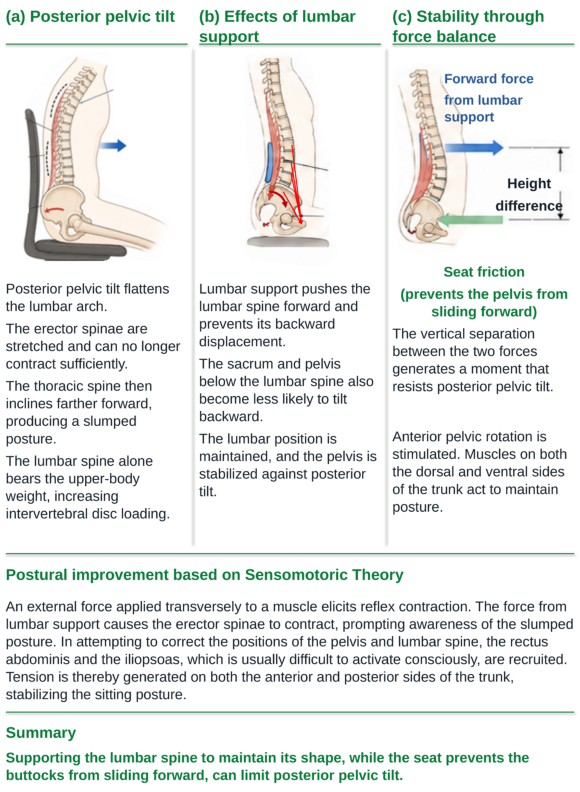
Recycled CFRP was molded into integrated, approximately 1.6–2.0 kg ALL CARBON CHAIR prototypes. Figure 1 summarizes the proposed mechanical and sensory pathways. Study 1 evaluates targeted pressure delivery; Study 2 examines external sitting geometry. The samples were separate, and pressure and posture were not measured concurrently. The illustrated muscle-recruitment sequence remains a hypothesis.
Figure 1: Proposed mechanical and sensorimotor account: (a) posterior pelvic tilt, (b) lumbar support and postural response, and (c) force balance. The illustrated muscle responses and reduction of spinal loading are design hypotheses, not measurements from these studies.
MATERIALS AND METHODS
The two pilot datasets were analyzed separately. Independent units were five participants in the four-chair pressure study and nine participants in the paired scan analysis; sensing cells and mesh points were not treated as additional participants.
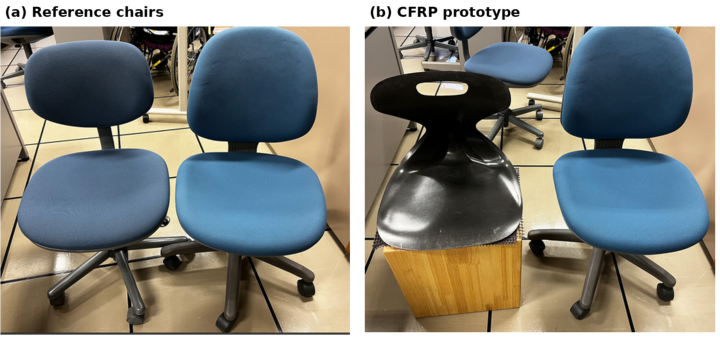
Study 1: Participants and Chair Conditions Five male university students participated (height 161–175 cm; mass 46–77 kg; BMI 17.75–26.33 kg/m²). Each tested all four chairs, with order randomized separately for each participant. Sanwa Supply had a long, reclined backrest with a forward-projecting lower portion; Itoki had no lumbar support. The CFRP prototypes, CarbonThin and CarbonThick, had 2- and 4-mm backrests, respectively. Seat heights were identical. Complete chair configurations, rather than material alone, were compared (Figure 2).
Figure 2: Study 1 chairs. (a) Itoki (left) and Sanwa Supply (right). (b) CFRP prototype (left) and Sanwa Supply (right). The photographs do not distinguish the two CFRP thicknesses.
Study 1: Pressure Measurement An MC266 Sensing Cushion Sensor Seat System (Maxrays Tech. Co. Ltd., Shenzhen, China) provided a 20 × 20 sensing matrix in a 438 × 438 mm flexible sheet. Calibration related voltage to known weights on an approximately 1 cm² element; values retain the original g/cm² convention.
Participants sat normally without prescribed backrest loading. After approximately 1 min, stable readings were confirmed visually and one pressure map was analyzed; no temporal averaging was performed. Active cells were measurement cells with pressure strictly greater than 5 g/cm². Values ≤5 g/cm² were displayed as zero, and the visualization-only maximum-value marker was excluded. The count measures above-threshold detection extent, not continuous anatomical contact area; lumbar localization was assessed qualitatively.
Chair condition was analyzed as a within-participant factor using a one-way repeated-measures ANOVA with Greenhouse–Geisser correction on the degrees of freedom at the F-test; participants, not sensing cells, were the statistical units (Gueorguieva and Krystal, 2004). For participant i = 1, …, 5 and condition j = 1, …, 4, active-cell count was modeled as µ α = + + + , ij j i ij Y s e (1)
where μ is the grand mean, αj the chair effect, si the participant-specific overall deviation, and eij the residual. The four observations of participant i were modeled jointly as Yi ~ 𝒩4 (Xcβ, Σ). (2)
Here, 𝒩4 denotes the four-dimensional multivariate normal distribution. The 4 × 1 vector Xc β contains the four condition population means; the 4 × 4 matrix Σ contains condition variances on the diagonal and within- participant covariances off the diagonal. Different participants’ vectors were assumed independent. The omnibus null hypothesis was µ µ µ µ = = = 0 Sanwa Itoki CarbonThin CarbonThick : . H (3)
Partial eta squared was reported. All six paired, two-sided t-tests formed one Holm-adjusted family. Exact Friedman and pairwise sign-flip analyses assessed sensitivity to parametric assumptions; pairwise findings were exploratory. The additive expression did not impose independent residuals across a participant’s four observations.
Study 2: Participants and Acquisition Study 2 compared conventional office-chair seating (Office) with a CFRP unit placed within the office-chair seating arrangement (CFRP). Of 11 same- person pairs, two failed the existing mesh-quality criterion described below. The final set comprised nine pairs, relabelled P01–P09 for reporting.
The core project involved bank office workers scanned before 17:00 after day-long chair use, in their usual working posture with close backrest contact. End-of-workday assessment targeted possible fatigue-related difficulty maintaining upright posture; fatigue was not measured. Protocol equivalence across recovered and added scans requires verification.
Study 2: Mesh Processing and Surface Measures The reported setup was an iPhone 13 Pro with Scaniverse 5.2.8 (“Mesh scan”; “Medium size object”). Stored metric units and the Y-up axis lacked independent calibration. Texture-free overlays used yaw/horizontal translation preserving Y, or unrestricted rigid iterative closest point (ICP) registration. Area-weighted samples at Y = 0.05–1.18 m used the closest 85% of correspondences. Room geometry was cropped where needed for registration/display only. Outcomes used original triangles before unrestricted ICP, without rescaling, nonrigid deformation, or hole filling.
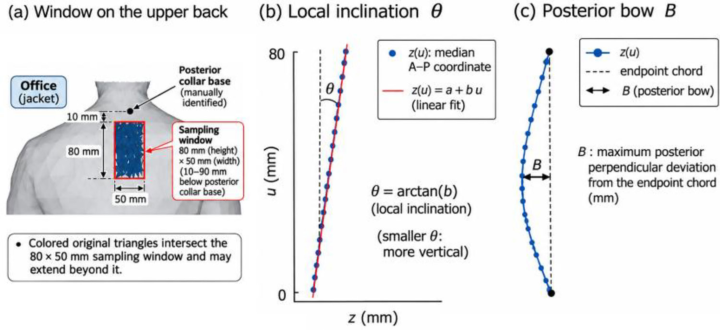
Improving Sitting Posture With Back-Pressure Stimulation 2445 Backrest-window reconstructions mixed chair mesh, clothing, and missing regions. Quantitative comparisons therefore used visible upper-back clothing: an 80-mm-high, 50-mm-wide band 10–90 mm below a manually identified posterior collar base (Figure 3). At 81 heights, the median anterior–posterior coordinate of 11 rays at 5-mm lateral spacing defined z(u). The 1-mm vertical interval is a calculation interval, not scanner precision. Local inclination was
( ) ( ) θ = + = , arctan . z u a bu b (4) A smaller positive θ denotes a more vertical local surface, not a whole-trunk or lumbar angle. Posterior bow was the maximum posterior perpendicular deviation from the endpoint chord, in mm. Intersected original triangles could extend beyond the nominal window. P08 wore a jacket in Office and a shirt in CFRP, leaving garment-related geometric uncertainty.
Figure 3: Upper-back measurement regions, definitions of inclination and posterior bow.
The existing gross-quality rules flagged an intersected triangle with vertical span >40 mm or a profile step >5 mm; a failure in either condition excluded the pair. These checks are not accuracy validation. Sensitivity scenarios shifted height ±5/10 mm, width to 30/70 mm, lateral position ±10 mm, or yaw ±5°; discontinuous scenarios were invalidated.
Study 2: Paired Inference and Effect Sizes For each local angle A, differences were CFRP minus Office; the null was a zero population mean difference. Two-sided paired t-tests used n = 9 and df = 8:
D D A A t
(5) s n
= − = ,CFRP ,Office, . / i i i D
2446 Ishihara and Ohara Mean differences have ordinary 95% confidence intervals. Cohen’s dz = D̄/sD standardizes by the SD of paired differences (Lakens, 2013); Hedges’ gz = 0.902703dz applies the small-sample correction for df = 8 (Hedges, 1981). A 95% interval for the population standardized paired effect was obtained by noncentral-t inversion (Kelley, 2007).
All 512 studentized sign flips were enumerated assuming independent differences symmetric under the null, not randomized assignment (Winkler et al., 2014). Holm correction covered angle and bow. The threshold remained two-sided 0.05; retrospective selection and interim analyses require exploratory interpretation. A supplementary whole-profile test used maximum |t| across heights, flipping each participant’s entire difference curve as a unit.
RESULTS
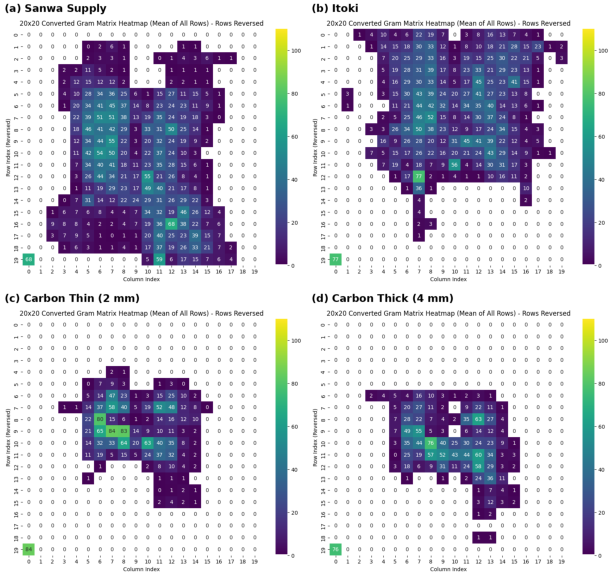
Study 1: Pressure Delivery Mean active-cell counts (SD) were 249.6 (32.25) for Sanwa, 246.6 (33.77) for Itoki, 121.2 (38.21) for CarbonThin, and 127.8 (40.29) for CarbonThick. Both prototypes had fewer active cells than both conventional chairs in every participant. Representative maps localized prototype contact near the intended lumbar region (Figure 4).
Figure 4: Representative pressure maps: (a) Sanwa Supply, (b) Itoki, (c) Carbon Thin, and (d) Carbon Thick. Each is one visually stable snapshot. The lower-left maximum- value display was excluded from analysis. The maps are neither temporal nor group averages.
Improving Sitting Posture With Back-Pressure Stimulation 2447 The chair effect was significant, F(1.318, 5.271) = 39.50, p = 0.000957, ε = 0.439, ηp
2 = 0.908. The exact Friedman p was 0.00136. Holm-adjusted significant paired contrasts (conventional minus CFRP) were Sanwa– CarbonThin, 128.4 cells (p = 0.01441); Sanwa–CarbonThick, 121.8 (p = 0.01337); Itoki–CarbonThin, 125.4 (p = 0.01048); and Itoki–CarbonThick, 118.8 (p = 0.00591).
Each conventional–CFRP exact sign-flip p was 0.0625; pairwise significance depended on parametric assumptions. Similar-looking peak pressures in the representative maps did not establish equivalent or acceptable loading.
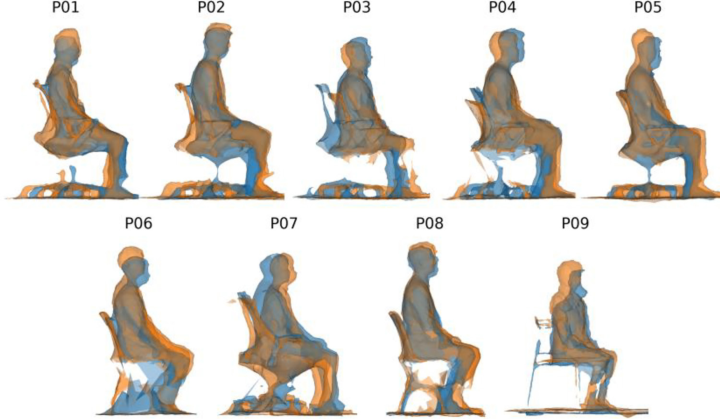
Study 2: Whole-Envelope Comparison Of 22 scans from 11 participants, three exceeded the 40-mm facet-span criterion: one scan in one pair and both scans in another. Those two pairs were excluded. All 18 retained scans passed the baseline screens (Figure 5). P04 CFRP remained close to the boundary (39.2 mm). Coarse or missing surfaces outside the local region remained; the screen does not validate accuracy.
Figure 5: Nine human–chair envelope overlays at a common scale (P01–P09). Blue: Office; orange: CFRP. The stored vertical axis is preserved, with only yaw and horizontal translation optimized. Differences include posture, clothing, chair configuration, and reconstruction.
Whole-envelope differences were heterogeneous around the head, backrest, seat, and limbs. The overlays are not anatomical displacement maps. Unrestricted ICP may absorb an inclination difference and was therefore used only for visual comparison.
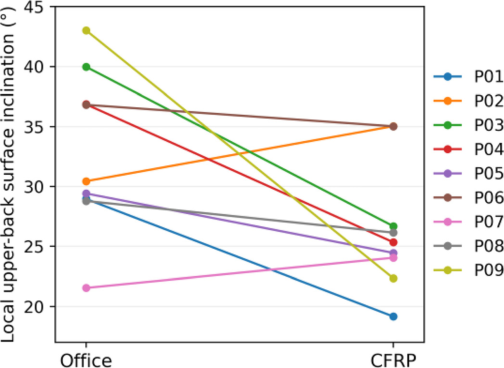
Study 2: Individual Surface Inclination Seven participants had a smaller local inclination with CFRP and two had a larger inclination (Figure 6). Paired changes ranged from −20.69° to +4.60°. P09 had the largest decrease (−20.69°); the response direction was not uniform.
Figure 6: Paired local upper-back inclinations for P01–P09. Lines connect the same participant. Display order is not acquisition order. Angles describe the 80 × 50 mm clothing surface, not the whole trunk or lumbar spine
Study 2: Mean Difference and Effect Size Mean inclination was 32.87° (SD 6.74) for Office and 26.47° (SD 5.34) for CFRP. The mean paired difference was −6.40° (95% CI −12.64 to −0.16), t(8) = −2.366, unadjusted p = 0.0455. Exact sign-flip p was 0.05078125 (26/512). Cohen’s dz was −0.789, and Hedges’ gz was −0.712; the 95% population standardized paired-effect interval was −1.526 to −0.015.
The local surface was more vertical on average with CFRP. Only the unadjusted t-test crossed the 0.05 threshold; the exact sign-flip test and the multiplicity-adjusted tests did not. Thus, significance depended on the analysis, despite the direction observed in seven of nine participants.
Study 2: Posterior Bow and Sensitivity Posterior bow averaged 4.10 mm in Office and 3.93 mm in CFRP: difference −0.17 mm (95% CI −2.24 to +1.90; t-test p = 0.8566; sign-flip p = 0.8477). After Holm correction across both outcomes, inclination p-values were 0.0911 for the t-test and 0.1016 for sign flips.
Across valid geometric sensitivity settings, mean angle differences ranged from −7.17° to −5.90°, with p-values crossing 0.05 across settings. The whole- profile maximum-|t| sign-flip p was 0.0703125. Omitting P09 reproduced the earlier eight-pair result (t-test p = 0.0853; sign-flip p = 0.1016), illustrating sensitivity to this participant; P09 was retained.
DISCUSSION
The two studies address separate stages of the design concept. Study 1 demonstrated more spatially restricted above-threshold contact, with representative lumbar localization. Study 2 showed smaller mean local
Improving Sitting Posture With Back-Pressure Stimulation 2449 upper-back inclination with CFRP; however, significance was confined to the unadjusted paired t-test. Together, these observations justify further staged investigation rather than establishing the sequence from pressure stimulus to muscular recruitment, lumbopelvic correction, and reduced internal loading. The samples differed and measurements were not simultaneous.
The −6.40° mean difference and seven negative individual differences support a direction toward a more vertical local surface. The normal-theory interval narrowly excludes zero, but exact sign-flip and Holm-adjusted results do not cross 0.05. The standardized estimates, dz = −0.789 and gz = −0.712, quantify magnitude relative to variability in paired differences, not percentages of improvement or independent evidence. The findings remain exploratory and method-sensitive. Inclination should not be restated as reduced local curvature: posterior bow did not show a corresponding change.
Limitations and Further Evaluation Both samples were small. Study 1 compared complete chair configurations, not material alone, and a single stable pressure map does not quantify repeatability. Detected-cell count is not total force, comfort, or anatomical contact area. Study 2 measured garments rather than skin or bone; P08’s jacket–shirt difference illustrates this limitation. Collar references were manual, reliability was unassessed, and stored scale and vertical direction were not independently calibrated.
The core scan protocol used separate days and fixed condition order, confounding workload, adaptation, and date with chair condition. Fatigue was not measured, and one evening observation cannot demonstrate day- long posture maintenance. Protocol equivalence for recovered and added scans remains unverified. The same quality criteria excluded two pairs, but retrospective data assembly and repeated analyses make conventional intervals and p-values exploratory, not selection-adjusted. Future work should standardize clothing and chair settings, use anatomical references and repeated scans, counterbalance conditions, and jointly measure pressure, posture, muscle activity, and perception.
CONCLUSION
In nine quality-screened scan pairs, local upper-back inclination was 6.40° smaller on average with CFRP (dz = −0.789; gz = −0.712). The unadjusted t-test gave p = 0.0455, but exact sign-flip p = 0.0508 and Holm-adjusted results were not significant. These exploratory findings support further evaluation, not confirmed postural efficacy, a sensorimotor mechanism, or reduced lumbar loading.
ACKNOWLEDGMENT
The study was recognized under a support program of the Hiroshima Prefecture Kansei Innovation Promotion Council and received expert advisory support from Tsukasa Watari. Chugoku Regional Innovation Research
2450 Ishihara and Ohara Center supported this research through the incubation support program. Noboru Shibamaru at CRIRC has provided valuable advice throughout. We would like to thank both experts.
REFERENCES
Callaghan, J. P. and Dunk, N. M. (2002). Examination of the flexion relaxation phenomenon in erector spinae muscles during short duration slumped sitting. Clinical Biomechanics, 17(5), pp. 353–360. doi: 10.1016/S0268-0033(02)00023-2. Gueorguieva, R. and Krystal, J. H. (2004). Move over ANOVA: Progress in analyzing
repeated-measures data and its reflection in papers published in the Archives of General Psychiatry. Archives of General Psychiatry, 61(3), pp. 310–317. doi: 10.1001/archpsyc.61.3.310. Hedges, L. V. (1981). Distribution theory for Glass’s estimator of effect size and related estimators. Journal of Educational Statistics, 6(2), pp. 107–128. doi: 10.3102/10769986006002107. Hok, P. and Hlustik, P. (2020). Modulation of the human sensorimotor system by
afferent somatosensory input: Evidence from experimental pressure stimulation and physiotherapy. Biomedical Papers, 164(4), pp. 371–379. doi: 10.5507/ bp.2020.052. Kelley, K. (2007). Methods for the Behavioral, Educational, and Social Sciences: An R package. Behavior Research Methods, 39(4), pp. 979–984. doi: 10.3758/ BF03192993. Lakens, D. (2013). Calculating and reporting effect sizes to facilitate cumulative
science: A practical primer for t-tests and ANOVAs. Frontiers in Psychology, 4, article 863. doi: 10.3389/fpsyg.2013.00863. Saito, H., Sekiguchi, M., Yamada, H., Kubota, T., Shigihara, T., Iwasaki, T., Yabuki, S.
and Konno, S. (2014). Comparison of postural changes and muscle fatigue between two types of lumbar support: A prospective longitudinal study. Fukushima Journal of Medical Science, 60(2), pp. 141–148. doi: 10.5387/fms.2014-17. Winkler, A. M., Ridgway, G. R., Webster, M. A., Smith, S. M. and Nichols, T. E.
(2014). Permutation inference for the general linear model. NeuroImage, 92, pp. 381–397. doi: 10.1016/j.neuroimage.2014.01.060. Yoo, W.-G., Yi, C.-H., Cho, S.-H., Jeon, H.-S., Cynn, H.-S. and Choi, H.-S. (2008).
Effects of the height of ball-backrest on head and shoulder posture and trunk muscle activity in VDT workers. Industrial Health, 46(3), pp. 289–297. doi: 10.2486/indhealth.46.289.
SEARCH THE AHFE DIGITAL BOOKSTORE BY ISBN
Explore the complete digital volume
Human Factors in Design, Engineering, and Computing
Read this individual research paper free through the original publisher, or explore the full digital proceedings book.