Akio Tsuchiuchi, Kengo Takezawa, Ryosuke Takahashi, Shinji Amano, Takashi Kido (2026). A Cross-Functional Value Engineering Approach to Transforming Existing Factories Into Advanced Factories. In: Human Factors in Design, Engineering, and Computing. AHFE Open Access, vol. 238, pp. 2560–2569. https://doi.org/10.54941/ahfe1008481
In recent years, the labor force in Japan’s manufacturing industry has been declining significantly, increasing the importance of reforming existing factory infrastructure and operations. To address this challenge, this paper proposes value engineering (VE) activities that enable the transformation into advanced factories that promote automation and labor-saving measures while maximizing the use of existing infrastructure. Specifically, based on a comprehensive analysis of the target factory, issues are identified and a project team including stakeholders is established. Additionally, a function analysis incorporating Industrial Engineering (IE) principles is conducted by all team members to develop and implement concrete improvement plans, considering the constraints of existing infrastructure. This paper introduces this approach.
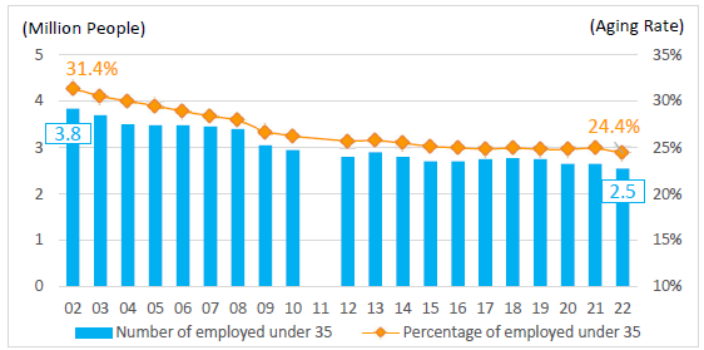
In Japan, the working-age population has been on a downward trend since peaking in the 1990s, and in recent years, the decline in the labor force aged 64 and under has become particularly pronounced. In addition, the proportion of young people aged 34 and under employed in the manufacturing sector has also been declining, raising concerns about future labor shortages (see Figure 1). The main causes include: (1) changes in the industrial structure have expanded occupational choices, leading to an increase in “non-factory” jobs; and (2) the spread of flexible work styles and values that are not restricted by time or location, resulting in manufacturing being less favored by younger generations. While it is necessary to enhance the attractiveness of manufacturing, the overall decline in the labor force is unavoidable. Therefore, realizing advanced factories that incorporate automation technologies capable of operating with fewer personnel is one effective countermeasure.
Figure 1: Population trends under 35 in manufacturing industry (Japan’s Ministry of Internal Affairs and Communications, 2023).
However, Japan faces unique challenges such as the lead time and costs associated with establishing new factories. Given limited land availability, constructing new factories through build-and-scrap methods is considered; however, the current realities include soaring construction costs and labor shortages in the building industry, which limit infrastructure renewal to specific applications.
Based on these factors, it is considered important not only to build cutting- edge new factories but also to transform existing factories into advanced facilities by introducing only the necessary automation technologies according to the workload and complexity of target processes.
The purpose of this study is to develop and validate an approach to implement this initiative. The purpose of this study is to develop and validate an approach that will enable the implementation of initiatives outlined in this policy.
DEVELOPMENT OF A VE APPROACH TO TRANSFORM EXISTING FACTORIES INTO ADVANCED FACTORIES Executing large-scale organizational transformations like the one discussed in this theme is not easy. The larger the target company, the broader the scope of impact; therefore, it is important for the approach to include the following perspectives:
(1) Establishing a “drive organization” to realize transformation (2) Identifying “challenge areas” to address for transformation (3) Designing an “implementation process” to drive transformation Specifically, regarding (3) implementation process, we have developed a unique process to achieve this transformation by incorporating various Industrial Engineering (IE) analytical methods into the Value Engineering (VE) approach—which is used for on-site production improvements and the commissioning of equipment, processes, and factories (Tsuchiya, 1998; Society of Japanese Value Engineering, 2007; Japan Industrial Engineering Association, 2021). The following sections explain each item.
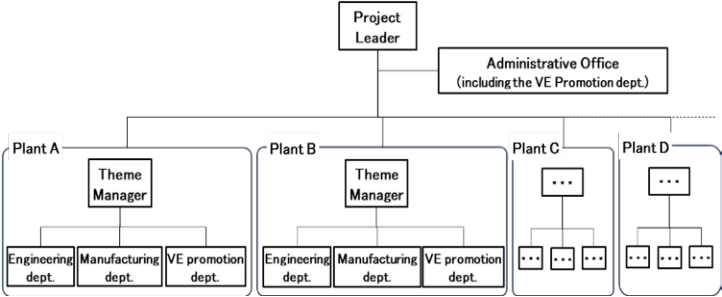
(1) Establishing a “Drive Organization” to Realize Transformation To achieve large-scale transformation, it is important to build a “team” that includes the organization’s leaders and units with the necessary skills. Since the theme here is the transformation of existing factories into advanced factories, a structure must be established that includes the factory leaders, the promotion department leading the activities, the design department concretizing the transformation, and the manufacturing department utilizing the post-transformation infrastructure (see Figure 2).
This enables all departments related to the selected transformation initiatives to work together as a unified team, thereby facilitating rapid transformation. It is also important to establish this structure at each factory. This allows ideas from one location to be rolled out to others, enabling more efficient and synergistic activities.
In practice, the authors were not able to establish this promotional framework immediately. The reality is that we began our activities at locations that showed understanding, gradually expanded our scope by sharing the results with other locations, and eventually succeeded in building this framework. Although this is a challenging task, we believe that it is crucial for building a promotional framework to generate “results” that support the “theory” and to increase the number of supporters through the synergistic effect of theory and results.
Figure 2: Establishing a “drive organization” (our example).
(2) Identifying “Challenge Areas” to Address for Transformation While larger drive organization lead to greater ripple effects and outcomes, they also involve an increased number of issues, making it essential to carefully decide which challenges to address. In this study, to address the common theme of “transforming existing factories into cutting-edge factories” through collaboration across the entire organization, we determined that it was important to identify “common challenges”—those with broad applicability and scalability—from the issues identified by each organization and prioritize resolving them (see Table 1). This approach enables greater results with limited resources.
Table 1: Approach to selecting target areas.
Table available in the original PDF paper.
In fact, during the evaluation and selection process for this initiative, we placed a high priority on the opinions of the stakeholders most directly involved in the issues (e.g., operators of the target processes). This is because we believe that the importance and urgency of the issues as perceived by these stakeholders significantly influence the effectiveness of the improvement activities following selection.
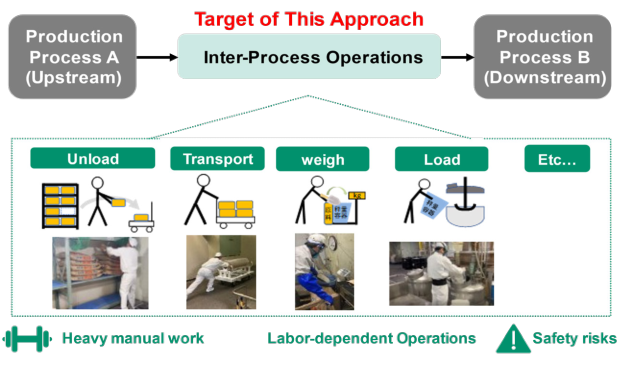
Based on the evaluation results, our company selected “functions and tasks connecting the various manufacturing processes” as a priority area (see Figure 3). The rationale behind this selection was twofold: (a) many tasks connecting key manufacturing processes still relied heavily on manual labor, and (b) this was a challenge common to all production sites, so we anticipated a ripple effect from the horizontal rollout of improvement measures.
Figure 3: Target areas for this approach (our example).
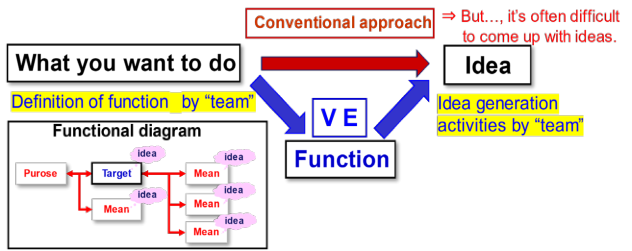
(3) Designing a “Implementation Process” to Drive Transformation VE is a method in which the objectives to be achieved are organized according to a “goal-means” relationship and defined as necessary functions; improvement proposals are then generated for those functions by leveraging the knowledge and experience of stakeholders (see Figure 4). The main characteristics of VE include: ① Converting objectives into functions—rather than examining the objectives directly—makes it easier to broaden the scope of ideas; and ② Bringing together the insights of multiple members creates a synergistic effect, enabling the generation of improvement proposals that would be difficult to achieve individually (Tsuchiya, 1998; Society of Japanese Value Engineering, 2007).
Figure 4: An idea generation approach using VE.
In this study, to leverage these characteristics, we based our approach on the fundamental VE methodology (VE implementation procedure). The basic VE approach allows for the clarification of the functions required by the target worksite or issue and enables the evaluation and determination of the applicability of automation or semi-automation in collaboration with stakeholders; therefore, it is highly applicable to the objectives of this study. On the other hand, relying solely on conventional VE methods presents the following challenges: ① It is difficult to grasp the chronological relationships between functions from a functional diagram, making it hard to understand the flow of the entire process; and ② Methods for conducting a thorough analysis and quantitative evaluation by breaking down tasks to the level of individual motions are insufficient.
Therefore, to address these challenges, this study integrates Industrial Engineering (IE) methods—such as process analysis, motion study, and work measurement—into the basic VE approach (Society of Japanese Value Engineering, 2007; Japan Industrial Engineering Association, 2021). The specific implementation process is outlined below.
(i) Identify the functions required for the target theme and site (ii) Break down the identified functions into specific work units (iii) Select functions and tasks to be improved through evaluation (iv) Generate improvement proposals for the selected functions and tasks (Sawaguchi, 2002)
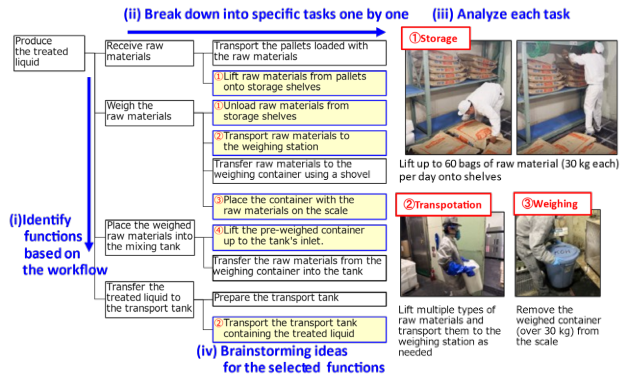
Figure 5 illustrates the implementation processes (i) through (iv) and their interrelationships, along with application examples. In the following sections,
A Cross-Functional Value Engineering Approach to Transforming Existing Factories 2565 we will describe in detail each process of the VE approach that integrates IE methods, using the examples shown in Figure 5.
Figure 5: The implementation process of this approach. (Our example: production process improvement in the liquid preparation process)
(3)-(I) Identify the Functions Required for the Target Theme and Site/ (3)-(II) Break Down the Identified Functions Into Specific Work Units This process corresponds to the stage of creating a function tree, which is a fundamental VE tool. By clarifying and sharing the functions required of the target process among stakeholders during the creation of a function tree, it is possible to foster a common understanding of the issues at hand. Furthermore, the creation process encourages active participation from stakeholders and enhances their understanding of and buy-in for subsequent improvement activities. In this study, we incorporated the concepts of industrial engineering (IE) methods into this process of function extraction and expansion.
Specifically, in (i), we utilize the concept of process analysis from IE to extract the necessary functions along the process flow. This method makes it easier to grasp the flow of the entire process and the relationships between each function; furthermore, from the perspective of ECRS (Eliminate, Combine, Rearrange, Simplify), it allows us to evaluate the potential for improvement of the process itself before considering automation or semi-automation.
In the example shown in Figure 6, two conflicting tasks—“Lift raw materials from pallets onto storage shelves” and “Unload raw materials from storage shelves”—were identified as tasks related to “Receive raw materials” and “Weigh the raw materials.” If there were no constraints regarding workspace or operations, these tasks could be candidates for elimination. In this way, visualizing the relationship between the process flow and functions allows us to first examine the potential for improvement in the process itself.
Furthermore, in (ii), we introduce the concept of IE’s “Motion analysis”— which breaks down human tasks into basic motion units for analysis—to expand the functions extracted in (i) to the level of specific tasks. This makes it possible to define functions that could be candidates for automation or semi-automation in a more concrete and clear manner.
For example, in the case shown in Figure 5, if we consider only the higher- level function “Weigh the raw materials,” the specific task to be automated remains ambiguous. On the other hand, by breaking it down to the level of specific tasks—such as “unload,” “transport,” “transfer,” and “place”—the target functions can be defined more clearly. In this way, systematically breaking down each function to the level of basic movements makes it possible to proceed more concretely and objectively with the subsequent processes of (iii) selecting targets for improvement and (iv) generating improvement proposals.
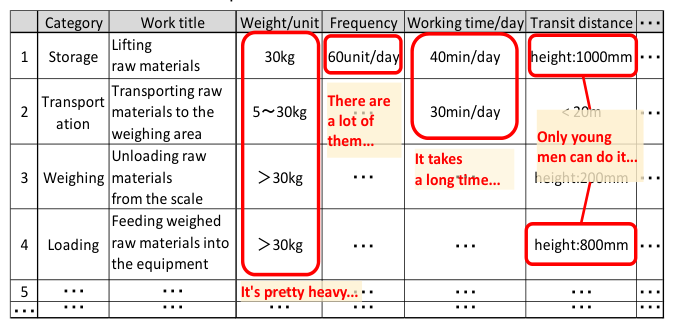
(3)-(III) Select Functions and Tasks to be Improved Through Evaluation This process involves selecting the functions and tasks that should be automated or semi-automated from among those identified in steps (i) and (ii). For each function and task, the process emphasizes quantitatively and qualitatively evaluating the workload and operational constraints, and clearly identifying which areas should be prioritized for improvement within limited managerial resources, along with the reasons for those priorities.
For example, regarding the task “① Lifting raw materials” in the case study shown in Figure 6, an evaluation based on factors such as the weight of the object, frequency of the task, and required time revealed that this task offers significant improvement benefits compared to other tasks and should therefore be given high priority (see Table 2).
Table 2: Quantitative and qualitative evaluation of each task.
Through this evaluation process, it is possible to objectively visualize the workload and operational issues that are recognized as tacit knowledge on the workplace floor. As a result, it becomes possible to select functions and tasks for improvement while building a shared understanding among stakeholders regarding the need for improvement. Furthermore, this process serves as the foundation for developing concrete and effective improvement proposals in the following (iv) improvement proposal generation process.
(3)-(IV) Generate Improvement Proposals for the Selected Items This process is the stage in which improvement proposals are generated for the functions and tasks selected in (iii). In this study, based on the principles of
A Cross-Functional Value Engineering Approach to Transforming Existing Factories 2567 team design, we conducted brainstorming sessions involving all stakeholders and adopted a VE approach to develop concrete improvement proposals by integrating the diverse knowledge and experience of the team members.
Furthermore, this approach utilizes the results of analyses conducted using industrial engineering (IE) methods to clarify not only the content of the tasks but also the issues and limitations within the work, as well as the necessary requirements for improvement. By using these as evaluation criteria for the improvement proposals, it becomes possible to efficiently identify those that are both feasible and highly effective.
For example, in the case study shown in Figure 5, the analysis focused on the “Lifting raw materials” and “Unload raw materials” tasks in the Storage process. As a result, multiple improvement proposals were generated, as shown in Table 3. Furthermore, by evaluating these improvement proposals based on the issues, limitations, and requirements identified in step (iii), it is possible to narrow them down to the most promising ones in terms of feasibility and effectiveness.
Subsequently, by further refining and detailing the selected improvement proposals, they are developed into actionable improvement measures. In this study, this process is applied to each function and task selected for improvement, and by integrating the improvement measures derived from each function and task, a draft improvement plan that takes overall optimization into account is formulated.
Table 3: Brainstorming ideas for the selected functions and tasks.
Table available in the original PDF paper.
Idea 3: Expand the Room and Lay the Pallets Flat
Idea 2: Use a Forklift for Loading and Unloading
Idea Idea 1: Use Assistive Devices for Loading and Unloading Shelves Image
Cost ○ △ ○
Evaluation points
Lead time ○ ○ ○ △ ○ ○ Workload per task
△ △ ◎ Eliminate the loading and
Frequency of work
unloading process itself ◎ Eliminate the loading and
△ × Narrow and
unloading process itself
Work speed (Efficiency)
difficult
Evaluation Results ○ Selected as the First
Choice Candidate (Our example: production process improvement in the liquid preparation process)
RESULTS AND CONSIDERATION Since September 2023, we have been implementing this approach and verifying its effectiveness at Fujifilm’s seven major domestic plants. As of 2026, we have applied it to 20 practical themes, and the main results are shown in Table 4.
Table 4: Key results of this approach.
Table available in the original PDF paper.
Notes
Evaluation Item Before Applying Proposed Approach
After Applying Proposed Approach
10 out of 20 themes 19 out of 20
themes
(1) Number of Themes for Which Improvement Measures Were Developed
Both before and after application, the evaluation was conducted using the same 20 themes. Before application, the themes included issues related to Q, C, or D, and only improvement measures with a reasonable expectation of issue resolution were counted.
(2) Average Estimated Cost of Improvement Measures
100% 54% Comparison was conducted for 10 themes in which both improvement measures and estimated costs had been specified. The estimated cost before application was normalized to 100%.
0 10 Number of ideas that could be applied to other themes.
(3) Number of Cross-Theme Applicable Ideas Generated 8 months 5 months Comparison was conducted for 10 themes in which concrete improvement measures were developed.
(4) Average Period Required to Develop Improvement Measures
Based on these results, we believe this study has yielded the following outcomes.
① By utilizing this approach, we were able to develop concrete improvement proposals involving automation and semi-automation even for themes where building deterioration and space constraints had previously made it difficult to formulate specific improvement plans. *Based on (1) ② By breaking down the functions of the target themes to the task level
and specifically evaluating which functions and tasks were suitable for automation and semi-automation, we were able to focus our analysis on the areas that should be prioritized for improvement. Consequently, this led to reduced investment costs and a shorter review period. *Based on (2) and (4)
A Cross-Functional Value Engineering Approach to Transforming Existing Factories 2569 ③ By selecting common themes and establishing a cross-functional
organizational structure, we were able to apply improvement proposals developed for one theme to other themes. As a result, knowledge sharing across themes was promoted, which also contributed to shortening the review period per theme. *Based on (3) and (4) On the other hand, one issue identified through this initiative was the lack of a sufficient mechanism for making early decisions on whether to address issues by retrofitting existing plants or by establishing new ones.
In fact, out of the 20 cases where this approach was applied, one case failed to yield a viable improvement proposal. For that theme, the aging of the existing plant and space limitations were particularly severe, resulting in significantly more constraints compared to other themes. As a result, not only did the review period become protracted, but we were also unable to confirm the cost advantages of utilizing the existing plant. Thus, when limitations at existing plants are significant, upgrading to automated or semi- automated facilities may require not only equipment upgrades but also a complete refurbishment starting at the infrastructure level. Therefore, a key future challenge is to establish a system for determining at an earlier stage whether plant rejuvenation or greenfield investment is the more appropriate course of action.
CONCLUSION
In this study, we proposed an approach that integrates VE and IE to systematically derive improvement plans for automation and semi-automation while considering the limitations of existing factories. Furthermore, by applying this approach to 20 real-world projects, we confirmed its effectiveness in clarifying improvement targets, reducing investment costs, and shortening the planning period.
Furthermore, we demonstrated that by combining VE’s stakeholder- participatory design approach with IE’s process and task analysis, it is possible to formulate highly feasible improvement plans while visualizing on-site challenges.
Moving forward, we intend to continue accumulating case studies and establish a system to support decision-making regarding the renovation of existing factories and the launch of new ones, thereby further refining this approach.
REFERENCES
Hiroshi Tsuchiya. (1998). “Shin VE no Kihon (New Basic VE in English)”, The SANNO Institute of Management Press. Japan Industrial Engineering Association. (2021). “Jissen IE no kyoukasho”, THE
NIKKAN KOGYO SHIMBUN, Ltd. Japan’s Ministry of Internal Affairs and Communications. (2023). “Labor Force Survey”. Society of Japanese Value Engineering. (2007). “Value Engineering Handbook”, The
SANNO Institute of Management Press. Manabu Sawaguchi. (2002). “ VE and TRIZ”, Doyukan Co., Ltd.
SEARCH THE AHFE DIGITAL BOOKSTORE BY ISBN
Explore the complete digital volume
Human Factors in Design, Engineering, and Computing
Read this individual research paper free through the original publisher, or explore the full digital proceedings book.