Julian Galindo-losada, Vilma Rodriguez, Viviana Parraga-Villamar, Mayra Carrion-toro, Marco Santórum (2026). Prompts to Impact: User Experience Design in AI-Enhanced Online Learning Environments. In: Human Factors in Design, Engineering, and Computing. AHFE Open Access, vol. 238, pp. 445–454. https://doi.org/10.54941/ahfe1008277
The growing integration of Artificial Intelligence (AI) into higher education requires a human-centered perspective that extends beyond technical functionality to examine how learners perceive, understand, and engage with AI-generated instructional content. This study evaluates the effects of prompt-engineered educational resources on user experience in a Moodle-based Business Intelligence workshop conducted in Ecuador. The intervention involved 10 advanced students from Information Technology and Software Engineering programs who independently interacted with AI-generated videos, code examples, simulations, scripts, and dashboard-related materials, with tutor support. The workshop was structured according to the Plan–Do–Check–Act framework and assessed through a pre-test/post-test design focused on learning facilitation, content comprehension, and engagement through multimedia resources. Results showed statistically significant improvements in all three dimensions. Learning facilitation increased from 3.5 to 4.3 (p = 0.0107, Cohen’s d = 1.01), content comprehension rose from 3.5 to 4.4 (p = 0.0294, d = 0.81), and multimedia engagement increased from 3.4 to 4.6 (p = 0.0002, d = 1.89). These findings indicate that prompt-engineered instructional materials can enhance motivation, conceptual understanding, and participation in online learning. The study contributes a methodological foundation for positioning prompt engineering not only as a content-generation technique, but also as a user-centered instructional design strategy for AI-enhanced education. Future research should examine affective responses, collaborative learning, scalability, and explainability in larger and more diverse populations.
Artificial Intelligence (AI) has begun to significantly transform online education, particularly due to its ability to generate dynamic content, provide immediate feedback, and support more personalized learning experiences (Jia, Sun and Looi, 2024). In recent years, tools based on large language models and prompt engineering techniques have expanded the possibilities
for creating educational resources enabling new forms of interaction between students and digital learning platforms (Holmes and Luckin, 2016; Kasneci et al., 2023).
Within virtual learning environments, User Experience (UX) has become a key factor in understanding how students perceive and interact with educational technologies. Aspects such as usability, motivation, satisfaction, and cognitive engagement directly influence participation and the way students construct knowledge in digital settings (Moreno-Marcos et al., 2020). Several studies have highlighted the potential of AI to support adaptive learning processes, intelligent tutoring, and personalized educational content generation (Holmes and Luckin, 2016; Zawacki-Richter et al., 2019). However, much of the current research continues to focus on predictive models, learning analytics, or academic task automation, while limited evidence still exists regarding how resources influence user experience, learner motivation, and student engagement in real higher education contexts (Liu, Zhang and Wang, 2026). In this context, the present study analyses the impact of prompt-engineered educational resources on UX within a virtual higher education workshop conducted in Ecuador. The workshop integrates AI-generated materials into a Moodle-based Business Intelligence course designed for Information Technology and Software Engineering students. Through a pre-test/post-test experimental design, the study evaluates aspects related to learner motivation, content comprehension, and student engagement when interacting with AI-enhanced educational materials. Beyond understanding prompt engineering solely as a content generation technique, this work approaches it as a user-centered instructional design strategy for digital learning environments.
RELATED WORK
Table 1 summarizes selected studies related to educational AI, UX, and human- centered approaches in virtual learning environments. The reviewed works cover higher education, digital education, online learning, human-centered learning, educational AI systems, explainable educational AI, multimodal learning, and Business Intelligence education. Their contributions include systematic reviews of AI applications, personalized learning frameworks, analysis of LLM opportunities and challenges, student persistence and engagement analytics, human-centered learning analytics, evaluation of educational AI systems, explainability and transparency, multimodal learning analytics, and the UX evaluation of prompt-engineered educational resources.
Table 1: Comparison of related work in educational AI and human-centered learning experiences.
Table available in the original PDF paper.
UX / Engagement
Learning Analytics
Teaching Context
Main Contribution
Reference Prompt- Based Content
Human- Centered AI – – – + Higher Education
(Zawacki- Richter et al., 2019).
Systematic review of AI applications in higher education (Continued)
Table 1: Continued.
Table available in the original PDF paper.
UX / Engagement
Learning Analytics
Teaching Context
Main Contribution
Reference Prompt- Based Content
Human- Centered AI – – + – Digital Education
(Holmes and Luckin, 2016)
AI-supported personalized learning frameworks
(Kasneci et al., 2023)
+ + + – Online Learning
Opportunities and challenges of LLMs in education – + – + Online Learning
(Moreno- Marcos et al., 2020)
Student persistence and engagement analytics
(Topali et al., 2025)
– + + + Human- Centered Learning
Human- centered learning analytics and AI
(Shoeibi, 2023)
– + + – Educational AI Systems
Evaluation of human- centered AI systems
(Khosravi et al., 2022)
– + + + Explainable Educational AI
Transparency and explainability in AI education
(Mohammadi et al., 2025)
– + – + Multimodal Learning
AI in multimodal learning analytics This Study + + + – Business Intelligence Education UX evaluation of prompt- engineered AI educational resources
Research Gap Although literature reports significant advances in adaptive learning, learning analytics, and automated educational content generation, most existing studies continue to focus on automation, academic prediction, or intelligent recommendation systems. In comparison, limited research has examined how prompt-engineered educational resources affect user experience, learner motivation, and student engagement in real higher education environments. To address this gap, the present study proposes a virtual workshop supported
by AI-generated educational resources, including programming examples, ETL simulations, database modeling activities, and explanatory videos, with the objective of analyzing how these materials influence learner motivation, content comprehension, and student participation within a Moodle-based environment. From a user-centered perspective, this work seeks to contribute to a broader understanding of UX and Human-Centered AI in AI-enhanced learning experiences.
METHODOLOGY AND EXPERIMENTAL STUDY A structured experimental workshop was designed following the Plan–Do– Check–Act (PDCA) framework, providing a systematic basis for iterative design, implementation, and evaluation. Ten students from Information Technology and Software Engineering programs at a national polytechnic university participated in a five-module online Business Intelligence course hosted on Moodle. Participants were selected based on prior technical knowledge and were in advanced semesters of their programs, ensuring a relevant baseline of digital literacy.
Plan To systematically evaluate the impact of prompt-based AI content generation on the user experience in online learning environments, a structured methodological plan was designed. This plan outlines the sequence of steps necessary to develop, implement, and assess the virtual workshop, ensuring the consistency and validity of the experimental approach. The online course was structured into five AI-enhanced modules, each designed to promote active participation and learning. The hypotheses proposed for this study are as follows: H1: A significant change in participants’ motivation is observed due to the integration of AI-generated content in the online course. H2: Participants experience a significant improvement in their content comprehension through AI-generated examples and scripts. H3: The use of AI-generated videos strengthens the learning process and increases engagement and understanding in the course.
Table 2: Distribution of AI-generated videos and activities in the course.
Table available in the original PDF paper.
Section Videos Before Activities After Sección 1 V1-V4, V5, V6-V14 Im1, Act1-Act3 Sección 2 V1-V2, V3-V4, V6-V9 Im1, Act1-Act3, Prompt
The study involved 10 students between the ages of 20 and 35, who individually participated in the online workshop. Participants were selected based on their prior knowledge of technology and were in the final semesters of their respective degree programs. Of the 10 participants, 2 were from
Prompts to Impact: User Experience Design in AI-Enhanced Online Learning 449 the Information Technology Engineering program and 8 from the Software Engineering program, both from the National Polytechnic School.
Research Design and Methodology This study employed a pre- and post-intervention comparative design to evaluate the impact of AI-driven instructional content across the primary user experience (UX) dimensions. By analyzing shifts in student perceptions regarding learning facilitation, content comprehension, and engagement, the study determined the quantitative effect of prompt-engineered materials on student performance and overall learning outcomes.
Research Instruments and Materials The virtual workshop introduced participants to AI architectures in education through structured, prompt-based modules. A primary focus of the intervention was a dedicated Power BI course, where prompt-engineered assets—including AI-generated videos, scripts, and dashboards—were systematically deployed to guide practical tasks such as data visualization and report design. To deliver these resources effectively, the Moodle learning management system (LMS) was adapted to seamlessly embed the AI-generated assets, granting students autonomous access to dynamic content and personalized pedagogical support. The specific system prompts were engineered to generate highly contextualized examples, directly minimizing cognitive friction within each module. Furthermore, these resources were categorized by topic to ensure a structured, cumulative learning pathway. Table 2 outlines the distribution of AI-generated videos and pedagogical activities across the respective course sections.
Do The experimental design and the evaluation strategy for the research instruments were carried out. The workshop was structured into five modules delivered over five consecutive days, each introducing core concepts and practical applications of AI-generated educational content using prompt- based methods.
Table 3: AI-enhanced course modules.
Table available in the original PDF paper.
ID Name Objective M1 Introduction to AI in Education
Provide a basic understanding of AI and its application in online learning.
M2 Prompt-based Learning Resources
Introduce and apply prompts to generate custom responses using AI.
M3 AI-driven Examples Enhance comprehension through automated examples and problem solving.
M4 AI-Generated Videos Reinforce concepts with video explanations produced using AI tools.
M5 Assessment and Feedback
Evaluate the effectiveness of AI integration and reflect on improvements.
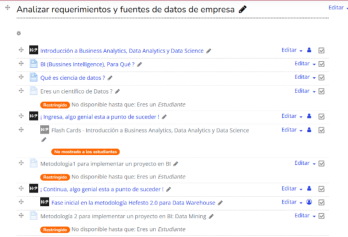
Figure 1: Interface of the first module.
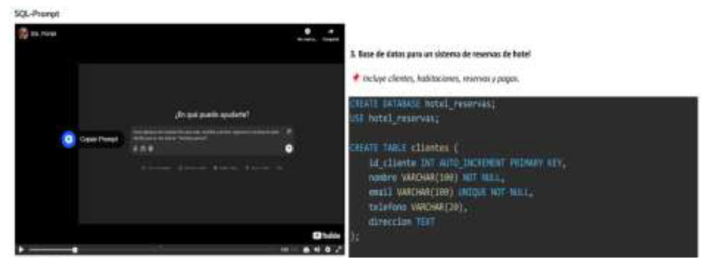
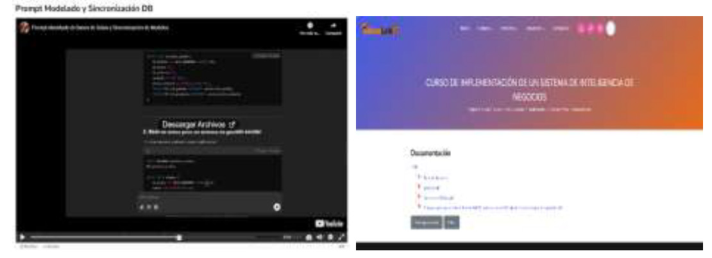
Each module included direct interaction with AI-generated content, covering the entire instructional process from concept explanation to guided application. Module 1 began with theoretical content and focused on defining the concepts of business analytics, data science, prompt engineering, and their pedagogical potential to implement a BI project (see Figure 1). Module 2 introduced AI-generated videos and exercises for practical scenarios (MySQL, WordPress, Database Modeling) as shown in Figure 2 and 3. Module 3 focused on ETL pipelines using RapidMiner, with prompts for query optimization. Module 4 used Power BI for dashboard design with AI-generated instructional resources. Module 5 consolidated learning, introducing Pentaho and DataFor plugins, emphasizing student reflection.
Figure 2: Prompts created code examples (left) and database setup scripts (right).Figure 3: Prompt-generated model export and sync tools (left) and AI-generated document folder interface (right).
Prompts to Impact: User Experience Design in AI-Enhanced Online Learning 451 Module 4 (ETLs with Pentaho) focus on the use of Power BI to design and personalize business dashboards. AI prompts were used to generate instructional resources that supported students in tasks such as creating maps, modifying reports, and configuring dashboard elements like filters and bookmarks. The prompts used in this section included: Introduction to Tools and Design – Prompt, Dashboard Creation and Configuration – Prompt, Data Visualization and Personalization – Prompt, and Alternative Tools and Plugins – Prompt.
Module 5 (Designing and Publishing Dashboards with Power BI) consolidates the learning experience by encouraging participants to integrate AI-generated materials into practical settings and reflect on their application. Learners were introduced to advanced tools, including Pentaho Community Server Edition and DataFor plugins. Additionally, this module utilized structured prompts to provide step-by-step instructions for deploying dashboards in professional environments. The key prompts used were: Visualization and Personalization: [Insert prompt details or leave as label], AI Tools in External Environments: [Insert prompt details or leave as label] and Final Reflection: “Did you use AI?” [Insert specific prompt details if applicable]. This final module placed a strong emphasis on student reflection through feedback forms and an open-ended discussion regarding the future of AI in education. Students were encouraged to assess their overall experience working with AI-generated content and propose actionable improvements for real-world applications.
Check This phase evaluated whether the study objectives were achieved, focusing on the impact of AI in enhancing UX during the online workshop.
– H1 – Learning Facilitation: Q4 scores increased from an average of 3.5 to 4.3. The improvement was statistically significant (t(9) = −3.2071, p = 0.0107) with a large effect size (Cohen’s d = 1.01). – H2 – Content Comprehension: Ratings for Q5 rose from 3.5 to 4.4, with a significant result (t(9) = −2.5861, p = 0.0294, Cohen’s d = 0.81). – H3 – Engagement through Multimedia: Q6 responses improved from 3.4 to 4.6, with a highly significant difference (t(9) = −6.0000, p = 0.0002) and a very large effect size (Cohen’s d = 1.89).
Table 4 reports the response weights disaggregated by individual user and specific question (Q4, Q5, and Q6) reveals a profound structural shift in user experience (UX) perception following the introduction of prompt- engineered AI tools. In the Pre-Workshop (Before) phase, individual response weights exhibit high dispersion and are predominantly concentrated within the intermediate levels of the Likert scale (scores of 3 and 4), reflecting a neutral or moderate baseline perception toward traditional online learning methodologies. Conversely, during the Post-Workshop (After) phase, the individual response weights undergo a sharp upward shift toward the absolute ceiling of the scale (primarily scores of 5, and select scores of 4). This
behavioral transition not only significantly raises the overall mean scores across all questions but also drastically minimizes the variance and standard deviation among participants. Empirically, these findings demonstrate that prompt-optimized instructional materials successfully homogenized the UX framework, bridging initial learner disparities to establish a unanimous, high- level consensus regarding enhanced motivation and content comprehension.
Table 4: Response weights by user and by question (before and after).
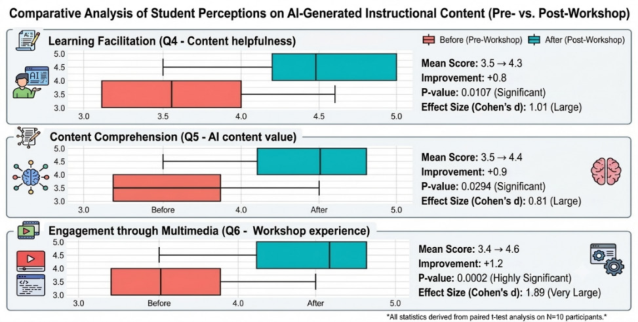
Figure 4: Comparative analysis of student perceptions on AI-Generated instructional content (Pre vs. Post workshop).
The pre- and post-workshop comparative analysis results reflect a significant improvement across all three evaluated dimensions regarding the AI-generated instructional content (Figure 4). First, learning facilitation (Q4) experienced a notable increase in its mean score, rising from 3.5 to 4.3 points with a large effect size (Cohen’s d = 1.01; p = 0.0107). Similarly, content comprehension (Q5) increased its mean from 3.5 to 4.4, consolidating a statistically significant impact (d = 0.81; p = 0.0294). Finally, the dimension of engagement through multimedia resources (Q6) recorded the most
Prompts to Impact: User Experience Design in AI-Enhanced Online Learning 453 prominent advancement, elevating the workshop experience from a mean of 3.4 to an outstanding 4.6; this shift demonstrated a highly significant statistical relevance supported by a very large effect size (d = 1.89; p = 0.0002). Collectively, the reduction in dispersion observed in the post- workshop box plots confirms that prompt-engineered AI tools positively homogenized the user experience, successfully boosting both student motivation and conceptual assimilation. Finally, the results confirm that the AI-driven instructional approach had a measurable and meaningful impact on students’ motivation, comprehension, and engagement (Table 4 and Figure 4). The strongest effect was observed for AI-generated videos (H3), followed by content comprehension through examples (H2), and facilitation of learning (H1).
Act In the final phase (Act), the quantitative findings were systematically analyzed to formulate actionable refinements and establish a methodological foundation for future iterations of AI-enhanced online workshops. The empirical results successfully validated all three core hypotheses. Based on these insights, the action plan for future deployments focuses on exploiting the high performance of prompt-engineered multimedia while addressing current architectural limits. To enhance scalability and student autonomy, future instructional designs will institutionalize collaborative learning frameworks and automated, personalized learning paths. These strategic adjustments aim to shift students from independent consumption to collaborative knowledge-building, thereby fostering deeper reflection and cross-contextual skill transfer beyond the virtual classroom.
CONCLUSION
This study demonstrates that prompt-engineered, AI-generated educational resources can meaningfully improve user experience in virtual higher education environments. Their integration into a Moodle-based Business Intelligence workshop produced statistically significant gains in learning facilitation, content comprehension, and engagement, indicating that AI-supported instructional materials can promote more interactive, accessible, and learner- centered online experiences. Participants reported improved understanding after working with AI-generated examples, scripts, simulations, and guided explanations. These resources helped translate technical concepts into more practical and comprehensible learning activities, supporting greater autonomy throughout the workshop. The strongest improvement was observed in engagement through multimedia resources, particularly AI-generated videos and walkthroughs, which achieved the largest effect size among the evaluated dimensions. The findings also show that prompt engineering should not be understood solely as a mechanism for producing educational content. When incorporated into a structured instructional process, it can function as a user- centered design strategy that connects content generation with learners’ needs, perceptions, and interaction experiences. In this sense, the study provides
an initial methodological foundation for integrating AI-generated resources into online course design while maintaining a focus on UX. Nevertheless, the findings should be interpreted considering the small and technically experienced participant group. Future studies should involve larger and more diverse samples, include control groups, and examine long-term learning outcomes. Further research should also incorporate collaborative activities, affective UX measures, stronger instructor mediation, and explainable AI mechanisms to improve transparency, trust, and understanding of AI-supported educational systems.
REFERENCES
Holmes, W. and Luckin, R. (2016) Intelligence unleashed: An argument for AI in education. London: Pearson : UCL Knowledge Lab.
Jia, F., Sun, D. and Looi, C. (2024) “Artificial Intelligence in Science Education (2013–2023): Research Trends in Ten Years,” Journal of Science Education and Technology, 33(1), pp. 94–117. Available at: https://doi.org/10.1007/s10956-023-10077-6.
Kasneci, E. et al. (2023) “ChatGPT for good? On opportunities and challenges of large language models for education,” Learning and Individual Differences, 103, p. 102274. Available at: https://doi.org/10.1016/j.lindif.2023.102274.
Khosravi, H. et al. (2022) “Explainable Artificial Intelligence in education,” Computers and Education: Artificial Intelligence, 3, p. 100074. Available at: https://doi.org/10.1016/j.caeai.2022.100074.
Liu, B., Zhang, W. and Wang, F. (2026) “Can Generative Artificial Intelligence Effectively Enhance Students’ Mathematics Learning Outcomes?—A Meta- Analysis of Empirical Studies from 2023 to 2025,” Education Sciences, 16(1), p. 140. Available at: https://doi.org/10.3390/educsci16010140.
Mohammadi, M. et al. (2025) “Artificial intelligence in multimodal learning analytics: A systematic literature review,” Computers and Education: Artificial Intelligence, 8, p. 100426. Available at: https://doi.org/10.1016/j.caeai.2025.100426.
Moreno-Marcos, P.M. et al. (2020) “Re-Defining, Analyzing and Predicting Persistence Using Student Events in Online Learning,” Applied Sciences, 10(5), p. 1722. Available at: https://doi.org/10.3390/app10051722.
Shoeibi, N. (2023) “Evaluating the Effectiveness of Human-Centered AI Systems in Education.” Topali, P. et al. (2025) “Designing human-centered learning analytics and artificial intelligence in education solutions: a systematic literature review,” Behaviour & Information Technology, 44(5), pp. 1071–1098. Available at: https://doi.org/10.1 080/0144929X.2024.2345295.
Zawacki-Richter, O. et al. (2019) “Systematic review of research on artificial intelligence applications in higher education – where are the educators?,” International Journal of Educational Technology in Higher Education, 16(1), p. 39. Available at: https://doi.org/10.1186/s41239-019-0171-0.
SEARCH THE AHFE DIGITAL BOOKSTORE BY ISBN
Explore the complete digital volume
Human Factors in Design, Engineering, and Computing
Read this individual research paper free through the original publisher, or explore the full digital proceedings book.