Daigo Misaki, Joohan Bae, Komei Miura (2026). Designing Human–AI Interaction to Foster Ambidextrous Thinking and Learner Ownership in Product Ideation. In: Human Factors in Design, Engineering, and Computing. AHFE Open Access, vol. 238, pp. 455–465. https://doi.org/10.54941/ahfe1008278
Generative AI is increasingly used in design education and product ideation, yet its role tends to be reduced to producing many ideas efficiently, whereas creative product development also requires deepening questions, testing assumptions, refining concepts, and maintaining ownership of the design process. This paper presents a human–AI interaction approach for fostering ambidextrous thinking and learner ownership in engineering design education at a Japanese university. It builds on a generative AI–based method that scaffolds ideas along two axes—exploration (qualitative shifts in design direction, extended with the notion of “darkness” from dark horse prototyping) and exploitation (quantitative refinement of feasibility and implementation quality)—in which custom GPT evaluators score sketches and return feedback. We add a Japan–Germany Global PBL in which students co-designed a companion robot, with findings from a questionnaire and interviews. Ownership was uniformly high and rooted in having physically realized the prototype; AI helped students verbalize the problem and expand their options, whereas convergence and design requirements were derived from users, the prototype, and experience. On this basis, we propose and discuss the design of human–AI interaction in design education in the age of AI.
Generative artificial intelligence (AI) is rapidly entering design education and project-based learning (PBL), yet it is often treated narrowly as an “idea vending machine” valued for the quantity and speed of its output. From a human-centered design perspective, this is insufficient: creative product development requires learners to deepen questions, test assumptions, reframe problems, and refine concepts while remaining the authors of the process. When AI only maximizes output, learners risk becoming passive selectors, losing reflective depth and ownership.
This paper is organized around two ideas: ambidextrous thinking, the deliberate movement between exploration (qualitative shifts in design direction) and exploitation (refinement of a chosen direction), and learner ownership, the agency, control, and authorship learners perceive over the design process. We argue that the central challenge is not to have AI generate
more ideas but to structure human–AI dialogue so that learners use its generative capacity while remaining the authors.
Building on our research on design education (Misaki and Ge, 2019), an evaluation study of GPT-based scoring against the instructor’s judgment (Miura and Misaki, 2025), and a classroom implementation (Misaki and Miura, 2026), we add a Japan–Germany Global PBL in which students co-designed a physical product using generative AI. We contribute (1) a partially validated two-axis model and GPT-based evaluation protocol, clarifying where automated evaluation can be trusted and where humans should remain involved; (2) an account of how engineering students use, modify, and reject AI and where reframing and ownership arise; and (3) a Human-Centered AI framework for testing whether interaction design, rather than the tool itself, keeps learners the authors.
BACKGROUND AND RELATED WORK Ambidexterity: Exploration and Exploitation The distinction between exploration and exploitation originates in organizational learning research, where exploration denotes search, variation, and risk-taking, and exploitation denotes refinement, efficiency, and execution (March, 1991); organizational ambidexterity is the capacity to pursue both and balance the tension between them (O’Reilly and Tushman, 2013). In engineering design, ambidextrous thinking has been discussed as whole-person creative thinking drawing on both the right and the left mode (Faste, 1994), and as a mindset relating the ways of “knowing, doing, and behaving” specific to design and to engineering (Lande, 2016). It is the learner’s ability to move deliberately between these modes without premature convergence or unfocused divergence.
Design Thinking Education: The Stanford Lineage and a Human- Centered View The engineering design education addressed here belongs to Stanford University’s design-thinking tradition: engineering design thinking has been characterized around divergent–convergent questioning, with PBL as its preferred pedagogy (Dym et al., 2005), and design has been framed as “dancing with ambiguity” through triple-loop learning (Leifer and Steinert, 2011) and as reframing, through which learners acquire sustained creative behavior (Ge and Leifer, 2017). Our course is modeled on Stanford’s ME101 (visual thinking) and was developed through discussions with, and advice from, researchers at the Stanford Center for Design Research, drawing on work on design thinking in Japanese engineering education (Misaki and Ge, 2019) and on creative problem-solving as culturally constructed (Ge et al., 2022). Exploration thus corresponds to the reframing, ambiguity-embracing side of design thinking, and the human-centered goal is to preserve the learner’s own reframing agency.
A complementary perspective comes from Kansei (affective) and human- centered engineering. Fukuda distinguishes technology, which pursues rationality and reproducibility, from engineering as pioneering, which pursues dreams even when irrational; in rapidly changing situations, coordinating the whole on the basis of bodily sensation—perceiving, deciding, and adjusting
Designing Human–AI Interaction to Foster Ambidextrous Thinking 457 through trial and error—matters more than controlling movement, and such integrative judgment differs from the precise analysis of known features at which current AI excels (Fukuda, 2023). Consistent with self-determination theory, which relates autonomy to intrinsic motivation and well-being (Ryan and Deci, 2000), this supports positioning AI as a partner coordinated by a learner who retains authorship rather than an autonomous idea generator.
Dark Horse Prototyping and the “Darkness” Criterion Defining exploration only as “qualitative change” blurs the line between a genuine conceptual leap and mere variation. We therefore draw on dark horse prototyping, in which a team deliberately pursues a seemingly improbable, high-risk idea; a prototype vision is “dark” when it is risky, radical, infeasible, or orthogonal to the solutions considered so far (Bushnell et al., 2013). This “darkness” criterion lets the evaluation of exploration reward reframing that departs from the converging direction rather than surface-level variation.
Generative AI in Design Education and Learner Ownership We introduced generative AI into a design engineering course to address a problem observed even before AI: engineering students tend to converge early on a single technical solution, such as an app, and their ideas can lack diversity. Although AI presents many ideas quickly, students’ ideas are sometimes pulled toward its suggestions and become similar, or students find it hard to leave their first idea, and students themselves worry that over-reliance on AI may hinder their growth and creativity (Misaki and Miura, 2026). AI can thus both broaden diversity and cause new convergence, which is the starting point of this paper. Our earlier AR- and GPT-based brainstorming prototype used GPT to structure spoken ideas into spatial representations with bodily movement to promote divergent thinking (Aikawa et al., 2023). When learners follow the model’s suggestions, however, authorship can shift from the person to the system. Learner ownership relates to psychological ownership (Pierce et al., 2001), reflective practice (Schön, 1983), and autonomy (Ryan and Deci, 2000), supports motivation and deep learning in PBL, and in AI-supported ideation depends on interaction design rather than on the tool; this paper therefore treats it as a central axis of design education, on a par with idea quality.
Because exploration dominates the divergent phases of design thinking and exploitation the convergent phases, AI can broaden perspectives and prompt dark-horse reframing during divergence and support feasibility checking, refinement, and communication during convergence, while the learner (an individual or a team) steers throughout. How to teach and use AI to provide this support needs to be examined.
A GENERATIVE AI–BASED SUPPORT METHOD FOR AMBIDEXTROUS IDEATION The method scaffolds product ideas along the two dimensions described above: rather than having AI generate as many concepts as possible, it structures the interaction so that learners move deliberately between exploration and exploitation while retaining decision-making authority. It was developed
as an evaluation method (Miura and Misaki, 2025) and then introduced experimentally into the third-year design engineering course at Kogakuin University, in which students find an everyday “bug” (inconvenience) and redesign a product or service that solves it (Misaki and Miura, 2026).
Two Scaffolding Dimensions Exploration (with “darkness”). The exploration axis evaluates qualitative shifts in design direction—that is, radical, high-risk, infeasible, or orthogonal reframings that challenge the current assumptions themselves rather than optimizing within them—thereby widening the design space and surfacing implicit constraints.
Exploitation. The exploitation axis evaluates the quantitative refinement of a chosen concept (feasibility, usability, manufacturability, and implementation quality) and strengthens it toward a practical product.
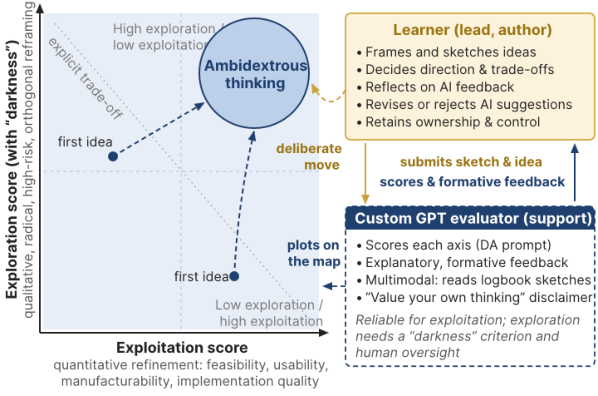
By naming the axes, learners gain a shared vocabulary for where they are in the process and a mechanism for deliberately choosing when to expand and when to refine. Ambidextrous ideation corresponds to moving purposefully across the two-dimensional exploration–exploitation map rather than drifting in one direction (Figure 1).
Figure 1: AI-supported ambidextrous-thinking education model. Ideas are positioned on the exploration–exploitation map, and the custom GPT evaluator scores each axis and returns formative feedback, while the learner, as the author, deliberately moves the idea toward the ambidextrous zone.
Custom GPT Evaluators The custom GPT evaluators are GPT assistants configured with a rubric for each dimension and a Direct Assessment (DA) prompt that scores quality on a continuous 0–100 scale (Kocmi and Federmann, 2023); the constructs build on prior work positioning products along these axes in engineering design (Okamoto and Murakami, 2023). Given a learner’s sketch and a short written explanation, each evaluator returns a score and explanatory feedback for its dimension. In the classroom version the interaction is multimodal:
Designing Human–AI Interaction to Foster Ambidextrous Thinking 459 handwritten logbook sketches are supplied as images to a vision-capable GPT, so the AI engages with the student’s design process rather than a textual summary alone. The output carries an explicit note that it is merely an AI evaluation and that students should value their own thinking, positioning the feedback as one formative reference rather than a verdict.
FINDINGS FROM THREE STUDIES Study A: GPT-Based Evaluation Versus the Instructor’s Judgment In the evaluation study (Miura and Misaki, 2025), third-year students’ product-redesign proposals were scored by the custom GPT on the two axes and compared with the course instructor’s evaluation. Exploitation scores were broadly consistent, whereas exploration scores diverged: the instructor emphasized conceptual “leaps,” while the AI tended to count ideas and sometimes rated proposals that reconsidered the assumptions themselves poorly. Adding the “darkness” perspective brought the AI closer to the instructor, though not fully, and the two axes were negatively correlated, indicating a trade-off between exploration and exploitation. Thus exploitation, tied to clear quality criteria, lends itself to automated evaluation, whereas exploration, tied to framing and meaning, requires careful prompt design and human oversight.
Study B: Classroom Implementation With the 2024 Cohort The method was then introduced into the 2024 design engineering course (Misaki and Miura, 2026). After the first of two final presentations, students received examples of dark horse prototyping and a custom GPT returning two- axis feedback on inputs including logbook sketches, and were encouraged to develop more innovative proposals on their own or with AI. Both exploration and exploitation improved significantly after the intervention, and on the two-axis map many proposals moved from positions high on one dimension to positions high on both.
In the post-course questionnaire and interviews, most students had used AI, mainly at the ideation stage. They valued the way AI broadened their perspectives and expected it to verbalize, concretize, and refine vague ideas, yet most modified its output and relied on their own intuitive judgment. Students who did not use AI explained that they “did not need to” rather than that they “could not,” and concern was expressed that over-reliance on AI may hinder their growth and creativity (Misaki and Miura, 2026).
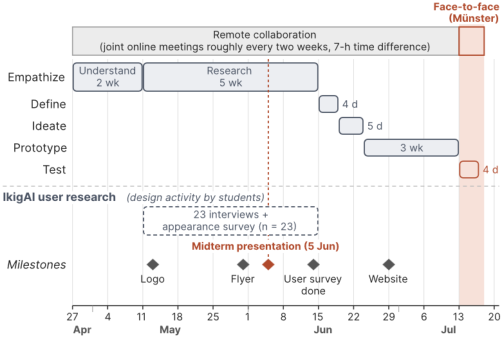
Study C: Japan–Germany Global PBL To examine ownership beyond the domestic course, we studied the 2026 Global PBL. In this PBL, master’s students in mechanical engineering at Kogakuin University and students majoring in information systems at the University of Münster, following the Stanford-style design-thinking process, developed “IkigAI,” a conversational companion robot for older adults experiencing loneliness. IkigAI integrates a voice-dialogue function based on a large language model into a bear-shaped body built by the Japanese team. After a remote collaboration period (Zoom, Discord), the two teams completed the bear-shaped robot during the face-to-face week in Münster (Figure 2).
During the design of IkigAI, the students conducted a user study of older adults and healthcare and nursing-care professionals (interviews and a questionnaire on appearance); the analysis here, however, concerns a separate participant survey conducted after the PBL ended. All four Japanese and four German members answered, with their consent, a bilingual seven-point questionnaire covering questioning and problem setting, self-directed design behavior, dependence on AI, creative design activity, collaboration, remote versus face-to-face work, and growth (n = 8), and 30- to 60-minute semi- structured interviews with the four Japanese members were coded on the same constructs (quotations are translated into English). All comparisons are descriptive; values below are means on the 1–7 scale (Japan n = 4, Germany n = 4).
The students used AI frequently, mainly for translation and writing and for idea generation (six of eight students in each case). Ownership was uniformly high (“the deliverable is something we made ourselves”: Japan 6.75, Germany 6.50), and the interviews traced it to physical realization—the moment when, after consecutive all-nighters, “the function actually worked,” and when “what was on the drawing became a real thing and moved.” Even the student who said they “could not have built the same robot” without AI felt a strong attachment “in the IKEA sense,” having made all the parts himself. AI was rated highly for expanding options (overall 6.13) and for concretizing and improving ideas (6.25), but lowest as a prompt to question the assumptions of the problem (3.50 in both teams); one student used AI to narrow the vague theme of “ikigai” (purpose in life) to loneliness after retirement, but the AI’s solutions were too generic and the team turned to user interviews. The other reframings arose from the interviews with older adults (“eye contact matters”), from the German team’s reaction at the midterm presentation, which led the first mechanism concept to be abandoned, and from physical constraints such as the base added to house the electronics. AI mainly generated code and eye animations, visualized the mechanism, and prepared materials for the partners.
Figure 2: Schedule of the Japan–Germany Global PBL. The phases proceeded in parallel and iteratively, and the mechanism concept was changed after the discussion at the midterm presentation.
Designing Human–AI Interaction to Foster Ambidextrous Thinking 461 AI broadened the options but did not make the decisions. Students in both teams reported having modified, restructured, or rejected AI suggestions (Japan 6.00, Germany 6.75); one student investigated and rejected an AI-proposed spherical gear for difficulty of control, space, and the deadline, noting that “with AI you can diverge, but… to converge, in the end you need knowledge,” and that convergence rested on “experience, by far,” including team constraints that AI cannot pick up. Dependence on AI (mean of five items) was higher on the Japanese side (3.70 vs. 2.75), and the two heaviest AI users rated the early-fixation item 7 and 6, although one interviewee attributed fixation to robot-contest experience and saw AI as a “third party” that breaks it. Translation and subtitles helped the Japanese students understand (Japan 6.25, Germany 3.25) but did not lead them to speak up (conveying one’s opinions across cultural and language differences: Japan 3.75, Germany 6.00); asynchronous Discord posts, checked before sending, widened the range in which they could “speak responsibly,” while the German students could not tell whether the Japanese students agreed or simply “don’t want to disturb us.” Interviewees attributed the differences to discipline, division of labor, and assessment methods rather than national character, proposed AI-generated summaries, subtitles, and AI-shared technical constraints so that non-specialists can join design discussions, and asked for face-to-face time without AI to share values.
TOWARD LEARNER OWNERSHIP: A FUTURE EXPERIMENTAL FRAMEWORK Studies A to C show that the two-axis method makes ambidextrous thinking visible and can raise both axes, and that students retain ownership, while AI mainly took on verbalization and expansion and convergence relied on people, artifacts, and experience. The question for design education in the age of AI is therefore not how to make students use AI, or how to restrict it, but whether the design of human–AI interaction can deliberately foster agency, ownership, and question-driven reframing rather than leaving them to habit or chance. In the spirit of Human-Centered AI and John E. Arnold’s creative engineering (Arnold, 2016), students are agents who direct AI output rather than consumers of it, and design education research needs to clarify the dialogue structure that supports this agency.
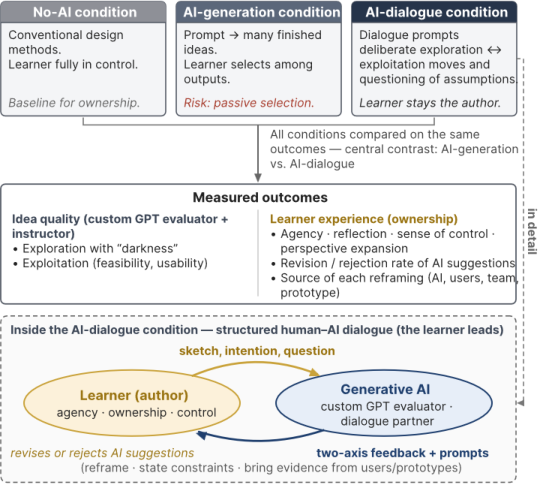
Three Ideation Conditions The framework compares three ideation conditions (Figure 3, top row): a No-AI condition (conventional design methods only; baseline), an AI-generation condition (prompting AI for many candidate ideas and selecting among them), and an AI-dialogue condition (AI-mediated dialogue that prompts deliberate exploration–exploitation transitions and the questioning of assumptions, with the learner as decision-maker). The central comparison is between the AI-generation and AI-dialogue conditions: both provide the same generative capability, but the former treats AI as a generator of finished options, whereas the latter treats it as a dialogue partner that makes the
current balance explicit on the two-axis map, prompts learners to move between exploration and exploitation, and—drawing on Study C—prompts them to question assumptions, state the constraints needed for convergence, and bring back evidence from users and prototypes. If ownership depends on interaction design rather than on the tool, the AI-dialogue condition should maintain or improve ownership relative to the AI-generation condition and help overcome the trade-off observed in Study A.
Measures and Hypotheses Idea quality is evaluated with the partially validated two-axis scheme combining GPT-based scoring with the instructor’s evaluation. Perceived agency, ownership, reflection, perspective expansion, and sense of control are measured through post-task self-report and short reflective interviews, piloted in Study C (ambiguous items will be revised), complemented by behavioral indicators: how often and how substantively learners modified or rejected AI suggestions (see Study B), and where each reframing originated (AI, users, team members, or the prototype). We expect the AI-generation condition to raise fluency over the No-AI condition but possibly lower ownership and reflection, whereas the AI-dialogue condition should retain much of the generative benefit while maintaining or improving agency, ownership, and reflection, and support perspective expansion by prompting “dark” reframing. These are hypotheses to be tested, not completed results.
Figure 3: Human–AI co-existence framework for learner-centered design education. The three conditions (No-AI, AI-generation, and AI-dialogue) are tested through a learner–AI dialogue loop that keeps the student the author, and both idea quality and learner ownership are measured as outcomes.
DISCUSSION
What runs through this paper is a shift in the design question: from how AI can generate more or better ideas to how AI-mediated dialogue can keep learners the active authors of their design process.
The three studies support this shift. Study A suggested that automated evaluation is reliable for exploitation but that exploration requires a criterion such as “darkness” and human oversight. In Study C, AI helped learners verbalize questions and diverge, whereas convergence relied on experience, users, and prototypes invisible to AI, and physically realizing the prototype was the source of ownership. The design challenge is thus not to protect ownership from AI but to expand AI’s role from supplier of answers to mediator of questions, leaving the judgment of leaps and convergence with the learner.
For educators and human-factors practitioners, these findings suggest four provisional guidelines, subject to future verification. First, name the two modes: an explicit exploration/exploitation vocabulary and a visible two-axis map can turn an implicit trade-off into a deliberate choice. Second, divide the labor of evaluation: use AI for exploitation feedback, leave the final judgment of exploratory leaps to humans, and treat AI evaluation of reframing, with a criterion such as “darkness,” as reference information. Third, protect authorship through interaction design: attach a “value your own thinking” note to AI feedback, position AI input around rather than in place of the student’s first ideas, tie reframing and convergence to users, prototypes, and explicit constraints, and treat modifying and rejecting AI output as behavior to encourage and measure. Fourth, in cross-cultural teams, use AI-generated summaries, subtitles, and shared technical constraints to support understanding while encouraging speaking up and securing AI-free time for sharing values (this rests on a single small PBL).
This research has several limitations. First, each study has design limitations: Study A compared the AI against a single instructor without examining inter- rater agreement; Study B’s pre–post comparison had no control group, so working time between presentations and feedback from the instructor and classmates cannot be separated out; and Study C is a descriptive, self-report analysis of eight respondents and interviews with the Japanese team only, so it shows neither causality nor differences between conditions, and one agency item was contradicted by a related item in the Japanese responses, suggesting a wording or translation problem. Second, the three-condition framework has not yet been carried out; custom GPT evaluation is sensitive to prompt design and can misread handwritten logbooks (Miura and Misaki, 2025), so exploration evaluation and human calibration are priorities, and the exploration–exploitation trade-off and the heaviest AI users’ high early- fixation ratings in Study C are risks the AI-dialogue condition must address. Third, because creative problem-solving is culturally constructed (Ge et al., 2022) and Study C’s differences were attributed as much to discipline and assessment methods as to culture, the framework needs verification across cohorts, disciplines, and cultures.
CONCLUSION
This paper presented a human-centered approach to human–AI interaction for product ideation based on ambidextrous thinking, learner ownership, a two-axis support method, and three studies. AI evaluation agreed well with the instructor for exploitation while challenges remained for exploration; two-axis support raised both axes; and students’ ownership was rooted in making things, with AI aiding verbalization and divergence while convergence relied on users, prototypes, and experience. We therefore proposed a three- condition framework measuring both idea quality and learner ownership as a study design to be tested. The purpose of generative AI in design education, we hold, is not only to produce more ideas but to design AI-mediated dialogue that keeps learners the authors of their own design process.
ACKNOWLEDGMENT
This work was supported by JSPS KAKENHI Grant Numbers 26K06491 and 23K02796. The authors thank the participating students.
REFERENCES
Aikawa, Y., Tamura, R., Xu, C., Ge, X., Misaki, D. (2023). Introducing Augmented Post-it: An AR prototype for engaging body movements in online GPT-supported brainstorming. In: Adjunct Proceedings of the 36th Annual ACM Symposium on User Interface Software and Technology (UIST ’23 Adjunct), pp. 1–3. Arnold, J. E. (2016). Creative Engineering: Promoting Innovation by Thinking
Differently (W. J. Clancey, Ed.). Stanford Digital Repository. (Original work published 1959). Bushnell, T., Steber, S., Matta, A., Cutkosky, M., Leifer, L. (2013). Using a “dark horse” prototype to manage innovative teams. 3rd International Conference on Integration of Design, Engineering and Management for Innovation, Porto, Portugal, 4–6 September 2013. Dym, C. L., Agogino, A. M., Eris, O., Frey, D. D., Leifer, L. J. (2005). Engineering
design thinking, teaching, and learning. Journal of Engineering Education, 94(1), pp. 103–120. Faste, R. (1994). Ambidextrous thinking. In: Innovations in Mechanical Engineering Curricula for the 1990s. ASME. Fukuda, S. (2023). Somesthesis and emotion. Journal of Japan Society of Kansei
Engineering, 21(1), pp. 33–39 (in Japanese). Ge, X., Leifer, L. (2017). Design thinking at the core: Learn new ways of thinking and doing by reframing. Proc. ASME 2017 IDETC/CIE, Vol. 7 (DTM), Paper No. DETC2017-67172. Ge, X., Xu, C., Furue, N., Misaki, D., Lee, C., Markus, H. R. (2022). The cultural
construction of creative problem-solving: A critical reflection on creative design thinking, teaching, and learning. In: C. Meinel, L. Leifer (Eds.), Design Thinking Research, Springer, Cham, pp. 291–323. Kocmi, T., Federmann, C. (2023). Large language models are state-of-the-art evaluators of translation quality. Proc. 24th EAMT, pp. 193–203.
Designing Human–AI Interaction to Foster Ambidextrous Thinking 465 Lande, M. (2016). Catalysts for design thinking and engineering thinking: Fostering
ambidextrous mindsets for innovation. International Journal of Engineering Education, 32(3), pp. 1356–1363. Leifer, L., Steinert, M. (2011). Dancing with ambiguity: Causality behavior, design thinking, and triple-loop-learning. Information Knowledge Systems Management, 10(1–4), pp. 151–173. March, J. G. (1991). Exploration and exploitation in organizational learning.
Organization Science, 2(1), pp. 71–87. Misaki, D., Ge, X. (2019). Design thinking for engineering education. Journal of the Japan Society for Precision Engineering, 85(7), pp. 636–639 (in Japanese). Misaki, D., Miura, K. (2026). Fostering innovation in engineering students: The role
of generative AI in engineering design class. International Journal of Engineering Education, 42(5B), pp. 1544–1556. Miura, K., Misaki, D. (2025). Leveraging generative artificial intelligence for prototyping: Ambidextrous thinking in engineering design. Journal of Research and Applications in Mechanical Engineering, 13(2), Paper No. JRAME 25-13- 029. Okamoto, M., Murakami, T. (2023). Proposal of cluster analysis method for products
considering exploration and exploitation in engineering design. Proceedings of the Design Society, 3, pp. 2995–3004. O’Reilly, C. A., Tushman, M. L. (2013). Organizational ambidexterity: Past, present, and future. Academy of Management Perspectives, 27(4), pp. 324–338. Pierce, J. L., Kostova, T., Dirks, K. T. (2001). Toward a theory of psychological
ownership in organizations. Academy of Management Review, 26(2), pp. 298–310. Ryan, R. M., Deci, E. L. (2000). Self-determination theory and the facilitation of intrinsic motivation, social development, and well-being. American Psychologist, 55(1), pp. 68–78. Schön, D. A. (1983). The Reflective Practitioner: How Professionals Think in Action.
Basic Books, New York.
SEARCH THE AHFE DIGITAL BOOKSTORE BY ISBN
Explore the complete digital volume
Human Factors in Design, Engineering, and Computing
Read this individual research paper free through the original publisher, or explore the full digital proceedings book.