Andrea Sofía Benítez Moreno, Sergio Alberto Navarro Tuch (2026). BrailleBridge: A Cost-Conscious Mechatronic Prototype for Digital Text-to-Tactile Braille Conversion. In: Human Factors in Design, Engineering, and Computing. AHFE Open Access, vol. 238, pp. 867–876. https://doi.org/10.54941/ahfe1008318
Refreshable Braille displays enable tactile access to digital text, but their cost and mechanical complexity can limit accessibility. This paper presents BrailleBridge, a modular electromechanical prototype developed to investigate the feasibility of cost-conscious refreshable Braille technology. Design requirements were informed by consultation with specialists in visual disability and Braille education. Two complementary prototypes were developed: an eight-cell electronic module with 48 independently controlled light-emitting diodes (LEDs) for text-to-Braille translation and navigation, and a three-cell tactile prototype with 18 solenoid-driven pins arranged in a staggered configuration. Following targeted corrections, the software passed all 74 selected host-based cases covering Spanish Braille translation, input handling, and eight-cell pagination and navigation. Electronic functionality was also evaluated on the assembled hardware. Mechanical testing demonstrated independent pin actuation and tactile pattern generation, while revealing intermittent sticking and return failures during repeated operation. In a retrospective follow-up interview, one blind, Braille-literate participant reported recognizing a short word through touch and navigating the display using physical controls. The findings support the initial technical feasibility of the modular architecture and identify mechanical repeatability, thermal management, and further user evaluation as priorities for continued development.
Access to digital information remains an important accessibility challenge for people who are blind or have low vision. Although audio-based technologies provide valuable access to digital content, Braille remains essential for tactile literacy, written-language comprehension, and educational participation (World Blind Union and International Council for Education of People with Visual Impairment, 2026). The Comisión Braille Española (CBE) describes six-dot Braille as two columns of three dots used to represent written characters and symbols through touch (CBE, 2005). Refreshable Braille displays extend this principle to digital content by electronically updating raised-dot patterns. However, their cost and technical complexity continue to limit accessibility (Zakrajsek et al., 2024).
868 Moreno and Tuch Existing research has investigated multiple actuation technologies for refreshable tactile displays, including piezoelectric, electromagnetic, and shape-memory mechanisms (Yang et al., 2021; Etezad et al., 2025). Despite these advances, actuator dimensions, mechanical stability, energy requirements, and tactile performance remain important engineering considerations. Furthermore, the relationship between tactile-reading requirements and the physical constraints of low-cost actuation warrants careful examination during early-stage development (Zakrajsek et al., 2024).
This paper presents BrailleBridge, a modular electromechanical refreshable Braille display prototype designed to convert digital text into tactile Braille patterns. The system integrates a web-based text interface, Spanish Braille translation, wireless communication, and electromagnetic actuation. Its development combines an eight-cell electronic validation module with a three-cell tactile prototype, informed by stakeholder consultation and tactile- reading requirements. The study investigates how these requirements can guide the implementation of a cost-conscious mechatronic architecture and identifies the technical constraints encountered during its initial functional evaluation. Rather than assessing comprehensive usability, the research focuses on establishing technical feasibility and informing subsequent development.
HUMAN-CENTERED DESIGN REQUIREMENTS BrailleBridge’s design requirements were established by translating tactile- reading needs into technical specifications. During initial planning, quality function deployment (QFD) was used to organize requirements related to Braille readability, access to digital text, nonvisual navigation, affordability, safety, and maintainability. QFD provides a structured approach for relating user needs to engineering characteristics (Akao, 1990). In this project, the resulting matrix guided design priorities and concept development rather than serving as a quantitative assessment of user preferences.
Subsequent consultations with representatives of the Organismo Mexicano Promotor del Desarrollo Integral de los Discapacitados Visuales, IAP, a Mexican nonprofit rehabilitation organization listed by Fundación ONCE América Latina (2012), provided specialist feedback on Braille conventions, tactile geometry, and interaction with limited-capacity displays. Particular attention was given to Spanish Braille signography, including capitalization, accented characters, numerical indicators, and punctuation (CBE, 2005). The tactile interface was also designed around established Braille dimensional recommendations, considering dot spacing, relief, and consistency across adjacent cells (CBE, 2024).
Stakeholder feedback further emphasized the importance of preserving word boundaries when navigating text, enabling interaction without visual assistance, and providing physically distinguishable controls. These considerations informed the text-segmentation logic, forward and backward navigation, and tactile identification of buttons. Requirements were balanced with the project’s manufacturing and technical constraints, leading to complementary eight-cell electronic and three-cell tactile verification stages. This approach allowed Braille-reading requirements to guide the engineering architecture while maintaining a feasible scope for initial prototype development.
SYSTEM DEVELOPMENT AND METHODOLOGY BrailleBridge was developed as a modular mechatronic platform integrating digital text processing, wireless communication, electronic control, and refreshable Braille output. The system comprises a web-based interface for text input through typing, pasting, or voice dictation; a deterministic text-to-Braille translation algorithm; Bluetooth communication; and microcontroller-based control of six-dot Braille patterns. The translation algorithm incorporates Spanish Braille conventions, including accented characters, capitalization and numerical indicators, and punctuation, following the signography established by the CBE (2005). Text is segmented into sequences of Braille characters according to the display’s cell capacity, allowing users to navigate between successive segments using physical buttons.
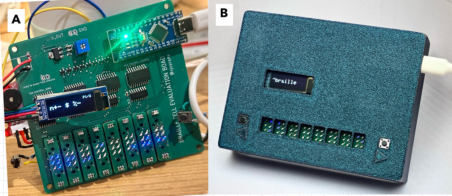
Development followed an iterative prototyping approach organized into two complementary verification stages. The first consisted of an eight-cell electronic module using 48 independently addressed 0603 surface-mount light-emitting diodes (LEDs) to represent Braille dots. This configuration enabled verification of text processing, translation, pagination, and electronic output without introducing mechanical actuation constraints. The second stage consisted of a three-cell refreshable Braille prototype incorporating 18 independently controlled electromagnetic actuators, enabling the evaluation of tactile dot actuation, Braille-cell geometry, and mechanical behavior.
Electromechanical Design and Iterative Development Actuator selection and mechanical retention are recognized design challenges in refreshable tactile displays, particularly because of the spatial and mechanical constraints imposed by tactile dot arrangements (Yang et al., 2021). The BrailleBridge mechanical architecture was designed around the dimensional requirements of six-dot Braille cells, targeting 2.5 mm center- to-center spacing between adjacent dots and 6.0 mm between corresponding dots of consecutive cells, consistent with the Marburg Medium spacing convention and Braille dimensional recommendations (PharmaBraille, n.d.; CBE, 2024).
Initial investigations explored custom electromagnetic coils coupled with magnets and cam mechanisms. Different copper-wire gauges (American wire gauge 44, 38, and 31) were evaluated to investigate the relationship between winding geometry, electrical behavior, and mechanical actuation. Qualitative observations revealed insufficient actuation force, voltage drops, friction- related movement restrictions, and localized heating, motivating a transition to commercially available push-pull solenoids.
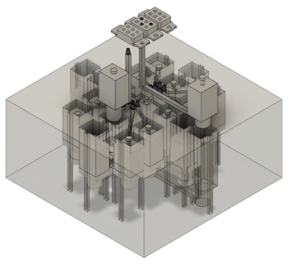
Although commercial solenoids enabled more consistent actuation under the tested conditions, their dimensions exceeded the available space beneath the intended Braille dot arrangement. Consequently, the mechanical design evolved toward a three-dimensional staggered actuator matrix incorporating indirect L-shaped transmission linkages. This configuration redistributed the actuators to accommodate the intended dot and cell spacing at the reading surface (Fig. 1).
The final tactile prototype incorporated 18 push-pull solenoids controlled through an Arduino Mega and an arrangement of ULN2003 Darlington drivers with paralleled channels. An external power supply was used to
870 Moreno and Tuch accommodate the actuators’ electrical demand. Tactile pins were fabricated through stereolithography, while structural components were manufactured through fused-deposition modeling using glycol-modified polyethylene terephthalate (PETG).
Figure 1: Computer-aided design representation of the three-cell Braille prototype, illustrating the staggered actuator arrangement and internal mechanical transmission linkages.
Evaluation Procedures Functional evaluation addressed software processing, electronic control, mechanical actuation, and preliminary tactile interaction. Text-to-Braille translation and pagination were verified using predefined inputs and expected patterns derived from Spanish Braille signography references (CBE, 2005, 2023). Following targeted software corrections, the revised Arduino translation and navigation logic underwent additional host-based verification using simulated hardware interfaces. A total of 74 selected test cases evaluated character mapping, input handling, and eight-cell pagination and navigation.
Electronic integration was evaluated through the eight-cell LED module by comparing intended Braille patterns against activated outputs. Mechanical verification of the three-cell prototype examined independent pin actuation, simultaneous pattern presentation, pin return, repeated operation, and stability under fingertip pressure. Functional outcomes were assessed through the correspondence between requested and observed pin states, while incomplete actuation, sticking, actuator heating, and visible structural changes were documented to identify implementation constraints.
Finally, an exploratory tactile evaluation was conducted with one participant who was totally blind and Braille-literate at Tecnológico de Monterrey, Campus Santa Fe, Mexico City, on June 4, 2026. Following an introduction to the prototype, the participant explored the tactile surface and navigation controls. Undisclosed text was subsequently transmitted to the display for tactile recognition, followed by interactions involving navigation between successive character groups and voice-dictated text input. The interaction and a retrospective follow-up interview provided preliminary observations and participant feedback to inform subsequent design improvements.
RESULTS
Software Functional Verification The text-to-Braille algorithm was evaluated using predefined inputs and independently specified expected patterns based on Spanish Braille signography (CBE, 2005, 2023). Host-based testing of the original Arduino implementation identified ten failures among 62 test cases, primarily involving capitalization, numerical notation, unsupported characters, and backward navigation. Following targeted corrections, all 62 original cases passed, together with 12 additional regression tests, resulting in 74 successful cases out of 74 executed as summarized in Table 1.
Table 1: Host-based software verification results before and after targeted corrections.
Table available in the original PDF paper.
Test Category Original Revised Alphabet mapping 27/27 (100%) 27/27 (100%)
Translation and input handling 17/25 (68%) 25/25 (100%) Eight-cell pagination and navigation 8/10 (80%) 10/10 (100%)
Original test suite 52/62 (83.9%) 62/62 (100%) Additional regression tests Not tested 12/12 (100%)
Total revised verification — 74/74 (100%) The revised implementation reproduced the expected patterns for the selected accented characters, capitalization conventions, numerical expressions, and punctuation. All ten pagination and navigation cases passed, confirming the expected segmentation of text according to the eight- cell display capacity. Words fitting within a single display segment remained intact, while longer words were divided into consecutive segments using a continuation hyphen. Navigation tests also verified correct forward and backward transitions, preservation of page order, and appropriate behavior at document boundaries. Additionally, unsupported inputs were rejected without modifying previously loaded content. These results verify the selected translation, input-handling, and eight-cell navigation cases under simulated hardware conditions.
Electronic Integration The eight-cell electronic prototype demonstrated the conversion of processed Braille patterns into independently controlled outputs. During laboratory verification, the assembled module displayed the expected combinations of illuminated LEDs across its 48 addressable positions (Fig. 2). The web interface, Bluetooth communication module, and microcontroller were also operated together, allowing text entered through the interface to be transmitted, processed, and represented electronically.
The electronic module provided a functional means of observing character patterns and navigation behavior without the constraints introduced by mechanical actuation. Following the host-based software corrections, the revised implementation was also retested on the original electronic hardware,
872 Moreno and Tuch providing an additional level of verification under the assembled system’s operating conditions.
Mechanical Verification The three-cell tactile prototype demonstrated independent actuation of all 18 Braille pins and the formation of coordinated tactile patterns. As summarized in Table 2, all 216 tests reported isolated pin-activation checks were successful. In contrast, coordinated-pattern verification succeeded in 10 of 12 repetitions (83.3%), with both unsuccessful presentations involving pins 8 and 11 in the central Braille cell.
Pin-return and repeated-operation tests revealed further inconsistencies concentrated in the same cell. Pin 11 exhibited three unsuccessful return checks, while pin 12 failed to return in two repetitions and required manual repositioning. During repeated actuation, pins 8, 11, and 12 showed intermittent failures, whereas no failures were reported for the remaining pins. All 12 fingertip-pressure demonstrations maintained the raised pin states under the applied contact.
Mechanical difficulties were more apparent following extended operation, during which heating of the solenoids and visible changes in PETG transmission components were observed. These findings demonstrate the prototype’s ability to generate tactile Braille patterns while identifying limitations in repeated actuation and mechanical stability.
Table 2: Mechanical verification outcomes for the three-cell tactile prototype.
BrailleBridge: A Cost-Conscious Mechatronic Prototype 873 Preliminary Tactile Interaction
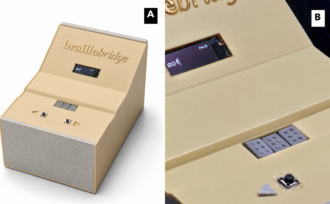
An exploratory evaluation was conducted with one totally blind, Braille- literate participant (P1), who interacted with the three-cell tactile prototype and its navigation controls (Fig. 3). During the demonstration, the participant explored the raised-dot patterns, navigated between successive character groups, and interacted with text entered through the web interface.
In a retrospective follow-up interview, P1 reported recognizing the word “hola” through touch and advancing between character groups using the physical navigation button. He described the textured controls as easy to distinguish and reported that the distribution of the Braille cells facilitated interaction. As this was his first experience with a refreshable Braille display, he particularly valued the opportunity to explore dynamically updated tactile text.
P1 did not report experiencing physical discomfort or perceiving excessive heat during the demonstration. Regarding potential applications, the participant identified educational activities as a promising use case, particularly where an instructor could enter short passages through a computer for tactile presentation. He also suggested incorporating speech output functionality for in future iterations. These comments provide preliminary feedback on perceived accessibility and potential applications, rather than evidence of effectiveness in sustained educational or independent reading tasks.
Figure 3: Three-cell refreshable Braille prototype: (A) assembled device with integrated display and navigation controls; (B) close-up of the tactile Braille cells and physical controls.
Preliminary Component Cost The recorded expenditure on electronic components and fabrication materials was approximately USD 204.34, excluding shipping and import duties. This amount includes components acquired for both the eight-cell electronic validation module and the three-cell tactile prototype. It represents the material expenditure associated with prototype development rather than the manufacturing cost of a complete commercial device.
DISCUSSION AND LIMITATIONS Technical Feasibility and Design Implications
The results support the technical feasibility of a modular approach to digital text-to-tactile Braille conversion, while highlighting the constraints associated with electromechanical actuation. Separating development into
874 Moreno and Tuch electronic and tactile verification stages enabled the evaluation of text processing and control independently from mechanical implementation. This approach allowed the system architecture to remain functional while different actuation mechanisms were investigated.
The transition from custom electromagnetic coils to commercial solenoids addressed the insufficient actuation force observed in the initial design but introduced new constraints related to component dimensions, power requirements, and mechanical transmission. The staggered actuator arrangement enabled the implementation of three tactile cells designed around the target Braille geometry. However, the differences between isolated pin activation and coordinated operation indicate that mechanical repeatability remains an important design consideration. These findings are consistent with the challenges associated with actuator selection and pin- retention mechanisms (Yang et al., 2021).
Human-Centered and Economic Considerations BrailleBridge was developed as an early-stage feasibility study in which tactile- reading requirements informed the engineering architecture. Stakeholder consultation contributed to decisions concerning Braille geometry, navigation, and interaction without visual assistance. The exploratory interaction and retrospective follow-up with one Braille-literate participant complemented the technical verification with initial feedback on tactile recognition, navigation, and potential educational applications.
The preliminary interaction was not intended as a systematic usability assessment. Rather, it provided an initial connection between the design requirements and the experience of a Braille reader, supporting the progression toward more extensive user-centered evaluation in subsequent development stages.
The recorded component and material expenditure was approximately USD 204, compared with listed prices of USD 1,899 for the 40-cell Orbit Reader 40 and USD 3,759 for the 40-cell Brailliant BI 40X (Orbit Research, n.d.; HumanWare, n.d.). Although this expenditure is substantially lower, BrailleBridge remains a three-cell research prototype, and the recorded amount includes development materials rather than commercial manufacturing costs. Increasing the number of tactile cells and improving mechanical reliability will require further cost evaluation.
Study Limitations The primary technical limitation identified during mechanical verification was the inconsistent operation of selected pins during repeated actuation. Observations of actuator heating, changes in PETG components, and mechanical sticking indicate the need to improve thermal management, material selection, and transmission geometry. Future iterations could investigate more thermally stable structural materials, reduced actuator energization times, and improved mechanical tolerances. Quantitative measurements of temperature, actuation force, and durability would also support a more comprehensive evaluation of operational performance.
BrailleBridge: A Cost-Conscious Mechatronic Prototype 875 The present study focused on technical and functional feasibility rather than sustained reading performance or usability. Subsequent research should involve a broader group of Braille readers to evaluate reading accuracy, usability, and interaction over longer periods. These evaluations represent the next stage of development, building upon the technical foundation established in this study.
CONCLUSION
This study investigated the development of a modular electromechanical refreshable Braille display informed by tactile-reading requirements. BrailleBridge integrated digital text processing, wireless communication, and electronic and tactile output through two complementary verification stages. The eight-cell electronic module enabled verification of text-to- Braille translation and control, while the three-cell tactile prototype demonstrated the implementation of 18 independently actuated Braille dots. The staggered actuator arrangement addressed the spatial constraints of commercial solenoids, enabling a three-cell design with the target dot and cell spacing.
The findings support the technical feasibility of the proposed architecture while identifying mechanical repeatability and thermal behavior as principal challenges for continued development. The exploratory interaction and retrospective follow-up with one Braille-literate participant provided initial feedback on tactile recognition and navigation to guide subsequent iterations. Future work should prioritize improving actuator efficiency and mechanical stability, extending the number of tactile cells, and conducting structured usability evaluations with Braille readers. Together, these findings establish a technical foundation for further development of accessible, cost-conscious refreshable Braille technology.
ACKNOWLEDGMENT
The authors would like to acknowledge the Organismo Mexicano Promotor del Desarrollo Integral de los Discapacitados Visuales, IAP, and its representatives for their guidance on Braille literacy and tactile-reading requirements, and the participant in the preliminary tactile evaluation for his time and valuable feedback. Special thanks are extended to Josué Albiter Benítez, Carlos Cristini Rullán and Professor Aldo Flores González for their contributions to the development of the original BrailleBridge prototype, and to Associate Professor Matthew Butler of Monash University, whose research and laboratory visit inspired the exploration of inclusive technologies that led to this work. The authors also acknowledge Tecnológico de Monterrey for providing the academic environment, facilities, and resources that supported the project.
REFERENCES
Akao, Y. (1990). Quality function deployment: Integrating customer requirements into product design. Cambridge, MA: Productivity Press. Comisión Braille Española (2005). Spanish Braille Commission Guides: Basic
Signography. 1st ed. Madrid: Organización Nacional de Ciegos Españoles (ONCE). https://biblioteca.fundaciononce.es/system/files/signografiabasica.pdf Comisión Braille Española (2023). Technical Document B 2: Basic sign notation for the co-official languages of Spain. Version 3. Madrid: Organización Nacional de Ciegos Españoles (ONCE). https://educacion.once.es/recursos-documentacion/ documentacion/documentos-braille-y-didactica/docs-braille-y-didactica/ b2-signografia-basica-de-lenguas-cooficiales-espanolas-v3-1 Comisión Braille Española (2024). Technical Document B 1: Dimensional parameters
of braille. Version 2. Madrid: Organización Nacional de Ciegos Españoles (ONCE). https://www.once.es/servicios-sociales/braille/comision-braille-espanola/documentos- tecnicos/documentos-tecnicos-relacionados-con-el-braille/documentos/b1-parametros- dimensionales-del-braille-2/download Etezad, M., Joshi, R. and Cibrian, F.L. (2025). Advancements in refreshable Braille display technology: A comprehensive survey. Displays, 90, 103133. https://doi. org/10.1016/j.displa.2025.103133 Fundación ONCE América Latina (2012). Mexican Organization for the Promotion
of the Integral Development of Visually Impaired Persons (IAP). FOAL. Available at: https://www.foal.es/es/asociaciones/organismo-mexicano-promotor-del-desarrollo- integral-de-los-discapacitados-visuales-iap (Accessed: 16 October 2026). HumanWare (n.d.). Brailliant BI 40X braille display. HumanWare Store. Available at: https://store.humanware.com/hus/brailliant-bi-40x-braille-display.html (Accessed: 16 October 2026). Orbit Research (n.d.). Orbit Reader 40 – Braille display, book reader and note-taker.
Orbit Research. Available at: https://www.orbitresearch.com/products/blindness- products/braille-devices/orbit-reader-40/ (Accessed: 16 October 2026). PharmaBraille (n.d.). Marburg Medium Braille Font Standard. Available at: https://www.pharmabraille.com/pharmaceutical-braille/marburg-medium-font- standard/ (Accessed: 16 October 2026). World Blind Union and International Council for Education of People with Visual
Impairment (ICEVI) (2026). Global Declaration on Braille Literacy in Education. Available at: https://wbu.ngo/resources/global-declaration-on-braille-literacy-in- education (Accessed: 16 October 2026). Yang, W., Huang, J., Wang, R., Zhang, W., Liu, H. and Xiao, J. (2021). A survey on tactile displays for visually impaired people. IEEE Transactions on Haptics, 14(4), pp. 712–721. https://doi.org/10.1109/TOH.2021.3085915 Zakrajsek, A.D., Foulkes, S., Nagel, N., Neurohr, F. and Nauman, E.A. (2024).
Biomechanical considerations of refreshable Braille and tactile graphics toward equitable access: A review. Journal of Biomechanical Engineering, 146(6), 060907. https://doi.org/10.1115/1.4064964
SEARCH THE AHFE DIGITAL BOOKSTORE BY ISBN
Explore the complete digital volume
Human Factors in Design, Engineering, and Computing
Read this individual research paper free through the original publisher, or explore the full digital proceedings book.