Niravkumar Suryakant Patel, Manasi Anand Kanetkar, Uttama Lahiri (2026). Designing for Technology Research: Case Study of Wearable Devices for Assistive Technology. In: Interdisciplinary Practice in Industrial Design. AHFE Open Access, vol. 222, pp. 196–206. https://doi.org/10.54941/ahfe1007759
Prototyping in industrial design (ID) has been framed as a step toward product commercialisation. In assistive technology (AT) research, however, prototypes function as research instruments that must support experimental variability, interdisciplinary collaboration, and longitudinal investigation under resource constraints. Existing prototyping approaches, largely derived from commercial and design research contexts, often fail to address the methodological demands of AT research, where customisation must coexist with experimental standardisation, and where prototype failure potentially compromises both data validity and engagement with users. This paper proposes a systematic, AT research-oriented prototyping methodology designed for academic settings. Drawing on practice-based design research conducted at an interdisciplinary academic AT laboratory, the study introduces three design principles: (i) research-centricity, (ii) systematic modularity, and (iii) contextual adaptability, following a five-stage prototyping framework. It structures the progression from research framing and modular planning to iterative deployment, validation, and reuse, positioning prototypes as a stable and adaptable tool. The methodology was practised through two wearable assistive devices developed within the same laboratory. The first case demonstrated the modularity, mid-fidelity prototypes that support controlled gait quantification research over extended periods, while the second illustrates methodological scalability in addressing more complex experimental scenarios related to freezing of gait. These two cases demonstrate reductions in iteration time and cost, component reuse, and reliability across diverse experimental conditions. Aligning prototyping decisions with research objectives and human factors considerations, this work contributes a transferable methodological approach that allows rigorous, efficient, and interdisciplinary AT research within constrained academic environments.
Conventional prototyping has been viewed as a step toward product commercialisation in industrial design (ID) practices, functioning primarily as
Designing for Technology Research: Case Study of Wearable Devices 197 a bridge between concept and outcome (Camburn et al., 2017). Alongside, prototyping has also been recognised as a method for evaluation and exploration, to learn through making and iteratively refine ideas (Gill Carolina et al., 2011). It also facilitates communication among stakeholders and supports collaborative design processes (Gill Carolina et al., 2011). The different prototyping techniques are often categorised according to their potential to improve outcomes, reduce development time and cost (Camburn et al., 2017). Particularly, low-fidelity prototypes are valued for their early-stage accessibility, despite misconceptions regarding their purpose and limitations (Lim et al., 2008). However, prototyping practices vary across domains, with some focus on technical specifications while others emphasise exploration and idea development (Schrage Michael & Winograd Terry, 2006). Accordingly, each prototyping effort requires a tailored strategy to address the specific problem, which shapes the type of information sought and what can be explored and learnt through the prototype (Lim et al., 2008). This indicates that the prototype should be planned and chosen based on the problem.
Challenges As design practices expanded into more complex social and systemic landscapes, the role of prototyping evolved from a focus on finishing products to a flexible and exploratory approach that facilitates co-creation and exploring the possibilities (Sanders Elizabeth & Stappers Pieter Jan, 2008). As complexity increases through research-driven innovation, designers are increasingly encouraged to adopt diverse prototyping strategies to address complex, socio-technical design challenges (Sanders Elizabeth & Stappers Pieter Jan, 2008). Buxton (2007) notes that while sketches and prototypes are representations of the design concept, they serve different purposes and therefore are distributed overconcentrated at different stages in the design process. However, these approaches are predominantly shaped by commercial design contexts, with fewer time, cost, or resource constraints. Such assumptions are problematic and may not be aligned with other domains, particularly academic research, where prototyping serves methodological objectives.
Academic research imposes structural constraints that reshape prototyping practice. Significant time limits, funding, and access to design support restrict the sophistication and durability of prototypes, which often create paradox (Santos et al., 2025). These constraints are critical in human studies, where prototype failure can disrupt data and validity. Studies involving users with disabilities, failures like these may have ethical and emotional implications, highlighting the stakes of prototyping decisions (Li & Aflatoony, 2025), often evident in assistive technology (AT) research laboratories. In AT research, disability and ageing contexts amplify these, requiring a balance between customisation and standardisation. They must accommodate wide variation in physical ability, cognition, and interaction preferences while maintaining consistent measurement across participants and sessions (Chavarria et al., 2025). This tension complicates reproducibility, comparability, and longitudinal investigation, particularly within resource-constrained academic
laboratories (Mathis et al., 2022). This creates a need for prototypes to function not only as participant-facing artefacts but also as research tools that can be understood, modified, and maintained by researchers. That means, they should be ergonomically and cognitively accessible to researchers, supporting research consistency and efficiency (Müller et al., 2025). Bouyam et al. (2025) indicated that participants must experience prototypes as realistic enough to elicit authentic responses, while researchers require standardised interfaces and reliable data. This duality creates methodological design challenges rarely addressed in existing prototyping literature.
These challenges are intensified in resource-limited academic laboratories, where additional constraints shape prototyping practices. This favours reusable, adaptable platforms capable of supporting multiple studies (Ye et al., 2024). At the same time, interdisciplinary teams bring heterogeneous research paradigms and measurement needs, requiring prototypes that can accommodate diverse investigative goals without sacrificing rigour (Müller et al., 2025). Addressing these challenges requires systematic, research- oriented prototyping that supports variability, interdisciplinarity, and experimental control within academic constraints.
Existing Methodological Approaches Studies indicate that academic research prototypes must prioritise experimental variability, repeatability, and longitudinal use, rather than solely aiming for functional completeness or market readiness (Blessing & Chakrabarti, 2009; Chavarria et al., 2025; Gero, 1990; Lim et al., 2008). There are multiple methodological approaches through which research prototypes are developed to address specific investigative needs. These include (1) exploratory prototyping within research through design to generate situated knowledge through iterative artefact creation (Gero, 1990) (2) validation-oriented prototyping embedded within Design Science Research, where artefacts serve as testbeds for hypothesis-driven evaluation (Hevner et al., 2004) and (3) user-centred and participatory prototyping approaches, which foreground stakeholder involvement and contextual fit, particularly in healthcare and AT domains (Sanders Elizabeth & Stappers Pieter Jan, 2008).
While traditional prototyping methods remain applicable for AT studies, they are often associated with usability challenges, high development costs, and limited translation to real-world use (Mathis et al., 2022). More broadly, while these approaches offer valuable foundations, they are often applied in isolation and remain fragmented across disciplines (Gerber & Carroll, 2012; Schrage Michael & Winograd Terry, 2006). As a result, decisions about prototype fidelity, modularity, iteration, and variable control are often implicit or constraint-driven rather than guided by a coherent research strategy, limiting the prototypes’ ability to function as systematic research instruments in AT research. Consequently, testing is often limited to short-term laboratory evaluations or narrow performance metrics, with little exploration of parameter variation, contextual effects, or longitudinal adaptation (Buxton Bill, 2007; Greenberg & Buxton, 2008). Such constraints are particularly consequential in AT research, where user capabilities,
Designing for Technology Research: Case Study of Wearable Devices 199 environments, and interaction modalities vary with each iteration and across populations (Clarkson John et al., 2003). Existing literature rarely addresses the methodological constraints of AT research. Existing frameworks are typically developed for broader product or interaction design contexts (Frauenberger et al., 2011) and are rarely validated against the clinical, ethical, and longitudinal demands of AT research.
In response, there is increasing interest in more systematic methodologies tailored to AT research. For instance, Beltramone and Pucheta, (2024) propose a comprehensive protocol for developing and selecting user- tailored AT, indicating a shift toward formalised, step-by-step procedures. Comparative analyses mapping classical and contemporary design methods further highlight efforts to structure methodological choices across analysis, synthesis, and implementation phases (Blessing & Chakrabarti, 2009). Advances in additive manufacturing have enabled small, modular AT components that support rapid iteration and user- specific customisation while configurable, plug-and-play architectures show how modular strategies can broaden applicability and reduce per-user development effort (Baldwin & Clark, 2018; Fixson, 2005). Modular and reconfigurable prototyping approaches may offer partial responses to these challenges. Interchangeable components might enable systematic investigation of design parameters by isolating specific variables while maintaining consistency across other system elements. Standardised interfaces and documented component specifications further facilitate collaboration, replication, and cross-validation across research groups and sites (Ribes & Finholt, 2009; Ye et al., 2024). Despite these advantages, existing methodologies rarely address how modularity can be systematically integrated into research-oriented design processes accessible to interdisciplinary teams in constrained academic environments. Although these approaches demonstrate effective research- led prototyping, they largely lack a design methodology centred on the specific needs of academic AT research.
Gap Existing prototyping frameworks largely follow commercial development trajectories, with limited consideration for experimental research, interdisciplinary collaboration, and long-term reuse (Camburn et al., 2017). The few research-oriented approaches that exist often lack systematic structure and validation, resulting in ad hoc solutions that are difficult to replicate or extend (Gero, 1990; Wensveen & Matthews, 2014). Design research frameworks recognise prototypes as knowledge-generating artefacts (Geng, 2024) but rarely operationalise them for academic research, and experimental design methodologies rarely indicate influence on prototype characteristics and research validity. Addressing this gap, the present work draws on practice-based design research in an academic AT laboratory to propose three design principles for a systematic methodology to develop modular, mid-fidelity research prototypes.
METHODOLOGY
Our approach treats prototyping as a research method, guided by design principles that shape how artefacts are designed, built, and used in interdisciplinary AT research. It positions prototypes as stable yet adaptable research tools, supported by three interrelated design principles (Table 1) that enable empirical study, collaboration, and long-term experimentation through participant and researcher-focused human factors.
Table 1: Prototyping principles.
Table available in the original PDF paper.
Principles Meaning Research-Centricity Positioning prototypes as research instruments, prioritising measurement reliability, experimental control, and data integrity over product refinement.
Systematic Modularity Enabling structured reconfiguration of prototype components to support iterative and comparative research, avoiding full redesign.
Contextual Adaptability Ensuring prototypes remain usable, modifiable, and reusable within the practical constraints of academic and interdisciplinary research environments.
The primary principle, research-centricity, treats prototypes as tools for inquiry. Design decisions focused on measurement reliability, experimental control, and consistency across iterations to support hypothesis-driven research. This principle prioritised data integrity, repeatability, stakeholder input, and controlled variation, enabling prototypes to support long-term research use without compromising data validity. The systematic modularity supports structured variation within a single prototype system. Modular architectures allowed components and subsystems to be reconfigured, replaced, or added without full redesign, supporting comparison across users, conditions, and research questions. Modularity operated at component, subsystem, and system levels, ensuring flexibility while maintaining coherence and measurement continuity. This was essential in AT research, where changing hypotheses and diverse user needs require adaptable yet consistent artefacts. Contextual adaptability addresses the realities of academic and interdisciplinary research. Prototypes were designed to function under constraints such as limited resources, tight timelines, shared infrastructure, and diverse expertise. This principle prioritised practical design choices that maximised research use, allowing artefacts to be maintained, modified, and reused across projects. By embedding adaptability into the design process, prototypes acted as shared boundary objects linking design intent, engineering feasibility, and research goals. These principles operationalised the needs for experimental variability, repeatability, and long-term use outlined in the Introduction.
Designing for Technology Research: Case Study of Wearable Devices 201 Framework Approach
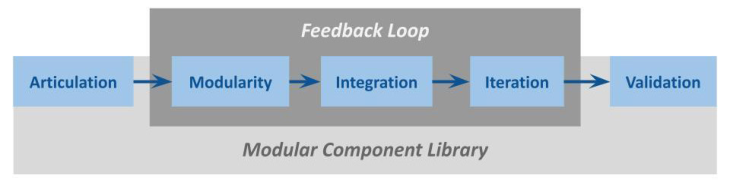
The implementation of those principles is structured through a five-stage prototyping framework that guided the progression from research framing to validation and reuse, as illustrated in Figure 1. The stages include: (i) Articulation; (ii) Modularity; (iii) Integration; (iv) Iteration; and (v) Validation. It integrates contextual analysis of the research underway, modular planning, prototype integration, and researchers’ and user engagement with iterative refinement.
Figure 1: Prototyping framework.
As shown in Figure 1, the framework provides a systematic structure that supports iterative movement between stages 2 and 4, with a shared modular component library supporting the process, ensuring that prototyping remains aligned with evolving research questions while maintaining methodological rigour.
IMPLEMENTATION The prototyping methodology was examined through two AT case studies developed in an academic research setting. Instrole provides a detailed application of the framework for gait quantification using a modular shoe- insole platform, while Smartstrole demonstrates scalability by extending the approach to more complex studies on freezing of gait. These cases show the potential of methodology’s adaptability and applicability across diverse AT research contexts.
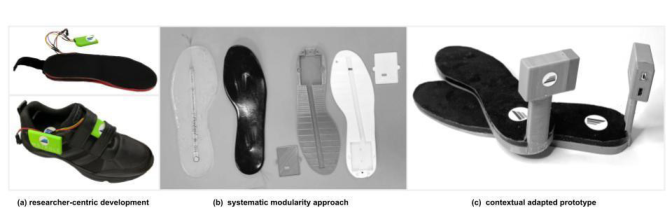
Case Study 1: Instrole Instrole is a wearable shoe insole designed for gait quantification across diverse users and experimental contexts. Pressure sensors are embedded at key plantar locations within an EVA foam insole, while the data acquisition unit (DAQ) is mounted externally on the shoe to improve accessibility, reconfiguration, and data reliability (Figure 2a).
The system was designed for data collection which is efficient and repeatable, with strong attention to researcher-facing ergonomics, enabling non-design researchers to transport, assemble, modify, dismantle and maintain the prototype during live experiments without disrupting protocols.
Figure 2: Instrole development process.
Gait quantification was specified as the primary research objective through the articulation stage, the main goal was to make the technology wearable and usable; efficacy of the research solely depended on this prototype which had to be tested with a population with gait disorders. Early co-design sessions with laboratory members, supported by low-fidelity ideation, aligned research questions, target populations, prototyping scope, and evaluation criteria, guiding subsequent design decisions. These decisions also included standardization of insole-templates as per market sizes, optimizing part- configuration and developing jigs for ease of assembly on site. A medium- fidelity modular architecture was developed to support technological variation and future extensions (Figure 2b). DAQ placement and interfaces were standardised to enable controlled modification across experimental conditions, consistent with principles of experimental control and instrument calibration (Blessing & Chakrabarti, 2009; Gero, 1990). The preliminary architecture combined paper-based assemblies and PLA 3D-printed components to balance robustness and adaptability (Figure 2c). Instrole was deployed in both laboratory and real-world settings, with iteration driven by empirical findings and user feedback. Compared to earlier single-purpose prototypes, the modular design enabled faster iteration by localising changes to specific components, supporting systematic refinement without disrupting research continuity. Over 200 hours of real-world use demonstrated reduced iteration time, lower costs, and sustained measurement reliability (Figure 2), with repeated reconfiguration introducing no variability beyond subject- and context-related factors.
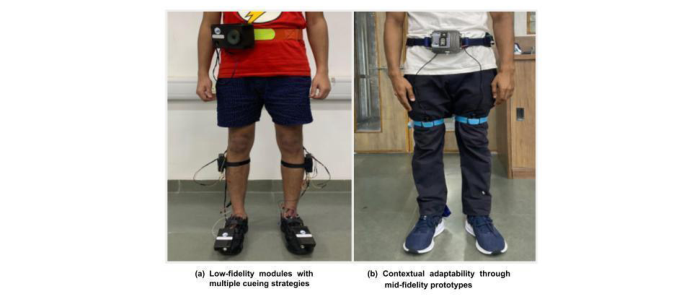
Case Study 2: Smartstrole Smartstrole investigates more complex research questions related to freezing of gait (FoG) in ageing populations by integrating a wearable cueing system with the existing Instrole platform. Using the same five-stage, principles-driven framework, this case evaluates methodological scalability and adaptability under increased system complexity. Additional subsystems aimed at gait rehabilitation, including a waist-mounted module and units on each leg were added as discrete modules without redesigning the core insole platform. These additions enable the technology to deploy in the new experimental conditions and exploration of rehabilitation strategies within a single prototype
Designing for Technology Research: Case Study of Wearable Devices 203 ecosystem (Figure 3a). Smartstrole supported data collection across 45 experimental conditions with frequent modification, demonstrating its ability to accommodate experimental variability. The system operated under the same resource, time, and expertise constraints as the earlier case study (Figure 3b), while substantially expanding experimental scope. Together with Instrole, this case demonstrates the transferability of a principles-driven prototyping methodology capable of supporting increased research complexity while maintaining methodological rigour in interdisciplinary AT research.
Figure 3: Smartstrole development process.
DISCUSSION
In interdisciplinary research such as for AT, prototypes act as shared reference points that allow engineers, clinicians, designers, and users to engage with abstract ideas in concrete ways. Their modular and mid-fidelity nature was critical to this role, providing enough detail to support discussion while remaining flexible to different perspectives. As a research instrument, the prototype functioned similarly to scientific equipment, with standardised measurement methods, documented calibration, validated reliability, and reuse across studies. This distinguishes research prototypes from product- oriented ones by shifting evaluation from market readiness for reliability and research utility. The work also highlights the designer’s role as an agency of methodological integration, bridging disciplinary perspectives, balancing requirements, and structuring experimental investigation. This reflects the evolution of ID towards research through design, where design participates in knowledge creation.
While there is a strong applicability of methodology in both case studies, it is important to acknowledge its limitations. The modular and research- centric approach requires significant upfront design effort to establish a robust and flexible architecture. The methodology also relies on a certain level of prototyping expertise, which may limit its applicability. While modularity enables controlled variation, it may also constrain some of the exploratory approaches based on prototyping. The proposed framework demonstrates a structured way to design artefacts that support both researchers and participants, particularly in longitudinal and interdisciplinary research in AT.
CONCLUSION
This paper presents a transferable prototyping methodology for academic AT research. The five-stage framework, guided by three design principles, addresses gaps between conventional prototyping practices and research needs by supporting prototypes as research tools within typical academic constraints. Evolved through practice-based research, the methodology enables rigorous investigation while reducing iteration time and cost, supporting component reuse, and maintaining consistency and reliability. The approach enhances academic research capabilities otherwise difficult to achieve with conventional practices followed by academic research groups. The framework is transferable to broader academic research contexts, though this study is limited to physical products for AT applications, a single laboratory setting, and mobility-focused cases. The validation presented in this study requires further work to assess its applicability across different domains, including digital systems and larger-scale deployments. Future work will focus on statistical validation and refinement of each of the five stages and their relationships across other research-based studies. The framework may also be extended to digital AT projects, including service design and problem-framing approach informed by Dorst (2015). The core contribution remains methodological: a systematic approach to research prototyping that treats prototypes as research instruments and designers as methodological facilitators, supporting rigorous and impactful interdisciplinary research.
ACKNOWLEDGMENT
The authors thank all participants for their time and cooperation. We acknowledge the Sarita G Laboratory for Intelligent Rehabilitation and Affective Computing Systems (IRACS), the Design and Innovation Centre, and the Centre for Biomedical Engineering at the Indian Institute of Technology Gandhinagar for providing facilities and resources. We thank the interdisciplinary researchers, engineers, and designers at IRACS whose collaborative inputs and discussions informed the development and evaluation of the prototypes.
REFERENCES
Baldwin, C. Y., & Clark, K. B. (2018). Design Rules. Design Rules. https://doi.
org/10.7551/mitpress/2366.001.0001 Beltramone, D. A., & Pucheta, J. A. (2024). A proposal for a comprehensive protocol to develop and provide user-tailored assistive technology. Technology and Disability, 36(3), 129–139. https://doi.org/10.3233/tad-240021 Blessing, L. T. M., & Chakrabarti, A. (2009). DRM, a design research methodology.
DRM, a Design Research Methodology, 1–397. https://doi.org/10.1007/978-1- 84882-587-1 Bouyam, C., Siribunyaphat, N., Anopas, D., Thu, M., & Punsawad, Y. (2025). Hands- Free Human–Machine Interfaces Using Piezoelectric Sensors and Accelerometers for Simulated Wheelchair Control in Older Adults and People with Physical Disabilities. Sensors, 25(10). https://doi.org/10.3390/s25103037
Designing for Technology Research: Case Study of Wearable Devices 205 Buxton Bill. (2007). Sketching User Experiences: Getting the Design Right and
the Right Design | Guide books | ACM Digital Library. In Morgan Kaufmann Publishers Inc. https://dl.acm.org/doi/10.5555/1526229 Camburn, B., Viswanathan, V., Linsey, J., Anderson, D., Jensen, D., Crawford, R., Otto, K., & Wood, K. (2017). Design prototyping methods: State of the art in strategies, techniques, and guidelines. Design Science, 3. https://doi.org/10.1017/ dsj.2017.10 Chavarria, M. A., Ortiz-Escobar, L. M., Bacca-Cortes, B., Romero-Cano, V., Villota,
I., Muñoz Peña, J. K., Londoño Sánchez, J. R., Campo, O., Suter, S., Cabrera- López, J. J., Sanchez Patiño, M. F., Caicedo-Bravo, E. F., Stein, M., Hurst, S., Schönenberger, K., & Rivas Velarde, M. (2025). Challenges and Opportunities of the Human-Centered Design Approach: Case Study Development of an Assistive Device for the Navigation of Persons With Visual Impairment. JMIR Rehabilitation and Assistive Technologies, 12. https://doi.org/10.2196/70694 Clarkson John, Keates Simeon, Coleman Roger, & Lebbon Cherie. (2003). Inclusive Design. In Inclusive Design. Springer London. https://doi.org/10.1007/978-1- 4471-0001-0 Santos, A. D. P., Loureiro, M., Machado, F., Frizera, A., & Medola, F. O. (2025).
NavWear: design and evaluation of a wearable device for obstacle detection for blind and visually impaired people. Disability and Rehabilitation: Assistive Technology, 20(6), 1800–1814. https://doi.org/10.1080/17483107.2025.24776 81 Fixson, S. K. (2005). Product architecture assessment: A tool to link product, process, and supply chain design decisions. Journal of Operations Management, 23(3–4), 345–369. https://doi.org/10.1016/j.jom.2004.08.006 Frauenberger, C., Good, J., & Keay-Bright, W. (2011). Designing technology for
children with special needs: Bridging perspectives through participatory design. CoDesign, 7(1), 1–28. https://doi.org/10.1080/15710882.2011.587013 Geng, X. (2024). Optimizing Post-Editing Strategies in Human-Computer Interaction: An Empirical Investigation of Efficiency and Cognitive Load. International Journal of Information and Communication Technology Education, 20(1). https://doi. org/10.4018/IJICTE.343634 Gerber, E., & Carroll, M. (2012). The psychological experience of prototyping.
Design Studies, 33(1), 64–84. https://doi.org/10.1016/j.destud.2011.06.005 Gero, J. S. (1990). Design Prototypes: A Knowledge Representation Schema for Design. AI Magazine, 11(4), 26–26. https://doi.org/10.1609/AIMAG.V11I4.854 Gill Carolina, Shim Scott, & Sanders Liz. (2011, September). Prototypes as
Inquiry, Visualization and Communication. https://www.researchgate. n e t / p u b l i c a t i o n / 2 6 6 1 3 5 9 8 3 _ P RO T O T Y P E S _ A S _ I N Q U I RY _ VISUALIZATION_AND_COMMUNICATION?channel=doi&linkId= 542581d60cf26120b7ac9f50&showFulltext=true Greenberg, S., & Buxton, B. (2008). Usability evaluation considered harmful (some of the time). Conference on Human Factors in Computing Systems - Proceedings, 111–120. https://doi.org/10.1145/1357054.1357074 Hevner, A. R., March, S. T., Park, J., & Ram, S. (2004). Design science in information
systems research. MIS Quarterly: Management Information Systems, 28(1), 75–105. https://doi.org/10.2307/25148625 Li, M., & Aflatoony, L. (2025). Parametric design and three-dimensional printing: enabling Occupational therapists to develop custom hand grips. Disability and Rehabilitation: Assistive Technology, 20(6), 1829–1837. https://doi.org/10.1080/ 17483107.2025.2483953
Lim, Y. K., Stolterman, E., & Tenenberg, J. (2008). The anatomy of prototypes: Prototypes as filters, prototypes as manifestations of design ideas. ACM Transactions on Computer-Human Interaction, 15(2). https://doi. org/10.1145/1375761.1375762 Mathis, F., Vaniea, K., & Khamis, M. (2022). Prototyping Usable Privacy and Security
Systems: Insights from Experts. International Journal of Human-Computer Interaction, 38(5), 468–490. https://doi.org/10.1080/10447318.2021.1949134 Schrage Michael, & Winograd Terry. (2006). CULTURES OF PROTOTYPING S CHRAGE 1 BRINGING DESIGN TO SOFTWARE: VERSION OF. Müller, P., Hofstetter, S., & Jahn, P. (2025). Sustainable Implementation of Digital
Assistive Technologies in Health Care Through a Simplified Interaction and Control Platform: Protocol for a Cocreative Feasibility Study. JMIR Research Protocols, 14. https://doi.org/10.2196/63089 Ribes, D., & Finholt, T. A. (2009). The long now of technology infrastructure: Articulating tensions in development. Journal of the Association for Information Systems, 10(5), 375–398. https://doi.org/10.17705/1jais.00199 Sanders Elizabeth B.-N., & Stappers Pieter Jan. (2008). Full article: Co-creation and
the new landscapes of design. International Journal of CoCreation in Design and the Arts, 4(1), 5–18. https://doi.org/10.1080/15710880701875068 Wensveen, S., & Matthews, B. (2014). Prototypes and prototyping in design research. The Routledge Companion to Design Research, 262–276. https://doi. org/10.4324/9781315758466-25 Ye, C., Wang, Z., Yu, S., & Jiang, C. (2024). An Image-Based Interactive Training
Method of an Upper Limb Rehabilitation Robot. Machines, 12(5). https://doi. org/10.3390/machines12050348
LISTED IN THE AHFE DIGITAL BOOKSTORE CATALOGUE
Explore the complete digital volume
Interdisciplinary Practice in Industrial Design
Read this individual research paper free through the original publisher, or explore the full digital proceedings book.
ISBN 978-1-964867-98-4
Explore this ISBN in the AHFE Bookstore ↗Listed in the July 2026 bookstore catalogue; search by ISBN to confirm current availability · Digital book purchase optional