Shuai Sun, Yuzhu Liu (2026). From “Disgust” to Acceptance: A Participatory Design Study of Insect- Based Foods Based on Cognitive Friction. In: Human Factors in Design, Engineering, and Computing. AHFE Open Access, vol. 238, pp. 972–983. https://doi.org/10.54941/ahfe1008328
In the context of sustainable dietary transformation, insect protein is regarded as an important food resource with high efficiency and low carbon characteristics, but its promotion is limited by cultural taboos and psychological aversion. This paper takes insect food as the object, based on the theory of cognitive friction, combined with interviews, material experiments and participatory workshops, analyzes the key factors that affect consumers ' acceptance of insect food. On this basis, the strategy of 'cognitive friction design ' is put forward, which is verified by the practice of ' insect macaron ' and blind box packaging design. The results show that the moderate introduction of sensory and symbolic conflicts can stimulate users ' reflection, promote the change of attitude from ' disgust ' to ' acceptance ', and provide new ideas and methods for new food design.
Against the backdrop of global climate change and population growth, conventional protein supply systems are increasingly unable to meet rising demand, while the high resource consumption and greenhouse gas emissions associated with traditional livestock production have further intensified food security challenges. In contrast, insect farming requires substantially less land, water, and carbon emissions than conventional livestock production (Van Huis and Laura, 2023). Insects are also rich in nutrients and provide high-quality protein that meets human nutritional requirements (Hazarika and Kalita, 2023).
As a major global market for protein consumption, China plays an important role in the transition toward alternative protein sources and future food security. Although entomophagy has a long tradition in some regions of China, modern consumers, particularly younger generations, show limited acceptance of insect-based foods. Recent systematic reviews and cross- cultural studies have identified food neophobia (FN), food disgust (FD) (Tian and Chen, 2025), insect visibility, and familiarity with insects as the primary factors limiting consumer acceptance (Kröger et al., 2022). However, existing research has focused primarily on the nutritional value and processing of insect-based foods, while emotional experience, cognitive mechanisms, and the role of design interventions remain underexplored. With the advancement
From “Disgust” to Acceptance: A Participatory Design Study 973 of experience design and the integration of interdisciplinary approaches, design is increasingly recognized as an effective means of reshaping food perception and cultural meaning, offering new opportunities to improve consumer acceptance of insect-based foods.
THEORETICAL FRAMEWORK AND RESEARCH PROCESS Cognitive Friction
Research on cognitive friction has developed along diverse trajectories. Existing studies have predominantly focused on reducing cognitive friction. Egger (2010), Lesandrini (2010), Conover (2011), Chen and Epps (2014), and Li et al. (2007) have proposed design principles and technical pathways for minimizing cognitive friction in products and interfaces. In contrast, Chen and Schmidt (2024) introduced the model of “positive friction” into the field of human–computer interaction, offering a critical reflection on the conventional ideal of “frictionless” user experience. Cox et al. (2016) further argued that the moderate introduction of design friction can disrupt users’ unconscious and automatic interaction patterns, encouraging reflection and thereby enabling a more conscious interaction experience. Babich (2017) explicitly distinguished between bad friction and positive friction and, through practical cases, identified five core values of positive friction: preventing operational errors, enhancing user engagement, facilitating cognitive learning, strengthening trust and safety, and optimizing long-term user behavior. Using a meditation app as an experimental prototype, Mejtoft (2019) conducted a comparative study and found that most participants preferred the version with friction, confirming that deliberately introduced friction can guide users into “slow thinking” and lead to higher user satisfaction.
This study extends the concept of cognitive friction to refer to the psychological tension or sense of contradiction experienced when external information received by an individual conflicts with their existing cognitive framework, beliefs, or expectations. It argues that such tension should be deliberately retained and appropriately regulated in order to guide individuals toward conscious interaction and reflection, thereby driving shifts in perception and attitude.
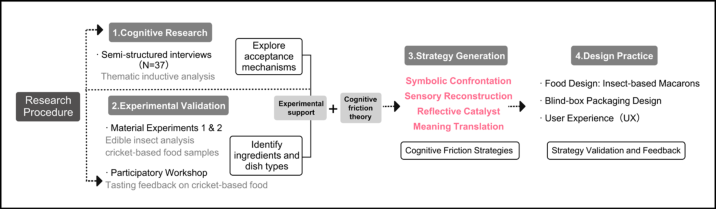
Research Procedure Guided by cognitive friction theory, this study constructs a research pathway comprising four stages: cognitive investigation, experimental validation, strategy generation, and design practice. The specific procedure is illustrated below (see Figure 1).
First, semi-structured interviews were conducted to identify users’ needs and psychological barriers when encountering insect-based foods, from which key influencing factors were extracted. Subsequently, material experiments were used to determine the types of ingredients and modes of presentation, followed by participatory workshops designed to collect users’ authentic
974 Sun and Liu emotional responses and evaluative data. These workshops served to verify the interview findings and provide additional behavioral evidence regarding users’ cognitive responses. On this basis, operational design strategies were developed in conjunction with cognitive friction theory. Finally, these strategies were applied in design practice and validated through “insect macarons” and blind-box packaging as design carriers. User experience evaluation was then conducted to assess their effectiveness in reducing disgust and improving acceptance, thereby completing the research loop.
Figure 1: Research procedure.
COGNITIVE INVESTIGATION AND EXPERIMENTAL VALIDATION Semi-Structured Interviews
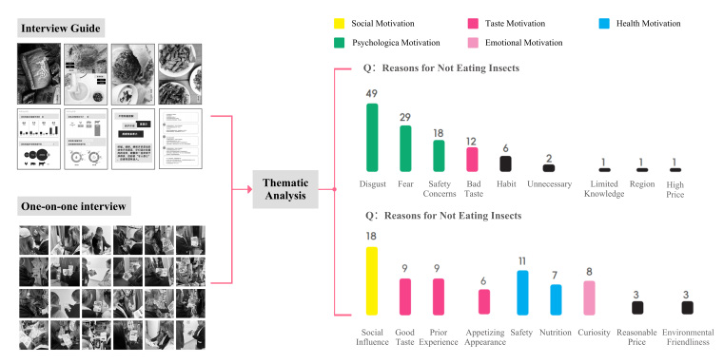
To investigate the acceptance of insect-based foods, 37 participants, including design practitioners and general consumers, were recruited for semi-structured interviews. Participants were grouped by age into young adults (18–30 years, n = 20), middle-aged adults (31–50 years, n = 10), and minors (<18 years, n = 7).
The interviews followed a self-developed interview protocol covering four themes: sensory experience, nutritional perception, hygiene concerns, and cultural associations. One-on-one semi-structured interviews were audio- recorded, transcribed, and analyzed using thematic analysis (see Figure 2). The results showed that psychological barriers were the primary reason for rejecting insect-based foods, with disgust, fear, and perceived safety concerns emerging as the dominant factors, reflecting typical characteristics of food neophobia. Thematic analysis further identified four key factors influencing consumer acceptance: visual perception (insect visibility, appearance familiarity, and color characteristics), sensory experience (flavor, odor, mouthfeel, and texture), cognitive evaluation (food safety, nutritional value, and health benefits), and sociocultural influences (food taboos, cultural associations, and social norms).
Overall, the findings suggest that psychological disgust drives rejection, sensory experience shapes hesitation, whereas social and health-related motivations facilitate willingness to try insect-based foods.
Figure 2: Content of the semi-structured interviews.
Material Experiments and Sensory Evaluation To determine the experimental ingredient and food forms, two material experiments were conducted:
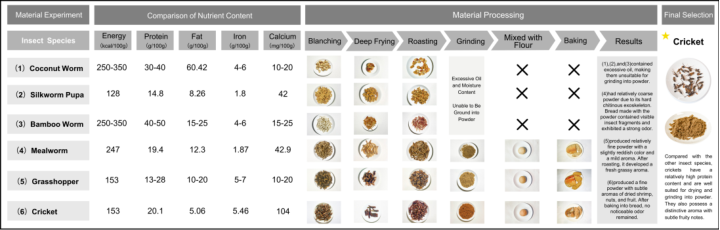
In the first experiment (see Figure 3), six edible insect species—crickets, grasshoppers, silkworm pupae, bamboo worms, coconut worms, and mealworms—were selected based on appearance, safety, protein, and fat content, and their nutritional composition, including energy, protein, fat, iron, and calcium, was analyzed. After cleaning, blanching, frying, baking, and grinding, the samples were incorporated into bread for sensory evaluation. Based on nutritional composition, processing performance, and sensory feedback, crickets were selected as the experimental ingredient for subsequent studies.
Figure 3: Material experiment 1: screening and suitability assessment of edible insect ingredients.
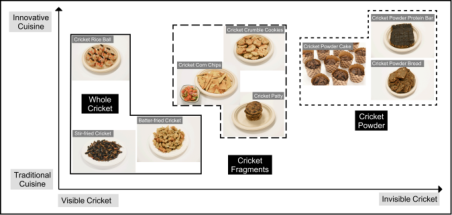
The second material experiment was informed by Gallen et al. (2022). Nine cricket-based food samples were developed and classified into powdered, fragmented, and whole-insect forms according to insect visibility for subsequent user evaluation (see Figure 4).
Figure 4: Material experiment 2: multi-form cricket-based culinary samples.
Participatory Workshop To examine participants’ initial attitudes toward insect-based foods, a pre- workshop questionnaire was administered before the Edible Insect Food Experience workshop. The results showed that consumers prioritized taste, safety, and health when selecting insect-based foods, whereas environmental and cultural considerations ranked lowest. In terms of food form, the preferred order was powdered products with no visible insect features, followed by whole-insect products and fragmented insect products.
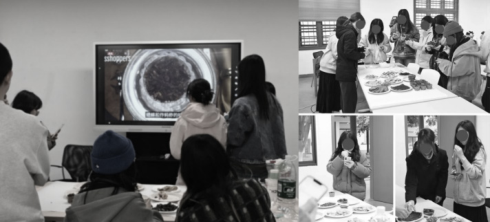
The formal workshop involved 12 participants. They first watched a documentary on edible insects and participated in a guided discussion to establish a more positive cognitive framework, after which they sequentially tasted nine cricket-based dishes. During the tasting session, participants rated each sample on odor, appearance, taste, texture, and overall impression, and recorded the reasons for liking or disliking each sample (see Figure 5).
Figure 5: Photographs of the workshop.
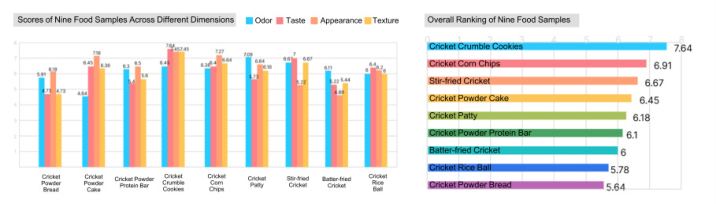
Notably, although fragmented insect products received the lowest acceptance in the pre-workshop questionnaire, two fragmented samples ranked among the highest-rated dishes during the tasting session, suggesting that direct experience can help overcome negative preconceptions. The overall results (see Figure 6) showed that powdered samples received the highest ratings, followed by fragmented samples and whole-insect samples. All nine samples achieved mean scores above 5.6 out of 8, demonstrating the basic feasibility of edible insects in terms of palatability and consumer acceptance.
Figure 6: Rating statistics for the nine food samples.
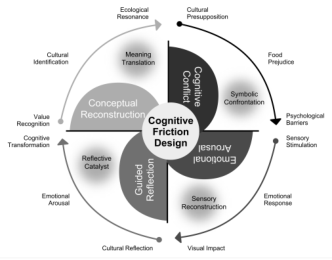
COGNITIVE FRICTION DESIGN STRATEGIES Based on cognitive friction theory and the experimental findings, this study proposes four core design strategies. Rather than encouraging consumers to overlook the presence of insects, these strategies employ controllable contradictions and conflicts to guide consumers through a psychological process of cognitive conflict, emotional arousal, reflective catalyst, and conceptual reconstruction, ultimately facilitating a shift in attitudes from rejection to acceptance (see Figure 7).
Symbolic Confrontation Unlike conventional approaches that reduce psychological resistance by minimizing or concealing insect-related elements, symbolic confrontation advocates the active, moderate, and gradual introduction of insect-related visual, semantic, and morphological cues, such as color, patterns, naming, and texture. By creating controllable cognitive conflict, this strategy seeks to challenge consumers’ stereotypes and cultural biases that associate insect- based foods with impurity, danger, and otherness. Emphasizing gradual and controllable exposure, it progressively increases the visibility of insect-related elements, encouraging consumers to confront psychological discomfort and reflect on food classification and cultural prejudice, thereby laying a cognitive foundation for attitude change.
Sensory Reconstruction Sensory experience is the most direct determinant of food acceptance, whereas psychological disgust often leads consumers to reject insect-based foods before tasting them. Sensory reconstruction counteracts this response through positive multisensory experiences involving appearance, taste, aroma, and texture. By combining insect protein with appropriate processing techniques, it creates enjoyable eating experiences that challenge the belief that insect-based foods are unpalatable. Replacing negative expectations with direct sensory experience helps dissolve prejudice and promotes consumer acceptance.
Reflective Catalyst Reflective catalyst communicates the functional value of insect-based foods, including their nutritional and health benefits, while embedding broader
978 Sun and Liu messages related to sustainability and ecological responsibility. For example, compared with conventional livestock production, insect farming requires less land, water, and feed, and generates lower greenhouse gas emissions. By integrating these messages into the design, this strategy encourages consumers to move beyond instinctive emotional responses toward deeper reflection on cultural values and environmental responsibility, fostering an intrinsic connection between individual dietary choices and ecological responsibility.
Meaning Translation Meaning translation systematically reorganizes cultural symbols through packaging design, visual reinterpretation, and contextual storytelling to reconstruct the cognitive context of insects within food culture. It transforms conventional labels of insects as “alien,” “taboo,” and “marginal” into positive cultural symbols associated with health and nutrition, ecological responsibility, innovation, fashion, and sustainability—values aligned with contemporary society. By reshaping cultural narratives and assigning new value meanings, this strategy seeks to reduce entrenched prejudice and cultural resistance toward insect-based foods.
Figure 7: Cognitive friction design strategies for insect-based foods (drawn by the author).
DESIGN PRACTICE AND VALIDATION OF “INSECT MACARONS” Carrier Selection and Semiotic Interpretation
The word macaron derives from the Italian maccarone, meaning “fine paste.” In contemporary consumer culture, the macaron symbolizes delicacy and pleasure while representing a highly aestheticized form of modern food culture. This ideal of culinary “perfection” has implicitly reinforced the rejection of non-conventional ingredients such as insects. Accordingly, this study adopts the macaron as a cultural symbol to challenge consumers’ existing food-related prejudices. The insect macaron was designed as a dual metaphor. Its delicate, fragile shell represents consumers’ superficial prejudice toward insect-based foods, whereas the filling symbolizes deeper psychological disgust. Through this symbolic design, the tasting experience encourages consumers to re-examine their own perceptions and reflect on the origins of food prejudice.
From “Disgust” to Acceptance: A Participatory Design Study 979 Graduated Design of Cognitive Friction
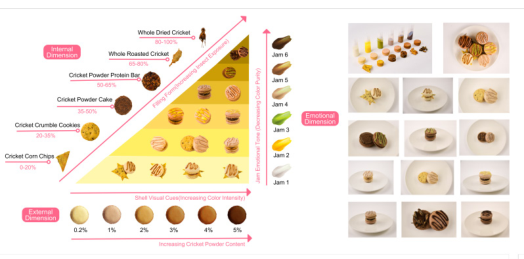
To examine the feasibility and psychological effects of cognitive friction design, this study developed insect macarons as an experimental prototype and established a quantifiable three-dimensional gradient system to simulate the psychological progression from mild discomfort to intense cognitive conflict. The system comprised three dimensions—filling form, shell visual cues, and jam color cues—which operated at the sensory, visual, and emotional levels, respectively, enabling multidimensional regulation of cognitive friction (see Figure 8).
Figure 8: Quantifiable three-dimensional gradient system for insect macarons.
Along the internal dimension, cricket ingredients were presented in fragmented, powdered, and whole-insect forms, creating a continuous gradient from implicit integration to explicit exposure. This dimension was designed to examine how processing depth and insect visibility influence consumers’ disgust, sensory experience, and acceptance.
Along the external dimension, the proportion of cricket powder in the macaron shells (0.2–5%) was adjusted to produce gradual changes in color and texture. These visual cues preserved recognizable traces of insect ingredients while avoiding excessive stimulation, thereby maintaining consumers’ awareness of the presence of a non-conventional ingredient.
The emotional dimension manipulated jam color as a cue for perceived psychological cleanliness. Following principles of color harmony, the color gradually transitioned from white to dark brown. White represented the highest level of purity and cleanliness, whereas progressively darker colors suggested decreasing purity, guiding consumers from feelings of safety and pleasure toward vigilance and discomfort, thereby intensifying the experience of cognitive friction.
Through the integration of these three dimensions, cognitive friction was operationalized as a measurable design variable. Multiple combinations of insect macaron samples were developed to examine changes in consumers’ sensory experience, emotional responses, and acceptance.
Blind-Box Packaging Design Consumers commonly experience psychological tension between curiosity and resistance toward edible insects. To transform this tension into an
980 Sun and Liu exploratory experience, the design incorporates a blind-box mechanism. Its inherent uncertainty simulates the omnivore’s dilemma, allowing consumers to experience both anticipation and anxiety in the face of the unknown. Package selection is based on intuitive visual perception rather than the rational decision of whether to consume insects, thereby reducing psychological barriers through playful interaction.
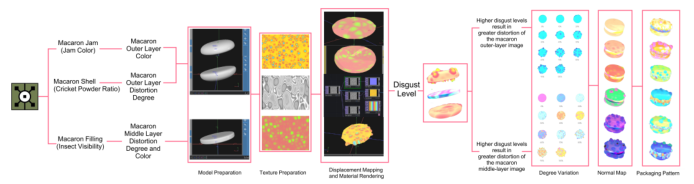
The packaging graphics were generated from three design dimensions: macaron filling, shell, and jam. Specifically, the internal dimension (insect visibility) determined the color and distortion of the middle layer; the external dimension (the proportion of cricket powder in the shell) controlled the distortion of the outer layer; and the emotional dimension (jam color) determined the outer-layer color. Together, these variables formed a disgust index, which was used as a parameter in the TouchDesigner system (see Figure 9) to establish a continuous mapping from ingredient characteristics to visual symbols, presenting cognitive friction as a visual gradient on the packaging.
The packaging graphics translate the internal intensity of cognitive friction into perceptible visual symbols. Consequently, selecting a package also represents selecting one’s preferred level of challenge, transforming the product experience into a symbolic psychological test.
Figure 9: Logic for packaging pattern generation.
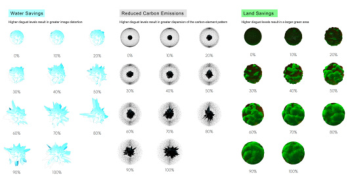
Beyond regulating emotional responses through visual design, the packaging also communicates product values. Environmental impact data are visualized to highlight the advantages of insect protein over conventional animal protein in terms of carbon emissions, water consumption, and land use (see Figure 10), enabling consumers to perceive the positive impact of their choices. In this way, consuming insects is reframed from an uncomfortable behavior as a sustainable action, reducing potential disgust while reinforcing its behavioral significance. The packaging also provides perceptible value feedback, making sustainability easier to understand and remember.
Figure 10: Visual display of environmental benefits.
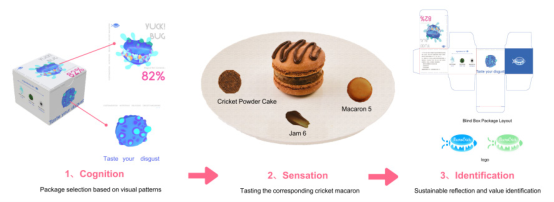
From “Disgust” to Acceptance: A Participatory Design Study 981 Finally, the blind-box packaging system integrates visual design, information, and brand narrative to create a progressive experience from cognition to sensory engagement and ultimately identification (see Figure 11). Consumers first make an intuitive selection based on the macaron’s perceived disgust level displayed on the front and top of the package, together with their individual tolerance. When tasting the corresponding insect macaron, the actual flavor and texture create sensory tension with prior expectations, enabling consumers to gradually recognize the product’s meaning and sustainable value. The brand name MacroCrick, combining Macro and Crick (cricket), represents a shift from individual dietary behavior toward broader ecological thinking. The logo integrates the forms of a macaron and a cricket, allowing refinement and primitiveness to coexist and symbolizing the integration of culture and nature, as well as reason and instinct. The packaging also presents environmental benefit data and includes descriptions of the emotional level and sustainability contribution on the back. These elements encourage consumers to associate individual food choices with ecological impacts, facilitating a transition from sensory experience to sustainable awareness and value identification.
Figure 11: Experiential pathway.
RESULTS
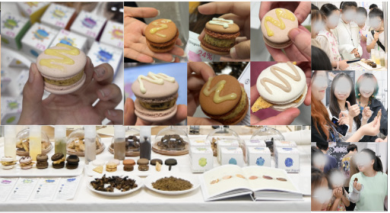
During the user-experience evaluation conducted upon completion of the design (see Figure 12), participant feedback suggests that the design process substantially alleviated feelings of disgust and could elicit positive emotions for some users. Several representative comments from participants include: “The blind-box format makes me really curious,” “At first, I thought eating insects would be a frightening challenge, but after tasting it and reading the explanatory text, I actually found it interesting. I did not expect my behavior to contribute to environmental protection,” and “This experience made me realize that insects are not disgusting at all; they can even feel somewhat premium.”
Compared with the hesitant attitudes observed in the preliminary questionnaire, users’ acceptance and favourable perceptions of insect-based foods increased markedly within this study. Participants’ understanding of the product also shifted from concerns over “whether it is edible” toward “whether it is worth trying” and “whether it carries sustainable value”. These findings further illustrate the potential of cognitive-friction-informed
982 Sun and Liu design to regulate emotional responses, reconstruct user cognition and evoke ecological resonance. They also provide preliminary evidence for the communicability and practical applicability of this design strategy within the Chinese cultural context.
Figure 12: Photographs from the user experience evaluation.
DISCUSSION
This study proposes cognitive-friction-informed design strategies for insect-based foods and explores their feasibility via the design of insect-based macarons and blind-box packaging. By framing psychological disgust as a design resource, these strategies offer a potential practical pathway for improving consumer acceptance of novel foods. Future research should further examine their cross-cultural applicability and long-term effectiveness in real-world consumption contexts.
REFERENCES
Babich, N. (July 17, 2017) When friction in design is good for UX. Babich Website: http://babich.biz/friction-in-design/ Chen, S. Epps, J. (2014). Using Task-Induced Pupil Diameter and Blink Rate to Infer
Cognitive Load, Human-computer Interaction Volume 29 No. 3-4:390–413. Chen, Z. Schmidt, R. (2024) “Exploring a Behavioral Model of “Positive Friction” in Human-AI Interaction”, proceedings of the International Conference on Human- Computer Interaction, Cham, Switzerland. Conover, K. (October 28, 2011) Cognitive friction. Ed-Informatics Website: https://
ed-informatics.org/2011/10/28/cognitive-friction/ Cox, A L. Gould, S J J. Cecchinato, M E., et al. (2016) “Design frictions for mindful interactions: The case for microboundaries”, proceedings of the 2016 CHI conference extended abstracts on human factors in computing systems. Egger, M. (2010) “Understanding Efficient UI Design”, proceedings of Dev
Connections Conference, Las Vegas. Gallen, C. Pantin-Sohier, G. Oliveira, D. (2022). How can the design thinking process improve an innovative insect-based food experience?, International Journal of Food Design Volume 7 No. 1:29–58. Hazarika, A. K. Kalita, U. (2023). Human Consumption of Insects, Science Volume
379 No. 6628:140–141. Kröger, T. Dupont, J. Büsing, L., et al. (2022). Acceptance of Insect-Based Food Products in Western Societies: A Systematic Review, Frontiers in Nutrition Volume 8.
From “Disgust” to Acceptance: A Participatory Design Study 983 Lesandrini, D J. (2010) Be careful of cognitive friction in program design. DevX
Website: https://www.devx.com/web-development-zone/45989/ Li, Shiguo. Hua, Meili. Jia, Rui. (2007). A New Mode of Product Design: Interaction Design, Packaging Engineering Volume 142 No. 04:90–92+95. Mejtoft, T. Hale, S. Söderström, U. (2019) “Design Friction”, proceedings of the 31st
European Conference on Cognitive Ergonomics (ECCE’19), New York, NY, USA. Tian, H. Chen, J. (2025). Association of Food Neophobia and Food Disgust with the Willingness, Benefits, and Risks of Insect Food Consumption among Chinese University Students, Frontiers in Nutrition Volume 12. Van Huis, A. Laura, G. (2023). Insects as Feed for Livestock Production, Science
Volume 379 No. 6628:138–139.
SEARCH THE AHFE DIGITAL BOOKSTORE BY ISBN
Explore the complete digital volume
Human Factors in Design, Engineering, and Computing
Read this individual research paper free through the original publisher, or explore the full digital proceedings book.