Katarzyna Ujma-Wasowicz, Klaudiusz Fross (2018). “Greenhouse of Senses” – A New Quality of Educational Space for the Blind. In: Advances in Human Factors and Sustainable Infrastructure. AHFE Open Access, vol. 3. https://doi.org/10.54941/ahfe100117
The idea of creating sensory gardens, also known as gardens of senses, is developing around the world since the beginning of the 20th century. Such places are organized mainly for the disabled people for the purpose of socializing, therapeutics and education. Spatial zones of sensory gardens refer to different senses like taste, smell, touch, hearing, kinesthetic sense and others. Following towards social expectations, the authors of the paper have taken the task which resulted in developing detailed guidelines for constructing innovative educational and recreational path called the Greenhouse of Senses dedicated to visually impaired as well as to healthy people. Three aims were given at the beginning of the research. The first was bringing new values into education programme for children and young people with visual disorders. The second was to develop a sensory garden independent from the climate conditions. The third task was to extend the available offer aimed at advancing integration processes between disabled and non-disabled people. Chosen research methods, which are based on close cooperation with users, as well as with experts on ergonomics, pedagogy, psychology, sociology, physiology, dendrology and others, are to bring effects in the form of the development of the functional and spatial plan including the arrangement and detailed equipment for this unprecedented educational training ground of a limited volume.The assumed final effect of the authors’ research is constructing a model facility near the school for blind and partially sighted children in Dąbrowa Górnicza (Poland) and supporting the implementation of new teaching methods and reinforcing integration processes within the facility, as well as in wider range of the city and the region.
There is no particular pressure in Poland towards promoting sensory gardens. The balance of people knowing and using such gardens in the country is little. According to the authors of this paper, the mentioned situation comes from the existing formula which does not encourage to common investing in these kinds of venues. Spaces constructed in our country nowadays are characterized by the following features:
- located far from urban areas and, as a consequence, far from the potential wider group of users; - construction ideas are based mainly on outdoor solutions which are seasonal in our climate; - such facilities (with few exceptions) are not directly related to educational institutions. This also limits their potential and the scope of impact in different social environments.
The authors of the paper developed their interest in “sensory gardens” on the occasion of collaboration with the Special Educational Center for Poorly Sighted and Blind Children in Dąbrowa Górnicza, Upper Silesia
Agglomeration / Poland, represented by the headmistress of the center - Mrs Violetta Trzcina. Conducted discussions with teachers and authors’ studies had shown the purposefulness of creating unprecedented and therefore innovative educational and recreational space for blind and poor sighted children at this particular school. According to plans, the new place would also be dedicated to disabled people from outside the school, as well as to non-disabled children as a part of sharing life experiences. Summing up, the authors took a task which will result in developing detailed functional requirements, preparing a project and, as a consequence, constructing a new open all- year-round spatial orientation school park called the ‘Greenhouse of Senses’.
TRADITION OF SENSORY GARDENS Hugo Kukelhaus – forerunner of sensory gardens
Sensory gardens, also known as the gardens of senses, are created in the world since the beginning of the 20 th century. German intellectualist and practitioner, Hugo Kükelhaus was the precursor of these places. In 1924 he developed an idea of composing the park space with educational installations dedicated to the users’ senses. The foundation of his research was a concern about the wide physical and intellectual development of children based on understanding uncountable environmental phenomena. In the mid-60s Kükelhaus initiated the creation of dozens of play-work stations for schools in Dortmund / Germany. In 1967 on an international EXPO exposition in Montreal / Canada, he introduced 12 examples of natural trails. Till the 70-s of the 20th century the exhibition called „The Field of Sensory Experience” was temporary and was presented in different places in Germany (Berant 2008). Today 37 play-works called “Sensorium” are placed in the rolling countryside of outsider Berne / Switzerland (Luescher 2006).
The idea of Kükelhaus was characterized by the desire to cause curiosity in men, so that they would wonder and inquire how different senses are working. He brought his offer to the following words: “how the eye sees – the ear hears – the nose smells – the skin feels – the fingers grope – the foot (under)stands – the hand grasps – the brain thinks – the lungs breathe – the blood pulses – the body swings - …” (www.hugo-kuekelhaus.de). Therefore spatial zones of Kükelhaus’ sensory gardens should stimulate all human senses. In the context of the discussed issues, this means that these sites are priceless sources of gaining life experience, without the use of sight.
Contemporary sensory gardens in the world and in Poland A characteristic feature of modern sensory gardens is the fact, that they have to be safe, comfortable in use and they should also ease or shape the ability to orientate in space. Each modern sensory garden is prepared to serve people with disabilities and, among them, also to the blind and poorly sighted people (specially marked path texture, sound signals at critical points, Braille descriptions of educational stands, vegetation, animals or simply large font descriptions). The specificity of these gardens is influencing different senses, and therefore is offering special places of sight, hearing, touch or smell stimulation.
According to the European scale, the most modern garden in Poland is the “Sensory Garden” at Special Educational Center for Blind Children (completed in 2012) in Owińska Village, 8 km north of Poznań. The solution received the first prize in 2013 in prestigious competition “Poland Getting More Beautiful – 7 Wonders of European Funds” in the category “Place Friendly for Children”. The garden is located in the former Cistercian park and it covers an area of about 2.5 hectares. It is a place not only for classes dedicated to blind children but also for all interested. Originators’ idea was to accustom poorly sighted children to the atmosphere of a big city without leaving the resort. This is possible due to so-called “library of sounds” containing over a thousand different types of sounds. It contains i.e. the sound of traffic from road intersections, roundabouts, tram and bus stops; sounds accompanying railway stations, airports and offices. Listening to gathered recordings takes place in typhloacoustic laboratory – properly soundproofed room. In the park, besides the devices imitating the traffic sounds, there are architectural models of existing places and special didactic devices (sound toys, beams, swings, obstacle course). Preparations to live in the world of people who can see are based on simulating various incidents and situations. The blind learn how to step off a curb and move around different surfaces. In addition to the park so-called “garden of sensory experiences” was developed – a place affecting all the senses. Besides stimulating the development of blind people, the garden also has an integrating function – it is to hold classes for sighted pupils of mass schools. Thanks to that young people can familiarize themselves with the functioning of blind and partially-sighted people in open spaces. This helps to overcome mental barriers in contact with disabled people and a better integration of these social groups (Wikipedia.pl).
Other sensory gardens located in Poland and described in publications (Dąbski 2010) (Wikipedia.pl) include: - “Stanisław Lem Garden of Experiences”, the first one built in Poland - in Kraków (2007); - “Zapopradzie Spa Park” in Muszyna Spa near Nowy Sącz; - „Integration Garden of Ecological Education” in Powsin near Warsaw; - Sensory garden in Bolestraszyce near Przemyśl.
The analysis of the research state do not omit spectacular examples such as: “Secluded Garden in Royal Botanic Gardens” in London (Great Britain), “The Garden of Senses” in Faelledparken in Copenhagen (Denmark), “Chicago Botanic Garden” in Chicago and “Brookside Gardens” in Silver Spring, Maryland (United States) and many others.
BASIC RESEARCH Typhlopedagogy – science dealing with disabilities of the blind
Typhlopedagogy is a branch of special pedagogy dealing with upbringing, education, therapy and rehabilitation of the blind and visually impaired people (from Gr. typhlos – blind) According to the generally accepted classification people with visual impairment are classified in following groups:
– Blind people who do not see since the day they were born, and therefore they don’t have any previous visual experiences as well as the blind who were born healthy (with previous visual experiences) but lost their sight after they were five years old. According to the polish law a blind person is someone with no more than 10% of full visual acuity or a person whose visual field - regardless of visual acuity – is no more than 30 O (the standard is 180 O). – People with poor eyesight who use their sight with limitations, i.e.:
poorly sighted person has the ability to identify outlines of people or large items but does not recognize the details;
others experience difficulties to move on their own (may experience minor accidents) but are able to read;
some can see everything but blurry;
some time can see partly clearly and in other time they do not see anything;
there are people who can see better one day and the next day their sight is deeply getting worse, etc.;
Therefore, the mentioned disabled commonly named blind or partially sighted are a group of people of different diseases and different types of damages to their visual system.
For the authors of the paper the important information is the fact that the majority of the blind people can function independently. On the other hand, being aware of imperfections of spatial solutions, the basic research problem is to identify the needs / limitations of the blind and on this basis to introduce new educational methods improving everyday life skills.
Poorly sighted person’s ability to orientate in space and to recognize the environment visually is taken over naturally by other senses. This phenomenon is known as ‘compensation’. Senses supporting the environmental functioning include: kinesthetic sense, hearing, smell and taste, somatic senses (touch, pain and heat perception), and sense of obstacles – characteristic for the discussed group of people.
Kinesthetic sense is an ability of internal orientation to recognize the arrangement of own limbs without interactions with the environment or observation. Receptors located in muscles and tendons are responsible for its correct functioning (so-called deep feeling) and the receptors in joints (responding to the pressure changes accompanying their movements).
Hearing is the most important ability for the blind. Such people read the environment thanks to sound reflection described as echo (single reflection) and reverberation (i.e. in a room where individual echoes overlap and prolong the sound). In a situation of a complete silence (i.e. in an open space) or surrounding noise (i.e. crowded city) space orientation of a blind is very difficult.
Touch, smell and taste are supplementing the hearing.
Sense of obstacles is an ability given almost only to the blind, particularly to those who are sensitive and skilled above the average level, to receive the external stimulus. These people are able to sense standing or moving obstacles at the height of their faces. The essence of the sense of obstacles is a gift, that can be practice which allows recognizing airwaves bouncing back from the object and sound waves causing the feeling of a touch.
From the point of the discussed subject, essential is the fact that visual disability, like in music education or in sports, requires methodical teaching involving multiple and systematic repeating of the same exercises and frequent raising of the difficulty level. All this to encode and preserve the right patterns. (Putkiewicz, 1987) (Wikipedia.pl) (Ujma-Wasowicz, 2013) Surveys with users and their caregivers
The aim of the first basic research (continuation is planned) was to obtain direct feedback from poorly sighted and blind people, as well as from their caregivers, regarding the existing spatial barriers that hinder fluent and safe movement in a building (in a flat, school and other interiors) and in open spaces (particularly in a city). Surveys were performed in the Educational Center for Poorly Sighted and Blind Children in Dąbrowa Górnicza, Upper Silesia Agglomeration (Poland). The set of survey queries was prepared by the authors of the paper: architects – researchers and academic teachers of the Faculty of Architecture at the Silesian University of Technology in Gliwice and, what seems to be essential, practicing designers. The use of this well-known research method had given a chance to provoke pupils, their parents and their caregivers to express opinions on inadequacy of the surrounding space in terms of the needs and limitations of poorly sighted and blind people (Fross 2012). Disabled themselves were valuable sources of information on ways of eliminating “spatial barriers”. The main aim of the questions was to obtain information confirming and correcting or supplementing more or less detailed knowledge in the field of space design for disabled, particularly for the blind.
The results of the studies will be used to develop a set of barriers and training equipment for the planned “adaptation path” in the ‘Greenhouse of Senses’. After completing first prototypes of educational and recreational sets – in cooperation with a producer - ATERNUS sp. z o.o. (Chorzów, Poland) – a next phase of tests will be conducted along with the research and collecting users’ opinion on the arrangement of “adaptation path” and on individual devices.
Some of the polled children answered the questions on their own while others used the help of their tutors. It is worth mentioning that no problems were experienced while collecting the answers. The surveys were conducted fast and efficiently during one day of classes and then forwarded to the research team. 40 pupil surveys and 30 teacher surveys were collected.
The survey directed to the pupils contained the following questions:
1. Name the most problematic barriers causing moving problems in a building. 2. Name the most problematic barriers causing moving problems in an open space. 3. Name one - the most difficult barrier causing moving problems in a building or in an open space. 4. According to you, what exercises, comforts, equipment, elements could improve your ability to overcome difficulties in navigating in a building or in an open space?
The survey directed to the teachers was referring the following subjects:
1. On the basis of your observation, name the most problematic barriers causing moving problems for students in a building. 2. On the basis of your observation, name the most problematic barriers causing moving problems for students in an open space. 3. According to you, what exercises or comforts could improve the ability to overcome difficulties in navigating in a building or in an open space?
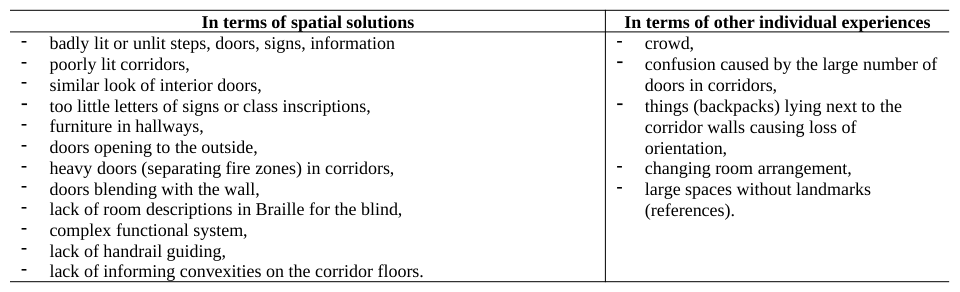
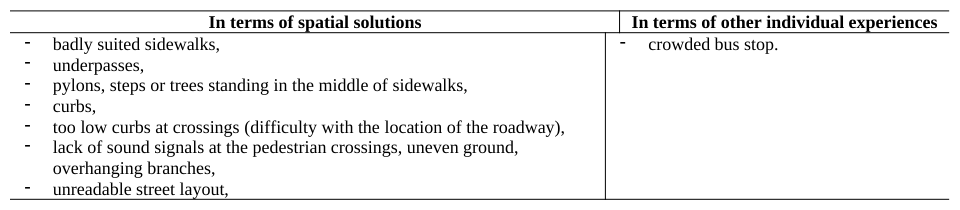
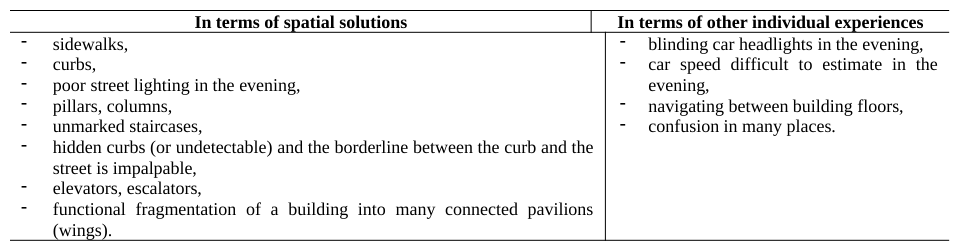
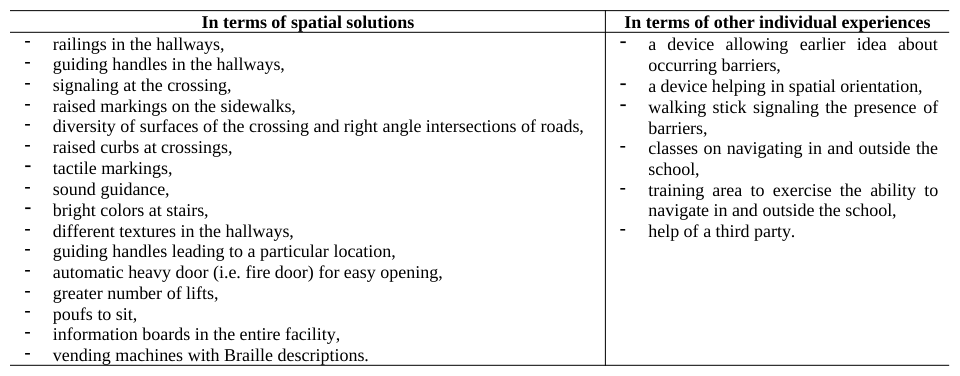
Conclusions of survey studies The surveys addressed to pupils and teachers revealed many clear answers to the given questions. Pupils had no problems either with understanding or with giving answers. 20 pupils (50%) listed no problems in navigating in a building. Answers listed below (see Table 1,2,3,4) on one hand are directing the correction of the environment of the blind, and on the other hand they are proposing new revalidating exercises which should be included in the education programme.
Table 1: Barriers causing most difficulties in navigating around a building (by authors)Table 2: Barriers causing most difficulties in navigating in an open space (by authors)Table 3: The most difficult barriers in navigating in the building or in an open space (by authors)Table 4: Exercises, conveniences, equipment, element in and outside the building improving the efficiency in overcoming navigating difficulties in a building or in an open space (by authors)
Research summary Surveys revealing the exact terrain barriers and improvements proposals for everyday movement (received from poorly sighted and blind children as well as from their school tutors) are a valuable source of information for the paper authors (architects). The gathered data not only gave a closer look to the real everyday life difficulties of poorly sighted or blind children, but also significantly influenced the increase of the designers’ consciousness and reading the scale of problems in this particular social group.
In terms of school interiors, pupils underlined the problem with heavy doors (caused by the fire protection of the facility); doors opening to the outside (causing possible injuries while sudden opening by another person; not noticing doors which are already opened); lack of clear markings of location of doors; differentiating shapes and written information.
Properly marked railings or stairs (see Figure 1) seem to be good examples of correct solutions. The most problematic issues for the blind people in an open space are curbs or lack of clear borderline and notification between the sidewalk and the roadway.
Proposals for the quality of the built environment and the functioning of poorly sighted and blind people are based mainly on informing signals indicating various obstacles, equipment supporting orientation or training exercises improving the efficiency of navigation within the built environment. All these information are valuable because they confirm adequacy of developing “adaptation path” and a set of barriers and prototypes of training devices inside of the path.
Figure 1. Markings on a museum flooring, Osaka,
Figure available in the original PDF paper.
Figure 2. Markings on a pavement, Osaka, Japan (Photo K. Fross 2013)
Figure available in the original PDF paper.
Japan (Photo K. Fross 2013) Analysis of surveys also pointed a significant contradiction between the need for facilities for disabled people in wheelchairs and the safety of the blind. Namely: the principle of reducing the curbs at pedestrian crossings. This comfort generates (among the visually impaired and blind) problems with the correct definition of the edge of the roadway. The correct solution can be as follows (see Figure 2).
The final and surprising test result was a fact that half of the children (20 out of 40 respondents) stated no obstacles in moving around the facility and outside of it and proposed no solution ideas improving the functioning of other poorly sighted or blind.
The research team will check the reasons for such an opinion: [Equation or mathematical symbol available in the original paper PDF]whether it comes from the fact that, despite a medical report, so many children feel strong in terms of ability to
see?; [Equation or mathematical symbol available in the original paper PDF]or maybe tutors’ help gives them a sufficient sense of security?; [Equation or mathematical symbol available in the original paper PDF]another source of such an opinion could be a misunderstanding of the purpose of the survey and the discussed issues?; [Equation or mathematical symbol available in the original paper PDF]or perhaps participation had a negative perception.
To answer mentioned queries, more surveys and interviews will be carried out as a supplementation of information enclosed in the conducted research.
Gathered surveys form an important base of information for designers and civil engineers of the “adaptation path” in the ‘Greenhouse of Senses’. Studies, besides valuable information for the design team, gave the possibility for pupils and their tutors to speak up reassuring everyone involved in a belief, that their opinion is important and can give a direct impact on improving the quality of life of poorly sighted and blind people. This fact has an important psychological and educational meaning.
IDEA FOR AN INNOVATIVE SENSORY GARDEN FOR THE BLIND PEOPLE Design guidelines
In the introduction of this article the authors of the ‘Greenhouse of Senses’ project showed three basic reasons which, in authors’ opinion, limit the popularity and utility of sensory gardens in Poland. These reasons include: unknown location – in small towns or villages; large distance to urban areas and therefore also from all kinds of schools and kindergartens; seasonal – open air character of many of these facilities.
Following this we, originators, lead new rules for shaping sensory gardens were searched. Such rules are to assure greater popularity in the society and all-year-round use, as well as to provide wider educational offer connected to the teaching and social integration.
As already mentioned, Hugo Kükelhaus was the originator of sensory gardens. He introduced innovative educational and play installations, stimulating various senses, into public park areas. For the authors of this paper, this was the first basic model to follow. The second inspiration was to follow the development of glass buildings of different volumes, so-called “palm houses”, whose prototype was J. Paxton’s “Crystal Palace” built for the event of an international exhibition in 1851. Exemplary of the most modern palm houses in the world is the ONE located in Gliwice (Poland) – a home city of The Silesian University of Technology. Other, new built is ‘The Crown Sky Garden’ in Chicago (USA).
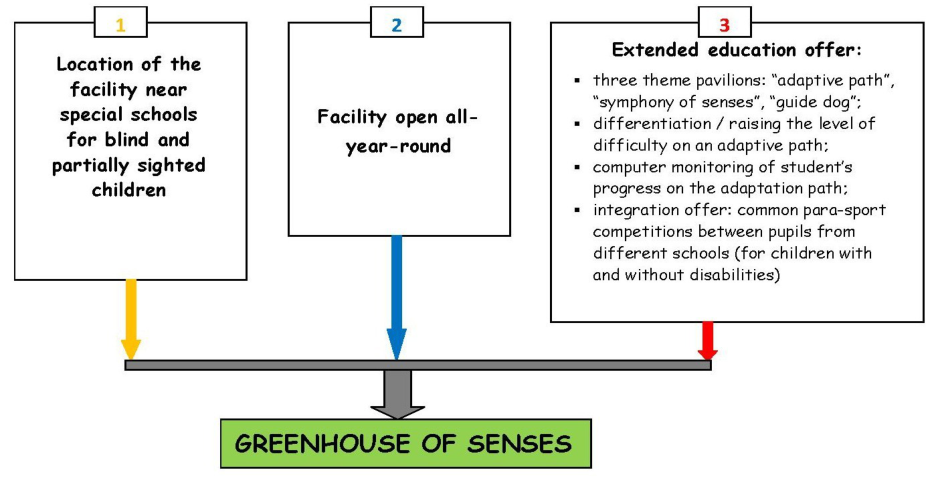
The planned structure will be smaller than a palm house in terms of volume and space, close to school and it will contain three, various theme pavilions:
The first will be associated with dealing with spatial and sound barriers - that is with dangers occurring in open spaces; it will include the discussed earlier “adaptation path”;
In the second pavilion, named "the Symphony of Senses", senses of touch, smell and taste will be involved. According to the designers, the space will be completely dark. This will allow the potential guests to involve the mentioned senses with their vision cut off;
The third area of the conservatory will be prepared to train guide dogs for the visually impaired people. (see Figure 3) ‘Greenhouse of Senses’ constructed in Dąbrowa Górnicza (Silesia, Poland), realized in the mentioned way, will accomplish two main objectives:
I. It will bring new values to the educational programme for children and young people with impaired vision, aimed at improving their life skills through learning and fun; II. It will expand the educational offer, aimed at deepening the integration processes between the disabled and nondisabled;
Figure 3. Characteristics creating new quality of sensory gardens (by authors)
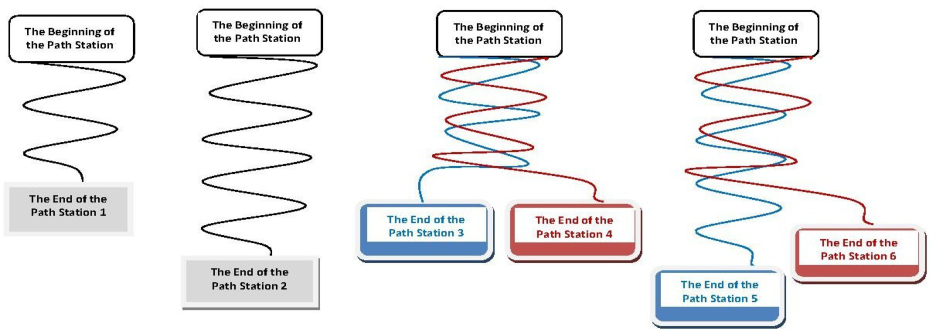
With regard to the first objective, the innovative aspect of educational exercises conducted in the ‘Greenhouse of Senses’ will be providing the participants with opportunities to raise the degree of difficulty on so-called "adaptation paths" (see Figure 4) and monitoring results associated with the activity (checking and documenting the progress for the verification and possible correction of the assumed teaching methods).
The second objective will be developed through generally available character of the school facility, with the possibility of exploring, conducting lectures, organizing para- sport competitions for pupils (Ujma-Wasowicz 2011), etc.
Figure 4. Overcoming difficulties of subsequent stages of the various adaptation paths in the
Greenhouse of Senses (by authors)
The end result, assumed by the authors, will be the construction of a model facility by the school for poorly sighted and blind children in Dąbrowa Górnicza (Poland), which will support the implementation of new methods of learning and reinforcing integration processes both within the facility, as well as at broader range – within the city and the region.
CONCLUSIONS
Most of the analyzed gardens / sensory parks offer nature didactic trails, that main task is to strengthen the ability of orientation in space and the advancement of knowledge on a variety of plant species (botanical gardens). All these places are organized in a way that ensures a pleasant and secure exploring.
The important question is, whether these friendly places will teach the blind the ordinary life?
Looking at the discussed issue from a different angle, one should note that in most cases sensory pathways are equipped with isolated and rather unrelated educational and play stands. The advantageous purpose of these different stands is to help improving the sense of balance, ability to recognize sounds, reading plants species, surface textures, etc. by touch and smell. Therefore, it seems legitimate to state that contemporary sensory gardens create the unreal.
On the other hand though, a different - more pleasant world is offered by the educational facilities. The basic task of teachers – typhlopedagogues is to develop various skills of people with vision impairments. But this is only half of their tasks - the principal aim is to reinforce the self-esteem of blind people and their strengths in general.
The idea of the authors of the paper is a combination of the above mentioned issues – their compaction. Hence the idea of locating the newly designed "sensory garden" as close to the school building as possible (a possibility of a direct connection), and making it a facility open all-year-round.
Another innovation will be monitoring the progress of students, raising levels of difficulty, and also providing the opportunity to strengthen their self-esteem by para-sport competitions with non-disabled children on an "adaptation path" or in “the symphony of the senses" pavilion.
Denying the existing assumptions of sensory gardens isn’t of course the intention of the authors – these assumptions are needed and they have their basis. There is, however, a lack in the educational offer of greater educational facilities that would train blind people in everyday life skills -skills needed in a life which is not always safe and clear of unpleasant "surprises" (even for non-disabled people).
Authors’ own research on sightless people (interviews, surveys) has shown their faith in their self-sufficiency, although their caregivers (teachers and parents) have a different opinion. The conclusion is: it is worth to try, even against the opinion of ambitious sightless people, to create a space prepared better for their everyday life. This action will have a preventive nature according to the principle: "prevention is better than a cure".
REFERENCES
Bernat, S. (2008), „Inicjatywy publiczno-prywatne w zakresie kształtowania krajobrazu dźwiękowego w Polsce” (Public and private initiatives in shaping the sound landscape in Poland”), Pub. of the Commision of Cultural Landscape (Poland) Dąbski, M., Dudkiewicz, M. (2010), “Przystosowanie ogrodu dla niewidomego użytkownika na przykładzie ogrodów
sensorycznych w Bolestraszycach, Bucharzewie i Powsinach” (Adaptation of a garden for a blind user based on an example of sensory gardens in Bolestraszyce, Bucharzew and Powsiny). Pub. of the Polish Academy of Sciences in Lublin (Poland) Geschäftsstelle Hugo Kükelhaus Gesellschaft e.V. Website: www.hugo-kuekelhaus.de Fross, K. (2012): „Badania jakościowe w projektowaniu architektonicznym na wybranych przykładach” (Quality evaluation in
architectural design on selected examples), Pub. Silesian University of Technology, Gliwice (Poland) Luescher, A. (2006), „Experience Field for the Development of the Senses: Hugo Kukelhaus’ Phenomenology of Consciousness”, JADE 25.1(2006), p. 67-73 Młodkowski, J. (1998), “Aktywność wizualna człowieka” (Human visual activity), PWN Warszawa (Poland) Putkiewicz, Z., Dobrowolska, B., Kukołowicz, T. (1987) „Podstawy psychologii, pedagogiki, i socjologii” (Fundaments of
psychology, pedagogy and sociology), PZWL Warszawa Sensory Trust Website, (date of download: Feb. 2014): www.sensorytrust.org.uk Ujma-Wasowicz, K. (2011), „Disabled youth in sports rivalry. What are the trends – real or virtual competition?”, in: HCI
International 2011, 14th International Conference on Human-Computer Interaction Proceedings Book title: Universal Access in Human-Computer Interaction, p. 390-399. LNCS 6766 Ujma-Wasowicz, K. (2013), “Szanse i zagrożenia współczesnych technologii medialnych dla aktywności fizycznej osób niewidomych” (Opportunities and risks of modern media technologies for the physical activity of visually impaired people), in: Zastosowania Ergonomii. Wybrane kierunki badań ergonomicznych w 2013 roku (Applications of Ergonomics. Selected directions of ergonomic research in 2013), Charytonowicz, Jerzy (Ed.), p. 151-158 (Poland) Wikipedia.pl Websiade, (date of download: Feb. 2014): Wysocki, M. (2010), “Projektowanie otoczenia dla osób niewidomych. Pozawzrokowa percepcja przestrzeni” (Design of the
environment for visually impaired people. Non-visual perception of space) , Pub. of Gdansk University of Technology (Poland)
LISTED IN THE AHFE DIGITAL BOOKSTORE CATALOGUE
Explore the complete digital volume
Advances in Human Factors and Sustainable Infrastructure
Read this individual research paper free through the original publisher, or explore the full digital proceedings book.
ISBN 978-1-4951-2092-3
Explore this ISBN in the AHFE Bookstore ↗Listed in the July 2026 bookstore catalogue; search by ISBN to confirm current availability · Digital book purchase optional