Katarzyna Jach, Rafał Michalski, Marcin Kuliński (2018). The Subjective Overall Workload Assessment (SOWA) Method as a Tool for Effectiveness Evaluation of Ergonomic Training in a Food Processing Industry. In: Advances in Human Factors and Sustainable Infrastructure. AHFE Open Access, vol. 3. https://doi.org/10.54941/ahfe100098
The Subjective Overall Workload Assessment (SOWA) is a tool for overall evaluation of workload. It takes into account the work environment, both static and dynamic workload as well as mental workload. The method allows to identify the dimensions and factors having the greatest influence on the workload. Its huge advantage is an internal consistency assessment which lets researchers to eliminate the unreliable subjects. SOWA has been applied as a tool for evaluation of workload until now. The article shows the application of SOWA method as an effectiveness evaluation tool in ergonomic training. About 300 workers participated in the two-part ergonomic training. Each part included an expert talk, a demonstration and training of proper technique of weight lifting and carrying as well as physical exercises. Between both parts of training there was a six-month interval. The SOWA questionnaire was applied before the first part of training and after the second one in order to control its effectiveness. As the conclusion, it was stated that the ergonomic training influences on the overall workload measured by the SOWA method.
Manual handling of loads is accused to be one of the main causes of musculoskeletal disorders (MSD) and incapabilities estimated for 30% of all work-related impairments (Forastieri 2006). There are three main groups of methods for workload assessment: performance based techniques, and direct physiological measures and subjective methods (Meshati, Rahimi 1992). The subjective methods are widely used for the assessment of work mental demands and psychological workload of employees e.g. SOWA (Grobelny et al. 2009; Michalski, Grobelny 2007 and 2006).
Sustainable Infrastructure (2018)
RESEARCH METHODOLOGY The main tool used to evaluate the employee workload was the Subjective Overall Workload Assessment (SOWA) method. An extended description of the SOWA method as well as its supporting software were presented in the following articles (Michalski, Grobelny 2007; Michalski, Grobelny 2006). The main purpose of using the SOWA was (1) to identify the most important factors influencing workload and (2) to assess the effectiveness of ergonomic training. The SOWA method takes into account four fundamental dimensions: (1) manual material handling, (2) material work environment, (3) body posture and movement and (4) mental demand. Each of these dimensions is characterized by several attributes. In order to determine weights for individual workload attributes the AHP technique is used. First, subjects make pairwise comparisons of parameters within the confines of each dimension. Then, subjects compare the attributes (see Table 1.) according to the same procedure. A detailed structure of the method is presented in Michalski, Grobelny 2007; Michalski, Grobelny 2006. The SOWA tool gives an information about overall perceived workload assessment (OWS – Overall Workload Score). Using the AHP technique for specifying importance hierarchy by comparisons allows for calculating the inconsistency ratio for each dimension. It is assumed that the IR (inconsistency ratio) value less than 0.1 indicates the high comparisons consistency, whereas IR values equalled approximately 0.5 signify a considerable incoherence.
Beside the SOWA questionnaire, subjects were examined by pain questionnaire. The pain questionnaire applied in the research was popular Nordic questionnaire (Kuorinka 1987) modified by Paluch (1985). The questionnaire allow for labelling the momentary pain intensity in each of 16 detailed localizations (body parts). A pain level is described by few metrics. Daily Change (DC) and Weekly Change (WC) of body parts pain intensity are measured as a sum of differences for each body part separately divided by possible maximum difference. These metrics are expressed as percent. Overall Pain Index (OPI) is described as a sum of frequency of pain, medicines applied and body movements restrictions, and the average of maximum pain intensity for each body part separately.
For physical activity measurement the standardized Physical Activity Index (PAI) questionnaire was applied (Telama et al. 2005). This measure was chosen due to its high validity, which was checked by significant correlation between PAI and fitness tests made in 2001 in Finland (Telama et al. 2005) . PAI value counted on the basis of the special questionnaire, can vary from 5 to 15. When PAI equals 5, a physical activity is at the minimum level while PAI around 15 testifies frequent and long-lasting physical activity.
The basic data including gender, age etc, as well as respondents’ body height and mass were collected. On the basis of these somatic characteristics Body Mass Index (BMI) was calculated (WHO 1995).
RESEARCH Work description
Production workers of seven divisions of an international food processing company took part in the research. All the investigated divisions (marked further with letters from A to G) are located in Poland. As all the factories produce animal feed mixtures (premixes, granulated mixes etc.), the production processes are very similar in all the divisions. The employees responsible directly for maintaining the production process are divided into two main groups: production workers and warehouse workers. The physical job requirements are high for both groups because of a huge biomechanical workload. The production workers are responsible for preparing mixes and premixes. They add each ingredient separately to the mixer according to recipes. Usually ingredients are added manually after weighing. Ingredients are packed into sacks weighting between 5 and 35 kg. The production workers need to prepare themselves the desired amount of ingredients, which are retrieved from the warehouse. Generally, they transport sacks from the warehouse with pallet trucks or platform dollies. In some cases transporters and turntables are used. Afterwards, the production workers pour the sack content into the mixer one by one. The mixer hole is located in the floor of production area. This part of job is always done manually, without any lifting supports.
The warehouse workers are responsible for packing the ready-to-sell mixes and premixes. They prepare a package (a paper sack mainly) and fulfill it by leaving an empty package below mixer chute one by one. The full sacks are weighed and stored on a pallet truck or a fork lift platform and transported to a proper warehouse zone. The sacks filled with mixture are lifted from the mixer chute, moved onto the scales and loaded on the pallet truck manually. Sustainable Infrastructure (2018)
Research process The research was carried out among almost 300 employees at the age of 18 to 57. The respondents were asked to fill a set of questionnaires including: the SOWA questionnaire, the PAI questionnaire, the metric and the pain questionnaire. The pain questionnaire was administrated four times: on Monday before and after work and on Friday before and after work. Thanks to the evaluation of results coherence which is given by SOWA method, cases with too high (over 0.5) MCR (mean consistency ratio) were rejected as untrustworthy. Due to this reduction, a further analysis covered 118 reliable cases. It can be observed that Overall Workload Score (OWS) of warehouse workers is lower than production ones (production workers 62.3 vs warehouse ones 49.7), but Overall Pain Index (OPI=8.6 for both groups) and Week Change of pain intensity (1.7 and 2.5) are almost the same and relatively low. Both groups reported too high BMI values, qualified as overweight or obesity (WHO 1995).
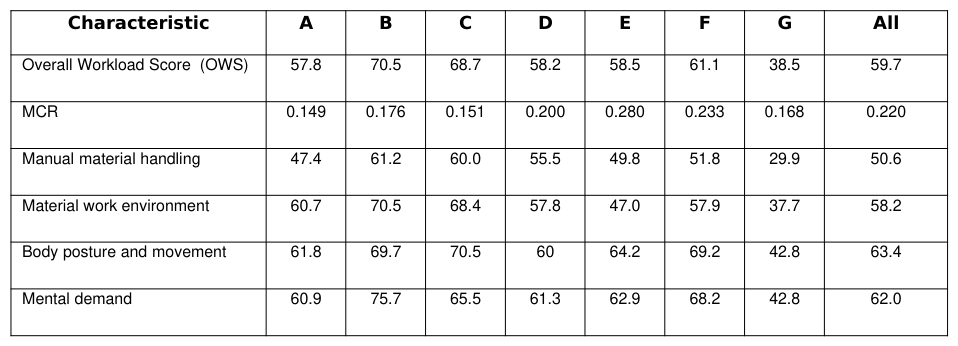
SOWA method was first used in order to identify a subject area of ergonomic training. Overall workload was assessed according to the procedure described above. For each dimension, main parameters explicating the weighted parameters were marked. Results are shown in Table 1. The ergonomic training was focused on reduction of manual material handling workload as well as a proper body posture according to the results for all the investigated subjects (last column of Table 1). As one common training for warehouse workers and production workers was predicted, both groups were assessed together. Special problems were taken into account for each division separately, depending on the most important attribute for each dimension. Additionally, the importance of physical activity at work and beyond work was emphasized. This problem proved to be essential in the context of high BMI values. During the practical part of training, the employees mastered a proper lifting technique and made a set of warming- up exercises (dedicated before work) and stretching (dedicated for microbreaks and after work).
Table 1. Workload characteristics before ergonomic training in divisions A-G.
The second stage of research was pursued after a six-month break once more. Additionally, some individual interviews were conducted. Due to some organizational problems, in the second stage of research workers from four divisions only took part only because of few valid cases in three other localizations.
RESULTS
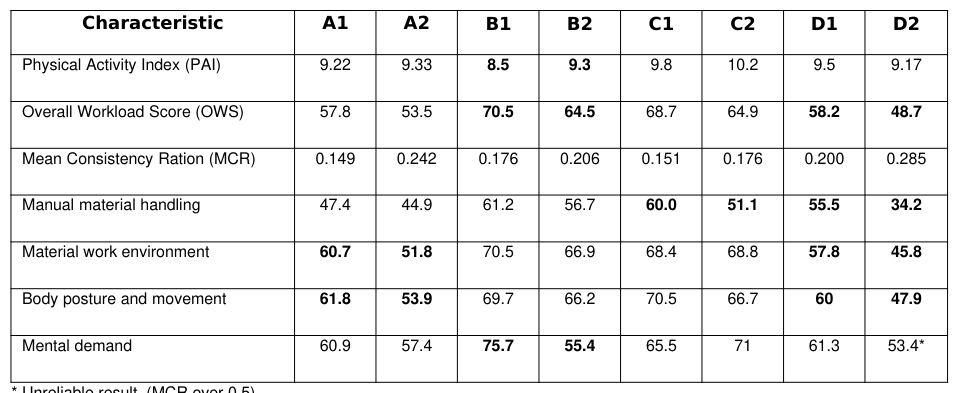
After ergonomic training, some positive changes were noticed, as it is shown in Table 2. In all the divisions having been compared, a higher Physical Activity Index (PAI) was stated. This score could be caused by the ergonomic training, but also the seasonal changes could affect the PAI increase. In all the divisions, the Overall Workload Score (OWS) declined, although not all the differences are statistically significant, which was checked by t-Student test (significance level α=0.05).
Sustainable Infrastructure (2018)
Table 2. Workload comparison before (N1) and after (N2) ergonomic training.
* Unreliable result (MCR over 0.5).
Bolded differences are statistically significant.
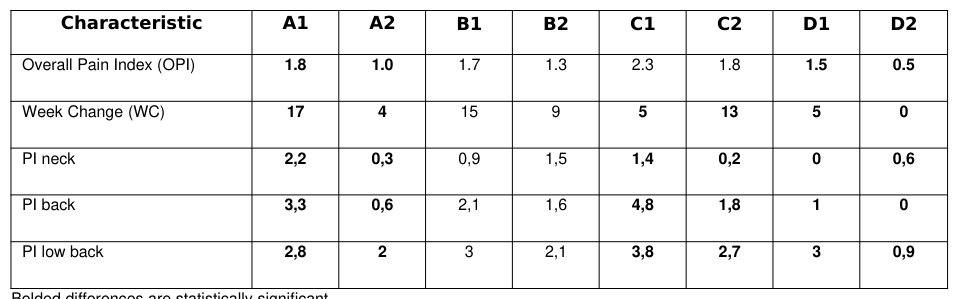
Similar analysis was made for pain index. In all the compared divisions Overall Pain Index (OPI) decreased, although not all differences were significant. More detailed information about three key body parts pain indexes (PI) can be found below (Table 3). Pain index for back and low back was reduced in all the investigated localizations, but neck PI increased in two divisions.
Table 3. Pain index comparison before (N1) and after (N2) ergonomic training.
Bolded differences are statistically significant.
According to some cases described in Ergonomics cost benefit case study collection (2007), a safety handling training as well as a physical activity development program can lead to approximately 20 percent reduction of back injuries. Although available data were imprecise, the overall pain index (OPI) reduction observed after the six- month period let assume that an influence on pain decrease was achieved in ergonomic training.
Ergonomic training as well as fitness training programs are supposed to significantly reduce long-term disabilities and accident rates, although the limited number of studies can prove it (Forastieri 2006; Lanoie, Trotter 1998). That Sustainable Infrastructure (2018) is why tools for evaluation of effectiveness of such programs are needed. As it was shown above, Subjective Overall Workload Assessment (SOWA) method can be applied as a supportive tool for evaluation of ergonomic training. However, during the assessment additional factors like seasonal changes, work process improvements, demand fluctuations, etc. should be taken into account.
The ergonomic training was part of a wider program of ergonomics and occupational health and it will be continued. Nowadays, some ergonomic solutions are implemented, especially from a manual handling support scope. Conveyor belts were already installed in two divisions in order to avoid manual transport. Some organizational changes concentrated on breaks layout were made. Some of the investigated workers (about 10 cases) use occasionally back belts (lumbar supports), which are available at individual request. The Subjective Overall Workload Assessment (SOWA) can be applied to the effectiveness evaluation of total set of ergonomic solutions.
REFERENCES
“Ergonomics cost benefit case study collection” (2007), Puget Sound Human Factors and Ergonomics Society & Washington State Department Labour & Industries, http://www.pshfes.org/cost-calculator, retrieved 2010-09- 05. Forastieri V., “Maximum Loads and Manual Material Handling”, in: Karwowski W. (ed.), International
Encyclopedia of Ergonomics and Human Factors, Taylor & Francis 2006, 1527-1532. Grieco A., Molteni G, De Vito G., Colombini D, Occhipinti E. (2006), “Exposure Assessment of Low Back Disorders: Manual Material Handling Limits”, in: Karwowski W. (ed.), International Encyclopedia of Ergonomics and Human Factors, Taylor & Francis, 1501-1502. Grobelny J., Michalski R., Karwowski W. (2009), “Workload assessment predictability for digital human models”,
in: Handbook of digital human modeling: research for applied ergonomics and human factors engineering, Duffy V.G (ed.). Boca Raton : CRC Press, 28-1 - 28-13. Kuorinka I, Jonsson B, Kilborn A, et al. (1987), “Standardized Nordic questionnaire for the analysis of musculoskeletal symptoms”, Applied Ergonomics, 18, 233–237. Lanoie P., Trottier L. (1998), “Costs and Benefits of Preventing Workplace Accidents: Going from a Mechanical to
a Manual Handling System”, Journal of Safety Research, 29(2), 65-75. Michalski R., Grobelny J. (2007), “Computer–aided subjective assessment of factors disturbing the occupational human performance”, Occupational Ergonomics, 7( 1), 27-42. Michalski R., Grobelny J. (2006), “Subjective methods of workload assessment”, in: L.M. Pacholski, J.S.
Marcinkowski, W.M. Horst (eds.), The role of education and researches in ergonomics and work-safety in health care of population, Proceedings of the XXnd International Seminar of Ergonomics Teachers, 286-299. Paluch R. (1985), “Ocena zmęczenia na podstawie subiektywnego odczucia - kwestionariusz japoński”, Bezpieczeństwo pracy, 7-8, 3-6. Telama R., Yang X., Viikari J., Välimäki I., Wanne O., Raitakari O. (2005) “Physical Activity from Childhood to
Adulthood. A 21-Yeat Tracking Study”. American Journal of Preventive Medicine. 28 (3). 267- 273. World Health Organization (1995), “Physical status: The use and interpretation of anthropometry”. Geneva, Switzerland: World Health Organization. WHO Technical Report Series.
Sustainable Infrastructure (2018)
LISTED IN THE AHFE DIGITAL BOOKSTORE CATALOGUE
Explore the complete digital volume
Advances in Human Factors and Sustainable Infrastructure
Read this individual research paper free through the original publisher, or explore the full digital proceedings book.
ISBN 978-1-4951-2092-3
Explore this ISBN in the AHFE Bookstore ↗Listed in the July 2026 bookstore catalogue; search by ISBN to confirm current availability · Digital book purchase optional