G. Andreonib, A. Carpentieroa, F. Costaa, S. Muschiatoa, L. Spreaficoc (2021). Music Therapy as an Interactive Rehabilitation Tool for People with Alzheimer’s: Ergonomical Issues. In: Advances in Human Aspects of Healthcare. AHFE Open Access, vol. 13. https://doi.org/10.54941/ahfe100497
The aim of this paper is to report the process to develop a new interactive tool for Alzheimer disease that utilizes music therapy. It is a design approach based on users’ needs, which involves the collaboration between patients, doctors, music therapists and designers, in order to develop a tool that can effectively works with patient’s memories. The work process was based on a multidisciplinary approach, and demonstrates how it is possible influence in a positive way different kind of patients, stimulating their lost memories with a new music therapy tool. The analysis work about the patients’ mental health, and their musical memories, was a fundamental part of the design process; the integration of new technologies – and the acceptance of those -, was one of the first goals that we wanted to achieve during the interaction between the product and the patient. With the assistance of an expert in music therapy, we have been able to integrate traditional tools for medical evaluation of memory and cognitive deterioration with new stimuli from the past life memories. When we finished designing the product, we conducted an evaluative test; this is the methodological process that we used to conduct it:a. Preparation:Setting: a room with no distractions, in order to create a relaxing environment that would not distract the patient’s attention.Staff: Music therapist / psychologistInclusion criteria: patients suffering from dementia (Alzheimer's) MMSE score = 15-20 (intermediate phase).We have chosen the interaction with patients undergoing intermediate because, since they still have good verbal expressive capabilities, they could directly, and more easily, provide important insights and analysis reflections.b. Tracks selection:6 tracks were needed in order for the test to take place; those tracks needed to be known and significant to the test subject. Tracks were selected following the directions of the medical director of the facility. We selected 30 tracks: in this way it would have been possible to select the 6 that would suit the patient best. The songs were divided into three categories: classical, traditional, light jazz.c. TestTo establish a communication channel linked to the archaic manipulation and sounds, from which arise the emotions of the person, speaking on the same conducting sound variations .After explaining in simple words what the object is, it is asked to press one of the buttons placed on the faces of the cube.After the button is pressed, a song previously selected is played; the therapist asks to the patients if he knows the song and if he likes it. After the patient has familiarized with the object, he is asked to press a button he has already pushed; then the therapist asks if he recognizes the song associated to the same button.
Alzheimer is a degenerative disease that cannot be cured; doctors can just slow the degenerative process. In order to do that, medics rely both on pharmacological and non-pharmacological therapies. Music therapy was, among the non-pharmacological therapies, the one with probably the greatest potential with Alzheimer’s, so I decided to focus on that. Music therapy has two main purposes: therapeutic, that through the relation between therapist and patient (or between patients), leads to improvements in the communication sphere; and rehabilitative, which through musical sound stimulation, has the main goal to maintain or enhance patients’ cognitive abilities.
Through the research process (that will be extensively covered in the next section), I discovered that there is a lack of products specifically designed to help the therapist and improve the music therapy experience. Can a designer project something like that? That is what I tried to achieve with my project.
For the whole design process, I adopted the “user centered design” approach, which consists into including the user needs (both explicit and implicit) from the start, actively engaging different professional figures and users themselves into the process. After defining the product concept, I built a model and used it for an ergonomic and utilization tests with patients; results suggest that “Music^3” fulfill its purpose and could be used for a more effective music therapy.
MATERIALS AND METHODS
Technical Research The first phase consisted into a deep research and analysis of scientific papers, studies and therapeutic procedures, which would demonstrate the efficacy of music therapy with Alzheimer’s patients. In order to design an useful tool for music therapy, it was essential to know and understands how music therapy works and how therapies are conducted. That lead to the basic understanding that music therapy interventions with Alzheimer’s. There is a therapeutic plan, designed by the music therapist, based on the needs of the patients, which includes songs research/selections, meetings with family members, ecc. It can be a single or group activity, conducted by the music therapist. It can have (i) evocative ends, where music activates a memory or a feeling (a crucial aspect to achieve with patients with memory loss problems), (ii) restraining ends, by reducing behavior disorders and (iii) social ends, by favoring and promoting the interaction between patients, medics and therapists. Another important thing was to find evidence of the efficacy of music therapy with Alzheimer’s. I’ve found several studies about it; the most relevant one was from Petr Janata “The Neural Architecture of Music-Evoked Autobiographical Memories” [Cerebral Cortex Advance Access published February 24, 2009], which demonstrates how a damaged brain like
Alzheimer’s one, can recognize familiar music, and associated it with memories that wouldn’t be accessible without a musical stimuli.
Field Research and Interviews After the first part of research, I visited two hospital structures with an Alzheimer’s dedicated space: RSA “Il Raggio Verde” Muggiò (MB) Italy and the geriatric institute “P. Radaelli” Milano, Italy. There I had the chance to see through my own eyes the daily life of an Alzheimer’s patient, so that I could find out their needs. I realized that most of the structures have a lack of stimuli that can involve all the five senses (a very important aspect for these patients). I also noticed a very important fact: Alzheimer’s afflicts anyone in a different way; that means that each therapy must be crafted to suit the patient best (Sacks, 2007). This translates into designing a tool that could be easily adaptable and programmable. Considering the music therapy aspect, both the hospitals did this kind of non- pharmacological therapy. They have a music therapist that conducts activities two times a week: the sessions usually involves the listening of some selected music reproduced by a stereo, or the interaction with (or without) music through percussive instruments such as cymbals, bells, rain sticks, maracas, ecc. During the same period, I had some meetings and e-mail correspondence with the medical director of the “Il Raggio Verde”, Doctor Luciano Spreafico, and with the music therapist and musician Alberto Morelli. They both provided me with crucial advices and suggestions for the concept idealization. They were also involved during the next phases.
Project Brief At the end of the research phase, it was clear that there was a lot that could have been done; in fact music therapists (and hospitals in general), still used standard tools for conducting the therapy; that lead to difficulties to actively engaging dialogues and activities with patients and, more generally, easily adapt the therapy to each patient. Some problems that I noticed where that (i) patients in a more advanced stage did not participate to music therapy activities: in this case a single therapy is needed, though with the current tool is more difficult to conduct. (ii) Not everybody would participate to the activities; in fact, some patients were disturbed by the noise created by all the percussive instruments. (iii) Lack of multi-sensorial stimuli. All these considerations lead to the project brief: “Provide the music therapist with an innovative tool for Alzheimer’s therapy”.
Requirements After analyzing the users (music therapists and patients) needs, I fixed some crucial requirements that the project should have. Those are:
- Simple: simplicity is a fundamental requirement that a product for Alzheimer’s should have. That means it must be simple in the shape and appearance, in order to keep the user focused on the therapy, and easy to use.
- Adaptable and inclusive: As I stated in the research paragraph, Alzheimer’s consequences are very different based on the patient, and presents different stages of degeneration. That means that the tool I have to design, must be easily adaptable to different patients, and consequentially to different therapies.
- Programmable: since the music therapist is the first user of the product, he must be able to program it based on the therapy plan he previously designed.
- Multi-sensorial: though keeping the auditive stimulus as the center of the intervention, giving the tool a multi-sensorial approach would increase the engagement of the patients in the usage, creating a stronger experience.
Concept Definition After the research phase was completed, I was able to dive into the actual design process. I also tried to do that before the research phase, in order to have a more free-minded approach, but in this particular project that lead to solutions that would not fit the therapists needs. That is why the visits, and especially the interviews with users, were essential. My first ideas in fact, provided a one-way interaction between object and patient, without including the therapist in the process; talking about music therapy though, the therapist must conduct the activity, and then he must be included as one of the users.
After these considerations, I came up with a final concept definition. The basic idea was to create a sound cube: a sort of music/sound player with a cube shape, capable to store an audio file linked to a single face of the cube. To clarify the several aspects, I will now proceed writing the “5 W” of Music^3:
- WHO: music therapists and Alzheimer’s patients will use the product.
- WHAT: an innovative music therapy tool cube shaped, capable of reproducing sounds, songs, ecc, each linked to a single cube face.
- WHY: a single product that could reach the music therapy finalities. (i) Evocative, by trigging memories through known songs. (ii) Social, creating a dialogue between patients and the music therapist. (iii) Restraining, by reducing behavior disorders.
- HOW: the music therapist programs the cube based on the therapy; it’s possible to upload different kinds of files, such as songs, sampled percussive instruments, animals sounds, ecc. The patient follows the instructions of the therapist and interacts with cube faces. Each has a big pushable button.
Operative Phase After doctor Spreafico and the music therapist Morelli approved the cube concept, I proceeded designing all the technical aspects. The first one was to find the best size and shape. In order to do that I built a polystyrene mockup, and choose its dimensions based on the anthropometric manual “Human Dimension & Interior Space” by Julius Panero and Martin Zelnik. The cube needed to be easily handled and moveable, without being too small to interfere with the interactive process (pressing the buttons on its faces). Being the 5th female percentile hand length of 170mm, the final measure of the cube was chosen to be of 150mm. Later I proceeded designing the plastic frames, the buttons, selecting internal components such as speakers, LEDs, the motherboard, ecc. For the LEDs positioning and selection we consulted the lightning design laboratory of the Politecnico di Milano. Later it was built a physical model in scale 1:1, completed with rubber buttons with the same textures of the original design.
Product Definition At this point all the technical aspects were satisfied, leading to the final definition of the product named “Music^3”. Music^3 is an innovative music therapy tool, designed for Alzheimer’s patients. It reproduces audio files associated to each face of the cube, which has a pushable button. The product is made by white and smooth plastic, while the 6 buttons are all of different colors and with unique tactile textures: in this way each face is easily distinguishable from the others both visually and tactilely. Before starting a therapy, the music therapist connects Music^3 to his PC, and uploads audio files into the internal storage, assigning each file to a single button. In order to activate the product, the user just need to push a button, and the product it will automatically reproduce the audio file assigned to it.
It adapts to different kinds of therapies:
- Individual therapy: INPUT: known and significative music. TASK: listening. OUTPUT: trigging memories and emotions, while relaxing the patient. Therapy efficacy ratable with BANNS scale (for severe Alzheimer’s cases), or PAI and MMS for the intermediate phase.
- Group therapy: INPUT: external device to reproduce music + music therapist instructions. TASK: execute the music therapist instructions, such has rhythmically following a song. OUTPUT: attention improvement, coordination, socialization, ecc.
Multi-sensorial stimuli:
- Auditive: sounds reproduce by Music^3
- Visual: colors and lightning of the buttons
- Tactile: texturized buttons
Test After completing the various stages of the project development and building a physical model, I proceeded conducting a test at the clinic RSA “Il Raggio Verde”. It was crucial to follow the scientific method, in order to make the test reproducible by others or in other occasions. The test was prepared with the help of the doctor L. Spreafico and the music therapist A. Morelli.
a) Preparation: - Setting: room with few distractions, table, chair, physical model, iPad with 30 songs - Personnel: music therapist / psychologist - Inclusion criteria: patients suffering from dementia (Alzheimer's) MMSE score = 15-20 (intermediate phase). - Individual test It was chosen an individual test in order to evaluate the tool acceptance and interaction in a more easy way. For the same reason were selected patients that were still able to talk and express their thoughts in an understandable way
(intermediate phase of Alzheimer’s).
b) Tracks selection: 6 tracks were needed in order for the test to take place; those tracks had to be known and significant to the test subject. Tracks were selected following the directions of the medical director of the facility. We selected 30 tracks: in this way it would have been possible to select the 6 that would suit the patient best. The songs were divided into three categories: classical, traditional, light jazz.
c) Scientific method: In order to make the test reproducible, we defined a protocol based on the scientific method: - Observation: Alzheimer’s patients react in a unique way to known music - Test goal: establish a communication channel linked to the archaic manipulation and sounds, from which arise the person’s emotions. - Hypothesis: patients could be emotionally stimulated by manipulating the object and listening to known tracks. - Test: After explaining in simple words what the object is, it is asked to press one of the buttons placed on the faces of the cube. After the button is pressed, a song previously selected is played; the therapist asks to the patients if he knows the song and if he likes it. After the patient has familiarized with the object, he is asked to press a button he has already pushed; then the therapist asks if he recognizes the song associated to the same button.
d) Test: In order to obtain comparable results, it has been necessary to create an items list that needed to be compiled during the test; each item would have a score linked to the legend.
1) User-friendly interface: are the shape and dimension appropriate? [1]: do not mobilize the object [2]: mobilize the object with no purpose [3]: mobilize the object with interest [4]: mobilize the object with interest and purpose
2) Interaction mode: [1]: does not attract interest [2]: generates discomfort [3]: generates pleasure
3) Interaction duration: how long does the subject interact with the object? [1]: 0s [2]: 3-5s [3]: >10s
4) Object recognition: how does the patients reacts when, after using the object for the first time, he is asked to use it again? [1]: Ignores it [2]: Moves it [3]: Uses it
5) Button/song recognition: the subject is asked to press a button he already pressed [1]: Does not recognize the button nor the linked song [2]: Does recognize the song but not the button / Does recognize the button but not the song [3]: Does recognize the button and the linked song Min score = 5 Max score = 16
It is possible to include the final score into three evaluation scales: 1) Score 5-8: the subject is not interested in the object nor does understand how it works. 2) Score 9-12: the subject understands how the object works, though is not particularly interested in it.
3) Score 13-16: the subject understands how the object works and he is interested in it.
e) Results: Will now be stated the test results; see legend above.
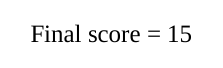
B.A. 80 years old, MMSE = 15 1) [4] mobilize the object with interest and purpose 2) [3] generates pleasure 3) [3] >10s 4) [3]: Uses it 5) [2]: Does recognize the song but not the button
Equation reproduced from the original PDF.
P.R. 84 years old, MMSE = 20 1) [4] mobilize the object with interest and purpose 2) [3] generates pleasure 3) [3] >10s 4) [1]: Ignores it 5) [2]: Does recognize the song but not the button Final score = 13
F.M. 86 years old, MMSE = 19 1) [1]: do not mobilize the object 2) [1]: does not attract interest 3) [3] >10s 4) [3]: Uses it 5) [3]: Does recognize the button and the linked song Final score = 11
DISCUSSION
Though the reduce test subjects number, the test allowed me to observe and evaluate the first approach of the user towards Music^3, giving me insights and defining new scenarios.
Easily understandable functioning: the test suggests that the object is easy and immediate to use; patients in fact understood the operation to activate the product immediately.
Positive reactions to music: the auditive element appeared very stimulant from the beginning: it was evident how known songs influenced on the emotional state of the patient, making him happier, activating the speech functions and movement.
Long term memory evaluation tool: the fact that every button activates a different song stimulated the patients into trying them all, also trying to guess the titles and the lyrics. This translates into trigging and retrieving memories from the patient’s life. Not only for recalling lyrics and titles, but also about trigging memories linked to the song itself (like when they usually listened to it, the historical period, ecc.). During the test all the patients talked about the memories linked to the songs, and sang along with them. It’s important to notice how they usually were more quiet and very less talkative. Music^3 helped them activating new brain areas (Janata, 2009).
Short memory evaluation tool: the object can also be used to test short memory, by the subject is asked to press a button he already pressed. This give the possibility to include Music^3 into the MMSE (mini mental state examination) test.
CONCLUSIONS
The initial hypothesis has been confirmed: patients can be emotionally stimulated by the sound element and manipulate the object.
REFERENCES
Baird, A., Samson, S., (2009). “Memory for Music in Alzheimer’s Disease: Unforgettable?”. France: Neuropsychol Rev. Bartlett, J., Halpern, A., Dowling W., (1995). “Recognition of familiar and unfamiliar melodies in normal aging and Alzheimer's disease”. University of Texas at Dallas, Richardson, Texas: Memory&Cognition Fukui, H., Arai, A., Toyoshima K., (2012). “Efficacy of Music Therapy in Treatment for the Patients with Alzheimer’s Disease”.
Japan: Hindawi Publishing Corporation International Journal of Alzheimer’s Disease Janata, P., (2009). “The Neural Architecture of Music-Evoked Autobiographical Memories”. Department of Psychology, Center for Mind and Brain, University of California: Cerebral Cortex. Kandinsky W., (1968). “Point And Line To Plane”. 29° ed. Milano: Adelphi. Sacks, O., (2007). “Musicofilia”. 2° ed. Milano: Adelphi. Simmons-Stern, N. R., Budson A. E., Ally, B. A. (2010). “Music as a Memory Enhancer in Patients with Alzheimer’s”. Center
for Translational Cognitive Neuroscience, Geriatric Research Education.
LISTED IN THE AHFE DIGITAL BOOKSTORE CATALOGUE
Explore the complete digital volume
Advances in Human Aspects of Healthcare
Read this individual research paper free through the original publisher, or explore the full digital proceedings book.
ISBN 978-1-4951-2093-0
Explore this ISBN in the AHFE Bookstore ↗Listed in the July 2026 bookstore catalogue; search by ISBN to confirm current availability · Digital book purchase optional