During Running (2020). Biomechanical Model of Bare-Breasts. In: Advances in Applied Digital Human Modeling. AHFE Open Access, vol. 11. https://doi.org/10.54941/ahfe100423
Sports bras are designed to reduce mammary glands or breast movement during exercises, but there is no standardized, valid and reliable method to evaluate relative three-dimensional (3D) breast movement; and there is no literature to predict the 3D force acting on the breasts during activities. A reliable method is essential to evaluate 3D breast movement and to determine the effective design features of supportive sports bras. This study derived and validated a new Breast Coordinate System (BCS) for investigating 3D breast movement, so as to identify the most effective bra features and to analyze the effects of breast volume and bra strap properties on breast movement, then to develop theoretical models of breast force generated during bare-breasted running. In the light of this, 3D mechanical models have been developed based on a system comprising a mass, springs and dampers. The orthogonal force exerted on the breasts during running was derived. The predicted results of maximum breast force were verified with previous literature. The new methods will contribute to future research on human locomotion and the design of close-fitting garments.
Breast tissue moves along with the thorax, but also presents inherent movement since it does not contain any skeletal structure. A bra works as external supports relieving breast movement. Especially, a sport bra is designed to minimize the movement of the breasts during the exercise (McGhee & Steele, 2010). The breast displacement is governed by the force associated with exercising motions and the force is the most critical factor to consider when the sport bra is designed. Apparent from Newton’s second law, F=ma, the breast mass and acceleration play important roles in calculation of breast force.
Historically, breast size was measured in volume rather than in mass. Conventional bra sizing is not reliable and cannot measure the breast volume or mass (Pechter, 1998). Previous researchers estimated that the breast mass was in a wide range of 150g to 2000g (Turner &Dujon, 2005). The vertical displacement of the breasts increased by 70% when the breast mass increased from 100g to 700g (Haake& Scurr, 2010), so the exercise-associated force can greatly affect the large-breasted women. Factors affecting the breast movement included the types of breast support (Scurr et al., 2011), levels of activities (Mason et al., 1999) and breast mass. However, previous research on breast movement and bra design has predominantly been limited to empirical studies (Lawson &Lorentzen, 1990; Mason, Page, & Fallon, 1999; Scurr, White, & Hedger, 2011; White, Scurr, & Hedger, 2011). To investigate the internal forces in the breast tissues, Gefen& Dilmoney (2007) have considered the structural support from Cooper’s ligaments, the fascia of the pectoralis muscle, and the ribs. Haake& Scurr (2010) used a mass-spring-damper system to introduce a theoretical mechanical breast model.
This research aims to develop the breast mechanical model to estimate the breast displacement and force during exercise. The breast is considered as an object of mass-spring-damper system. Through the free-falling breast tests with a female subject, spring constant and damping coefficient was calculated. An equation to calculate net force affecting the breast discomfort during running was established. The breast mechanical model is expected to provide a theoretical foundation to understand optimum support and comfort in sport bra design.
METHODOLOGY
Mass-Spring-Damper System In this study, the mass-spring-damper system is based on the Kelvin-Voigt model (Yang &Qiang, 2009). The breast movement was assumed to be represented by a point mass at the nipple (Gefen& Dilmoney, 2007; Haake& Scurr, 2010) in an ideal mass-spring-damper system in which mass (m), spring constant (k) and damping coefficient (c) are to be determined. It is assumed that the breast is a homogeneous object with elastic and viscous properties; both breasts are identical in perfect symmetry; and orthogonal forces acing on the breasts are considered.
A typical damped spring movement of a visco-elastic object is shown in Figure 1. The elastic movement is governed by spring constant (k) that is related to the oscillation frequencies (ω), as shown in Equation 1. Viscous movement is governed by the damping ratio (ζ) that can be calculated from the Logarithmic decrement (δ) of the breast in the time domain, which refers to the natural logarithm of the ratio of amplitudes of two adjacent peaks xn and xn+1 in displacement (Equation 2). Then, damping ratio (c) and damping coefficient (ζ) are defined by Equation 3 and Equation 4 respectively.
Figure 1. Damped spring movement
Figure available in the original PDF paper.
2m [1]
Equations and mathematical formulas are available in the original paper PDF.
[2]
n ln x0
xn
During running, the nude breasts have a range of oscillating displacement (x) in the time domain, from which velocity (˙x) and acceleration (¨x) can be derived. The net force (FN) applied to the breast is a sum of spring force (FS), damping force (FD), and total force (FT) acting on the breasts, as shown in Equations , , and respectively. The net force can be written in a function of time with given mass, spring constant, and damping coefficient (Equation ).
FN=mg+c ˙x+kx=mg+cf x' (t)+k f x(t) [8] The methods to determine the constants of breast mass (m), spring constant (k) and damping coefficient (c) will be presented in the following sections.
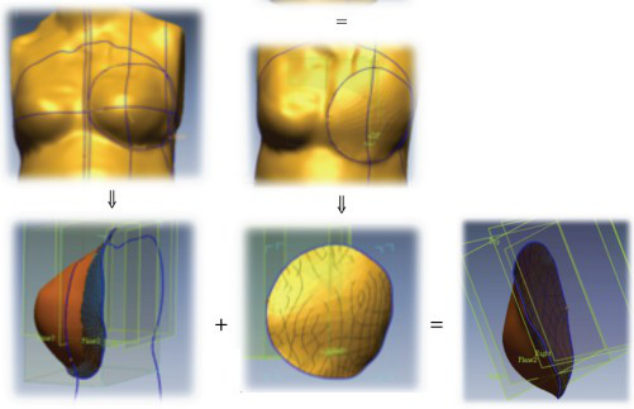
3D Body Scanning for Estimation of Breast Mass Breast mass (m) was calculated by multiplying breast volume (v) by breast density (ρ). Breast volume was measured by image analysis of the 3D scanned breast surface. The image was captured by TC2 body scanner (NX-16, Textile/Clothing Technology Corporation, USA), and the data cloud was import into the Rapidform XOR software for meshing, filling holes, trimming the breast shell, building the curvy breast base (Figure 2). Then the breast shell and base were connected together to make the breast solid for the automatic calculation of breast volume. The breast root was determined manually based on the change of surface curvature.
Figure 2. Extracting breast volume from a 3D body image
Breast density could be estimated from the breast fat and glandular tissue, whose densities are approximately 500 kg/m3 and 1,060 kg/m3, respectively (Vandeweyer & Hertens, 2002). Breast density changes in the percentage of fat and glandular tissue, depending on age, nutritive condition, and ethnic group. According to Katch et al. (1980), a breast density of 1,017 kg/m3 was adopted. This paper presents the methods tested on a Chinese woman with her informed consents. She is aged 40, married and has one child. Her breast size was 80B in a ptotic drooping tear shape. Her breast volume was 311.5 cm3 and therefore by multiplying the density, the breast mass was computed to be 0.3168 kg.
Breast Free Falling Experiment For Determining Spring Constant And Damping Coefficient To estimate the damping ratio of human breast, the same subject participated in a breast free-falling experiment. She lifted up her left breast to the highest position, and then released it to fall freely. The breast vibration was captured using the Vicon motion analysis system (Vicon, 612, Oxford Metrics, Oxford, UK). Markers were attached to the nipple and sternal notch. Six cameras on the ceiling recorded 3D coordinates of passive retro-reflective markers on the breast at the frequency of 120 Hz in order to track the breast movement. Each marker was 9.5mm in diameter and 1.81g in weight. The measurement was repeated for three times. The vertical movement of the nipple (Figure 3) against time was used to obtain her inherent spring constant and the damping coefficient.
Motion Capture of Breast Displacement and Acceleration During Running The subject was asked to run with bare breasts at a constant speed of 6 km/h on a treadmill, for at least 100 seconds. To remove the background noise signals during motion capturing, the motion data was first smoothed out by using a low pass filter with a cut off frequency of 8 Hz. MATLAB version 7 (The MathWorks, Inc.) was used to plot the breast coordinates against time. The breast displacement was defined as the change of the coordinates from a static condition to a dynamic condition. Three running strides were taken for analysis.
RESULTS
Spring Constant and Damping Coefficient The waveforms of the vertical breast movement in Figure 3 show the damped and oscillating behavior of the nude breast. The breast fell from a high position and entered into the equilibrium within a second. The first and second peaks were recorded to be approximately 1.2 cm and 0.3 cm respectively.
Figure 3. Vertical movement of a free-falling breast
Figure available in the original PDF paper.
The similar behavior was observed for repeated experiments. Detailed measurements are extracted and given in Table 1.
Table 1. Free-falling breast observation in a braless condition
Based on these measurements, spring constant and damping coefficients of the nude breast were calculated as below.
c0=3.9546 (±0.21)(Ns/m) These values were slightly different from the findings in previous research (Haake & Scurr, 2010). Higher spring constant and lower damping coefficient was observed in this investigation due to the different age, race, and personal history e.g. breast-feeding. Future studies on the damped spring movement of human breasts should recruit a larger sample size to obtain the statistical result for more generic biomechanical modelling.
Breast Force During Bare-Breasted Running When the subject was running on the treadmill, her breast movement was captured in real time. Figure 4 shows the breast movement in a form of continuous waveforms. Two cycles of the waveform were used to show a full single running stride. There was a small vibration when the breast moved upwards, which was consistent with the findings from Haake & Scurr (2011).
Figure 4. Vertical movement during breast jogging
Figure available in the original PDF paper.
A trendline of the vertical breast displacement (z) can be presented in a function of time (t). Then the first and second differential functions derived from it becomes the velocity (˙z) and acceleration (¨z) of the breast movement, respectively.
Using Equations 5 to 7, the spring force (FS), damping force (FD), and total force (FT) during bare breast running can be calculated respectively with a given mass, spring constant, and damping coefficient. Then, the net force (FN) was estimated in a function of time by adding up these forces using Equations, Error: Reference source not found, andError: Reference source not found.The net force shown in Figure is considered the excessive force that causes breast discomfort during the exercise.
a.
b.
c.
Figure 5. Net force during bare-breasted running(a: x-direction; b: y-direction; c: z-direction)
Figure available in the original PDF paper.
As shown in Figure 5, the net force was the biggest in superior-inferior (z) direction. The downward force was about twice bigger than the upward force. Therefore, the upward breast support is critical in bra design. The net force in medial-lateral (x) direction is much smaller, but the considerable amount of net force was observed along the anterior-posterior (y) direction. Specifically, the net force was more dominant in posterior direction. This implies that the control on breast movement is important in anterior-posterior direction as well. Elastic modulus of under- band and shoulder strap should be carefully decided to provide optimum control along the downward and posterior directions.
CONCLUSIONS
Movement of breasts can be explained with a mass-spring-damper system. The spring constant and damping coefficient were computed based on the waveform of breast vibration during free-falling. The breast mass was calculated from the breast volume extracted from a 3D scan body image. Considering the spring and damping forces during running in the breast mechanical model, the net force can be computed. This new knowledge will be useful to reduce the exercise-associated discomfort on the breasts by providing the necessary amount of support by a sports bra. An effective sports bra should be designed in a way to minimize the net force in all directions. However, excessive control in posterior direction may let the wearer feel constrained too much in bras. Compromise between support and comfort is inevitable.
REFERENCES
Bowles, K. A., Steele, J. R., & Munro, B. (2008). What are the breast support choices of Australian women during physical activity? British Journal of Sports Medicine, 42(8), 670-673. Gefen, A., & Dilmoney, B. (2007). Mechanics of the normal woman's breast. Technology and Health Care Electronic Resource,
15(4), 259. Haake, S., & Scurr, J. (2010). A dynamic model of the breast during exercise Sports Engineering, 12(4), 189-197. Haake, S., & Scurr, J. (2011). A method to estimate strain in the breast during exercise. Sports Engineering, 14(1), 49-56. Katch, V. L., Campaigne, B., Freedson, P., Sady, S., Katch, F. I., & Behnke, A. R. (1980). Contribution of breast volume and weight to body fat distribution in females. American Journal of Physical Anthropology, 53(1), 93-100. Lawson, L., & Lorentzen, D. (1990). Selected sports bras: Comparisons of comfort and support. Clothing and Textiles Research
Journal, 8(4), 55-60. Mason, B. R., Page, K., & Fallon, K. (1999). An analysis of movement and discomfort of the female breast during exercise and the effects of breast support in three cases. Journal of Science and Medicine in Sport Formerly Australian Journal of Science and Medicine in Sport Electronic Resource Electronic Resource, 2(2), 134. McGhee, D. E., & Steele, J. R. (2010). Breast elevation and compression decrease exercise-induced breast discomfort. Medicine
& Science in Sports & Exercise, 42(7), 1333-1338. doi:10.1249/MSS.0b013e3181ca7fd8 Page, K. A., & Steele, J. R. (1999). Breast motion and sports brassiere design: Implications for future research. Sports Medicine Electronic Resource, 27(4), 205. Pechter, E. A. (1998). A new method for determining bra size and predicting postaugmentation breast size. Plastic &
Reconstructive Surgery, 102(4), 1259-1265. Scurr, J. C., White, J. L., & Hedger, W. (2011). Supported and unsupported breast displacement in three dimensions across treadmill activity levels. Journal of Sports Sciences, 29(1), 55-61. doi:10.1080/02640414.2010.521944 Turner, A. J., & Dujon, D. G. (2005). Predicting cup size after reduction mammaplasty. British Journal of Plastic Surgery, 58(3),
290-298. Vandeweyer, E., & Hertens, D. (2002). Quantification of glands and fat in breast tissue: An experimental determination. Annals of Anatomy - Anatomischer Anzeiger, 184(2), 181-184. doi:10.1016/S0940-9602(02)80016-4 White, J., Scurr, J., & Hedger, W. (2011). A comparison of three-dimensional breast displacement and breast comfort during
overground and treadmill running. Journal of Applied Biomechanics, 27(1), 47-53. Yang, W. Y., & Qiang, W. (2009). Mechanical behavior of materials. Beijing Shi: Hua xue gong ye chu ban she. Zhou, J. (2011). New methods to evaluate breast motion in braless and sports bra conditions. (Unpublished Doctoral dissertation). Hong Kong Polytechnic University, Hong Kong.
LISTED IN THE AHFE DIGITAL BOOKSTORE CATALOGUE
Explore the complete digital volume
Advances in Applied Digital Human Modeling
Read this individual research paper free through the original publisher, or explore the full digital proceedings book.
ISBN 978-1-4951-2094-7
Explore this ISBN in the AHFE Bookstore ↗Listed in the July 2026 bookstore catalogue; search by ISBN to confirm current availability · Digital book purchase optional