Erik Brolinab, Dan Högberga, Lars Hansonbc (2020). Design of a Digital Human Modelling Module for Consideration of Anthropometric Diversity. In: Advances in Applied Digital Human Modeling. AHFE Open Access, vol. 11. https://doi.org/10.54941/ahfe100418
Digital human modelling (DHM) tools are useful when evaluating human-machine interaction as they enable consideration of anthropometric diversity by facilitating the creation of human models, so called manikins, of different sizes and proportions. This paper presents the design of a module, as part of a DHM tool, made to enable a more holistic approach when defining manikin characteristics. The module is created based on previous user interviews and literature studies on the use of DHM systems and advanced mathematical methods for anthropometric diversity consideration. The module is aimed to support and guide non-expert users while at the same time support effective use and provide appropriate functionality also for expert users. The module acts as a digital guide and supports standardised working procedures when creating manikins to be used in subsequent ergonomics simulations and analyses, and shows a strong visual connection between user interface choices and their response.
Digital human modelling (DHM) tools are useful when evaluating human-machine interaction as they enable consideration of anthropometric diversity by creating human models, so called manikins, of different sizes and proportions . Industry practice has previously been based on the utilization of rough approaches when considering anthropometric diversity . Even today, ergonomics evaluations and analyses are at times done with few manikins because of the time consuming process of creating and performing analyses for each manikin . Because of the fact that humans vary a lot in sizes and shapes, there is considerable uncertainty whether the expected proportion of the target population is covered by the analyses being performed . Hence it is important to support users of DHM tools when they are using these tools and trying to consider human diversity at the same time.
suggest a guide and documentation system to support DHM applications by guiding the simulation tool user through an established process which documents, stores and keeps track of ongoing and previous analyses, and facilitates the reuse of studies. Guidelines for the consideration of anthropometric diversity and for how to select relevant test cases, e.g. manikins for virtual simulation and evaluation, have been presented by and in the form of flowcharts where the type of manikins depends on the design problem at hand. The objective of these approaches is to facilitate guidance through an appropriate process of handling issues related to anthropometric diversity.
Future technological and organizational trends and demands of DHM tools is presented in through the results of a survey using the Delphi technique. In this survey, 44 experts answered questions and assessed statements regarding upcoming trends in “Digital Ergonomics”. Results from the survey show that, among other things, functionality connected to providing sufficient mapping of anthropometric and biomechanical variance, and increased software usability to support software use for novices, was deemed important and state-of-the-art between 2015 and 2020. Software support for virtually designing and evaluating products and processes for different regions of the world was deemed important and state-of-the-art between 2020 and 2025. Important and state-of-the-art after 2025 was considered to be holistic tools that allows for cognitive, anthropometric and biomechanical evaluation of products and work processes. Challenges and deficits using DHM tools was, among other things, considered to be high software complexity, in some cases unknown validity and a lack of standard for models and file formats.
To address these current problems and future challenges the DHM tool IMMA (Intelligently Moving Manikins) was introduced in 2010 as a DHM tool that uses advanced path planning techniques to generate collision free and biomechanically acceptable motions for digital human models (as well as parts) in complex assembly situations. The aim of IMMA is to develop a non-expert tool with high usability, where the tool supports the user to consider human diversity, to easily instruct the manikin to perform tasks and functionality to perform time-dependent ergonomics evaluations to control and assess complete motions . This paper presents the design of a module, as part of the IMMA DHM tool, made to enable a more holistic approach when defining manikin characteristics. An aim of the work is to include all necessary functionality but at the same time maintain a high usability of the interface and software tool. The module is aimed to support and guide non-expert users while at the same time support effective use and appropriate functionality also for expert users.
INPUT OUTPUT Processed own anthropometric data Input of own anthropometric data Anthropometric
stored for later use
Module
Definition of single
Correlation data Surface measurement
manikin Predefined person Data input
to joint-center
Choice of existing anthropometric data Gender Age Nationality
Definition of manikin
Percentage mix of anthropometric data
family
Data on key measurements Direct export of manikin data within developed DHM tool
Figure 1. Flowchart depicting the anthropometric module and work process
Figure available in the original PDF paper.
METHODS
The module and its user interface is created based on previous user interviews and literature studies of the use of DHM systems and advanced mathematical methods for anthropometric diversity consideration . Based on the results from these studies, a module and work process has been described which would facilitate a more supportive way of working with anthropometric diversity in DHM systems (Figure 1). Most of the functionality of the anthropometric module in Figure 1 was implemented in early versions of IMMA, operated by a basic user interface . Initial evaluations by users, and development of new functionality, confirmed needs for further development of the module and its user interface to achieve intended usability. In addition to added features of the anthropometric module, the structure of the updated interface is based on the five states of the ergonomic design process presented by :
State 1: Statement of the design problem State 2: Defining the target population
State 3: Anthropometric databases State 4: Representing body size variability using cases
State 5: Transitioning cases to products The module’s user interface is divided into different sections where each section is intended to match a state in the ergonomic design process. To achieve the intended usability the different functions are structured throughout the interface in the same order as they would typically be used in an analysis. Mathematical and statistical methods connected to each state have been developed or adapted from literature. Design of products and workplaces are often aimed at an international target group and therefore functionality for assessing several populations simultaneously is incorporated by combining mean, standard deviation and correlation data from different populations . To increase flexibility when selecting anthropometric key measurements a conditional regression model is implemented. A conditional linear regression model has the advantage that any measurement can be used as independent key measurement which gives the possibility to only include measurements that have a direct connection to the design problem. To be able to address multi-dimensional design problems, where many body measurements are of interest to include in the analysis, functionality that facilitates the creation of a group of manikins is implemented . This functionality creates a confidence region, in the shape of a multidimensional hyper-ellipsoid, based on the selected anthropometric key measurements. Functionality for using principal component analysis (PCA) to reduce the dimensionality of the confidence region and thus limit the number of manikins is also implemented. Functionality for selecting different types of cases on the surface of the confidence region is also added . The methods have been implemented into the user interface by keeping cognition and usability principles, guidelines and heuristics in mind and by discussing with a usability expert. Ideas and good examples have been adapted from existing software, web sites and literature.
RESULTS
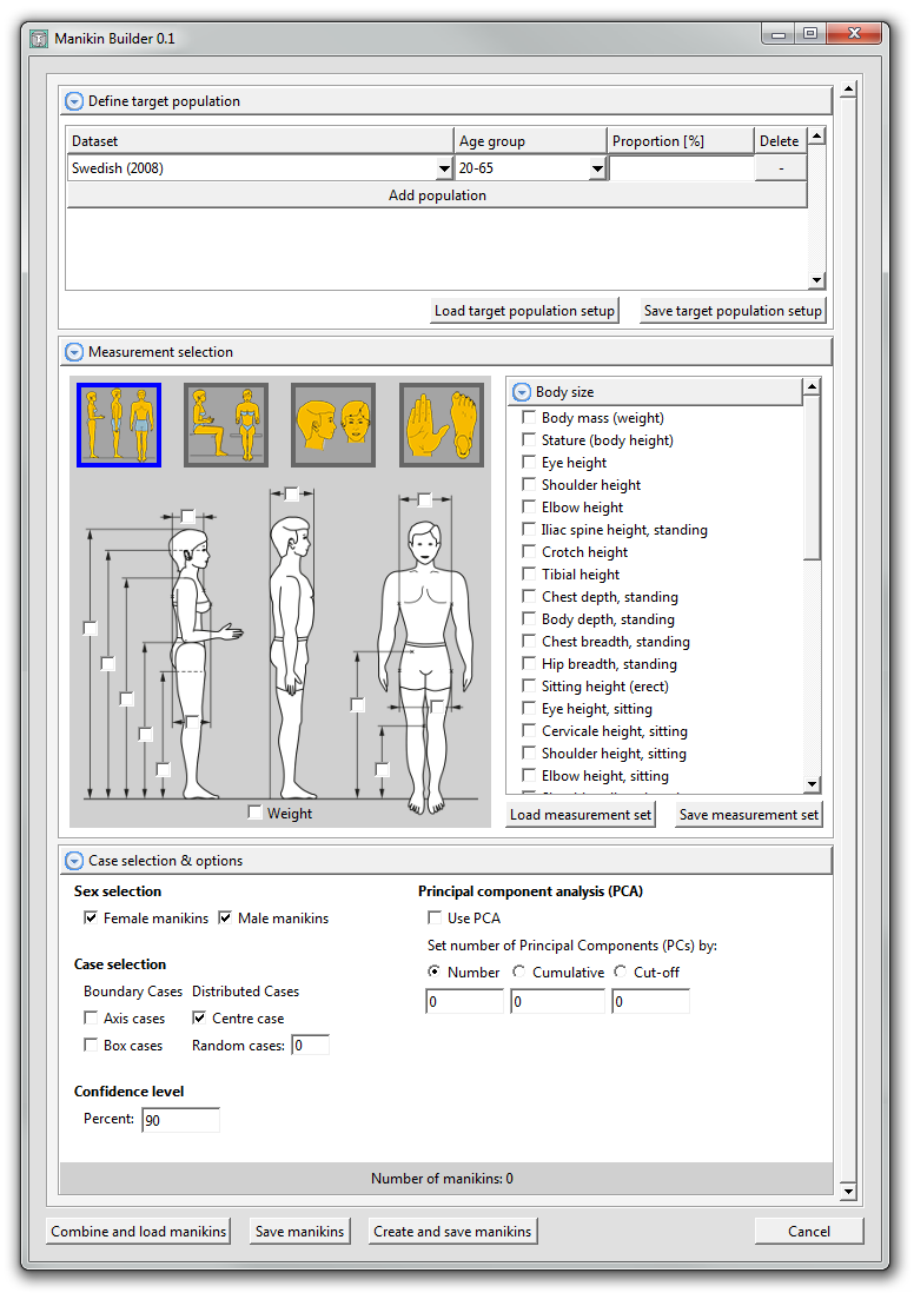
The resulting user interface is divided into three sections that match state 2, 3 and 4 in the ergonomic design process (Figure 2). State 1 of the ergonomic design process, statement of the design problem, is assumed to have been performed at an early stage of the design process before the use of DHM tool is applied and is therefore not included in the user interface. State 5 of the ergonomic design process, transitioning cases to products, is considered to be performed during the actual simulation and through following ergonomics analysis. Thus, the main areas of the user interface are:
Defining target population
Measurement selection
Case selection & options
Figure 2. The graphical user interface of the anthropometric module
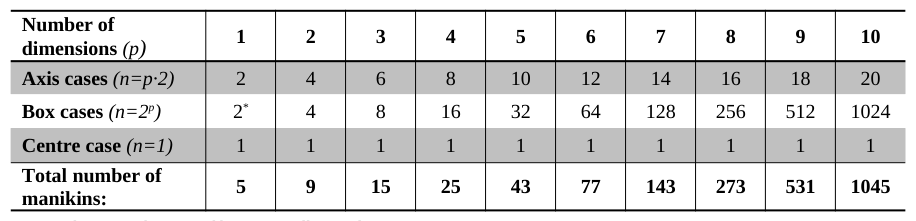
Defining the target population is done by selecting different population datasets and age groups and proportion of each dataset. Based on the selected datasets and the proportion of each data set, new data for a synthetic population is generated. It is also possible to save and load specific target population setups. Selection of anthropometric key measurements, used to determine the size of each manikin, can be done in two ways, either by selecting check boxes via a graphical interface or directly from a list of measurements. The two check boxes connected to a specific measurement are checked regardless if the graphical interface or the list is clicked. The third section is concerned with additional options such as case selection, size of confidence region and use of principal component analysis (PCA). The user gets immediate feedback on how many manikins that will be created at the bottom of this section, dependent on selected choices. The first choice for the user is to select whether female and/or male manikins should be created. The following case selection is done by specifying which type of cases that should be created. Boundary cases are defined on the surface of the calculated multidimensional confidence region; Axis cases can be found on the ends of the axes of the hyper-ellipsoid and Box cases are found on the edges of a hyper-cuboid that spans the biggest volume inside of the hyper-ellipsoid. It is also possible to select an average centre case with mean values for each selected anthropometric key measurement or to include a selected number of randomised cases based on a normal distribution. The next step is to set the confidence level, which is used to scale the multi-dimensional hyper- ellipsoid. The hyper-ellipsoid is scaled so that the surface encapsulates a percentage of the data corresponding to the selected confidence level. The number of manikins depends on the dimensionality of the confidence region, i.e. the number of selected anthropometric key measurement, as well as the selected choices in the sex and case selection (Table 1). The number of manikins can quickly become large and difficult to process, even for an automated simulation process as the one used in the IMMA DHM tool. Therefore PCA is useful as it reduces the dimensionality but still explains as much as possible of the variation of the original data based on the number of included principal components (PC). In the interface it is possible to set the number of PCs either by their specific number or the desired cumulative percentage of the variation that the remaining PCs should contribute with. The PCs can also be limited by discarding all PCs that are smaller than a specific cut-off value.
Table 1. Number of manikins dependent on the number of dimensions for axis, box and centre cases Number of dimensions (p) 1 2 3 4 5 6 7 8 9 10
* For 1 dimension the axis and box cases will coincide DISCUSSION & CONCLUSIONS
The resulting anthropometric module includes functionality argued to be appropriate for the consideration of anthropometric diversity in a DHM tool, and the user interface supports a structured work process and shows a strong visual connection between interface choices and their response. The user interface is based on anthropometric design guidelines and includes known methods found in literature. In addition, new methods have been developed and implemented that supports the user when creating manikins for ergonomics simulations and evaluation. An aim and a challenge of the work has been to include all necessary functionality but at the same time maintain a high usability of the interface without creating clutter and information overload for the users. One of the main advantages of the interface is the possibility to include necessary factors or measurements that can have an effect on the human- machine interaction and at the same time limit the number of human models to facilitate time efficient simulation procedures. Some of the trends and demands of DHM tools presented in are met or regarded by the module, e.g. the module provides sufficient mapping of anthropometric and biomechanical variance as it is possible to create a group of manikins that represents the anthropometric variation within the targeted population. The module should also have an increased software usability to support software use for novices thanks to the clear structure and possibility to explore the user interface by having all necessary functionality visible and possible to select or deselect at any time . The importance, presented in , of being able to virtually design and evaluate products and processes for different regions of the world is also regarded through the module as it is possible to mix and combine population data of different groups into a new synthetic population.
Still, added and improved functionality would further increase the usability of the developed module. In the creation of the user interface of the module focus have been to support the creation of a group of manikins used in an automated simulation process. Yet, functionality for creating a single manikin, based on anthropometric measurements from a specific individual, will also be added. Other functionality that could be added in the module is for example the possibility to alter appearance, to add equipment to the manikins and the possibility to preview the manikins that would be created according to the current selection of options. This preview function could be done by displaying what call humanoid glyphs that show the size and proportion of each manikin. Existing functionality in the module can also be improved to increase usability. It could, for example, be easier to select anthropometric measurements, which will be important if other types of anthropometric measurements beside body size variables are to be considered, e.g. strength and range-of-motion variables. The somewhat difficult task of selecting principal components to maintain when using PCA could be improved by visualising the options through a chart that shows how much of the variance that each PC describe. Still, additional improvements are necessary before we can have what describes as a holistic tool that allows for cognitive, anthropometric and biomechanical evaluation of products and work processes. Other demands such as high software complexity, unknown validity and a lack of standards for models and file formats are challenges that need to be addressed. We believe this would be supported by more transparency among companies and researchers involved in the development of DHM systems.
The module and its user interface are not yet completely finished and have not gone through formal user testing. The interface has been designed through analysis of user needs and the utilization of interface design guidelines but will need to go through user testing with different types of users such as simulation experts, industry non-expert users and university students. The results from these tests will show the validity of the design choices and indicate possible improvement areas. The objective of the user test iteration is that the final module and its user interface will offer high usability related to the consideration of anthropometric diversity and contribute to an enhanced accuracy in meeting desired levels of accommodation when using DHM tools for the design of products and workplaces.
REFERENCES
Bertilsson, E., Hanson, L., Högberg, D., Rhén, I.-M. (2011), "Creation of the IMMA manikin with consideration of anthropometric diversity", Proceedings of the 21st International Conference on Production Research (ICPR). Fraunhofer Verlag. Bertilsson, E., Högberg, D., Hanson, L. (2010a), "Digital Human Model Module and Work Process for Considering
Anthropometric Diversity", In: Karwowski, W., Salvendy, G. (eds.) Proceedings of the 3rd Applied Human Factors and Ergonomics (AHFE) International Conference. Miami, USA. Bertilsson, E., Högberg, D., Hanson, L. (2012), "Using experimental design to define boundary manikins", Work: A Journal of Prevention, Assessment and Rehabilitation, 41, 4598-4605. Bertilsson, E., Svensson, E., Högberg, D., Hanson, L. (2010b), "Use of digital human modelling and consideration
of anthropometric diversity in Swedish industry", Proceedings of the 42nd annual Nordic Ergonomic Society Conference. Stavanger, Norway. Brolin, E., Hanson, L., Högberg, D., Örtengren, R. (2013), "Conditional Regression Model for Prediction of Anthropometric Variables", Second International Digital Human Modeling Symposium. Ann Arbor, USA. Brolin, E., Högberg, D., Hanson, L. (2012), "Description of boundary case methodology for anthropometric
diversity consideration", International Journal of Human Factors Modelling and Simulation, 3, 204-223. Cooper, A., Reimann, R., Cronin, D. (2012), "About face 3: The Essentials of Interaction Design". John Wiley & Sons. Dainoff, M., Gordon, C., Robinette, K. M., Strauss, M. (2004), "Guidelines for using anthropometric data in product
design", HFES Institute Best Practices Series. Santa Monica: Human Factors and Ergonomics Society. Daniels, G. S. (1952), "The" Average Man"?". Wright-Patterson Air Force Base, Ohio: Air Force Aerospace Medical Researh Lab. Duffy, V. G. (2009), "Handbook of Digital Human Modeling". Boca Raton, CRC Press. Dunlap, J. W. (1937), "Combinative properties of correlation coefficients", The Journal of Experimental Education,
5, 286-288. Garneau, C., Parkinson, M. (2013), "The use of humanoid glyphs in graphs for representing human variability in the spatial design of products", Second International Digital Human Modeling Symposium. Ann Arbor, USA. Hanson, L., Blomé, M., Dukic, T., Högberg, D. (2006), "Guide and documentation system to support digital human modeling applications", International Journal of Industrial Ergonomics, 36, 17-24. Hanson, L., Högberg, D. (2012), "Use of Anthropometric Measures and Digital Human Modelling Tools for Product and Workplace Design", In: Preedy, V. R. (ed.) Handbook of Anthropometry: Physical Measures of Human Form in Health and Disease. Springer. Hanson, L., Högberg, D., Söderholm, M. (2012), "Digital test assembly of truck parts with the IMMA-tool - an illustrative case", Work: A Journal of Prevention, Assessment and Rehabilitation, 41, 2248-2252. Meindl, R. S., Hudson, J. A., Zehner, G. F. (1993), "A multivariate anthropometric method for crew station design".
Wright-Patterson Air Force Base, Ohio: Crew Systems Directorate, Human Engineering Division, Armstrong Laboratory. Robinette, K. M. (2012), "Anthropometry for product design", In: Salvendy, G. (ed.) Handbook of Human Factors and Ergonomics. 4th ed. Hoboken: John Wiley & Sons. Roebuck, J. A., Kroemer, K. H. E., Thomson, W. G. (1975), "Engineering anthropometry methods". New York,
John Wiley & Sons. Speyer, H. (1996), "On the definition and generation of optimal test samples for design problems". Kaiserslautern Human Solutions GmbH. Wischniewski, S. (2013), "Delphi Survey: Digital Ergonomics 2025", Second International Digital Human
Modeling Symposium. Ann Arbor, USA. Ziolek, S., Wawrow, P. (2004), "Beyond Percentiles: An Examination of Occupant Anthropometry and Seat Design". Warrendale: Society of Automotive Engineers, SAE Technical Paper.
LISTED IN THE AHFE DIGITAL BOOKSTORE CATALOGUE
Explore the complete digital volume
Advances in Applied Digital Human Modeling
Read this individual research paper free through the original publisher, or explore the full digital proceedings book.
ISBN 978-1-4951-2094-7
Explore this ISBN in the AHFE Bookstore ↗Listed in the July 2026 bookstore catalogue; search by ISBN to confirm current availability · Digital book purchase optional