Kjell I. Øvergårda, Linda J. Sorensena, Tone J. Martinsena, Salman Nazirb (2021). Characteristics of Dynamic Positioning Operators' Situation Awareness and Decision Making during Critical Incidents in Maritime Operations. In: Advances in Human Aspects of Transportation: Part I. AHFE Open Access, vol. 15. https://doi.org/10.54941/ahfe100626
1 Buskerud and Vestfold University College, Department of Maritime Technology and Innovation, Maritime Human Factors Research Group, Postboks 4, 3199 Borre, Norway. ↗
2 Politecnico di Milano, Department of Chemistry Materials and Chemical Engineering, Piazza Leonardo da Vinci 32, 20133 Milano MI, Italy. ↗
The maritime and offshore industries are increasingly becoming dependent on Dynamic Positioning (DP) systems for automated vessel station keeping. This study aimed to identify characteristics of DP Operators' Situation Awareness (SA) and decision-making during critical incidents. Critical incidents were defined as events that were unplanned, non-routine and where accidents could be avoided. SA was defined by Endsley's three levels model involve perception of cues in the environment (Level I SA), understanding the meaning of the cues (Level II SA) and projection of system state (Level III SA). Semi-structured interviews using the Critical Decision Method were conducted with 13 experienced DP operators. The onset of the critical incident in all 24 incidents was used as a center point for the creation of event trees. Results indicate that in 10 incidents the DPOs were not able to identify the base events (did not form Level I SA) but were able to realize the problem (understand the situation, e.g. form Level II SA), indicating that the establishment of high-level SA may not depend entirely on the establishment of low-level SA. This study contributes to an improved understanding of the formation of situation awareness and the recovery of critical incidents during demanding maritime operations.
The maritime and offshore industry is increasingly becoming dependent on automated vessel station keeping for demanding operations at sea (Fossen, 1994; Sørensen, 2011). Sophisticated automation intends to reduce operator error and enhance efficiency (Parasuraman, Mouloua, & Molloy, 1996; Leveson & Palmer, 1997; Satchell, 1998).
However, this is not always achieved.
Automated systems have been associated with human out-of-the-loop problems. In highly automated systems the human role shifts from active involvement to mere interruption management (Dekker & Woods, 1999; Sarter, 2000). The human operator is challenged to distribute attention according to the automated systems needs. Unable to anticipate the automated systems' needs, the human operator is trapped in the situation and becomes error prone, risking to fall out of the control loop (Kaber & Endsley, 2004).
Human error has been described as one undesired consequence of human automation interaction (Sarter & Woods, 1995; Reason, 1997). Large-scale accidents, such as Chernobyl, Three Mile Island and the Costa Concordia grounding, have primarily been attributed to operator error (Meshkati, 1991; Eagle, Davis & Reason, 1992). Although the human operator is heavily involved in performing errors, full understanding of the errors' origin is found within the complexity of the work setting as a system, including all elements and interaction.
Automation in Maritime Operations In the maritime field DP has been introduced as an automated aid, taking over the performance of tasks previously performed by people, with the intention of increasing performance and safety (Parasuraman et al., 1996; Sheridan, 1992; Wickens, 1998). DP is an automated system for vessel station keeping. A computer control system automatically maintains a vessel's position and heading by controlling machinery power, propellers and thrusters. Position reference sensors, along with wind sensors, motion sensors and gyro compasses provide input to the computer in order to maintain the vessel's position, making allowances for the size and direction of environmental forces (Sørensen, 2011).
When new automation is introduced into a system, or when there is an increase in the autonomy of automated systems, developers often assume that adding automation is a simple substitution of a machine activity for human activity (see substitution myth, Woods & Sarter, 2000). Empirical data on the relationship of people and technology suggest that this is not the case and that traditional automation has several negative performance and safety consequences associated with it stemming from the human out-of-the-loop (OOL) performance problem (Endsley & Kiris, 1995; Kaber & Endsley, 2004).
The OOL performance problem prevents human operators of automated systems from taking over operations in the event of automation failure (Endsley & Kiris, 1995), and has been attributed to a number of underlying factors, including human vigilance decrements (Billings, 1991), complacency (Parasuraman, Molly & Singh, 1993, 1997), skill degradation (Parasuraman, Sheridan & Wickens, 2000) and loss of operator situation awareness (SA) (Endsley, 1995; Endsley & Kiris, 1995; Nazir, Colombo & Manca, 2012).
Automation can result in the human operator becoming a passive supervisor unable to intervene if necessary (Endsley, 1996). When a human operator is out of the loop, instances will occur, when s/he cannot maintain control over the system (Norman, 1990). A supervisory role requires a different set of cognitive skills (Bainbridge, 1983) than the role of control and intervention. Thus, system design must take into consideration the elements that determine the quality of task performance (Woods & Roth 1988).
Situation Awareness and Decision-Making in the Maritime Domain Major revisions to the International Convention on Standards of Training, Certification and Watchkeeping for Seafarers (the STCW Convention), and its associated Code were adopted at a Diplomatic Conference in Manila (The Manila Amendments), in June 2010 (IMO, 2011). The Manila amendments set the course for future maritime leadership and teamwork training addressing SA and decision-making. Consequently, these days a very high number of maritime officers are undergoing training to meet these requirements so that they will be able to handle critical situations in maritime operations independently or as a team.
The DP operator must intervene when the automation’s capacity is exhausted or in the case of system failures. The operators’ awareness at this point is essential to the outcome (Endsley, 1995). Whether an operator is “in” or “out” of the control loop can be understood through the theory of SA. Situation Awareness has been defined as "the perception of the elements in the environment within a volume of space, the comprehension of their meaning and the projection of their status in the near future" (Endsley, 1995, p. 5). Endsley (1995) developed a three level model to describe the different levels involved in the formation of SA. Level I, perception, refer to the perception of attributes Human Aspects of Transportation I (2021) and dynamics of, elements in an environment. Level II comprehension, refers to the integration and interpretation of that information to understand what is happening in a situation, i.e. it involves the human operator´s meaning- making processes given that these processes reflect what is actually occurring. Level III, projection, involves the operator's estimation of the system's future states. The outcome from this continuous assessment of the current situation can be utilized to determine future courses of action.
The three level SA model (Endsley, 1995) reveals how deficiencies in developing and maintaining this awareness can lead to serious problems. Most research on SA has studied dynamic environments such as aviation (Wickens, 2002) and air traffic control (Endsley, 1996). In their study of aircrew performance Jentsch, Bowers, Bartnett and Salas (1999) found that the loss of SA could lead to errors in assessments that could result in major accidents. A sudden loss of SA by a pilot due to inadequate detection of changes in the position of a hostile aircraft could allow the hostile aircraft to manoeuvre into a superior tactical position (Jentsch et al., 1999). The failure to perceive the change might lead to an incorrect understanding of the situation and hence prediction of where the hostile aircraft might be. An incomplete overview might result in poor or erroneous decisions such as placing one's own aircraft at a disadvantageous position. SA is therefore an important component of sound decision-making (Endsley, 1995; Lipshitz, Klein, Orasanu & Salas, 2001).
Establishment of Situation Awareness The recent convention require maritime officers to be able to recognize the importance of SA to decision-making, state the three levels of SA and list factors affecting SA (IMO, 2011). Specific demands also require ship officers to have the knowledge and ability to apply the following decision-making techniques: situation and risk assessment, identifying and generating options, selection of course of action and evaluation of outcome effectiveness (IMO, 2011).
In recent history it has been argued that rational theories of decision-making fail when applied to real-life decision- making (Klein, 2008). It has been suggested that in a natural decision-making situation a rational model of decision- making does not adequately describe the decision process (Klein, 1993). The search for a more appropriate model of decision-making under these conditions has seen the development of Naturalistic Decision Making (NDM) theory (Cannon-Bowers, Salas & Pruitt, 1996). Zsambok (1997) defines NDM as: "how experienced people, working as individuals or groups in dynamic, uncertain, and often fast paced environments, identify and assess their situation, make decisions and take actions whose consequences are meaningful to them and to the larger organization in which they operate." (p. 5). In other words, NDM research investigates how people use experience to make decisions in naturalistic environments (e.g. under time pressure, shifting conditions, unclear goals, degraded information and within team interactions). Consistent with this definition of NDM, research has aimed to identify more fitting models of decision-making to be applied to real life context. Relevant research on this particular issue includes the Recognition Primed Decision Making model (RPDM) (Klein, 1993) and mental models and schema theory of decision-making (Lipshitz & Shaul, 1997).
Klein et al. (1986) identified the following specific features about NMD decision-making. First, the fire ground commanders drew on their previous experience to recognize a typical action to take. Second, they did not have to find an optimal solution, merely a workable one. Third, they mentally simulated the solution to check that it would work. Klein et al. (1986) proposed the Recognition-Primed Decision-Making (RPDM) model which focuses on situation assessment and explains how an experienced professional can make rapid decisions. Situation assessment in the RPDM model considers understanding of plausible goals, recognition of important contextual cues, the forming of expectations and identification of courses of action as the four most vital aspects (Klein, 1993). Such a situation assessment, including mental simulation, explains how experienced decision makers can identify a reasonable good option as the first one they consider, rather than generating and evaluating a series of alternatives. Expertise has been found to be essential in order to make decisions in uncertain contexts (Kahneman & Klein, 2009). Expertise is characterized by a high ability of skill and/or and knowledge within a domain (Salas et al., 2010). Expertise-based intuition, also called recognition-primed decision-making (Kahneman & Klein, 2009), is the rapid, automatic generation of single decision options, rooted in extensive domain-specific knowledge and the recognition of patterns from past events (Salas, et al., 2010).
This study investigated 24 work situations where DP operations suddenly escalated from routine operation to critical incident while the human operator was able to recover the situation and prevent a disastrous outcome. The purpose was to make an initial characterization of decision-making and situation assessment in time-critical situations occurring during work with dynamic positioning systems.
METHOD
Sampling A non-probabilistic and purposive sampling strategy was used to target experienced DP operators and gather information about critical incidents in DP operations. Informants were contacted through various channels such as a DP training centre in western Norway, maritime educational institutions, drilling companies and shipping companies. All informants were required to have a minimum of 5 years seagoing experience and 3 years or more as a fully trained DP operator. All had a nautical education and unlimited DP certificates. The informants had to have been on board the vessel at the time of the incident and been actively involved in the incident. Incident recollections that were not personally experienced were excluded from the study. Only incident reports where all questions from the interview guide were responded to were included in the study. Collecting from various sources ensured reports of critical incidents reports from broad range of DP operations. The final sample consisted of 13 informants. The age ranged from 29 to 69 (mean = 44.3, σ = 12.1). Seagoing experience varied from 5 to 40 years (mean = 20.2, σ = 11.4). Experience as DP operators ranged from 4.5 to 33 years (mean = 12.9, σ = 8.1). The informants’ experience on working on different DP vessel types ranged from 1 to 8 different DP vessel types (mean = 4.3, σ = 2.3).
Critical Incidents The informants provided 24 incident reports for further analysis. All 13 informants were asked to remember two critical incidents they had been involved in. Two of the informants only recalled one incident.
Data Collection A demographic questionnaire collected data about DP operator expert characteristics. A semi-structured interview based on the Critical Decision Method (CDM) collected data on DP operator decision-making in critical incidents.
Procedure The informants were informed briefly about the study and its purpose and were free to accept or decline the request. If the informant agreed to an interview time and setting was scheduled. Before beginning with an interview a written consent form was presented to the informant. The informants were presented with information about what their involvement would entail such as anticipated duration of the interview and where it would be conducted. General information about measures taken to guarantee confidentiality was also provided. If the candidate agreed, an interview session was scheduled and signed consent was collected. The study was approved by the Norwegian Science Data Services (project number 33042). A demographic questionnaire was presented to the informant along with the informed consent form, following a short description of the study objective, interview objective and procedure. The questionnaire included 7 questions, determining sex, age, nautical education and experience, dynamic positioning education and experience, and a brief description of the dynamic positioning experience. The semi-structured (CDM) interview allowed the researcher to come up with follow up questions if the informant presented areas of interest that might not have emerged otherwise. Interview sessions lasted approximately one hour.
Data Analysis All the interviews were tape-recorded and transcribed word by word for use in data analysis. Verbal and non-verbal cues were included in the transcriptions. The interviewer transcribed the interviews shortly after the interview, which ensured that the interviews were accurately interpreted and reported. After the transcription, the interviews were read twice before a timeline for each incident was constructed. The outline of the incident identified the sequence of events, decision points, cues and all technical and human operators involved in the incident.
RESULTS
Base Events Base events in this study were the initiating events as defined by the informants. The five categories of base events were Environmental Impact (7 times), Power Management System/DP (PMS/DP occurring 6 times), Human Error (6 times), DP Reference System (2 time), Component Failure (2 times), and DP Software problem (1 time). All 24 incident recollections describe causal reasoning during the event.
Situation Awareness SA, as a theme, was mentioned 119 times during the interviews. In critical incidents DP operators were directed by an overarching risk awareness that was determined through an assessment process (Endsley, 1995; Klein et. al, 1986). The DP operator’s situation and risk assessment was affected by cues, expectancy, problem and goal identification, time limitation, uncertainty and the identification of base events. Further, sudden changes and continuous updating characterized SA in critical incidents on DP. This is in line with the idea that SA is dynamic and alters along with internal and/or external influences (Smith & Hancock, 1995; Bedny & Meister, 1999).
During the situation assessment process the DP operators strove to reach an optimal level of SA through an assessment of the situation. The assessment of the situation involved an overarching evaluation of perceived potential risk. All 24 informants mentioned risk as an element in situation assessment, as illustrated by the following quote from an informant: "The most important thing was to secure the gangway, close the traffic on the gangway to protect people from stepping on the gangway. Stop the vessel from drifting and avoid collision with the installation."
The DP operators' situation assessment in critical incidents is triggered by cues in the external environment, which may or may not lead to expectations about the imminent events. Whether anticipations arose or not; the DP operators may or may not realize the problem and may or may not identify the base event, before reaching a decision strategy.
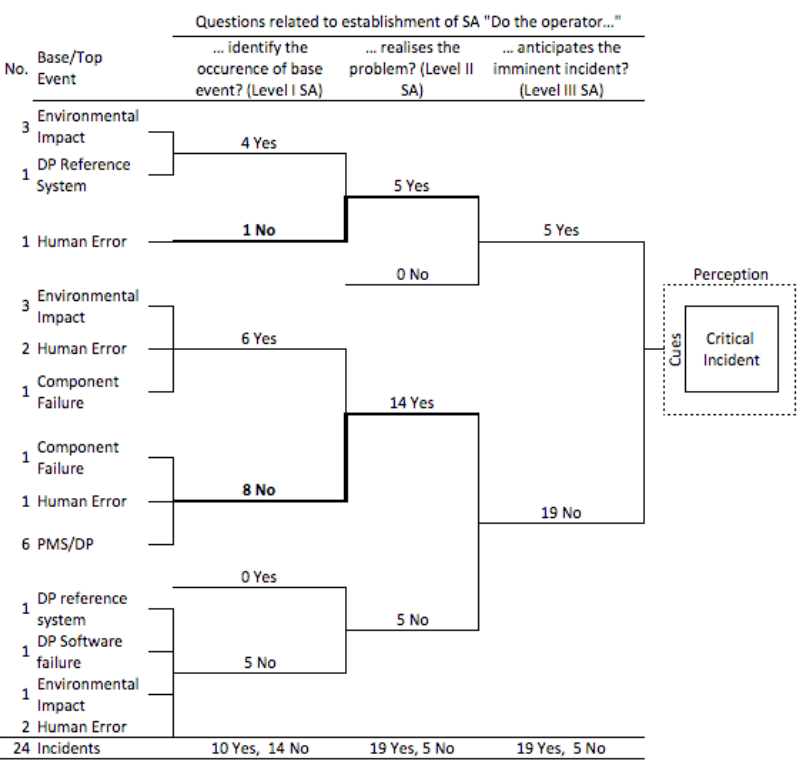
An event tree covering all 24 critical incidents can be seen in Figure 1. The event tree is formed according to whether the operator showed indication of establishment of the three different SA levels prior to the onset of each incident.
Establishment of Level I SA. Base events where only correctly identified during the situation assessment in 10 out of 24 incidents. In the remaining 14 incidents the operator became aware of the base event after the critical incident was over. Even though the operators where not able to identify the base events or the “element in the environment that was of relevance to the controlled process” (i.e. they did apparently not form adequate Level I SA) they where still able to make a decision that stopped the escalation of the situation and thereby prevented an accident.
Establishment of Level II SA. The operators managed to identify that there was a problem prior to the incident in 19 out of 24 incidents (i.e. they where able to form a level II SA by understanding the relevance of part of the information).
In the remaining 5 incidents the DP operator at the point did not understand that there was a problem (i.e. did not form level II SA) prior to the onset of the critical incident.
Of particular interest is the finding that for 9 incidents (marked with bold lines in Figure 1) the operators where seemingly able to understand that there was a problem (Level II SA) without being able to perceive the occurrence of a base event (Level I SA).
Establishment of level III SA. DP operators were able to retrospectively describe the outcome of the situation in all of the critical incidents. However, in only five (5) incidents the DP operators said certain cues lead them to expect the incident before it happened (form adequate level III SA). In the remaining 19 incidents the operators did not expect the occurrence of a critical incident and where henceforth taken by surprise when the incident started to escalate.
In 14 out of these 19 incidents the operators did not anticipate the near future occurrence of a critical incident (i.e. did not form Level III SA). So, during these incidents the operators where able to identify that something was wrong, even though they did not identify the reason of the discrepancy.
Figure 1. Reconstructed sequence of the operator´s establishment of SA. The bold lines shows incidents where higher-level SA is established without indication of adequate Level I SA.
Figure 1 shows the event tree involving 24 incidents. On the left are the base events that initiated or caused the incidents. Each step of the event show how many incidents where the operator where able to form the different levels of SA – going from level I SA to Level III SA. The bold lines indicate instances where the operator where able to understand that something was not right (Level II SA) while not being able to identify the elements in the system or environment that led to this situation (thereby indicating lack of proper Level I SA) Expected versus Observed Levels of SA
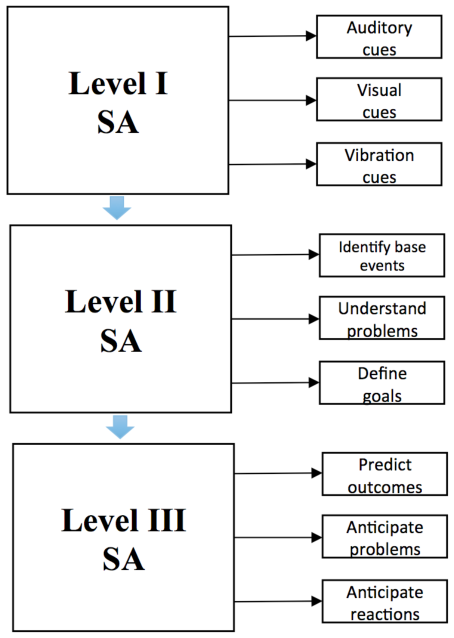
Endsley’s three level model (Endsley, 1995) defines SA as perception of cues in the external environment (e.g. Level I SA), understanding of these cues (Level II SA) and projecting what these may mean for future system states (e.g. Level III SA). Endsley’s model (1995) asserts that to achieve Level III SA (e.g. sound or a high level of SA) the preceding levels of SA ought be achieved first. In other words, the achievement of SA takes place in a linear fashion. Using this notion of SA the sequence portrayed in Figure 2 would be expected. Human Aspects of Transportation I (2021)
Figure 2. Expected sequence of SA development, based on Endsley's (1995) three-level model
What was observed, however, was that the operators did not always understand the cues preceding the critical incident. In order to understand the base event (e.g. Level II SA) the operators should have first perceived cues (Level I SA) indicating a problem developing. Instead, in 9 incidents DP-operators displayed Level II SA without indications of having formed adequate Level I SA. These 9 incidents are marked out with bold lines in Figure 1. Similarly, in 19 incidents, the operators did not predict the occurrence of an incident (lack of Level III SA) but still managed to make decisions that rescued the situation.
All operators where able to avoid an accident, and this also occurred for those that not perceive the base events leading to the critical incident or those who did not understand the relevance of the base events. This is evidenced in five of the incidents where the operators stated that they did not understand the problem, all these operators where able to understand that something was wrong and where able to rescue the situation.
Decision-Making in Critical Incidents A total of 24 incidents are included in the Fault Tree Analysis seen in Figure 3. The square box to the left represents all 24 top events collectively. Top events were events that were undesirable, have an uncertain and possible safety- critical outcome and that needs to be controlled. The event tree displays a representation of the chain of events from onset of the critical incident to the operator had made a corrective action leading to the consequences in the right side of Figure 3. The Failure Tree includes the following; whether the following elements where parts of the decision-making process, Level III SA (prediction of incident), Level II SA (understanding of cause of problem), consideration of time limitations, evaluation of the reliability of information, and then decision strategy with relevance to existing procedures, and finally the outcome of the control action. The event tree specifies the frequency of occurrence from incident to consequence on each sequence.
This study identified 5 types of consequences; drive off (the vessel’s own power plant drives the vessel off the setpoint), drift off (when the vessel´s power plant is not sufficient to keep position), force off (when external influences forces the vessel off its set-point), keep position and collision course (with other vessel or installation). These are common consequences in the maritime domain – especially in off-shore maritime operations using DP.
Figure 3. Failure tree of critical incidents on DP.
Figure available in the original PDF paper.
Results with respect to the decision strategy show that the operators chose to follow predetermined procedures (as they are trained to do) to avoid accidents and to rectify the situation in 18 out of the 24 incidents. In 3 incidents the DP operator consciously chose to break procedures in order to carry out a more efficient strategy. Third, three incidents were recovered utilizing a more efficient strategy without violating procedures. The statements below are extractions from incident recollections and exemplify the three different decision strategies.
From an informant who acted in accordance with the procedures, "That is never questioned. The decision is to withdraw”. From two informants who chose to break the procedure to use a more efficient strategy: "We were both aware of it, but we chose to do it", and "In our judgment we had the situation under control". These informants indicated that they trusted their understanding of the system and the situation to such an extent that they ignored existing procedures and found another way of recovering the situation. One informant utilized a more efficient decision strategy, but within procedures: "But if things had happened faster, then I might have had to take it in manual. By the book." This last quote also clearly shows how the perceived time constraints affected their decision- making. Human Aspects of Transportation I (2021)
Following procedures occurred in all of the 5 incidents where the operator expected the occurrence of a critical incident. Choosing to adapt or break procedures was done in 6 out of the 19 incidents where the operator’s did not anticipate the onset of a critical incident. The operators said they chose to break procedures because they knew that they still had enough power to remain in position (i.e. involves knowledge of system dynamics and system constraints). The operators considered the lack of time available for making corrective actions in a total of 19 incidents, with no difference between
DISCUSSION
In all of the 24 recollections, the incident brought with it a sudden shift in SA. High levels of SA are needed to project a situation (Endsley, 1995) and sudden shifts in the situation can often lead to an incomplete overview over the situation, thereby leading to a situation where the DP operators does not have all the information they need to stay in the control loop. In situations where the automation system no longer functions properly the human operator must take over control. Consequently, when the situation changes unexpectedly the DP operators immediately engages in an intense evaluation of the situation, producing a problem solving strategy. One informant described how he reacted to a sudden change and engaged in a process of obtaining an overview of the situation in order to react correctly. During critical incidents, experience was an important factor in making good situation assessments. This is in accordance with SA theory and Naturalistic Decision Making which shows that experience from previous situations can enhance situation awareness and thereby provoke more efficient or safer actions (Endsley, 1995; Stanton, Chambers & Piggott 2001; Klein et al., 1986).
With regard to the assessment of situations this study also unveiled some interesting findings. First, DP operators engaged in situation assessment to achieve situation awareness, so that they could predict the correct course of actions. DP operators reported that they assessed any situation based on their perception of risk. The DP operators described risk as the parameter to measure all scenarios against. Second, DP operators’ situation assessments in critical incidents can be thought of a timeline of mapping out the situation from base event to consequence (see Figure 3). Sudden shifts in awareness when an incident occurs characterized critical incidents. At this moment the DP operator engaged in an intense assessment process to formulate a decision strategy. Situation assessment did not suddenly begin at this moment, but rather was intensified. The DP operators explained how they immediately felt whether they could identify the base event. This reveals that they already had a certain level of awareness, based on experience and recognition. Third, The DP operators reported that they recognized certain cues that revealed the underlying cause or base event for the incident. Recognizing the base event, or not, had an effect on expectations, uncertainty and the course of action in critical incidents on DP. This is in accordance with research on fire ground commanders, where Klein et al. (1986) found that in some cases certain cues revealed the cause and that knowing the cause had an effect on the situation assessment. One of the DP operators explained that he knew the vessel's history and system design so well, that when s/he spotted a change in rpm (revolution per minute) on the thruster screen, he was able to pin-pointed the problem and identified a course of action immediately. These findings show that work automated systems in the maritime domain have clear similarities with recognition-primed decision- making (Klein, 1993).
DP operators appeared to maintain whatever degree of awareness they found necessary to perform their work effectively in order to optimize available mental resources. In routine operations this typically included minimal or selective awareness with a focus on monitoring and tracking of necessary information. In critical incidents prediction of forthcoming events was required and the DP operators' role changed from monitoring to action taker. This is consistent with general SA theory since SA in DP incidents was determined by task relevance (Endsley, 1995, Salmon et al., 2008; Stanton et al. 2006). In critical incidents DP operators appeared to have simultaneous, but different levels of SA concerning various aspects of the situation. Therefore the process of reaching levels of SA in critical incidents may not be entirely sequential, as implied by Endsley’s (1995) model. It is possible that the establishment of SA (which is a higher-level cognitive construct) can be both sequential and/or parallel depending on the human operator's attention resources and information available. In our study we found that even level II SA was formed even though the operators had formed level I SA (had not identified the base event that initiated the critical incident). However, this might also be due to the fact that they perceived that something was amiss (e.g. observing that the ship deviated from its set position or course, observing that information in the interface did not fit with the situation) and thereby using additional information to form a level II SA. We did not find any indication that the DP operators where able form Level III SA - predicting the occurrence of a critical incident – if they did not had formed Level II SA (see Figure 1) thereby showing a sequential relationship between Level II SA and Level III SA.
Limitations or this paper We did not enquire about the specific DP-systems that were used during the critical incidents. There exist a number of different manufacturers of DP-systems in the world. It is possible that the human-machine interface of the DP systems could have affected the operator´s ability to detect and identify the imminent critical situations, however, our data do not allow us to make any conclusions about the influence of DP systems toward these critical incidents, nor can we make any conclusions regarding the suitability of DP systems from different software and hardware producers.
The retrospective and interview-based nature of our study stops us from making any conclusions of the possible causal relationship between the three SA levels and the relationship between SA and performance. With respect to this our results regarding the seemingly non-sequential nature between Level I SA and Level II SA may be open for discussion. However, we would argue that our study at least can be a starting point for making empirical evaluations of the empirical relationships within the SA construct as well as between SA and performance.
CONCLUSIONS
Critical incidents in DP operation involve rapid and often unexpected changes in the status of the system, thereby requiring substantial effort on the part of the human operator to regain control. In a majority of critical incidents the DP operators do not expect the occurrence of a critical incident. Interestingly, some of the DP operators where able to predict the occurrence of a even though some the DP operators seemingly was not able to either identify the relevant base events (lack of Level I SA), to understand the relevance of the base event (lack of Level II SA) or to predict the occurrence of the critical incident (lack of Level III SA) they where still able to make control actions to enable successful recoveries from the critical incidents. From a theoretical viewpoint, the process of gaining SA did seemingly not follow sequentially Level I SA to Level II SA, as set out by Endsley (1995) but rather the build-up seemed to be adaptive and related to the work system´s higher-level goals (such as “avoid collision”).
Predefined procedures where involved in the majority of these incidents and they allowed many of the DP operators to safely guide the system even though they did not know exactly the cause of the disturbance/error. Interestingly, the interplay between procedures and the operators’ technical skills or seamanship was apparent in a total of 6 out of 24 incidents where the DP operator either broke or adapted the procedures in order to successfully recover from the critical situation thus pinpointing how the dynamic nature of the maritime environment require skilful adaptations on the part of the seafarers to ensure a balance between safety and efficiency.
Acknowledgements
This research has been partly financed by the Norwegian Research Council through the SITUMAR project (project number 217503).
REFERENCES
Bainbridge, L. (1983). Ironies of automation. Automatica, 19(6), 775-779. Bedny, G., & Meister, D. (1999). Theory of activity and situation awareness. International Journal of Cognitive Ergonomics, 3(1), 63-72. Billings, C. (1991). Human-centered aircraft automation: A concept and guidelines. Moffett Field, CA.: National Aeronautics
and Space Administration. Cannon-Bowers, J. A., Salas, E., & Pruitt, J. S. (1996). Establishing the boundaries of a paradigm for decision-making research. Human Factors, 38(2), 193-205. Degani, A & Wiener E.L. (1997). Procedures in complex systems: the airline cockpit. IEEE Transactions on Systems, Man and
Cybernetics, 27(3), 302-312. Dekker, S. W. A. (2003). Failure to adapt or adaptation that fail: contrasting models on procedures and safety. Applied Ergonomics, 34, 233-238. Dekker, S. W. A., & Woods, D. D. (1999). To intervene or not to intervene: the dilemma of management by exception.
Cognition, Technology and Work, 1, 86-96. Eagle, C. J., Davies, J. M., & Reason, J. (1992). Accident analysis of large-scale technological disasters applied to an anaesthetic complication. Canadian Journal of anaesthesia, 39(2), 118-122. Endsley, M. R. (1995). Toward a theory of situation awareness in dynamic systems. Human Factors, 37(1), 32-64. Endsley, M. R. (1996). Automation and situation awareness. In R. Parasuraman & M. Mouloua (Eds.). Automation and human
performance: Theory and applications (pp. 163-181). CRC Press. Endsley, M. R., & Kiris, E. O. (1995). The out-of-the-loop performance problem and level of control in automation. Human Factors, 37(2), 381-394. Fossen, T. I. (1994). Guidance and control of ocean vehicles. New York, Wiley. Jentsch, F., Barnett, J., Bowers, C. A., & Salas, E. (1999). Who is flying this plane anyway? What mishaps tell us about crew
member role assignment and air crew situation awareness. Human Factors, 41(1), 1-14. IMO (2011). International Convention on Standards of Training, Certification and Watchkeeping for Seafarers. London, UK: International Maritime Organisation. Kaber, D. B., & Endsley, M. R. (2004). The effects of level of automation and adaptive automation on human performance,
situation awareness and workload in a dynamic control task. Theoretical Issues in Ergonomics Science, 5(2), 113-153. Kahneman, D., & Klein, G. (2009). Conditions for intuitive expertise: a failure to disagree. American Psychologist, 64(6), 515. Klein, G. A. (1993). A recognition-primed decision (RPD) model of rapid decision making. In G. Klein, J. Orasanu, R.
Calderwood & C. E. Zsambok (eds.). Decision making in action: Models and methods (pp. 138-147). Ablex Publishing. Klein, G. (2008). Naturalistic decision making. Human Factors, 50(3), 456-460. Klein, G. A., Calderwood, R., & Clinton-Cirocco, A. (1986). Rapid decision making on the fire ground. In Proceedings of the Human Factors and Ergonomics Society annual meeting, 30(6) 576-580. Leveson, N. G., & Palmer, E. (1997). Designing automation to reduce operator errors. IEEE Systems, Man, and Cybernetics, 2,
1144-1150. Lipshitz, R. & Shaul, O. B. (1997). Schemata and mental models in recognition-primed decision making. In C. A. Zsambok & G.
Klein, (eds.). Naturalistic Decision Making (pp. 293-303). Hillsdale, NJ: Lawrence Erlbaum. Lipshitz, R., Klein, G., Orasanu, J., & Salas, E. (2001). Taking stock of naturalistic decision making. Journal of Behavioral Decision Making, 14(5), 331-352. Meshkati, N. (1991). Human factors in large-scale technological systems' accidents: Three Mile Island, Bhopal,
Chernobyl. Organization & Environment, 5(2), 133-154. Nazir, S., Colombo, S., & Manca, D., (2012). The Role of Situation Awareness for the operators of process industry. Chemical Engineering Transactions, 26, 303-308. Norman DA (1990). The ‘problem’ with automation: inappropriate feedback and interaction, not over-automation. Philosophical
Transactions of the Royal Society of London, B327:, 85–593. Parasuraman, R., Mouloua, M., & Molloy, R. (1996). Effects of adaptive task allocation on monitoring of automated systems: Human Factors, 38(4), 665-679. Parasuraman, R., Molloy, R., & Singh, I. L. (1993). Performance consequences of automation-induced 'complacency'. The
International Journal of Aviation Psychology, 3(1), 1-23. Parasuraman, R., Sheridan, T. B., & Wickens, C. D. (2000). A model for types and levels of human interaction with automation. IEEE Systems, Man and Cybernetics, Part A: Systems and Humans, 30(3), 286-297. Reason, J. T. (1997). Managing the risks of organizational accidents. Aldershot, UK: Ashgate. Salas, E., Rosen, M. A., & DiazGranados, D. (2010). Expertise-based intuition and decision making in organizations. Journal of
Management, 36(4), 941-973. Salmon, P. M., Stanton, N. A., Walker, G. H., Baber, C., Jenkins, D. P., McMaster, R., & Young, M. S. (2008). What really is going on? Review of situation awareness models for individuals and teams. Theoretical Issues in Ergonomics Science, 9(4), 297-323. Sarter, N. B. (2000). Multimodal communication in support of coordinative functions in human-machine teams. Human
Performance, Situation Awareness, and Automation: User-centered Design for the New Millenium, 47-50. Sarter, N. B., & Woods, D. D. (1995). How in the world did we ever get into that mode? Mode error and awareness in supervisory control. Human Factors, 37(1), 5-19. Satchell, P., (1998). Innovation and Automation. Ashgate, USA. Sheridan, T. B. (1992). Telerobotics, automation and human supervisory control. The MIT press. Smith, K., & Hancock, P. A. (1995). Situation awareness is adaptive, externally directed consciousness. Human Factors, 37(1),
137-148. Stanton, N. A., Chambers, P. R. G., & Piggott, J. (2001). Situational awareness and safety. Safety Science, 39(3), 189-204. Stanton, N. A., Stewart, R., Harris, D., Houghton, R. J., Baber, C., McMaster, R., ... & Green, D. (2006). Distributed situation awareness in dynamic systems: theoretical development and application of an ergonomics methodology. Ergonomics, 49(12-13), 1288-1311. Sørensen, A. J. (2011) A survey of dynamic positioning control systems. Annual Reviews in Control, 35(1), 123-136. Weick, K. E. (1993). The collapse of sensemaking in organizations: The Mann Gulch Disaster. Administrative Science Quarterly,
38, 628-652. Wickens, C. D. (Ed.). (1998). The future of air traffic control: Human operators and automation. National Academies Press. Wickens, C. D. (2002). Situation Awareness and workload in aviation. Current Directions in Psychological Science, 11(4), 128-
133. Woods, D. D., & Roth, E. M. (1988b) Cognitive Systems Engineering. In M. Helander (Ed.), Handbook of Human-Computer Interaction (pp. 3-43). New York: North-Holland. Woods, D. D., & Sarter, N. B. (2000). Learning from automation surprises and “going sour” accidents. In N. B: Sarter, & R.
Alamberti (eds.), Cognitive Engineering in the Aviation Domain (pp. 327-353). Mahwah, NJ: Lawrence Erlbaum. Zsambok, C. E. (1997). Naturalistic decision making: where are we now? In C. E. Zsambok, & G. Klein, (eds.) Naturalistic decision making. (pp. 3-16) Mahwah, NJ: Lawrence Erlbaum.
LISTED IN THE AHFE DIGITAL BOOKSTORE CATALOGUE
Explore the complete digital volume
Advances in Human Aspects of Transportation: Part I
Read this individual research paper free through the original publisher, or explore the full digital proceedings book.
ISBN 978-1-4951-2097-8
Explore this ISBN in the AHFE Bookstore ↗Listed in the July 2026 bookstore catalogue; search by ISBN to confirm current availability · Digital book purchase optional