Claudia Witzlack, Peter Cocron, Josef F. Krems (2021). Pushing the Limits? Regenerative Braking in Takeover Situations. In: Advances in Human Aspects of Transportation: Part II. AHFE Open Access, vol. 16. https://doi.org/10.54941/ahfe100696
The aim of the study was to investigate if individual experience in driving an electric vehicle (EV) influences the interaction with regenerative braking. Therefore, a field experiment was developed to explore driver behavior in takeover situations. Here regenerative braking reaches its limits, so drivers must use the conventional brake to come to a stop in a safety manner. Furthermore, it was tested, if trust towards regenerative braking changes as experience in driving an electric vehicle increases. Especially the changes in trust when regenerative braking meets its limits were investigated. Results showed that drivers with little EV-experience come closer to a stop in front of stop line and overshot this stop line more often compared to inexperienced drivers. Trust towards regenerative braking increased slightly after the subjects without driving experience gained experience in driving an electric vehicle und decreased after takeover situations. Altogether subjects with little EV-experience showed a higher trust in regenerative braking than subjects without EV driving experience. Finally, the impact of trust on driver behavior is discussed as a possible explanation for our findings.
In times of shrinking fossil fuels one of the biggest challenges of our age is the extraction of renewable energy sources to control the emission of carbonic acid gas. One of the leading approaches to reduce carbonic dioxide emission in traffic is the electrification of power trains. Electric vehicles (EV) are typically equipped with regenerative braking systems (RB), which are focused on the present study. Those braking systems recapture the kinetic energy which is released while the EV decelerates and feed the battery of the car with electric energy.
During the last years extensive field studies that investigated human-machine interaction and adaptation processes in electric mobility (Ramsbrock, Vilimek, & Weber, 2013). Concerning RB, studies revealed that subjects appreciate RB to be a very comfortable feature of EV’s (Krems, Weinmann, Weber, Westermann, & Albayrak, 2013; Turrentine et al., 2011). Nevertheless subjects reported decelerating with RB to be the biggest adjustment compared to other EV features (Krems et al., 2013). Objective data reported by Cocron, Bühler, Franke, Neumann, Dielmann and Krems (2013) revealed that drivers can quickly adapt to RB system which is triggered via accelerator. The authors found out that it takes about several hours up to one day until subjects mostly use RB. The portion of conventional braking maneuvers decreased mostly at the beginning of the EV usage followed by reaching a kind of constant level in dependence of driving duration. The process of learning to use an accelerator triggered RB system seems to be an important factor to transfer the system’s usage to different traffic situations and to integrate it into every-day driving behavior (Cocron et al., 2013; Turrentine et al., 2011).
The degree to which people adopt new technologies like RB and are willing to use or rely upon them depends on psychological factors like acceptance and trust (Jian, Bisantz, Drury & Llinas, 1998; Sheridan, 1988). Muir and Moray also supported this assumption and argued that the tendency of using a system depends on trust. If there is trust in a system, the probability to use it increases and vice versa. Those findings were mostly situated in the domain of automated or partly-automated systems but here we tried to transfer them to RB. Furthermore, Lees and Lee (2007) stated that trust is an important factor to understand any human-machine interaction. If new technology is brought to the human-machine interaction, the behavior of the human operator will change. For example, the lack of control over a certain event or action in an automated system is usually compensated by trust (Cahour & Forzy, 2009). In conclusion we assumed trust to be a decisive variable in human-machine interaction that is used by the human operator to decide if he delegates certain tasks to a system or not (Cocron et al., 2013).
The question that arises here is how do people set their level of trust? Can people trust too much in a system and what happens then? To describe this problem Parasuraman and Wickens (2008) introduced the constructs of overreliance or overtrust, which means an inappropriate level of trust towards a technological system. There are several studies which investigated the consequences of overreliance. Sparaco (1995) found that aviators of an Airbus relied too much on autopilot which was followed by an air crash. Another study in the field of shipping (Lee & Sanquist, 2000) showed that an inappropriate level of trust in a navigation system lead to a misrouting of the ship. In that sense a disproportion of trust can cause very serious consequences. Parasuraman and Riley (2007) described the disproportion of trust in human-machine interaction as disuse (level of trust is too low so people do not use the system) or misuse (inappropriate level of trust so people use the system unintentionally in a false manner). To sum up, trust is the variable which decides whether people misuse or disuse a certain system. Furthermore, there is a common ground because the pilots or captains missed the point to take back control from the system. Here we define takeover situations in RB systems, when the driver is forced to take back the control from the system, which means that he has to utilize the friction brake to decelerate.
A System which is often investigated in relation to takeover situations and trust is the Adaptive Cruise Control System (ACC). Rajanoah, Anceaux and Vienne (2006) investigated the ACC in takeover situations and also measured the level of trust. They found out that subjects who showed a high level of trust used the system more often (Jian et al., 1998; Lewandowsky, Mundy & Tan, 2000; Muir & Moray, 1996; Sheridan, 1988) than subjects with lower levels of trust. Those subjects who relied too much on the ACC used the conventional brake later in the deceleration process than subjects with lower levels of trust. As mentioned above, trust regulates the manner people use certain technologies and also the actions of a system can regulate the level of trust. Either the system works properly and therefore confirms the trust of the human operator or -in case of malfunction- trust decreases (Kantowitz, Hanowski & Kantowitz, 1997; Lee & See, 2004).
To sum up, the aim of the study was to investigate the behavior of drivers while using RB and experiencing takeover situations. Here we define takeover situations as a possible traffic incident, where RB reaches its limits so the driver is forced to use the conventional brake to come to a stop in a safety manner. Furthermore we wanted to compare different levels of trust in RB. We developed a deceleration task in which drivers had to come to a stop by only using the deceleration of RB. We tested inexperienced and drivers who were familiar with the test EV and assumed that drivers with EV experience come to a stop more closely in front of a stop line. Furthermore we expected that they would overshoot the stop line more often due to their higher level of trust. In addition we suppose that reaching the limits of RB should cause a bigger decrease in trust.
METHODS
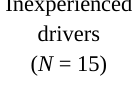
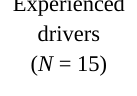
Participants In total, 29 subjects participated in this study, which differed in their EV experience. The group of subjects (N = 14) which was familiar with the EV drove the test vehicle (MINI E) for 24 hours before (in further paragraphs they are called experienced drivers). In that period drivers covered a mean distance of 165 kilometers (SD = 107.5 kilometers). The group of inexperienced drivers (N = 15) had no experience in driving an EV at all (in further paragraphs they are called inexperienced drivers). Both groups where matched using certain socio-demographic variables like age, gender or driven kilometers in the past year. The whole group of subjects consisted of 8 females and 21 males and had a mean age of 37.52 years (SD = 10.09 years).
Test Vehicle The test vehicle was a MINI E, which is a two-seated EV with a bttery pack in the back of the vehicle. The vehicle had an engine power of 150 kW, a torque of 220 Nm, a top speed of 152 km/h and a maximum range of 250 km (under controlled conditions). The RB system was triggered by the accelerator pedal. As soon as the driver released the gas pedal, there was a noticeable deceleration. The RB system had a deceleration rate of -2.25 m/s² (Eberl, Sharma, Stroph, Schumann & Pruckner, 2012).
Furthermore, there was a notebook integrated inside the vehicle, which was placed on the right side of the car dashboard to show a stop signal.
Test Area We used a rectangular sealed area (30 m x 50 m) to conduct the experiment (see figure 1). Three stop lines were marked in each direction. At the rightmost position of each linear slope there were yellow and red pylons in different positions, which indicated the investigator to give the stop signal.
Figure 1. Test area in view from above (not true to scale)
Figure available in the original PDF paper.
Procedure The whole experiment consisted of two parts. The aim of the first part was the investigation of learning processes while using the RB. Details are reported in Witzlack, Cocron and Krems (2013).
The second part of the experiment is reported here. Subjects were instructed to drive through the circuit and accelerate at the linear slopes up to 30 km/h respectively 40 km/h. Furthermore they were told that there will be a signal via the display of the notebook which tells them the number of the stop line at which they must come to a stop. Here subjects had to decide by themselves whether to use the conventional brake or RB. In total subjects drove nine rounds and had to stop three times per speed level.
The stop line at which they had to come to a stop, the number of round and the side of the course were randomly chosen. The investigator gave the signal to stop when the vehicle passed a specific pylon. The aim of this experimental setting was to provoke a takeover situation where the deceleration of RB reached its limits. When the signal indicated to come to a stop it was not possible to stop in front of the stop line without using the conventional brake. Therefore participants had to take over control and brake conventionally. This situation reflects an incident in traffic, when an unexpected event (e.g. the car in front of the own vehicle decelerates very quickly without a visible reason) occurs and one has to stop very quickly.
When the subject came to a stop the experimenter measured the distance between stop line and the front bumper of the car. After passing the three braking maneuvers per speed level, subjects had to rate their trust based on items by Cocron et al. (2013).
RESULTS
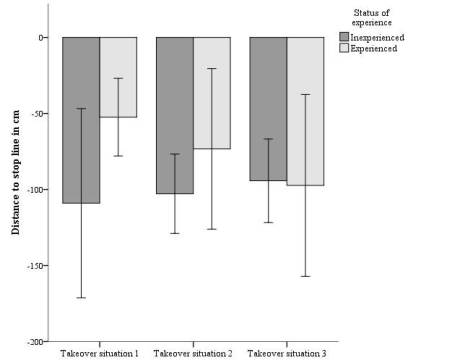
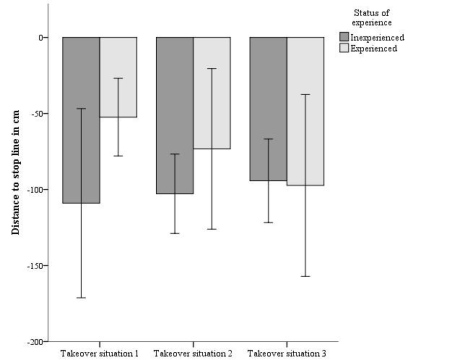
To investigate if there is any different behavior between experienced and inexperienced drivers in takeover maneuvers, we compared the distances in which they came to stop in front of a stop line. We assumed that experienced drivers came more closely to a stop in front of the stop line than inexperienced drivers. Therefore we compared the different speed levels (30 or 40 km/h) and each takeover maneuver (see figure 2 and figure 3). In this part of the statistical analysis we only focused on those drivers who came to a stop in front of the stop line, so we had to compare groups of widely different size. Therefore we used several t-Tests, but corrected the accumulation of the alpha error using the method of Bonferroni-Holm (Holm, 1979).
At 30 km/h, results pointed in the assumed direction but revealed no significant differences. In the third takeover situation inexperienced drivers came marginally closer to a stop in front of the stop line than experienced drivers (Meaninexperienced drivers = -91.64 cm vs. Meanexperienced drivers = -92.80 cm). Regarding the speed level of 40 km/h (see figure 3), results support the assumption mentioned above. Nevertheless, there are no significant differences between the distances of inexperienced and experienced drivers (see table 1; none of the calculated p-values falls below the corrected alpha-value of .017).
Table 1: Statistical analysis of mean distance in which inexperienced and experienced drivers stopped in front of a stop line 30 km/h speed level 40 km/h speed level
Table available in the original PDF paper.
1st takeover situation
2nd takeover situation
3rd takeover situation
1st takeover situation
2nd takeover situation
3rd takeover situation
t -1.585 -1.512 .550 -1.869 -.554 -1.841
df 18 22 22 24 20 24
p .065 .042 .037 .478 .293 .039
Figure 3. Comparison of distances in front of the stop line concerning speed level of 40 km/h (mean, confidence interval)Figure 2. Comparison of distances in front of the stop line concerning speed level of 30 km/h (mean, confidence interval)
Another way to investigate differences in the braking behavior of inexperienced and experienced drivers concerning takeover situation is to analyze the amount of subjects who overshot the stop line. Here, we supposed that the experienced drivers would overshoot the stop line more often than inexperienced drivers. The results supported this assumption, because in each takeover maneuver irrespective of the speed level there were more experienced drivers who overshot the stop line (see table 1). Still, we couldn’t find any significant differences in the frequency of inexperienced and experienced drivers overshooting the stop line (see table 2).
Table 2: Comparison of the amount of drivers who overshot the stop line and results of significance analysis 30 km/h speed level 40 km/h speed level
Table available in the original PDF paper.
1st takeover situation
2nd takeover situation
3rd takeover situation
1st takeover situation
2nd takeover situation
3rd takeover situation
Inexperienced
4 1 1 0 1 0
Equation reproduced from the original PDF.
4 3 3 2 6 2
Equation reproduced from the original PDF.
1.000 .311 .311 .206 .029 .206
Test)*
*footnote: We report the exact fisher test, because there often were often values below 5 in the cells.
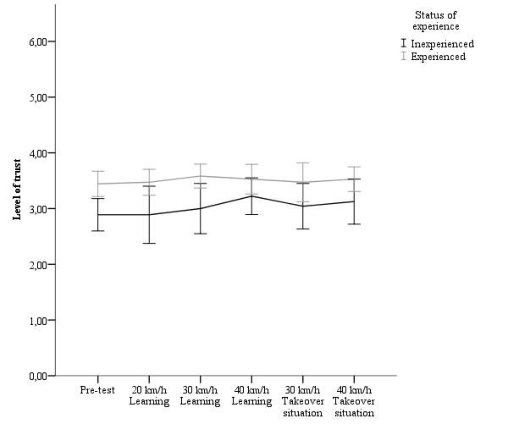
Additionally, we investigated trust and to which extend trust was adjusted in takeover situations. For a better understanding we also report the level of trust in pre-test measurement and for all learning points of measurement (see figure 3). We assumed that experienced drivers show a higher trust in RB at every point of measurement than inexperienced. Results support this assumption (see figure 3). Here the statistical analysis showed a significant influence concerning the experience F(1,22) = 6.202, p = .011 and a very big effect size ηp
2 = .220. There were neither significant influence in relation to the different experimental settings (learning vs. takeover situation) F(3.392, 74.615) = 2.027, p = .055 nor for the interaction of experience and experimental setting F(3.392) = .998, p = .203.
Furthermore, we supposed a decrease in trust when the RB reached its limits. Notably inexperienced drivers should show a higher decrease in trust compared to experienced drivers when they passed the takeover situations (see in figure 3). Here we compared the points of measurement after finishing the experimental part of learning with 40 km/h and the first part of takeover situations with 30 km/h. We found a significant influence of experience F(1, 24) = 1.694, p = .043 and a big effect size ηp
2 = .125. There were no significant results concerning the point of measurement F(1, 24) = 1.694, p = .103 or the interaction of experience and point of measurement F(1) = .152, p = .350.
Figure 3. Comparison of trust in regenerative braking several points of measurement (mean, confidence interval)
DISCUSSION
The aim of the study was to investigate the braking behavior of inexperienced and experienced drivers in takeover situations. In our experiment inexperienced and experienced drivers went through a learning procedure where especially the inexperienced drivers had the chance to gain some practical experience in using RB. In the takeover situations subjects had to stop in front of a stop line deciding whether and when to step on the conventional brake. We assumed that inexperience drivers used the conventional brake earlier in the deceleration process and came to a stop earlier than experienced drivers. As a consequence, inexperienced drivers were expected to overshoot the stop line less often than experienced drivers. Results showed tendencies in direction of our hypothesis, but there were no significant differences. That means inexperienced drivers tended to come to a stop further in front of the stop line and tended to overshoot the stop line less often than experience drivers. One could argue that the level of trust the drivers developed towards RB might be a possible reason for our findings. (Lee & Sanquist, 2000; Sparaco, 1995). Inexperienced drivers had a lower level of trust in the RB system than experienced drivers. Especially in situations where RB reaches its limits, trust seems to decrease so inexperienced drivers might switch more often and earlier to systems they already know and perhaps trust in like the conventional brake. The other way to understand this explanation means that experienced drivers, who already know and eventually trust the RB system, might use the system more often and until it reaches its limits, so they also might overshoot the stop line more often. Another explanation for our findings might be the small sample seize and our definition of experience. Perhaps, our definition was not as selective as it should have been. That means we eventually compared groups of drivers who differed that much in their level of EV-experience or 24h EV-experience might not be enough to produce distinct results in our study.
One can associate these results with studies of Parasuraman and Riley (2007). They described the mismatch in human-machine interaction as misuse or disuse, which is determined by the level of trust. Do people trust too much in a system, they might misuse it (or in this case maybe overshoot the stop line). A lower level of trust should lead more often to disusing a new system rather using an already known system (or in this case not using the conventional brake instead of RB).
Trust seems to be an influencing factor on how people use technologies (Lee & See, 2004). That is why we assessed the level of trust towards RB in both groups of drivers. As we mentioned above trust exceeds when people gain experience in using a certain system. Therefore we assumed that experienced drivers would show a higher level of trust irrespectively of the experimental setting. Furthermore we supposed that passing the takeover situation would decrease the level of trust, especially in the group of inexperienced drivers. The results supported our hypothesis and showed the biggest impact on the differences in trust and the decrease of trust for both experimental groups to be the experience. More experience with a certain technological system can lead to a higher level of trust and also to overreliance, which can cause serious problems, like accidents (Lee & Sanquist, 2000; Sparaco, 1995). Based on studies of Muir and Moray (1996), we supposed a relation between trust and the usage of a system like RB and found supporting results. In total, our results could be associated to studies, which postulate that the level of trust determines on the hand the acceptance of a certain system and on the other hand the extent to which people rely on a system (Jian, Bisantz, Drury & Llinas, 1998; Sheridan, 1988) and finally use a system. Considering the decrease of trust after experiencing the first takeover situations shows that the level of trust is adaptable towards actions of a system. If the systems does not work as excepted or like in this study it reaches its limits, people decrease their level of trust which supports results from Kantowitz, Hanowski and Kantowitz (1997) or Lee and See (2004). Following these thoughts the relation between trust and the usage of a certain system shows a kind of two-way influencing character. Trust determines the extent to which people use a system, but the other way round the usage of the system can adjust the level of trust. Nevertheless, to find more solid results that support a relation between trust and the usage of RB objective data like data loggers should be taken into consideration.
CONCLUSIONS
Regenerative braking as tested in the current study seems to be a trustworthy system, because all of our subjects showed levels of trust around the mean or higher values regarding the used scale for measurement. The minority of subjects overshot the stop line, so one could reason that the used takeover maneuvers were manageable, but still worked to provoke erratic behavior. However there is a real traffic meaning of our results. Takeover situations can happen for example when driver use the RB system more often than conventional braking and experience a situation similar to those we provoked in our study. Consequences might be heavy traffic accidents. Another possible situation might be that drivers use their conventional car which has no RB system, but maybe they rely upon this assumption (Cocron et al., 2013). We also found that experience seems to influence the level of trust towards RB and also a two-way dependence between trust and the usage of the system. Nevertheless both groups do not show clearly distinguishing results neither regarding their braking performance nor their levels of trust, which may have caused only occasional emerging significant results. With regard to future studies, it might be a solution to adjust the definition of experience in terms of e.g. more driven kilometers.
ACKNOWLEDGEMENTS
This study was funded by the German Federal Ministry for the Environment, Nature Conservation and Nuclear Safety. Any views expressed herein are those of the authors and do not necessarily reflect those of the German Federal Ministry for the Environment, Nature Conservation and Nuclear Safety or of other partners involved in the project.We are grateful for the support of our consortium partners, Vattenfall Europe AG (Dr C.F. Eckhardt and F. Schuth) and the BMW Group (G. Schmidt, Dr M. Hajesch, Dr A. Keinath and Dr M. Schwalm) which made our research possible.
REFERENCES
Cahour, B. & Forzy, J.-F. (2009). Does projection into use improve trust and exploration? An example with a cruise control system. Safety Science, 47(9), 1260-1270. Caroll, S., & Walsh, C. (2010). The smart move trial – Description and initial results. Research Report. Retrieved
from: http://www.cenex.co.uk/wp-content/uploads/2013/06/2010-03-23-Smart-move-trial-report-v3- Compatibility-mode-11.pdf Cocron, P., Bühler, F., Franke, T., Neumann, I., Dielmann, B., & Krems, J. F. (2013). Energy recapture through deceleration – regenerative braking in electric vehicles from a user perspective. Ergonomics 56(8), 1203-1215. Cocron, P., Franke, T., Neumann, I., Wege, C., Bühler, F., & Krems, J.F. (2010). Ist das Fahren mit einem
Elektrofahrzeug so besonders? Anpassung des Verhaltens beim Fahren mit Elektrofahrzeugen [What is so special about driving an electric vehicle? Behavioral adaptation while driving an electric vehicle]. In C. Frings, A. Mecklinger, D. Wentura & H. Zimmer (Hrsg.), Beitrage zur 52 . Tagung experimentell arbeitender Psychologen (S. 28). Lengerich: Pabst Science Publishers. Eberl, T., Sharma, R,, Stroph, R., Schumann, J. & Pruckner, A. (2012). Evaluation of interaction concepts for the longitudinal dynamics of electric vehicles. In N.A. Stanton (Ed.): Advances in Human Aspects of Road and Rail Transportation (pp. 263-173). Boca Raton, Florida: CRC Press. Holm, S. (1979). A simple sequentially rejective multiple test procedure. Scandinavian Journal of Statistics, 6, 65–
70. Jian, J.-Y., Bisantz, A.M., Drury, C.G., & Llinas, J. (1998). Foundations for an empirically determined scale of trust in automated systems. Research Report, AFRL-HE-WP-TR-2000-0102. Buffalo: United States Airforce Research Laboratory. Kantowitz, B. H., Hanowski, R. J., & Kantowitz, S. C. (1997). Driver acceptance of unreliable traffic information in
familiar and unfamiliar settings. Human Factors, 39, 164–176. Krems, J. F., Weinmann, O., Weber, J., Westermann, D., & Albayrak, S. (Hrsg.) (2013). Elektromobilität in Metropolregionen: Die Feldstudie MINI E Berlin powered by Vattenfall. Fortschritt-Berichte VDI Reihe 12 Nr. 766 [Electric mobility in model regions: The field study MINI E Berlin powered by Vattenfall]. Düsseldorf: VDI Verlag. Lee, J. D., & Sanquist, T. F. (2000). Augmenting the operator function model with cognitive operations: Assessing
the cognitive demands of technological innovation in ship navigation. IEEE Transactions on Systems, Man, and Cybernetics – Part A: Systems and Humans, 30, 273–285. Lee, J.D., & See, K.A. (2004). Trust in automation: Designing for appropriate reliance. Human Factors, 46, 50-80. Lees, M.N., & Lee, J.D. (2007). The influence of distraction and driving context on driver response to imperfect collision warning systems. Ergonomics, 50, 1264-1286. Lewandowsky, S., Mundy, M., & Tan, G.P.A. (2000). The dynamics of trust: Comparing humans to automation.
Journal of Experimental Psychology, 6(2), 104-123. Muir, B. M., & Moray, N. (1996). Trust in automation: 2. Experimental studies of trust and human intervention in a process control simulation. Ergonomics, 39, 429–460. Parasuraman, R., & Riley, V. (1997). Humans and automation: Use, misuse, disuse, abuse. Human Factors, 39,
230–253. Parasuraman, R., & Wickens, C.D. (2008). Humans: Still vital after all these years of automation. Human Factors, 50, 511-520. Rajaonah, B., Anceaux, F., & Vienne, F. (2006). Trust and the use of adaptive cruise control: a study of a cut-in
situation. Cognition, Work & Technology, 8, 146-155. Ramsbrock, Vilimek, & Weber, 2013 Sheridan, T.B. (1988). Trustworthiness of command and control systems. IFAC Man-Machine Systems, 427-431.
Sparaco, P. (1995). Airbus seeks to keep pilot, new technology in harmony. Aviation Week and Space Technology, 62–63. Turrentine, T., Garas, D., Lentz, A., & Woodjack, J. (2011). The UC Davis MINI E Consumer Study. Research
Report, UCD-ITS-RR-11-05. Retrieved from: http://pubs.its.ucdavis.edu/publication_detail.php?id=1470 Witzlack, C., Cocron, P., & Krems, J. F. (2013). Verzögern mit Rekuperation - Lernprozesse aus der
Nutzerperspektive [Deceleration using regenerative braking – learning processes from the user point of view]. In VDI (Hrsg.). Der Fahrer im 21. Jahrhundert. VDI-Berichte 2205 (p. 107-118). Düsseldorf: VDI Verlag.
LISTED IN THE AHFE DIGITAL BOOKSTORE CATALOGUE
Explore the complete digital volume
Advances in Human Aspects of Transportation: Part II
Read this individual research paper free through the original publisher, or explore the full digital proceedings book.
ISBN 978-1-4951-2098-5
Explore this ISBN in the AHFE Bookstore ↗Listed in the July 2026 bookstore catalogue; search by ISBN to confirm current availability · Digital book purchase optional