Niklas Strandab, I.C. MariAnne Karlssonac, Lena Nilssonab (2021). End-users’ Acceptance and Use of Adaptive Cruise Control Systems. In: Advances in Human Aspects of Transportation: Part II. AHFE Open Access, vol. 16. https://doi.org/10.54941/ahfe100671
An online survey was distributed to end-users of adaptive cruise control (ACC). In total 90 drivers answered the questionnaire, which covered e.g. ACC usage and how such use affects driver behaviour. According the responses: the ACC is used primarily on roads with higher speed limits; the end-users trust the system even though it has some functional limitations; they have a very positive attitude towards the system; and positive effects on comfort and safety are observed including reduced inclination to overtake and increased compliance with speed regulations.
Advanced driver assistance systems (ADAS) in vehicles are associated with safety and comfort benefits for the driver (Brookhuis, de Waard, and Janssen, 2001). Adaptive Cruise Control (ACC) is an ADAS that controls speed and distance to vehicles ahead based on speed and time-gap settings (for a description of ACC systems see e.g. Naranjo, González, Reviejo, Garzia, and de Pedro, 2003, or Stanton and Young, 2005). Several studies concerning ACC systems have been carried out. A majority of these studies has however not focused actual users, instead car drivers in general have been appointed as participants. Such a recruiting strategy has advantages when addressing certain research questions, while for other questions knowledge and experience of a specific system are essential. In comparison with studies not including actual users studies including them are scarce. There are nevertheless a few exceptions including studies by Strand, Nilsson, Karlsson, & Nilsson (2010); Larsson (2012); Piccinini, Simões, and Rodrigues (2012), and Sanchez, et al. (2012) which all focus actual end-users and their assessment of and behavioural adaptation to the systems.
Behavioural adaptation (BA) is a psychological issue that explains behaviours that occur in response to change in a road-vehicle-user system (OECD, 1990). (For a full account of BA see the review by Saad, et al. (2004).) Strand et al. (2010) explored end-user experiences of ACC by means of focus group interviews and the study by Piccinini et al. (2012) used a similar approach. Both studies showed that, overall, end-users were satisfied with their ACC systems and that there are positive effects in terms of convenience as well as safety. Nevertheless, some negative effects were also identified. Strand et al. (2010) revealed that there are users carrying mental models, which to some extent can be considered rudimentary. Mental models can be viewed as our understanding of objects and processes that guide our interaction with them (Bernstein, et al. 2003) and proper metal model of system functionality are important to cope with for instance mode errors (Sarter and Woods, 1995). Another finding was that the drivers had experienced situations, such as roundabouts, in which ACC functionality could be improved. Negative aspects related to ACC use concluded in the study by Piccinini et al. (2012) were that end-users were not fully aware of potential critical situations when driving with ACC and that improper usage of ACC occurred. They also found that tasks distracting driving were more frequent when driving with ACC, compared to manual driving. The study by Larsson (2012) reported on a survey to 130 ACC users. In this case the results indicated that use experience is crucial for the understanding of functional limitations of the ACC.
The report by Sanchez, et al. (2012) addresses user acceptance of ACC. The results are based on a survey to 227 participants in the EU-project euroFOT (www.eurofot-ip.eu). The majority was drivers of passenger cars equipped with ACC, but the study also included those who drove trucks equipped with the same system. The results suggest that acceptance (defined as perceived usefulness and driver satisfaction) was very high and, in addition, stable over time. The ACC was rated most useful in normal traffic on motorways. Furthermore, ACC increased perceived comfort (stated by 80 %) and safety (stated by 94 %).
The main purpose of this study was to follow up on earlier studies and investigate end-users’ experiences of ACC with regards to drivers’ use and acceptance of ACC; usability assessment; and perceived influence on driving behaviour. An additional aim was to investigate if these aspects were affected by ACC use experience (self-rated).
METHOD
Data collection
Data was collected by means of an on-line questionnaire, set up with SPSS DimensionNet software, version 5.5, patch level 3 (SPSS Ltd., 2008), and distributed by e-mail. The questionnaire included slightly more than 70 questions covering the topics: experience, usage pattern, acceptance and perceived usability. For acceptance, a new acceptance scale was used, SKAS (Strömberg & Karlsson, 2012). The scale includes 20 items covering four areas:
Trust & Control attempts to capture how secure the user feels with the system. It consists of three items capturing aspects of the perceived technical reliability of the system, whether the user thinks that the information that the system gives or the action it takes can be trusted, and whether the user feels in control of the system.
Perceived benefit aims to find whether the user perceives the system as something useful and as something that provides benefits (in terms of convenience, joy, efficiency etc.) to them in the task they are trying to perform.
Perceived effort tries to identify the effort the users feel they have to put into gaining the benefits. It draws on classical usability in terms of ease of use, logic and coherence, etc.
Compliance tests more abstract level aspects of acceptance. The dispensability item aims to capture whether the users feel that the problem that the product is trying to solve actually is a problem that needs solving, and the appropriateness item aims to capture whether the product is a suitable way of solving that problem.
All but one question in the questionnaire were closed-ended. The major part of questions was of a Likert type (Likert, 1932) with five response categories, including a neutral category. There were also a few questions with rating scales, from low to high (1-5). In SKAS the response scales were instead of a semantic differential type. The semantic differential scales used bipolar categories, with one positive and one negative pole. (See for instance McQueen and Knussen (2006) for a brief overview of rating scales, Likert scales, and semantic differential scales.)
Analysis Statistical analyses were conducted with IBM SPSS statistics software, version 21 (IBM Corp., 2012). First a descriptive data analysis was conducted. This was followed by a Mann-Whitney test in which driving context (mainly within urban areas and mainly outside urban areas) was used as grouping variable. Only significant tests are presented in the results section.
Participants A list of 414 end-users’ of ACC was handed over by Volvo Cars Corporation. They were approached by e-mail and asked to answer the on-line survey: 90 end-users of ACC completed it. However, three of them stated that their cars were either not equipped with ACC. These were excluded from the analysis.
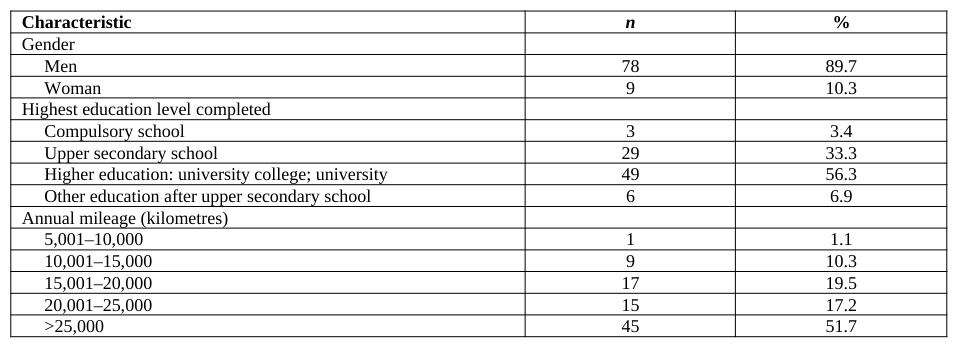
The respondents’ ages varied between 31 and 76 years (M = 53.18, SD = 10.69, n=87). A majority had completed higher education (higher than upper secondary school). All of them had a valid driver’s license and had held them for between 13 and 58 years (M = 34.75, SD = 10.69, n=87). The majority drove more than 25,000 kilometres per year. (See table 1 for an overview of participants’ characteristics.)
Table 1: Participants Characteristics (n= 87)
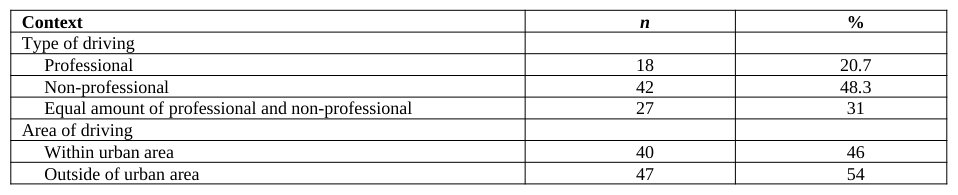
About half of the participants were primarily engaged in non-professional driving, and one third drove equal amounts professionally and non-professionally. The remaining drove mainly in a professional role. Furthermore, roughly equal amounts of the drivers drove mainly within urban areas and outside of urban areas respectively. (See table 2 for overview of responses regarding context of driving.)
Table 2: Context of Driving (n= 87)
The participants were all owners of cars from the S, V, or XC ranges manufactured by Volvo Cars. At the time of the survey (i.e. 2013) all cars were fairly recent year models with the oldest being of year model 2009 and the latest 2014. The majority (65,5%) drove a car with automatic transmission.
A majority rated themselves as experienced or very experienced ACC users and only a few considered themselves to be beginners why any analysis of differences between experienced less experienced ACC users was not feasible.
RESULTS
One of the questions posed to the respondents concerned their general attitude towards ACC. Overall the respondents had a very positive attitude towards the ACC. As many as 94.3 per cent was “very positive”, 4.6 per cent was “somewhat positive” and 1.1% neither negative nor positive. None rated their attitude towards ACC as negative.
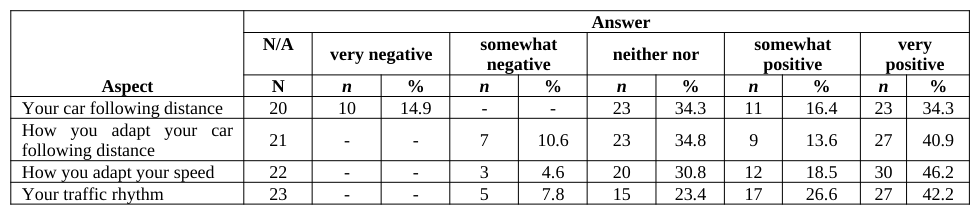
Earlier studies (Strand et al., 2010) have indicated that ACC users experience that other drivers react to the car driven with the support of an ACC. The respondents were therefore asked to answer the question: “Do you worry about how your driving with adaptive cruise control is perceived by your fellow commuters?” According to the responses to the survey, the major part of the respondents had no such worries. Instead it seems as if they are signifying a positive influence on other commuters (Table 3). Nevertheless, 14,9% notes that other road users have a negative perception of the car following distance. Approximately 22% provided answers suggesting that they had not received any reactions to their driving or that they had not considered the matter.
Table 3: “How Do You Think Your Fellow Commuters Have Perceived Your Driving with Adaptive Cruise Control Regarding the Following Aspects?” (n = 87). Percentages given are the valid per cent.
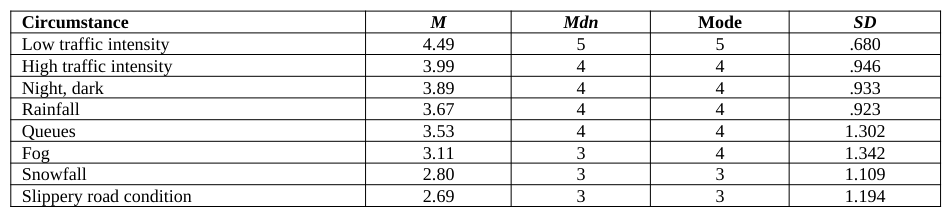
A particular topic addressed was the drivers’ usage of the ACC (Table 4). When asked how often they activate the ACC under different circumstances the respondents answered that the system is frequently used under low as well as high traffic intensity. The ACC is also used when there is a queue, when it is raining, and when driving in the dark. However, there are, as indicated in earlier studies, also situations where drivers do not activate the ACC as often. These include snowfall and slippery road conditions.
Table 4: “How Often Do You Choose to Activate the Adaptive Cruise Control in the Following Circumstances?” (1 = never, 5 = always), (n = 87).
The responses also show that the higher the allowed speed limit, the more frequently the ACC is used (Table 5). The drivers use the function the most on roads with speed limits of 100/110/120 km/h. and the least in living streets.
Table 5: “How Often Do You Choose to Activate the Adaptive Cruise Control When the Following Speed Regulations Apply?”Equation reproduced from the original PDF.
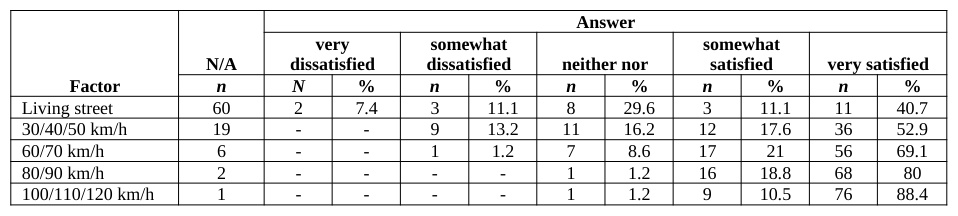
The respondents’ answers to how frequently they use ACC depending on the speed regulation reflect in the answers they provide on how satisfied they are with the function during the same speed regulations (Table 6): the higher the speed the more satisfied the user and the lower the speed the less responses are provided.
Table 6: “How Do You Perceive the Adaptive Cruise Control When the Following Speed Regulations Apply?” (n = 87)
Percentages given are the valid per cent.
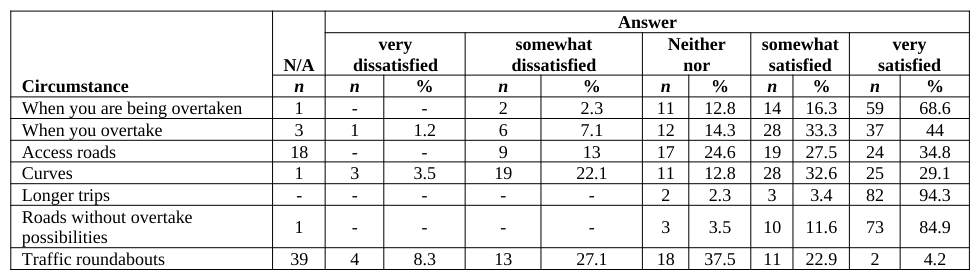
The respondents’ general attitude towards the ACC is positive, 94% are very positive and no one negative. The respondents are particular satisfied the ACC during longer trips and when driving on roads without possibilities to overtake. The respondents’ ratings of satisfaction when being overtaken and when overtaking was higher for those who drove mainly outside urban areas (mode = 5;5) than it was for those who drove mainly within urban areas (mode = 5;4): (U = 701.5, p = .021, and U = 555.5, p = .002). There are nevertheless specific situations, such as driving in roundabouts and curves, where satisfaction drops. For instance 35% of the respondents answers that they are somewhat or very dissatisfied with the function when driving in a roundabout. There are also a considerable number of responses missing which could indicate that the drivers do not use the function in this condition.
Table 7: “How Do You Perceive the Adaptive Cruise Control during the following circumstances?” (n = 87). Percentages given are the valid per cent.
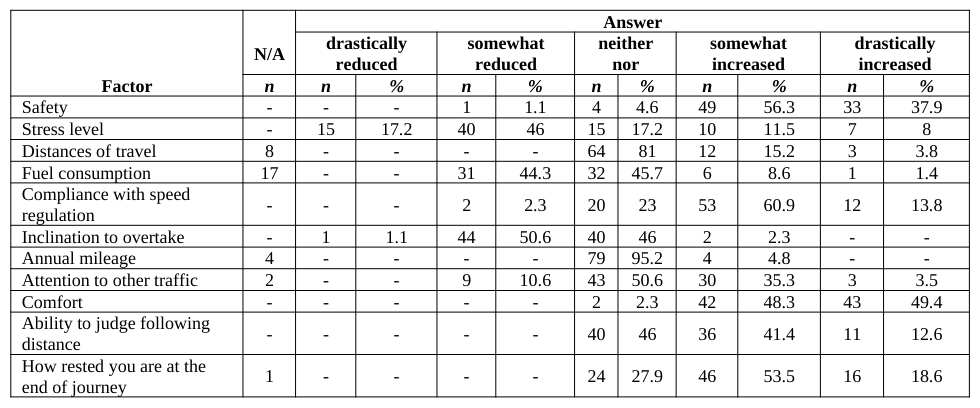
The participants were also asked to assess if and in what way their access to ACC had influenced their driving and their experience of driving (Table 8). According the responses the most common effect concerns comfort. A majority of the drivers stated that access to ACC has increased their comfort. It is also apparent that the ACC has perceived safety effects. Approximately half of the respondents indicated a reduced inclination to overtake other vehicles, a response which is in line with earlier findings (Strand et al. 2010) and almost three out of four answered that ACC has meant that their compliance with speed regulations has increased.
Table 8: “How Would You Assess the Influence of Using the Adaptive Cruise Control on the Following Factors?” (n = 87).
Percentages given are the valid per cent.
Somewhat incongruent with the response regarding comfort, approximately 20% of the respondents’ answer that their stress level had increased rather than decreased as a consequence of their access to ACC. Less or no effects were indicated for distances travelled, annual mileage, or fuel consumption. Negative effects were only reported by 10% of the drivers and concerned their attention to other traffic. Almost 40% thought, on the other hand, that the same function had resulted in increasing their attention. A rated increase in “attention towards other traffic” was more common for those who drove mainly outside urban areas (mode = 4) than it was for those who drove mainly within urban areas (mode = 3), (U = 671.0, p = .028).
A number of studies have shown that trust and control is a key component for acceptance. The answers to the question “Does it happen that the ACC is behaving in a way you did not expect?” show that the drivers find ACC to be a fairly predictable system (1 = always, 5 = never: N = 87, M = 4.07, Mdn = 4, mode = 4, SD = .938). Those who drive mainly outside urban areas (mode = 5) consider the system more predictable than those who drove mainly within urban areas (mode = 4): (U = 679.0, p = .018). More than half or 51.7% of the drivers feel very safe when handing over the control to the ACC, 46% feels safe and only 4% feels neither safe nor unsafe. No one feels unsafe.
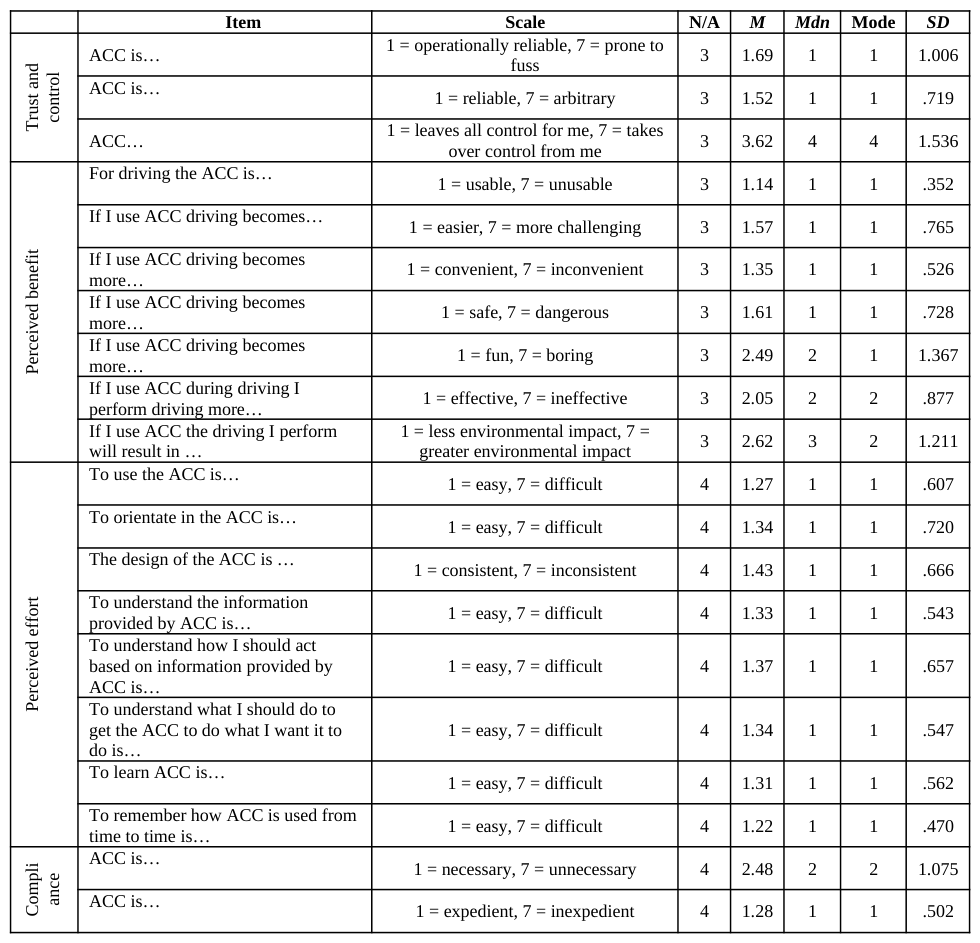
Finally the respondents were asked to answer a number of questions that together made up a new acceptance scale (Strömberg & Karlsson 2012). The scale includes 20 items addressing the topics trust and control, perceived benefit, perceived effort, and compliance. Overall, the ratings indicate that acceptance of the ACC was very high: according to the ratings the ACC is reliable, usable, and driving becomes easier and more convenient. Driving does not however necessarily become more fun or more effective. The drivers assess the ACC not to completely “take control away” and ACC is not by all considered “absolutely necessary”
Table 9: Responses to the 20-item SKAS Acceptance Scale (n = 87) Item Scale N/A M Mdn Mode SD
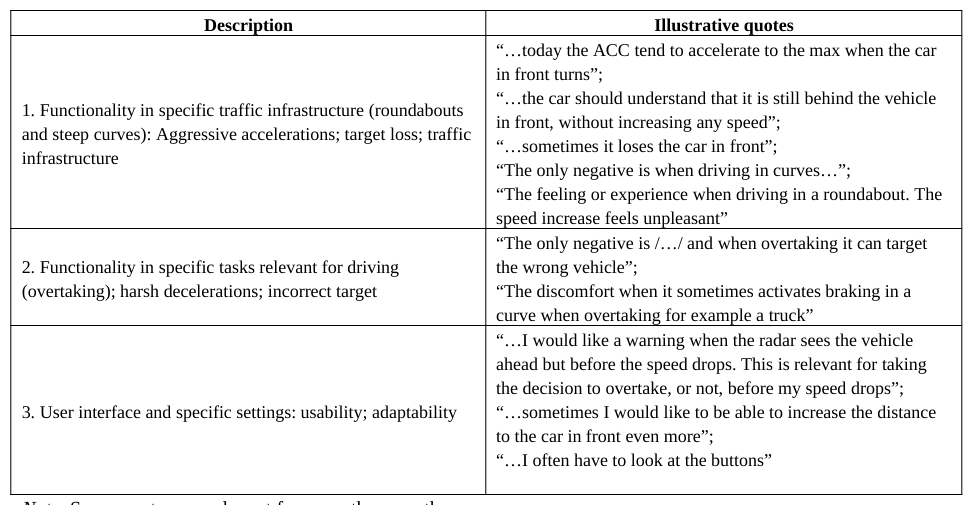
When answering the questionnaire the participants were also given the opportunity to provide answers as to how they would like to improve the ACC. Even though the respondents were very positive towards and considered the ACC to work well in different situations, there were (as already indicated) some limitations and there were also quite a few suggestions for modifications. Three recurring themes could be distinguished from the provided answers (Table 10). These themes were connected to i) the functionality of ACC in relation to specific traffic infrastructure, (ii) a specific task relevant for driving, and (iii) the user interface.
Note. Some quotes are relevant for more than one theme.
DISCUSSION
In large, the results are in line with previous studies on the subject (e.g. Strand et al., 2010; Larsson, 2012; Piccinini et al., 2012, Sanchez, et al. 2012). It shows for example that end-users, in general, are satisfied with their ACC. More in particular, it confirmed many of the findings by Strand et al. (2010) regarding safety and comfort. The results also show that use frequency increase as do how positive the ratings of the performance of the ACC when speed limits increase and road types are more adapted towards higher speeds, a result which is in accordance with Sanchez, et al. (2012). However, some earlier findings could not be supported by results of the present study. For example the results do not show that worries about other road-users are a frequent matter.
The study by Piccinini et al. (2012) presented results indicating that end-users were not fully aware of the limitations of the ACC function. This study indicates that ACC is perceived as a very predictable system. These results could be interpreted as though end-users really are not aware of ACC limitations as was evident in the Piccinini et al. (2012) study, or that drivers are aware of the limitations and therefore view ACC as a predictable system. In this particular study the respondents were experienced ACC users and their use patterns indicate that they use it under some conditions and not under other. Hence, it is feasible that the end-users in this study are aware of the limitations and has adapted to it.
The study by Piccinini et al. (2012) suggested that drivers engage in tasks that distract them from driving when the ACC is activated. In the study by Sanchez, et al. (2012) 13% of the participants stated that they use ACC in order to free more time to perform other tasks, such as changing radio channel or eating. This study present results on a related question, namely if the drivers were less attentive to other traffic (as could be a consequence of a distractive task). Half of the answers were that ACC does not affect how attentive they are to other traffic. Of the remaining answers, the majority provided answers suggesting that they are even more attentive to other traffic. On the other hand about 10% provided answers suggesting that ACC had a negative effect on how attentive they are to other traffic (worth noting is that there were no answers stating that it had drastically reduced). The difference in responses between overall experienced ACC users is interesting but not altogether easy to explain. It is possible that the drivers do not want to admit to becoming distracted from driving, it is also possible that they are not aware that they are distracted. How drivers make use of the handing over control to an assistance system is a topic that needs further investigations.
Overall the drivers are satisfied with the ACC, a result with complies with the findings of Sanchez, et al. (2012), and their acceptance of the system is high. Nevertheless the drivers’ responses to the different items in the acceptance scale and their comments indicate a potential for improvement. One concerns control. It is possible that a goal should be to design the function so that the drivers feel more in charge, or control, even when the ACC is performing its duties. Such reasoning would be in line with for instance Norman’s (2007) proposition that one should “make people think they are in control” (p. 193). However, it can be debated whether this is a desired strategy when designing ADAS. Instead, the strategy could be to design systems which are more transparent in order to contribute to the drivers developing a correct and meaningful mental model of the system, developing enough trust in order to hand over the control, but at the same time be aware of the limitations of the system so that they will be able to master takeovers when so is required.
Another item concerns effectiveness of driving where the ratings suggest that drivers experience to become more effective in their driving with access to ACC. However the earlier study by Strand et al. (2010) highlighted a potential to improve ACC in situations where drivers overtake and the answers in the present study also display some improvement potential regarding such situations.
The drivers were very satisfied with the ACC but even though it was considered to contribute to comfort as well as safety the function was not considered absolutely necessary. The respondents in the survey are experienced drivers who have driven a considerable number of kilometres without the support of ACC or other ADAS. Safety and comfort benefits of ACC are by no means insignificant, but they are most probably viewed as a bonus to a higher order need, rather than crucial for it. An investigation some ten or twenty years from now may well tell another story. Future generation of drivers, given the present automation trend, may never have first-hand experience of driving without support systems. Rather than questioning the drivers’ trust in handing over control to the system, the challenge may be to design vehicles in which the drivers are comfortable with taking over control.
The differences between the present study and earlier ones could be partly attributed the differences in methods used, but perhaps more so the sampling differences. The participants who took part of this study were very positive towards their ACC as well as rated themselves to be very experienced ACC users. At the same time the response rate was 21,7 %, which means that a substantial number of the population did not answer the questionnaire. The mean age of the respondents is fairly high and very few women answered the survey. It is possible that this profile reflects the end-users of ACC systems, but it could also be that the non-respondents represent another user group with other experiences of their ACC systems than the group that provided answers to this study. For instance, could the responses fail to reflect the views of users who have found the ACC less useful and who choose not to activate it because of its limitations in certain conditions. It is feasible that less experienced drivers are less prone to hand over control to the system as well as less aware of the limitations of the ACC. If so, the results are a display of the experiences of a particular user group, and not the whole ACC end-user population.
At the same time a major part of the results is consistent with earlier studies why it is feasible to assume that a considerable amount of drivers appreciate the ACC function and adapt to its limitations. There are benefits in terms of increased perceived comfort and safety. Reported changes in driving behaviour in terms of less overtaking and increased compliance with speed regulations support this assumption. At the same time some drivers report feeling more stressed when driving with ACC than without and there are contradictory results regarding drivers’ attention to traffic. These factors need further investigations.
ACKNOWLEDGMENTS
This work has been carried out at SAFER – Vehicle and Traffic Safety Centre at Chalmers, Sweden. The authors would like to acknowledge valuable input on the development of the questionnaire from SHADES project members, co-workers at VTI and CHALMERS. The authors would also like to acknowledge Mr. Mats Petersson (Volvo Cars) for contributing to the selection of participants.
REFERENCES
Berstein, D. A., Penner, L. A., Clarke-Stewart, A., & Roy, E. J. (2003). Psychology (6th ed.). Boston, MA: Houghton Mifflin. Bianchi Piccinini, G. F., Simões, A., & Rodrigues, C. M. (2012). Effects on driving task and road safety impact induced by the usage of Adaptive Cruise Control (ACC): a focus groups study. International Journal of Human Factors and Ergonomics, 1(3), 234-253. Brookhuis, K. A., de Waard, D., & Janssen, W. H. (2001). Behavioural impacts of Advanced Driver Assistance Systems – an
overview. European Journal of Transport and Infrastructure Research, 1(3), 245-253. IBM Corp. (2012). IBM SPSS Statistics (Version 21.0) [Computer software]. Armonk, NY: IBM Corp. Larsson, A. F. L. (2012). Driver usage and understanding of adaptive cruise control. Applied Ergonomics, 43(3), 501-506. Likert, R. (1932). A Technique for the Measurement of Attitudes. Archives of Psychology, 22(140), 1–55. McQueen, R. A., & Knussen, C. (2006). Introduction to Research Methods and Statistics in Psychology. Harlow, Essex, UK: Pearson Education. Naranjo, J. E., González, C., Reviejo, J., Garcia, R., & de Pedro, T. (2003). Adaptive fuzzy control for inter-vehicle gap keeping.
IEEE Transactions on Intelligent Transportation Systems, 4(3), 132-142. Norman, D. A. (2007). The design of future things. New York: Basic Books. OECD. (1990). Behavioral Adaptations to Changes in the Road Transport System. Chicago: University of Chicago Press). Saad, F., Hjälmdahl, M., Cañas, J., Alonso, P., Garayo, L., Macchi, F., Bekiaris, E. (2004). Literature review of behavioural effects (Deliverable No. D1_2_1). Retrieved from EU-project AIDE – Adaptive Integrated Driver-vehicle InterfacE website: http://www.aide-eu.org/pdf/sp1_deliv_new/aide_d1_2_1.pdf Sanchez, D., Garcia, E., Saez, M., Benmimoun, M., Puts, A., Ljung Austm M., … Obojski, M-A. (2012). Final results: User
acceptance and user-related aspects (Deliverable No. D6.3). Retrieved from EU-project euro FOT website: http://www.eurofot-ip.eu/download/library/deliverables/eurofotsp620121119v11dld63_user_acceptance_and_userrelated_a spects.pdf Sarter, N., & Woods, D. (1995). How in the world did we ever get into that mode? Mode error and awareness in supervisory control. Human Factors, 37, 5-19. SPSS Ltd. (2008). SPSS Dimension Net (Version 5.5) [Computer software]. Stanton, N. A., & Young, M. S. (2005). Driver behavior with adaptive cruise control. Ergonomics, 48(10), 1294-1313. Strand, N., Nilsson, J., Karlsson, I.C.M., & Nilsson, L. (2011) Exploring end-user experiences: self-perceived notions on use of
adaptive cruise control systems. In J. F. Krems (Ed.), Selected papers from the 2nd European Conference on Human Centred Design in ITS [special issue]. IET Intelligent Transport Systems, 5(2), 134-140. Strömberg H. & Karlsson, I.C.M. (2012) A new scale for addressing acceptance. Working paper. Design & Human Factors, Chalmers University of Technology, Gothenburg
LISTED IN THE AHFE DIGITAL BOOKSTORE CATALOGUE
Explore the complete digital volume
Advances in Human Aspects of Transportation: Part II
Read this individual research paper free through the original publisher, or explore the full digital proceedings book.
ISBN 978-1-4951-2098-5
Explore this ISBN in the AHFE Bookstore ↗Listed in the July 2026 bookstore catalogue; search by ISBN to confirm current availability · Digital book purchase optional