Luis Cuautle, Gerson Beristain (2019). Main Factors for an Occupational Health and Safety Management System for Mexican Manufacturing Companies. In: Advances in Safety Management and Human Factors. AHFE Open Access, vol. 5. https://doi.org/10.54941/ahfe100159
The Occupational Health and Safety are factors and conditions that have a positive impact, promotes a safe and healthy working environment, and these issues among the companies give wellness to personnel, contractors, visitors and any other person in working places, and this is achieved with the help of managing risks in the workplace. In Mexico, the occupational health and safety factors have been treated individually to reduce accidents, insurance cost and increase performance of existing operations but these individual actions created confusion among Mexican manufacturing companies. The Social Prevention and Labor Secretary established a technical program in occupational health and safety management. Five steps are used to represent basic security scheme. On the other hand, the health programs deal with the identification of important alarms and the promotion of actions to eliminate them. These issues consider job environments as well as pandemic. In order to control both aspects, Mexican factories have created an Occupational Health Management System as well as a Safety Management System. The purpose of this research is to formulate a unique Occupational Health and Safety Management System (OHSMS) using structural equation models (SEM) to help Mexican manufacturing companies to conduct their efforts. A survey was conducted with 14 items based on international occupational health and safety standards. This research questionnaire was applied to 32 certified manufacturing companies within Mexico. An exploratory and confirmatory factorial analysis was focused. With exploratory factorial analysis we could established the three main factors and their components and these three main factors were validated using the confirmatory factorial analysis. The three factors were: health and safety focus, occupational health and safety management system, and continuous improvement. The Tucker-Lewis Index obtained is equal to 0.999 which is higher that the recommended value of 0.90. Thus, the three main factors can be considered for a structural equation model. Some of the variables considered for the OHSMS were: risk control, corrective actions, planning, audits, education and training, etc. Using LISREL, a structural equation model was created to propose a valid OHSMS model for Mexican manufacturing companies to implement and benefit from good health and safety management in their facilities.
Occupational health and safety are factors and conditions that have a positive impact, promotes a safe and healthy working environment, and these issues among the companies give wellness to personnel, contractors, visitors and any other person in working places, and this is achieved with the help of managing risks in the workplace. In Mexico, these issues have been treated individually creating confusion among Mexican manufacturing companies in 2009. The Social Prevention and Labor Secretary established a technical program in occupational health and safety management. This scheme is based on five actions lines: planning, resources creation, voluntary commitment, audits Safety Management (2019) and recognition (Safety Company). See (Instituto Mexicano de Normalización y Certificación, 2000) for an overview of the elements. In this last point, there are three types of award in accordance of the maturity level of the OHSMS: a) for the accomplishment of the national standard, b) for the continuous improvement actions, and c) for the results in management. However, only 15 Mexican manufacturing factories have the safety company recognition due to the great documentation work. The national oil company PEMEX (Camacho, M., 2007) is the pioneer in implementing this kind of management.
In this paper, an occupational health and safety management system is developed by using structural equation models (SEM) to help Mexican manufacturing companies to conduct their efforts. The data in regards to the actions followed by the firms has been collected thru an e-mail survey and their results have been considered to the creation of the OHSMS.
The remainder of the paper is structured as follows: the general research is presented in Section 2. In Section 3, the factorial analysis is developed. The structural equation model is described in Section 4. Finally, the conclusions and the proposed model are shown in Section 5.
RESEARCH Based on extensive research about the different standards and best practices related with occupational health and safety in Mexico and around the world (Petersen, D., 2000) (Wilkinson, G., and Dale, B.G., 1999), (Koehn, E., and Datta, N. K., 2003), (Schaechtel, D., 1997), (Gundz, M., and Simsek, B., 2007), (Carrillo, J., and García H., 2002), (Bolton, F. N., and Kleinsteuber, J. F., 2001), (Secretaría del Trabajo y previsión Social, 2008), (Arkins, P., 2003), a construct is created for the identification of the elements of an OHSMS (see Table 1).
Table 1: Sample human systems integration test parameters (Folds et al 2008)
Table available in the original PDF paper.
Levels
1 2 3
Assessment (VAR00029)
Risks
Control (VAR00030) Occupational Health and Safety Policy (VAR00031)
Planning (VAR00032)
Management
Inspection (VAR00033) Process Emergency preparation and response (VAR00034)
Occupational Health
Corrective Actions (VAR00035)
and Safety Management System
Preventive Actions (VAR00036)
Improvement
Audits (VAR00037) Education and training (VAR00038)
Occupational Health and Safety Manual (VAR00039)
Documentation
Procedures (VAR00040) Registers (VAR00041)
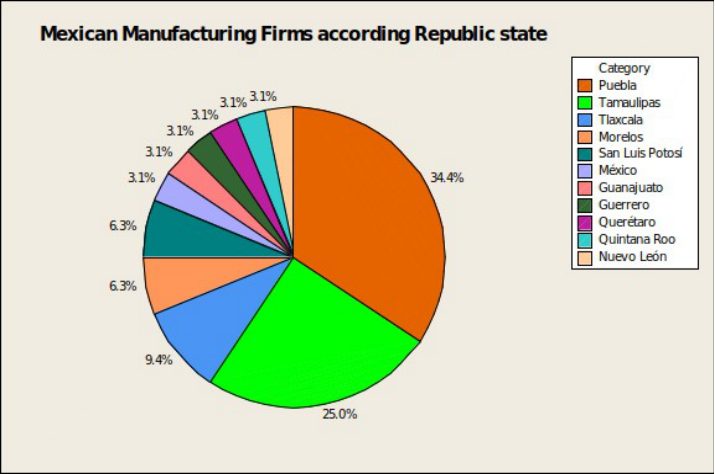
Using this construct, a questionnaire is designed. This instrument consists in 13 questions using a 5 points Likert scale. A survey is conducted among 32 manufacturing companies across Mexico (see figure 1) that have a certified management system either occupational health or safety. The person in charge of the respective management system answers the assessment instrument.
Figure 1: Mexican manufacturing firms according Republic state
FACTORIAL ANALYSIS Exploratory factorial Analysis
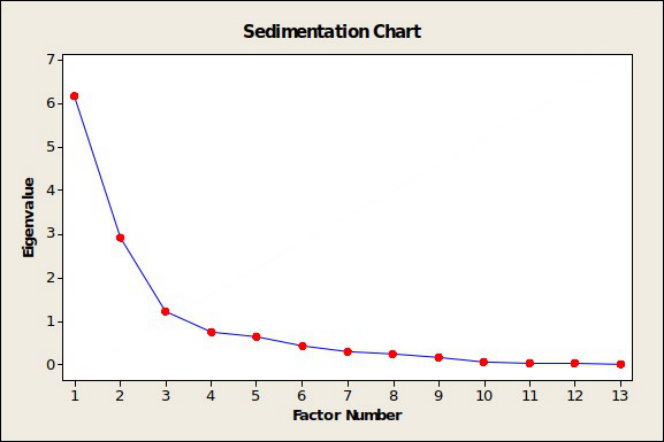
With the aid of SPSS software and the results of the survey, the principal components of the OHSMS of the 13 items (See Table 2) are calculated by those factors which variance value is greater than 1.0.
Table 2: OHSMS Components Occupational Health and Safety Management System
Table available in the original PDF paper.
Factor Variance
1 6.578
2 2.440
3 1.037
Using the varimax criteria as the orthogonal rotation method, the components of each factor (Figure 2) are defined with the above criteria. Both analysis shows that the occupational health and safety management system have three
main elements.
Figure 2: Mexican manufacturing firms according Republic state
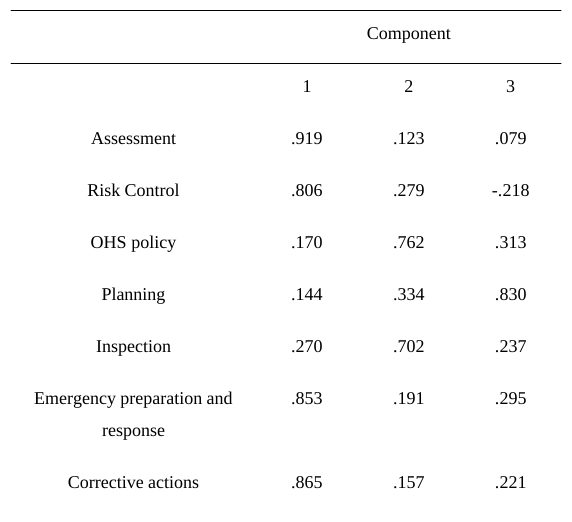
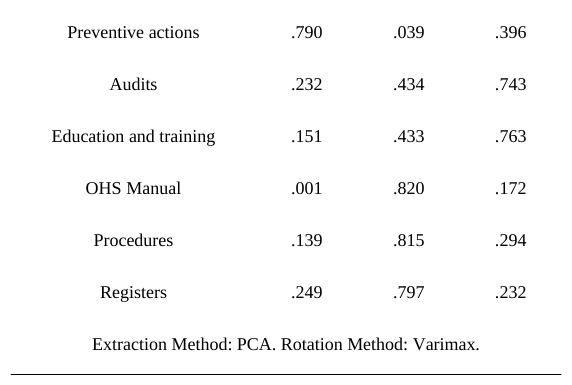
Then, the rotated components matrix is established in order to determine which item belongs to each factor (see Table 3). To determine which item corresponds to each factor, the value obtained is compared to a value of 0.70. If the value is greater than 0.70, the item is part of that factor.
Table 3: Rotated components matrix Component
Therefore, the three main factors and their components are established (see Table 4). According to their nature, the factors are named: health and safety focus (e.seguri), health and safety management (g.seguri), and continuous improvement (mejora).
Table 4: OHSMS Factors Factor
Health and Safety Focus Health and Safety
Continuous Improvement
Management
Assessment OHS policy Planning Risk Control Inspection Audits
Emergency preparation
OHS Manual Education and training
and response Corrective actions Procedures
Preventive actions Registers
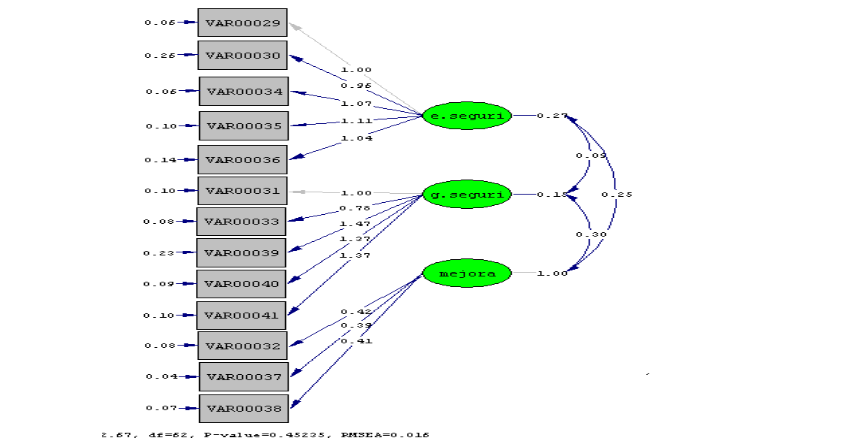
Confirmatory factorial analysis The regression techniques as well as the path analysis are types of structured equation models that analyze the causal and not causal relationships between the variables considered in the constructs (Casas, M., 2002). Considering the information of the exploratory factorial analysis, the three main factors were validated using the confirmatory factorial analysis (see Figure 3).
The Tucker-Lewis Index obtained is equal to 0.999 which is higher that the recommended value of 0.90. Thus, the three main factors can be considered for a structural equation model.
STRUCTURAL EQUATION MODEL The variables for the OHSMS considered are:
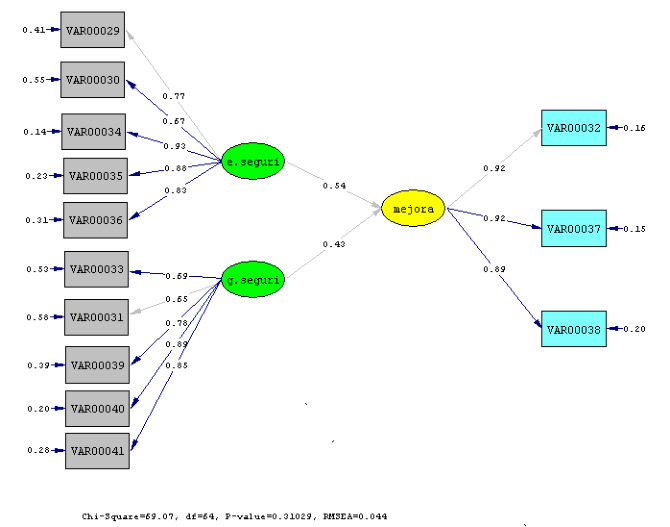
a) Health and safety focus: Factor that considers assessment, risk control, emergency preparation and response, corrective actions, and preventive actions. b) Health and safety management: Factor that includes occupational health and safety policy and the documental aspect of the management system. c) Continuous improvement: Factor that considers planning, audits, and education and training.
Using LISREL, a structural equation model (see Figure 4) is developed and confirmed due to the Tucker-Lewis Index obtained is equal to 0.991 which is higher that the recommended value of 0.90.
This paper shows a survey conducted among 32 Mexican manufacturing companies. The 34% of the companies belongs to the State of Puebla while the 25% and 9.4% comes from the states of Tamaulipas and Tlaxcala respectively. In terms of the business sector the automotive, metal-mechanical and chemical result the most representative ones.
Using factorial analysis, the elements of the OHSMS are identified and confirmed. An occupational health and safety management system is proposed (see Figure 5) to the Mexican manufacturing companies in order to facilitate the implementation of both issues in working areas. It is expected that this OHSMS allows Mexican firms to control their operations in terms of occupational health and safety and to prevent and reduce accidents in their facilities..
Figure 5: OHSMS model
Figure available in the original PDF paper.
The author suggests creating more structural equations models employing other estimation methods and different correlations matrix, also to consider other processes such as quality or environmental management to create more Safety Management (2019) integrated management systems.
REFERENCES
Arkins, P., 2003, “Solving the Mystery: A summary of OHSAS 18000, ISO18000 & ISO/IEC JTC-1/SC31,” Professional Safety,
13. Bolton, F. N., and Kleinsteuber, J. F., 2001, “A perspective on the Effectiveness of Risk Assessment by First-Line workers and supervisors in a safety management system,” Human and Ecological Risk Assessment, Vol. 7 (7), 1777 – 1786. Camacho, M., 2007, “Implantación de un sistema de Administración de Seguridad, Salud y Protección Ambiental en Petróleos
Mexicanos,” Proc. of the Reunión Nacional de Seguridad Industrial y Protección Ambiental, December, Mérida, Yucatán. Carrillo, J., and García H., 2002, “Evolución de las maquiladoras y el rol del gobierno y del mercado en la seguridad en el trabajo,” Papeles de población, No. 33, 173 – 186. Casas, M., 2002, “Los modelos de ecuaciones estructurales y su aplicación en el índice Europeo de Satisfacción del cliente,”
Retrieved March 19, 2010 from http://www.uv.es/asepuma/X/C29C.pdf Gundz, M., and Simsek, B., 2007. “A strategic safety management framework through balanced scorecard and quality function deployment,” Canadian Journal of Civil Engineering, 622 – 630. Instituto Mexicano de Normalización y Certificación, 2000, “Norma Mexicana IMNC NMX-SAST-001-IMNC-2000. Sistemas
de administración de seguridad y salud en el trabajo. – Especificación”. Koehn, E., and Datta, N. K., 2003, “Quality, Environmental, and Health and Safety Management Systems for Construction Engineering,” Journal of Construction Engineering and Management, 562 – 569. Petersen, D., 2000, “Safety Management 2000 Our Strengths and Weaknesses,” Professional Safety, 16 – 19. Secretaría del Trabajo y previsión Social, 2008, “Otorgamiento de Reconocimientos por Revalidación del Tercer Nivel de
Empresa Segura”, Retrieved October 21, 2009 from http://trabajoseguro.stps.gob.mx/trabajoseguro/boletinesanteriores/ 2008/8.OtorgamientoReconocimientospoRevalidaciondelTercerNiveldeEmpresaSegura2008.pdf”. Schaechtel, D., 1997, “How to build a safety management system,” Professional Safety, Vol.42 (8), 22 – 23. Wilkinson, G., and Dale, B.G., 1999, “Integration of quality, environmental and health and safety management systems: an examination of the key issues,” Proceedings of the Institution of Mechanical Engineers, 213 (Part B), 275 – 283.
LISTED IN THE AHFE DIGITAL BOOKSTORE CATALOGUE
Explore the complete digital volume
Advances in Safety Management and Human Factors
Read this individual research paper free through the original publisher, or explore the full digital proceedings book.
ISBN 978-1-4951-2100-5
Explore this ISBN in the AHFE Bookstore ↗Listed in the July 2026 bookstore catalogue; search by ISBN to confirm current availability · Digital book purchase optional