The pandemic caused by COVID-19 significantly affected small and medium-sized entrepreneurs and their workers in Colombia, who, in order to give continuity to their organizations and comply with legal requirements during the health emergency, turned their homes into workspaces, giving rise to the modality of "home-at-work”, which differs from the usual teleworking model.This new context required that organizations implemented strategies for managing occupational risks which arose in households whose workers adopted the home-working mode and had to share family, personal, and/or school spaces at the same time.The research aimed to identify the management of occupational risks for 400 workers linked to Mypymes companies in Bogotá city that adopted the modality of homeworking during 2021, because of the pandemic conditions. The current work was framed in mixed descriptive approach research (Hernández et. al, 2010) through the application of a virtual survey to the sample, interviews with employers, and RAEs.The results of the survey applied show that 41.6% of the workers did not receive a visit to inspect and adapt the workspace at home, and 25% received some virtual guidance. On the other hand, 67% mentioned that the chair and work surfaces did not fulfill ergonomic conditions and they were not improved by the employer. Only 50% received training on occupational hazards of working at home and 36.1% received guidance on active breaks. Finally, 50% stated that the workload increased significantly, generating anxiety and stress, and 46.4% were never informed how to report an accident at work while working at home.Thus, the intervention of occupational risks in the work-at-home modality was low, especially in the adaptation of workstations. However, the employers affirmed that, although there was not strong intervention in that aspect, they gave self-care guidelines to workers, and efforts were focused on preserving productive activities to keep companies afloat.
During the last two years, the world has been completely transformed because of the SARS-COV2 (Covid-19) pandemic, this situation has had a significant impact on the world’s population in all possible scenarios such as social, eco- nomic, cultural, and work, requiring a rapid adaptation process to try to provide continuity to a new reality for which the appropriate management was unknown.
Home-At-Work and Occupational Risk Intervention During the Covid-19 Pandemic 691
In this sense, organizations from different economic sectors, who, accor- ding to their productive activity or service provision, had to make multiple adaptations to try to give continuity to their businesses and thus maintain jobs positions as much as possible, had to adopt working methods for which they were not prepared and for which there were not technical and legal gui- delines for their development. Consequently, enterprises became scenarios of improvisation and rapid adaptation for both employers and workers who moved their work activities to their homes, in many cases without having the appropriate conditions for the safe development of their activities in relation to the inherent occupational risks.
This phenomenon had a marked spread, since according to a study by PageGroup, in 2020, 96% of organizations in Latin America used home wor- king in the face of the pandemic. In Colombia, 57% of companies had 80% of their structure working remotely. The Ministry of Labour estimated that around six (6) million people were working from home (Redaction El País, 2020). The aforementioned figures, particularly for Colombia, presume the imple- mentation of a new scenario for working well-known by the National Government as Home-at-work, which is defined as enabling public servants or private sector workers to temporarily carry out their work functions or activities outside the place where they usually perform them, without modifying the nature of the contract or employment relationship, or the respective legal and regulatory framework, nor worsening the conditions of the employment contract, when there are occasional, exceptional or special circumstances that prevent the worker from carrying out his or her functi- ons in the workplace, favoring the use of information and communications technologies.
This is not limited to work that can be carried out through information and communication technologies, computers, or similar means, but extends to any type of work or labor that does not require the physical presence of the worker or civil servant on the premises of the company or entity (Law 2088 dated in 2021). This previous definition, which is different from Teleworking model accor- ding to its characteristics, was only established in May 2021, so employers and workers carried out implementations since the declaration of the health emergency for Colombia in April 2020, without clear guidelines to consi- der the proper management of occupational risks that were transferred to an uncontrolled scenario that warranted the identification and evaluation of hazards, risk assessment and implementation of intervention mechanisms in order to control and mitigate the possible occurrence of occupational acci- dents and diseases of occupational origin, thus increasing the likelihood of affecting health and safety of workers.
This situation had a greater impact on small and medium-sized enterprises, which prioritized keeping their activities afloat to avoid closures and mass redundancies of workers, seeking alternatives for business continuity while largely omitting the management of occupational risks.
From this context, the research was developed through a mixed descri- ptive approach, it formulated theories from the data collected and analyzed
692 Puentes and Lapeira
(Strauss & Corbin, 2002), addressing 400 workers linked to Mipymes com- panies in the Bogotá city (Colombia), whose working conditions during the pandemic included the modality of home-at-work during 2021. Through the application of a virtual survey, we inquired about aspects such as the increase in working hours and workload, adaptation of workstations, risk prevention activities, active breaks, training on issues related to occupational health and safety, identification of hazards, and risk assessment, as well as the repor- ting of accidents at work, with the aim of analyzing the management of occupational risks carried out by employers in relation to the home-working modality.
In addition, interviews were conducted with employers to find out their views on the management of the pandemic and the challenges that home-at- work implied for them to preserve the safety and health of their employees, all of this added to verification the various legal contexts that arose and which, over time, became the guiding principles for the management of the pandemic in the workplace.
THE MIPYMES AND THEIR MANAGEMENT OF OCCUPATIONAL RISKS WHILE HOME AT WORK Through the application of selected instruments to develop this research, it was established 53.8% of the participating population had been working in this modality for more than 12 months, followed by 22.9% who only worked between 1 and 3 months, which determines enough time for the employer to do some of the obligations described in the Article 2 of Resolution 2400 of 1979 related with reporting workers before start working about exposure to occupational hazards and connected to Article 2. 2.4.6.8 of Decree 1072 of 2015, on the promotion and prevention of those risks, a situation that was not reflected in the statements of the respondents.
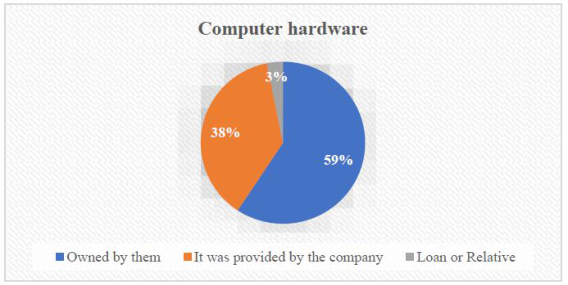
Under this scenario, it was identified 86.6% of the participants carried out their activities using a video terminal, so it was necessary to verify about the origin of this equipment, the results of this situation are described in the following graph:
Figure 1: Computer harware (authors, 2022).
Home-At-Work and Occupational Risk Intervention During the Covid-19 Pandemic 693
Additionally to this situation, we asked about the need to adapt the work- stations in order to have appropriate and safe places to develop working activities, showing that for 66% of the total, the employer did not provide aids to adapt their workstation at home, nor the corresponding workplace inspections were implemented directly by those in charge of Occupational Health and Safety departments of the companies or through the technical support of Occupational Risk Insurance Companies (ARL), who were sup- posed to promote activities and prevent issues to the companies (Circular 041 of 2020).
Consequently, 80.5% of the workers had to adapt their workstations at home by their own, investing between US$80 and US$650 buying several items such as computer equipment, desks, adjustable chairs, keyboards, mice, footrests, lighting, and electrical equipment, without the technical expert’s recommendations in risk management issues, nor they received financial support to cover these aspects.
Finally, we inquired about the working journey and the workload during the pandemic in this new labor environment. According to this, 69.4% of the workers stated that under home-working modality the journey increased over the normal daily hours, even to work at night and sometimes on weekends, this means a huge impact on a workload rise; taking into account this, 33% of the workers generated an increase in stress and anxiety, while for 36.8% there was a significant rise, but they controlled it, for 23.2% the workload was maintained as in the on-site modality and for only 7.1% this reduced, also the work stress.
Considering this essential condition related with psychosocial risk factor, the Ministry of Labour issued Circular 064 of 2020 establishing the need to carry out minimum actions for the evaluation and intervention of psychoso- cial risk factors, the promotion of mental health and the prevention of mind problems and disorders in workers in the framework of the health emerge- ncy in Colombia for SARS-COV-2 (Covid-19), seeking the respect for the corresponding 48 working hours, the right to digital disconnection, avoiding overloads and looking forward the working context and personal and family life harmony, a situation shown and mentioned in the previous figures so, this situation was not fully accepted by employers, for that it means the increase of probable physical, mental and social health problems.
Video Workstations at Home Considering the high percentage (86.6%) of workers who worked at home using video terminals, it was necessary to verify the adapted conditions of the workstations, mainly considering the ergonomic aspects, without igno- ring the importance of other factors such as lighting, electrical conditions, ventilation and location.
In this sense, the respondents were asked about the characteristics of the work chair used at home, identifying that 30.4% had an ergonomic chair that allowed height and tilt adjustment and it was in a good condition, 25%, although the chair was in good condition, could only be adjusted in height but not in tilt, and the most complex situation was presented by 34.4% of
the respondents who indicated that the chair in which they worked was rigid, without any type of adjustment and was usually the chair of the dining room.
It should be taken into account that the design of these chairs is not adapted to the needs of an ergonomic workplace as described in the Colombian Tech- nical Standard NTC 1440: Office furniture, considerations relating to the working position: desk chair. The above, considering the relationship of hei- ght, depth, seat width, backrest, chair armrests and height ratio (ICONTEC, 1978), the same situation that is related in the Technical Prevention Note 1129 regarding criteria for the selection of office chairs, indicating that: An office chair should provide the body with stable support, allowing the worker to adopt a comfortable posture for a given period of time, so that the task or activity can be performed properly (INSST, 2018).
In addition to this condition, we asked about the layout of the work sur- face in relation to the location of the keyboard, considering the criterion of a minimum of 10 centimeters from the edge of the desk which 35.6% of the workers stated that they had sufficient space to maintain the distance indi- cated for the use of the keyboard while keeping their forearms resting on the desk. 19.1% indicated that although they did not have the distance, the chair they used had armrests, while 45.3% reported insufficient surfaces and limitations for supporting their arms, which suggests a greater physical load on the hand-arm system, considering the inadequate postures adopted by the worker when handling the VDT.
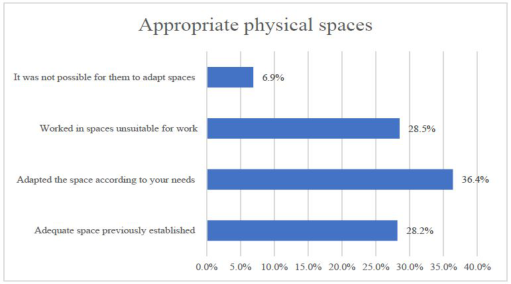
It was also investigated whether the workers had adequate physical space for the development of their work activities that allowed them to maintain an appropriate posture, work surfaces free of obstacles, stable and safety condi- tions in terms of electrical connections, lighting, and ventilation, identifying that for those workers who were not able to have appropriate workspaces, they developed their activities in places such as the dining room and the room: It is worth mentioning that since working at home is a situation in which the office environment is transferred to the home, it is possible that the risk factors have changed and/or accentuated in a generalized way to psychosocial and biomechanical/ergonomic risk, which can extend the radius of accidents and occupational diseases (Briceño & Guerrero, 2020 cited by Restrepo &
Home-At-Work and Occupational Risk Intervention During the Covid-19 Pandemic 695
Mesa, 2021) and that its management presents various difficulties for emplo- yers, since the privacy and intimacy of the worker at home is a priority, and it is difficult to control the levels of noise generated in their environment or the music they listen while they are working, as well as the use of chemicals for cleaning, the proper use of electrical installations, among others (Serra, 2020; Fernández et al., 2020). Linked to the controls put in place by employers to manage occupatio- nal risks and with an emphasis on ergonomic interventions as mentioned by the International Labour Organization (ILO, 2020) employers should have informed homeworkers about alternating tasks to avoid working in the same position for long periods of time; how to position the screen, for example, away from the window so as not to cause glare; positioning equipment so as to minimize twisting or over-reaching; adequate workspace space for equi- pment and any other materials needed to carry out the work, and encouraging them to take regular breaks and to get up and move around for one minute every hour (HSA, 2020), we asked whether workers had received support and guidance on how to take active breaks from their employer or the ARL, 36.1% stated that the employer did not develop any guidance or recommen- dation regarding the importance of taking active breaks, 27% indicated that although they received guidance on the subject they did not apply it and 17.4% stated that they received general information but had no guidance on how to take active breaks.
A similar situation arose concerning the elements of training on issues rela- ted to occupational hazards that occur in the home, possible emergencies and control measures to be applied to develop activities in a healthy and safe envi- ronment, for which 23% of respondents indicated that they did not receive training on these issues during the development of work at home, 27% only received training on biosafety protocols and 31.9% received some training focused on the implementation of prevention and control measures.
Lastly, it was asked whether the employer had established and commu- nicated any procedure for reporting work-related accidents occurring while working at home in order to receive attention from the ARL to which they are affiliated. 46.4% of the workers stated that they had never been told how to report such an event, while 15.8% indicated that they had been informed at some point about the report, but not about how to receive attention from the ARL.
In this aspect, it is necessary for the employer to establish the link betw- een the event and the work activities carried out at home, a situation that, as mentioned by Vicente et al. (2018), it is difficult to prove the causal relation- ship and that the exposure and latency criteria stipulated in the current legal regulations applicable to occupational accidents in Colombia are met.
CONCLUSION
Covid-19 pandemic brought not just an impact on the health of the world’s population but also a new reality generating great efforts by some essential and non-essential economic sectors to keep businesses working.
696 Puentes and Lapeira
The results of this research process showed that the generation of new forms of work, such as working at home, implied the transfer of occupational risks to home context, without the corresponding identification, evaluation, and assessment actions by employers, leaving aside the implementation of controls to mitigate the possible occurrence of a working accident., pro- voking a terrible management in security and health by companies, even the different tools established by the National Government and Internati- onal Organizations as the ILO and WHO that provided guidelines about occupational risks protocols.
Regarding the ergonomic conditions surveyed, a deficit was identified in aspects related to the adequacy of workstations at home, leading workers to carry out their activities in conditions that are not very favourable to adopt suitable postures and enough working surfaces to develop daily tasks. This situation, with the increase of workload, demands a greater physical and mental effort than the normal on working in face-to-face mode, may con- tribute to the appearance of symptoms that could be related to probable occupational origin illnesses connected to biomechanical and psychosocial risk factors.
Finally, working at home became a new work alternative for many compa- nies that were not just so useful to give continuity for people to work during the pandemic, but also in this new reality can be continued, so employers must develop adequate risk management actions that contribute to take care of workers’ health and safety in their new workspaces.
ACKNOWLEDGEMENT
The authors wish to acknowledge the efforts made by the workers and col- leagues who took part in this research, and who faced Covid-19 pandemic, adapting their work in familiar, personal, and social spaces that became in their new offices, thus contributing to the businesses’ survival in this new reality.
REFERENCES
Circular 041 of 2020. [Ministry of Labour.] Guidelines regarding work at home.
https://www.mintrabajo.gov.co/documents/20147/60876961/Circular~\protec t$\relax+$~0041-2020.PDF/98d19065-352d-33d2-978e-9e9069374144?t= 1591222484807 Circular 064 of 2020. [Ministry of Labour]. Minimum actions for evaluation and intervention of psychosocial risk factors, promotion of mental health and prevention of mental problems and disorders in workers in the framework of the current health emergency due to SARS-COV-2 (Covid-19) in Colombia. https://www.mintrabajo.gov.co/documents/20147/0/Circular~\protect$\rela x+$~0064.PDF/a3370954-2e5c-72fd-0801-f359a91ba67c?t=160210757#:~: text=Establecer%20las%20medidas%20especiales%20de,la%20infecci%C3% B3n%20con%20COVID%2D%2019 Colombian Institute of Colombian Technical Standards - ICONTEC (1978). Colom-
bian Technical Standard NTC 1440. Office furniture. General considerations regarding the working position: chair-desk. https://toaz.info/doc-view
Home-At-Work and Occupational Risk Intervention During the Covid-19 Pandemic 697
Decree 1072 of 2015. [Ministry of Labour.] Whereby the Sole Regulatory Decree of the Labour Sector is issued. https://www.mintrabajo.gov.co/documents/20147/0/ DUR+Sector+Labour+Updated+to~+~15+April+of~+~2016.pdf/a32b1dcf-7a4e -8a37-ac16-c121928719c8 Ensuring Safety and Health at Work. https://www.ilo.org/wcmsp5/groups/public/--
-ed_protect/---protrav/---safework/documents/publication/wcms_742732.pdf Fernández, C., Vieco, J., Sepúlveda, C., Restrepo, J. and Arrieta, E. (2020). Working from home: possibilities and challenges. Centro de Estudios Sociales y Laborales (CESLA). http://www.andi.com.co/Uploads/Trabajar%20desde%20casa%20pos ibilidades%20y%20desaf%C3%ADos%20CESLA%20ANDI.pdf Health and Safety Authority (HSA). (2020). FAQ’s for Employers and Employees in
relation to Homeworking on a temporary basis (COVID-19). https://www.hsa. ie/eng/news_events_media/news/news_and_articles/faq’s_for_employers_and_em ployees_in_relation_to_home-working_on_a_temporary_basis_covid-19_.html Hernández, R., Fernández, C., & Baptista , P. (2010). Research methodology.
Mexico: Editorial Mc Graw Hill. Available at http://www.sidalc.net/cgi-bin/wxis. exe/?IsisScript=EARTH.xis&method=post&formato=2&cantidad=1&expresio n=mfn=022575 International Labour Organization ILO (2020). Facing the pandemic: Law 2088 of 2021. Regulating work at home and enacting other provisions. May 12, 2021. D.O. 51.672. http://www.secretariasenado.gov.co/senado/basedoc/ley _2088_2021.html National Institute for Safety and Health at Work - INSST (2018). Techni- cal Prevention Note NTP 1129. Ergonomic criteria for the selection of office chairs. https://www.insst.es/documents/94886/564690/NTP-1.129w.pdf /0495a165-4f77-4444-a2c9-90963623e286 Redacción El País. (2020, May 26). In Colombia there are six mil- lion people working from home because of the Covid-19 pandemic. El País. https://www.elpais.com.co/economia/en-colombia-hay-seis-millones-de-pe rsonas-trabajando-desde-casa-por-la-pandemia-de-covid-19.html Resolution 2400 of 1979. [Ministry of Labour and Social Security.] By which some
provisions on housing, hygiene and safety in work establishments are established. https://www.ilo.org/dyn/travail/docs/1509/industrial%20safety%20statute.pdf Restrepo, L. and Mesa, N. (2021). Challenges and implications in safety and health at work in the modality of work at home, as a response in times of pandemic by Covid-19 in Colombia. [Master’s degree the- sis, Pontificia Universidad Javeriana]. Repositorio Javeriana. https: //repository.javeriana.edu.co/bitstream/handle/10554/55539/Retos%20e%20i mplicaciones%20en%20seguridad%20y%20salud%20en%20el%20trabajo %20en%20la%20modalidad%20de%20trabajo%20en%20casa%2c%20com o%20respuesta%20en%20tiempos%20de%20pandemia%20por%20Covid -19%20en%20Colombia.pdf?sequence=2&isAllowed=y Serra, F. (2020) Telework - Implications for Safety and Health at Work. Prevyso. https://prevyso.com.uy/wp-content/uploads/2020/09/FRANCISCO-SERR A-EL-TELETRABAJO-08.20.pdf Vicente, M.T.; Torres, J.I.; Torres, A.; Ramírez, M.V.; Capdevila, L. (2018). Tele-
working in occupational health: Medico-legal and labor aspects. CES Derecho Journal, Vol. 9, No. 2, July- December 2018, 287-297. https://revistas.ces.edu.co/ index.php/derecho/article/view/4668/2970
Read this individual research paper free through the original publisher, or explore the full digital proceedings book.
ISBN 978-1-958651-44-5
Explore this ISBN in the AHFE Bookstore ↗Listed in the July 2026 bookstore catalogue; search by ISBN to confirm current availability · Digital book purchase optional