Roger C. Jensen (2019). Hierarchies of Hazard Control: A Proposal to Resolve Different Lists. In: Advances in Safety Management and Human Factors. AHFE Open Access, vol. 5. https://doi.org/10.54941/ahfe100165
This paper reviews the historical roots of attempts to establish a hierarchy of hazard control, points out that these lists have converged into a suboptimal standard hierarchy, and proposes an alternative approach. The failure to converge stems from attempting to first categorize risk-reduction strategies, then assuming the categories fit into a priority order reflecting most effective to least effective. The proposed solution distinguishes priority categories from risk-reduction strategies. The approach uses three priority categories: (1) eliminate the hazard, (2) use engineering controls, and (3) use administrative methods, while a second list identifies nine risk-reduction strategies that map to the priorities. The first priority category has one risk-reduction strategy: eliminate the hazard. The second priority had five strategies: moderate the hazard, avoid releasing the hazard, modify release of the hazard, separate the hazard from that needing protection, and improve the resistance of that needing protection. The third priority category has three strategies: help people perform safely, use personal protective equipment, and expedite recovery. The risk-reduction strategies within a priority category are neither in priority order nor exclusive options for addressing a particular hazard.
The practice of occupational safety and health (OSH) includes taking the lead on risk assessment teams. Among the roles of the OSH professional is establishing a regular structure for these assessments. This often involves adopting processes established by a respected standards-writing organization, followed by working out the particular methods for completing each step.
Basic steps in OSH-related risk assessment may be organized into six sequential processes: (1) set the limits of the analysis, (2) identify tasks and hazards, (3) assess initial risks, (4) reduce risks, (5) assess residual risks, and (6) decide if residual risks are acceptable (Main, 2004). Each process can be tailored to fit the organization’s needs. This paper discusses the core part of the fourth step—figure out how best to reduce the risks of each identified hazard to the lowest feasible level the organization is willing to tolerate or accept. The various standards, industry recommendations, and governmental regulations require or recommend having the risk assessment team follow an ordered menu of options for reducing risk. This paper summarizes the origins and evolution of some of these menu items, describes a synthesized version of the options (risk-reduction strategies), and proposes an alternative approach for prioritizing the options.
METHODS
Following a review of prior literature on hazard control strategies, the author synthesized the best ideas into a list of risk-reduction strategies (Jensen, 2007). This list was subsequently refined and described more completely in a book (Jensen, 2012). The author prepared this paper in order to promote a proposal for an alternative to a currently- popular occupational safety and health hierarchy of hazard controls. The alternative is presented first, followed by some background on the historical roots of hazard control hierarchies, a comparison between the alternative and the currently-popular approach, a list of tactics with the proposed strategies, and conclusions.
PROPOSED HIERARCHY The proposed approach is depicted in Table 1. The left side shows three fundamental approaches for controlling hazards, in order of priority. The right side lists risk-reduction strategies that fit within respective priority categories. This approach differs from the traditional attempts to list the strategies in a priority order.
Table 1: Proposed hazard control approaches with applicable risk-reduction strategies.
Table available in the original PDF paper.
Hazard Control Approaches Risk-reduction Strategies
Priority I: Eliminate the hazard. Strategy 1: Eliminate the hazard.
Priority II. Use engineering controls. Strategy 2: Moderate the hazard.
Strategy 3: Avoid releasing the hazard.
Strategy 4: Modify release of the hazard.
Strategy 5: Separate the hazard from that needing protection.
Strategy 6: Improve the resistance of that needing protection.
Priority III. Use administrative methods. Strategy 7: Help people perform safely.
Strategy 8: Use personal protective equipment.
Strategy 9: Expedite recovery.
With this approach, a risk assessment team first considers the possibility of eliminating the hazard. If that Priority I approach is infeasible, they consider the feasibility of controlling the hazard using engineering controls. Unlike traditional hierarchies, Strategies 2 through 6 are considered to be equal in priority so a risk assessment team may consider in a single process all five strategies to find those that suit the application. Some hazards can be effectively addressed by only one of the engineering strategies, while others may involve multiple strategies. After considering the Priority II options, the risk assessment team considers the Priority III strategies. These administrative approaches often complement the engineering strategies. The reason for their lower priority is they ultimately depend on performance by humans, and humans are normally considered less reliable than engineering methods (Manuel, 2005). In this scheme, Strategies 7 through 9 have equal priority, so any that fit the hazard are considered useful. For many hazards, multiple risk-reduction strategies are needed to reduce overall risk to an acceptable level.
HISTORICAL ROOTS Early strategy lists were proposed by Johnson (1975) and Haddon (1973a, 1973b). An update by Haddon (1980) provided a somewhat modified list. The two lists are presented in Table 2 for comparison. Some of the strategies are similar except the words used. For example, the last two on each list address the value of post-incident actions to effectively respond and follow up with rehabilitation. Another similar strategy is Johnson’s Number 10 (raise the injury or damage threshold) and Haddon’s Number 8 (make that to be protected more resistant to damage from the hazard).
Other strategies mention similar approaches with different numbers of strategies. For example, both recognize the usefulness of addressing the release of a hazard. Johnson has three strategies about hazard release (prevent release of energy, provide for slow release of energy, and channel energy release away). In contrast, Haddon consolidates these into his fourth (modify the rate or special distribution of the hazard from its source). Both include barriers, but Johnson’s list has three strategies (Numbers 7, 8, and 9) while Haddon consolidates his into one strategy (Number 6).
1. Limit energy. 1. Prevent creation of the hazard in the first place.
2. Substitute a safer energy form. 2. Reduce the amount of the hazard brought into being.
3. Prevent energy buildup. 3. Prevent the release of a hazard that already exists.
4. Prevent release of energy. 4. Modify the rate or spatial distribution of the hazard from its source.
5. Provide for slow release of energy. 5. Separate in time or in space the hazard and that which is to be protected.
6. Channel energy release away. 6. Separate the hazard and that which is to be protected by interposition of a material barrier.
7. Have barriers on the energy source. 7. Modify relevant basic qualities of the hazard.
8. Have barriers between energy source and persons or objects to be protected.
8. Make that to be protected more resistant to damage from the hazard.
9. Have barriers on human objects. 9. Begin to counter the damage already done to the environment.
10. Raise the injury or damage threshold. 10. Stabilize, repair and rehabilitate the object of the damage.
11. Ameliorate once the energy is released.
12. Rehabilitate.
Some differences in the two lists warrant mention. The first concerns personal protective equipment (PPE). Johnson acknowledges PPE in his Number 9 (have barriers on human objects). Haddon is less explicit; he seems to incorporates PPE into his Number 8 (make that to be protected more resistant to damage from the hazard). In lists today, PPE is explicitly included as a strategy, and in most lists PPE is placed at the bottom of the strategy list. Perhaps the most important difference between the two strategy lists is that Haddon has as his first priority preventing creation of the hazard in the first place. This strategy has gained worldwide acceptance as the most preferred strategy. Today that strategy is stated simply as eliminate the hazard.
Manuele (2005) provided a convenient review showing how these early hierarchies evolved into numerous alternative lists. He followed that paper with another one supporting the use of six strategies in an ordered list based on effectiveness (Manuele, 2006). The American National Standards Institute (ANSI) has been incorporating the same hierarchy into a number of voluntary standards applicable to occupational safety and health. Because ANSI has a policy to harmonize standards with those in Europe, it seems appropriate to discuss this hierarchy with colleagues on both sides of the Atlantic. In particular, this paper presents an alternative to the hierarchy list being incorporated into American standards.
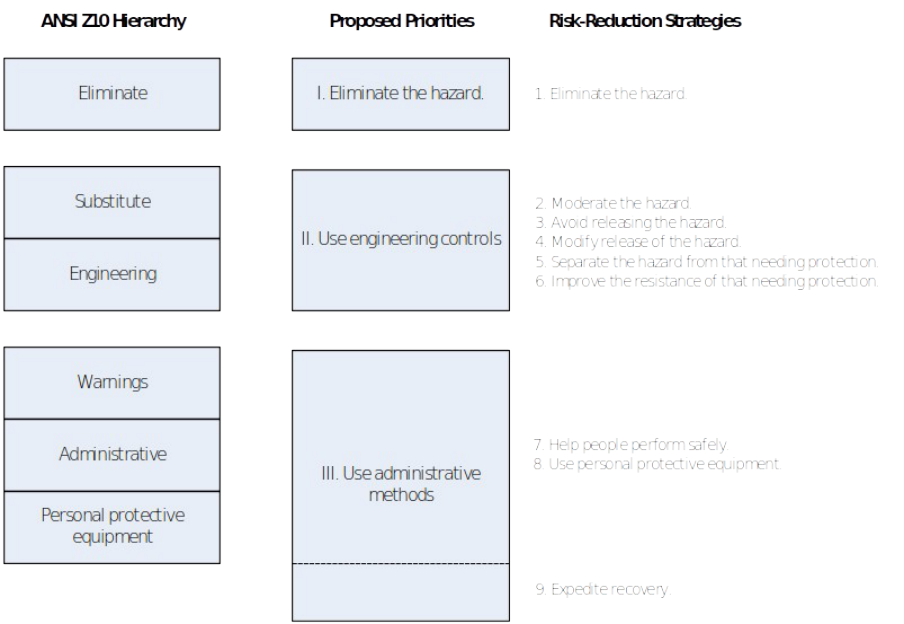
COMPARING TWO HIERARCHIES The nine risk-reduction strategies in Table 1 are described in great detail by Jensen (2012). They are similar to but broader than those incorporated into recent ANSI standards such as the Occupational Health and Safety Management Systems standard developed by the ANSI/AIHA/ASSE Z10 Committee (2012). Figure 1 provides a means for visualizing the differences and similarities between the ANSI approaches and the proposed approach.
Figure 1: Comparison of two approaches for prioritizing options for addressing hazards
The ANSI hierarchy on the left side of Figure 1 depicts the traditional approach of having a single list for both priority order and the strategies. The proposed approach distinguishes priorities (center column) from risk-reduction strategies (right column). The two risk-reduction strategies have much in common and well as some differences. Looking first at shared strategies, both recognize the best approach is to eliminate the hazard. This can be achieved either by not creating the hazard in the first place or by removing an existing hazard. Both place engineering approaches higher than administrative approaches.
Differences in the two lists come from Jensen seeking to improve on the ANSI list. While ANSI uses substitution of a less hazardous method, process, or material as a distinct approach, Jensen includes this within the engineering approaches; specifically as part of Strategy 2, moderate the hazard. Several tactics for moderating a hazard are noted in Table 3. Each of these tactics changes the hazard so it has less inherent hazardousness. When it comes to substituting, the safety benefits can range from substantial to minimal, depending on how much the substitution reduced the original hazard level. Examples for environmental hazards include reducing the concentration of an air contaminant and replacing a liquid chemical with one less hazardous. An example of a physical hazard is a sharp edge on a cabinet above a sink. People using the sink expose their head to the sharp edge. Beveling the edge to make it rounded will lessen the inherent hazardousness.
Except for the substitution strategy, the engineering approaches of the two schemes may be regarded as equivalent. The Jensen strategies listed on the right of Figure 1 are synthesized versions of those originally proposed by Johnson and Haddon and listed in Table 2.
The two approaches appear to differ substantially in the administrative approaches. The strategies on the left side of Figure 1 present warnings, administrative, and PPE strategies in order of preference. The Jensen approach includes those three strategies in Priority III, and adds the post-incident strategy he simply calls expediting recovery. Both recognize that multiple strategies may be, and often are, needed to reduce the risk of a particular hazard to an acceptable level.
Jensen identifies a risk-reduction strategy not found in previous ANSI strategy lists. His Strategy 7 is to help people perform safely through the design of work and human interfaces. This includes administrative practices such as providing warnings, conducting training, establishing procedures, and providing equipment designed for effective human use. All these practices contribute to workplace safety by helping people know what to do and how to do it safely.
The authors of most prior strategy lists fail to acknowledge the many ways ergonomics contributes to helping people perform safely through the design of work and human interfaces. The ergonomics and human factors community pioneered the concept of designing for the human user. Example approaches are:
Design human-machine interfaces to minimize errors and maximize correct performance,
Design work that matches task demands to the capabilities and limitations of the workers,
Design work so the convenient method is also the safest method, and
Design equipment and work demands to tolerate foreseeable human errors.
Pawłowska (2010) also recognized this strategy, describing it in the following manner.
Adapting the conditions and work processes to the capabilities of the workers, especially through the following:
Appropriate design and organization of workstations
Selection of machines and other technical equipment and work tools
Selection of methods of production and work, bearing in mind the need to reduce monotonous work and work at a predetermined pace and reduce the negative effects on workers’ health.
Ergonomics and human factors professionals developed and refined these and other work facilitators (Peacock and Laux, 2005). In addition to contributing to making facilitators effective, ergonomics and human factors practitioners and researchers have substantially contributed to training methodologies and improvements in safety-related signage.
The use of PPE has historically been placed at the bottom of hazard control hierarchies because it is regarded as the last line of defense. Strategies for preventing potentially harmful events and exposures are certainly a higher priority. Jensen’s approach differs somewhat. It puts Strategies 7, 8, and 9 into the same priority. The idea is that any of these that will reduce the risks associated with a particular hazard is equally worthy of consideration. For example, where a room has a high noise level, putting a warning sign on the door informing people of the noise hazard and instructing them to wear hearing protection is worthy of adoption, but it will not protect people from overexposure. Protecting people in that example also requires training on the proper way to use hearing protection PPE, providing the PPE, locating it in convenient places, and having administrative rules that are enforced. In Jensen’s view, these strategies do not fall into any particular order of effectiveness. Each of these strategies alone may have some effectiveness, but together they are much more effective.
The last difference between the two approaches is the Jensen list extends to post-incident response, recovery, and rehabilitation. It includes efforts to minimize the harm done, whether an injury, illness, or damage to equipment or the environment. It is considered risk-reduction because risk includes both the probability and the severity of the harm. An example of a response tactic is having portable fire extinguishers in rooms where fires might occur along with training personnel to use the equipment. Another is having a response plan to protect personnel in event of a fire or attack. An example of a recovery tactic is having first aid kits readily available and having personnel trained in first aid. An example of rehabilitation is having a chemical spill response plan with trained personnel. Measures such as these are widely recognized as effective because they can reduce the severity after an initial incident. When a risk assessment is performed, these incident response actions are appropriately included in the hazard control column, so they should be included in a hierarchy of hazard controls.
Two important points warrant restating. The first is that in the Jensen approach, the risk-reduction strategies within a priority category are not in priority order. The second is that with both the ANSI and the Jensen approaches, selecting one strategy does not preclude selecting other strategies. Often multiple strategies are needed to bring the hazard risk level down to an acceptable level.
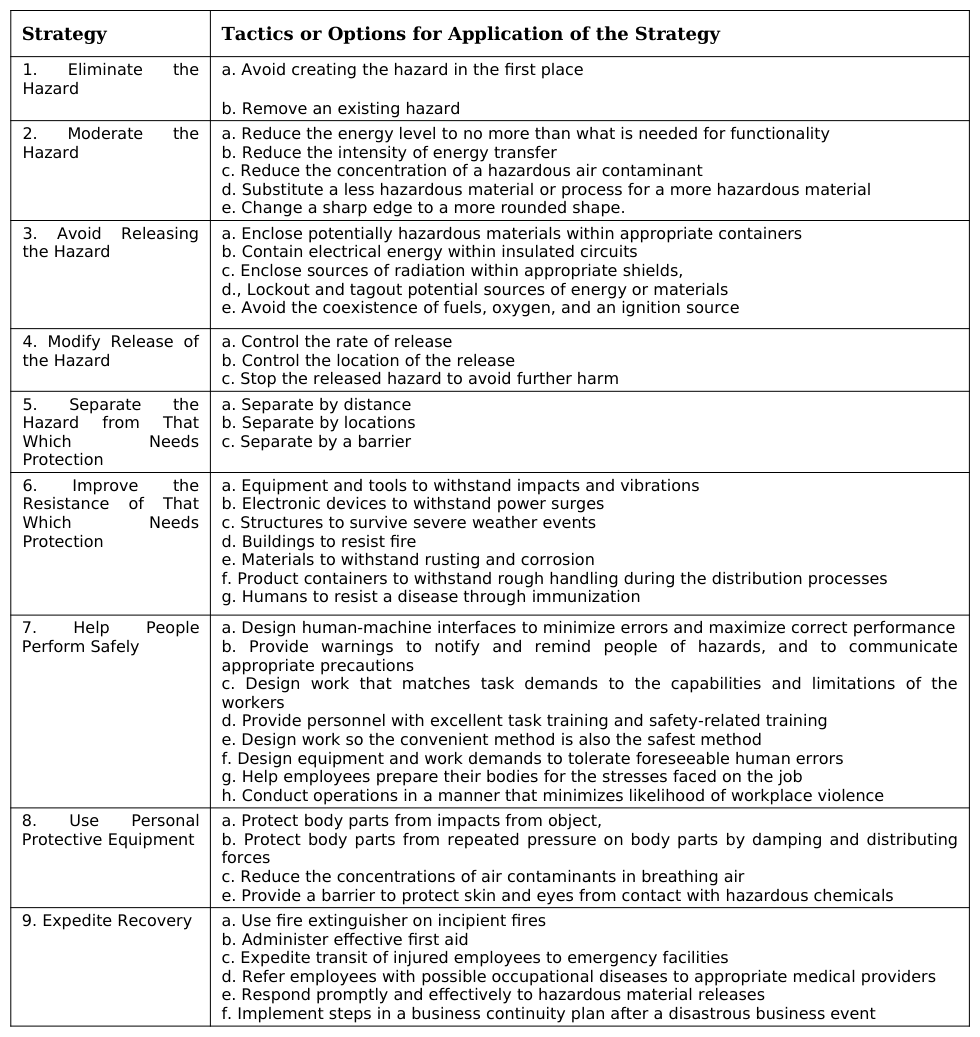
TACTICS WITHIN STRATEGIES The Jensen approach to risk reduction involves three levels: (1) priorities, (2) risk-reduction strategies, and (3) risk- reduction tactics. The tactics are more specific than strategies. Table 3 concisely lists tactics mentioned by Jensen in his book as well as a few additions (2012).
CONCLUSIONS
This paper presents a proposal for an alternative to currently-popular occupational safety and health hierarchies of control. The proposal is to do away with the single list of hazard control strategies in a priority order; and replace it with two lists, one for three general approaches in priority order, and a second list of risk-reduction strategies mapped to one of the priority categories. It is understood that some people will take issue with the nine strategies. That is less important than the larger concept proposed—to distinguish priority order from strategies.
Two significant contributions stem from this approach. First, it avoids making the assumption that all risk-reduction strategies have a priority order reflecting most effective to least effective. It does this by treating Strategy 1 as most effective, Strategies 2–6 as equally effective, and Strategies 7–9 as equally effective. The second significant contribution is it explicitly acknowledges the contributions of the ergonomics and human factors fields to helping people perform safely.
Table 3: Strategies with applicable tactics mentioned (adapted from Jensen, 2012) Strategy Tactics or Options for Application of the Strategy a. Avoid creating the hazard in the first place
REFERENCES
ANSI/AIHA/ASSE Z10 Committee, (2012). Occupational health and safety management systems–2012. Des Plains.
IL: American Society of Safety Engineers (www.asse.org). Haddon, W. J. (1973a). Energy damage and the ten countermeasure strategies. J Trauma, 13(4), 321–331. Haddon, W. J. (1973b). Energy damage and the ten countermeasure strategies. Human Factors, 15(4), 355–366. Haddon, W. J. (1980). The basic strategies for reducing damage from hazards of all kinds. Hazard Prevention, 16(5), 8–12.
Jensen, R. C. (2007). Risk reduction strategies: Past, present, and future. Professional Safety, 52(1), 24–30. Jensen, R. C. (2012). Risk-reduction methods for occupational safety and health (pp. 135–143). Hoboken, NJ: John Wiley. Johnson, W. G. (1975). The management oversight and risk tree. J. of Safety Research, 7(1), 4–15. Main, B. W. (2004). Risk Assessment: A review of the fundamental principles. Professional Safety, 49(12), 37–47. Manuele, F. A. (2005). Risk assessment & hierarchies of control. Professional Safety, 50(5), 33–39. Manuele, F. A, (2016). Achieving risk reduction, effectively. Process Safety and Environmental Protection, 84(B3),
184–190. doi: 10.1205/psep.05083 Pawłowska, Z. (2010). Occupational risk assessment. In D. Koradecka(Ed.), Handbook of occupational safety and health (pp. 473–4811). Boca Raton, FL: CRC. Peacock, B. & Laux, L. (2005). "WARNING: Do not use while sleeping" — The role of facilitators. Applied
Ergonomics, 13(4), 5–29.
LISTED IN THE AHFE DIGITAL BOOKSTORE CATALOGUE
Explore the complete digital volume
Advances in Safety Management and Human Factors
Read this individual research paper free through the original publisher, or explore the full digital proceedings book.
ISBN 978-1-4951-2100-5
Explore this ISBN in the AHFE Bookstore ↗Listed in the July 2026 bookstore catalogue; search by ISBN to confirm current availability · Digital book purchase optional