Haftay Hailay Abraha, Jayantha P. Liyanage (2019). Human and Organizational Factors Contribution to the Occurrence of Major Accidents Using Offshore Accidents as a Case Study. In: Advances in Safety Management and Human Factors. AHFE Open Access, vol. 5. https://doi.org/10.54941/ahfe100158
Human and organizational factors (HOFs) are important causes of accidents. As the design of technological equipment becomes more and more safe, the causes of accidents are more likely to be attributed to HOFs. The offshore drilling is, for instance, controlled by safety barriers that are dominantly dependent on HOFs. In a dynamic and volatile environment, every organization goes through a drifting process where the kind of logic of action taken depends on the contextual and temporal factors, the tightness of the coupling, and the complexity of the situation. The drifting process both affects and is affected by the management structure, the communication systems, the kinds of competence possessed, external pressures, and whether it is possible to comply with organizational procedures and whether these procedures are in accordance with regulatory requirements. These areas are important to examine to improve understanding of contribution of HOFs in major accidents. The knowledge and detail understanding of the contribution of HOFs to the offshore accidents provides new insights as well as practical guidelines for how to understand, assess and manage (potential) hazards and unforeseen surprises in a practical operational setting.
In complex and dynamic organizations as in the oil and gas industry, it is important that safety is adequately addressed at every point during the life cycle of oil and gas fields. This industry operates with a highly dynamic and tightly coupled socio-technological system, which requires comprehensive safety risk assessments in order to avoid malfunctions and prevent accidents. When engineers design a subunit of a complex system it is necessary to consider how each component is integrated with the rest of the system both in loosely and tightly coupled situations. In the development of a new system, the design task is divided into subunits which companies with special expertise are engaged to manufacture. In these companies there are different actors and different situational demands which contribute to form the result of the subtask. This means that in most companies there is some deviation between the project set by the operator of the system, and the subcontractor’s actual result. In complex systems which consist of many components made by different subcontractors these deviances can affect each other in unexpected manners when they interact. In order to decrease this tendency there are regulations and industrial standards to regulate the interaction, but these static tools do not always correspond to the task at hand and may therefore be inefficient.
The four accident cases that have been analyzed and compared in this article include Macondo blowout (USA- 2010), Montara wellhead platform blowout (Australia-2009), Gullfaks c platform incident (Norway-2010), and Piper Alpha disaster (UK-1998). The in-common characteristics of these accidents are that both technical and HOFs explanations were used to describe why they happened. Even though these explanations varied from accident to accident, some key HOFs constituted the constant variable. It seems we often do not do new mistakes; we have done the same mistakes, may be with new people. The claim in this paper is that in-common HOFs need to be addressed to improve major accident performance. An industry with great faith in technology will normally consider technological solutions to be lessons from past accidents and incidents. The problem is that the focus on knowledge management, information, communication, leadership, situation awareness, procedures, safety culture, competence, and compliance has suffered as a result.
An important contextual factor in these four cases is that three different regulatory regimes were involved. The main objective of this study is to seek an answer to why accidents occur, with respect to HOFs, and to determine how we can learn from such accidents so that the chances of recurrences decrease. Since specific HOFs were key elements in all the accidents, studying these factors is essential. We need to keep in mind the relationships among technical, organizational, and human factors play a key role and affect the ways in which the organization thinks about and addresses risk and safety issues. On the basis of the investigative reports, the following questions will be analyzed:
How did different underlying HOFs affect the occurrence of these accidents?
How did interaction among HOFs increase the chances for such accidents to occur?
How did the different regulatory regimes influence the organizations’ handling of safety and risk?
SHORT SUMMARY OF THE ACCIDENTS Macondo Well Blowout (USA)-2010
The blowout in the Gulf of Mexico (GoM) on the Deepwater Horizon drilling rig took place on April 20, 2010. The explosion left eleven workers dead and 17 others injured. Two days later, the rig sank. The well flowed oil into the GoM for 87 days before it could be controlled. According to the National Commission on the BP Deepwater Horizon Oil Spill and Offshore Drilling (here after National Commission), the Macondo blowout was the product of several individual missteps and oversights by BP, Halliburton, and Transocean, which government regulators lacked the authority, the necessary resources, and the technical expertise to prevent (National Commission, 2011). The immediate cause of the blowout was the undetected flow of hydrocarbons into the well. The blowout preventer (BOP) also failed to seal the well after the hydrocarbons flowed uncontrolled into the well. In addition, some have claimed that the cementing was not proper (BP, 2010). As the BP inquiry report stated, the cause of the accident was complex and involved “mechanical failures, human judgments, engineered design, operational implementation and team interaction came together to allow the initiation and escalation of the accident” (BP, 2010). BP found the root causes of the blow out were:
Industry management failures –ultra deep
Poor risk assessment(due to lack of knowledge and poor assessment of uncertainty) of late design changes and decision making processes within BP; no Management of change(MOC) processes
Poor communication between BP and other contractors (Halliburton, Transocean, etc.)
Failure to communicate lessons from earlier near-miss by drilling contractor (Transocean)
Inadequate consideration of risks created by time and money saving decisions Montara Blowout (Australia)-2009
The blowout on Montara Wellhead Platform occurred on August 21, 2009. In this accident, no one died, but the oil spill was major. For more than 10 weeks, oil and gas flowed into the Timor Sea just a couple of kilometers from the Northwest Australian coastline. Several organizations were also involved with this West Atlas-owned platform and this specific well: the operator PTT Exploration and Production Australia (PTTEPA), West Atlas – the rig owner, and Halliburton (Montara Commission, 2010). The immediate cause of this accident was that hydrocarbons entered the well in the 9-⅝” casing where the primary barrier in the well – a 9-⅝” cemented casing shoe – failed. The casing as a common barrier element for the primary and secondary well barrier thereby failed (Montara Commission, 2010). The Montara Commission of Inquiry found the root causes of the blow out were:
Failure to maintain two well barriers
Failure to verify barriers
Poor management of change(MOC) control
Lack of personnel and organizational competence, which led to deficient decision making
Gullfaks C Incident (Norway)-2010 The incident on the Gullfaks C (here after GFC) platform took place on May 19, 2010, as the drilling of production well C-06 at GFC was about to be completed, in the North Sea. Because of its lesser severity, GFC is called a serious incident, as no lives were lost and no damage to the environment occurred (PSA, 2010). The difference between an accident and incident is a question of severity or seriousness of the outcome. According to Hollnagel, “[t]he importance of making the distinction is that an incident generally is understood as an event that might have progressed to become an accident, but which for one reason or another did not do so” (Hollnagel, 2004).
Statoil and Seawell were organizations involved on the GFC platform. According to the Norwegian Petroleum Safety Authority (PSA), the immediate cause of this incident was a total loss of well control (‘lengthy loss of barrier’): “Planning of well C-06A on the Gullfaks A began in 2008. The original well bore was plugged back in the late fall of 2009 and drilling activity in the sidetrack was initiated in December 2009. Based on the measured strength of the formation Statoil decided to drill the last part of the well by means of managed pressure drilling (MPD) technology. Statoil experienced more incidents of instability during drilling of the well, and eventually got an event with the total loss of well control on 19.5.2010” (PSA, 2010). PSA findings indicate serious deficiencies on key factors such as risk management and change control, experience transfer and use of expertise, knowledge of and compliance with governing documents, and documentation of decisions.
Piper Alpha Explosion (UK)-1998 167 men died in the explosion and fire on 6 July 1988 on the Piper Alpha fixed production platform in the North Sea. The immediate cause was the ignition of a leakage of gas condensate, resulting from the pressurization of pipework which was undergoing maintenance. Following this the structural collapse of the platform was hastened by a series of major explosions (Barren, 1993). With striking similarity to many offshore incidents, the underlying causes were:
lack of proper attention to risk and consequence assessment,
lack of proper attention to management of change (MoC),
lack of basic control of work and,
miscommunication between different actors during critical operations
missing risk assessment and management
THEORETICAL FRAMEWORK Practical Drift
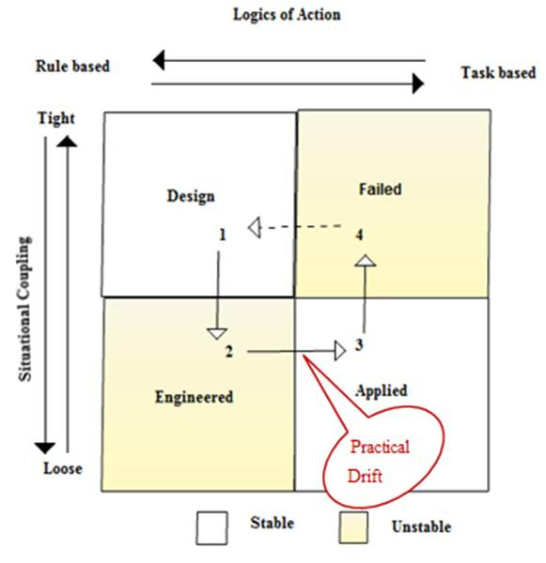
Snook (2000) defined ‘practical drift’ as the “slow, steady uncoupling of local practices from written procedures”. So when does practical drift occur in the context of the practice of safety? Snook’s Practical Drift Model (PDM combines “Normal Accident Theory “(NAT) and the High Reliability Organization(HRO) theory(Todd et al, 1991) to explain how apparently highly regulated and managed organizations over time develop traits that can lead to serious incidents and accidents. PDM emphasizes firstly how different degrees of “Mindfulness” vary from situation to situation, and how organizational systems develop both tight and loose couplings over time. The main objective of the model is to capture both contextual and temporal factors in explanations of why incidents and accidents occur.
As shown in , Snook (2000) captures three dimensions in his PDM: Situational Coupling, Logics of Action, and Time. Situational Coupling (vertical axis) indicates organizations alternate between loose and tight couplings as dependency relationship between different units vary in strength. As we can see these are the same concepts as Perrow uses in his analysis of NAT (Perrow, 1984). However; unlike Perrow, Snook focuses on the dynamic nature of coupling. The interdependence of units change over time as the organization has to handle different situations. The second dimension in the PDM is Logics of Action, which is described as either “rule-based logics” or “task- based logics”. The “logics of action” are the scripts, norms, and routines among which people shift according to the contextual factors. People move back and forth from rule-based to task-based logics of action depending upon the context in which they find themselves. When organizations develop their own cultural traits, the independence is reinforced by further local adaptation of patterns. Such release could lead to improvement of local tacit knowledge and expertise, but this knowledge harmonizes not necessarily with the governance structure or purpose of the security system. Compliance is therefore a key concept here. Lack of compliance is not due to discrepancies, but is a consequence of local interpretation of governing documentation and task-based logic of action (i.e., compliance must be understood contextually). The third dimension is Time. The arrows through the four quadrants imply a cycle of time. Each quadrant represents a different state of stability the organization is in based on the pressure of the current situational coupling and logics of action taking place.
Figure 1. Practical Drift Model (PDM)
Quadrant 1 and 3 indicate a state of stability; i.e., the logic of action matches the situation. Quadrants 2 and 4 represent instability wherein the rule-based logics do not match loose coupling, and task-based action is no match for tight coupling. Each quadrant depicts a point in time where the organization pauses (sometimes for years) in the natural flow of the transition from one quadrant to another and carries a label (Snook, 2000). Quadrant 1 is labeled “Designed” indicating, for example, the organization is at the planning stage. Members follow the rules in a tightly coupled environment. Quadrant 2 depicts an “Engineered” organization in which the organization is operating as designed (i.e., following the rules) even though the situation is loosely coupled. In Quadrant 3, labeled “Applied,” members of the organization take on a pragmatic approach to applying the rules and become more task-based. Finally, in Quadrant 4, labeled “Failed,” the task-based operations do not align with the tightly coupled organization. It is at this point in the cycle that an organization is most likely to experience a significant event.
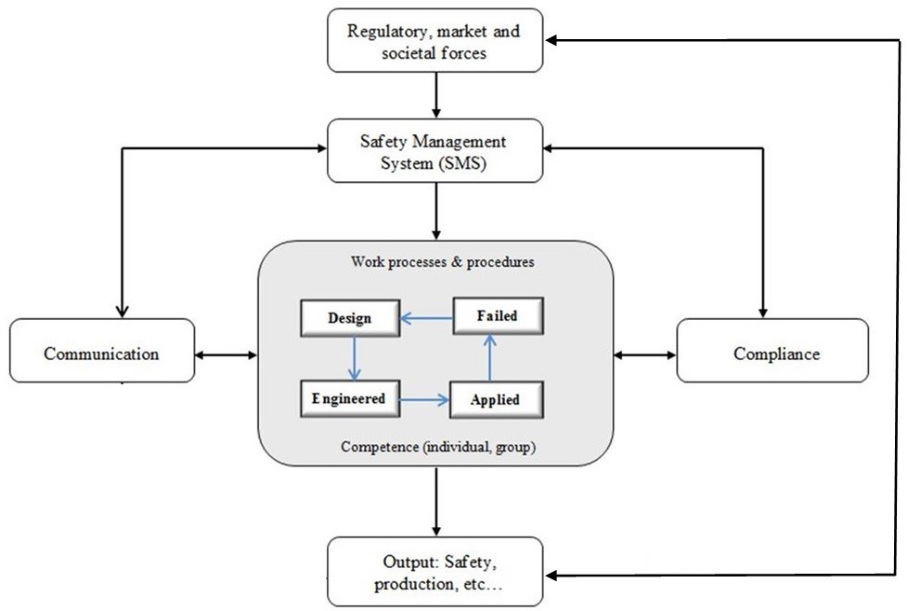
Safety Rules and Regulations The framework in connects the PDM to the HOFs aspect of communication, management, compliance and, regulatory regime. The logic of the model is as follows: In the early stages, the organization will be characterized by top-down management structure where communication and compliance with rules / procedures and organizational design implemented for the various sub-units are in focus. When the organization enters the "practical operation mode", both communication and compliance worsens. The local units will adapt and develop location-specific varieties of the general management procedures, and base their communication on a more informal basis between colleagues and sub-units. Important information from management can thus be sufficiently emphasized, and important routines can be modified or eliminated, which in turn will have implications for production and safety.
Operating teams and organizations are dynamic, i.e., they are influenced by internal and external performance shaping factors. Acquiring new technology, a new leadership, new procedures, new regulations, economic pressures, interaction with various other organizations, and so forth, have some effect on each organization’s HOFs to adjust their behavior accordingly. Such dynamicity can increase or decrease complexity and/or tighten or loosen couplings. This is important to keep in mind when studying the HOFs with respect to the risk and safety.
Figure 2. Governance structure and PDM (modified from IRIS, 2011)
ANALYSIS AND DISCUSSION By using the framework (see ), we can identify how the management structures shifted from a top-down to a flat and task-based logic of action. As the model implies, we will see whether communication and compliance deteriorate when shifting to a practical drift mode. How do the subunits in an organization affect the management and regulatory regimes, and vice versa, especially considering compliance with rules and procedures? In what way is the individuals’ competence affected by the shift and how does their competence affect how well they execute both rule- based and task-based logics of action?
The Regulatory Influence Regulatory regimes affect how organizations manage risk and safety. Since the four accidents studied occurred in different parts of the world, different types of regulatory regimes were involved. The way the different regulatory regimes were organized and structured affected both the degree of influence they had on the different organizations and the relationship between the organizations and the regulators. For offshore activities, the world split into goal- based and prescriptive regulatory regimes. The former required risk assessment (analysis of both hazard and consequence), the latter did not, driving safety through a more lessons-learned approach-rules were developed based on observed accidents. While the Norwegian, UK and Australian industries are required to take a proactive attitude toward safety (goal-setting approach), it seems that the US industry is more or less prescriptive approach. Safety case is an approach to safety of major hazards in UK and Australia, but not in the USA. Norway does not implement safety case for offshore, however Norway has similar safety record to UK.
One of the similarities between all the four accidents is that each state profited from this industry. In other words, management within the organizations must balance the need for profit and safety. As the National Commission stated, ”[f]rom birth, Minerals Management Service(MMS) had a built-in incentive to promote offshore drilling in sharp tension with its mandate to ensure safe drilling and environmental protection” (National Commission, 2011). When MMS tried to introduce something, it did not receive support, either political or financial, from central authorities. Politicians were on the same side as the industry, with financial gain as a high priority and long-term investment in safety a low priority. For the balance between production and safety to be optimal, “[f]undamental reform will be needed in both the structure of those in charge of regulatory oversight and their internal decision- making process to ensure their political autonomy, technical expertise, and their full consideration of environmental protection concerns” (National Commission, 2011). It is important for the regulators to acknowledge that organizations drift from stage to stage, depending on their context, degree of complexity, and how tight/loose the couplings are. Regardless of whether or not the regulatory requirements are functional or detailed demands, this must be taken into consideration. Changes will occur; therefore, organizations need to have a formalized relationship with their regulators to ensure that regulatory requirements are also as optimal as possible. When one communicates both how the requirements function and how they don’t, a proactive environment in which actors communicate with each other can be established to devise the best possible requirements and procedures to achieve the best safety outcome for the organizations and still fulfill the meaning and intention of the regulatory requirements.
Of course there would be challenges in the process of determining which rules should be considered and how to implement these rules in every region, because although this is a global industry; there are still location-specific differences of each region and even each installation that we should take into account. As one can see from the findings in the reports from the Piper Alpha, Montara and the Macondo accidents, the relationship between the regulators and safety managements were inadequate. In the search to find commonalities across the accidents and incident, the Norwegian system does not fit the description of a poor or inadequate relationship between the regulator and industry/safety management. Perhaps the formal relationship among the three parties in the Norwegian system is a recipe for other regions to follow. This does not mean that the Norwegian cooperation system is perfect, but it might have diminished some of the issues the two others confronted. Ryggvik(2000) said, “one could argue that participation of the employee representatives that are so central to the Norwegian system, has a positive safety impact”.
Safety Management System (SMS) While several versions of SMS exist, more or less they are similar in content. Risk based safety management (e.g. in the North Sea offshore activities) are more modern than hazard based systems. A common feature is that most of these systems were developed in response to some major accidents. As Robin and Peter (2013) indicated, the insight in all cases was that accident causes are not simply technical, but have underpinning HOFs influences and hence major accidents would recur unless improved management systems were implemented.
The PSA inquiry after the GFC incident stated that “management at all levels inadequately ensured that the planning of the operation was carried out in accordance with the company’s requirements, Health, Safety and Environment (HSE) policy and strategy” (PSA, 2010). Similarly, the National Commission (2011) was quite direct in its statement that “[t]he most significant failure at the Macondo – and the clear root cause of the blowout – was a failure of industry management.” The decision-making process at Macondo did not adequately ensure that personnel fully considered the risk created by time- and money-saving decisions. For example, “neither Halliburton’s nor BP’s management process ensured that cement was adequately tested. Halliburton had insufficient controls in place to make sure laboratory testing was performed in a timely manner or that test results were vetted rigorously in-house or with the clients. It appears that Halliburton did not even have testing results in its possession showing that the Macondo slurry was stable until after the job had been pumped. It is difficult to imagine a clearer failure of management or communication, the commission stated. BP’s management process did not adequately identify or address risks created by late changes to well design and procedures. BP did not ensure that key decisions in the months leading up to the blowout were safe or sound from an engineering perspective” (National Commission, 2011). A PTTEPAA failure in management was also a major issue. “The management structure paid insufficient attention to putting in place mechanisms to asses and manage project risks, the competence of key personnel, the adequacy of Well Operations Management Plan (WOMP), and the interaction with contractors (Montara Commission, 2010). This in turn resulted in several poor decisions and judgments by both PTTEPAA’s senior personnel on the rig and onshore personnel.
In all of the four case studies, clearly, the top-down management structure was not adequate, not even in the planning stage when one would think it is important. As the process begins, safety programs and procedures are defined. The situation is assumed as tightly coupled and that a safety activity or decision in one subunit will directly affect what happens in another. It is also assumed employees will “follow the rules” in the SMS. Thus, the design state of your planning stage is a tightly coupled, rule-based logic of action (i.e., Quadrant 1 in the PDM). Management needs to be consistent for the procedures to reach their full potential. In fact, if procedures are not followed and the organization shifts to a more task-based logic of action with tight couplings in the drifting toward stage 4, then management needs a system to detect what is happening in the organization. If one could recognize when different subunits shift from rule-based to task-based logics of action, one might develop a more proactive strategy for change. A key factor here would be adequate communication systems, which are discussed later.
As Snook (2000) stated, a task-based logic of action is sometimes the “right way” to do the job, depending on both the context and the temporal factors. Tinmannsvik (2008) asserted the reason we use people instead of machines is that in some situations there is a need to be adaptable and to do something outside the procedure to perform the best and safest job. However, it is important to understand the consequences of actions that are not consistent with procedures. According to Tinmannsvik (2008), the local adjustments in relation to the planned procedures for performing the job (informal deviations) can cause unexpected interactions that have serious consequences. It does not matter how good the systems look on paper if the people in the organization do not have a culture of thinking and acting in accordance with work practices. One way to improve or develop procedures and job descriptions are to make the silent deviations visible. A prerequisite for this is a working environment that encourages openness and learning. Making sure that the organization has the system for developing adequate procedures and a culture of reporting, openness, awareness and learning is management’s responsibility. That means, even if management itself does not catch the drifting within the organization or operation, the management system and procedures need to be designed in a way that detects this drifting.
By using the terms of the PDM, one will hit the ‘Failure’ stage (Quadrant 4) when personnel feel that they must take shortcuts and do things differently and quicker to achieve the company’s goals. This is not necessarily a conscious choice by management, but this is due to some internal and external influencing factors/pressures. In accordance with Rasmussen’s model (1997), pressure comes from internal goals, but also from the competition of other organizations, stringent regulations, market forces and similar external forces. The analytical framework (see ) exemplifies how both the regulatory regime and the market affect the SMS and the practical drift within the organization. There is an obvious need to increase awareness of how different contextual frames affect the logic of action in organizations. When subunits feel that they are forced to prioritize job elements to get the job done quickly, rather than safely, they take shortcuts. This is when the subunits are more or less forced to detach themselves from rule-based logic of action. As Snook points out, “when the rules do not match the situation, pragmatic individuals adjust their behavior accordingly; they act in ways that better align with their perceptions of current demands. In short, they break the rules.” As time passes, “the seductive persistence of pragmatic practice loosens the grip of even the most rational and well-designed procedures.” Employees’ practical actions gradually drift away from the originally established SMS procedures (Snook, 2000).
The drift is reinforced daily when employees turn to their fellow workers for advice on completing job tasks versus relying on the SMS procedures. For each uneventful day in this loosely coupled environment, it becomes even more difficult to persuade employees of the benefits of following the rules. In the “Applied” world (Quadrant 3), the engineered organization governed by SMS rules gives way to locally pragmatic responses by employees to their daily tasks. With time, these locally pragmatic responses become the “new” rules. Interestingly, Snook notes in the “Applied” stage employees act based on the assumption that people outside their own work group are behaving in accordance with the original set of established rules. Have you ever heard a victim of a serious incident saying, “I’m surprised those guys were breaking the rules.”? Such statements are commonly heard when practical actions have drifted far away from the designed SMS rules.
Communication Risk communication could be a challenge in a stressful situation. Misunderstandings & poor communication can lead to serious incidents. Communication is dependent on many different HOFs such as: communication procedures, situational awareness, alertness, working procedures, and cultural factors among the stakeholders involved in communication. For offshore (remote) operation, the stability, quality, and resilience of communication infrastructure become more important. In all the four cases (Piper Alpha, Macondo, Montara and GFC), unsafe conditions were detected prior to the actual loss events or precursor incidents occurred but were not adequately reported, or investigated so that the loss event could be prevented. Information is never effectively used to redesign the social and technical components of the sociotechnical system.
The importance of communication is also visible in the different stages of practical drift in that communication is affected by the drifting between the different stages. When dealing with the interaction of multiple organizations involved in one operation, there is still a need for a management and communication system that handles the cooperation and interfaces between the organizations involved. The industry is organized so that one organization is the operator on the platform, but several organizations act as suppliers on each platform. At the Deepwater Horizon rig, BP was the operator and Halliburton and Transocean, among others, were supplying companies. At the Montara accident, PTTEPAA was the operator and Halliburton and West Atlas were involved as supplying companies. Similarly, several organizations involved on the GFC and Piper Alpha Platforms. In accordance with Turner and Pidgeon (1997) the involvement of multiple organizations in a complex work setting environment makes communication even harder. As the findings from the different reports have indicated, this will lead to a more complex situation with tight couplings where Snook argued the need for a top-down rule-based logic of action.
The National Commission report clearly argued that among the failures in management and training of personnel “…better communication both within and between BP and its contractors...” would have prevented the Macondo accident (National Commission, 2011). BP’s own investigation report indicated communication issues between BP and Halliburton when it came to the planning, design, execution, and confirmation of the cement job (BP, 2010). The Montara inquiry (2010) discovered systemic failures of communication between PTTEPAA and Atlas personnel. For example, Atlas was not involved in the actual decision during two critical procedures; this reflects a poorly formalized relationship/cooperation. These examples are clearly similar to the GFC incident, and the IRIS report stated this in the discussion of sharing knowledge and learning across organizations and subunits, the report said that “several of the informants experience Statoil as closed and that suppliers have little insight and understanding of the processes that occur along the way” (IRIS, 2011).
Without communicating the issues that need to be addressed in the different stages of PDM, chances are the organization will never achieve its goals and it is unlikely to follow the procedures specified. In the early stages of implementation, employees obey the rules to avoid punishment. As subunits form and drift further away from the rule-based logic of action, communication between the different subunits will also drift further away as a natural consequence. The Norwegian system is characterized by the three-party cooperation, which is an important element when it comes to communication. Drifting further to the next stages in the PDM arises, as the operation starts and time passes. As Snook(2000) indicates, “once the SMS is written, it is time to go live at the operations level and move from Quadrant 1 into 2 (i.e., Engineered), where the organization operates as designed. Operators follow the rules, but in a looser fashion even though you assumed the organization would remain tightly coupled. “When subunits have the time to develop and drift further and further away from the rule-based logic of action, communication between the different units will be affected and become more challenging. Over time operators gain experience with the SMS procedures and begin to take risks in order to get the job done. When this shift in behavior becomes commonplace, the organization moves from Quadrant 2 to 3 (i.e., Applied), and Snook’s phenomenon of Practical Drift sets in. Then at some point in this “Applied” world, a rare stochastic (random) event occurs causing the system to rapidly contract and become tightly coupled moving the system from Quadrant 3 to 4 (i.e., a “Failed” world). According to Reason (1997) effective communication is determent for the identification and removal of latent pathogens.
Procedures Procedures are established as a way to meet regulatory requirements or industry’s internal standards. The Norwegian system is characterized by tripartite involvement, the US system by the operators’ strong role in self-determination, and the Australian and UK systems by cooperation between the state as an inspection authority and the operators. Of course, different cultures in the different regions and specific installation locations affect how one develops these procedures and how they are implemented. Poor transfer of experience and knowledge, and poor communication might indicate weaknesses in procedures. PSA report (2010) indicated failures in procedures concerning risk assessment, especially in how the organization did or did not learn from previous accidents such as on the Snorre A platform. Frustration over complicated and to some degree misleading procedures established by management might also be a cause of why personnel develop their own local ways of doing things. The National Commission’s inquiry report cited in several places indicate inadequate procedures, lack of procedures, and in some cases a failure to train personnel in accordance with established procedures. This included procedures such as the performance and interpretation of the negative pressure testing of the cement, management of change, risk analysis, and peer reviews (National Commission, 2011). At the Montara well accident, the most prominent cause was inadequate procedures. The inquiry found that procedures were poor and deviant and, at best, ambiguous. The inquiry after the Montara well accident clearly identified the lack of adequate procedures within PTTEPAA and suggested that these shortcomings in the company’s procedures led directly to the blowout (Montara Commission, 2010).
Failures in procedures for risk assessment and management and for involving the right competent personnel are commonalities across all the four case studies. However, failures in procedures differed from accident to accident depending on the relationships between the regulator and organization, organizational culture, and other organization-and-installation-specific aspects. One can clearly see the link among regulatory regime, safety management, and the work process in the forms of procedures; how they are designed and how well the work is affected by the relationship between the regulator and the regulated. As is the case at GFC, when subunits are more or less forced to drop what they are doing in order to fulfill the new requirements set by PSA, shortcuts will be taken and the drifting towards failure will occur. One is now drifting away from the rule-based logic of action where you follow procedures, towards taking the shortcuts needed to fulfill the new ones. Even if the orders set by PSA are intended to increase safety, in worst case the opposite will happen as a result to the shortcuts being made. Similarly, BP’s own inquiry stated, when well influx occurs, rapid response is critical. The rig crew needs effective procedures and must effectively implement them to maintain control over deteriorating conditions in the well” (BP, 2010). The relationships or interaction between the regulatory regimes and the organization, the macro level, ultimately affected the micro level within organizations, or how one followed the procedures. While the US system has been characterized by a strong lobbying industry where self- determination has been an important principle, regulators have had minor or little real impact on the industry. The Norwegian system, on the other hand, has had a culture of cooperation with tripartite involvement where all parties have both a duty and the privilege to contribute (detailed risk analysis). The Australian and UK systems are characterized by functional but complicated sets of demands and regulations where the employer is established as the only responsible party (Safety Case).
As the “Design” stage in the PDM indicates, there is a need for safety management to take the steps concerning the choice of procedures seriously. This is where management plans and designs the operation, using “mindfulness” to foresee what might go wrong and how to correct course if the organization is drifting in that direction. As indicated in , the drifting process over the lifetime of an organization, where it goes from tight to loose coupling and has differing degrees of complexity, affects the occurrence of subunits and how they actually execute their jobs. How well one follows procedures within this drifting process varies from the rule-based to the task-based logic of action. However, without the foundation of a good rule-based logic of action, a task-based logic of action might drift even further away from the procedures in the document. On some level, subunits might even be forced to devise their own way of doing things to operate safely because of inadequate procedures. For example, the Montara accident report clearly stated that “Well Construction Standards (WCS) were at best ambiguous and open to different interpretations” (Montara Commission, 2010). Different units interpreted standards differently. If the organization has not implemented functioning procedures and a culture for reporting, openness, and communication, the actual way of doing things might drift far away from how management thinks personnel are doing things. Even though management is responsible for the whole operation, how can it be held responsible when it does not know what is happening within its own organization and operation? As the IRIS report (2011) stated, management had the impression that procedures were followed no matter what, but responses from personnel indicated the opposite; they felt that the procedures were complicated and not that easy to comply with. During a drift from stage 3 (Applied) to stage 4 (Failed), if the subunits do not manage to shift back from a task-based logic of action to a rule-based logic of action, accidents can happen.
Snook (2000) notes, it is the “perverse combination of practical drift and tight coupling which set the conditions for randomly triggered disaster.” As the organizational system moves from stability to instability, energy is created that leads to change. In the “Failed” world, this instability drives management to save the organization from recurrence of the disaster, while overlooking the systemic nature of the disaster. The dotted arrow from Quadrant 4 feeds back into Quadrant 1, where the cycle starts over and fixes are implemented in ‘Re-design’ stage, which often leads to an overcorrection for the task-based actions by over-tightening the rules. This knee jerk reaction provides the energy to spawn subsequent cycles of disaster. This notion was supported by how the organizations did not manage to transfer critical learning points from previous accidents and incidents; how someone at the GFC did not manage to involve the staff with the right competence (experience and knowledge); how someone at the Macondo site did not manage to properly consider the risk due to changes; and how one at the Montara site initially did not create adequate procedures at all. All these occurred after management failed to implement appropriate and efficient procedures.
Competence Competence includes knowledge and experience. Statoil did not use the appropriate competence in key processes. “A dedicated risk coordinator responsible for risk management was never appointed, and the group conducting the operational risk assessments lacked the necessary expertise to conduct proper risk analyses” (PSA, 2010). Personnel lacking skills or expertise were responsible for analyses and making key decisions and these decisions included the failure to use MPD expertise for the MPD operation. There was a change in organizational structure (the merger between Statoil and Hydro) and the replacement of personnel (a lot of people with great experience left the organization and there was insufficient transfer of knowledge). In addition to failures in the management decision- making process and communication, both within BP and between BP and its cooperating organizations, “…training of key engineering and rig personnel would have prevented the accident at the Macondo well” (National Commission, 2011). BP (2010) itself stated that lack of competence was one of the issues that caused this accident.
Management failed to ensure that personnel fully considered the risks in the operation/work task. For example, during the negative pressure test of the cementing, several issues related to competence and procedures were inadequate. Neither BP nor Transocean had procedures for running or interpreting the negative pressure test, nor had they trained their personnel to do so (National Commission, 2011). (The negative pressure test was used as one of the testing methods to ensure that the barrier of the cement was adequate.)
PTTEPAA’s senior personnel had only limited experience with batch drilling and batch tieback operations. By failing to test all barriers properly, PTTEPAA’s personnel on the rig demonstrated inadequate understanding of the company’s WCS. They also failed to comprehend the manifest problems in the cementing job for the 9-⅝” casing shoe (Montara Commission, 2010). Once again, the importance of having a well-planned recruitment strategy in the “Design” stage might be crucial to the rest of the drift over the lifetime of an organization. When the work is executed, management needs the right competence at each concrete work task. The competence the management has within its organizations will determine how well the organization undergoes the drifting process and how subunits are developed and function/dysfunction, including how well one shifts from rule-based to task-based logic of action when the situation demands it. In these three accidents and one incident, it seems that failures in all of the stages developed―from the stage 1 (Design) of strategy and recruitment, to how personnel developed their subunits, to how personnel did not manage to shift from a task-based logic of action to a rule-based logic of action when needed. Ultimately, what caused these accidents were wrong decisions made by people without the competence to make them. A statement that supports this assertion was taken from the National Commission report: “…individuals often found themselves making critical decisions without a full appreciation for the context (or even without recognizing that the decisions were critical)” (National Commission, 2011).
In stage 3 (Applied), this might in fact be the best and safest path. To be creative and develop a task-based logic of action when the situation demands it, as in stage 3, organizations need a competence that corresponds to the situational task. This is also stated in the National Commission report: “[i]t takes good experienced personnel to understand the situation and cope with it” (National Commission, 2011). Then again, to have the ability to go back to the rule-based logic of action when that is demanded, just tacit knowledge and task-based practice will not be sufficient. Management must also set competence to be in second position and do what is demanded in a rule-based logic of action to follow established procedures. This will ensure that everyone knows exactly how to perform and exactly what others are supposed to do. Again, one can see the importance of having appropriate procedures for competence to be used in the best possible way to achieve operational safety and avoid accidents or incidents. As Nordhaug (2007) stated, having the right competence might be a determinant to surviving competition in the market. As can be seen from these case studies, there are some crucial commonalities showing that possession of the right competence is in fact crucial. Common to all of the four cases is the fact that personnel without the proper skills or expertise made critical decisions both in planning and in operation. As a result, failure to detect and address safety- critical issues and risk assessments arose. According to Snook (2000), this creates greater risk for something to go wrong, especially if subunits were performing with a task-based logic of action when they really should have been following a rule-based logic of action.
Compliance The different logics of action will affect how the subunits and organizations comply with both internal and external requirements. In the discussion of procedures and competence, compliance was a key factor because it involves how personnel comply with procedures and requirements. As discussed above, the procedures themselves were not, according to PSA (2010), a significant reason for the occurrence of the incident, but compliance was an issue. While planning the well, risk analyses were not carried out in accordance with Statoil’s own requirements and guidelines. Despite the fact that the well was of a complex nature and represented a significant risk, only basic risk analysis methods were applied. PSA (2010) also identified a lack of knowledge and compliance with governing documents, as well as inadequate deviation treatment procedures. This included a lack of knowledge about risk assessment and management guidelines and quality control and quality assurance (QA/QC) methods, as well as uncertainty regarding the interpretation of key concepts.
At the Macondo accident, several separate missteps and crucial elements lacked proper compliance, including that the cement was not adequately tested by the personnel on the rig. The Deepwater Horizon rig was reckoned by BP to be one of its safest rigs (Ryggvik, 2012). Significant time had passed since its last serious incident and the constant pressure for productivity and profit have contributed to the disastrous situations; “[i]t is easy to forget to fear things that rarely happen, particularly in the face of productive imperatives such as growth, profit and market share” (Reason, 1997). Although PTTEPAA’s procedures themselves were inadequate, the company’s personnel on the rig demonstrated a manifestly inadequate understanding of their content and knowledge of what they required. In fact, the inquiry discovered that none of the Montara wells complied with the company’s WCS.
In the analytical framework, compliance is linked to the SMS and the practical drift process to show how the day-to- day organization acts in accordance with safety management and how this shift depends on the stage the organization is in. Compliance is, of course, closely tied to the logic of action because compliance with procedures involves acting in accordance with a rule-based logic of action. Then again, as mentioned, this might not always be possible, as in the “Engineered” stage where one might think that compliance and following a rule-based logic of action is not the best and safest way to act. At this stage, one might demand, unconsciously, that the competence of personnel in the subunits needs to comply with their own task-based logic of action to operate more safely and efficiently. An important aspect of compliance is how one manages to comply with all of the requirements established by the regulators and how this might affect the drifting towards failure. Regardless of whether the requirements are detailed or function based, they are still requirements that need to be acted upon.
As discussed, the Norwegian system has a tripartite framework and goal-based set of requirements where how the organizations comply with them is more or less up to the organizations. The US system has a large number of detailed requirements that must be fulfilled and the Australian and UK systems are more goal-based, but still has complicated and comprehensive requirements. How the regulators organize their requirements and expectations of the organizations will also affect how well the procedures set by management function and how well they are complied with by the organization’s subunits. After an incident or accident, the regulator will also investigate and establish requirements. At least, this is the case in Norway and the US. In Australia, the regulator does not give instructions or orders, but makes recommendations to the Ministry.
The point being made in this section is that these requirements after investigations are often time-limited and come as additional requirements on top of the requirements organizations already have. This can lead the organizations and their subunits to feel more or less forced to take shortcuts to meet the requirements. These shortcuts can cut across what was intended. The move here is from a rule-based logic of action to a task-based logic of action, where shortcuts offer the solution to meeting the requirements within specified deadlines. As the practical drift demonstrates, this is when the risks get higher and dangerous events can occur in the moving towards failure.
LESSONS LEARNED AND THE WAY FORWARD Lessons that we can draw from this study is that, system failures develop over long periods of time, involve many people and organizations, and result from a sequence of multiple malfunctions that combine to result in high consequence failures. Lessons that we draw from the study include:
Accidents such as the DwH and Piper Alpha involved complex processes
Inconsistence and lack of transparency in incident data and learnings from investigations
Lack of risk-based, location specific and goal setting regulatory regime
Uneven technical expertise among regulators, industry
Fragmented global requirements and approaches-goal setting versus prescriptive, etc..
When operating in a high-risk industry like the oil industry, communication is of the essence to ensure that everyone has the same understanding of safety-critical issues. The logic of action must be consistent with the situation and must be loud and clear to all parties in the operation. Without communication, which Champoux (1999) stated involves information sharing, feedback, integration, persuasion, emotion, and innovation, organizations have no clue whether they have the same view and knowledge of an operation or situation. All of these accidents show that communication failed, either inside the organization or in the interface between organizations. There is a need to focus on communication systems to ensure that everyone involved has the same information available at all times. Applying the concept of “Mindfulness” as interpreted in studies of HRO (Thorogood, 2012), with its five characteristics (i.e., preoccupation with failure, reluctance to simplify, sensitivity to operations, and commitment to resilience and deference to expertise) helps improve formal communication between subunits with in organization, other organizations and with the management and the regulator and other external factors.
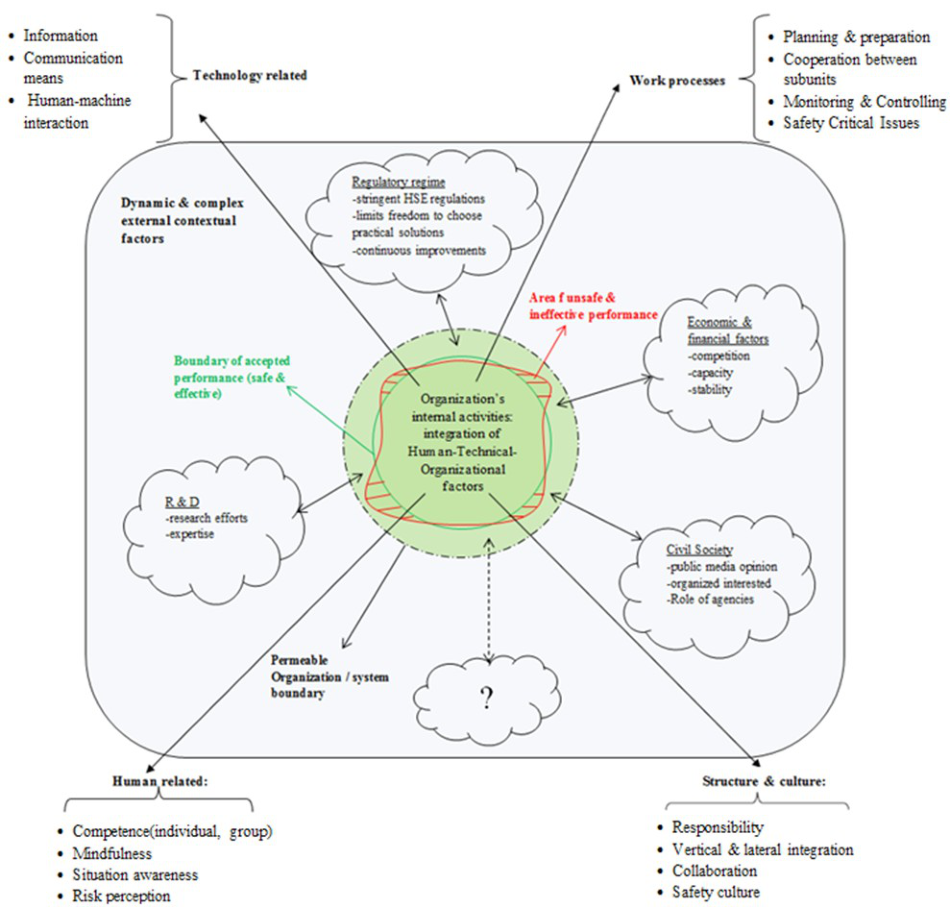
In general advanced offshore oil & gas operations are characterized as high risk, dynamic and complex systems where outcomes are not necessarily predictable from simple cause-and-effect relationships. Accidents such as the Deep Horizon and Piper Alpha disasters involved complex processes, where the risk assessment had not been systematically explored on a broad basis involving relevant stakeholders. So the way forward is to developing systemic approaches such as seen in Figure 3, in order to see the external and internal performance influencing factors. This framework in Figure 3 includes internal factors (technology related, work process, human related, safety culture and organizational structure, etc.) and external factors (external contextual factors such as market and economic factors, scientific knowledge (research efforts, expertise etc.); regulations (e.g. stringent HSE regulations); civil society (organized interests, public opinions, Medias etc.) With this approach, we can boost our knowledge on the dynamic nature of risks and risk influencing factors. This holistic approach may cover three aspects: (i) a continuous process of monitoring to identify hazards and opportunities; (ii) predicting risk scenarios using a variety of techniques in broader sense; and (iii) using organizational learning to profit from past lessons (successes and failures). In this approach, when a sociotechnical system detects that a demanding situation is developing, it changes rapidly into a more flexible and resilient mode to cope with the unexpected. The two usual shortcomings (i.e., a failure of foresight and, a failure to learn) could be avoided.
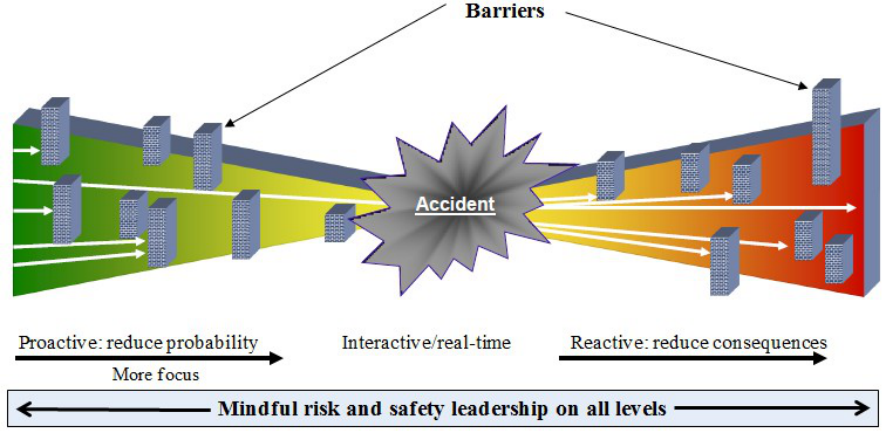
Figure 3. Open system perspective: internal and external performance shaping factors influencing safety and performance Full understanding of hazards and risks is possible by integrating different and interrelated human-organization- technical elements (Lindøe, 2011) as a continuous process-in concert with the complex and dynamic external contextual factors. Comprehensive risk assessment and management utilizes three complementary approaches and strategies – barriers – to address both likelihoods and consequences of failure (see Figure 4): proactive (activities
implemented before malfunctions occur), reactive (activities implemented after malfunctions occur), and interactive or real-time (activities implemented during development of malfunctions). In the context of these three approaches the primary strategies to be employed are: reduce incidence of malfunctions, increase detection and correction of malfunctions, and reduce effects of malfunctions. Effective risk assessment and management should be continuous and holistic process that is conducted throughout the life-cycle of a modern system. The system must be prepared to deal with the potential consequences of the potential failures. Risk managers on all levels should be mindful and know that in practice system failures caused far more damage than random hardware failures. It is with this systemic perspective where safety and risk is treated as a dynamic property (i.e. safety and risk as a learning process across system levels.)
Figure 4. Safe and efficient operation
CONCLUSION
This research demonstrated the contribution of HOFs in an organization’s drift from stage to stage to end up in failure. Increasing focus on key HOFs helps in understanding how major accidents in the offshore drilling industry can occur. Even though one can claim that technical problems are the direct cause of an accident, there is a need to determine the potential for how a focus on HOFs can significantly reduce the chances for technical failure because problems would be detected sooner, handled more properly, and eventually mitigated and/or eliminated.
What the discussion in this article has shown is how the different HOFs interact with each other and both affect and are affected by the practical drift process over the lifespan of an organization. The nature of relationships between organizations and their regulatory regimes (and other outside forces) represent a key finding and an issue that needs to be thoroughly addressed by the industry.
This study has emphasized the importance of recognizing that an organization is dynamic, with different contexts and different degrees of couplings and complexity. It is only when organizations are aware of and acknowledges this fact that they can organize themselves in a safer way, without affecting production in a significant way. Organizations must be willing to share learning points from past events, both internally and externally. Organizations operate in different stages and must therefore have a proactive attitude toward the various subunits’ ways of performing, which may require revision of current procedures. Enhanced tools such as comprehensive safety management system (preferably-risk based) are needed. Risk managers on all levels should be mindful and know that in practice system failures caused far more damage than random hardware failures. ‘Mindfulness” helps to attaining greater focus on risk assessment and management, maintaining barriers (technical, organizational, operational barriers) in excellent condition throughout operational life. These are the key activities required to reduce (and/or eliminate) major accidents.
REFERENCES
Barren, A.C. (1993). The British Government's approach to improving offshore safety. Paper OTC7094 published at Offshore Technology Conference, Houston: Texas. BP (2010). Deepwater Horizon Accident Investigation Report. Retrieved from:
h t t p: / / www .bp. c om/liveasse t s/bp_ i nte r n e t/g l obal b p/gl o bal b p _ u k _en g lish/i n c i de n t_r e s p onse / S TAGING / local _ asse t s/do w nlo a ds_ p dfs / D e e p w a t er _ H o r i z o n_A cc i d e n t_ I nvestig a tion_R e p o r t.p d f Champoux, J.E. (1999). Organizational Behavior. Essential Tenets for a New Millenium. University of New Mexico: South- Western College Publishing. Cullen, W.D., (1990). The Public Inquiry into the Piper Alpha disaster. Department of Energy, London Hollnagel E., Pariès, J., Woods, D.D., (2011). Resilience Engineering in Practice: A Guidebook. Aldershot: Ashgate. IRIS (2011). Læring av hendelser i Statoil. En studie av bakenforliggende årsaker til hendelsene på Gullfaks C og av Statoils
læringsevne. Bergen. IRIS. Leveson, N. (2011) Risk Management in the Oil and Gas Industry. Retrieved from http://mitei.mit.edu/news/risk-managementoil-and-gas-industry Lindøe, P. H. & Signe, S. (2011). “Chemical hazards and safety barriers a case study of the Norwegian offshore oil and gas
industry”. Safety Science Monitor, 15(article 3). National Commission. (2011). Deep Water. The Gulf Oil Disaster and the Future of Offshore Drilling. National Commission on the BP Deepwater Horizon Oil Spill and Offshore Drilling. Retrieved from: h t t p: / / www .oilspill c ommission. g ov/si t es / d e f a ul t / files / do c u m e n ts/DE E PW A TER_Rep o r t to th e Presi d e n t _FINAL. p d f Montara Commission. (2010). Report of the Montara Commission of Inquiry. Montara Commission. Australia. Retrieved from:
h t tp : // www .ret. g ov . au / Depa r tm e n t /Do c u ment s /MI R / M on t ar a -R e port . p d f > Nordhaug, O. (2007). LMR. Ledelse av Menneskelige Ressurser. Målrettet personal- og kompetanseledelse. Oslo: Oslo Universitetsforlaget. Perrow, C. (1984). Normal Accidents: Living with High-Risk Technologies. New York: Basic Books. Rasmussen, J. (1997). “Risk Management in a Dynamic Society: A Modeling Problem”. Safety Science, 27(2), pp.183-213. Reason, J. (1997). Managing the Risks of Organizational Accidents. England: Ashgate. Robin, P. and Peter, B. (2013) Offshore Major Accident Safety: Is SEMS Enough? Paper OTC23922 published at Offshore
Technology Conference, Houston:Texas. Ryggvik, H. (2012). Dypt vann i horisonten. Regulering av sikkerhet i Norge og USA i lys av Deepwater Horizon ulykken.
University of Oslo. TIK. Petroleum Safety Authority Norway (PSA). (2011). The Deepwater Horizon Accidents-assessments and recommendations for the Norwegian petroleum industry. Retrieved from: http://www.ptil.no/main-page/category9.html> Snook, S. A. (2000). Friendly Fire. The Accidental shootdown of U.S. Black Hawks over northern Iraq. Princeton: Princeton
University Press. Tinmannsvik, R.K.(2008) Robust arbeidspraksis. Hvorfor skjer det ikke flere ulykker på sokkelen. Trondheim.Tapir Akademisk Forlag. Thorogood, J.L. (2012). Is there a place for the High Reliability Organization in Drilling? Paper IADC/SPE 151338 published
at the Drilling Conference and Exhibition, San Diego, California, USA. Todd, R. LaPorte, Paula, M. Consolini. (1991) “Working in Practice but Not in Theory: Theoretical Challenges of High- Reliability Organizations". Journal of Public Administration Research and Theory: J-PART, 1(1). pp. 19-48. Oxford, Journal of Public Administration Research and Theory, Inc. Turner, B.A. and Pidgeon, N.F. (1997). Man-made Disasters. Oxford, Butterwoth Heineman.
LISTED IN THE AHFE DIGITAL BOOKSTORE CATALOGUE
Explore the complete digital volume
Advances in Safety Management and Human Factors
Read this individual research paper free through the original publisher, or explore the full digital proceedings book.
ISBN 978-1-4951-2100-5
Explore this ISBN in the AHFE Bookstore ↗Listed in the July 2026 bookstore catalogue; search by ISBN to confirm current availability · Digital book purchase optional