Madalena Ribeiro a, Abel Gomes (2019). Creating Accessibility to Web Contents for Colorblind People. In: Advances in Safety Management and Human Factors. AHFE Open Access, vol. 5. https://doi.org/10.54941/ahfe100147
The color is a very important asset when comes the time of interacting with other people and the ambient world, where the color may turn into the message itself. As known, about 5% of the people all over the world suffer from colorblindness, also formally called color vision deficit (CVD). It is clear that this visual impairment compromises the way those people see and interpret their surroundings and the visual messages they receive continuously. This is particularly relevant not only for those who need to correctly interpret the traffic lights — and recall that color blind because people see reds and greens in the same way —, but also for those who use the web for leisure and professional purposes daily. With this critical problem in mind, this paper proposes a new algorithm to adjust those colors that shed confusion on dichromate people (deuteranopes and protanopes). This algorithm takes advantage of a simple formula that operates on the HSV color space. The implementation of the algorithm was made by using web compliant languages, which confirm the appliance viability on web, which contributes to achieve a more inclusive visual communication. The final goal is the integration on system with the ability of performing the recoloring automatically images and text blocks, providing a better accessibility to the web pages to the CVD people, so reaching a more ergonomic design.
The people perceive each color of the visible spectrum as a mixing of three primary colors: red, green and blue. So, those without anomalies in the perception of color are called as trichromats. Those with some sort of color vision deficit (CVD) are called CVD people or colorblind people. Depending on their disability (Birch, 2001), these CVD people are classified as follows: Anomalous trichromacy
This is the weakest anomaly of color vision in CVD people and the most common. Anomalous trichromats see the colors of the visible spectrum, though with some degree of distortion. The distortion is the result of the malfunctioning of some sort of cones (Pokorny, Smith and Katz, 1973), (McIntyre, 2002). There are three types of anomalous trichromacy: protanomaly (or red-weak vision because the L-cones have been affected), deuteranomaly (or green-weak vision because the M-cones are not functioning properly) and tritanomaly (or blue-weak vision because the S-cones are not working fully) (Sharpe, Stockman, Jagle and Nathans, 1999).
Dichromacy Dichromats have only two principal color channels (i.e., a 2D domain) functioning properly. The third color channel does not exist because the corresponding cones are not functioning at all. Depending on the type of non-functional cones, we have three possible dichromatic anomalies: protanopy (non-functional L-cones), deuteranopy (non- functional M-cones) and tritanomaly (non-functional S-cones). This impairment is quite limitative for the impaired people, because they only see two different hues (yellow and blue, in the deuteranopy or in the protanopy cases; greenish blues and red, in the tritanopy cases). The other colors are seen as dingy brownish colors (Horst Scheibner, 1998).
Monochromacy This is the most severe vision anomaly in the universe. The affected people possess gray scale vision, but some of them can see grays with a touch of blue. That is, the color domain of monochromats is 1D (Alpern, 1974).
About 5% of the world population (8% of the universe of men) have some sort of color vision deficit, that is, some degree of color blindness. This imposes significant restrictions on the way those people see the environment they live. For example, some people see reds and greens in the same way, which may be risky for those who drive on the road, in particular at the spot of transit lights. Usually, these people learn to overcome color troubles in the streets or on the road, distinguishing confusing colors of transit lights through their relative positions.
Being aware of these circumstances, some researchers have developed significant efforts to minimize this problem somehow. In particular, some recoloring algorithms for still images, and not so much for video images, have been proposed in the literature. In this paper, we propose another recoloring algorithm that, unlike most of others, operates on the HSV color space.
The main contribution of this algorithm lies in the simple formula used in the recoloring of images, in particular still images found over the web. The recoloring algorithm presented in this paper only applies to the two major classes of dichromats, that is, deuteranopes and protanopes, because they see colors in a similar manner.
BACKGROUND
RGB Color Model The primary colors of the RGB model are the red (R), the green (G) and the blue (B). In the display devices, the value of the parameters R, G and B varies between 0 and 255. So, the represented colors are achieved by mixing different amounts of the primaries, concerning (R, G, B) = (0, 0, 0) to the black color and (R, G,B) = (255, 255, 255) to the white color. The other colors are gotten by specifying amount of R, G and B, all of them in the domain [0, 255]. So, this means that the RGB color space is the cube [0, 255] [Equation or mathematical symbol available in the original paper PDF] [0, 255] [Equation or mathematical symbol available in the original paper PDF] [0, 255].
The main disadvantage of the RGB model is that it is not intuitive enough when we intend to change the color of some element existing in an image. For example, it is not straightforward to change a saturated yellow to a lighter yellow. This lack of intuitiveness of the RGB color model originated the appearance of the called ”phenomenal color spaces“ (Tkalcic and Tasic, 2003), namely: HSL (hue, saturation, luminosity), HSV (hue, saturation, value) and the HSI (hue, saturation, intensity). These models were developed from the Munsell Color System (Munsell, 1907), which is close to how human beings perceive colors intuitively, being all of them resultant from linear transformations of the RGB color space.
HSV Color Model The HSV color space can be obtained by means of a linear transformation of the RGB color space. Being it a phenomenal color space, we can define colors in a more intuitive manner than in the RGB (Ford and Roberts, 1998) color space. Hues (H) are property which distinguishes the green from the yellow or from the blue. The vividness of a color increases with its saturation (S), distinguishing the vivid colors from the grayish. The value (V) has to do with the lightness or darkness of a color.
(a) (b) (c)
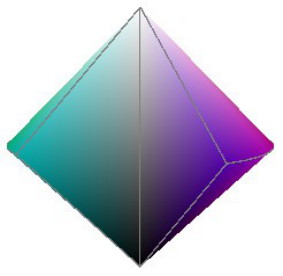
Figure 1. Color Models generated through the Processing language. (a) RGB; (b) HSV; c) HSL.
The HSV model represents colors as triplets (H, S, V ), where H [Equation or mathematical symbol available in the original paper PDF] [0º, 360º], S [Equation or mathematical symbol available in the original paper PDF] [0, 1] and V [Equation or mathematical symbol available in the original paper PDF] [0, 1]. This color space is geometrically a cone (Figure 2a), where the hues the hue vary with the angle measured around the axis of the cone, the brightness varies along the cone axis, being the black color at the apex and the white color at the center of the cone base, increasing the saturation with the distance to the cone axis. Sometimes, the value parameter is also called brightness, so this color space is referred often as HSB instead of HSV (Smith, 1978), (Travis, 1991).
HSV Color Model Similar to the HSV color space, on this color space, every color is represented as a triplet (H, S, L), where H [Equation or mathematical symbol available in the original paper PDF] [0º, 360º], S [Equation or mathematical symbol available in the original paper PDF] [0, 1] and L [Equation or mathematical symbol available in the original paper PDF] [0, 1]. However, unlike HSV, the HSL color space attains the chromatic maximum at the midpoint of the grayscale L = 1/2, not when L = 1. As a consequence, geometrically, the HSL color space is a double cone with coincident bases, so the white color is at one of the apexes and the black color is at the other apex.
Note that there is another color space, called HSI, that is congruent with the HSL color space (Gonzalez and Woods, 1992), but they are obtained from RGB using distinct linear transformations.
RELATED WORK
As noted above, the recoloring images allow to CVD people to distinguish confusing adjacent regions of an image. That is, the recoloring methods works as a color contrast technique in order to offer an individual a better perception and understanding about the image contents.
Recoloring for anomalous trichromats. The recoloring algorithms for anomalous trichromats essentially are corrective algorithms of the color distortion, since these people see all color of the visible spectrum (Ichikawa et al., 2004), (Yang et al., 2004), (Wakita and Shumamura, 2005). Martin et al. used a homomorphic model of the human color visual system (Martin, Keller, Rogers and Kabrinsky, 2000), previously outlined by Faugeras (Faugeras, 1979), which matches the human perceptual structure and reflects the physiology of the sight. Ichikawa et al. designed an algorithm to for anomalous trichromats in order to get a better contrast of the background in web pages (Ichikawa et al., 2003), (Ichikawa, et al., 2004). Ro and Yang introduced a visual accessibility technique within an MPEG-21 framework (Yang, et al., 2004), encompassing both the dichromacy and anomalous trichromacy, which as later extended by Yang et al. (Yang, Ro, Wong and Lee, 2008). In the meanwhile, Yang et al. proposed a color compensation method based on error score of the FM-100 test (Yang, Ro, Wong and Lee, 2005). Wakita and Shumamura proposed a framework to recolor documents with the purpose of applying it to web pages (Wakita and Shumamura, 2005). This framework makes usage of three goal functions, but it takes too much time even for a short set of colors.
Recoloring for dichromates. In respect to dichromats, the recoloring algorithms essentially replace some colors by others because those people are not able to see certain colors (Yang and Ro, 2003), (Yang, et al., 2005), (Rasche, Geist and Westall, 2005a, 2005b), (Jefferson and Harvey, 2006, 2007), (Huang, Tseng, Wu and Wang, 2007), (Anagnostopoulos, Tsekouras, Anagnostopoulos and Kalloniatis, 2007), (Jinmi Lee, 2008), (Kuhn, Oliveira and
Fernandes, 2008), (Doliotis, Tsekouras, Anagnostopoulos and Athitsos, 2009), (Liu, Wang, Linjun, Xiuquing and Xian-Sheng, 2009), (Wang, Liu and Hua, 2009, 2010), (Machado and Oliveira, 2010), (Jinmi Lee and Santos, 2010a, 2010b). Yang and Ro combines the HSI color model with some CMY values in the process of remapping unseen colors to the visible color spectrum of dichromates (Yang and Ro, 2003). Iaccarino et al. proposed a algorithm which works in a similar color space - the HSL (Iaccarino, Malandrino, Del Percio and Scarano, 2006). Also Ching and Sabudin opted by a color space from the same family to outline their own solution (Ching and Sabudin, 2010). The algorithms due to Huang et al. work in the HSV and CIELab color spaces altogether (Huang et al., 2007),(Huang, Wu and Chen, 2008), (Huang, Chen, Jen and Wang, 2009); in particular, they use the histogram equalization in the CIELab color space as a way of reinforcing the contrast of mapped colors, trying at the same time to preserve the naturalness of colors as much as possible by leaving the saturation and lightness unchanged. Jefferson and Harvey based their recoloring algorithms on the W3C criteria (Jefferson and Harvey, 2006, 2007), in a way inspired in the work of Brettel et al. (Brettel, Vienot and Mollon, 1997). Also inspired in the work of Brettel et al. (Brettel, et al., 1997), Anagnostopoulos et al. proposed a recoloring method especially adapted to protanopes (Anagnostopoulos, et al., 2007), having Doliotis et al. (Doliotis, et al., 2009) developed still further this work later. In the last few years, a number of algorithms based on disparate approaches have emerged in the literature, as it is the case of neural networks (Ma, Gu and Wang, 2006), matrix similarity (Ma, Gu and Wang, 2008), and fuzzy logic (Jinmi Lee and Santos, 2011).
Recoloring for monochromats. With the exception of the algorithms due to Rasche et al. (Rasche, et al., 2005a, 2005b), recoloring algorithms for monochromats are almost inexistent in the literature, possibly because the monochromacy is a rare visual impairment among world population. However, there can be used the algorithms concerning the color-to-gray conversion.
In short, the focus of the first algorithms was on the changing of color in images to provide a better perception to those people with some degree of visual impairment. The time spent by the algorithms was not a priority concern, neither their specific applications. With the increment of multimedia contents on web, the attention has shifted to get faster methods, including the recoloring in video.
THE SHRINKINVERSE ALGORITHM Recoloring Function
The ShrinkInverse algorithm has been designed for the major two families of dichromats, i.e., deuteranopes and protanopes, mainly because of the following: § Deuteranopy and protanopy are the most common visual impairments in dichromats; § Unlike tritanopes, deuteranopes and protanopes see colors in a very similar way; § The dichromacy is quite disabling.
The ShrinkInverse algorithm proposed in this paper makes usage of the HSV color space to carry out the recoloring procedure. So, firstly, the color of the pixel is converted from RGB to HSV.
Then, the colors too dark (light less than 20%) or little saturated (less than 30%) becomes darker. These colors are gray tones or colors quite dark. Diverting them to the area of the darker colors allows to assign more contrast to the image and, simultaneously, release the rest of the color domain to the remaining colors.
Considering the other colors, the ones on the domain of hues [50º, 160º] remain unchanged - the yellows and the greens. The yellows are seen correctly and the greens are seen in a more faint, but without too much away to its original nature. In addition, there are mainly in the green environments from nature, so the way they are seen is not completely unsuitable.
The colors which hues is out of that domain [50º, 160º] are mapped as follow, consisting of the strategy in two steps:
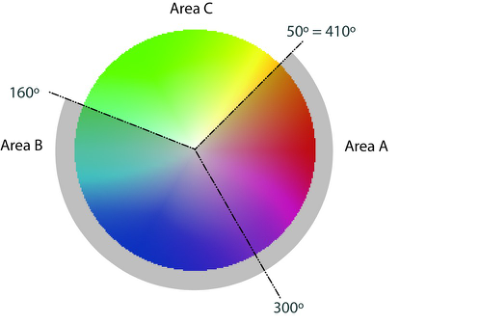
1. To stretch the interval [160º, 410º] into the interval [160º, 300º]; 2. To invert the hues, by symmetry, relative to the center of the interval.
The step 1 is performed in order that the colors more close to 160º becomes more compacted than the ones near 410º. The compression factor starts from the value of 0.2 and is increased until it reaches the value of 0.35. This tactic provides that the blues becomes more compacted than the reddish colors, because that area integrates the pinks/magentas, reds and oranges, a domain with much more diversity, which leads to the need of more differentiation.
In order to augment that differentiation from the colors of the reddish zone (pinks/magentas, reds and oranges) it is performed the step 2, in which is executed an inversion of the distribution of the hues in the new target domain [160º, 300º].
Figure 2. Schema representing the step 1. Area A: The colors are shrunken and pushed to the right section of the Area B, where the colors are also shrunken and pushed to the left section of the domain of the Area B. The colors of the Area C remains unchanged.
After the first step, the blues are distributed from 160º onwards, then appears the mapped violets, magentas, reds and, at last, the oranges near 300º. However, the deuteranopes and protanopes perceives much better the differentiation in hues between 160º and 240º, then from 240º to 300º. So, by inverting the position of the mapped hues, the discrimination between the reddish colors is improved. Besides, the colors near 300º are seen (by the target people) as a very strong blues, while the really blues are seen in a lighter way.
This recoloring is applied not only to colors like pink, red and orange, i.e., colors that are normally mistaken by greens, but also to blues. The idea is to remap blues into blues and the magenta, reds and oranges, also into blues, but different. This is achieved but compressing the blues into a small area, leaving the remaining part of the blue area to the reddish colors (pinks, reds and oranges).
The recoloring is done by only re-mapping the hue (H) for some colors and the value (V) for other colors; the saturation (S) remains always unchanged. That is, we end up having the following trivariate recoloring functions: (1)
The hue remapping function ρ(H) is as follows:
(2)
where
(3)
and
(4)
The value changing function μ(V ) is as follows:
(5)
The hue remapping function (2) works as inversion operation after a shrink process for the angular interval [160º, 410º ≡ 50º]. The shrink process is performed by the function (3) and the inversion operation is made by the function (4).
The Recoloring Algorithm The recoloring algorithm here proposed in based on two concepts: ” shrink” and ”inversion” operations. So, taking these two concepts, let us call it ShrinkInverse algorithm. The shrink is expressed in line 10 of Algorithm I, while the inversion of hues performed by the symmetry with respect to 230º, appears on lines 12 and 14 of Algorithm I.
Algorithm 2 iterates on all pixels of an n[Equation or mathematical symbol available in the original paper PDF]m image, calling then the PIXELREMAP procedure (Algorithm I) that remaps every single from the range of colors to map. It is clear that the re-mapping of any hue requires the previous conversion of the (R, G, B) values to their corresponding (H, S, V ) values, and vice-versa, as expressed in lines 2 and 18 of Algorithm I.
Algorithm I: ShrinkInverse Recoloring Algorithm for a Single Pixel 1: procedure PIXELREMAP(R,G,B) 2: Convert the (R, G, B) to (H, S, V) 3: if (V < 50) || (S < 30) then 4: V [Equation or mathematical symbol available in the original paper PDF] 0.5 [Equation or mathematical symbol available in the original paper PDF] V 5: else 6: if (H [Equation or mathematical symbol available in the original paper PDF] 50) then 7: H [Equation or mathematical symbol available in the original paper PDF] H + 360 8: end if 9: if H[Equation or mathematical symbol available in the original paper PDF] [160º, 410º] then 10: H [Equation or mathematical symbol available in the original paper PDF] 160 + 0.2 [Equation or mathematical symbol available in the original paper PDF] H + 0.1415 [Equation or mathematical symbol available in the original paper PDF] (Abs (160 - H) / 250) [Equation or mathematical symbol available in the original paper PDF]H 11: if (H < 232) then 12: H [Equation or mathematical symbol available in the original paper PDF] 230 + Abs(H - 230) 13: else 14: H [Equation or mathematical symbol available in the original paper PDF] 230 - Abs(H - 230) 15: end if 16: end if 17: end if 18: Convert the (H, S, V) to (R, G, B) 19: end procedure Note: R,G,B [Equation or mathematical symbol available in the original paper PDF][0,255]; H [Equation or mathematical symbol available in the original paper PDF][0,360[; S [Equation or mathematical symbol available in the original paper PDF][0,100]; V [Equation or mathematical symbol available in the original paper PDF][0,255]
Algorithm II: ShrinkInverse Recoloring Algorithm for a n [Equation or mathematical symbol available in the original paper PDF] m Image 1: procedure IMAGEMODIFY(R,G,B) 2: for i=1 [Equation or mathematical symbol available in the original paper PDF] n do 3: for j=1 [Equation or mathematical symbol available in the original paper PDF] n do 4: (R, G, B) [Equation or mathematical symbol available in the original paper PDF] components R, G, B of pixel (i, j) 5: PIXELMODIFY(R,G,B) 6: end for 7: end for 8: end procedure
EXPERIMENTAL RESULTS Setup
In terms of hardware and software set, all experiments and testing were carried out using: § An Intel Core 2 Quad CPU Q9550 with 4G RAM; § An 64-bit Microsoft Windows operating system; § Javascript programming language in order to run the ShrinkInverse algorithm on HTML5 web browsers.
In particular, the ShrinkInverse algorithm has been designed and implemented for deuteranopes and protanopes. As argued above, this was so because deuteranopy and protanopy are not only the most frequent cases of dichromacy, but also because they see all the colors in a similar manner. It is also worthy noting that our experiments and testing have focused only on still images.
Comparative Analysis In order to compare our algorithm with others found in the literature, we thought reasonable only compare it with those two due to Iaccarino et al. (Iaccarino, et al., 2006) and Ching and Sabudin (Ching and Sabudin, 2010) for the following reasons:
§ They are also applied to deuteranopes and protanopes; § They also use a phenomenal color space to remap hues; § They are the two most recent algorithms, among the few which use a phenomenal color space in the recoloring process.
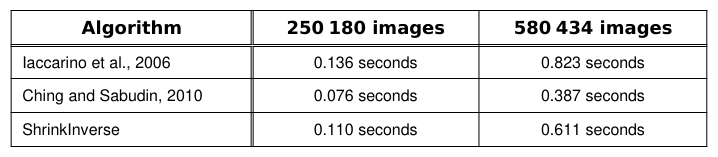
Time Performance Apart the ShrinkInverse algorithm, we also implemented those algorithms due to Iaccarino et al. (Iaccarino, et al., 2006) and Ching and Sabudin (Ching and Sabudin, 2010) within the setup described above. We have used a dataset of about one hundred 250[Equation or mathematical symbol available in the original paper PDF]180 and 580[Equation or mathematical symbol available in the original paper PDF]434 images to measure the average times taken those three algorithms, as shown in Table 1.
As shown, our algorithm is around 30% slower than Ching-Sabudin algorithm, but and 30% faster when compared to the algorithm due to Iaccarino and colleagues. In a way, this is so because the ShrinkInverse does not perform any pre-processing step as happens in Iaccarino et al. algorithm to calculate the ‘red pixels’ and ‘green pixels’ of each image, before starting the recoloring procedure itself. The algorithm due to Ching and Sabudin is faster because, before the conversion of the pixels from RGB to HSV, there are excluded all the pixels which red value is greater than the green and the blue values. In this way, around of third of the total of pixels are not converted and reconverted. This explains the speedup of 30%, though it is due to leaving out an important part of the color domain.
Table 1: Average time spent by the algorithms in recoloring 250[Equation or mathematical symbol available in the original paper PDF]180 and 580[Equation or mathematical symbol available in the original paper PDF]434 images.
The performing time depends on the used browser. The times presented on the table 1 are extracted, using the IE 11. However they can be significantly lower (50% to 70%), using the Firefox 27.
Comparative Recoloring Before proceeding any further, let us say that we had also to implement the simulation algorithms proposed Brettel et al. (Brettel, et al., 1997). This is a very important requirement to realize how deuteranopes and protanopes see colors in images. This understanding of how deuteranopes and protanopes see colors also led us to use images with high chromatic diversity, as those shown in Fig. 3, during our experiments and testing.
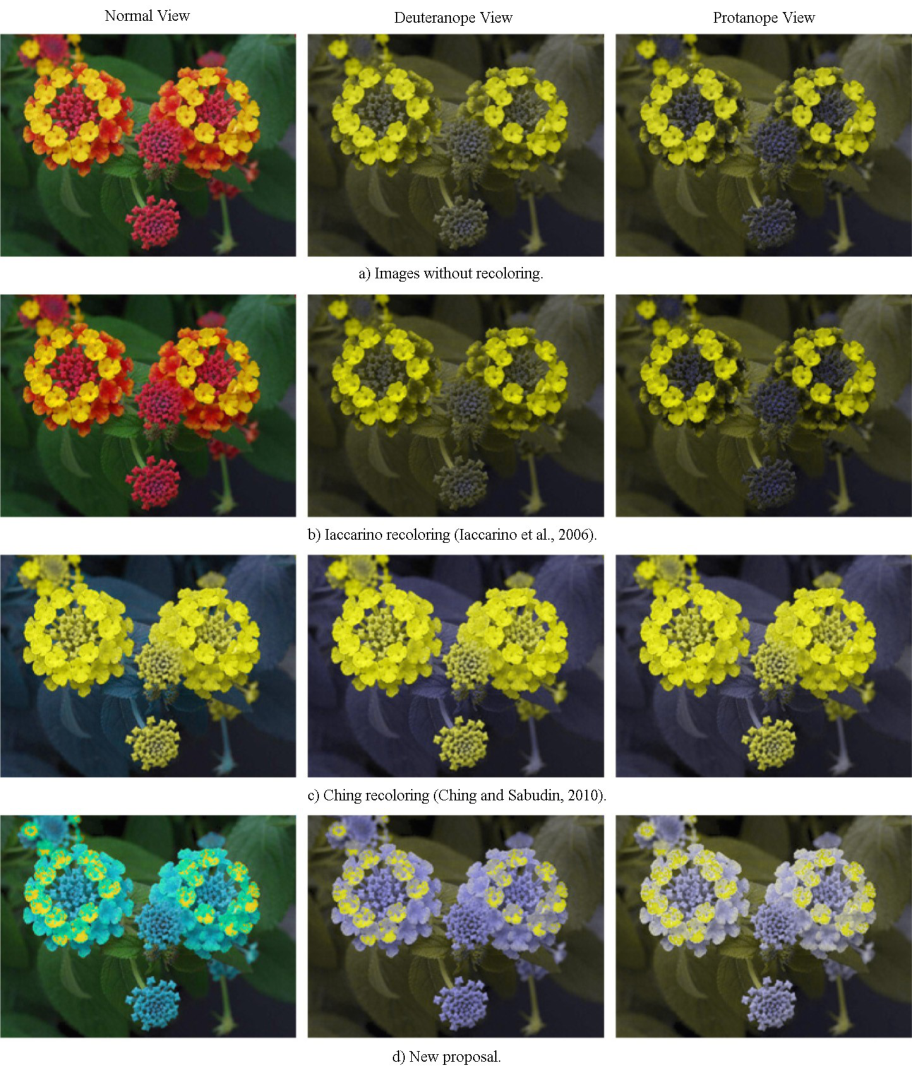
Figure 3. Recoloring flowers for dichromats (no CVD), deuteranopes and protanopes.
As known, deuteranopes and protanopes see yellows and blues in a correct manner and the greens in a downfallen way. This is illustrated in Fig. 3(a) and means that these colors must remain unchanged after the recoloring a given image, yet deuteranopes and protanopes see greens with less saturation and lightness. Note that these dichromats do mistake reddish colors, including pinks and oranges, with greenish colors.
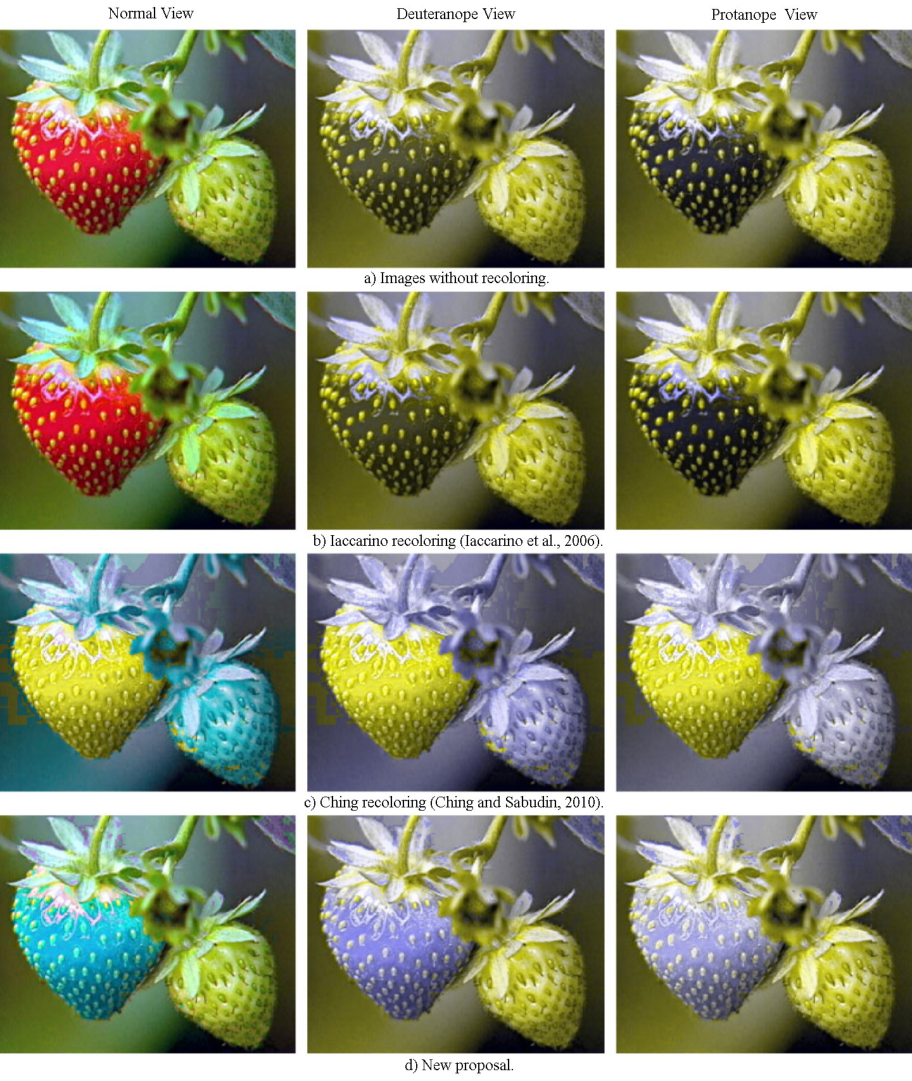
Fig. 3(b) depicts the images recolored by the algorithm due to Iaccarino et al. (Iaccarino, et al., 2006). As observed, in respect to deuteranopes and protanopes, this recoloring technique does not enhance that much the chromatic diversity of the image in relation to the image without recoloring. Besides, this algorithm does not hold the colors in the range of reds. The appliance of this algorithm leads to images very similar with the original, so it not provides a clear improvement.
Figure 4. Recoloring strawberries for dichromats (no CVD), deuteranopes and protanopes.
Fig. 3(c) shows images recolored by the algorithm introduced by Ching and Sabudin (Ching and Sabudin, 2010). Unlike Iaccarino et al. (Iaccarino, et al., 2006), this algorithm retains the vivid yellows, but the images recolored in this manner look too yellowish and the details are not differentiated, since the reddish colors were mapped into yellow, and the yellow presents a low domain of diversity. Besides, most greens are now mapped into blues, what implies that deuteranopes and protanopes can no longer see greens, which is a color that they see, although less saturated.
Visual results produced by the ShrinkInverse algorithm are shown in Fig. 3(d). Although the original image has no blue, we can guarantee that this color remains unchanged as well the yellows and greens. Since the confusing colors in the range of reds, those color are remapped to the range of blues. As observed in Fig. 3 and Fig. 4, the images recolored by the ShrinkInverse algorithm retain a clean visual appearance because, with a clear enhancement of the way the flowers and the strawberries are seen by deuteranopes and protanopes. It is notorious the improvement on the discrimination of the details of the images, . As a margin note, the images of flowers shown in Fig. 3 and the images of strawberries depicted in Fig. 4 can be produced within a HTML5-compliant browser.
CONCLUSIONS
In all the situations that deuteranopes and protanopes face daily, it seems much more significant to be able to distinguish between reds and greens - as necessary to correctly interpret the transit signage - than between any other two colors of their narrower visible spectrum. Besides the meaningful of reddish colors is not found by that target people.
Taking this into consideration, we have designed and implemented a recoloring algorithm for dichromats that enables to distinguish between reds and greens unambiguously, without changing the saturation and lightness of the original colors. Additionally, as the reddish hues are not seen, the vividness of those colors is represented through the blue color, one of the only two hues seen by the deuteranopes and protanopes. Recurring to this artifact, it was possible to recover part of the visual expressiveness of the scenes.
The time performance tests presented above include the time taken to load images in memory. But, if we consider that images are already in memory, we easily draw to the conclusion that the ShrinkInverse algorithm runs at a real- time rate, what makes it adequate not only for recoloring still images in web pages, but also for recoloring video applications. For example, the pictures of flowers and strawberries used in this paper are recolored in about 30 ms, what means that each one of them can be recolored 33 times per second, clearly above the barrier of 24 fps (frames per second) that establishes a real-time standard.
REFERENCES
Alpern, M. (1974). "What is it that Confines in a World Without Color?". Investigate Ophthalmology, 13(9), 648-674. Anagnostopoulos, C.-N., Tsekouras, G., Anagnostopoulos, I., Kalloniatis, C. (2007). "Intelligent Modification for the Daltonization Process of Digitized Paintings". Paper presented at the 5th International Conference on Computer Vision Systems (ICVS), Bielefeld, Germany. Birch, J. (2001). "Diagnosis of Defective Colour Vision" (Second edition ed.). Edimburgh: Elsevier Science. Brettel, H., Vienot, F., Mollon, J. D. (1997). "Computerized Simulation of Color Appearance for Dichromats". [Article]. Journal
of the Optical Society of America a-Optics Image Science and Vision, 14(10), 2647-2655. doi: 10.1364/josaa.14.002647 Ching, S.-L., Sabudin, M. (2010, 2-4 Nov. 2010). "Website Image Colour Transformation for the Colour Blind". Paper presented at the 2nd International Conference on Computer Technology and Development (ICCTD). Doliotis, P., Tsekouras, G., Anagnostopoulos, C.-N., Athitsos, V. (2009). "Intelligent Modification of Colors in Digitized
Paintings for Enhancing the Visual Perception of Color-blind Viewers". In I. Iliadis, M. Maglogiann, T. Tsoumakasis, V. Vlahavas andB. Bramer (Eds.), (Vol. 296, pp. 293-301): Springer Boston. Faugeras, O. (1979). "Digital Color Image Processing within the Framework of a Human Visual Model". IEEE Transactions on Acoustics, Speech and Signal Processing, 27(4), 380-393. Ford, A., Roberts, A. (1998). "Colour Space Conversions". London: Westminster University. Gonzalez, R., Woods, R. (1992). "Digital Image Processing" (1st ed.): Addison-Wesley. Horst Scheibner, S. C. (1998). "Dichromacy Characterized by Chrominance Planes". Vision Research, 38(21), 3403-3403. Huang, J.-B., Chen, C.-S., Jen, T.-C., Wang, S.-J. (2009). "Image Recolorization for the Colorblind" IEEE International
Conference on Acoustics, Speech, and Signal Processing (Vol. 1(8), pp. 1161-1164). New York: Ieee. Huang, J.-B., Tseng, Y.-C., Wu, S.-I., Wang, S.-J. (2007). "Information Preserving Color Transformation for Protanopia and
Deuteranopia". IEEE Signal Processing Letters, 14(10), 711-714. Huang, J.-B., Wu, S.-Y., Chen, C.-S. (2008). "Enhancing Color Representation for the Color Vision Impaired". Paper presented at the ECCV Workshop on Computer Vision Applications for the Visually Impaired. Iaccarino, G., Malandrino, D., Del Percio, M., Scarano, V. (2006). "Efficient Edge-services for Colorblind Users". Paper
presented at the 15th International Conference on World Wide Web (WWW), Edinburgh, Scotland. Ichikawa, M., Tanaka, K., Kondo, S., Hiroshima, K., Ichikawa, K., Tanabe, S., et al. (2003). "Web-Page Color Modification for Barrier-Free Color Vision with Genetic Algorithm". Ichikawa, M., Tanaka, K., Kondo, S., Hiroshima, K., Ichikawa, K., Tanabe, S., et al. (2004, 10-13 Oct. 2004). "Preliminary Study
on Color Modification for Still Images to Realize Barrier-free Color Vision". Paper presented at the IEEE International Conference on Systems, Man and Cybernetics. Jefferson, L., Harvey, R. (2006). "Accommodating Color Blind Computer Users". Paper presented at the ACM 8th International Conference on Computers and Accessibility (SIGACCESS), Portland, Oregon, USA. Jefferson, L., Harvey, R. (2007). "An Interface to Support Color Blind Computer Users". Paper presented at the Conference on
Human Factors in Computing Systems (SIGCHI), San Jose, California, USA. Kuhn, G., Oliveira, M., Fernandes, L. (2008). "An Efficient Naturalness-Preserving Image-Recoloring Method for Dichromats".
IEEE Transactions on Visualization and Computer Graphics, 14(6), 1747-1754. Lee, J. (2008). "Uma Ferramenta Adaptativa para Facilitar a Visualização de Imagens para Pessoas Portadoras de Daltonismo". Bacharel em Engenharia da Computação, Escola Politécnica de Pernambuco - Universidade de Pernambuco, Recife. Lee, J., Santos, W. (2010a). "An Adaptative Fuzzy-Based System to Evaluate Color Blindness". Paper presented at the 17th
International Conference on Systems, Signals and Image Processing (IWSSIP), Rio de Janeiro, Brazil. Lee, J., Santos, W. (2010b, Aug. 31 2010-Sept. 4 2010). "Fuzzy-based Simulation of Real Color Blindness". Paper presented at the IEEE Annual International Conference of the Engineering in Medicine and Biology Society (EMBC) Lee, J., Santos, W. (2011). "An Adaptive Fuzzy-based System to Simulate, Quantify and Compensate Color Blindness".
Integrated Computer-Aided Engineering, 18(1), 29-40. Liu, B., Wang, M., Linjun, Y., Xiuquing, W., Xian-Sheng, H. (2009, June 28 2009-July 3 2009). "Efficient Image and Video Recoloring for Colorblindness". Paper presented at the International Conference othe Multimedia and Expo (ICME). Ma, Y., Gu, X.-D., Wang, Y.-Y. (2006). "A New Color Blindness Cure Model Based on BP Neural Network". In J. Wang, Z. Yi,
J. M. Zurada, B. L. Lu andH. Yin (Eds.), Advances in Neural Networks (Vol. 3973, pp. 740-745). Berlin: Springer- Verlag Berlin. Ma, Y., Gu, X., Wang, Y. (2008). "Color Discrimination Enhancement for Dichromats using Self-organizing Color Transformation". Information Sciences, 179(6), 830-843. doi: 10.1016/j.ins.2008.11.010 Machado, G. M., Oliveira, M. M. (2010). "Real-Time Temporal-Coherent Color Contrast Enhancement for Dichromats".
Computer Graphics Forum, 29(3), 933-942. doi: 10.1111/j.1467-8659.2009.01701.x Martin, C., Keller, J., Rogers, S., Kabrinsky, M. (2000). "Color Blindness and a Color Human Visual System Model". IEEE Transactions on Systems, Man and Cybernetics, Part A: Systems and Humans, 30(4), 494-500. McIntyre, D. (2002). "Colour Blindness: Causes and Effects". Chester: Dalton Publishing. Munsell, A. H. (1907). "A Color Notation - A measured color system, based on the three qualities Hue, Value and Chroma " Pokorny, J., Smith, V. C., Katz, I. (1973). "Derivation of the Photopigment Absorption Spectra in Anomalous Trichromats".
Journal of the Optical Society of America, 63(2), 232-237. doi: 10.1364/josa.63.000232 Rasche, K., Geist, R., Westall, J. (2005a). "Detail Preserving Reproduction of Color Images for Monochromats and Dichromats".
IEEE Computer Graphics and Applications, 25(3), 22-30. Rasche, K., Geist, R., Westall, J. (2005b). "Re-coloring Images for Gamuts of Lower Dimension". Computer Graphics Forum, 24(3), 423-432. doi: 10.1111/j.1467-8659.2005.00867.x Sharpe, L., Stockman, A., Jagle, H., Nathans, J. (1999). "Opsin Genes, Cone Photopigments, Color Vision and Color Blindness".
In K. Gegenfurtner andL. Sharpe (Eds.), Color Vision. New York: Cambridge University Press. Smith, A. R. (1978). "Color Gamut Transform Pairs". SIGGRAPH, 12(3), 12-19. doi: 10.1145/965139.807361 Tkalcic, M., Tasic, J. F. (2003). "Colour Spaces: Perceptual, Historical and Applicational Background ". Paper presented at the EUROCON 2003 - Computer as a Tool, Ljubljana University, Slovenia Travis, D. (1991). "Effective Color Displays: Theory and Practice". London: Academic Press. Wakita, K., Shumamura, K. (2005). "SmartColor: Disambiguation Framework for the Colorblind". Paper presented at the
ASSETS'05, Baltimore, Maryland, USA. Wang, M., Liu, B., Hua, X.-S. (2009). "Accessible Image Search". Paper presented at the ACM 17th International Conference on Multimedia, Beijing, China. Wang, M., Liu, B., Hua, X.-S. (2010). "Accessible Image Search for Colorblindness". ACM Trans. Intell. Syst. Technol., 1(1), 1-
26. doi: 10.1145/1858948.1858956 Yang, S., Ro, Y. M. (2003, 14-17 Sept. 2003). "Visual Contents Adaptation for Color Vision Deficiency". Paper presented at the International Conference on Image Processing (ICIP). Yang, S., Ro, Y. M., Nam, J., Hong, J., Choi, S. Y., Lee, J.-H. (2004). "Improving Visual Accessibility for Color Vision
Deficiency based on MPEG-21". [Article]. Etri Journal, 26(3), 195-202. Yang, S., Ro, Y. M., Wong, E. K., Lee, J.-H. (2005, 17-18 Jan. 2006). "Color Compensation for Anomalous Trichromats Based on Error Score of FM-100 Hue Test". Paper presented at the IEEE 27th Annual International Conference of the Engineering in Medicine and Biology Society (EMBS). Yang, S., Ro, Y. M., Wong, E. K., Lee, J.-H. (2008). "Quantification and Standardized Description of Color Vision Deficiency
Caused by Anomalous Trichromats - part II: Modeling and Color Compensation". EURASIP Journal on Image and Video Processing, 2008. doi: 10.1155/2008/246014
LISTED IN THE AHFE DIGITAL BOOKSTORE CATALOGUE
Explore the complete digital volume
Advances in Safety Management and Human Factors
Read this individual research paper free through the original publisher, or explore the full digital proceedings book.
ISBN 978-1-4951-2100-5
Explore this ISBN in the AHFE Bookstore ↗Listed in the July 2026 bookstore catalogue; search by ISBN to confirm current availability · Digital book purchase optional