Alessio Silvetti, Massimo Gismondi, Silvia Mari, Federico Forzano (2020). sEMG Studies of Milking Activities in Two Different Working Conditions. In: Advances in Social and Organizational Factors. AHFE Open Access, vol. 9. https://doi.org/10.54941/ahfe100343
The increasing degree of specialization of the work involved in milk production due to the growing size of herds often leads to upper limb repetitive movements. Despite the adoption of automation processes, milk production is still an occupation that is susceptible to biomechanical overload. Muscle activity of the extensor pollicis brevis (EXT), flexor carpi radialis (FLEX), biceps brachii (BB) and deltoideus anterior (DA) was studied in five workers while they performed udder cleaning and tapping tasks both before and after an ergonomic intervention consisting in 1) reducing the working plane height by means of a carpet; 2) changing the plastic bottles used in tapping tasks regularly to prevent them from hardening. The mean activation and the time percentage over 10% of the maximal voluntary contraction were calculated. Both tasks induced a marked effort from the EXT and DA muscles, and a milder effort from the BB and FLEX muscles. The ergonomic intervention was followed by a downward trend in both parameters. Further data are currently being acquired on a larger sample of workers to verify whether these preliminary findings are supported more robust statistical analyses.
The increasing degree of specialization of the work involved in milk production due to the growing size of herds often leads to upper limb repetitive movements. The activity of dairy parlor workers in recent years has changed radically. Milking activities, which require no more than a few minutes per cow, may in large herds last the entire working shift. Despite the adoption of automated processes, milk production remains an occupational problem, as reported in many studies in the literature, with milkers often experiencing pain in different parts of their musculoskeletal system. Vostrikov (Vostrikov, 1995) demonstrated that the efficiency of skilled workers after two hours of continuous milking activities tended to decrease, resulting in an increased number of errors and disruptions as well as a loss of productivity.
Lundqvist (Lundqvist et al., 1997) reported a high risk of repetitive movements of the upper limbs for parlor milkers, as did Stal (Stal, 2001), who found high flexo-extension and radial deviation values in both wrists. More recently, Pinzke (Pinzke, 2003) and Stal (Stal et al., 2000) applied surface electromyography to assess milkers’ muscle activity. Pinzke, who recorded the biceps brachii and forearm flexors bilaterally in three main tasks, i.e. “drying (the cow’s udder)”, “pre-milking (the first milk)” and “attaching (the milking unit to the udder)”, found high muscle load values and a lack of time for rest. Stal recorded the biceps muscle and the flexor and extensor muscles of the forearm bilaterally in both a traditional and a more modern milk production system. She found that the peak loads for the flexor and extensor muscles were close to their maximum capacity. Both studies concluded that the combination of high muscle activity values and extreme wrist and hand postures might contribute to the development of musculoskeletal disorders.
The afore-mentioned studies highlight the risk of upper limb musculoskeletal disorders associated with milking activities. However, it should be borne in mind that these studies were conducted with wired sEMG equipment that restricted the workers’ movement during the recordings. For the purposes of our study, we instead adopted totally wireless equipment that allowed us to record muscles involved in fine motor skills, such as the extensor brevis pollicis, without affecting the real working conditions and, consequently, to record milking activities not in laboratory simulation conditions but in a real working environment.
MATERIALS AND METHODS
Five skilled male workers were enrolled in the study. The tasks of udder cleaning and tapping were studied in two different work stations before and after ergonomic interventions consisting in 1) reducing the working plane height by means of a 5 cm-thick carpet; 2) changing the plastic bottles used in tapping tasks regularly to prevent them from hardening. Each task was based on the milking of six cows; the workers’ mean age (SD) was 37 years (4.2) and their mean height was 170 cm (3.8). None of the participants had a history of either musculoskeletal disorders or neurological diseases. No information regarding the expected results was provided in order to avoid the results being biased, whether consciously or unconsciously. Electrical muscle activity was recorded using a 16 channel Wi-Fi surface electromyography system (FreeEMG, BTS SpA, Milan, Italy) at a sampling frequency of 1 kHz.
After skin preparation, surface electromyographic signals were detected from each muscle by means of two Ag/AgCl pre-gelled disposable surface electrodes (H124SG, Kendall ARBO, Donau, Germany), which had a detection surface of 10 mm (gelled). Electrodes were placed in the direction of the muscle fibers, according to the European Recommendations for Surface Electromyography (SENIAM) (Hermes et al., 2000), with a centre-to- centre distance of 20 mm. We investigated the following muscles on the right side of the body: extensor pollicis brevis (EXT), flexor carpi radialis (FLEX), deltoideus anterior (DA) and biceps brachii (BB). In order to elicit the maximal voluntary isometric contraction (MVCi) from each muscle, six isometric exertions were performed, according to SENIAM recommendations. The sEMG signals were rectified, integrated with a mobile window of 0.125 s, filtered with a 5 Hz Hamming low-pass filter and normalized to the maximum value of the MVCi. The mean activation and the time percentage exceeding 10% of the MVCi were measured.
Figure 1 shows the probe placement. The probes were protected by means of gloves used specifically for milking activities (Figure 2).
Figure 3 contains a sample of the data we recorded. The recordings clearly illustrate the activity of each of the four muscles studied while the six cows were being milked. Figure 4 shown the tie stall before (above) and after (below) the ergonomic intervention performed by adding a 5 cm high plate.
Figure 3: a sample of the four sEMG signals recorded. The image shows (from top to bottom): the extensor pollicis brevis, flexor carpi radialis, deltoideus anterior and biceps brachii
Figure available in the original PDF paper.
Figure 4: tie stall before (above) and after (below) the ergonomic intervention. Below the 5 cm high carpet and an aiding cradle containing dirty and clean wipes are shown
Figure available in the original PDF paper.
The results show that both tasks induced a marked effort from the EXT and DA muscles, and a milder effort from the BB and FLEX activities.
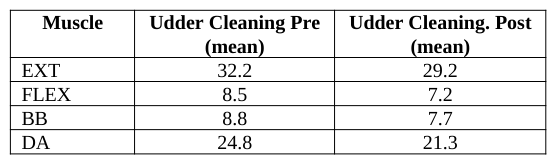
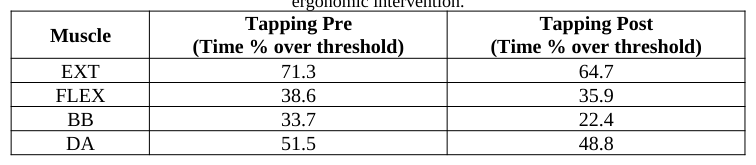
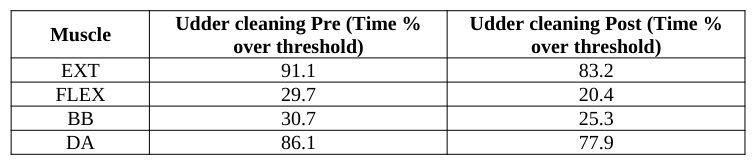
Tables 1 and 2 show the mean values in both tasks before and after the ergonomic intervention. Figures 5 and 6 schematize the values shown in Tables 1 and 2. Tables 3 and 4 and Figures 7 and 8 instead illustrate the time percentage over the 10% threshold of the MVC.
Table 1: mean activities before and after the ergonomic intervention in the tapping task Muscle Tapping PreTable 2: mean activities before and after the ergonomic intervention in the udder cleaning task.Figure 5: comparison of mean muscle activities in the tapping task pre- (dark gray) and post- (light gray) ergonomic intervention.
Figure available in the original PDF paper.
30
25
20
Pre Post
15
% MVC
10
5
EXT FLEX BB DA 0
Figure 6: comparison of mean muscle activities in the udder cleaning task pre- (dark gray) and post- (light gray) ergonomic intervention.
Figure available in the original PDF paper.
35 Mean activity - Udder cleaning
30
25
20
Pre Post
15
% MVC
10
5
EXT FLEX BB DA 0
Table 3: time percentage activity over the 10% threshold of the MCV for each muscle in the tapping task before and after the ergonomic intervention.Table 4: time percentage activity over the 10% threshold of the MCV for each muscle in the tapping task before and after the ergonomic intervention.Figure 7: comparison of time percentage activation over the 10% threshold of the MCV in the tapping task pre- (dark gray) and post- (light gray) the ergonomic intervention.
Figure available in the original PDF paper.
100 Time % over threshold - Tapping
80
60
Pre Post
%
40
20
EXT FLEX BB DA 0
Figure 8: comparison of time percentage activation over the 10% threshold of the MCV in the udder cleaning task pre- (dark gray) and post- (light gray) the ergonomic intervention.
Figure available in the original PDF paper.
100 Time % over threshold - Udder cleaning
80
60
Pre Post
%
40
20
EXT FLEX BB DA 0
DISCUSSION
In contrast to the papers cited in the introduction, our study was not conducted in laboratory simulation conditions but directly in the stall thanks to the non-invasiveness of the sEMG recording technologies available nowadays.
Indeed, the equipment we used allowed us to investigate not only the muscles normally studied, such as the biceps brachii, flexor and extensor of the forearm, but also the extensor pollicis brevis muscle, which played a major role in the two sub-tasks investigated.
After the ergonomic intervention, we observed a downward trend in both parameters (mean activity and time percentage over threshold) in both tasks (tapping and udder cleaning) in the muscles involved most, i.e. extensor pollicis brevis and deltoideus anterior. There were, instead, no substantial differences in the muscle activity of the flexor carpi radialis or biceps brachii in either task between the pre- and post-ergonomic intervention values. We thus observed, albeit in a small sample of workers, that the measures we adopted (i.e. reducing the working plane height by means of a 5 cm-thick carpet and changing the plastic bottles used in tapping tasks regularly to prevent them from hardening) may be considered as two simple and cheap solutions to reduce the risk of biomechanical overload in milking activities.
Further data are currently being acquired on a larger sample of workers to verify whether these preliminary findings are supported more robust statistical analyses.
REFERENCES
Hermes, H., Freriks, B., Merletti, R. et al. (2000), “European recommendations for surface ElectroMyoGraphy (SENIAM)”, CLUT Ed pp 138. Lundqvist, P., Stal, M. and Pinzke, S. (1997), “Ergonomics of cow milking in Sweden”, J-Agromed Volume 4 No. 1/2 pp. 169-76. Pinzke, S. (2003), “Changes in working conditions and health among dairy farmers in southern Sweden. A 14-year follow-up”.
Ann Agric Environ Med, Volume 10 pp. 185–195. Stal, M., Hansson, G.A., Moritz, U. (2000), “Upper extremity muscular load during machine milking”, International Journal of Industrial Ergonomics Volume 26 No. 1 pp 9-17. Stal, M, and T Juliszewski. (2001). “Analysis of wrist angles and movements applied to machine milking”. Farm Work Science
Facing the Challenges of the XXI Century. Proceedings XXIX CIOSTA GIGR V Congress, Krakow, Poland, 25-27 June, pp. 273-276. Vostrikov, VA. (1995), “Development of methods for relieving fatigue in milking machine operators”. Tekhnika v Sel'Skom Khozyaistve. Volume 199 No. 4 pp. 24-26.
LISTED IN THE AHFE DIGITAL BOOKSTORE CATALOGUE
Explore the complete digital volume
Advances in Social and Organizational Factors
Read this individual research paper free through the original publisher, or explore the full digital proceedings book.
ISBN 978-1-4951-2102-9
Explore this ISBN in the AHFE Bookstore ↗Listed in the July 2026 bookstore catalogue; search by ISBN to confirm current availability · Digital book purchase optional