Jonas Schmidtler, Christin Hölzel, Verena Knott, Klaus Bengler (2020). Human Centered Assistance Applications for Production. In: Advances in The Ergonomics in Manufacturing: Managing the Enterprise of the Future. AHFE Open Access, vol. 12. https://doi.org/10.54941/ahfe100459
The term human centered assistance applications for production is formed by three researchers within the connected human modelling group at the Institute of Ergonomics of Technische Univeristät München (TUM). The common research objective is to facilitate work while increasing the efficiency of the process in production environments and logistics. The three approaches Lifting Aid, Cobot and Assembly Glove treat the topic in different perspectives and crafts. While Lifting Aid addresses logistics, Cobot deals with material handling in automotive assembly and Assembly Glove sets its focus on the assembly process in the narrow sense. This paper will give an impression about the Institute of Ergonomics` fields of research in the production context and how ergonomic design of future production systems should be implemented.
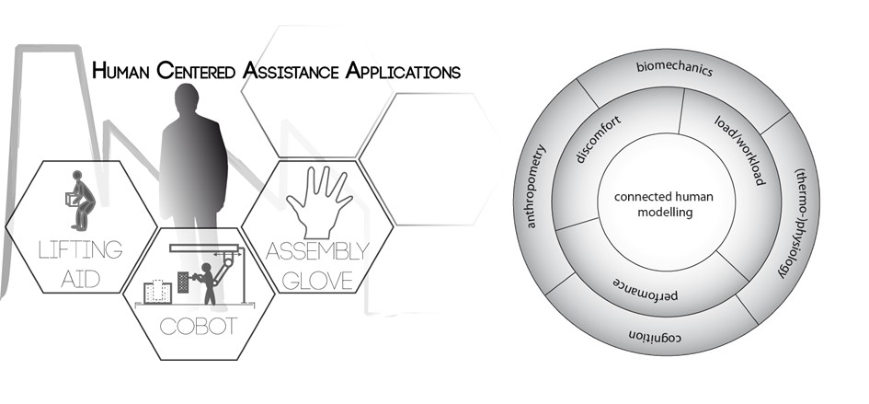
Today one of the biggest challenges in designing work stations in a production line or in logistics is the demographic change. Due to increasing musculoskeletal disorders (MSDs) with age work station design needs to be ergonomic and age related to offer bearable work for every person. Companies like BMW or VW are well aware of the defiance as four out of ten workers will be over 50 in ten years. Besides the demographic change and its challenging tasks, human resource development (i.e. diversity management) is another crucial topic and should be considered in the development of new products and production systems (Zülich, 2010). Therefore the resulting question is: How could the factory of the future look implying flexible, ergonomic and age related working stations? Common solutions for some of these problems are highly automated systems with robots attending the hard work. Another obvious solution is the use of Intelligent Assist Devices like handling systems. From the authors opinion there could be another holistic approach for future production systems using the benefits of common solutions. Universal designed Human Centered Assistance Applications (HCAAs, Figure 1, left) should offer physical as well as cognitive support to the workers. HCAAs should decrease physical and cognitive workload while increasing efficiency and quality. The Institute of Ergonomics follows this approach in three projects: Körpergetragene Hebehilfe (Lifting Aid) and KobotAERGO (Cobot) both funded by the Federal Ministry of Education and Research (BMBF) and a cooperation with BMW (Assembly Glove).
These three projects are placed among others in the connected human modelling research group (Figure 1, right) at the Institute of Ergonomics of Technische Universität München (TUM). The Munich Ergonomic Approach of connected human modelling can be pictured as a scheme of two concentric segmented circles. The outer one describes the main fields of research and is divided in anthropometry, biomechanics, (thermo-)physiology and cognition, while the inner one illustrates the main evaluation criteria. This paper will deal with a subgroup in this context that sets its main focus on the production environment.
Figure 1. Human Centered Assistance Applications at the Institute of Ergonomics, TUM (left); Munich-Ergonomic-Approach of connected human modelling (right)
LIFTING AID Definition
Nowadays new assistance systems are becoming increasingly important for users in the field of logistics. A variety of devices and machines which facilitate the handling of heavy loads and allow lifting and carrying movements without health risk can be summed up under the terms Lifting Aid or Transportation Assistance. Lifting aids can be divided into body-worn systems and systems, which are fixed at a defined static point. Body-worn lifting aids offer the special feature that a use in practice under ceiling or in corners is possible as they are decoupled from a fixed point. The categorization is made by the class load and throughput.
In practice, for example, in the field of manual picking, post logistics or baggage handling at the airport, the manual handling of loads occurs in the range of 5 to 35 kg at high dynamics (600 picks/h). Especially the use of assistance systems during the process of manual handling could help to reduce stresses and acting forces on the human body. A body-worn lifting aid could be a tremendous support in these areas and represents the first HCAA of the Institute of Ergonomics. However such a lifting aid should not be distracting to the employees. It must be well adapted to the anatomy of the human body to improve the working conditions. For this reason the research in the field of body- worn lifting equipment at the Institute of Ergonomics can be assigned to the working group connected human modeling (Figure 1, right). In particular, there is a view from the side of anthropometry and biomechanics. Main focus is to reduce the stress of individual workers in the field of manual handling.
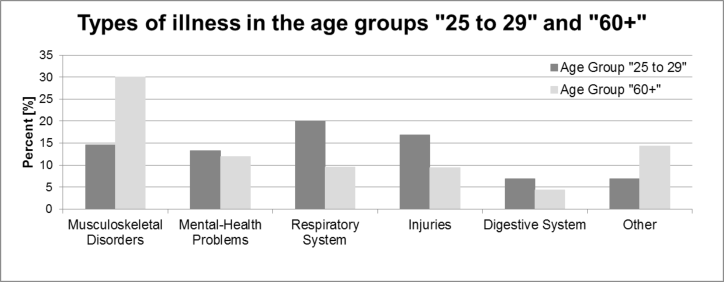
Motivation Test results in Germany shows that MSDs, with over 26.5 percent of the total, are the most common cause of incapacity for work (BKK 2012). Statistics in the U.S. and in Australia provide similar results (e.g. Bureau of Labour Statistic 2009; Queensland Government 2008). Literature also provides the statement that MSDs correlate with an untimely entry into occupational disability (Liebers et al., 2013). Handling high physical loads can be cited as reason for diseases of the musculoskeletal system. Many activities are related to the task of lifting and carrying of heavy loads, whether in the field of logistics or production. Publications of the Federal Institute for Occupational Safety and Health (BauA) show that over 7.6 million employed persons have to carry and lift heavy loads in their everyday work. The definition of heavy loads refers to weights higher than 10 kg for women and higher than 20 kg for men (Brenscheidt et al., 2012). Analyses in Germany indicate that in the age group of “60+” 30.1 percent of the main types of illness are MSDs in comparison to the group of 25-29 year old workers, where only 14.6 percent of the cases are MSDs (Figure 2) (Kordt, 2013).
Figure 2. Proportions of the major types of illness that cause incapacity of work in the age groups “25 to 29” and “60+”
(based on Kordt, 2013)
Knowing that handling of heavy loads in the range from 5 kg to 35 kg causes adverse health effects and that carrying and lifting of these loads cannot be avoided in future situations in logistics or in production areas makes it necessary to take measures to reduce the stress on the human musculoskeletal system and thus to prevent the risk of MSDs.
State of the art Due to the fact that not all working tasks – in particular lifting and carrying of heavy loads – can be performed by robots, a number of international research institutes and companies are engaged in the development and implementation of support systems for manual handling to assist the human body. The research in the field of exoskeletons currently ranges from systems for running support for disability or paralysis to assistance systems for the military or the logistics (Figure 3).
Figure 3. The research in the field of exoskeletons focuses on different areas of application One of the most advanced assistance systems in the field of exoskeletons is the exoskeleton suit Hybrid Assistive Limb® (HAL) which was developed in cooperation with the University of Tsukuba (Japan) and the Japanese company CYBERDYNE. The system can be regarded as one of the biggest competitors for the development of a new body-worn lifting aid. The exoskeleton supports the user on the functional principle of control by nerve signals. These signals are recorded by sensors attached to the skin and forwarded to electric motors in the area of the joints which trigger a movement of the muscles. At present, the system is in use for test purposes in hospitals. On the other hand, the developers of the HAL have the goal to use the assistance system in emergencies or disaster (Sankai, 2006; Nabeshima et al., 2012). However, this system is uneconomical and not suitable for use as a lifting aid in the field of manual picking or postlogistics.
Figure available in the original PDF paper.
Since 2000, the University of California-Berkeley (USA) researches in the field of exoskeletons and has built up some prototypes so far. Three of the systems are used as assistance systems in the military sector, while two of them particularly support disabled people in daily life (Kazerooni and Steger, 2006; Kazerooni, 2007). Another system which was developed for the rehabilitation sector and for personal use is the ReWalk™ exoskeleton of Argo Medical Technologies Ltd. The assistance system for running support for mobility impaired persons with a net Ergonomics in Manufacturing (2020) weight of less than 20 kg can be used as a reference system for body-worn lightweight systems (Esquenazi et al., 2012; Zeilig et al., 2012). StringMan developed by Fraunhofer IPK in Berlin is a wire rope based and not body-worn concept for the use in rehabilitation. The robot-based suspension system helps to create a synchronous movement of the lower limbs and thus ensures the recovering of the movement functions of mobility-impaired patients (Surdilovic et al., 2003, Surdilovic et al., 2007).
In particular, work in the field of exoskeletons for the logistics is crucial for the development of a new body-worn lifting aid. The following systems can currently be used in the field of manual handling as they have several advantages. Nevertheless there are still disadvantages which should be eliminated for a meaningful use. The German logistics company Gebhardt Logistic Solution GmbH developed an assistance system – the EcoPick® – to support lifting tasks which occur during the process of manual picking of pallets (Gebhardt, 2008). The wire rope system is mounted on ground conveyors, which is the biggest disadvantage of the assistance system. As the employees are connected to the system, they are restricted in their freedom of movement. Thus, the usability of the system should be improved. Another approach to support manual handling tasks in the field of logistics has been developed by the American company Strong Arm Technologies, Inc. The Strong Arm Vest is a system which dedicates in particular the support of the upper body, but did not consider an economic force application. Due to this the forces are uneconomical initiated in the back (Strong Arm, n.d.; RIT, 2011). The most important solution in the field of exoskeletons for the use in the logistic application represents the Muscle Suit, which was presented by the Koba Lab of the Tokyo University of Science and works pneumatic. (Kobayashi and Nozaki, 2007; Muramatsu et al., 2011). The Muscle Suit was developed to assist nursing staff while carrying people or other heavy loads (Ponsford, 2013).
Research topic The summary of the state of the art shows that numerous systems focus the effects on the human body caused by repeated manual handling tasks. However at present systems for use in rehabilitation predominate. Therefore the goal of research should be to close the gap of assistance systems with lifting and carrying support in the field of logistics and production.
The main objective in the development of body-worn lifting aids is beside to the optimization of the working conditions the reduction of the forces acting on the human musculoskeletal system caused by the manual handling tasks in logistics or in production. In order to achieve this primary objective and to contribute to the prevention of musculoskeletal disorders, however, an economic introduction of the forces in the body is required. For the implementation of the research focus, detailed analyses of the working tasks in the field of manual handling are necessarily the first step. Based on the findings of the task analyses, it is possible to replicate a workplace that corresponds to the real situation of the manual handling of loads in logistics in a laboratory environment. Thus a study can be conducted to detect the movements of the body during manual lifting activities using a motion capture system (VICON). A detailed procedure using this method is described in Engstler (2012). After data preparation the results of the motion analysis result in joint angles over time that can be used for biomechanical human modeling (AnyBody Modelling System). Muscle activity, and the resultant stresses in the body caused by the external loads can be identified as it is done in Guenzkofer (2013). With musculoskeletal human modeling the optimal location of the force application is now to be determined in order to reduce the stress on the human body while manual handling.
Discussion
Due to demographic change, the importance of new assistance systems increases in society. One advantage of an assistance system in manual handling in the field of logistics or production is the reduction of the loads acting on the human body. As workplace conditions can be optimized and the possibility of an accident-free work can be given by systems such as the body-worn lifting aid, older people can stay healthy in their profession. Three types of assistance systems can be distinguished for this sector. Rail mounted cranes and hoisting devices have the disadvantage that they are only for limited use for specific activities due to the attachment to the ceiling. Nevertheless the above-mentioned advantages can be combined in an ergonomic body-worn lifting aid adjusted to the individual anatomy of the human body, which allows freedom of movement and work detached from a fixed point. The main objective of lifting equipment in form of a body-worn lifting aid, however, is to minimize the loads acting on the body during manual lifting tasks. For this purpose the determination of the location of the optimum force application is of enormous importance. As part of the research group connected human modeling this aspect is considered in more detail.
COBOT Definition
This approach studies collaborative robots or cobots as a part of Intelligent Assist Devices (IADs) and represents a class of handling systems that combine the characteristics of industrial robots and handheld manipulators (Akella et al., 1999). On this view collaborative robots interact directly with the human worker in a designated collaboration area (DIN EN ISO 10218-2). The goal of the new solutions is to close the gap between the stated limits and combine the respective advantages of each other: easy operation and low cost of the manipulators on the one hand and the precision, programmability and path guidance of an industrial robot on the other. Cobots are meant to be used in a physical interaction for strength amplification, inertia masking (starting, stopping, and turning forces) and guidance via virtual surfaces (walls, paths) (Colgate, Peshkin and Klostermeyer, 2003). Hence cobots are able to support the human not only in a physical but also in a cognitive way. They can be used to facilitate handling tasks while increasing the efficiency of the process itself. As a HCAA it refers to the Munich Ergonomic Approach (Figure 1, right) and is a part of the Institute’s research group connected human modelling.
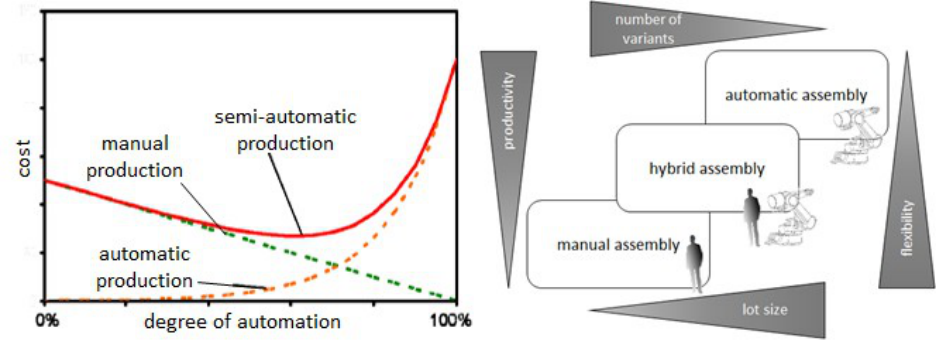
Motivation Nowadays the production environment faces decisive trends that cause a rethinking of classical production schemes. The continuing trend of mechanization and automation of work systems (Schlick, 2009) stands contradictory to the upcoming customization of production ((Fogliatto, da Silveira and Borenstein, 2012), (Da Silveira, Borenstein and Fogliatto, 2001)). The latter is characterized by a customer orientation that causes decreasing lot sizes and increasing variety that have to be managed by flexible production systems. Modern automation can’t fulfill the required flexibility and the presence of the human worker will still be necessary (Figure 4, right). In addition to that Figure 4 (left) depicts the cost-optimum at semi-automatic production where manual tasks operated by human workers are combined with automatic contents. In the assembly context Lotter and Wiendahl (2006) postulate this kind of system as a hybrid assembly system.
Figure 4: Cost optimum at semi-automation (left, Matthias (2011)); operating range of manual, hybrid and automatic assembly
(right, based on (Lotter and Wiendahl, 2006))
In reference to the fact that the assembly is the last link in the value chain and still the most employee-intensive area of production the designer of new solutions should always take the human in consideration with his needs and capabilities. In the assembly area most of the operations are handling tasks. The human with his abilities like fast perception and processing of various information or flexible adaption and improvisation can be the key success factor. If it is possible to bring these benefits together with advantages of automation systems like the precision, strength, and reproducibility of robots, many problems could be solved at a time. Cobots are able to bring these facts together and combine the characteristics of industrial robots and manual operated handling devices like they are already common in automotive assembly lines. In this way assembly systems gain flexibility, the human worker gets support, and the overall effectiveness increases.
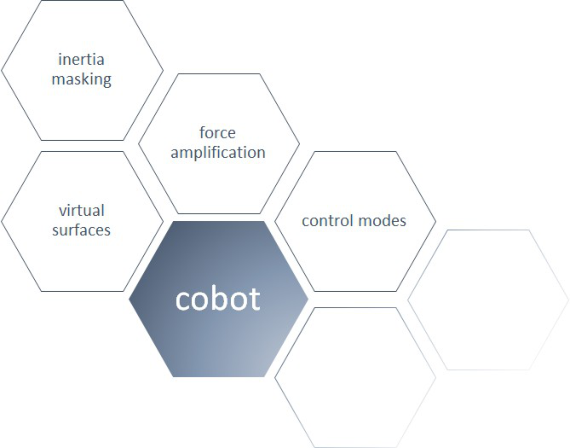
State of the art The word cobot was introduced by Michael Peshkin and J. Edward Colgate associate Professors of Mechanical Engineering at Northwestern University, USA. Based on Peshkin and Colgate (1999) cobots are meant to be used in direct interaction with a human worker, handling a payload together. Unlike industrial robots they are not separated from people because of safety reasons. They are able to improve ergonomic working conditions, product quality, and productivity. (Peshkin and Colgate, 1999) In the following the capabilities of these new systems are described (Figure 5).
Figure 5: Capabilities of a new class of material handling devices: cobots
One crucial advantage of the new technology is the possibility to implement virtual surfaces in the handling process. For clarification virtual surfaces can be described by the analogy to the role of a straightedge in drafting (Peshkin and Colgate, 1999). The virtual surfaces as well as the straightedge provide physical guidance along a defined shape path but it leaves the decision to the operator to use it (push payload up against) or not (pull away and guide payload by the worker himself). In this way an important ergonomic improvement arises. By supporting lateral and stabilizing forces on a payload, stress to the muscles of the upper body and back is minimized. Furthermore through virtual guidance it is possible to increase the overall efficiency by precise and quick assembly processes while the cognitive workload on the human operator is getting reduced. The virtual walls or paths could be used additionally for obstacle avoidance like virtual fences that surround and protect objects in the workspace.
The second main advantage of a cobot is to reduce the forces required of the human operator in the handling task. When handling large unhandy objects the worker is supported by power assistance (compensation of frictional and acceleration/deceleration forces) and force amplification (compensation of inertial, gravitational and frictional forces) (Akella et al., 1999). In this way not only the human strength is amplified also inertia forces (starting, stopping and turning forces) that act on the human body are getting masked and MSDs can be prevented.
Basically a cobot is able to be used in three modes of operation (Robotic Industries Association, 2002): Hands-on- controls mode when the operator is in physical control from a designated control interface (e.g. handles), hands-onpayload when the powered motion is in response to forces applied directly to the payload and hands-off control mode where the motion follows a pre-determined path and is not in response to forces applied by the operator. A fourth control mode might be a hybrid form of hands-on-controls mode and hands-on-payload where the user can manipulate the position of the payload relatively to the cobot. This scheme explains the semi-automatic abilities of a cobot system. While in hands-on-control and hands-on-payload mode the user executes mainly manual tasks, supported by the automation, the cobot is able to act autonomously in hands-off control mode. With functions like return-to-home or bringing the next part time can be reduced and the process gains flexibility and efficiency.
Besides these functionalities cobots also provide benefits by offering an interface to sensors for special purposes ,e.g. weighing parts or tracking moving assembly lines, and plant information systems, for error-proofing and data logging (Colgate et al., 2003).
Research topic As said before in hands-on-controls/hands-on-payload mode the operator is in direct contact with the cobot/payload and experiences a reaction force. Simultaneously sensing the intention of the human operator and how much feedback he gets is of central importance. According to that the main research topic in the field of cobotic for the Institute of Ergonomics is to examine the human characteristics while performing pushing and pulling tasks with power assisted and force amplified systems. On the one hand the haptic feedback should be designed like it is most natural for the human operator, ideally as if the worker were performing the task manually (Colgate et al., 2003) and on the other hand the handling task must not demand too little from the worker.
Because the acceptance of the new systems depends directly on the sensitivity, intuitiveness, and transparency of the haptic interface and its interpretation, it is crucial to understand how the human reacts while pushing/pulling a cobot and what he actually senses. Before the design and implementation of the cobot control system preliminary tests will be used to model the human while pushing/pulling tasks. Thereafter the system will be validated in an assembly of the panoramic sunroof as it currently exists at VW AG for a precise quantification of the reduced physical exposure caused by using a cobot.
The overall goal is to enable a flexible optimal adjustment of the cobot to the physical abilities and needs of each individual in the field of sensomotoric and cognitive skills. In the context of a simple and natural, intuitive, and interactive process-oriented operation the Institute of Ergonomics will develop a comprehensive interaction of cobot and human regardless of age, gender, and skill level.
Discussion
As mentioned in the research topic the hands-off controls mode will not be the focus in terms of this work. Many studies have been done at the Institute in the fields of Human-Robot-Interaction that deal with the coexistence of a human and a robot in the same workspace working on the same task without direct physical contact ((Bortot, Born and Bengler, 2013), (Bortot, Ding, Antonopolous and Bengler, 2012), (Bortot et al., 2010)). The results will be implemented in the upcoming cobot system.
With the implementation of the developed solution a reduction of physical and cognitive load will be achieved. The work will be health preserving and appropriate to the performance of each individual. In this way ergonomic impacts of the demographic change and as a consequence thereof the decreasing physical performance of the workforce are manageable, handling tasks can be performed by everybody and include the mental experience that improve during a working life.
It has been shown that the design and evaluation of HCAAs like the cobot is mainly located in the fields of biomechanics and cognition and deals with load/workload as well as performance which can be depicted in Figure 1. The identification and interpretation of human characteristics and intentions is an important point of modeling to provide a transparent behavior and intuitive operation while experiencing physical support through the new systems. The study and design of human modelling to individualize the new assistance systems through a flexible adaption to the operator and process properties is critical for the success of the system.
ASSEMBLY GLOVE Definition
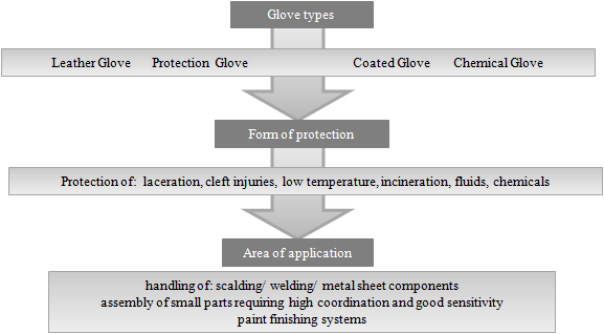
Ordinary assembly gloves have to be used for manual assembly tasks to ensure safety of the worker. Gloves are disposed due to different task requirements. They shield workers hands from varying influences. Figure 6 shows a compilation of the common glove types.
Figure 6: Compilation of ordinary assembly glove types used for manual tasks at production sites The assembly glove referred to in the current paper is somehow different from the common gloves used for the workers safety only. It consists of special features developed to reduce risks of work related upper limb disorders rather than to just ensure safety. The assembly glove can be disposed between basic working gloves and assisting hand exoskeletons. Therefore it can be defined as a HCAA which enables the worker to reduce physical strain while performing their manual assembly tasks. Regarding the Munich Ergonomic Approach the assembly glove project is part of the research group connected human modeling (Figure 1, right side). This is because the knowledge of biomechanics as well as anthropometry of the human, especially the human hand, is important for developing a supporting glove. Furthermore physical strains and workload need to be examined in workers performing manual assembly tasks to know where support is sufficient.
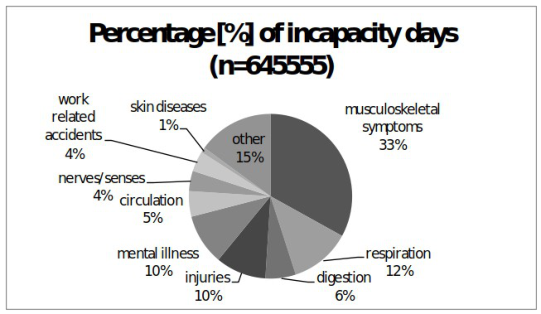
Motivation Concerning the challenge that many production tasks are still low automated and therefore attended with the hands of workers an assembly glove consisting special features should be developed to reduce risks of upper limb disorders. Assembly line tasks, especially in the automotive production, include high repetitions as well as high forces applied by the worker (Fransson-Hall et al., 1996). Due to shorter time cycles and simplified tasks physical strain is increasing (Diaz et al., 2012). Hence the number of work incapacity days in the automotive production in Germany is quite above the average of the whole German population (report of the health insurance agency BMW BKK 2012). Furthermore 33% of the work incapacity days are related to musculoskeletal disorders (MSDs) (Figure 2).
Figure 7: Percentage of disorders accounting for the work incapacity days in the automotive production of a German OEM in
2012 (report of the health insurance agency BMW BKK, 2012)
According to Hussain (2004) the most frequently regarded MSDs in truck assembly workers are pain in the lower back, neck, and shoulders. Additionally 46% of the 461 assembly workers mentioned hand and wrist disorders. Winter (2010) confirmed these results when evaluating overhead work with 41 assembly line workers where 21% had lower back pain, 23% neck problems, 17% shoulder pain and 9% problems with their wrists and hands. Aside this many authors describe high prevalence for hand and wrist symptoms among automobile assembly workers (Silverstein et al., 1986; Jantree et al., 2010). Obviously assembly tasks require high application forces, high repetitions and extreme wrist postures due to difficult attainable assembly positions within a car body. The mentioned requirements are risk factors for several cumulative trauma disorders (CTD) like carpal tunnel syndrome, tenosynovitis or Quervain’s disease (Schoenmarklin et al., 1994). Due to this there is high evidence for the appearance of CTD because of work related strains in the automotive production (Silverstein et al., 1986). Automation of manual tasks could be one way to reduce physical strain of workers by replacing them through highly automated systems. Nevertheless this approach cannot be followed because of an increasing number of archetypes and an increasing flexibility of assembly line tasks. Substitution of the worker is therefore not desired but an assembly glove could be one approach to reduce risks of stress and strain for hands and fingers.
State of the art Most of the existing assistance systems for manual assembly tasks are ergonomic tools which enable the worker to perform their tasks more easy or to adopt an ergonomic body posture during their work. Those tools often stay unintended by the workers because they require additional time for picking them up, positioning them at the car body and putting them back. Applications attached at the human body seem an approach to increase the acceptance of ergonomic tools as they require no additional time of the assembly process. There is a wide range of products, consisting a wide range of features that could be worn in direct interaction with the human (Figure 8).
Figure 8: Range of the state of the art considering hand worn devices
Common working gloves are basic tools for shielding the hands of workers from several influences (Figure 6). Besides that a small number of special developed working gloves as well as passive and active supporting systems for the hand or several fingers exist. There are three important types of working gloves with additional features. Those gloves offer passive prevention against impacts, vibration and extreme wrist postures. Foam materials located at the thenar and hypothenar should provide impact protection. Special cushion pads at the palm of the hand care for vibration protection. A glove with integrated wrist control prohibits extreme wrist angles when performing assembly tasks. Other opportunities for passive support are thumb and wrist orthoses which should reduce wrist muscle load. Johansson et al. (2004) and Bulthaup et al. (1999) found no decrease in muscle loads wearing orthoses. Nevertheless some workers still use orthoses for prevention after injuries. The most technical approach, offering assistive engineering, is a hand exoskeleton. Exoskeletons are attached to the human hand or arm and are able to provide active support by increasing the strength of fingers and hands. Hand exoskeletons can be used to automate hand motions or to assist the hand function by amplifying gripping strength (Heo et al., 2012). The biggest concern regarding exoskeletons is the safety of the human because the exoskeleton moves under close contact conditions with the wearer. Any malfunctions can therefore cause harm. Furthermore exoskeleton devices are still huge and unwieldy as there is the need of including actuators as well as sensors to assist human motion.
Research topic Based on the state of the art the assembly glove provides a compound of passive and active support and therefore reduces stress and strain for the wearer. Instead of replacing the worker for highly automated systems it offers a new approach that combines both, benefits of workers and automation. The abilities and experiences of the worker are of high importance in times of demographic change. Compared to exoskeleton devices the goal is to have a lighter and smaller tool which enables assembly work. The assembly glove is meant to improve working tasks due to reduced loads at the wrist, thumb and index finger. Furthermore it might act as an instrument for quality improvement by implemented sensors detecting the obstructed parts. Several other features improving physical as well as cognitive workload are considered. To offer effective support working tasks have to be analyzed in a first step. Therefore a study examining action forces and capturing the workers motion when inserting plugs was carried out. The study took place at a typical assembly work station of the automotive production where plugs are inserted by the hands of workers. The results provide basic information about the forces workers have to apply during the assembly process as well as the movements of wrist and fingers. Risk factors for upper limb disorders can be identified. Furthermore musculoskeletal modeling should be done, based on the experimental examined workloads, to help reducing physical strain by developing concepts for a supporting assembly glove. The most important goal is to enable the workers to stay healthy during their labor time as well as after retiring work by the support offered from the assembly glove.
Discussion
Based on challenges like the demographic change and diversity management assembly line tasks need to be improved to reduce physical as well as cognitive strain and workload, to prevent upper limb disorders and minimize incapacity days. Different solutions can be considered therefore. As the assembly line processes claim high flexibility highly automated systems are no option (Figure 4, right). Hand assisting devices as exoskeletons could be another approach. Regarding the safety requirements and the complexity of those tools they are neither an option regarding the closer future. Constructive changes are expensive and mostly not practicable in a running production system. An assembly glove could therefore offer the most effective support for workers as it might have several benefits (for example time saving) compared to existing ergonomic tools. The overall goal of such a glove is to ensure a decreased physical workload as well as an increased quality of assembly line processes. Therefore the knowledge of the biomechanics of the hand as well as of occurring strains is of strong importance. The research group connected human modeling deals with a multiplicity of these problems. Connecting different projects provides the most successful way for dealing with such a complex development of a supporting assembly glove.
CONCLUSIONS
The three research approaches of human centered assistance combine advantages of common solutions for production lines and put the human with his abilities, flexibility and knowledge into the center of the assistive application. The three proposed approaches offer great opportunities for future production systems. It has to be investigated whether the solutions could be transferred to other domains like service or healthcare. Another topic of investigation is the question whether – in the sense of a holistic approach – the solution can be combined. Summarized it could be shown that challenges like mastering demographic change and diversity management could be approached by supporting natural strength and using the intelligence, experience, and abilities of humans with HCCAs, to gain efficiency and quality.
REFERENCES
Akella, P. Peshkin, M. Colgate, E. Wannasuphoprasit, W. Nagesh, N. Wells, J. (1999). “Cobots for the automobile assembly line”, International Conference on Robotics 10-15 May 1999, 728–733. doi:10.1109/ROBOT.1999.770061 BKK Bundesverband (2012). „Gesundheitsreport 2012. Gesundheit fördern - Krankheit versorgen - mit Krankheit leben.“,
http://www.bkk.de/fileadmin/user_upload/PDF/Arbeitgeber/gesundheitsreport/Gesundheitsreport_2012/ Gesundheitsreport_2012.pdf. BMW-BKK health report (2012). Report of the health insurance agency BMW-BKK Germany. Brenscheidt, F. Nöllenheidt, Ch. Siefer, A. (2012). “Arbeitswelt im Wandel: Zahlen – Daten – Fakten. Ausgabe 2012”.
http://www.baua.de/de/Publikationen/Broschueren/A81.pdf;jsessionid=5E164D065DED25E43F0AEB6036499FD5.1_cid3 89?__blob=publicationFile&v=8. Bortot, D., Ding, H., Günzkofer, F., Stengel, D., Bengler, K., Schiller, F., & Stursberg, O. (2010). „Effizienzsteigerung durch die Bewegungsanalyse und-modellierung der Mensch-Roboter-Kooperationen.“ Bortot, D., Ding, H., Antonopolous, A., & Bengler, K. (2012). “Human motion behavior while interacting with an industrial
function“, The American Journal of Occupational Therapie 53 (5), S. 434–440. Bureau of Labor Statistics (2009). “Nonfatal Occupational Injuries and Illnesses Requiring Days Away From Work, 2007”.
http://www.bls.gov/iif/home.htm. Colgate, J. Peshkin, M. & Klostermeyer, S. (2003). “Intelligent assist devices in industrial applications: a review”, 2516–2521.
doi:10.1109/IROS.2003.1249248 Da Silveira, G., Borenstein, D., & Fogliatto, F. S. (2001). „Mass customization: Literature review and research directions”, International journal of production economics, 72(1), 1-13. DIN EN ISO, 10218-2 (2012). „Industrieroboter – Sicherheitsanforderungen – Teil 2: Robotersysteme und Integration“, Berlin:
Beuth Verlag GmbH. Diaz, J. Weichel, J. Frieling, E. (2012). „Analyse körperlicher Belastung beim Einbau des Kabelbaums in das Fahrzeug und Empfehlung zur Belastungsreduktion – eine Feldstudie in einem Werk der deutschen Automobilindustrie“, Zeitschrift für Arbeitswissenschaft 13-23, 1-2012 Engstler, F. (2012). „Perzentilierung maximaler Gelenkmomente des Menschen.“ Dissertation, Technische Universität München. Esquenazi, A. Talaty, M. Packel, A. Saulino, M. (2012): ”The ReWalk Powered Exoskeleton to Restore Ambulatory Function to
Individuals with Thoracic-Level Motor-Complete Spinal Cord Injury”, In: American Journal of Physical Medicine & Rehabilitation. 91 (11), S. 911–921. Fogliatto, F. S., da Silveira, G. J., & Borenstein, D. (2012). “The mass customization decade: An updated review of the literature”, International Journal of Production Economics, 138(1), 14-25. Fransson-Hall, C. Byström, S. Kilbom, A. (1996). “Characteristics of forearm-hand exposure in relation to symptoms among
automobile assembly line workers”, American Journal if industrial medicine 29:15-22 Gebhardt (2008). “ECOPICK® ausgezeichnet”. http://www.gebhardt.eu. Guenzkofer, F. (2013). “Elbow Strength Modelling for Digital Human Models.“ Dissertation, Technische Universität München. Heo, P. Gu, G. M. Lee, S. Rhee, K. Kim, J. (2012) “Current hand exoskeleton technologies for rehabilitation and assistive engineering“, International Journal of Precision Engineering and Manufacturing 13 (5), S. 807–824. Hussain, T. (2004). „Musculoskeletal symptoms among truck assembly workers“, Occup Med (Lond) 54 (8), S. 506–512. Jantree, C. Bunterngchit, Y. Tapechum, S. Vijitpornk, V. (2010). „An Experimental Investigation on Occupation Factors
Affecting Carpal Tunnel Syndrome in Manufacturing Industry Works“, AIJSTPME - Asian International Journal of Science and Technology in Production and Manufacturing Engineering 3 (1), S. 47–53. Johansson, L. Björing, G. Hägg, G. M. (2004). „The effect of wrist orthoses on forearm muscle activity“, Applied Ergonomics 35 (2), S. 129–136. Kazerooni, H. (2007): “Human Augmentation and Exoskeleton Systems in Berkeley”. In: International Journal of Humanoid Ergonomics in Manufacturing (2020)
Robotics. 04 (03), S. 575–605. Kazerooni, H. Steger R. (2006): “The Berkeley Lower Extremity Exoskeletons”. In: ASME Journal of Dynamics Systems, Measurements and Control (V128), S. 14–25. Kobayashi, H. Nozaki, H. (2007): “Development of Muscle Suit for Supporting Manual Worker”. In: Proceedings of 2007
IEEE/RSJ International Conference on Intelligent Robots and Systems, San Diego, CA, USA, Oct. 20-Nov.2, 2007, S. 1769–1774. Kordt, M. (2013): „DAK-Gesundheitsreport 2013“.
http://www.presse.dak.de/ps.nsf/Show/998583CFE0F4B967C1257B18004DA198/$File/ Gesundheitsreport_2013_Druckfassung%2015.2.2013.pdf. Liebers, F. Brendler, C. Latza, U. (2013): “Alters- und berufsgruppenabhängige Unterschiede in der Arbeitsunfähigkeit durch häufige Muskel-Skelett-Erkrankungen. Rückenschmerzen und Gonarthrose”. In: Bundesgesundheitsblatt 56 (3), S. 367– 380. Lotter, B., & Wiendahl, H. P. (2006). “Montage in der industriellen Produktion“. Springer-Verlag Berlin Heidelberg Matthias, B. (2011). “Sichere MRK in industriellen Anwendungen – Entwicklungsschritte bei ABB Corporate Research“. 44.
assessment of Robot Suit HAL”. In: 2012 IEEE International Conference on Robotics and Automation (ICRA), May 14-18, 2012, S. 2743–2748. Peshkin, M., & Colgate, J. E. (1999). “Cobots”. Industrial Robot: An International Journal, 26(5), 335-341. Ponsford, M. (2013): “Robot exoskeleton suits that could make us superhuman”. In: CNN, May 22, 2013. Prasch, M. (2010). “Integration leistungsgewandelter Mitarbeiter in die variantenreiche Serienmontage“, Herbert Utz Verlag. RIT (2011): “Venture Creations. Featured Story - Strong Arm”. Hg. v. Rochester N. Y. Rochester Institute of Technology.
http://www.rit.edu/research/vc/story/strong-arm. Robotic Industries Association. (2002). “T15. 1 Draft Standard for Trial Use for Intelligent Assist Devices—Personnel Safety Requirements”. Queensland Government (2008). “Injury statistics for musculoskeletal disorders (all industries)”.
http://www.deir.qld.gov.au/workplace/documents/showDoc.html?WHS%20Publications/general%20-%20musculoskeletal %20disorders#.UpMXDOKwW9g. Sankai, Y. (2006). “Leading Edge of Cybernics: Robot Suit HAL”. In: SICE-ICASE: International Joint Conference 2006. Oct.
18-21, 2006 Bexco, Busan, Korea. Schlick, C. M. (2009). “Industrial engineering and ergonomics: Visions, concepts, methods and tools: Festschrift in honor of professor Holger Luczak”. Berlin; Heidelberg: Springer-Verlag. Schoenmarklin, R. W. Marras, W. S. Leurgans, S. E. (1994). ”Industrial wrist motions and incidence of hand/wrist cumulative
trauma disorders“, Ergonomics 37 (9), S. 1449–1459. Silverstein, B. A. Fine, L. J. Armstrong, T. J. (1986). ”Hand wrist cumulative trauma disorders in industry“, British Journal of industrial Medicine 43 (11), S. 779–784. Strong Arm (n.d.): “Strengthening Our Workforce”. http://strongarmvest.com. Surdilovic, D. Bernhardt, R. Schmidt, T. Zhang, J. (2003): “STRING-MAN: A New Wire Robotic System for Gait
Rehabilitation”. In: Proceedings of the ICORR International Conference on Rehabilitation Robotics, April 22-25, 2003, S. 64–66. Surdilovic, D. Zhang, J. Bernhardt, R. (2007). “STRING-MAN: Wire-robot technology for safe, flexible and human-friendly gait rehabilitation”. In: Proceedings of the ICORR International Conference on Rehabilitation Robotics, June 13-15, 2007, S. 446–453. Winter, G. (2011). “Ergonomie-Werkzeuge zur Bewertung körperlicher Arbeit in der Montage vor dem Hintergrund eines
betrieblichen Arbeits- und Gesundheitsschutzes”, Dissertation, ergonomia Stuttgart. Zeilig, G. Weingarden, H. Zwecker, M. Dudkiewicz, I. Bloch, A. Esquenazi, A. (2012): “Safety and tolerance of the ReWalk exoskeleton suit for Ambulation by people with complete spinal cord injury: A pilot study”. In: Journal of Spinal Cord Medicine 35 (2), S. 96–101. Zülich, G. (2010). “Prognose der Produktivitätsentwicklung bei älter werdenden Mitarbeitern - dargestellt am Beispiel der
Automobilmontage“, In M. Schütte (Ed.): Vol. 2010. Herbstkonferenz / GfA, Gesellschaft für Arbeitswissenschaft e.V, Mensch- und prozessorientierte Arbeitsgestaltung im Fahrzeugbau. Tagungsband zur Herbstkonferenz 2010 der
Gesellschaft für Arbeitswissenschaft; Volkswagen AG, Wolfsburg, MobileLifeCampus, 23. und 24. September 2010 (pp. 5– 18). Dortmund: GfA-Press
LISTED IN THE AHFE DIGITAL BOOKSTORE CATALOGUE
Explore the complete digital volume
Advances in The Ergonomics in Manufacturing: Managing the Enterprise of the Future
Read this individual research paper free through the original publisher, or explore the full digital proceedings book.
ISBN 978-1-4951-2103-6
Explore this ISBN in the AHFE Bookstore ↗Listed in the July 2026 bookstore catalogue; search by ISBN to confirm current availability · Digital book purchase optional