Daniel Schilberg, Erhard An-he Kinzelbach, Sven Pfeiffer (2025). CoBotCraftLab – Approaching Human-Robot Collaboration in Digital Craft. In: Human Systems Engineering and Design (IHSED2025): Future Trends and Applications. AHFE Open Access, vol. 198, pp. 63–68. https://doi.org/10.54941/ahfe1006762
1 Institute of Robotics and Mechatronics, Department of Mechatronics and Mechanical, Engineering, Bochum University of Applied Sciences, Am Hochschulcampus 1, 44801, Bochum, Germany ↗
2 Chair of Design and Building Construction; Department of Architecture, Bochum, University of Applied Sciences, Am Hochschulcampus 1, 44801, Bochum, Germany ↗
3 Chair of Digital Design, Planning and Building, Department of Architecture, Bochum, University of Applied Sciences, Am Hochschulcampus 1, 44801, Bochum, Germany ↗
This paper intends to depict the specific research approach established through the CoBotCraftLab portal - a robot cell for automated collaborative manufacturing in the construction industry - that is currently being installed at Bochum University of Applied Sciences (HSBO). This manufacturing cell consists of 6 collaborative robots (cobots) with individual load capacities of 20-25 kg each, which are movably mounted on linear axes and equipped with application-specific or generalist manipulators via tool changing systems. The overall system has 42 degrees of freedom of movement and will thus be able to perform a wide range of automatable tasks from the field of building construction. These include additive manufacturing of complex components, automated and collaborative prefabrication of component parts, automated application of tools such as drills and milling machines in regard to joints in lightweight structures, and applications from the field of non-destructive testing of building materials. The large-scale equipment, once installed, will present a significant contribution to the establishment of an interdisciplinary laboratory environment for research into working methods for collaborative manufacturing with craftsmen and robots in building construction. The innovative approach is to enable simultaneous and collaborative manufacturing between humans and robots by setting up the large-scale device using small-scale collaborative robots, allowing the precise and rapid production of a variety of prototypes from different materials at 1:1 scale. In this work environment, collaborative workflows involving robots and humans, both in separate and shared workspaces, will be able to be tested. Using the robotic manufacturing cell, a prototypical fabrication of demonstrators is intended to help find answers to research questions in the fields of "Digitalization of construction and craft", "Demographic change and safety" and "New methods for circular building". The cell will be used to develop workflows and record process data, which will form the basis for dealing with the following major research questions:To what extent are robotic processes capable of replicating traditional crafts, reanimating traditional techniques and transferring and scaling them to match the realm of construction? Can joint workspaces that are simultaneous in terms of space and time, involving craftsmen and robots, be developed that efficiently enable the fabrication of building components, such as for example built-in elements in housing construction? How do requirements for work safety and ergonomics change in the context of digital craft and demographic change? How can the existing gap between the experiential knowledge of humans and the precision and speed of robotics be closed in the context of construction processes? Can collaborative human-robot interactions go beyond the synthesizing function to also cater to disassembling and analytically sorting processes, as we encounter an emerging circular construction industry?
In this paper we present CoBotCraftLab, a robot cell for automated collaborative manufacturing in construction. The laboratory environment creates the possibility of exploring automated construction processes to enable resource- and cost-efficient individual production of structures and components whose shape is optimally adapted to their intended task. The innovative approach is to increase the precision and diversity of possible components through simultaneous work between humans and robots, while at the same time physically relieving the burden on the craftsman. Different aspects of human-robot collaboration are investigated, such as ergonomic aspects, feedback mechanisms, techniques of typological transfer between analogue and digital crafts as well as automated joining techniques. The project aims to close the existing gap between human experiential knowledge and the precision and speed of robotics through a
collaborative model that is essentially based on simultaneous collaboration over time and space. Knowledge is intended to be gained on the following questions:
To what extent are human-robot collaborations able to map conventional manual processes, reanimate traditional techniques and transfer and scale them to match construction processes?
Is it possible to create common workspaces (simultaneous in space and time) for craftsmen and robots that enable the production of building elements in an efficient way?
How are occupational safety and ergonomics requirements changing in the context of digital crafts and demographic change?
How can the existing gap between human experience and the precision and speed of robotics in the context of construction processes be closed?
COLLABORATIVE ROBOTICS IN THE BUILDING INDUSTRY – STATE OF THE ART Robotic manufacturing in construction has become an active area of research and transfer, mainly due to the increasing need for productive and sustainable methods. It is currently concentrating on the use of large-scale stationary systems, such as the additive manufacturing of concrete (Pfeiffer et al., 2020), the cutting and assembly of wooden elements (Kyjanek et al., 2019; Weinand et al., 2018). Production is usually separated from human work in terms of time and space due to safety considerations (COBOD, 2025). Although robotic manufacturing can already be used to create complex three-dimensional building elements, the separation of machine and human creates process disadvantages. This is where the present project comes in. The ability of multiple robots to cooperate achieves flexible scalability, while their mobility and autonomy allow them to be used in both new and existing contexts and coordinate operations for direct and indirect interaction with humans. While experience has already been gained in the field of coexistence and cooperation between human and robotic actors in the construction process (Huang et al., 2021), the collaborative model, in which humans and machines really work hand in hand, in the same workspace and simultaneously on the same components, is still under-researched. The most important research question in the use of collaborative robotics is the transfer of human skills to the technical system (Boston Consulting Group, 2015), the so-called “skills”. For cobots and humans to cooperate seamlessly, the robot must have knowledge of its “skills” so that they can be used in a targeted manner (Kragic et al., 2018). As part of the cooperation project, the skills necessary for wood handling are to be developed. The use of cobots makes it possible to let the robots learn through interaction (Goldberg, 2019) and thus to take artificial intelligence techniques into account in the project. In addition to the topics of safety and the enhancement of systems through artificial intelligence, another important factor is work ergonomics and how cobots can support this, whether as a “third hand” or by means of other assistive tasks (Michalos et al., 2018).
CoBotCraftLab – Approaching Human-Robot Collaboration in Digital Craft 65
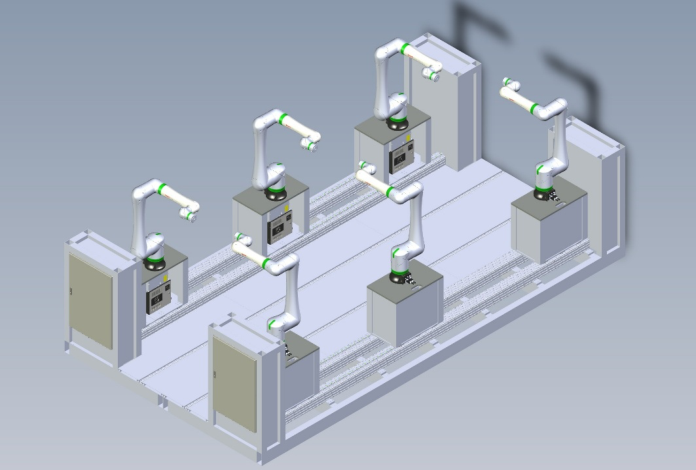
COBOTCRAFTLAB To enable the precise and fast production of a variety of prototypes made of different materials on a 1:1 scale, the collaborative production cell is equipped with six Fanuc CRX i25, which are particularly user-friendly and flexible in use. The robots can be programmed with an intuitive, graphical user interface that requires no special programming knowledge. The robot can also be operated via a simple hand control that allows its movements to be controlled manually. It can be used in a variety of applications, including assembly, material handling, packaging, and palletizing. In addition to the cobots, 3 of which are each mounted on a linear axis, the manipulators (grippers) used on the cobots are essential for the safety and the range of applications of the collaborative production cell. Since the individual payloads of the cobots are far below the payloads of comparable conventional industrial robots, several systems must be provided for simultaneous use to cover the working area of 21m2. Figure 1 shows that the robots can be moved along the linear axes, so that they can handle total loads beyond their possible single loads. Therefore, the robots can collaboratively support larger structures and thus prevent or counteract deformations caused by bending. The grippers used can work safely with people and avoid injuries.
Figure 1: CoBotCraftLab (DFG large-scale equipment initiative), illustration of the collaborative process to produce dismountable wooden structures.
RESEARCH APPROACH The definition of the production process, and consequently the abstraction and integration of sequence and robot motion planning into design processes, is crucial to explore the design space. Therefore, the basis for the development
of secure collaborative workflows is to build an information model for intention-based human-robot collaboration (Schilberg and Schmitz, 2016). This information model provides general motion sequences for robots, from which humans can clearly recognize the intention behind the movement, i.e. which goal is to be achieved by the movement. Here, processes such as lifting, palletizing, sawing, milling, joining, etc. and their combination are examined, with special consideration of aspects of safety and ergonomics in human-robot cooperation. Concrete robot trajectories are then derived from the information model. Since collaboration between humans and robots in construction is a non-deterministic system, tools of probabilistic robotics are applied to deal with inaccuracies. In order to generate a goal-oriented path planning from necessary individual movements, a Q-learning approach is applied to obtain a situation-adapted path planning for the respective production sequences.
APPLICATION SCENARIOS The research applications intend to address the high consumption of resources and the limited recycling of components and materials predominant in the construction industry. With a growing level of knowledge, work on the following topics is conducted.
Joining processes: Due to its high degree of prefabrication, timber construction is predestined to investigate the potential of human- robot collaboration for the prefabrication of individualized components. Typologies of traditional joining techniques in timber construction are to be transferred into the present with the help of digital and automated processes. As a result, the potentials of human-robot collaboration (e.g. precise joining, quality assurance, flexibility and work ergonomics) for individual prefabrication of vernacular joints in timber construction are to be identified.
Additive Processes: Collaborative methods are to be developed for additively manufacturing individualized, multifunctional lightweight components. The methods are to be applied in constructions for housing.
Design-to-Disassembly: In order to address the high consumption of resources and very limited recycling of components and materials in the construction industry, collaborative processes between craftsmen and robots will be investigated for their potential in terms of the detachability and reusability of joints and the separation of composite materials by type. The sorting and evaluation of the material and material components with non-destructive testing is also to be tested.
Design with Robots: The integration of robot motion planning into design processes is crucial to explore the entire design space. The aim is to develop a design and robot motion planning environment
CoBotCraftLab – Approaching Human-Robot Collaboration in Digital Craft 67
for the efficient design planning of robotically assembled structures. The multidimensional design space of these is a direct result of the kinematic behaviour of the robots, which cannot be intuitively described in conventional CAD applications. In addition to the movement of the robots, the definition of the production process is crucial.
Process Safety and Ergonomics In construction processes, robots must be adaptable and flexible. Especially if direct cooperation with human craftsmen is also to take place, safety and ergonomic aspects must be considered. The existing gap between human experience and the precision and speed of robotics is to be closed by a collaborative model to move ergonomically and safely within the same workflow. The aim is to make this workflow visible and assessable by means of the production of prototype demonstrators and thus to gain insights into sensible protocols for occupational safety and ergonomics.
CONCLUSION AND OUTLOOK The interdisciplinary application of domain-specific methods of the project partners from architecture and mechatronics maximizes the scientific knowledge gained. With the CoBotCraftLab, a new research focus for collaborative robotics in building construction will be established at Bochum University of Applied Sciences (HSBO), which will enable the interdisciplinary transfer of scientific findings into applications in cooperation between the faculties of mechatronics and mechanical engineering and architecture. To answer all the research questions outlined in the application scenarios, an extensive database is required. The more extensive the data collected from the collaborative work processes, the more extensive the associated research fields are regarding knowledge- oriented research. The procurement of the proposed large-scale equipment will therefore strengthen HSBO’s infrastructure across departments and lay a correspondingly broad basis for further funding. It is planned to establish further cooperations on these topics and to submit funding applications. Future research will be conducted into how these generic assembly and disassembly processes are further specified and developed in collaboration with craftsmen into an agile process. Due to the modular design of the large device used, scaling effects can also be realized. Sustainable construction processes for future demountable constructions can then potentially be developed for scenarios in small and medium-sized enterprises.
ACKNOWLEDGMENT
The authors would like to acknowledge that the project CoBotCraftLab is generously funded by the Deutsche Forschungsgemeinschaft (DFG, German Research Foundation) under the project number 533325395.
REFERENCES
Pfeiffer, S., Stephan, D., et al. (2020): Architectural Applications and Workflows for Additive Fabrication with Concrete; in: Digital Concrete 2020, Conference Proceedings; Springer Verlag; pp. 946–955. https://doi.org/10.1016/ j.cemconres.2020.106070. Kyjanek, Menges, A. et al. (2019). Mensch-Roboter-Kooperation im Holzbau: Potentiale für die Vorfertigung; Forschungsinitiative Zukunft Bau F3180; Fraunhofer IRB Verlag; Yves Weinand, et al. (2018). Théâtre de Vidy-Lausanne, Conference paper, 8e Forum
International Boid Construction FBC https://cobod.com/, accessed 29.6.25 Huang, Y., Gramazio, F., Kohler, M., et al. (2021). The new analog: A protocol for linking design and construction intent with algorithmic planning for robotic assembly of complex structures, Proceedings of the 6th Annual ACM Symposium on Computational Fabrication. https://doi.org/10.1145/3485114.3485122 Boston Consulting Group, (2015). Industry 4.0: The Future of Productivity and
Growth in Manufacturing Industries. https://www.bcg.com/publications/2015/ engineered_products_project_business_industry_4_future_productivity_growth_ manufacturing_industries Kragic, D, et al. (2018) Interactive, Collaborative Robots: Challenges and Opportunities. In: IJCAI. S. 18–25. Goldberg, K. (2019). Robots and the return to collaborative intelligence. Nat Mach Intell1, 2–4. https://doi.org/10.1038/s42256-018-0008-x G. Michalos, et al. (2018). Seamless human robot collaborative assembly – an
automotive case study, Mechatronics 55 194–211. Schilberg, D., Schmitz, S. (2016). Information Model for Intention-Based Robot- Human Interaction. In: Advances in Human Factors and System Interactions. In Advances in Intelligent Systems and Computing Vol. 497, Proceedings of the AHFE 2016 International Conference on Human Factors and System Interactions„ Springer 2016, ISBN 978-3-319-41955-8, pp. 129–140.
LISTED IN THE AHFE DIGITAL BOOKSTORE CATALOGUE
Explore the complete digital volume
Human Systems Engineering and Design (IHSED2025): Future Trends and Applications
Read this individual research paper free through the original publisher, or explore the full digital proceedings book.
ISBN 978-1-964867-74-8
Explore this ISBN in the AHFE Bookstore ↗Listed in the July 2026 bookstore catalogue; search by ISBN to confirm current availability · Digital book purchase optional