Mohsen Zare, Michel Croq, Julie Bodin, Elodie Cercier, Yves Roquelaure (2018). What are the Feelings of Operators about Physical and Psychosocial Ergonomic Risks? A Case Study in SCANIA Production Angers. In: Advances in Physical Ergonomics and Human Factors: Part II. AHFE Open Access, vol. 2. https://doi.org/10.54941/ahfe100067
Laboratoire d’ergonomie et d’épidémiologie en santé au travail, LUNAM Université, Université d’Angers, Angers, France b Pôle santé, XSXEA, Scania Production Angers SAS, Angers, France ↗
Ergonomic improvement and prevention of musculoskeletal disorders still remain quite important among assembly manufacturing. Then, having the valid and precise evaluation for psychological and physical risk factors as well as musculoskeletal symptoms is the first step for ergonomic risk management. The aim of this study was to evaluate the operators’ feelings in regards to physical and mental workloads a long with musculoskeletal symptoms. Furthermore, the interview was done with all the people Friday afternoon and Monday morning to compare the perceived exertion force at the first day and the last day of week. This cross-sectional study was done in SCANIA production Angers. In this trucks assembly plant one sector was chosen and two different questionnaires including self reported and interview questionnaire were filled out. Self-reported questionnaire evaluated 130 ergonomics variables and interview questionnaire 27 variables. The latter was completed two times Friday afternoon and Monday morning. Our finding showed that Most of study population show pain in lower back, elbow and shoulder. The most observed risk factors were in shoulders, elbows and wrists. The prevalence of psychosocial factors were high among assembly operators as 78% reported low decision latitude. Perceived exertion force for whole body for high workload working day in Friday was more than Monday morning even the difference wasn’t significant. The results showed that in addition to physical ergonomic workloads, there are psychosocial risk factors among assemblers. Furthermore, the body region that were more affected by risk factors were reported as WMSDs symptoms.
Manufacturing success in the competitive industrial world definitely depends on developing employees wellness as well as productivity and quality (Falck & Rosenqvist, 2012; Törnström, Amprazis, Christmansson, & Eklund, 2008). Pervious studies showed that musculoskeletal disorders (WMSDs) are one of the prominent causes of occupational disease mainly among automotive assembly manufacturing. WMSDs could affect on the muscles, tendons, and nerves of the limbs and back. The claims for WMSDs are increasing hugely and it is estimated that 40% of occupational costs is related to WMSDs (Speklé et al., 2010). 45 million employees are influenced by WMSDs in Europe and particularly in France 67% of all occupational claims (31 461) was WMSDs in 2002 (Roquelaure, Catherine, and Marine, 2005). In addition to affect of WMSDs in the business performance, they have considerable impacts on human quality of life as they are the main causes of discomforts and pains in daily work. Indeed, WMSDs are serious ergonomic problems among automobile assembly workers due to large variety of tasks including tightening, picking, lifting, material handlings, and characteristics of assembly line (Wang, et al, 2011). Body regions affected through an unlimited number of risk factors are mainly neck, shoulders, elbows, hands and low back (Sunwook, 2012). The significant link between mechanical exposure and prevalence of WMSDs is reported among a variety of occupations in the researches (Sadra-Abarqhouei, Hosseini-Nasab, 2011). Therefore, risk exposure assessment with screening methods is helpful for identifying the main risk factors and making strategy to improve working conditions. The purpose of this study is to assess the feelings of manufacturing assemblers relating to ergonomic risk factors and WMSDs symptoms in a truck assembly plants. The interview was also done with all the people Friday afternoon and Monday morning to compare the perceived exertion force at the first and the last day of week.
METHODS
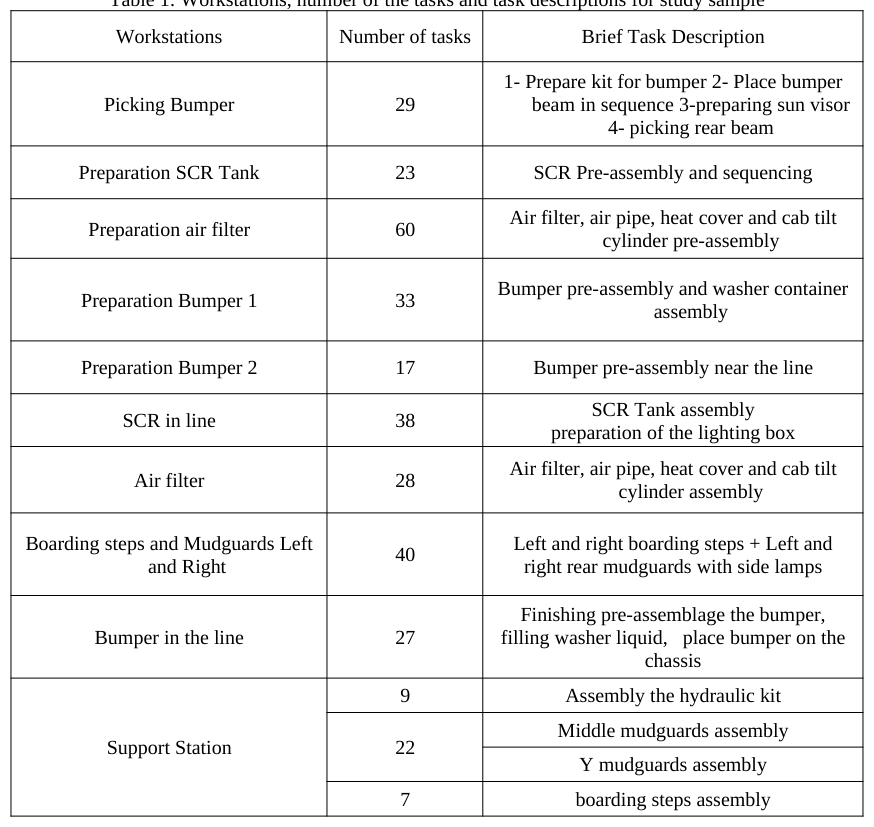
This study was done in SCANIA manufacturing plant in France. One sector of truck assembly process including 15 people was selected. The prominent workstations in this sector are provided in Table 1. The operators performed various tasks ranged 10 to 60 tasks in each workstation in function to truck options. Working hours started 7:30 in the morning to 16:00 in the afternoon with three pauses during the day for breakfast, lunch and mealtime.
Table 1: Workstations, number of the tasks and task descriptions for study sample Workstations Number of tasks Brief Task Description
To evaluate the feeling of operators concerning their jobs, the self-reported questionnaire was used. This tool was Physical Ergonomics II (2018) composed of various questions about demographic information, musculoskeletal symptoms and potential biomechanical & psychosocial risk factors. The operators were asked to answer the questions which assess the musculoskeletal symptoms such as pain or discomfort in neck, shoulders, elbows/forearms, hands/wrists and back during last 12 month. The questions were derived from Nordic questionnaire (Hagberg et al. 1995). The symptoms which their intensity were more than 5 on a scale of 10 at the moment of filling out the questionnaire was considered as WMSDs. The second part of our tool has evaluated the biomechanical risk factors. This section of questionnaire was developed according to European consensus criteria about WMSDs risk factors in upper limbs. The questions were about the postures of upper limbs (neck, shoulders, elbows, and wrists/hands) and back. If the operators answer “often” or “always”, it was defined respectively as 2 hours/day and 4 hours/day. For measuring work psychosocial risk factors, the French version of karasek job content questionnaire was used. This questionnaire including 26 questions which were categorized into 3 class as including high psychological demands, low decision latitude, and low social support. To determine the prevalence of job strain and iso-strain among study population, the score of low decision latitude, high psychological demands and low social support were dichotomized. The dichotomization of questionnaire scores were performed according to French Medical Surveillance of Occupational Risk Exposure (SUMER). So, high psychological demands and low decision latitude were two factors which determine the job strain and high psychological demands, low decision latitude and low social support altogether provide iso-strain.
Another method used in this study to measure perceive force exertion was Borg scale. The interview was performed by ergonomist for all the participants with Borg scale method in two period of time, Friday after noon at the end of the week and Monday morning at the beginning of the week after rest in weekend. Borg scale range from 6 “very very light” to 20 (very very hard). Third quartile which was 15 is considered as high perceive physical exertion in this study. Descriptive statistical analysis was used to analyze the results.
RESULTS
This study was done among assembly manufacturing workers. Our study population was 15 people who comprised all the workers in the one sector of truck assembly manufacturing. This sector includes 12 workstations and in overall operators had to perform 333 different assembly tasks during their working days (see Table 1). The people were divided into 3 improvement group (GAC) in which there are 3 or 4 workstations and the operators rotate within the GAC each two hours. All the subjects in this study were men with a mean age of 42 (±7.6) years. The mean of work experiences in the current job was 16 (±6) years while, the total length of work (in current job and the other jobs) was 22.2 (±7.2) years.
Musculoskeletal Symptoms
Figure 1 shows the prevalence of musculoskeletal disorders among study population in 3 GACs. The prevalence of musculoskeletal symptoms (intensity > 5/scale of 10 at the time of filling the questionnaire) such as pain, numbness or stiffness of upper limbs during the past 12 months was high (see Figure 1). The median of pain for shoulders and elbows were 5. This median for wrists and lower back were 4. The prevalence rate of symptoms on four anatomical regions of upper limb (shoulder, elbow, wrist, fingers) were respectively 66%, 53%, 40% and 33%. Low back symptoms during the last 12 months were reported by 46% of subjects.
10
10
9
9
9
9 9
8
8
8
8
7
7
7
6
5 5 5
6
5
5
6
5
7 7 7 5
5
7 7 5 4
5
3.5 3.5 4
4
4
3
4
3
3
3 3 3 3
2.5 3 2 2.5
3
3 1 1
2
2 2
2
1.5
1
1
1
0
0 0 0 0
0 0 0 0 0
0
0
0 0 0 0 0 0 0
Knee
Neck
Wrist
Elbow
Fingers
Hip/Thigh
Shoulders
Ankle/Foot
Upper back
Lower back
GAC 1
GAC 2
Upper Quartile Lower Quartile Median
Minimum Maximum Median
Maximum Minimum
Lower Quartile Upper Quartile
10
10
9
9 9
9
9
9
9
9 9
8
8
8
8
8
8
7
7
7
7 7 7
7
7
6
6
6
5
5
5 5
5
5
4
4
4
4
3
2.5
3
3
3
3
3
5 3.5 3.5 4 2.5 3
3
2
2
2
2 2
2
2
1.5
1
1
1 1
1
1
0
0 0
0 0 0
0
0
0 0 0 0 0 0 0
0
Knee
Neck
Wrist
Elbow
Fingers
Shoulders
Hip/Thigh
Ankle/Foot
Lower back
Upper back
GAC 3
All of subjects
Upper Quartile Lower Quartile Median
Minimum Maximum Median
Maximum Minimum
Lower Quartile Upper Quartile
Figure 1. WMSDs month among study population and for each improvement group (GAC) Perception of Exertion in Physical Work
Figure available in the original PDF paper.
In this study, Borg scale was used to measure the perceived exertion of the operators in the first (Monday) and the last (Friday) day of week. Figure 2 shows the median of exertion force for each GAC in function to 3 different type of working days for Friday and Monday. As it is shown the median for high workload working day in both Friday and Monday is high, even on Monday the median of exertion force for high workload working day is less than Friday (see Figure 2).
Figure 2. The median of perceive exertion on Borg scale for 3 types of working day on Monday and Friday
Figure available in the original PDF paper.
Figure 3 shows the percentage of exertion force for three working day on Friday and Monday. 60% of operators reported force exertion more than 15 (hard) for the high workload on Friday while 66% of people reported the same on Monday (see Figure 3).
Monday Friday
Typical working day high workload working day low workload working day
Figure 3. The percentage of exertion force>15 on the Borg scale on Friday and Monday for three different working days Risk Factors of WMSDs
Figure available in the original PDF paper.
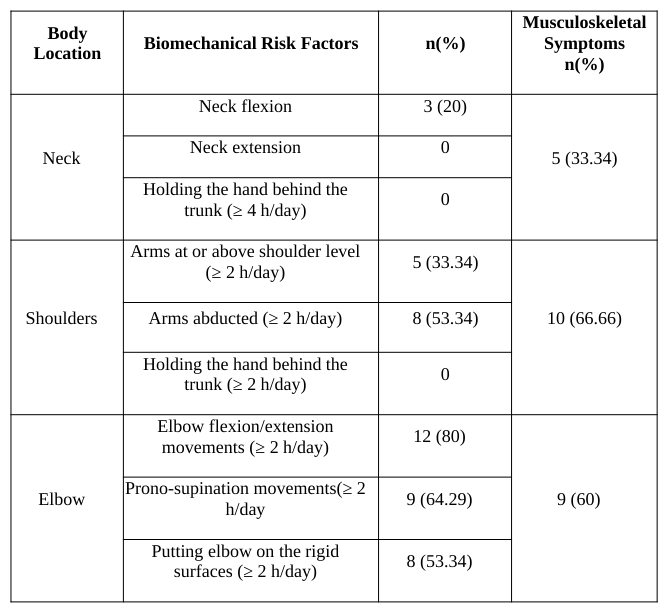
The most common reported biomechanical risk factors among assemblers were flexion/extension of the elbow (reported by 80% of operators), pinch grip (73.3%), and working with prono-supination movements (64.29%). The risk factors in the elbow were reported more than the other locations of the body. The WMSDs symptom was also high for elbow (60%). The shoulders risk factors including abducted arms and working above shoulder level were reported respectively by 53% and 33% of the subjects. 66% of subjects showed WMSDs symptoms in shoulders (see Table 2).
Table 2: Biomechanical risk factors and musculoskeletal symptoms for each body section among study subjects N=15 Musculoskeletal
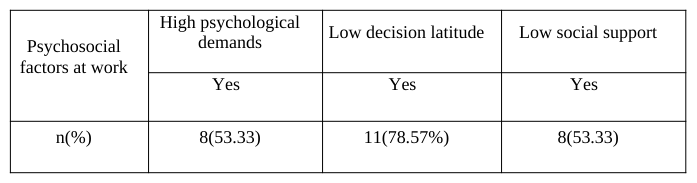
Psychosocial Factors The results of psychosocial factors of assembly manufacturing operators is evaluated by Karasek questionnaire. Table 3 presents three psychosocial factors including High psychological demands, Low decision latitude, Low social support. As you can see low decision latitude factors is high among study population (78.57%).
Table 3: Psychosocial risk factors according to karasek questionnaire among study subjects N=15 High psychological demands Low decision latitude Low social support
42% of operators were exposed to job strain which means low latitude decision and high level of psychological demands. The low level of decision latitude, high level of psychological demands and low level of social support which is considered as iso-strain was reported by 21% of subjects.
CONCLUSIONS
The aim of this study was to assess the feelings of assembly operators about the ergonomic risks including physical and psychosocial risk factors in their jobs. The self report and interview tools were used and the results showed that there are quite high percentage of WMSDs symptoms particularly in upper limbs. Potential physical risk factors mainly in upper limbs were considerable. Most of subjects reported risk factors for elbows, shoulders and wrists while the reported WMSDs symptoms in these members were high. Perceive exertion force on the Borg scale for more than half of our subject was hard (>15/20) in the high workload working day. While this risk factor was not considerable in the typical and low workload working day. Perceive exertion force was not difference for Monday and Friday among assemblers although its median on Friday was more than Monday for high workload working day. Approximately half of our subjects declared job strain. Low decision latitude was also a common risk factors among our subjects.
REFERENCES
Falck, A.C., Rosenqvist, M. (2012), “What are the obstacles and needs of proactive ergonomics measures at early product development stages?–An interview study in five Swedish companies”. International Journal of Industrial Ergonomics, 42(5), 406-415. Roquelaure, Y., Catherine H., Marine S. (2005), " Réseau expérimental de surveillance épidémiologique des troubles musculo-
squelettiques dans les Pays de la Loire". http://fulltext.bdsp.ehesp.fr/Invs/Rapports/2005/rapport_tms.pdf Sadra-Abarqhouei, N., Hosseini-Nasab, H. (2011), "Total Ergonomics and Its Impact in Musculoskeletal Disorders and Quality of Work Life and Productivity." Open Journal of Safety Science and Technology 1, 79-88. Speklé, E., Heinrich, J., Hoozemans, M., Blatter, B., van der Beek, A., van Dieën, J., Van Tulder, M. (2010), “The cost-
effectiveness of the RSI QuickScan intervention programme for computer workers: Results of an economic evaluation alongside a randomised controlled trial”. BMC musculoskeletal disorders, 11(1), 259. Sunwook K. (2012), "Exposure assessments in manual materials handling: evaluation of task-classification methods using wearable technologies." 49. Törnström, L., Amprazis, J., Christmansson, M., Eklund, J. (2008), “A corporate workplace model for ergonomic assessments
and improvements” Applied ergonomics, 39(2), 219-228. Wang, Z.X., Ru-Li, Q., Yu-Zhen. L., Xue-Yan, Z., Ning Jia, Q.Z., Gang Li, J.Z., Huan-Huan, L., Hai-Qiang, J. (2011), "[The epidemiological study of work-related musculoskeletal disorders and related factors among automobile assembly workers]." Chinese journal of industrial hygiene and occupational diseases 29, 8: 572-578.
LISTED IN THE AHFE DIGITAL BOOKSTORE CATALOGUE
Explore the complete digital volume
Advances in Physical Ergonomics and Human Factors: Part II
Read this individual research paper free through the original publisher, or explore the full digital proceedings book.
ISBN 978-1-4951-2105-0
Explore this ISBN in the AHFE Bookstore ↗Listed in the July 2026 bookstore catalogue; search by ISBN to confirm current availability · Digital book purchase optional