Manida Swangnetr, David Kaber (2018). Analysis of Novice and Experienced Rice Farmer Grip Force and Arm Muscle Activity in a Plowing Task. In: Advances in Physical Ergonomics and Human Factors: Part II. AHFE Open Access, vol. 2. https://doi.org/10.54941/ahfe100054
A previous study observed significant differences in rice farmer exertion and fatigue potential based on levels of expertise in field plowing. The present study sought to identify arm and hand movement strategies of experienced farmers for reducing fatigue and minimizing injury potential. Twenty experienced farmers (>= 2 years of experience) and 10 novices were asked to perform eight replications of a simulated plowing task using a high-fidelity apparatus. Grip force and arm muscle activity levels were collected for the flexor digitorum superficialis (FDS), extensor digitorum (ED) and triceps. Comparisons were made on the fatigue rate of response measures and effectiveness of muscle use between experienced and novice participants. Results revealed experienced farmers to generate higher grip force and lower fatigue rates with the FDS muscle, as well as more effective use of ED muscles (higher grip/activity), as compared to novices. Experienced farmer strategy also involved balanced activity levels for agonist (FDS) and antagonist (ED) muscles. Novices were found to largely use ED muscles to generate grip force. Imbalance in agonist and antagonist muscles activity could lead to rough movement patterns and increased risk of muscle overuse. These findings may be useful for developing training for farmers to achieve effective muscle use and minimize risk of arm and hand injuries.
Currently, Thailand has relatively few advanced agricultural technologies to use in rice cultivation. Rice farming activities are still based on manual work and human-machine interaction (Thailand National Statistical Office, Year). With a recent increase in production demands, rice farmer health and safety has become a more important issue in order to ensure a sufficient workforce. Prior research has shown that musculoskeletal disorders (MSDs) are the most common of all occupational non-fatal injuries and illnesses for farm workers (see Kirkhorn et al., 2010; Fathallah, 2010 for a comprehensive review). Low-back pain and hand and wrist disorders are common. In a study of prevalence of MSDs in Thai farmer, Puntumetakul et al. (2011) found that 73.3% of Thai farmers experience low- back pain, 36% report shoulder pain, 35.4% report knee pain, and 12.5% report wrist joint pain. Related to this, field preparation activities have been found to be the most energy-consuming tasks in agriculture (Mamansari and Salokhe, 1995). Our previous research involved a task analysis and systematic screening of initial rice field preparation to identify ergonomics-related risk factors (Swangnetr et al., 2012). In specific, we observed plowing machine use. The job screening revealed awkward hand posture, including extreme ulnar deviation with the potential to create high compression in the carpal tunnel due to associated gripping force. Asymmetrical whole-body postures were also observed primarily due to the lack of footwear use, leading to an imbalance in loading among the hands, feet and limbs. The job screening also revealed high grip forces in holding plowing machine handles and high forearm activity (motion) to control the machine. NIOSH (2001) previously identified awkward posture positions, repetitive wrist motion, excessive pinch grip forces and fatigue as risk factors for hand and wrist pain in occupational tasks. Beyond these factors, tool vibration has been found to cause acute ischemic effects in the hands and neurosensory problems (Walker-Bone and Palmer, 2002). Exposure to all these MSD risk factors occur in rice farming in mechanical plow use for field preparation.
With respect to upper extremity pain (forearm and hand), we also conducted a preliminary survey of farmers with a focus on field preparation (Swangnetr et al., in press). Results indicated that highly experienced farmers perceived significantly lower pain in both areas (p<0.05), as compared with ratings from less experienced farmers as well as injury risk ratings from job screening by ergonomists. Based on these observations, we speculated that there may be substantial differences in terms of farmer exertion and fatigue potential based on levels of expertise in task performance and equipment use. Numerous joints and muscles are involved in this task and this allows farmers to develop different muscular activity patterns (Cresswell and Ovendal, 2002). Related to this, studies on sport and occupational work have found that experts develop efficient and safer movement strategies (Gagnon et al., 1996; Plamondon et al., 2010; Chen et al., 2011) and generate more muscle strength (Chen et al., 2011) and less fatigue (Maisetti et al., 2006; Boyas et al., 2009), as compared with novices.
Unlike other highly structured and regulated work domains, such as industrial manufacturing where worker time at specific jobs and skill level is monitored, rice farming has few documented measures of worker experience. In order to objectively quantify levels of farmer expertise, it was proposed that physiological responses be considered, including cardiac outputs and muscle activation levels in target work tasks. Among these classes of variables, electromyography (EMG) may be most sensitive to expertise in terms of work posture control, levels of efficiency in muscular use and endurance (Konrad, 2005). Furthermore, EMG may be robust as a measure for classifying degrees of farmer expertise due to lower sensitivity to environmental conditions (temperature, humidity, etc.), as compared with cardiovascular measures (Astrand and Rodahl, 1986).
With respect to assessing exposure to risk factors as a basis for identifying efficient movement strategies, grip force can be measured using dynamometers, linear force transducers, and other pressure pads or glove sensors. Some studies have found that elbow and shoulder postures are significant in grip forces (Kattel et al., 1996; Doheny et al., 2008). That is, exposure and measurement of one risk factor (high grip force) may be mediated by another (i.e., awkward posture positions). Consequently, body postures and motion should be considered in making force measurements.
Like grip force, muscle activity has been found to be influenced by posture position. Among upper arm muscles, for example, Doheny et al. (2008) found triceps brachii (long head) activity to be significantly determined by elbow joint angle. A number of studies have shown muscle activity, including flexor digitorum superficialis (FDS) and extensor digitorum (ED), to be correlated with grip force (Radwin et al., 1987; Sudhagar et al., 1988; Hoozemans and van Dieen, 2005; Doheny et al., 2008). In order to capture rice farmer exposure to ergonomics-related risk factors and to provide a basis for movement strategy evaluation, the present study examined EMG activity of farmer forearm flexor and extensor muscles, as well as the triceps. The muscle activity levels were used to indicate efficiency in application of force as well as worker fatigue. Efficiency in muscle use can be determined by the ratio of grip force to EMG for specific muscles (Ayoub and Lopresti, 1971). Muscle fatigue levels are typically identified by time domain changes of amplitude parameters (Basmajian and De Luca, 1985; Konrad, 2005).
This research focused on the task of rice field preparation. On the basis of the prior research, we hypothesized that the efficiency and effectiveness of arm and hand movement patterns would be significant indicators of rice farmer experience levels. The overarching goal of the present study was to identify a set of rice farmer muscle activity (EMG) parameters in lab simulation of plowing tasks for differentiating among experienced and novice farmers. Such results might generally be useful for developing training and guidelines for famers on physical behaviors towards minimizing risk of MSDs.
METHODOLOGY
Participants Two groups of subjects were recruited for the study including: experienced farmers and novices (with no rice farming experience). The experiment was conducted with a sample size of 10 novices and 20 expert farmers (> 2 years in the field) randomly selected from the Khon Kaen, Thailand area (due to the location of the study). The level of experience within the farmer group was found to be normally distributed. The experienced farmer age range was between 18 to 55 years and the numbers of years in rice field plowing was between 2 to 40. Novice participants had an age range between 20 to 25 years with no rice field experience. (Although the experienced group of farmers had a wider age range, grip force and muscle activity responses ultimately revealed lower variability, as compared with responses from novice participants.)
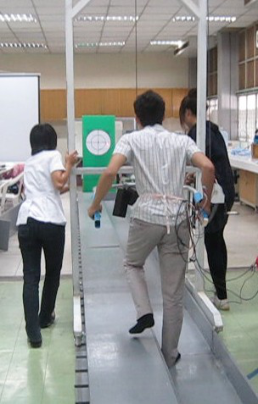
Apparatus and Task Participants were asked to perform simulated plowing in a laboratory setting using a high-fidelity simulator (see Figure 1). The simulator included a plowing apparatus with custom handles attached with weights (20 kg) to represent a typical mechanical plow. The apparatus was pushed over an uneven walkway representing typical rice field conditions. Rumble strips were also used beneath the wheels of the simulated plow to cause vibration. Each participant was asked to maintain a laser pointer, mounted on the tip of the plow handles, in a target area at the end of the terrain (also see Figure 1). Two researchers assisted in pushing the machine at 0.4 m/s, according to a metronome and stride length markings on the floor. Each participant completed a total of eight replications of the task in order to assess farmer fatigue potential in plowing.
Figure 1. Participants performing simulated rice field plowing
Experiment Variables Independent variable: Participant reported experience in the rice field was considered as an independent (grouping) variable. The settings of the variable included novice with no field experience and expert farmers with varying levels of field experience greater than 2 years.
Dependent variables: As identified above, the response measures to be collected during the experiment included: 1) Physical Ergonomics II (2018) grip force; 2) FDS muscle activity; 3) ED muscle activity; and 4) triceps brachii (long head) muscle activity. These measures were collected for all replications of the simulated plowing task during the experiment. A hand dynamometer (Biopac Systems, Inc.) was integrated in a handle of the simulated plow and used to measure grip force. Forces were transmitted to a Biopac data acquisition system and recorded using AcqKnowledge software (Biopac Systems, Inc.). The grip force was sampled at 60 Hz and subsequently normalized based on maximum voluntary contraction value.
EMG activity for the three selected muscles was recorded through bipolar configuration electrodes and ground leads (see Figure 1). Electrode placements followed a guideline from Basmajian and Blumenstein (1989). Sintered shield Ag/AgCl circular electrodes were used. The diameter of the electrodes was 1 cm. A Biopac MP100 data acquisition system was used with the AcqKnowledge software to record the output voltages of the EMG signal in a computer using. The muscle activity for the FDS, ED and triceps, was sampled at 1024 Hz. Signal processing of 20-500 Hz bandpass and notch filter of 50 Hz was used to eliminate electrical system interference in Thailand. The rectified EMG activity was then normalized based on maximum voluntary contraction values for each muscle.
Dependent variables derived from these raw measures included: 1) level of muscle fatigue, determined based on slopes of EMG amplitude; and 2) muscle efficiency, calculated as the ratio of grip force to EMG activity of the FDS and ED muscles. Triceps muscle efficiency was not analyzed as this muscle is not a prime mover in gripping tasks; it acts as a synergist.
Hypotheses Based on the review of research, the following research hypotheses were formulated:
Hypothesis 1: Experienced farmers were expected to exhibit a lower rate of muscle fatigue, as compared with novices.
Hypothesis 2: Experienced farmers were expected to exhibit more effective use of muscles during simulated plowing. That is, higher grip force with lower muscle activity, and therefore higher muscle efficiency (Grip/ EMG), was expected from the experts as compared with novices.
DATA ANALYSIS AND RESULTS Analysis of Grip Force and Muscle Fatigue
Repeated measures ANOVA was conducted for each subject group in order to determine whether a time effect was present among the eight replications. This analysis was conducted separately for each group due to the unbalanced sample size (and the potential for a violation of the repeated measures ANOVA assumption of sphericity of the covariance matrix).
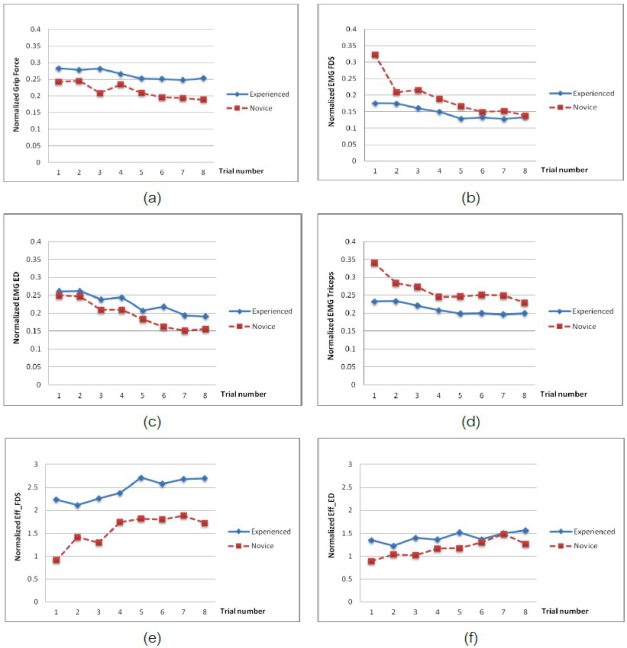
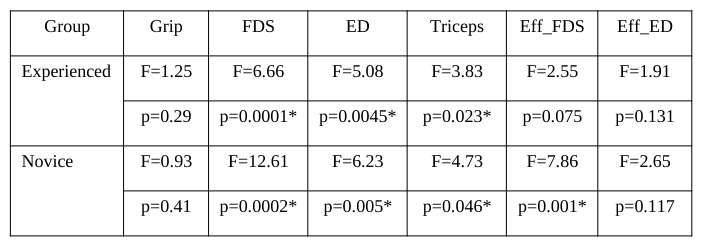
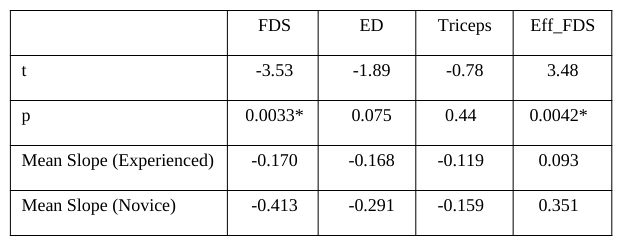
Figure 2 reveals the change in mean response measures for each participant group across experiment trials. In general, grip force and EMG responses decreased as time increased; while efficiency in muscle use increased over time. In general, the decrease in response measures may be due to fatigue. The repeated measures ANOVA analyses (see Table 1) revealed significant time effects for EMG responses for both novice and farmer groups. Efficiency in FDS muscle use also changed over time for the novice participant group (significant at p<0.05) and expert farmer group (marginally significant at p<0.1). However, no significant time effect was found for grip force and efficiency of ED muscle use. For responses indicating a significant time effect, the slopes of power functions were used to represent the rate of mean changes (or the rate of fatigue). Results from Welch’s t-test (see Table 2) revealed significant slope differences between novices and experienced farmers in terms of FDS muscle activity (t= -3.53, p=0.0033) and efficiency in use (t= 3.48, p=0.0042).
Figure 2. Mean of response measures, including: (a) grip force; (b) FDS activity; (c) ED activity; (d) Triceps activity; (e) efficiency of FDS use; and; (f) efficiency of ED use of experienced farmers and novices for each trialTable 1: Results of repeated measures ANOVAs on response measures (* indicates significant difference at p<0.05) Group Grip FDS ED Triceps Eff_FDS Eff_EDTable 2: Results of Welch’s t-test on slope of power function on response measures indicating significant time effect (* indicates significant difference at p<0.05)
Analysis of Response Measures with Absence of Fatigue Welch’s t-test was conducted on mean response measures that did not reveal a change over time (i.e., grip force and efficiency of ED muscle use). Results revealed experienced farmers to generate significantly higher grip force (t= - 2.98, p= 0.0034) and higher efficiency of ED muscle use (t= -2.56, p= 0.011), as compared with novices.
DISSCUSSION Results revealed participants were able to maintain grip force throughout experiment trials. In support of Hypothesis 2, experienced farmers generated significantly higher grip force levels, as compared with novices. However, arm muscle activity levels generated by both novices and experienced farmers significantly decreased over time. Decrease in amplitude of muscle activity has been associated with muscle fatigue levels (Basmajian and De Luca, 1985; Konrad, 2005). In line with Hypothesis 1, the rate of FDS muscle fatigue observed for experienced farmers was lower than the fatigue rate obtained for novices. The reduction in FDS activity, while maintaining grip force level, resulted in an increase in efficiency in FDS use over time. Although the increase in rate of efficiency in muscle use was significantly higher for novices than for experienced participants, experienced farmers generally achieved higher FDS efficiency levels.
Contrary to Hypothesis 1, fatigue rates for the ED and triceps muscles were not different between experienced and novice groups. This finding might be explained by the abilities of both groups to maintain grip force throughout the experiment. While the FDS muscle revealed fatigue, other muscles were used to sustain grip force. The slope values for the power functions also suggested that the ED and triceps muscles were less susceptible to fatigue than the FDS in the simulated plowing task. No time-dependence of the efficiency of ED muscle use for both participant groups also indicated any decreases in grip force and ED activity were minor and proportional. That is, the fatigue rate of the ED muscle was not great enough to reduce the effectiveness of use in generating grip force. In line with Hypothesis 2, results revealed experienced farmers to have significantly higher ED efficiency, as compared with novice participants. Experienced farmers exhibited more effective use of ED muscles during simulated plowing.
During experiment trials, we also observed experienced farmers to perform smoother motions with fewer jerks (i.e., fewer right angle movements and reversals), as compared with novice participants. Such movement patterns have been reported to be safer and have been used as an optimal model of human motion (Flash and Hogan, 1985; Hsiang and McGorry, 1997). Related to this, the mean fatigue rate for FDS and ED muscles was comparable in experienced farmers (-0.17 and -0.168, respectively). Therefore, experts used both flexor and extensor forearm muscles to control plowing machine as well as the triceps to stabilize the forearm throughout the experiment. In contrast, novice participants relied largely on the ED and triceps muscles. Unbalanced use of agonist and antagonist muscles has been found to result in less smooth movement patterns and risk of muscle overuse injury (Renstrm and Kannus, 1991; Muscolino, 2011). The present findings indicated that novice farmers may be at greater risk of MSDs due to unbalanced muscle use and rough movement patterns.
CONCLUSIONS
This study was conducted to compare the efficiency and effectiveness of arm and hand movements between experienced and novice rice farmers. The experiment was also to identify a means of objectively quantifying farmer expertise using physiological measures in lab simulations of farming activity. Results revealed experienced farmers to generate higher grip forces and lower fatigue rates in flexor muscle use, as compared with novices. In rice field preparation, higher plow grip force translates to greater machine control and stability. Experienced farmers were also observed to perform plowings task with balanced activation of agonist and antagonist forearm muscles. Such a strategy has been associated with smoother and safer movement patterns. Results also showed that participants with no experience in plowing used extensor muscles to generate grip force when the flexor was fatigued. Overuse of the extensor muscles for this purpose could lead to elevated risk of muscle injury. These results might generally be useful for developing training and guidelines for famers on physical behaviors towards minimizing risk of injury, especially for long-term arm and hand pain, and to achieve effective use of muscles during plowing tasks.
It should be noted that EMG analyses are difficult to conduct in field settings due to limited portability of equipment, the need for sensors and amplifiers to be connected to fixed-position data collection systems, and the potential for signal interference due to environmental noise. EMG measures might be correlated with other demographic data on farmers, for example age (Galganski et al., 1993; Laidlaw et al., 2000; Vaillancourt et al., 2003), years of task experience (Boyas et al., 2009; Plamondon et al., 2010; Chen et al., 2011) and anthropometric characteristics (Watts et al., 1993; Grant et al., 1996), which could be practically collected in the field using surveys or structured interviews. In future work, we will identify demographic variables predictive of objective measures of farmer work efficiency (in target tasks) and validate a set of descriptors of levels of expertise. The demographic data will be integrated with the muscle physiological responses for quantitatively describing farmer expertise.
ACKNOWLEDGMENTS
This study was supported by grants from the Back Neck and Other Joint Pain Research Group and Khon Kaen University. David Kaber’s work on the study was supported by a grant from the U.S. National Institute for Occupational Safety & Health (NIOSH) (No. 2 T42 OH008673-06). The opinions expressed in this paper are those of the authors and do not necessarily reflect the views of Khon Kaen University or NIOSH.
REFERENCES
Astrand, P.O., & Rodahl, K. (1986). Textbook of work physiology. New York: McGraw Hill. Ayoub, M.M., & LoPresti P. 1971. The determination of an optimum size cylindrical handle by use of electromyography.
Ergonomics, 14(4), 509-518. Basmajian, J., & Blumenstein, R. (1989). Electrode placement in electromyographic biofeed back. In: Buttler, E., editor.
Biofeedback: Principle and practice for clinicians. (3rd ed.). Baltimore: Williams & Wilkins. Basmajian, J.V., & De Luca, C.J. (1985). Muscles alive: Their function revealed by electromyography. Baltimore: Williams & Wilkins. Boyas, S., Maïsetti, O., & Guével, A. (2009). Change in sEMG parameters among trunk and thigh muscles during a fatiguing
bilateral isometric multi-joint task in trained and untrained subjects. Journal of Electromyography and Kinesiology, 19 (2), 259-268. Chen, Y-L., Lee, Y-C., & Chen, C-J. (2011). Differences in lifting strength profiles between experienced workers and novices at various exertion heights. International Journal of Industrial Ergonomics, 41, 53-58. Cresswell, A. G., & Ovendal, A. H. (2002). Muscle activation and torque development during maximal unilateral and bilateral
isokinetic knee extensions. Journal of Sports Medicine and Physical Fitness, 42 (1), 19–25. Doheny, E. P., Lowery, M. M., FitzPatrick, D. P., & O’Malley, M. J. (2008). Effect of elbow joint angle on force–EMG relationships in human elbow flexor and extensor muscles. Journal of Electromyography and Kinesiology, 18, 760–770.
Fathallah, F. A. (2010). Musculoskeletal disorders in labor-intensive agriculture. Applied Ergonomics, 41, 738-743. Flash, T., & Hogan, N. (1985). The coordination of arm movements: an experimentally confirmed mathematical model. J.
Neurosci., 5(7), 1688–1703. Galganski, M.E., Fuglevand, A. J., & Enoka, R. M. (1993). Reduced control of motor output in a human hand muscle of elderly subjects during submaximal contractions. Journal of Neurophysiology, 69, 2108–2115. Gagnon, M., Plamondon, A., Gravel, D., & Lortie, M. (1996). Knee movement strategies differentiate expert from novice
workers in asymmetrical manual material handling. Journal of Biomechanics, 29(11), 1445-1453. Grant, S., Hynes, V., Whittaker, A., & Aitchison, T. (1996). Anthropometric, strength, endurance, and flexibility characteristics of elite and recreational climbers. Journal of Sports Sciences, 14, 301–309. Hermens, H.J., Freriks, B., Disselhorst-Klug, C., & Rau, G. (2000). Development of recommendations for SEMG sensors and
sensor placement procedures. Journal of Electromyography and Kinesiology, 10(5), 361-374. Hoozemans, M. J. M., & van Dieen, J. H. (2005). Prediction of handgrip forces using surface EMG of forearm muscles. Journal of Electromyography and Kinesiology, 15, 358–366. Hsiang, S.M., & McGorry, R.W. (1997). Three different lifting strategies for controlling the motion patterns of the external load.
Ergonomics, 40(9), 928–939. Kattel, B. P., Fredericks, T. K., Fernandez, J. E., & Lee, D. C. (1996). The effect of upper-extremity posture on maximum grip strength. International Journal of Industrial Ergonomics, 18, 423-429. Kirkhorn, S. R., Earle-Richardson, G., & Banks, R. J. (2010). Ergonomic risks and musculoskeletal disorders in production
agriculture: recommendations for effective research to practice. Journal of Agromedicine, 15, 281–299. Konrad, P. (2005). The ABC of EMG. A practical introduction to kinesiological electromyography. Scottsdale, AZ: Norazon. Laidlaw, D. H., Bilodeau, M., & Enoka, R. M. (2000). Steadiness is reduced and motor unit discharge is more variable in old adults. Muscle and Nerve, 23, 600–612. Maïsetti, O., Boyas, S., & Guével, A. (2006). Specific neuromuscular responses of high skilled laser sailors during a multi-joint
posture sustained until exhaustion. International Journal of Sports Medicine, 27(12), 968–975. Mamansari, D. U., & Salokhe, V. M. (1995). The need for ergonomics considerations for the design and development of agricultural machinery in Thailand. Journal of Human Ergology (Tokyo), 24(1), 61-72. Muscolino, J.E. (2011). Kinesiogy: The skeletal system and muscle function. (2nd edition). Elsevier, China. National Institute for Occupational Safety and Health (NIOSH). (2001). Simple solutions: ergonomics for farm workers. Report
No. 2001-111, 1–53. Plamondon, A., Denis, D., Delisle, A., Larivière, C., & Salazar, E. (2010). Biomechanical differences between expert and novice workers in a manual material handling task. Ergonomics, 53(10), 1239-1253. Puntumetakul, R., Siritaratiwat, W., Boonprakob, Y., & Puntuatakul, M. (2011). Prevaleance of Musculoskeletal Disorder in
Farmer: Case study in Sila, Muang Khon Kaen, Khon Kaen Province. J. Med. Tech. Phy. Ther., 23, 298-303. Radwin, R. G., Armstrong, T. J., & Chaffin, D. B. (1987). Power hand tool vibration effects on grip exertions. Ergonomics, 30(5), 833-855. Renstrm P., & Kannus, P. (1991). Prevention of sports injuries. In: Krauss RH editor. Sport medicine. Philadelphia: WB
Saunders, 307-329. Sudhakar, L. R., Schoenmarklin, R. W., Lavender, S. A., & Marras, W. S. (1988). The effects of gloves on grip strength and muscle activity. Proceedings of The Human Factors Society-32nd Annual Meeting (pp. 647-650). Swangnetr, M., Kaber, D., Puntumetakul, R. & Gross, M. T. (in press). Ergonomics-related risk identification and pain analysis
for farmers involved in rice field preparation. To Appear in Work: A Journal of Prevention, Assessment and Rehabilitation. Swangnetr, M., Namkorn, P., Phimphasak, C., Sanelee, K., Buranrak, O., Kaber, D. B., & Puntumetakul, R. (2012). Task analysis and job screening on rice plowing activity. In Proceedings of the 2012 Applied Human Factors & Ergonomics Conference. Boca Raton, FL: Taylor & Francis CRC Press. Vaillancourt, D. E., Larsson, L., & Newell, K. M. (2003). Effects of aging on force variability, single motor unit discharge
patterns, and the structure of 10, 20, and 40 Hz EMG activity. Neurobiology of Aging, 24(1), 25-35. Walker-Bone, K., & Palmer, K. T. (2002). Musculoskeletal disorders in farmers and farm workers. Occupational Medicine, 52(8), 441-450. Watts, P., Martin, D., & Durtschi, S. (1993). Anthropometric profiles of elite male and female competitive sport rock climbers.
Journal of Sports Sciences, 11, 113–117.
LISTED IN THE AHFE DIGITAL BOOKSTORE CATALOGUE
Explore the complete digital volume
Advances in Physical Ergonomics and Human Factors: Part II
Read this individual research paper free through the original publisher, or explore the full digital proceedings book.
ISBN 978-1-4951-2105-0
Explore this ISBN in the AHFE Bookstore ↗Listed in the July 2026 bookstore catalogue; search by ISBN to confirm current availability · Digital book purchase optional