Ting Xia (2018). Modeling Peripheral Muscle Fatigue Using a Variable Recovery Rate. In: Advances in Physical Ergonomics and Human Factors: Part II. AHFE Open Access, vol. 2. https://doi.org/10.54941/ahfe100077
Muscle fatigue is a transient and reversible decrease in performance capacity after a period of physical exertion. A variety of approaches have been applied to model muscle fatigue. Recently a theoretical, phenomenal parameter-based model (Liu-Xia model) was proposed with the capability of predicting fatigue for tasks of any force-time history. The Liu-Xia model has two parameters F and R that define the fatigue and recovery behavior, respectively. Previously, F and R were treated as constant in model validation. In the current study, R is redefined as a function of exertion level in attempt to reflect the effect of muscle contraction on blood flow. The purpose is to examine if an R varying with exertion level can improve model prediction for low intensity, static and intermittent tasks. Particularly, R is modeled as a step-wise function of three regions: 0-10% maximum voluntary contraction (MVC), no occlusion; 10-50% MVC, 0-100% occlusion, assuming a linear relationship in the region; and 51-100%, full occlusion. The results suggest that an R varying with exertion level may serve as a viable way to improve model performance, dependent on a better modeling of the relationship between muscle contraction and blood flow.
Determining and modeling human physical capability are critical for the advancement of fields such as human factors engineering, occupational health and safety, and rehabilitation. There are three main aspects of human physical capability, including range of motion (position, as well as speed), strength (from a single joint to the whole body), and endurance. Among them, endurance is understood the least due to the complex physiology underlying the fatigue phenomenon (Enoka and Duchateau, 2008). Additionally endurance is highly task-related. Furthermore endurance can be affected by individual, environmental, and psychosocial factors. Due to the overwhelming complexity of the fatigue phenomenon, which ideally should be examined with the involvement of all bodily systems, the current work focuses on fatigue at muscles (i.e. muscle fatigue) and its modeling.
Muscle fatigue is a transient and reversible decrease in performance capacity after a period of physical exertion. It may rise peripherally at the muscle level (force generation ability) and/or centrally in the brain (neural drive to muscles). In human factors engineering endurance time, i.e. the period till failure to maintain the required or expected force (Edwards, 1981), is typically used to define fatigue. Three distinct types of approaches have been applied to model muscle fatigue mathematically, including experimental data-driven regression models, theoretical, physiology-based models, and theoretical, phenomenal parameter-based models.
The experimental data-driven regression fatigue models, such as Rohmert’s curves, are obtained primarily using endurance time data. While a Rohmert’s curve describes the relationship between exertion level and endurance time for static tasks (Rohmert, 1960; El ahrache et al., 2006), the approach can also be applied to describe endurance time for intermittent tasks by incorporating the effects of cycle time and duty cycle (Iridiastadi and Nussbaum, 2008). It is worth noting that these endurance time models predict the point of task failure instead of level of fatigue. The major advantage of the regression fatigue models is their simplicity while the major limitation is the lack of generalizability.
The theoretical, physiology-based fatigue models are primarily derived using previously available, muscle force generation models with the addition of fatigue components. These fatigue components can be viewed as scaling factors derived either from fatigue-related measurements such as metabolite (Giat et al., 1996) or from experimental muscle force-time profiles (Ding et al., 2000). In theory, these physiology-based fatigue models promise to predict fatigue for tasks of any kinds once validated. The major limitation is the complexity and the associated computational cost, not to mention the lack of thorough understanding of fatigue phenomenon. As result, there is only one physiology-based fatigue model existing in the literature capable of dealing with submaximal, non- isometric conditions (Marion et al., 2013). Up to now, physiology-based fatigue models are more influential in the medicine-related field, e.g. fatigue control in functional electrical stimulation for the rehabilitation of muscular function.
The theoretical, phenomenal parameter-based fatigue models take a systems approach, i.e. with motor unit (MU) as the building block, and describe fatigue behavior using only two phenomenal parameters, i.e. fatigue (F) and recovery (R) factors (Liu et al., 2002; Xia and Fey Law, 2008a). They possess the simplicity and computational efficiency of the regression models and the generalizability of the physiology-based models, e.g. the model improved by Xia and Frey Law (2008) is the only other model existing in the literature capable of dealing with submaximal, non-isometric conditions (Marion et al., 2013). Overall these models are fairly new and remain to be adopted in the field. In the current work, further development of phenomenal parameter-based muscle fatigue models is presented and validated. Particularly, the possibility if a varying R factor can improve model prediction for low intensity static and intermittent tasks is examined.
MATERIALS AND METHODS
Major Feature of the Existing Liu-Xia Model In 2002, Liu and colleagues (2002) proposed a novel, phenomenal parameter-based muscle fatigue model (Liu model for simplicity). In brief, the model simulates muscle force generation and fatigue-recovery behavior by postulating that an MU has to be in one of three hypothetical states: resting, activated, and fatigued. Hence muscle force can be easily represented as the percent of MUs in the activated state and fatigue as the percent of MUs in the fatigued state. Xia and Frey Law (2008a) adopted the Liu et al.’s three-state concept and combined it with their own innovative contribution, i.e. a task force-driven central command for MU activation and deactivation. The new model (Liu-Xia model for simplicity) in theory is capable of handling tasks of any kinds and has since been validated for static tasks using literature endurance time data (Xia and Frey Law, 2008b; Ma et al., 2009; Frey Law et al., 2012). Below is the summary of the existing Liu-Xia model.
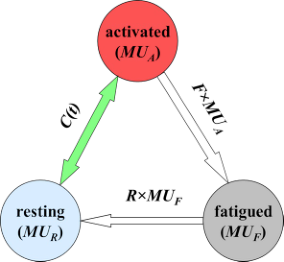
The basic components of the Liu-Xia model are three compartments representing Liu et al.’s (2002) three-state concept, i.e. a pool of MUs distributed in the resting (MUR), activated (MUA), and fatigued (MUF) compartments (Figure 1). The flows between the compartments are: F and R define the flow rates of the unidirectional Fatigue and Recovery processes, respectively (Liu et al., 2002), and a third bidirectional C(t) describes the central command for MU activation and deactivation (Xia and Frey Law, 2008a). The major difference between C(t) and F-R is that F-R are conventional transfer efficiencies, while C(t) is the instantaneous movement between the MUR and MUA compartments at any rate (number of MUs) as seen in muscle activation and deactivation. Additionally C(t) acts as a controller according to the demand of task and the availability of MUs. Furthermore C(t) serves to keep the size of
MUA, a feature seen in the muscular system that a central command is always required for keep muscle active.
Figure 1. Liu-Xia, phenomenal parameter-based muscle fatigue model. (Adapted from Xia and Frey Law, 2008a)
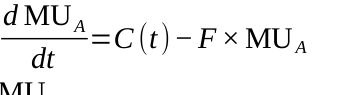
Besides F and R, there are two more intrinsic parameters that define force development rate (LD) and relaxation rate (LR) for muscle activation and deactivation, respectively. The mathematical representation of the Liu-Xia model is: d MUR dt =−C (t)+R×MUF
d MUA
eq. 1
Equation reproduced from the original PDF.
When performing a task of target load (TL), the response of the Liu-Xia model is governed by:
eq. 2
If MUA<TL and MUR>TL−MUA, C(t)=LD×(TL−MUA) If MUA<TL and MUR<TL−MUA, C(t)=LD×MUR If MUA≥TL, C (t)=LR×(TL−MUA) Modeling the Exertion Level-Dependent Recovery Factor
For the Liu-Xia model, the four intrinsic parameters, F, R, LD and LR, determine the response characteristics of the system, while C(t) is a controller making the system output stay on track with TL. The model not only predicts endurance time, i.e. the time when the system can no long output required force by a task, but also the level of fatigue before and after task failure, i.e. MUF. For LD and LR, Xia and Frey Law (2008a) found that a value of 10 was sufficient to keep the system output reasonably close to TL, with C(t) simulated using the simplest proportional controller. While there are more advanced, proportional-integral-differential controllers available, Xia and Frey Law (2008a) argued that the fatigue phenomenon is a rather slow process in the order of seconds when compared to muscle force development and relaxation, which are in the order of 100 hundred milliseconds, thus justifies the usage of a simple proportional controller. Based on this rationale, C(t) remains the same in the current work.
For F and R, the Liu and Liu-Xia models actually does not impose any restriction on them. Previously, F and R were treated as constant in model validation. In the current work, it is postulated that F is a constant while R as a function of exertion level (percent of maximum voluntary contraction, %MVC). The postulation of F as a constant is justified because the excitation-contraction process not only is the source of muscle force generation, but also the cause of local muscle fatigue. For example, consumption of oxygen, accumulation of lactic acid (decrease in pH), increase in CO2, and etc. are the results the excitation-contraction events. Obviously when higher force production is needed, more substrates are consumed and more metabolites accumulate, i.e. fatigue builds up. For simplicity a Physical Ergonomics II (2018) linear relationship between force production and fatigue, or constant F, was assumed.
On the other hand, the same cannot be said for recovery rate due to blood occlusion during muscle contraction. The replacement of substrates such as oxygen and glucose and removal of metabolites such as CO2 and lactic acid require blood flow. While lactic acid produced by white muscles can be consumed locally by red muscles, oxygen is still needed for this process with CO2 as the end product. It well documented that blood flow is affected by exertion level, e.g. the starting point of blood occlusion can be as low as 5-15% MVC while 50% MVC isometric contraction is sufficient to induce full occlusion (Rowell 1993). For simplicity, a piece-wise linear relationship is assumed between the exertion level and blood flow (BF, 0-100%, unit-less), i.e.
eq. 3
Equation reproduced from the original PDF.
Equation available in the original PDF paper.
Furthermore a linear relationship is assumed between blood flow and fatigue recovery. Hence we have R=R0×BF eq. 4
where R0 is a constant represent the maximum recovery rate when there is no blood occlusion (100% BF). It is worth noting that the 100% blood flow is not necessarily equal to blood flow at rest, more likely to be larger due to potent vasodilation effect of end products such as CO2 following a period of exertion.
Model Validation with Static Task Cases Previously, El ahrache et al. (2006) conducted a systematic literature of exertion level-endurance time models. The work has been used by Xia and Frey Law (2008b) and Ma et al. (2009) respectively for model validation. In the current work, the same endurance time models are applied to validate fatigue prediction using both constant and varying R. It is worth noting that most prolonged intermittent tasks in workplace are low intensity in nature. Additionally high intensity exertion is dominated by different fatigue process, e.g. disruption of action potential propagation. Therefore the validation is chosen for static exertion between 5% - 60%MVC.
Custom-written program in MATLAB (Mathworks, Natick, MA) is implemented for validating the Liu-Xia model using a numerical approach (Frey Law et al., 2012). The major advantage of the numerical approach is to avoid solving a set of rather complex differential equations (eqs. 1-4) analytically, which may not even be possible. In brief, the eq. 1 can be transformed to difference equations readily using the built-in MATLAB function “C2D”. L D and LR are set at 10 as suggested by Xia and Frey Law (2008). The time step is set at 1 s based on the rationales also provided by Xia and Frey Law (2008). F and R are then derived using the MATLAB nonlinear curve fitting function “NLINFIT” and the average behavior of the existing endurance time models sorted according to body joints. Coefficients of determination (R2) are provided to evaluate the performance quality of the model using two types of R.
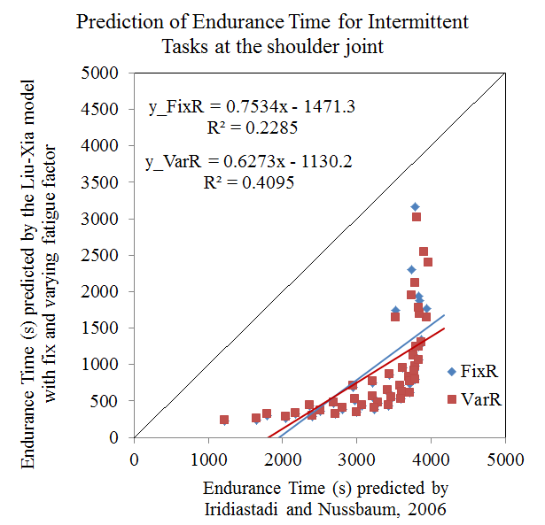
Model Validation with Intermittent Task Cases Iridiastadi and Nussbaum (2008) examined shoulder eundrance time under a variety of exertion level, cycle time, and duty cycle and formulated a regression model. Based on the model validation for static cases on the shoulder joint, F and R for both fixed R and varying R approaches are applied to predict the endurance time using the Liu-Xia model. The results are compared to the values predicted by Iridiastadi and Nussbaum’s model. The exertion conditions used for prediction are TL: 10, 15, 20, 25, and 30; cycle time 30 seconds, and duty cycle from 20-80% with a 5% increment. The predicted values are plotted against each other. Therefore, a straight y=x line indicates a perfect match, concave curve and to the right side of y=x indicating under-estimation, and convex curve and to the left side of y=x indicating under-estimation by the Liu-Xia model when compared to the Iridiastadi and Nussbaum’s model.
RESULTS AND DISCUSSION
Previously Xia and Frey Law (2008b) derived the analytical solution of the Liu-Xia model and fit F and R using the average behavior of the literature endurance time models sorted according to body joints. The authors found R2 > 0.998 for all curve fitting cases. Ma et al. (2009) applied a similar analytical approach to fit their version of modified Liu model using individual literature endurance time models. The authors found R2 > 0.95 for all curve fitting cases except one case at 0.727. Frey Law et al. (2012) fitted the Liu-Xia model numerically using a systematic literature review of fatigue data sorted according to body joints (Frey Law and Avin, 2010) and local optimization for exertion levels between 10% and 90% with an increment of 10% (i.e. 9 levels). The authors found the Liu-Xia model was able to fit at least 7 out of 9 exertion levels within the 95% confidence internal of the literature fatigue data for all curve-fitting cases.
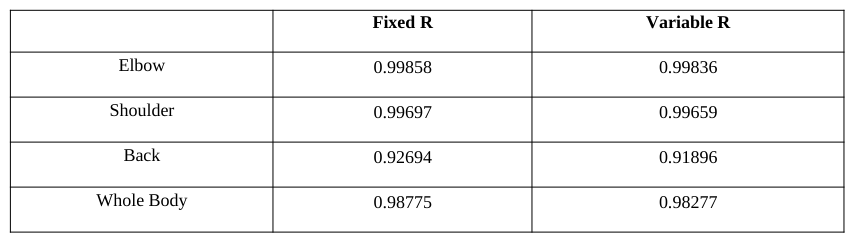
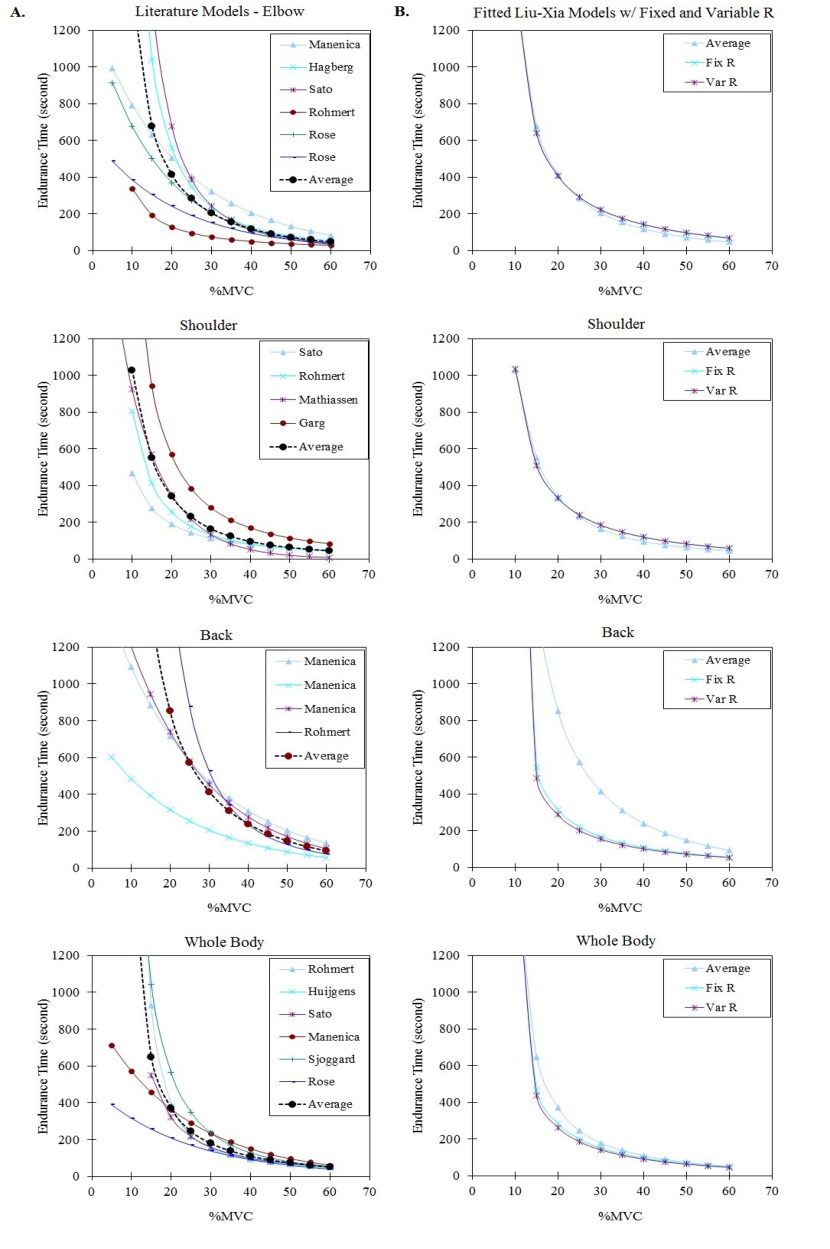
Compared to the Liu-Xia model using constant R, the model with a varying R produces similar results. Figure 1 demonstrates the literature endurance time models, and the Liu-Xia model with a fixed R or an R varying with exertion level (i.e. eqs. 3-4) when fitted using the average behavior of endurance time models sorted according to static tasks performed at the elbow joint, shoulder joint, back, and the whole body. Overall, both modeling approaches perform exceptionally well in predicting endurance under static loads and there is simply not much room to improve (Table 1).
Table 1: Coefficients of determination (R2) of fitted Liu-Xia models with fixed and variable fatigue factors, respectively.
Figure 2 demonstrates the comparisons between the endurance time predict by Liu-Xia model with both fixed and varying R and the endurance time predicted by Iridiastadi and Nussbaum’s model for intermittent shoulder tasks. The model with varying R shows some promise over the constant R, i.e. a higher R2. On the other hand, the model with varying R suffers from a significant under-estimation error just like the case with fixed R, i.e. significant deviation to the right side of the y=x line (the diagonal line in Figure 2). Therefore, the approach using the simple inverse relationship between blood flow and recovery process is as unsatisfactory as using a fixed R. However, there are studies demonstrated that blood flow actually increases under the loading conditions used by Iridiastadi and Nussbaum (2008) instead of the arbitrary, inverse relationship used in the current work (Rowell, 1993). It is expected that the curve predicted from the varying R will shift closer to the y=x line due to a faster recovery from the negative correlation between blood flow and exertion level around the middle region.
One limitation of the current work is that only fatigue associated with the metabolic aspect of the excitation- contraction chain is considered. Decrease in muscle force production ability can also be attributed to the disruption of action potential propagation in locations such as T-tubule (Enoka and Duchateau, 2008). Because the disruption of action potential propagation is more likely to happen in high intensity exertion conditions, it is justified for the current work to focus on low intensity exertion conditions. Another limitation of the current work is the over- simplification of blood flow regulation during exertion. Other factors such as muscle volume, muscle shape, and muscle fiber arrangement can significantly influence blood flow and distribution within the muscle, not to mention the blood vessel tonicity regulation by the nervous system and local chemical environment. In fact, there is evidence that blood flow actually increases during low intensity isometric contraction (Rowell, 1993). Nevertheless the current work is intended as a proof-of-concept study that a variety of fatigue recovery processes can be integrated into fatigue modeling. Finally, the current work does not address the effect of central fatigue, which is contained within the experimental fatigue data. It is the opinion of the author of the current work that the Physical Ergonomics II (2018) manipulation of F in the Liu-Xia model in a similar manner to the manipulation of R, i.e. an F varying according to fatigue level and work history, may be able to incorporate the central fatigue in fatigue prediction.
Figure 2. Literature endurance time models and fitted Liu-Xia Models with fixed and variable recovery factor R.
Panel A: literature models and the average behavior sorted according to body joint; Panel B: model fitting using both fixed and variable recovery factor R when compared the average behavior of literature models.
Figure 2. Comparison of prediction of endurance time for intermittent shoulder tasks between the Liu-Xia model using a fixed or a varying R and the model by Iridiastadi and Nussbaum (2008).
CONCLUSIONS
The major findings of the current work are that compared to the Liu-Xia model using constant F and R, the same model with R varying with exertion level produce similar results when validated using the endurance time data. There is improvement in fatigue prediction for the model with varying R when validated using prolonged, low intensity, intermittent task fatigue data, though still not satisfactory. The explanation could be that the relationship between blood flow and muscle contraction is over-simplified in the current work. Additionally the literature experimental data may not distinguish particularly between peripheral and central fatigue. Therefore, further development of muscle fatigue prediction depends on accurate peripheral muscle fatigue modeling in dealing with the effect of blood flow during exertions, as well as more understanding of central fatigue.
STATEMENT OF CONFLICT INTEREST None.
ACKNOWLEDGMENT
The modeling and simulation work was conducted on computers and MATLAB software package provided by the College of Engineering, University of Iowa, Iowa City, IA. The preparation of the manuscript was done at a facility constructed with support from Research Facilities Improvement Grant Number C06 RR15433 from the National
Center for Research Resources, National Institutes of Health.
REFERENCES
Ding, J., Wexler, A.S., Binder-Macleod, S.A. (2000), “A predictive model of fatigue in human skeletal muscles”, Journal of Applied Physiology 89, 1322–1332 El ahrache, K., Imbeau, D., Farbos, B. (2006), “Percentile values for determining maximum endurance times for static muscular
work”, International Journal of Industrial Ergonomics 36, 99–108 Edwards, R.H.T. (1981), “Human muscle function and fatigue”, Ciba Foundation Symposium 82, 1–18. Enoka, R.M., Duchateau, J. (2008), “Muscle fatigue: what, why and how it influences muscle function”, Journal of Physiology, 586, 11-23. Frey-Law, L.A., Looft, J.M., & Heitsman, J. (2012), “A three-compartment muscle fatigue model accurately predicts joint-
specific maximum endurance times for sustained isometric tasks”, Journal of Biomechanics, 45, 1803-1808 Giat, Y., Mizrahi, J., Levy, M. (1996), “A model of fatigue and recovery in paraplegic’s quadriceps muscle subjected to intermittent FES”, Journal of Biomechanical Engineering 118, 357–366 Iridiastadi, H., Nussbaum, M.A. (2006), “Muscle fatigue and endurance during repetitive intermittent static efforts: development
of prediction models”, Ergonomics, 49, 344-360. Liu, J.Z., Brown, R.W., Yue, G.H. (2002), “A dynamical model of muscle activation, fatigue, and recovery”, Biophysical Journal 82, 2344–2359 Ma, L., Chablat, D., Bennis, F., Zhang, W. (2009), “A new simple dynamic muscle fatigue model and its validation”, International
Journal of Industrial Ergonomics 39 (1), 211-220 Marion, M.S., Wexler, A.S., Hull, M.L. (2013), “Predicting non-isometric fatigue induced by electrical stimulation pulse trains as a function of pulse duration”, Journal of Neuroengineering and Rehabilitation, 10, 13 Rohmert, W. (1960), “Determination of the recovery pause for static work of man”, Internationale Zeitschrift fur Angewandte
Physiologie 18, 123–164. Rowell, L.B. (1993), “Human cardiovascular control”, Oxford University Press, New York, NY Xia, T., Frey Law, L.A. (2008a), “A theoretical approach for modeling peripheral muscle fatigue and recovery”, Journal of Biomechanics, 41(14), 3046–3052 Xia, T., Frey Law, L.A. (2008b), “Modeling muscle fatigue for multiple joints”, Poster presentation at 2008 North American
Congress on Biomechanics, Ann Arbor, MI, Aug 5-9, 2008
LISTED IN THE AHFE DIGITAL BOOKSTORE CATALOGUE
Explore the complete digital volume
Advances in Physical Ergonomics and Human Factors: Part II
Read this individual research paper free through the original publisher, or explore the full digital proceedings book.
ISBN 978-1-4951-2105-0
Explore this ISBN in the AHFE Bookstore ↗Listed in the July 2026 bookstore catalogue; search by ISBN to confirm current availability · Digital book purchase optional