Katja Bühlmeyer, Johannes Theurer und Hubert Wittmann (2020). A New Generation of Tractor Seats. In: Advances in Social and Organizational Factors. AHFE Open Access, vol. 9. https://doi.org/10.54941/ahfe100367
Tractor drivers have an 8-fold higher risk of getting back pain compared to office workers. Reasons therefore are being a long time in awkward postures and being forced to whole-body vibrations. With that biomechanics knowledge and the help of input user studies a totally new tractor seat generation was developed. Hereby a unique seat feature was integrated which has never been on the market before. The goal of this experimental study was to investigate the healthy and comfort potential of the new feature.Objective as well as subjective measurements have been done to observe whether the new seat feature is better compared to the serial seat without that feature. Objective methods were EMG measurements and body posture detection. The objective measures were done in the laboratory with 3 test persons. A field test has been done with 10 professional drivers to get the subjective ratings of the comfort. The results showed a difference in the muscle activity. The new feature reduced the activity of up to 30%. Slightly differences in the posture could have been seen. Posture detection revealed strong interindividual differences. All test drivers gave a good subjective feedback regarding the comfort of the new feature. In summary this is the most promising feature in the area of tractor seats with respect to short-term and long-term comfort. Additionally the feature leads to a muscle activity reduction. This comes along with a reduced fatigue and might protect the driver’s spine in the long term against impairments.
Musculoskeletal disorders lead to enormous costs and absence times. One of the most frequent diseases out of this group is back pain. Back pain was the second most common cause of absence in Germany in 2011 (Badura et al. 2012). Causes of back pain are for example static sitting postures (e.g. Videman et al. 1976), whole-body vibration or awkward postures like for example twisting (Nordin 2004). The prevention of back pain or musculoskeletal disorders has an enormous potential of keeping the work performance on a maximum level and reducing the primary (loss of productivity) and secondary (e.g. alternative employee, quality problems) costs for the company.
There exist several epidemiological studies which showed that farmers have a higher risk (annually prevalence rate of low back pain: 72%) of getting back pain in comparison to the European population (annually prevalence rate for low back pain: 38%). Next to a higher percentage rate of low back pain tractor drivers also might have a higher risk of getting visible disk degenerations (45.8% of the investigated tractor drivers, limitation: no control group; Stawczyk 1983). Another study showed that tractor drivers have an 8-fold higher risk of getting back pain compared to office workers (Punnett et al. 2005). In general there is evidence that tractor drivers are a risk group of getting back pain. Reasons therefore are being a long time in awkward postures and being forced to whole-body vibrations. Nordin (2004) developed a model reflecting the situation of many commercial vehicle drivers with respect to the risk of getting back pain. In this model sitting itself might induce back pain. The combination of sitting with whole body vibrations or sitting with awkward postures leads to an increase of the risk of getting back pain. The worst case is the combination of all three parameters (see Figure 1).
Figure 1. Risk factors contributing to the development of back pain. (Adapted from Nordin, 2005)
Figure available in the original PDF paper.
With the above mentioned biomechanical knowledge and the help of input user studies a totally new tractor seat generation was developed. Hereby a unique seat feature was integrated which has never been on the market before. The goal of this experimental pilot study was to investigate the preventive and comfort potential of the new feature.
MATERIALS & METHODS To investigate the preventive and comfort potential of the new tractor seat a laboratory pilot study and subjective field tests have been done. The pilot study was planned to objectify the differences of the two seats regarding muscle activity and motion patterns. The field test has been done to determine the subjective short and long-term comfort of the new feature Dualmotion.
New tractor seat with Dualmotion The new tractor seat includes a new feature called Dualmotion. This backrest extension can be moved from the neutral driving situation (see Figure 2 left picture) to a left-side oriented position (see Figure 2 right picture) in which the driver is supported while sitting backwards rotated. This new seat was compared to the current series seat (without backrest extension). Both seats were adjusted equally regarding seat height, backrest inclination, armrest adjustment and seat cushion inclination.
Figure 2. New tractor seat with Dualmotion and its adjustment range. The two end positions are the neutral (left) and sideward position (right).
Figure available in the original PDF paper.
In the pilot study (see next chapter) three seat arrangements have been compared: A) the series seat without Dualmotion (no backrest extension at all) = series
B) the new tractor seat with Dualmotion = new + Dualmotion C) the new tractor seat with Dualmotion and using the swivel (30°) = new + Dualmotion + swivel
Test procedure pilot study A first pilot study was done which reflected the field situation. To ensure a systematic way of movements a protocol was fixed and shown to the test persons. The content of that protocol was the position of the feet and the left as well as the right hand in 4 different body postures together with the order to look at 4 different markers on the floor (see Figure 2). The simulated body postures were the following:
2) rotated body posture reflecting observing the right edge of e.g. a trailer (Figure 3, marker 2)
3) rotated body posture reflecting observing an attachment behind the tractor (Figure 3, marker 3)
4) rotated body posture reflecting observing e.g. the end of a plough (Figure 3, marker 4)
Figure 3. Study design: positions of the seat with the test person (shown here: neutral posture, no 1) and the markers which had to be observed.
Figure available in the original PDF paper.
Three test persons have been involved in the pilot laboratory experiment. Electromyography and motion analysis has been done.
Electromyography (EMG) analysis For the EMG analysis the system “myomuscle” with a DTS Desk Receiver EMG system and the software “Noraxon MR3.4” was used. The following muscle types have been investigated according to the specifications of Konrad (2006): Musculus sternocleidomastoideus, cervical extensors, musculus trapezius pars descendens, lumbal back extensors. The pilot study has been done together with the company Velamed. After the laboratory test procedure each test person had to perform a maximum voluntary contraction (MVC). All EMG results have been set in reference to the MVC value. The mean values were used for the normalization procedure.
Kinematic analysis For the kinematic analysis the inertial sensor technology of the company Noraxon was used with the software “Noraxon MR3.4”. The system includes 16 sensors and leads to 21 anatomical angles. The calibration of the motion system was done by starting each measurement series with a calibration posture. In that posture the body angles were set 0° (wrist, spine, shoulder) respective 90°.
Field tests A field test has been done with 10 professional drivers to get the subjective ratings of the comfort. The tests started in June 2012 and are lasting on till then. Two evaluation steps have been done after 8 weeks and after 1 year. The test procedure was a nondirective half-structured interview.
RESULTS
Electromyography (EMG) analysis The muscle activity of the lumbar back extensors (left & right) showed values below 10% of MVC in the case of all test persons, all seat arrangements (A-C) as well as in all conditions (posture 1-4, see Figure 3).
Test person 2 and 3 showed MVC-values of the cervical extensors (left & right) below 10% except one situation which was 15% (test person 2, new + Dualmotion, posture 4, right cervical extensor). Test person 1 showed an activity of the cervical extensors above 10% MVC during posture 2 (new + Dualmotion + swivel, left & right cervical extensor) and posture 3 (series, right cervical extensor / new + Dualmotion, left and right cervical extensors). Sitting in posture 4 led to an increase in muscle activity compared to the neutral posture (1) in the case of test person 1 in all seat arrangements with a tendency of a decrease of cervical muscle activity (left & right) from the series seat up to the new seat + Dualmotion + swivel.
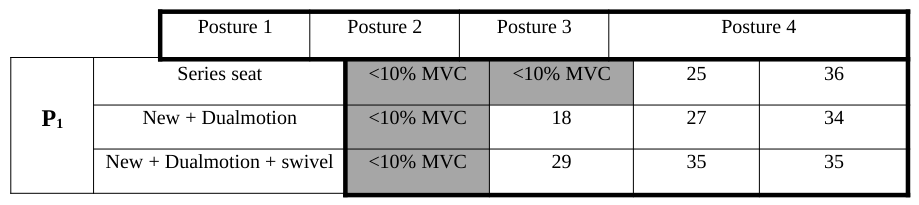
There was no muscle activity of the right musculus sternocleidomastoideus except in one case (test person 3, series seat, posture 4). The activity of the left musculus sternocleidomastoideus showed MVC activity levels below 10% in the neutral posture in the case of all test persons (see Table 1). There is a tendency of an increase of the muscle activity in all test persons and all seat arrangements from posture 2 to posture 4 (except series seat, test person 2). A comparison of the 3 seat arrangements showed a clear trend of muscle activity reduction in the case of posture 2 (all test persons) from the series seat up to the new seat + Dualmotion + swivel. The same trend was seen for test person 3 in posture 3 and 4. Test persons 1 and 2 did not show this clear trend for posture 3 and 4 (see Table 1).
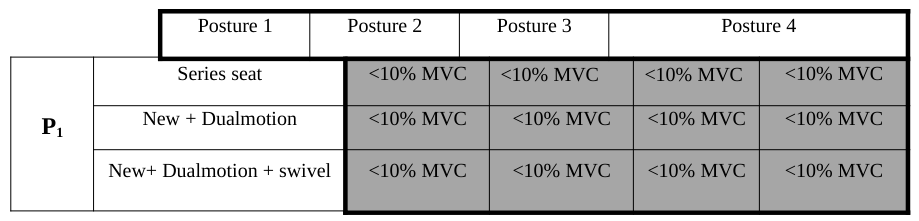
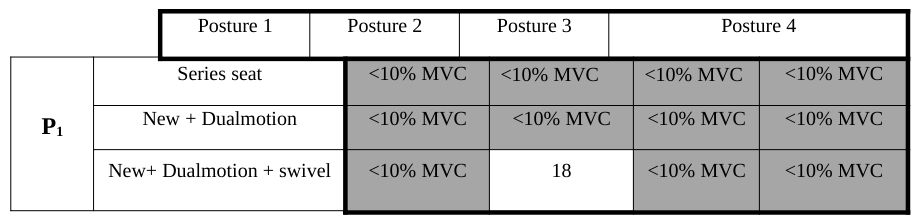
Test person 1 showed no muscle activity of the musculus trapezius (left & right) except in one case (new + Dualmotion + swivel, posture 2, right side). Test person 2 and 3 showed MVC-values mainly below or slightly above 10 % MVC in the neutral posture (left and right musculus trapezius). Both test persons (2 and 3) showed a trend of a decrease of the activity of the left and right musculus trapezius in all active postures (2-4) from the series seat to the new seat + Dualmotion + swivel (except test person 2, new seat + Dualmotion, posture 4) (see Table 2 and 3).
The mean values of all test persons and the different postures (1-4 plus 2 additional postures not discussed here in detail) showed no relevant activity (muscle activity below 10% MVC) for the lumbar extensors, the left cervical extensor as well as the right musculus sternocleidomastoideus. The muscle activity (% MVC) of the left upper trapezius was 18% for the series seat, 13% for the new seat + Dualmotion and 8% for the new seat + Dualmotion + swivel. The muscle activity (% MVC) of the right upper trapezius was 17% for the series seat, 14% for the new seat + Dualmotion and 10% for the new seat + Dualmotion + swivel. The muscle activity (% MVC) of the right cervical extensors was 14% for the series seat, 15% for the new seat + Dualmotion and 10% for the new seat + Dualmotion + swivel. The muscle activity (% MVC) of the left musculus sternocleidomastoideus was 30% for the series seat, 32% for the new seat + Dualmotion and 22% for the new seat + Dualmotion + swivel.
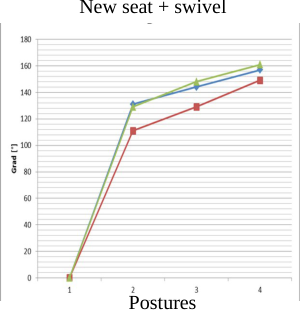
Kinematic analysis The kinematic analysis showed a clear reduction of the axial rotation of the whole spine (head, upper spine, lower spine, pelvis) on all test persons. There are only minor differences of the axial rotation using the series seat compared to the new seat + Dualmotion. This trend was seen in all segments of the spine. Figure 4 shows the trend for the axial rotation of the head.
Figure 4. Head rotation (°) by using the three seat arrangements: A) series B) new + Dualmotion C) new + Dualmotion + swivel of the three test persons (1 - blue line, 2 - red line, 3 - green line)
Figure available in the original PDF paper.
Series seat New seat + swivel New seat + Dualmotion + swivel
Postures Postures Postures
Interindividual differences could be seen in the movements occurring in the frontal and sagittal plane. Figure 5 shows the lateral bending of the head. Test person 1 and 3 showed a lateral bending to the right (positive values) and test person 3 showed a lateral bending to the left.
Figure 5. Head side bending (°) of the three test persons (1 - blue line, 2 - red line, 3 - green line) by using the series seat
Postures
Field test Driver reactions after 8 weeks had been very positive in all 10 cases. All 10 test drivers gave a good feedback about the new feature Dualmotion. Additionally this is much higher to rate, because it was the first of all positive feedbacks the drivers gave, and this happened without a calling. This happened many times. Here is an overview of the feedbacks:
“…I’m amazed of the Dualmotion, because it is movable” “…the Dualmotion is great, because we have to turn around very often” “…the Dualmotion is very efficient, that’s nice” “…extremely useful, you get used to it very quick” “…turning around is much more easier now and the rear view is significantly better” “…the Dualmotion is great, it’s much easier to look around” The telephone interview after 1 year gave no relevant differences compared to the evaluation after 8 weeks.
DISCUSSION
The results showed a huge interindividual difference in the muscle activity between the seat arrangements and the test persons. This is reflected by the EMG values as well as the motion patterns. Due to the small size of test persons there is less redundancy between the motion patterns and corresponding muscle activity. This was a limitation of this small study.
An example for such a special motion pattern is shown in Figure 5. Test person 2 showed a head side bending to the left side in the seat arrangements “series seat” and “new + Dualmotion“(test person 1 and 3 showed a right side bending). A reason here for might be the (dis)ability of the test persons regarding flexibility and muscle status. This special motion pattern could not have been seen in the muscle activities of the cervical extensor or the musculus trapezius. Nevertheless the increased activity of the left musculus sternocleididomastoideus while sitting in the new seat + Dualmotion might reflect this individual motion pattern. All test persons had less muscle activity of the lumbar and cervical extensors. A reason might be less side bending activity of these two muscle groups during the investigated motion. It might be an indicator for the ability of the seat at supporting the drivers during the backward oriented posture. Andersson et al. (1974) showed that a reclined backrest induced lower back muscle activities compared to a more vertical backrest. Additionally a larger support area showed a decrease in muscle activity. This comes along with a decrease of intradiscal pressure of the spine (Andersson et al. 1974). The underlying results of this study together with earlier findings (Andersson et al. 1974) show that all seats provide a good support in both the rotated and the neutral posture with respect to the activity of the spinal extensors.
Next to the low activity of lumbar and cervical extensors an increase of muscle activity of the left musculus sternocleidomastoideus was seen due to the increase of axial rotation related to the performed tasks (from posture 1 to 4). The same trend was seen for the right musculus trapezius but not for the left musculus trapezius. This increase, forced by the axial rotation of the test persons, was reduced by using the new seat. Especially in posture 2 there was a clear trend of decreased sternocleidomastoideus (all test persons) and upper trapezius muscle (test person 2 and 3) activity while using the new seat (with and without swivel). This trend was also seen for the upper trapezius in posture 3 and 4 (test person 2 and 3).
The mean values of all test persons and postures showed a reduction of up to 30% muscle activity while comparing the series seat with the new seat + Dualmotion (left upper musculus trapezius). A larger decrease of muscle activity could be seen while using the new seat + Dualmotion + swivel. The reductions of the axial rotation in all spine segments support the upper findings. Wilder et al. (1976) showed increased physical fatigue of the muscles and ligaments and Adams (2004) revealed increased fatigue of the neuromuscular coordination due to whole body vibration and loss of support. Therefore the reduction of muscle activity might prevent an early exhaustion. This is an indication of body load reduction especially when using the new seat with all features (Dualmotion and swivel).
Together with the good subjective test ratings regarding short and long-term comfort the new seat might be a good preventive tool to reduce the load on the human body.
CONCLUSIONS
In summary the new feature Dualmotion especially in combination with a swivel is the most promising feature in the area of tractor seats with respect to short-term and long-term comfort. Additionally the feature (with and without using the swivel) leads to a muscle activity reduction. This comes along with a reduced fatigue and might protect the driver’s spine in the long term against impairments. The underlying results of this study show that all seats provide a good support in both the rotated and the neutral posture.
Further studies have to investigate the most relevant muscles for the tractor driver´s movements and the test procedure has to be repeated including more test persons.
REFERENCES
Adams, M. (2004), „Biomechanics of back pain“, ACUPUNCTURE IN MEDICINE Volume 22 No. 4 Andersson, BGJ. Örtengren, R. Nachemson, A. Elfström, G. . (1974), „Lumbar disc pressure and myoelectric back muscle activity during sitting“, SCAND J REHAB MED Volume 6 No. 3 Badura, B. Ducki, A. Schröder, H. Klose, J. Meyer M. (2012): „Fehlzeiten-Report 2012: Gesundheit in der flexiblen
Arbeitswelt: Chancen nutzen – Risiken minimieren“, Springer Verlag Konrad, P. (2006): „The ABC of EMG – a practical introduction of kinesiological electromyography“, Noraxon U.S.A. Nordin, M. (2004), „Zusammenhang zwischen Sitzen und arbeitsbedingten Rückenschmerzen“, in: Ergomechanics®. Hans- Joachim Wilke (Ed.), pp. 10-35 Punnett, L. Prüss-Ustün, A. Nelson, D.I. Fingerhut, M.A. Leigh, J. Tak, S. Phillips, S. (2005), „Estimating the global burden of
low back pain attributable to combined occupational exposures“, AMERICAN JOURNAL OF INDUSTRIAL MEDICINE Volume 48 No. 6 Stawczyk, W. (1983) „Lumbar section of the spine in tractor operators”. MED WIEJSKA Volume 18 Videman, T. Nurminen, M. Troup, J.D. (1976), „Lumbar spinal pathology in cadaveric material in relation to history of back pain, occupation, and physical loading“, SPINE Volume 15 No. 8 Wilder, DG. Aleksiev, A.R. Magnusson, M.L. Pope, M.H. Spratt, K.F. Goel, V.K. (1976), „Muscular response to sudden load. A
tool to evaluate fatigue and rehabilitation“, SPINE Volume 21 No. 22
LISTED IN THE AHFE DIGITAL BOOKSTORE CATALOGUE
Explore the complete digital volume
Advances in Social and Organizational Factors
Read this individual research paper free through the original publisher, or explore the full digital proceedings book.
ISBN 978-1-4951-2102-9
Explore this ISBN in the AHFE Bookstore ↗Listed in the July 2026 bookstore catalogue; search by ISBN to confirm current availability · Digital book purchase optional