Chan-O Kim, Young-Guk Kwon, Se-Jung Oh (2018). A Study on the Occupational Health & Safety Management System Integrated with Business Continuity Management System. In: Advances in Physical Ergonomics and Human Factors: Part II. AHFE Open Access, vol. 2. https://doi.org/10.54941/ahfe100055
Recently, incidents and disasters occurring in home as well as abroad influence whole industrial society not just limited in business places or districts. If safety management system of business is broken, then an incident occurs. This brings out a huge loss at the scene of an incident and other businesses. And then, delayed and passive reaction to this incident may be expanded to a national disaster. A state of emergency caused by these disasters threatens countries and public's safety in addition to company's loss, and it can encourage social and financial anxiety worldwide. If BCMS(Business Continuity Management System)’s, which has recently been adopted as a social safety system, is established in a general place of business, overlap and collision are inevitable in many sides. And it will make an overlapped organization that makes confusion in company by a cost of management. To avoid these overlap and collision, for making better OH&SMS (Occupational Health and Safety Management System), companies need to construct a unified business system after adding applicable requirements in business place. And then we can minimize confusions and burdens in company, and operate integrated system including BCMS. This study suggests using HSSMS (Health, Safety and Security Management System) which is KOSHA 18001 - nowadays many companies are used in KOREA - utilized by BCMS. If company adopts this HSSMS(Health, Safety and Security Management System), following positive effects can be expected.1) HSSMS makes it possible for company's OH&SMS to unify with BCM systems and to be continual improvement and operation.2) Because HSSMS makes OH&SMS communicate with national BCMS, it helps constructing and operating BCMS being cooperated by the public and civil sector.3) OH&SMS and BCMS make it easier to decrease accident rate, enhance working environment, increase productivity, hold a dominant position in internal and external market, preoccupy the appearance of global standard, and respond the voluntary restraints of market.
Background and Purpose of the Study Recently, over the large hurricane or earthquake, human error due to the changes in the social environment, or even paralysis (or blocking) of social infra structures caused by terrorism, are causing the personnel and property damages we have never experienced before. East Japan’s Great Earthquake that occurred in March 2011 produced an explosion accident of the Fukushima nuclear power plant with the radiation leakage result in long-term power shortages. The damages of personnel and property, and atrophy (or shrink) of consumption affected enormously in the economy of a society. In September 2012 South Korea's Gumi Industrial Complex HF gas leakage and explosion caused a number of human casualties, and animals, crops, environment and the community. It was so seriously damaged, so the region was declared as "a special disaster area" (Oh, 2013).
This is continued to happen, it makes a bigger problem. But the government knew the risks and tended to ignore the problem, it ends up resulting in massive damages. The real problem is to raise damage without properly taking care of before preparedness or after response against accident which were exposed by the disasters. It became obvious that lack of safety management could lead the workplace around the site to the disaster, it also could be expanded to "the national disaster". These recently occurred disasters, unlike the past, cannot prepare or respond to by person or organization alone. So systematical approach should be made by the social or a national scale.
However, the disaster management system by established the social security system is applied to the general workplace. There would be many conflicts (overlap or collision) in existing safety and health management system and there would be more financial and managerial burdens on workplace. To avoid these problems, and in order to minimize the chaos and burdens, it would be necessary to implement the integrated management system (Oh, 2013; Oh & Kim, 2013; Kim et al., 2010).
This study suggests a new safety and health management system that could lead to minimize the damages from the accidents and provide prevention activities by applying BCMS(ISO 22301), which is the standard system for international disaster management, to OH&SMS(KOSHA 18001) (Oh, 2013).
OH&SMS AND BCMS Occupational Health & Safety Management System (OHS&MS)
Today, more and more companies try to reduce costs and improve productivity with high competition of all areas. They require the reliable performance across all sectors including safety management. The OH&SMS is a management system for a composition intended for workers' safety and health maintenance, and promotion of set goals. To achieve these goals, they require responsibilities and procedures for the company within the material and human resources to effectively allocate a management system.
In general, projects of lower costs and improving productivity in the enterprise depend on mainly producing, buying, selling, and others. These have been treated as a company's main issues. But technical support areas like quality and environment and safety, which were not treated important. However, the recent management approach in all areas of the organization to pursue a holistic approach, and the quality and environment, safety and health issues, such as the area of technical support are no longer separate from the day-to-day business management system. So now the field of safety and health management is not just in the technical area of expertise.
Standards or guidelines for occupational safety and health management, can be divided generally into two categories. One, developed by the Certificate Authority and public authorities is the third multilateral standard, like BS 8800, OHSAS 18001, KOSHA 18001 and so forth, and the other is the its own unique standards of safety and health management standards which were developed by business area, like Ford's U.S. SHARP, P & G's OHSMS (Oh & Kim, 2013; Kim et al., 2010).
In Korea, some large and leading companies build their own safety and health management system, and many small companies adopt OHSAS 18001 or/and KOSHA 18001. Multi-national companies which get invested by foreigners are interested in establishing its own OH&SMS. Recently, they are trying to integrate the safety, health, and environment management system all together.
OHSAS 18001 and KOSHA 18001 OHSAS is OHSAS 18001(1999, Occupational Health & Safety Assessment Series) and OHSAS 18002(1999, Guideline for the Implementation of OHSAS 18001) which are the guidelines for safety evaluation series, and this was enacted to activate the certification market after standardization failed for ISO international safety and health management system in Jan. 1997 (Oh & Kim, 2013).
OHSAS has developed OHSAS 18001 for industry safety management standard system in April 1999 centered by BSI, and spreading it throughout the world. The basic concept of this is BS 8800, which based its guide category by British health and safety management system. And it united several kinds of safety and health management systems into one for the international standard.
OHSAS 18001 are intended to be consistent with ISO 9001 and ISO 14001. And the companies can work efficiently for safety management. OHSAS 18001 categories is composed of four chapters like ISO 14001. The first chapter consists of applying Scope, second, Normative references, third, Terms and definitions, fourth, components of safety and health management system. Annex A contains the association of ISO 14001(Environmental Management System) and ISO 9001(Quality Management System), bibliographies, and others.
The components of the OHSAS 18001 are General Requirements, OH & S Policy, Planning, Implementation and Operation, Checking and Corrective Action, and Management Review of. And OHSAS 18001 systems and a key component for reaching goals cyclical process are shown in Figure 1 below.
Fig. 1 Cycle of safety and health management system (Oh, 2013)
OHSAS 18001 consists of a same cycle system from the ISO 9000 quality management system and ISO 14001 environmental management system. OHSAS 18001 management system establishes the company's policy and to Physical Ergonomics II (2018) implement this, it sets goals and details and divides the works and responsibilities. The CEO regularly checks how it's working and improving the system when it's necessary. In Korea, KOSHA 18001which was based on BS 8800, was devised as a corresponding measure for OSHAS 18001. The components are not quite different from OHSAS 18001.
Both can expect the follow effects and goals below.
- Fast settle and continuous improve the voluntary workplace safety and health management systems - Corporate quantitative assessment of the risk to promote an effective safety and health management - Accidents, compensation for disaster reduction and reduced job loss, increased productivity, and contribute to improving workers' welfare - Ensuring comprehensive stakeholder and social images for improving public confidence - Growing of trade through resolving of safety barriers - Reducing of the poor quality by on-site environmental improvements - Possible to establish the integrated system with ISO 9000 and ISO 14000 - Contributing the employee-employer relations stable by entire participation to the management system
ISO/TC 223 ISO/TC 223 (Societal Security) is the international organization for standardization of disaster management. It treats the international standards about EM(Emergency Management) and BCM(Business Continuity Management), and also the field of Societal Security questions. Those are containing the natural disasters (earthquakes, hurricanes, tornadoes, tsunamis, floods, etc.) and unintentional or intentional human induced disasters (chemicals, radiation pollution, terrorism, strikes, etc.) and technical crisis (Y2K, communication failure), etc., and the risk awareness, warning, guidance, mitigation strategies, impact analysis, and communication among stakeholders, resource utilization, prevention measures, recovery, training, assessment.
Based on NFPA 1600(US), the BS 25999-1(UK), HB 221(Australia), HS2-0142(Israel) and standard of Japan, ISO/TC 223 enacted international standard, IPOCM (ISO/PAS 22399 Societal Security - Guideline for Incident Preparedness and Operational Continuity Management) in Dec, 2007. The main contents of the IPOCM consist of crises prevention, preparedness, response and recovery as to prepare the system, disaster preparedness and operational continuity within the organization to understand, develop, and provide a framework for running between the organization and the community business. Also it is designed to give the trust between the organization and the customer management system, and to determine potential impacts that threaten an organization and to minimize the impact to provide a framework for the overall management process. ISO/TC 223 enacted a management system standard that can apply IPOCM to the field in May, 2012. It is BCMS (ISO 22301 Societal Security - Business Continuity Management Systems - Requirements) .
Business Continuity Management System (BCMS) This standard establishes the effective BCMS and provides requirements of system operation, and emphasizes the importance of following rules.
- Setting BCM policies and goals of the organization and the understanding of requirement and needs - The ability to manage the overall control and the means required to manage the implementation and operation - The monitoring of the performance and effectiveness of BCMS and review - The continuous improvement based on objective measurement BCMS is in accordance with the PDCA model, and the major components are the Organization, Leadership, Planning, Support, Operation, Performance evaluation, and Improvement (BSI, 2006; BSI, 2007; ISO, 2007a; ISO, 2007b).
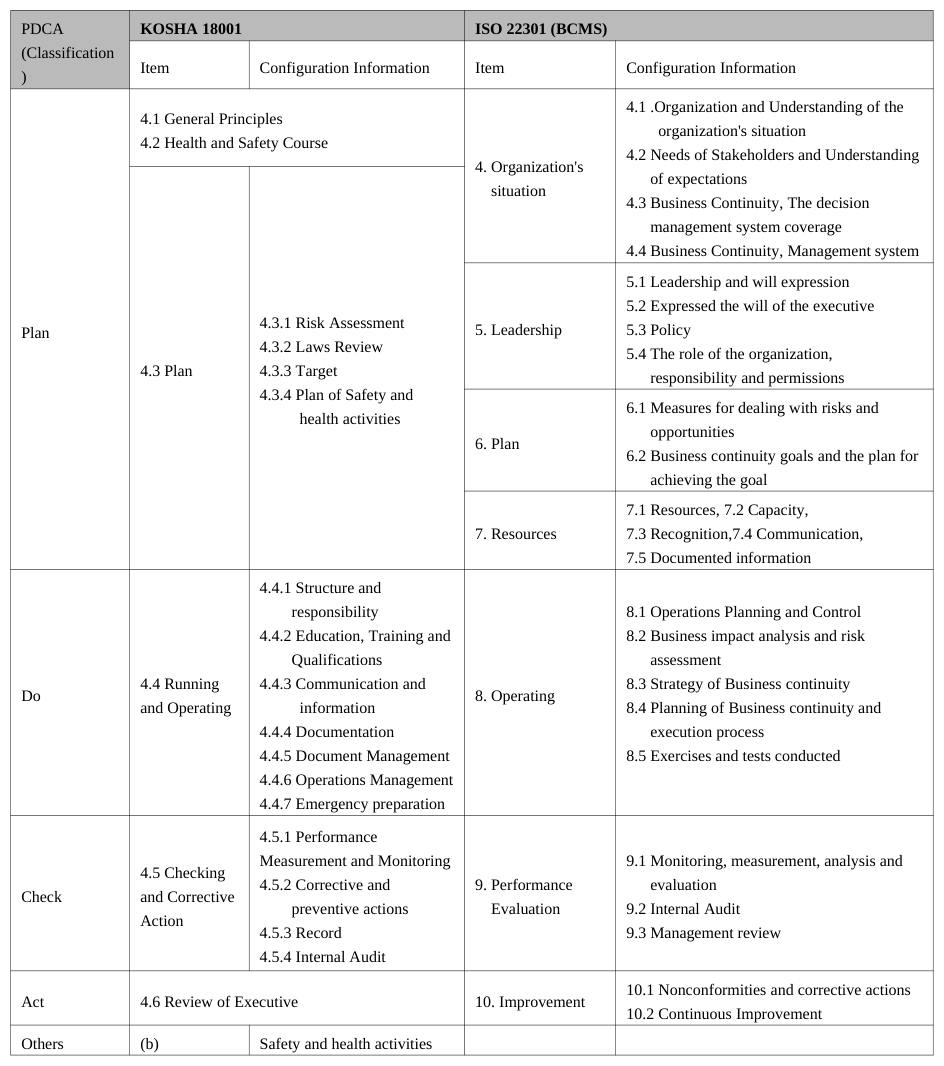
COMPARISON BETWEEN KOSHA 18001 AND ISO 22301 (BCMS) A safety and health management system KOSHA 18001, based on BS 8800 (Occupational Safety and Health Management System Guidelines), OHSAS 18001 (Occupational Health and Safety Assessment System), ILO-OSH (Occupational Safety and Health Management System Guidelines), and a disaster management system ISO 22301 (BCMS) which is based on BCP and BCM, are shown in Table 1.
Table 1. Comparison between KOSHA 18001 and BCMS (ISO 22301) (Oh, 2013) KOSHA 18001 ISO 22301 (BCMS)
However, in KOSHA 18001, the range of risk reaches mechanical failure, the state of the system, human error, accidents by physical, chemical, biological, psychological, and behavioral causes. Otherwise, in ISO 22301, the range of risk includes not only human errors but natural disasters and intentional behaviors and all incidents. In addition, looking the comparison of 'terms and definitions' analysis, most terms of ISO 22301 consist with the terms of KOSHA 18001 or have similar meaning or definition of them. It is known that the range of ISO 22301 covers a whole range of KOSHA 18001 more over on the view of 'terms and definitions'.
In case of operating the OH&SMS which BCM activities (such as, planning, strategy, establishing procedure and execution for achievement of business continuity) of ISO 22301 are reflected in KOSHA 18001, it will be able to configure the integrated OH&SMS which is not only the prevention and recovery of internal and external industrial disaster, but also keeping the company's essential functions.
PROPOSITION OF HSSMS In cases of mass incidents occurrence, such as, recently occurred Nuclear accident caused by the East Japan Great Earthquake, Gumi HF chemical spill accidents in Korea, electric power outages due to equipment accidents, It is necessary that such an accidents or disasters to be managed collectively in the social security level, because the influences of workplace accidents are not limited inner workplace area and be able to spread widely across sites or outer areas result in "the national disaster".
It is demand to the integrated management system which is the one management system colligated with two or more management systems, regardless of size or sector of management system such as OH&S, Quality, Environment, Information Security, Food Safety, Security and Service. So that system can effectively operate of the business and the OH&S management of company.
At this moment, Some companies and organizations of domestic and oversea try to develop or propose the integrated management systems, but those are not realized effectively.
This study proposes the integrated system colligating OH&SM and BSM to easily apply for companies which have established with KOSHA 18001 before.
ISO 22301 (BCMS) provides requirements concerning to plan, develop, execute, operate, monitor, review, maintenance and continuous improvement a documented management system for prevention and mitigation, preparedness, response and recovery against system break-down, as a standard for business continuity planning. KOSHA 18001 is the voluntary OH&SMS, provides the employer executes the risk assessment periodically and improves the problems based on the Occupational Health and Safety Act, for preventing the occupational accidents. In KOSHA 18001, the range of risk reaches mechanical failure, the state of the system, human error, accidents by physical, chemical, biological, psychological, and behavioral causes. Otherwise, in ISO 22301, the range of risk includes not only human errors but natural disasters and intentional behaviors and all incidents. So if company applies KOSHA 18001 which is rooted from BS 8800 colligated system with BCM, they could expect not only the occupational accidents but also prevention and solutions for potential harms.
In KOSHA 18001 which is similar to OHSAS 18001, the necessaries for introducing the organization and the operating techniques of BCMS are as follows.
- In workplaces, BCMS is needed to interrupt before the predetermined-scale incidents influence to the social security. - KOSHA 18001 and ISO 22301establish the similar concepts, terms, in particular, the configuration the safety- related systems such as BS 8800, OHSAS 18001, ILO-OSH 2001, ISO 22300 series of the same model, and the operating system is similar to the PDCA cycle management process cycle that is easy to apply. - the words are very similar between KOSHA 18001 and ISO 22301 so the uses can be done easily.
Considering the analysis of contents in the previous chapter, the integrated management system, so called HSSMS(Health, Safety and Security Management System), which colligates with KOSHA 18001 OH&SMS and ISO 22301 BCMS is presented.
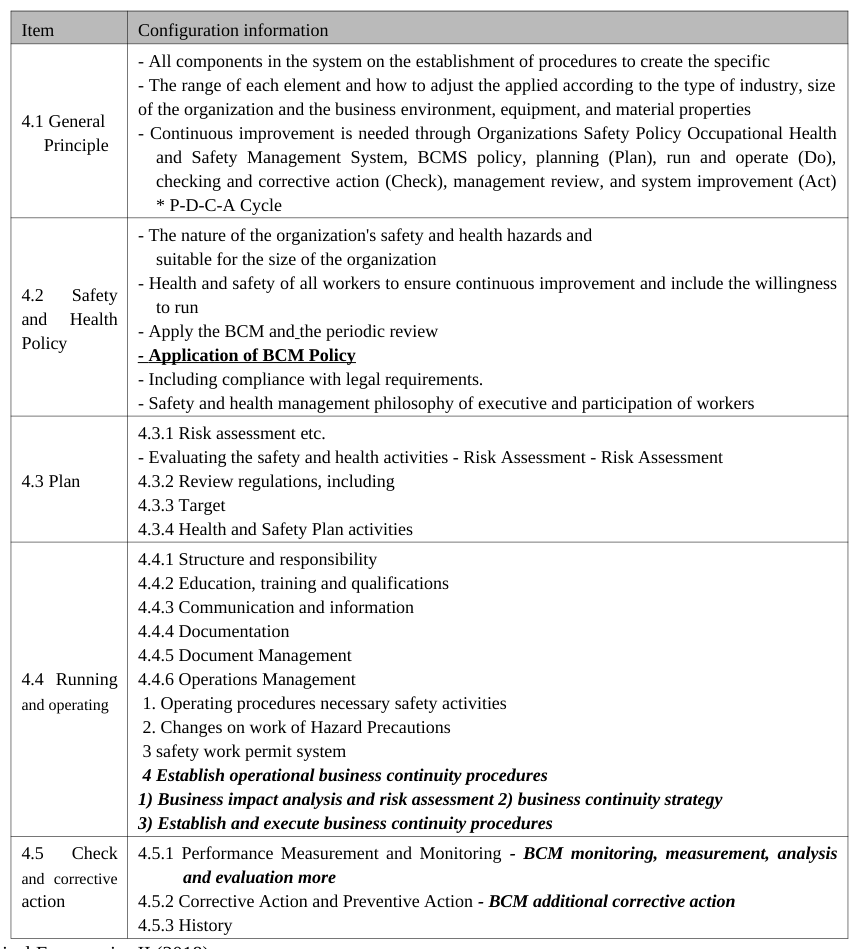
The proposed HSSMS model is summarized in Table 2, and the items to be included in the configuration by reviewing the details change, add, adjust were made to the font to bold parts of the paragraph, and underlines and body tilt and details of notation Review were checked by the item-by-item basis.
Table 2. HSSMS(Health, Safety and Security Management System) Model (Oh, 2013) Item Configuration information
CONCLUSIONS
Recently, incidents and disasters occurring in Korea and other countries give a deep impact on global industrial society. When the incident happens, the problem site is being destroyed along with the related companies which are damaged greatly. This sometimes leads to the serious problem for a nationwide. Many recent incidents show these patterns. If it just adds disaster management system to the existing OH&SM system, the redundancy will happen and the conflicts (overlap and collision) will most likely occur.
In order to avoid these problems, HSSMS was suggested to the KOSHA 18001 which is similar to OHSAS 18001. And this integrated system has follows characteristics.
1) BCMS of ISO 22301 was integrated to KOSHA 18001 which is widely used OH&SMS in Korean industries. 2) The applied scope contains personnel and social risk factors which can be expanded to natural risk factors and social disaster along with existing industrial accidents 3) The system was consists integration of stepwise requirement of PDCA along with unification of terminology. 4) The system is good at to reduce the recovery time and to minimize the damage by systemic emergency response to overcome the weak points which has a limit on the treatment of damage expansion when disaster occurred.
When companies use this integrated disaster management system, they can expect following results.
1) If HSSMS is used, company's safety management and BCMS can be united and also it could be expanded to unified OH&SMS and expansion of BCM operation with a continuous enhancement. 2) When integrated business system is operated, the communication between OH&SMS and national emergency management system can be utilized that cooperation can be made. 3) Accident reduction, improved working conditions & productivity can be assured improved public confidence through ensuring safety management and business continuity in the domestic and international markets to work and ease with the response of appearance of various integration standards and market self-regulation.
The ultimate goal of safety management is to protect the life of personnel and prevent property damage. The safety management is necessary to widely use in entire society. The current safety management is positioned in macroscopically the concept of societal security. If social safety standard for disaster management is additionally applied to the company, it is raised to redundant overlap problem. In order to build a national disaster management system for societal security including the company's accident and disaster, it is necessary to accept to build a disaster management system as a sub system which operates OH&SMS with integration of BCMS for companies. The government related organization should accept strategically and support this.
REFERENCES
BSI (2006), “BS 25999: Business Continuity Management - Part1: Code of practice”, BSI. BSI (2007), “BS 25999: Business Continuity Management - Part2: Specification”, BSI. Chan-O Kim, Hyoung-Joon Choi, Choong-Hwan Lee (2010), “The comparison between OHSMS and PCMS for business area”, Paper ID 961. AHFE. ISO (2007a), “ISO/WD 22300: Societal security - Fundamentals and vocabulary”, 2007-11-29, ISO. ISO (2007b), “ISO/PAS 22399: Societal security - Guideline for incident preparedness and operational continuity
management”, 2007-12-10, ISO. ISO (2012), “ISO 22301, Societal security-Business continuity management systems-Requirements”, ISO. KOSHA Code G-04-2003 (2003), “KOSHA 18001”, KOSHA. Se-Jung Oh (2013), "A Study of the Occupational Health & Safety Management System Integrated with Business Continuity Management System", Ph.D. dissertation, Seoultech, Korea. Se-Jung Oh, Chan-O Kim (2013). “A Study on the Application of Disaster Management System for business area”,
vol.28, No.1, pp.132~136, KOSOS, Korea.
LISTED IN THE AHFE DIGITAL BOOKSTORE CATALOGUE
Explore the complete digital volume
Advances in Physical Ergonomics and Human Factors: Part II
Read this individual research paper free through the original publisher, or explore the full digital proceedings book.
ISBN 978-1-4951-2105-0
Explore this ISBN in the AHFE Bookstore ↗Listed in the July 2026 bookstore catalogue; search by ISBN to confirm current availability · Digital book purchase optional