Sani. M.Najiba, Yusoff. B.Saifulb (2022). The Analysis of the Floor-Sitting Behavior Within the Context of Ergonomics Science Elements for the Development of the Floor-Sitting Furniture Design. In: Advances in Ergonomics In Design, Usability & Special Populations: Part I. AHFE Open Access, vol. 18. https://doi.org/10.54941/ahfe100784
This paper presents an analysis of the floor-sitting behavior within the ergonomics’ science context for the development of the floor-sitting furniture design. This study was conducted by observing the floor-sitting behaviors using the video surveillance method within the perimeters of a home environment. The floor-sitting furniture prototype was used as the auxiliary tool to manifest the dwellers’ postural dynamics. Data collection was used over a 6-month period in order to identify the frequency of floor-sitting postures, based on the synthesis of ergonomics science elements. These include: physics, psychology, anatomy, physiology, and engineering, which are mellifluously articulated within the ergonomics’ ergosystems. The prototype of floor-sitting furniture contemporaneously exhibits the significant context of objects used as perching mechanisms; where through this engagement to floor-sitting expressions, the dwellers form another dimension to the sitting comfort definition. This study has successfully produced a detailed illustration of the floor-sitting postures which are idyllically practiced by Malaysians within their home environments. The majority of houses used in this study were fully furnished. However, it was identified that the majority of Malaysians in this study typically preferred sitting on the floor with their bodies perched against objects used for resting. A compilation of floor-sitting data was obtained, and the designed prototype demonstrates the capability of the culturally linked subject’s extension within the explication of the ergonomics, and creative design contexts.
While Western society does not customarily exercise and accept ground-based sitting (except in some regions of South America according to Hewes ). It is nevertheless, a common custom that is symbolically practiced in Malaysia, and many other Asian countries. The sitting position that is favorably associated with the legs crossed is commonly recognized for its association with cultural traditions, and religious implications. As a common alternative posture to universal chair sitting, and by viewing this phenomenon into wider perspectives; ground-based sitting has the capacity to be explored, and understood within the biomechanical articulation of ergonomics justifications. Floor sitting is culturally anchored, and that was established; on the contrary, due to its biomechanical Ergonomics In Design, Usability & Special Populations I (2022) https://openaccess.cms-conferences.org/#/publications/book/978-1-4951-2106-7
Edited by T. Ahram, W. Karwowski and T. Marek
variegated characteristics, this phenomenology and the subject’s exploration could potentially contribute to another level of knowledge beyond its cultural recognitions. The sitting position is often irregular with the posture tending to change incontrovertibly. This is the result of floor sitting being practiced within ample ground space, and varying postures such as: sitting with the legs folded to the side, sitting with one knee up and the other stretched, and sitting with legs stretched out. This natural tendency has been called free posturising and observed as another branch of extensive definition of comfort in sitting. In exploring the subject of culture and amalgamate into the context of furniture design, the analysis of the sitting behavior within the ergonomics ergosystems interface is coherently significant, as this projects the cultural context subtlety within the technical clarifications. In justification of this concept, this paper presents (1) the analysis of the ergonomics science elements leading to the understanding of the embodiment of floor-sitting behaviors based on body responses to furniture design prototypes and (2) the elucidation of the process in designing floor-sitting furniture prototypes that subsequently demonstrate ergonomics connection. A total of six participants were involved in the analysis.
ANALYSIS Physic
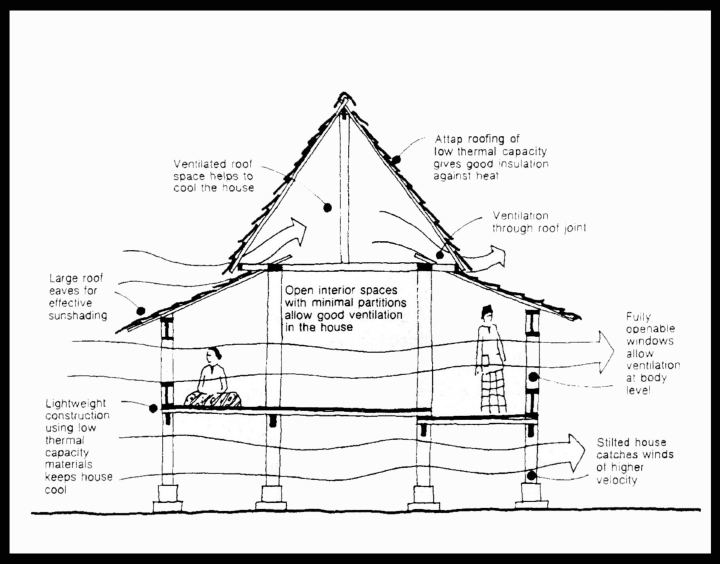
Based on the literary significances and observations made within Malaysian homes, the thermoregulation of subject’s body temperature was recognized as the key factor in contributing towards postural behavior. The subject’s compatibly associated to the environmental physics significance that engages the interaction of the human (dwellers), machine (objects/the architecture elements) and the ambience of a designed space. Upon observing further into the Malaysian living environment, temperature and dwelling space design contexts as to where the thermoregulations significances thrived to the articulation of body kinesthesia, an instantaneous look at the retrospective of modern Malaysian architecture history is a prerequisite towards developing a clear comprehension on the whole body animation. Based on the architecture research conducted by Syed Ahmad Iskandar , Lim and Mohd Tajuddin et al , the floor-sitting subject often connected to the construction of the Malay vernacular house. Aside from cultural aspects and having been taught certain sitting positions from infancy, the convergence to the embodiment of the floor-sitting weaved to the magnitude of materiality where, since 1950s, modernist architecture in Malaysia has reinvigorated the installation of sustainable building materials for housing construction based on the regionalist orientations for thermal comfort replacing timber materials. Wan Hashimah expounded this relevancy in her writings on the construction of the modern Malaysian homes. Particularly in the 1980s she wrote, Malaysian houses started the use of tinted glass for windows and sliding doors for purposes of replacing clear glass, and by complementing the installation of good insulators such as marble and ceramic floor tiles , this researcher observed that through the connection of the concept of materials and floor-sitting towards thermal comfort are mellifluously coherent. These significances are relatively connected to the propagation of ergonomics within the climatic design of the Malay vernacular house. Also, to the ergonomics of its dwellers that consequently moulds the postural behavior (in relationships to the context of sitting) (see Figure 1). As a reflection to the nature of tropical conditions, this type of installation has become standard in the majority of modern houses in Malaysia. The nature of cool surfaces can be quite pleasant and comfortable for floor-sitting in order to achieve thermal balance. Philosophically, the building concept and the installation of materials promote both a measure of possession, and surrounding for dwellers. This allows dwellers to integrate their sense of interiority through the manifestation of the body dynamics where the floor is defined as the alternative body resting and sitting mechanism to achieve comfort. It was discovered that through the addition of other materials, various textures and forms, manipulation and utilization of objects within the environment that a range of varying postural sitting positions were produced.
Ergonomics In Design, Usability & Special Populations I (2022) https://openaccess.cms-conferences.org/#/publications/book/978-1-4951-2106-7
Edited by T. Ahram, W. Karwowski and T. Marek
Figure 1. The example of the climatic design concept in house construction that consequently moulds the dwellers postural behavior. (Adapted from Lim J.Y, 2008).
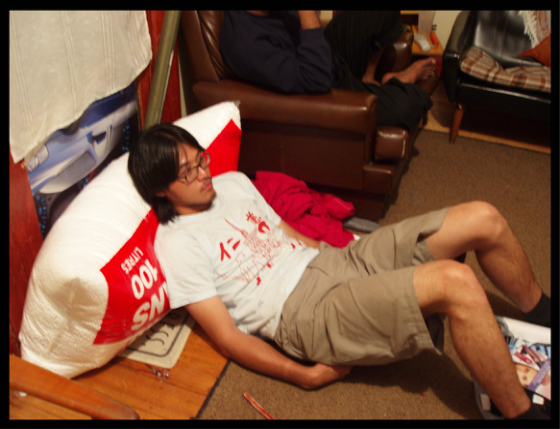
Psychology Based on the survey conducted by this researcher, it was discovered that 78% of the respondents sat on the floor even though there were chairs and sofas installed in their dwellings. Additional findings showed that 58.59% respondents took the floor-sitting position as a bodily strategy to comfort their lower body parts due to the ample space for free postural expressions. This allowed them to experience the cool surface of the floor for optimal thermal comfort. These significances were graphically evidenced (see Table 1) through the demonstration of the sitting expression in which the legs are folded to the side, sitting flexed with one knee up and the other down, sitting with one knee up and the other stretched, and sitting with both legs stretched out. In addition, these sitting postures were not consciously planned, and the dynamics were not unanimously moved in the same patterns, as individual comportments are subjective with unpredicted kinesthesia. We can relate the body kinesthesia significances to the articulation of the human sensory system (particularly relating to the senses of touch) to which it was graphically evidenced through the influence of the dwellers’ dynamics. While sitting on the floor, the normal demeanor of finding a place to perch was demonstrated to adjust the constrained sitting posture through the dynamics of the said sitting expression, and consequently signified the relevance of body-image propagation by the psychologist James J. Gibson into practice. This human postural reaction towards comfort is closely associated to the coherency of the psychoanalytic thoughts. It stimulates one’s imagination to find a comfort zone, and a sensation of feeling at home. The individual sensory experience through the projection of floor-sitting expressions is integrated mellifluously in order to achieve such aim. Objects such as pillows, roll-up futon mattresses, and short stools are examples of the architectural elements or machines in accordance to ergonomics justification, and are utilized by users within the home environment in many inspired ways. The utilization of objects around an individual is often used as a comfort mechanism (see Figure 2). This was shown through the connection of body movements, as well as various body orientations such as; leaning with the legs stretch, laying down and sitting symmetrical or asymmetrical.
Ergonomics In Design, Usability & Special Populations I (2022) https://openaccess.cms-conferences.org/#/publications/book/978-1-4951-2106-7
Edited by T. Ahram, W. Karwowski and T. Marek
Figure 2. The utilization of object as a comfort mechanism. (Self creation).
Pallasmaa in his writings: “..Our bodies and movements are in constant interaction with the environment; the world and the self inform and redefine each other constantly. The percept of the body and the image of the world turn into one single continuous existential experience; there is no body separate from its domicile is space, and there is no space unrelated to the unconscious image of the perceiving self. The body image …..is performed fundamentally from haptic and orienting experiences early in life.”
Our senses form the indicator to constant body interaction within the environment from the coordination of the psychoanalytic thoughts that in addition works on remembering and imagining places. The floor locus ignites the sense of dwelling or home and created the space satisfaction.
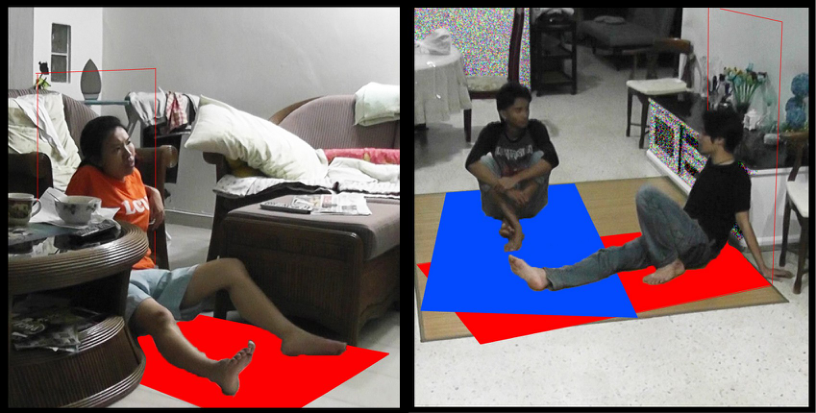
People will generally use what is made available to them; the dweller utilizes the space they occupy due to the need of feeling pleasant, and having a sense of security when attached to the dwelling space. The psychoanalytic thoughts articulate with what this researcher describe as ones’ ‘space of imagination’ (see Figure 3 for example), where the unused spaces they ‘see’ when finding perching spot were explored and freely expressed through floor- sitting postures. The sitting is repeated voluntarily even though criticism underpins sitting on the floor’s ergonomic as opposed to the standard 45 centimeters above the ground sitting. Again, the issue of comfort sitting is observed as rather subjective and there is no exact definition towards comfort. Therefore, another stream of comfort definition can be defined at this point of research . For example, the flat surface of low cabinet doors can be used as a backrest, as well as table legs, or even wall surfaces for the same reasons albeit the elements were not intentionally designed for such purposes while sitting on the floor. The designed prototype embodies this coherency (see Figure 4). The space satisfaction were cherished and experienced but not seeking it.
Ergonomics In Design, Usability & Special Populations I (2022) https://openaccess.cms-conferences.org/#/publications/book/978-1-4951-2106-7
Edited by T. Ahram, W. Karwowski and T. Marek
Figure 3. The ‘space of imagination’ that individual ‘see’ when sitting and perched on the floor. (Self creation).
Anatomy and Physiology Observations clearly indicated that all subjects habituated to floor-sitting positions, this poses similar patterns although there are only minor individual differences. Based on the application of the principles showing the body- link concept, the sitting’s kinesthesia are involuntary, continuous, and in constant movement. During floor-sitting, the unused space that encompasses the participants’ sitting periphery was extensively utilized. The attitude towards the utilization of the unused space is however, unpredictable due to the subjective human behavioral context that depends on the individual locus. By using the video surveillance technique, uncertainty of to what the sitting postures might be posed individually was ascertain and came into convergence. The predominant body-image such as (1) sitting with the knee flexed and one leg stretched (SKX), (2) sitting with one knee up, other down and flexed (S1KU), (3) cross-legged sitting (CLS), (4) sitting with the legs folded to the side (LFS) and (5) sitting with legs stretched out (LS) was established. Such postures intertwine in different sequences when the body is connected to the floor, and supported by the prototype. The sitting postures signified that the definition of comfort in floor-sitting is mélange. Sitting with the knee up or flexed posses a much more leisurely body-image. Whereas other such postures indicated the strategy of balancing the open and closed-chain system by releasing leg muscle tension through flexing and stretching the legs regularly. Results delivered with Table 1 shows the analysis of the distribution of the floor-sitting frequency in different dwelling space and Table 2 – Table 3 shows the findings in the distribution the posed floor-sitting.
Ergonomics In Design, Usability & Special Populations I (2022) https://openaccess.cms-conferences.org/#/publications/book/978-1-4951-2106-7
Edited by T. Ahram, W. Karwowski and T. Marek
Table 1: The analysis of the distribution of the floor-sitting frequency in different dwelling space. (Self creation).
Table available in the original PDF paper.
Ergonomics In Design, Usability & Special Populations I (2022) https://openaccess.cms-conferences.org/#/publications/book/978-1-4951-2106-7
Edited by T. Ahram, W. Karwowski and T. Marek
Figure 4. The use of the designed prototype during the floor-sitting behavior analysis. (Self creation).
Figure available in the original PDF paper.
RESULTS
a. Different participants at different home setting unanimously exercised LS1U 1, LS1U 2 ([Equation or mathematical symbol available in the original paper PDF]1, [Equation or mathematical symbol available in the original paper PDF]2) and SqX1, SqX 2, SqX 3 ([Equation or mathematical symbol available in the original paper PDF]3, [Equation or mathematical symbol available in the original paper PDF]4 and [Equation or mathematical symbol available in the original paper PDF]5) at different sequences (see Table 2).
Table 2: The distribution of other floor-sitting postures frequently exercised based on the sitting behavior analysis (Adapted and adjusted to this research context from Hewes, 1955).
Table available in the original PDF paper.
b. The designed prototype increases the CLS ([Equation or mathematical symbol available in the original paper PDF]), S1KU ([Equation or mathematical symbol available in the original paper PDF]), LFS ([Equation or mathematical symbol available in the original paper PDF]), SKX ([Equation or mathematical symbol available in the original paper PDF]), LS ([Equation or mathematical symbol available in the original paper PDF]) (see Table 3), LS1U 1 and LS1U 2 ([Equation or mathematical symbol available in the original paper PDF]1, [Equation or mathematical symbol available in the original paper PDF]2,) and SqX 1, SqX 2 and SqX 3 ( [Equation or mathematical symbol available in the original paper PDF]3, [Equation or mathematical symbol available in the original paper PDF]4, [Equation or mathematical symbol available in the original paper PDF]5) postures.
Table 3: The typology of the floor-sitting postures’ frequency and propensity. (Adapted and adjusted to this research context from Hewes, 1955).
Table available in the original PDF paper.
c. Some contrastive sitting and lounging postures were found. Nevertheless, they were not regular, or recognizable, and varied among the participants. d. The floor sitting dynamics were affected by the environmental physics of the home environment such as its physical and atmospheric conditions made by the architectural elements.
Ergonomics In Design, Usability & Special Populations I (2022) https://openaccess.cms-conferences.org/#/publications/book/978-1-4951-2106-7
Edited by T. Ahram, W. Karwowski and T. Marek
e. The adaptations of a person’s sitting postures in the room are built by perceptual responses and tactility persuasions within the environment. f. In a dynamics’ sense, a person will change from one sitting posture to another. He or she is more likely to change position when the lower body segments show discomfort from the length of the sitting. Often they folded, flexed and stretched the legs for comfort. g. Although individual postural experience varies, the similarities in terms of the body segment’s comfort during floor-sitting are unanimous and noticeable. h. The designed floor-sitting furniture increased the dynamics of the floor-sitting behaviour.
THE PROTOTYPE DESIGN: THE ENGINEERING SIGNIFICANCE The design process embodies the connections of the ergonomics and somatic principles. ‘Somatic’ is the field of enquiry and practice that according to Linden engages the participation of the human being as a whole and focuses in a practical way on the interactions of posture within the articulation of movement, emotion, self-concept and cultural values. Three somatic principles were extracted as Cranz initially outlined, and thus adopted to this analysis and the connections to the construction of the furniture design prototype:
a. Philosophical ideas about the human body. b. Ideas about anatomy. c. Ideas about psycho-physical processes.
Compared to the concept of ergonomics that normally focuses on one part of the body; for example by designing good lumbar support for cushioning only the curves of the lumbar lordosis. The two fields of discipline (ergonomics and somatic) subtly articulate the participation of the mind to reorganize, and realign the entire body at which this point steers this researcher to design a ‘complete package’ product. Furthering this relevancy, the exploration of ‘space of imagination’ significance where the utilization of the unused space ones ‘sees’ within sitting peripherally, and refuge while being perched on the floor was developed. The essential criterion of designing this prototype was based on the anatomical concern of the freedom a person has to organize and maintain appropriate dynamics, and thus consequently balancing the open-chain system.
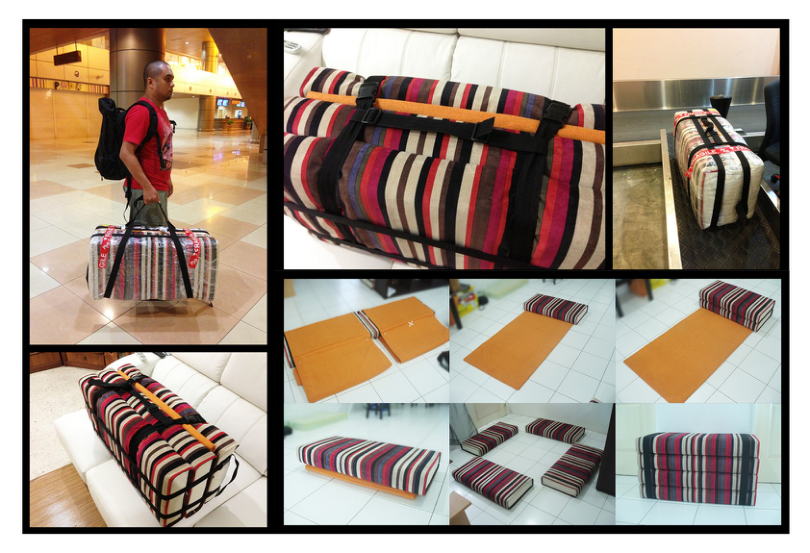
The Lapis prototype conveys the meaning of ‘layers’ is designed with adjustability, and can be dismantled, or arranged into four segments or stacks of cushion seats. These features are specifically designed for the sitter’s adjustment, and to their desired sitting or lounging positions. The design features and the sitting positions linking to Cranz writing, would take off the load experienced by the spine, neck, and head with the softness and firm characteristics of the cushions. The prototype was designed in such a way that it fits into the nature of the human dynamics where most people will make use of what is available to them in search for comfort within their surroundings when sitting on the floor. Such behavior has been proven in the findings from earlier performed sitting behavior analysis. The prototype with stacked cushions demonstrates a platform for a headrest, shoulder rests, and other parts of the cushions technically support the kyphosis to the lower lordosis. This subsequently demonstrates the Alexander Techniques manifestation of good biomechanical articulation which begins with head and neck primacy; and subsequently is followed by the kinesthesia of the pelvic balance or hip, knee and ankle joints. This was demonstrated by the test participants in the floor-sitting behavior observation (see Figure 4).
The idea of design is influenced by the ‘space of imagination’ significance within an unused area where the individual’s floor-sitting behavior is steered by the synchronization of their locus within the dwelling space. Linking this relationship, the floor mat forms the subject matter, and is visualized within the designed form due to its cultural implications, and customization to Malaysians. Moreover, with the characteristics of the subject matter that can be spread out, kept rolled, or can be folded at user’s degree of utilization and “rarely kept spread all the time” , the concept of modularity was considerately applied into the design. In terms of materiality, soft materials that comprise of the combination of cushion foam and fabrics, from the use of imitation leather to tweed felt were employed to suit the engagement of the tactility stimulation of the designed form, and its textures to the whole body when assimilating to the sitting environment. The floor base that associated to the cushions, measures at a stretchable 95th percentile of the overall Malaysian anthropometry. The loosening cushions when it is stacked, forms a single seater at the Malaysian standard of 40.8 cm sofa heights (see Figure 5).
Ergonomics In Design, Usability & Special Populations I (2022) https://openaccess.cms-conferences.org/#/publications/book/978-1-4951-2106-7
Edited by T. Ahram, W. Karwowski and T. Marek
Figure 5. The design of Lapis. (Self creation).
In comparison to some of the similar design work such as Sam Sannia’s Ooch, Martí Guixé’s Xarxa, Claesson Koivisto Rune’s Dodo, Kristian Gavoille’s Kloc and Matali Crasset’s When Jim Comes to Paris , the Lapis design harmonizes the physical significations imposed by those types of designed furniture. With the application of Malaysian anthropometry, it is hoped that Lapis could provide another extension of comfort to some of the available ergonomic design work in Malaysia that regularly stresses on adjustability and flexibility concern. Baba et. al. in the research paper titled the Application of Malaysian Anthropometric Data in Home Furniture Design signified that even though there are ergonomically designed furniture available in the market, the ergonomics approach within the Malaysian product are not fully practiced. Overall, six target features were adopted and applied in the prototype design as these features are suggested and endorsed by Springer’s in designing sitting furniture: a. Support a person’s body. b. Support activity. c. Promote movement. d. Enable performance. e. Be easy to use. f. Do no harm.
CONCLUSIONS
The articulation of the ergonomics science elements manifested the embodiment floor-sitting behavior aside the factor of culture. Furthermore, the projections of the floor-sittings’ body image, propagated Pallasmaa’s propagation on the incontrovertible interconnection of the body, and the movement through our haptic and body orienting experience. Although individual’s postural experience varied, all subjects that habituated to floor-sitting had similar patterns of behavior. In parallel to the context of the floor-sitting furniture, the designed prototype varied Ergonomics In Design, Usability & Special Populations I (2022) https://openaccess.cms-conferences.org/#/publications/book/978-1-4951-2106-7
Edited by T. Ahram, W. Karwowski and T. Marek
the users’ floor-sitting expressions as the instrument that promoted the interplay of users, and objects within the occupied space. The designed prototype that was based on the local anthropometry repudiates the standards and static anthropometry that is still applied in universal furniture design, especially in Malaysia. The standards are relevant guidelines, that is undeniable, and as mentioned by Dolmjan et.al that it should be considered only as dimensional recommendations. He added that people do not generally sit with “90[Equation or mathematical symbol available in the original paper PDF] flexion of the hip joint, and a concavity in the small of the back”. Present research shows variations between symmetrical and asymmetrical sitting, and lounging postures due to the prototype that allows free movements. The increasing dynamic of the asymmetrical postures (SKX ([Equation or mathematical symbol available in the original paper PDF]), LS ([Equation or mathematical symbol available in the original paper PDF]) and LS1U ([Equation or mathematical symbol available in the original paper PDF]1, [Equation or mathematical symbol available in the original paper PDF]2) and SqX ([Equation or mathematical symbol available in the original paper PDF]3, [Equation or mathematical symbol available in the original paper PDF]4, [Equation or mathematical symbol available in the original paper PDF]5)) signifies the relevancy of the application of local anthropometry for comfort that fits within the designed floor-sitting furniture. Every piece of the designed prototype supports the participants’ postural needs. This ramification is opposed to universal furniture design which promotes constrained posture as the “function and situation are fixed in a single place where the user is certain” .
Individual psychoanalytic thoughts and the perceptual system mellifluously articulate to such coherency towards the propagation of the body image expression. Through the body link concept demonstrated in the body kinesthesia, the projected body image are interwoven to create balance through friction in the open-chain system towards achieving sitting comfort. The projection of the CLS, LFS, S1KU, SKX, LS, LS1U and SqX in random sequences illustrates the postural example that articulates the body-link concept. Based on theories propagated in the literatures, the ergonomics science elements such as the physic, psychology, anatomy, physiology, and engineering were verified as the determinant to the whole understanding of the interaction of the body kinesthesia when immersing into the closed environment.
The findings reinvigorate earlier complied postural data by Hewes where the body image of sitting alternating the right and left knee up while other leg stretched (LS1U) was an established practice among the studied Malaysians. Based on such coherency, a reproduction of the postural typology is successfully constructed (see Figure 6). It is foreseeable that the construction of the designed prototype will stimulate future exploration of the subject, along with development of ideas, and integration of contexts within research pertaining to culture, ergonomics, and creative design. The obtained postural data can be used for further development of furniture design research, and ethnographer’s references regarding the Malaysian floor-sitting behavior.
Ergonomics In Design, Usability & Special Populations I (2022) https://openaccess.cms-conferences.org/#/publications/book/978-1-4951-2106-7
Edited by T. Ahram, W. Karwowski and T. Marek
Figure 6. The postural typology of the floor-sitting behavior frequently exercised by Malaysians at home. (Adapted and adjusted to this research context from Hewes, 1955).
Figure available in the original PDF paper.
REFERENCES
Baba, M. D., Darlina, M., & Ahmad Rasdan, I. (2009). Application of malaysian anthropometric data in home furniture design. Paper presented at the National Symposium on Advancements in Ergonomics and Safety (ERGOSYM) 2009, Perlis, Malaysia. Cranz, G. (2000). The chair: Rethinking culture, body, and design. New York: W.W.Norton & Company. de Looze, M. P., Kuijt-Evers, L. F. M., & Dieën, J. V. (2003). Sitting comfort and discomfort and the relationship
with objective measures. Ergonomics, 46(10), 985-997. Domljan, D., Vlaović, Z., & Grbac, I. (2010). Pupil's working posture in primary school classrooms. Periodicum Biologorum, 112(1), 39-45. Fremdkörper. (2012). Modern furniture: Moderne möbel (M. Buchanan, N. Mizelle, M. Piontek, C. Jany, M. Borka,
C. van Wijk & C. Mützelburg, Trans.). Potsdam, Germany: h.f.ullman GmbH. Gençoglu, M. T. (2007). The comparison of ceramic and non-ceramic insulators. New World Sciences Academy, 2(4). Gibson, J. J. (1966). The senses considered as perceptual system. Boston: Houghton Mifflin Co. Helander, M. G., & Zhang, L. (1997). Field studies of comfort and discomfort in sitting. Ergonomics, 40, 895-915. Hewes, W. G. (1955). World distribution of certain postural habits. American Anthropologist, 57(2), 231-244. Kim, J., & Choi, K. (2004). Comparative study on korean and japanese traditional furniture design. Paper presented
at the Proceedings of the 6th Asian Design Conference, Tsukuba, Japan. Kroemer, K. H. E. (1994). Sitting (or standing?) at the computer workplace. In R. Lueder & K. Noro (Eds.), Hard facts about soft machines: The ergonomics of seating (pp. 187-191). London: Taylor & Francis. Lim, J. Y. (1984). Under one roof: The traditional malay house. The International Development Research Centre,
Ottawa. Lim, J. Y. (2008). The traditional malay house. Institute for Society, 2(6). Linden, P. (1994). Somatic literacy: Bringing somatic education into physical education. Journal od Physical Education Recreation & Dance, 12. Lueder, R. (2004). Ergonomics review : Ergonomics of seated movement: A review of the scientific literature:
Considerations relevant to the sum chair. Encino, CA: Humanics ErgoSystems, Inc. Mohd Tajuddin, M. R. e. a. (2005). The architectural heritage of the malay world: The traditional houses. Skudai, Johor: Universiti Teknologi Malaysia. Pallasmaa, J. (2005). The eyes of the skin: Architecture and the senses. West Sussex, United Kingdom: Wiley-
Academy, John Wiley & Sons Ltd. Springer, T. (2009). The future of ergonomic office seating. In K. Inc. (Ed.). East Greenville, PA, USA: Knoll Inc. Syed Ahmad Iskandar, S. A. (2001). Order in traditional malay house form. Ph.D, Oxford Brooks University, Oxford. Wan Hashimah, W. I. (2005). Houses in malaysia : Fusion of the east and the west (I ed.). Skudai, Johor: Universiti
Teknologi Malaysia.
Ergonomics In Design, Usability & Special Populations I (2022) https://openaccess.cms-conferences.org/#/publications/book/978-1-4951-2106-7
LISTED IN THE AHFE DIGITAL BOOKSTORE CATALOGUE
Explore the complete digital volume
Advances in Ergonomics In Design, Usability & Special Populations: Part I
Read this individual research paper free through the original publisher, or explore the full digital proceedings book.
ISBN 978-1-4951-2106-7
Explore this ISBN in the AHFE Bookstore ↗Listed in the July 2026 bookstore catalogue; search by ISBN to confirm current availability · Digital book purchase optional