Michal Hovaneca, Teodor Tóthb, Viktória Rajťúkováb, Hana Pačaiováa, Jozef Živčákb (2022). Application of 3D Full Body Scanners in Ergonomics. In: Advances in Ergonomics In Design, Usability & Special Populations: Part I. AHFE Open Access, vol. 18. https://doi.org/10.54941/ahfe100814
1 Department of Safety and Quality, Technical University of Košice, Faculty of Mechanical Engineering, Letná 9, 042 00, Košice, Slovakia ↗
2 Department of Biomedical Engineering and Measurement, Technical University of Košice, Faculty of Mechanical Engineering, Letná 9, 042 00, Košice, Slovakia ↗
The submitted study deals with the optimization of a work system with consideration of generic processes in work environments. For the purpose of identifying the resulting quality of a workplace, the structure of an ergonomic program was created on the basis of a digital factory, and a knowledge database was created for the criteria and parameters of ergonomic evaluation of work systems influencing their quality. On the basis of an analysis of the present state of the application of ergonomics, an ergonomic workplace was implemented for the purpose of increasing the quality of the work environment. The application of a work environment design was used in a selected workplace dealing with courier services. With use of the Tecnomatix program the workplace took on a digital form, which consisted of a 3D scanning of the work environment, a 3D whole-body scanning of the workers, the modelling of the work environment in the Plant SIMULATION module and the application of the obtained data itself in the Tecnomatix Jack program. It is possible to anticipate or to limit many problems by observing work regulations. One of the possibilities is the creation of an electronic database of employees which offers input data for the simulation of a specific work position.
The main criteria for the proper creation of a workplace is respecting the spatial link between the physique of a person and the parameters of the workplace while taking into account the bodily dimensions, physiological possibilities and physical strength of the person. The basic elements of designing and modelling a person-machine- environment system is the person, the work space and resolution of the corresponding requirements from the viewpoint of safety, ergonomics and quality of the performed process. With the design of a workplace it is necessary to start from the physiological and anthropometric characteristics of the employee and an analysis of the individual movements with respect to the performed activities. On the basis of these analyses, a movements study is performed and a detailed project of the work system is prepared.
For obtaining information about anthropometric measures of the given employee and about the environment itself
3D scanners have begun being used in an increasing measure. This involves devices serving for the transfer of a real object into a digital form. During the process of scanning the scanner using different technologies gathers information about the shape and dimensions of the scanned object. The scanned data create a so-called point cloud; this means that each scanned point has a determined position in space with respect to a system of coordinates. It is possible to subsequently use the information obtained for the creation of a digital three-dimensional model of the scanned object. The resulting data can be subsequently processed for different purposes through specialised software products. It is possible to classify 3D scanners using several criteria.
The first criteria is the division of 3D scanners according to construction, namely into stationary (these are bound to one place) and mobile (the possibility of transport to an immovable object). In terms of method of scanning, 3D scanners are divided into contact and non-contact types.
Based on the principle of scanning 3D scanners are divided into:
optical
based on photographic principle the object is scanned from various positions
laser
based on triangulation sensing the reflected laser
ultrasound
based on ultrasound waves sensing the time to reflection and the angle of reflection
X-ray
based on X-ray sensing the residual radiation impact on the detector after passing thru the subject
mechanica l
touching scanners - CMM and measuring arms informations are obtained from selected points, not from whole surface
destructiv
during scanning the object is destroyed the outer and inner geometry is obtained
e
At present the software used supports the import of models of real persons, through use of which a simulation of workers in the work environment is performed. The problem of configuration of an already pre-set model is thus simplified. For obtaining a virtual model from real persons, whole body 3D scanners are used. This involves to a predominant measure stationary optical scanners, using scanning technology based on light sources (the Moiré method) projected onto the scanned subject. The scanner uses white light for lighting and projecting bars onto the subject. The individual points are obtained from the surface through use of triangulation – a pair of mutually angularly rotated cameras is used. In the submitted study a 3D whole-body scanner TC2 NX 16 was used to obtain a 3D model of the human body. In the scope of this study the stage of digitalization of the workplace was preceded by an ergonomic study for the purpose of determining the necessary parameters of the workplace. As a scanning device a 3D Leica SCANSTATION 2 scanner was used, which is assigned to the category of active scanners with its own source of radiation – a laser.
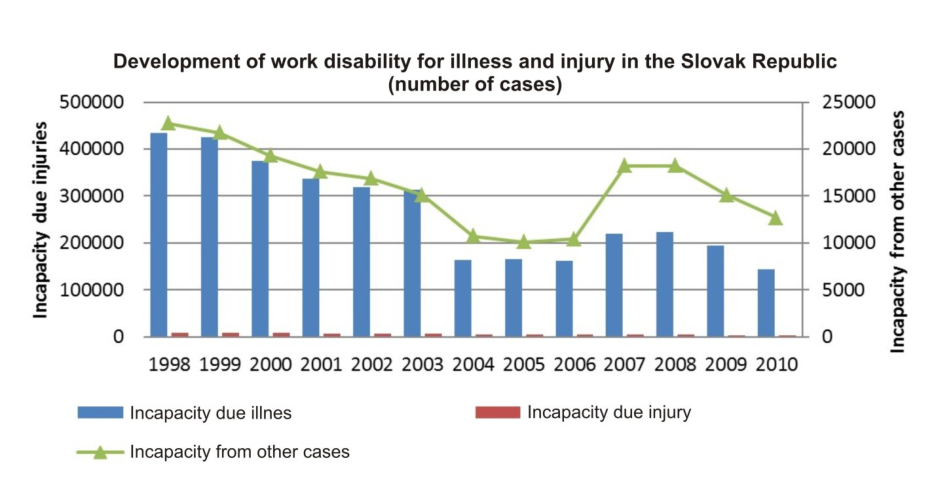
ANALYSIS OF THE PRESENT STATE OF APPLICATION OF ERGONOMICS The Statistical Office the Slovak Republic regularly evaluates the status of occupational accidents and illnesses in enterprises. Processed data on the development of work disability for illness and injury in the Slovak Republic is located in the SLOVSTAT database. The development of work disability for illness and injury in the industry of the Slovak Republic in the years 1998 – 2010 is shown in Fig. 1. The number of cases of work disability for illness and injury in industry in 2010 in comparison with 1998 fell by 65% and a total of 160,970 cases were recorded. The number of cases of work disability due to work accidents in industry in 2010 was 3,461.
The mentioned facts point out the importance of observing the principles of ergonomic design and analysis and evaluation of the ergonomics of a work system, which enable problems and deficiencies of a designed or existing work system to be revealed so that relevant preventive or corrective measures can be planned. The design of a workplace which satisfies the principles of ergonomics is a complex problem because a significant number of integrating and variable elements must be taken into consideration.
Figure 1. Development of work disability for illness and injury in the Slovak Republic REALISATION OF AN ERGONOMIC WORKPLACE
For the formulation of a quality work environment it is necessary to consider basic requirements deriving from standard STN ISO 9004:2009, where the exact processes for the needed sustainable long-term success of an organization are defined. This basic aim, together with respecting ergonomic principles, is necessary for every organization which has the ambition to succeed in the global competitive market in the present day economy. With the realization of an ergonomic workplace we focus in the submitted study on the design of the ergonomic aspects for the purpose of increasing the quality of the work environment and on the design of a work environment with regard to qualitative and ergonomic factors. The processes of individual designs are listed in the following graph:
Design of ergonomic aspects for the purpose of increasing the quality of the work environment design of the given workplace according to defined ergonomic aspects defining of the ergonomic aspect of a design derived from the type of work environment creation of a knowledge database for analysis of the work environment (work surface, work tools, movable space,...) Design of the work environment with regard to qualitative and ergonomic aspects
software support of the module PLANS SIMULATION planning and designing of a process using the module PROCESS DESIGNER verification and kinematic movements for robots and machines within the work environment using PROCESS SIMULATE assessment and optimalisation of the work environment with a view on the human factor using TECNOMATIX JACK
APPLICATION OF THE DESIGNED MODEL IN THE WORK ENVIRONMENT Application of the proposed model in the work environment consists in the training of an employee into a newly created or modified work environment. The first part represents the application of a digital factory orientated on a person in the form of new digital forms of modelling of the human factor in production. For the need of generalization of the proposed model the submitted study of the work process deals with the pressing, pulling and carrying of loads.
Figure 2. Decomposition of the workplace and selected processes
Figure available in the original PDF paper.
For a graphical example of a work environment a workplace dealing with courier services was selected. The given workplace features the carrying and lifting of loads. The work activities in question are accompanied by a great exertion of strength by workers and unnatural movements of the upper limbs. This leads to unnatural physiological work positions, which are the foundation and initiating source of health damage, particularly of the support- movement apparatus. The work tasks of workers consists in the process of unloading (worker no. 1, Fig. 2a), the process of lifting a load (worker no. 2, Fig. 2b), the process of placing a load on a conveyor (worker no. 2, Fig. 2c), the process of weighing the load (worker no. 3, Fig.2d), the process of labelling and registering the load (worker no. 3, Fig. 2e) and the process of classification (worker no. 4, Fig. 2f).
Through use of the program Tecnomatix PlantSimulation the workplace is transformed into digital form, in which a simulation of the workplace is run, the course of processing a package, the movement of workers in the workplace, as well as the movement of the package itself. The process of creation of optimization is included in the following steps:
modelling of
modeling of workplace in
ergonomic workplace in
3D scanning of workplace
3D scanning of worker
Plantť Simulation
Tecnomatix
module
Jack
3D SCANNING OF A WORK ENVIRONMENT AND A WORKER Within the framework of the submitted study the stage of digitalization of the workplace was preceded by an ergonomic study for the purpose of determining the necessary ergonomic parameters of the workplace. The scanning device used for scanning the work environment utilized a 3D scanner Leica SCANSTATION 2 (Fig. 3b), which is assigned to the category of active scanners with its own light source – a laser (Fig. 3). The output of the scanning process of the object is a group of scans, each of which is made up of a point cloud. The obtained scans are subsequently processed and a scanned object/environment is created from them (Fig. 3c).
Figure 3 3D scanners: Next Engine (a), Leica Scan Station 2 (b) and outputs from scanners (c) After the scanning of an employee with a whole body 3D scanner, it is possible to use the scan in the software for simulation, e.g. of the work environment. An evaluation of the required dimensions of the human body and their implementation into the simulation software used is also a possibility.
Figure 4 Acquisition and evaluation process using 3D whole body scanner
After scanning of the employee with a whole body 3D scanner, it is possible to use the scan in the software for simulation, e.g. of the work environment. An evaluation of the required dimensions of the human body and their implementation into the simulation software used is also a possibility. In the study a TC2 NX16 whole body 3D scanner was used to obtain a 3D model of the human body. The process of scanning and evaluation using the TC2 NX16 whole-body 3D scanner is depicted in the figure 4.
THE MODELLING OF A WORKPLACE IN THE PROGRAM PlantSimulation In the introductory phase of modelling the workplace using the software support PlantSimulation, the setting of the primary parameters of the model is necessary. In the introduction an input process (the Source) is selected, through with which the object (a package) of the simulation is entered. The object subsequently proceeds along a line which has the appropriate parameters set (length, speed of movement, time in which the object passes along the line,...). The line ensures the movement of the object to the first process, called Classification, where the time needed for performing the work is set. Subsequently another line is added with the necessary parameters. The workplaces need to be added to the individual processes. The worker arrives from a circumscribed location. At the conclusion the time of the simulation and the workers is started and set. With launch of the simulation workers appear for whom individual attributes such as walking speed, efficiency, place of movement and others are already defined. The model of the simulation is transferred into a three-dimensional image using 3D icons. The simulation is started and stopped using Event Control (Fig. 5a) and the functionality of the system is monitored and potential deficiencies are changed in 2D, which are then automatically changed in the 3D depiction.
THE MODELLING OF A WORKPLACE IN THE PROGRAM Tecnomatix JACK In the Tecnomatix Jack program it is possible to identify risks following from work activities – in the given case the risk following from linked to unfavourable physiological positions when handling loads. Another step for complex digitalization of a work system is the modelling of work activities of the employee. Work movements are subsequently assigned to the model and a simulation of work activities is created. The simulation serves for visualisation of the work activities, for verification of the time needed to carry them out and as a foundation during the training and preparing of employees for the given workplace.
In the virtual workplace it is possible to conduct different experiments, and this design is implemented into real production, which is from the viewpoint of the defined conditions considered to be optimal. If the basic digital model of the workplace with its primary functions is completed, an ergonomic study can be conducted at the workplace. In the scope of ergonomic studies it is possible to evaluate the physical burden and working positions of employees during work, to analyse the dimensions of the workplace and the activities that an employee performs while working there and to carry out a time study of the workplace, etc. (Fig. 5b).
Figure 5 Modeling of the workplace in Plan SIMULATION (a) and Tecnomatix Jack (b)
ANALYSIS IN THE WORK ENVIRONMENT AND USE OF DATABASES For evaluation and analysis of the physical loading of employees, the acknowledged European standards for the evaluation of handling loads over 5kg NIOS (National Institute of Occupational Safety and Health) were used, as well as the method for evaluating the cyclical repeating activities RULA (Rapid Upper Limb Assessment) and OWAS analysis (Ovako Working postures Analysis System) for the evaluation of the relative discomfort of a worker in work positions.
ANALYSIS OF A WORK LOAD – NIOSH Loading on the most loaded part of the body is evaluated using the European standard NIOSH. The standard lists the maximum weight of a load that a person can handle under the given conditions. If regular exceeding of the recommended weight were to occur, this could lead to overloading of the spine and subsequently damage to it (Fig.6).
Figure 6 Load measurement using NIOSH standard
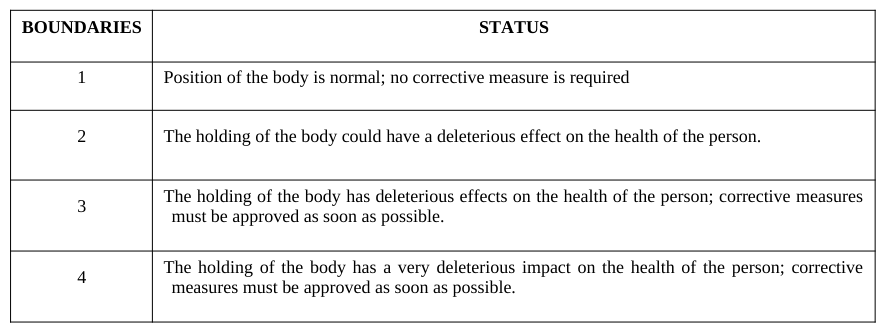
ANALYSIS OF A WORK POSITION – OWAS Using OWAS analysis it is possible to evaluate the relative discomfort of a person in a working position, particularly the position of the back, and the upper and lower limbs. This analysis is helpful with determining urgency regarding the acceptance of corrective measures. Analysis of working positions according to OWAS is assessed using the four levels described in Table no. 1.
Table 1: Basic levels of evaluation of work positions according to OWAS BOUNDARIES STATUS
An analysis of the work position according to OWAS was performed in the basic work position of worker no. 1 (Figure 7a) on the left, near the green package, with the work activities of worker no. 2 (Fig. 7b) and likewise with worker no. 3 when pulling the load in a bent over position (Fig. 7c).
Figure 7 Load measurement using OWAS analysis
The analysis in both workers analyses was demonstrated to be on level 1. The working position is normal and natural. The loading of the movement system is favourable and no corrective measures are necessary. In the scope of work activities of worker no. 3 the analysis performed obtained level 2. This indicates that the holding of the body could have deleterious effects on the health of a person. Necessary corrective measures should be approved in the foreseeable period.
ANALYSIS OF THE LOADING OF A WORKER – RULA The results of Rula analysis are depicted in the Tecnomatix Jack program in a dialogue box, together with proposed corrective measures. In the given case, the Rula analysis was again carried out in three cases. During the analysis normal muscle load and a load in the range of 2-10 kg were used as input parameter for the upper limbs and wrists. For the neck and torso input parameters of a static muscle load and a load in the range of 2-10 kg were used. Further, helpful parameters, such as position in standing and without support of the legs and feet, were also used.
Figure 8 Results of RULS analysis for workers 1 (a) and 2 (b)
The results of analysis in the first case represented an overall score of 4 (Fig.8a) and in the second case an overall point evaluation of 3(Fig. 8b). In both cases changes in working positions are required.
Figure 9 Results of RULS analysis for worker 3
The results of analysis in the case of worker number 3 represented an overall score of 6. The result of the given analysis speaks about the fact that immediate interventions are necessary in the form of corrective measures for the work activities performed by worker number 3 (Fig. 9).
Unsuitable work conditions, overloading and affiliated complications lead to serious injury of the so-called musculoskeletal disorder (MSD) by damage of the supporting-movement system. The majority of damage to the supporting-movement system associated with work worsens over time and is caused either by the work itself or the work environment of an employee. They can also be the consequences of accidents, for example a broken bone or dislocation. Such damage usually disables the back, neck, shoulders and upper limbs; less often they can also disable the lower limbs.
Health problems can be serious or lesser pain as well as more serious medical conditions requiring work leave and in Ergonomics In Design, Usability & Special Populations I (2022) the end even treatment. In chronic cases treatment and rehabilitation are often wanting – which can have as a consequence permanent invalidity and a loss of employment. Many problems can be anticipated or markedly limited by observing existing legal provisions in the area of occupational health and safety and by observing proper well- established processes. In the following part of this section procedures and processes for performing the necessary tasks in the scope of constantly improving and for the purpose of minimizing of risks associated with MSD will be described.
One of the possibilities for minimizing MSD illnesses is the use of knowledge of applied ergonomic principles and identification of the initial requirements. One possibility is the creation of an electronic database of employees which will contain not only their basic characteristics but also a 3D model of each of them. This data is subsequently possible to apply as an input for simulation of an already existing or newly opened work position.
Figure 9 Monitoring system employees
CONCLUSIONS
The article is a synthesis of information and knowledge presented through selected innovative instruments and methodological processes based on a generic approach deriving from the requirements of STN ISO 9004: 2010 from the field of ergonomically designed work systems. For sustaining competitiveness it has become an essential condition to develop and support through strategic decision-making human resources having the required level of knowledge and responsibilities for the achieved results. Thanks to appropriate integration, summarization of knowledge, wise practices and other supporting methods, techniques and innovative technologies it is possible to achieve permanent success. For introducing new products on the market the setting of new processes and approaches is necessary. One of the possibilities is the implementation of software solutions for the simulation of the work environment and the use of modern technologies in the form of 3D scanners.
ACKNOWLEDGMENT
The study was conceived in connection with resolving research, grant and implementation of projects for a training workplace. The intermediate analyses and solutions included in the dissertation work were during the course of the doctoral study presented from time to time at domestic and foreign scientific conferences and published in domestic and foreign periodicals. This contribution is the result of the project implementation KEGA 031TUKE-4/2013: Prosthetic and orthotic proposal process in education.
REFERENCES
Cerny, M., Penhaker, M.: Wireless body sensor network in health maintenance systems, Electronics and Electrical Engineering, vol. 115, no. 9, pp. 113–116, 2011 Dúbravčík M. : Prostriedky digitalizácie, [online]. http://www.sjf.tuke.sk/transferinovacii/pages/ Fišerová, S. (2011). Moderní ergonomie - cesta k optimalizaci lidské práce. 24-th International conference "Aktuálne otázky
bezpečnosti práce". Košice: Technical univesity of Kosice. p. 55-64, ISBN 978-80-553-0764-0. Helander M. (2009). A Guide to Human Factors and Ergonomics, Second edition, CRC Press New York: p. 400, ISBN 978-1- 4200-7751-3. Hovanec M., Varga M., Sobota B., Pačaiová H. (2012). Inovatívne trendy a vízie v ergonómii využitím rozšírenej a virtuálnej
reality. In: Aktuálne otázky bezpečnosti práce: 25-th International conference, Štrbské Pleso - Vysoké Tatry, 06.-08. 11.2012. p. 1-7, ISBN 978-80-553-1113-5. Hovanec, M., Varga, M., Sobota, B., Pačaiová, H.: 5. Inovatívne trendy a vízie v ergonómii využitím rozšírenej a virtuálnej reality / M. Hovanec ... [et al.] - 2012.In: Aktuálne otázky bezpečnosti práce : 25. medzinárodná konferencia : Štrbské Pleso - Vysoké Tatry, 06.-08. 11.2012. - Košice : TU, 2012 S. 1-7. - ISBN 978-80-553-1113-5 Lukáč M. : Laserový skener, Žilinská univerzita v Žiline, Elektrotechnická fakulta, Katedra riadiacich a informačných systémov,
[ online]. http://fel.uniza.sk/~janot/ Majernik, Jaroslav. 3D Virtual Projection and Utilization of Its Outputs in Education of Human Anatomy. Multimedia Technology, 2013 Marras,W.S., Karwowski,W. (2006). Fundamentals and Assessment Tools for Occupational Ergonomics, Taylor&Francis Group,
CRC. ISBN 0-8493-1937-4. Michal Hovanec, Juraj Sinay, Hana Pačaiová; Application of Proactive Ergonomics Utilizing Digital Plant Methods Based on Augmented Reality as a Tool Improving Prevention for Employees / 2014. In: International Symposium on Occupational Safety and Hygiene: 13. - 14.2.2014: Guimares, Portugalsko P. 182-185 Guimares : SPOSHO, 2014, ISBN : 978-989- 98203-2-6 Piľa J., Antoško M., Korba P. (2014). Ergonomy Of An Atco Training Work Place, Croatia, Naše more, ISSN 0469-6255. Rajulu, Sudhakar - CorneR, Brian D.: 3D Surface Scanning. In: GOONETILLEKE, Ravindra S.: The Science of Footwear. the
United States of America : CRC Press, 2013. ISBN 978-1-4398-3568-5, s.127-145. Rajťúková, V., Hudák, R.; Živčák, J.: Biomedicínske aplikácie celotelového 3D skenera, Produktivita a inovácie. Roč. 13, č. 5 (2012), s. 8-9. - ISSN 1335-5961 Šimoník, M. Digitalizace - její princip a rozdelení. MM Prumyslové spektrum [online]. 2004 Teodor Tóth, Viktória Rajťúková, Jozef Živčák Comparison of Optical and Laser 3D Scanners - 2013. In: CINTI 2013: 14th
IEEE International Symposium on Computational Intelligence and Informatics : Proceedings : November 19-21, 2013, Budapest. - Piscataway : IEEE, 2013 P. 79-82. - ISBN 978-1-4799-0195-1
LISTED IN THE AHFE DIGITAL BOOKSTORE CATALOGUE
Explore the complete digital volume
Advances in Ergonomics In Design, Usability & Special Populations: Part I
Read this individual research paper free through the original publisher, or explore the full digital proceedings book.
ISBN 978-1-4951-2106-7
Explore this ISBN in the AHFE Bookstore ↗Listed in the July 2026 bookstore catalogue; search by ISBN to confirm current availability · Digital book purchase optional