Hande Ayanoğlu, Emília Duarte, Paulo Noriega, Júlia Teles, Francisco Rebelo (2022). Examining Hazard-Related Perceptions of Virtual Household Package Prototypes. In: Advances in Ergonomics In Design, Usability & Special Populations: Part I. AHFE Open Access, vol. 18. https://doi.org/10.54941/ahfe100807
Many household products have “hidden hazards”. Also, because of package similarity, people may have difficulty distinguishing chemicals from consumable goods. The incorrect identification of a hazard can result in injuries. Many efforts have been done to improve package warnings, but little is known about the extent that the package’s shape can be used to communicate, in an implicit manner, safety-related messages. This study examined the effect of package’s shape on hazard-related perceptions (i.e., hazardousness and awareness of consequences). Participants observed eight virtual package prototypes of household products grouped into four sets according to their original content’s hazard (i.e., nonhazardous vs. hazardous) and familiarity (i.e., familiar vs. unfamiliar). An uncluttered virtual environment was used to display and interact with the prototypes. Results for familiar and unfamiliar packages differed. For familiar cases, hazardous packages were rated as significantly more hazardous and attained higher awareness of consequence than the nonhazardous ones. For unfamiliar cases, no statistically significant differences were found between hazardous and nonhazardous packages. The implications are two-fold. First, the results suggest people can perceive hazard from the package’ shape, but their perceptions are affected by familiarity. Second, the results suggest the simulator based methodology is feasible for this type of study.
A well-designed product is one that presents a reduced risk of injury. Usually, this is achieved by designing out the hazard. Unfortunately, it is not always possible to eliminate the hazards without compromising the product’s func- tion or performance, as is the case of many household chemicals. Although such chemicals are intended for domes- tic usage, they may have substances that can put in risk the safety of the user (e.g., poisonous to drink, toxic to in- hale, irritant to contact with skin). In that case, other safety measures are usually implemented, according to the haz- ard-control hierarchy (Wogalter and Laughery, 2001), such as guard against hazards (e.g., child-resistant caps, dos- Ergonomics In Design, Usability & Special Populations I (2022) https://openaccess.cms-conferences.org/#/publications/book/978-1-4951-2106-7 ing dispensers) and/or warn about hazards. However, these solutions may be ineffective due to many reasons; e.g., “hidden hazards”, misunderstanding of the hazard nature and impact. These problems can be aggravated by the packaging similarity, which may raise the users’ difficulty in distinguishing the contents.
Generally, warning labels are employed to inform users and increase safety, since they provide a method to convey the required risk information (e.g., hazard, consequences and recommended behavior). However, people do not al- ways search for labels (Laughery and Wogalter, 1997), and there are findings in literature suggesting that warnings are read more careful and adhered to more often on products that are perceived as more hazardous and less familiar (e.g., Wogalter, Laughery and Barfield, 2001). Furthermore, some situational variables (e.g. limited time to perform an action, concurrent tasks) or limited knowledge on the product/context may reduce the users’ systematic process- ing and lead them to rely on heuristics (e.g., Ratneshwar and Chaiken, 1991). Systematic processing is assumed to be more effective than heuristic processing. However, according to the heuristic-systematic model, systematic pro- cessing will only occur when an individual possesses adequate levels of both cognitive capacity and motivation (Zuckerman and Chaiken, 1998). Thus, the package’s shape, that can be in some extent familiar to users and can contain implicit information (e.g., perceived affordances/signifiers) that is relevant for a given judgment, as well as requiring less cognitive capacity to be processed, can play a role in the facilitation of a correct perception of risk an promote compliance with warnings.
In other words, if a package is poorly designed, users may make wrong assumptions about the content and, as a re - sult, injuries can happen related to hazardous products (e.g., Desai, Teggihalli and Bhola, 2005). In this context, the objective of this study was to examine the effect of container’s shape on hazard-related perceptions (i.e., hazardous- ness and awareness of consequences).
Gibson (1986) introduced the term affordances to refer to the actionable properties between the world and an actor. According to Gibson’s ecological perception theory, affordances are a part of nature and they are there even if they are not seen, known, or desirable. Norman (2010) denotes that when users fail to notice the affordance, designers would add visible signs of its existence with what he calls signifiers. In other words, signifiers make the affordance perceived. By weakening the signifiers, or making it less suitable, according to the hazardous content, users’ safety can be increase even before they handle a packages (Ayanoğlu, Duarte, Noriega, Teixeira and Rebelo, 2013) Different methodologies to evaluate perception of hazard are described in literature, in which 2D images and ques- tionnaires are the most common tools (Serig, 2001; Wogalter et al., 2001). However, 2D images have a limited abil- ity to display all the properties of an object, which may affect understanding and influence user’s judgments (Ayanoğlu, Rebelo, Duarte, Noriega and Teixeira, 2013; Landabaso, 2006). Furthermore, users’ opinions are strongly affected by the context in which they find/use with product and by having or not the chance to interact with it (e.g., manipulate, observe from different viewpoints). Therefore, Virtual Reality (VR), as a tool can benefit the evaluation of products and its associated user experience (UX) (Rebelo, Noriega, Duarte and Soares, 2012). Further- more, results from a previous exploratory study suggested that VR simulation can be an effective way to present sce- narios that facilitate effective interaction between users and products (Ayanoğlu, Rebelo, Duarte, Noriega and Teix- eira, 2013; Rosson and Carroll, 2002), thus increasing the study’s validity. In this manner, a virtual environment (VE) was used in this study, in which the participants could observe the packages, as 3D virtual prototypes, from di- verse viewpoints.
METHOD
Design of Study The study used a within-subjects design in which the type of package is the main factor, with four levels (HF - Haz- ardous Familiar, NHF - Nonhazardous Familiar, HUF - Hazardous Unfamiliar and NHUF - Nonhazardous Unfa- miliar). The dependent variables were the scores of hazard perception and awareness of consequences. Familiarity was used as a control variable. Additionally, measures regarding the quality of the interaction in the VE (i.e., if par- ticipants can observe the packages from different viewpoints, and were able to walk freely in the VE), the usability of the equipment (e.g., mouse), the instruments (i.e., questionnaire) as well as the occurrence and severity of simula- tor sickness, were collected through a follow-up questionnaire.
Ergonomics In Design, Usability & Special Populations I (2022) https://openaccess.cms-conferences.org/#/publications/book/978-1-4951-2106-7
Sample The sample consisted of 20 undergraduate design students, equally distributed by gender, ranging from 18 to 24 years old (Mean Age = 20.35, SD = 1.82).
Experimental Settings and Virtual Environment A computer and a video projector were used for data collection. The VE, room with table and the eight packages, were designed in 3D using Rhinoceros® and then exported to Unity 3D. All extra details beyond the packages’ shape, such as colors, textures, labels, brands, were removed in order not to influence the participants’ judgments. Also, the surroundings were designed to be minimalist, only considering aspects such as accessibility (e.g., dimen- sions and space layout) and visibility (e.g., light, shadows and contrast). The participants’ were given a question- naire in which responses were registered using paper and pencil.
Participants remained seated during the experiment and viewed the 3D prototypes in a first person view (egocentric point of view). They were free to visually explore the 3D prototypes by navigating in the VE using a mouse. Press- ing the left button of the mouse allowed the participants to move forward and the right button to move backward. By moving the mouse completely, the participants were able to control their point of view. The direction towards partic- ipants would move was given by the direction of their point of view.
The VE was a closed room, measuring 6.6 m by 6.6 m, containing a table (260 cm length, 30 cm depth and 90 cm height) in the middle. The packages were placed on the table standing 20 cm away from each other. There was no sound in the VE. When the simulation began, the participant’s view was as if they were standing 1 m away from the table. Each package was associated to a letter, from A to H, so that their identification was easier and accurate (see Figure 1).
Figure 1. Screen shot of the Virtual Environment
Figure available in the original PDF paper.
Note. HF-Hazardous Familiar (Package C and F), NHF- Nonhazardous Familiar (Package E and G), Hazardous Unfamiliar-HUF (Package A and B) and Nonhazardous Unfamiliar-NHUF (Package D and H).
The tested packages were the same used in a previous study (Ayanoğlu, 2013). In that study, the selection process of packages was carried out through a focus group, with experts in Ergonomics, which made the selection according to the following criteria (a) familiarity (familiar or unfamiliar); (b) content hazardousness (hazardous or nonhaz- ardous); and (c) shape (rectilinear and curvilinear). In the previous study, user’s hazard perception was evaluated through eight packages in 2D.
Procedure Upon arrival, participants were welcomed and asked to sign an informed consent form. Participants were then seated
Ergonomics In Design, Usability & Special Populations I (2022) https://openaccess.cms-conferences.org/#/publications/book/978-1-4951-2106-7 and presented to the equipment. They were told that the study was about package design and concerned with users’ safety. At this point, the researcher stressed that they could stop the experiment at any time without any prejudice. The study consisted of three steps: training, experiment, and follow-up questionnaire.
Training Participants were able to train by exploring a VE created for such purpose. The training VE was a closed room where different 3D objects (e.g., sphere, cylinder, cone, cube) were located on a table. Participants asked to observe the 3D objects while “walking” around the table and to reply to questions (similar to the ones that would be part of the experimental session). If they were able to accomplish the task without showing any symptoms of simulator sickness, they were considered able to do the experiment.
Experiment In the experimental stage of the study, participants were given a scenario/cover story and a task. The cover story and the task were as follows: Cover Story: Imagine that your friend is moving to a new house and he/she asks you to help unpack and to organize liquid household products’ packages according to their level of hazard (e.g., how poisonous can the content be when drunk, how toxic can it be when inhaled, or how irritant/harmful can it be if it comes into contact with skin).
Task: Observe the packages and reply to the questions.
Questionnaire on packages hazard-related ratings: The questionnaire on hazard-related ratings (see Table 1) was intended to evaluate participants’ hazard-related perceptions regarding the different household packages. The 12 questions were adapted from the questionnaire used by Wogalter and colleagues (Wogalter et al., 2001; Wogalter, 1999). All the packages were rated for each question. The questions were organized according to the following sets: hazard perception (questions 1 to 8, and 10), awareness of consequences (questions 9, 11 and 12) and familiarity (question 6). Each question was associated with a 9-point Likert type scale, from 0 to 8, where 0 indicates the mini- mum and 8 indicates the maximum. The questionnaire was administered during the interaction with the VE, in order to participants being able to observe the packages.
Table 1. Questionnaire related for the rating of virtual package prototypes.
Table available in the original PDF paper.
Questions Hazardous Contents: Based on its shape, how hazardous would you rate its contents?
Hazardous Package: Based on the shape of the package, how hazardous do you rate the package itself?
Hazardous to Children: Based on the shape of this package, how hazardous would it be if children come into contact with it? Flammable/Combustible Hazard: Based on the shape of this package, how likely would hold a flammable/com- bustible substance? Familiarity: How familiar are you with this package?
Hazardous to Drink: Based on the shape of this package, how hazardous would its contents be to drink?
Hazardous to Inhale: Based on the shape of this package, how hazardous would it be to inhale its contents?
Hazardous to Skin Contact: Based on the shape of this package, how hazardous would it be if it contacted the skin?
Cautious Intent: Based on the shape of this package, how cautious would you be when using this package?
Hazardous in Closed Spaces: Based on the shape of this package, how hazardous would it be if used in closed place?
Likelihood of Injury: Based on the shape of this package, how likely are you to receive any injury with this package?
Severity of Injury: Based on the shape of this package, how severely (i.e., degree, extent or magnitude) might you be injured by this package?
Follow-up questionnaire (demographics and experience with the simulator) The second questionnaire, which was administered after the end of simulation, aimed to collect basic demographic data and to assess the quality of the experience with the simulator (see Table 2) including simulator-sickness symp- toms (see Table 3) in a Likert type scale. The questions for the experience with the simulator were created according to following categories: physical fidelity (how well the VE emulates the real world), usability of VE and interaction devices, performance of the participant (accomplishment of the task), presence (whether the participant was dis- tracted with the equipment) and simulator sickness (Kennedy, Lane, Berbaum, and Lilienthal, 1993). The first nine Ergonomics In Design, Usability & Special Populations I (2022) https://openaccess.cms-conferences.org/#/publications/book/978-1-4951-2106-7 questions used a 7-point Likert type scale from (1) very easy/low/little, (4) average to (7) very hard/high/much, whereas questions about simulator sickness had a 4-point scale: (0) absent, (1) slight, (2) moderate and (3) severe.
Table 2. Questionnaire related to the overall quality of the experience with the simulator.
Table available in the original PDF paper.
Questions Category 1. How easy could you control the point of view in the virtual environment? Usability 2. How easy could you control the navigation in the virtual environment? Usability 3. How easy could you explore/visually search the details of 3D packages? Physical Fidelity 4. How easy could you associate the letters with the 3D packages? Usability 5. How conscious were you of the mouse presence during the simulation? Usability 6. How much did the mouse cause distraction? Presence 7. How much did the shadows of the packages cause difficulty on observing details of the packages? Physical Fidelity
8. How easy was to reply the questions asked during the test? Performance 9. How much did you feel claustrophobic inside the room? Usability
Table 3. Questionnaire related to the simulator sickness.
Table available in the original PDF paper.
Symptoms Generalized Indisposition Difficulty in concentrating Tiredness “Heavy head”
Increase in salivation Vertigo Sweat Abdominal discomfort Nausea Burp
RESULTS
Packages’ hazard-related ratings The statistical analysis was performed with the software IBM SPSS Statistics, version 21, and a significance level of 5% was considered.
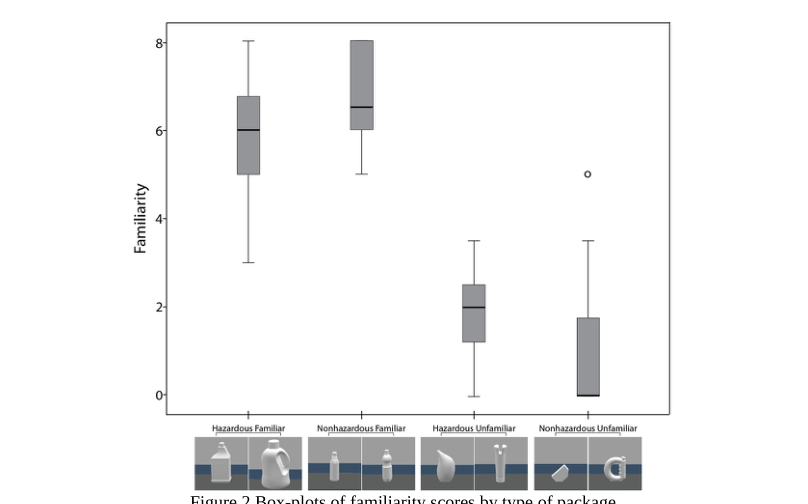
Familiarity Question 6 asked participants to state how familiar they were with the packages. As seen in see Figure 2, the pack- ages that were previously classified as being familiar were considered as such by the participants, and the contrary for the other two packages that were considered unfamiliar.
Ergonomics In Design, Usability & Special Populations I (2022) https://openaccess.cms-conferences.org/#/publications/book/978-1-4951-2106-7
Figure 2. Box-plots of familiarity scores by type of package
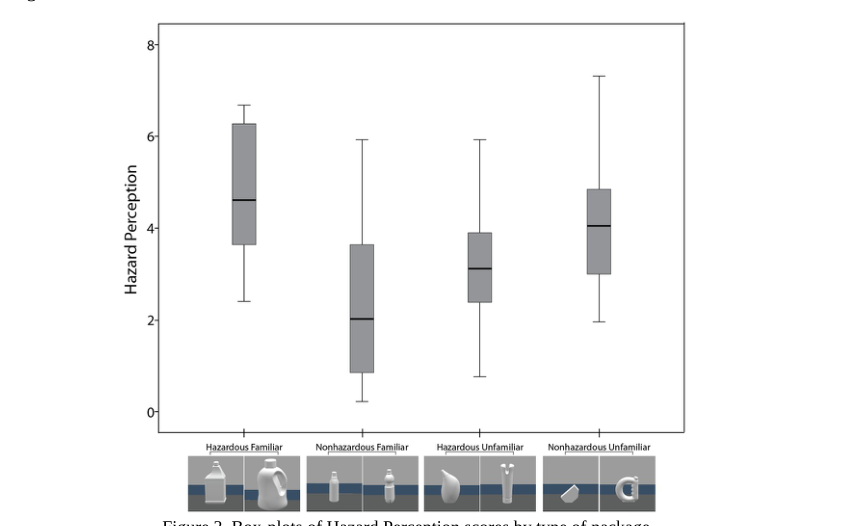
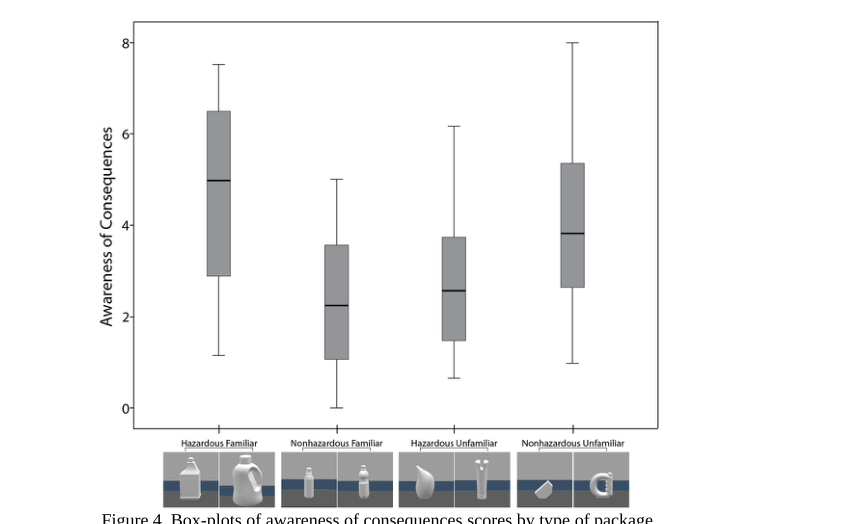
Type of Package Effect The results of Friedman tests revealed that the type of package (i.e., HF, NHF, HUF, NHUF) has a significant effect on both hazard perception (X²(3) = 20.27, p < .001) and awareness of consequences scores (X²(3) = 15.47, p = .001).
Concerning the hazard perception scores, post-hoc comparisons revealed that there were significant differences be- tween HF (Mdn = 3.61, IQR = 2.69) and both NHF (Mdn = 2.04, IQR = 2.89; p =.001) and HUF type of package (Mdn = 3.13, IQR = 1.56; p =.005). The chart in Figure 3 presents the box-plot of hazard perception subscale of each package.
Figure 3. Box-plots of Hazard Perception scores by type of package
Regarding the awareness of consequences scores, post-hoc comparisons also revealed that there were significant dif- ferences between HF (Mdn = 5.00, IQR = 3.63) and both NHF (Mdn = 1.92, IQR = 2.59; p =.005) and HUF type of package (Mdn = 2.59, IQR = 2.38; p =.013). The box-plots of awareness of consequences subscale for each package are presented in Error: Reference source not found.
Ergonomics In Design, Usability & Special Populations I (2022) https://openaccess.cms-conferences.org/#/publications/book/978-1-4951-2106-7
Figure 4. Box-plots of awareness of consequences scores by type of package
Experience with the Simulator The quality of the experience with the simulator, and simulator sickness can significantly impact the participants’ perceptions. The results regarding the overall quality of the experience with the simulator and the simulator sickness are shown in Table 4 and Table 5 respectively.
Table 4. Median ratings and Interquartile Range for the subjective questions regarding experience with the simulation Question 1 2 3 4 5 6 7 8 9
Note. The response format was a 4-point Likert type scale, (0) absent, (1) slight, (2) moderate and (3) severe.
By analyzing the data according to the category, see in Table 4, it is possible to see that for physical fidelity, distin- guishing the packages’ features was below the average level (Question 3), and that the presence of shadows did not cause difficulty in distinguishing such features (Question 7). For the usability category, the point of view (Ques- tion 1) and navigation (Question 2) were found easy to control. Participants were also able to easily match the letters with the packages (Question 4) and they did not feel claustrophobic inside the VE (Question 9). An almost average number of participants claimed that they were aware of mouse presence (Question 5). Considering the data gathered Ergonomics In Design, Usability & Special Populations I (2022) https://openaccess.cms-conferences.org/#/publications/book/978-1-4951-2106-7 for performance question, participants considered that they could reply to the questions that were asked during the simulation (Question 8). According to the presence category, the distraction caused by the mouse (Question 6) was low during the simulation.
Finally, regarding simulator-sickness (see Table 5), participants reported a minimal level of sickness symptoms. Possible explanations for this could be that the experiment used a large screen projection instead of head-mounted display, the reduced dimensions of the VE, as well as its low level of visual complexity, reduced motion of users and objects, the simple task to be performed, and the short amount of time spent inside the VE (Ruddle, 2004).
DISCUSSION
The main objective of this study was to examine the extent that the package’s shape can be used to communicate, in an implicit manner, the hazard level of the content and, therefore, contribute to increase users’ safety. For such, the effect of container’s shape (from eight 3D virtual package prototypes) on hazard-related perceptions (i.e., hazardous- ness and awareness of consequences) was examined using a simulator based methodology.
The results showed that, even though using virtual prototypes displaying minimal details, the participants were able to perceive diverse levels of hazard from the packages. Informing users about the correct hazard level associated with hazardous products can be one of the most important measures to help promote safety. The current results sug- gest that the shape of the package can be used to communicate risk information, informing users’ about the nature of the hazard and the hazard level associated with the content that they will be using. Also, these results support the previous studies (Serig, 2001; Wogalter et al., 2001) in which was found that shapes might serve as a cue to the type and extent of the hazard related with the content. Therefore, it can be suggested that the concept of perceived affor- dances (i.e. signifiers) could be helpful to increased individuals’ awareness about content’s hazard and, conse- quently, search for warning labels. Through the manipulation of different features of the shape, designers might weaken or strengthen the signifiers that change desirable action possibilities.
The results also indicate that the devices and Virtual Environment used in the experiment did not negatively affect task performance. Additionally, the participants did not report symptoms of simulator sickness, or reported light symptoms. These results suggest that simulator based methodology can be successfully used to assess users’ percep- tions about packages’ hazardousness. Thus, to understand the extent to which this methodology has more advantages compared with the methodology that using static 2D images, clearly, further investigation is required.
A main implication of this study is that it would be inappropriate to deliver a hazardous content in a familiar non- hazardous content’s package. When designing a package for hazardous content, it is crucial to take into account whether the same package was used elsewhere for nonhazardous products since it will increase the probability of people perceive it nonhazardous.
This study is an initial research concerning users’ hazard-related perceptions of 3D virtual package prototypes. Ad- ditional research shall be done to examine the effects of other features of a package (e.g., color, texture, material) to determine the extent other features can affect hazard-related perceptions as well to promote safe behaviors.
REFERENCES
Ayanoğlu, H. (2013). Implications of Package Design on Hazard Perception (Unpublished Doctoral Dissertation). Second University of Naples. Ayanoğlu, H., Duarte, E., Noriega, P., Teixeira, L., & Rebelo, F. (2013). The Importance of Integrating Perceived Affordances
and Hazard Perception in Package Design. In F. Rebelo & M. Soares (Eds.), Advances in Usability Evaluation Part I (pp. 627–636). CRC Press/Taylor & Francis, Ltd. Ayanoğlu, H., Rebelo, F., Duarte, E., Noriega, P., & Teixeira, L. (2013). Using Virtual Reality to Examine Hazard Perception in Package Design. In A. Marcus (Ed.), Design, User Experience, and Usability. User Experience in Novel Technological Environments SE - 4 (Vol. 8014, pp. 30–39). Springer Berlin Heidelberg. doi:10.1007/978-3-642-39238-2_4 Desai, S. P., Teggihalli, B. C., & Bhola, R. (2005). Superglue mistaken for eye drops. Archives of Disease in Childhood, 90(11),
1193. Gibson, J. J. (1986). The Ecological Approach to Visual Perception. New York: Taylor & Francis.
Ergonomics In Design, Usability & Special Populations I (2022) https://openaccess.cms-conferences.org/#/publications/book/978-1-4951-2106-7
Kennedy, R. S., Lane, N. E., Berbaum, K. S., & Lilienthal, M. G. (1993). Simulator Sickness Questionnaire: An Enhanced Method for Quantifying Simulator Sickness. The International Journal of Aviation Psychology, 3(3), 203–220. Landabaso, J. L., Pardàs, M., & Casas, J. R. (2006). Reconstruction of 3D shapes considering inconsistent 2D silhouettes.
International Conference of Image Processing. Laughery, K. R., & Wogalter, M. S. (1997). Warnings and risk perception. In G. Salvendy (Ed.), Handbook of human factors and ergonomics (2nd Editio., Vol. 2, pp. 1174–1197). Wiley) New York. Norman, D. A. (2010). Living with complexity. Signals. London: The MIT Press. Ratneshwar, S., & Chaiken, S. (1991). Comprehension’s Role in Persuasion: The Case of Its Moderating Effect on the Persuasive
Impact of Source Cues. Journal of Consumer Research. doi:10.1086/209240 Rebelo, F., Noriega, P., Duarte, E., & Soares, M. (2012). Using Virtual Reality to Assess User Experience. Human Factors: The Journal of the Human Factors and Ergonomics Society, 54(6), 964–982. Rosson, M. B., & Carroll, J. M. (2002). Usability engineering : scenario-based development of human-computer interaction.
Interface (p. 446). San Francisco: Academic Press. Ruddle, R. A. The effect of environment characteristics and user interaction on levels of virtual environment sickness. , IEEE Virtual Reality 2004 141–285 (2004). Ieee. Serig, E. M. (2001). The influence of container shape and color cues on consumer produckt risk perception and precautionary
intent. In Michael S. Wogalter, Stephen L. Young, & K. R. Laughery (Eds.), Human Factors Perspective on Warnings Volume 2 : selections from Human Factors and Ergonomics Society annual meetings, 1994-2000 (pp. 185–188). Human Factors and Ergonomics Society. Wogalter, M. S. (1999). The Relative Contributions of Injury Severity and Likelihood Information on Hazard-Risk Judgments and Warning Compliance. Journal of Safety Research, 30(3), 151–162. Wogalter, M. S., & Laughery, K. R. (2001). Warnings. In (W. Karwowski, Ed.)International encyclopedia of ergonomics and
human factors, Volume 2. Taylor & Francis. Wogalter, M. S., Laughery, K. R., & Barfield, D. A. (2001). Effect of container shape on hazard perceptions. In Human Factors Perspective on Warnings Volume 2 : selections from Human Factors and Ergonomics Society annual meetings, 1994-2000 (pp. 231–235). Zuckerman, A., & Chaiken, S. (1998). A heuristic-Wsystematic processing analysis of the effectiveness of product warning
Ergonomics In Design, Usability & Special Populations I (2022) https://openaccess.cms-conferences.org/#/publications/book/978-1-4951-2106-7
LISTED IN THE AHFE DIGITAL BOOKSTORE CATALOGUE
Explore the complete digital volume
Advances in Ergonomics In Design, Usability & Special Populations: Part I
Read this individual research paper free through the original publisher, or explore the full digital proceedings book.
ISBN 978-1-4951-2106-7
Explore this ISBN in the AHFE Bookstore ↗Listed in the July 2026 bookstore catalogue; search by ISBN to confirm current availability · Digital book purchase optional