Francisco Rebelo, Diana Carvalho, Paulo Noriega, Elisangela Vilar (2022). HeroFit: A Gamification Solution With a Mini-Game to Promote the Sedentarism Behavior Change. In: Ergonomics In Design. AHFE Open Access, vol. 47, pp. 457–464. https://doi.org/10.54941/ahfe1001970
One of the main barriers to non-sedentary behavior is the fact that professional work needs to be done while seated. Since non-sedentary tasks must be performed repeatedly, one should not solely exercise outside of work, as this can lead to a long period of sedentary lifestyle during working hours. In this study, a solution was thought up, HeroFit, that would motivate people to perform low intensity exercises for longer periods of time and consequently lead to a change in their routines. The results showed that the HeroFit application, had a good acceptance rate by users who have tested it. It had all the necessary features to monitor physical activity, as well as a strong gamification component, which goes further than the existing applications on the market, by incorporating a mini game where the user had a greater goal than just socialization and physical performance.
The sedentary lifestyle is a serious public health problem that has been silen- tly increasing its prevalence and incidence in recent decades (Owen et al. 2010). In evolutionary terms, humans are not prepared to spend much of their daily lives sitting in front of a computer or television, although techno- logical advances are driving humanity forward to this scenario (Ciapa, 2019). In contemporary society, it is highly common for people to be seated when they are working or even having fun (O’ Donoghue, 2016), which implies that during the day, most of the time they are in a sedentary situation. In addition to this problem, it is also verified that people have increasingly lost interest in cooking or setting aside a long interval for meal consumption. This leads dire- ctly to greater access to fast and pre-cooked meals, which are characterized by being rich in energy. A sedentary lifestyle with dietary deficiencies causes several health problems, such as excess body weight and obesity, which are some of the main risk factors in producing diseases like diabetes, vascular disease, and cancer (Owen et. al., 2010; Kyle at. al. 2004). While this may seem surprising, physical activity and physical inactivity are not mutually
exclusive; even if a person is physically active (for example, goes for a run first thing in the morning), she may also be sedentary (e.g., remaining seated during the rest of the waking hours). Thus, the guidelines from the World Health Organization (2020) to combat sedentary lifestyle aim to battle this issue, by focusing on frequent and low-intensity physical activity to avoid negative health effects. This organization recommends at least 150 to 300 minutes of moderate aerobic activity per week for adults, and an average of 60 minutes per day for children and teens. As research on physical activity and health has evolved, new ways of thin- king emerged about the understanding and influence of the adverse health consequences of inactivity (Ng and Popkin, 2012). Ergonomics and design, as active actors in people’s lives, must reflect on this situation, to which they have also contributed, and acted upon the combat of this problem. To encou- rage physical activity, mobile applications have already been created, such as Fitbit or Google fit, which has the advantage of being easily accessible and able to monitor physical activity. On the other hand, a variety of “exergames” have been developed that also encourage people to stay active by integra- ting exercise into game mechanics. Smartphone use is already common and there is a wide variety of applications that help and monitor the practice of physical exercise. Ahtinen et al. (2010) from Nokia’s research center develo- ped a mobile application to increase people’s physical activity level. The idea based itself on a virtual journey, which was carried out by recording users’ steps with the help of the cell phone’s accelerometer, using data tracking, social sharing, and playfulness. Morris et al. (2008) developed SuperBreak, to encourage people who work with computers to take breaks. They deve- loped an application for Microsoft Windows where, using a camera, they gave users a game to stretch their upper body. Personalization has been con- sidered, allowing users to change notification settings. It was concluded that mobile applications can be effective in motivating users to take breaks regu- larly. Sunny Consolvo et al. (2008) developed a system that encourages people to have a more active life, the Ubifit Garden, which uses the user’s cell phone background screen to display a garden that blooms as he physically performs activities throughout the week. However, these exergames may also not work to combat sedentary behaviors, as we have already seen prolonged activity throughout the day. There is modest evidence that these applications can be effective and that multi-component interventions appear to be more effective than stand-alone application interventions (Stephanie Schoeppe et. al., 2016). It turns out that the problem persists, for example, an App designed to encou- rage a jogger may help at that time, but it does not help to combat sedentary behavior during the remaining waking hours. There is also a lack of adequate advice to the user to progress more easily and a lack of engagement that leads to prolonged use and change from a sedentary routine.
In this context, the main objective of this study is the development and evaluation of a gamified strategy, with an application, to create habits of physical activity during the day and in the long term, promoting the habit of walking. As for the specific objectives, we intend to study user engagement with games as extra motivation for physical activity to combat sedentary life- styles. Despite increasing the amount of time spent on the phone, combining
HeroFit: A Gamification Solution With a Mini-Game 459
a popular leisure activity with physical activity, can potentially facilitate the transition to a more active lifestyle. Thus, it is intended to: understand and define the strategy to combat sedentary behavior; define Personas through interviews that represent potential users; develop and evaluate a solution proposal (gamification strategy with a mobile application).
GUIDELINES TO COMBAT SEDENTARY BEHAVIOR The recommendation of physical activity guidelines helps to guide and pro- vide a daily goal to meet to improve the health of an individual. In contrast, the guidelines to combat a sedentary lifestyle have a focus on encouraging frequent, low-intensity physical activity to avoid negative health consequ- ences. This section presents some of these guidelines to combat sedentary behavior. In 2020, the World Health Organization (WHO) created a report with guidelines on physical activity and sedentary behavior where it provides evidence-based recommendations, for children, adults, and elderly people. Since this study focuses on the working-age population in Portugal, we will focus on the guidelines about the adults.
In contrast to physical activity guidelines designed to encourage physical exertion, anti-sedentary guidelines focus on reintroducing physical activity into daily routines. Regarding adults, the WHO suggests that they should limit the time they spend being sedentary, replacing it with physical activity of any intensity (including low intensity). Larger amounts of moderate to vigo- rous physical activity can mitigate the associated harm between sedentary behavior and health consequences (World Health Organization Guidelines). Other studies, Owen et. al. (2010), also indicate that several sociodemogra- phic and health factors appear to be reliably linked to sedentary behavior, but there is a lack of research focused on cognitive, social, and environmen- tal factors that could be useful in anti-sedentary behavioral interventions. People spend too much time sitting, the routines of modern civilization form a significant barrier to non-sedentary behavior. These barriers can be roughly categorized into three main types: psychological barriers (i.e., phy- sical activity is often boring and antisocial, with significant ability, physical fitness, and perceived ability barriers to entry), temporal barriers (i.e., phy- sical activity is often disruptive of modern schedules) and physical barriers (i.e., physical activity often requires access to hardware or specialized locati- ons, or is restricted by physical processes beyond our control, such as time). It is necessary to change people’s routines and mentality, by taking breaks from sitting and changing their behavior about the various day-to-day scena- rios, for example, giving preference to climbing stairs, walking, or running, instead of sitting on the couch.
METHODS
The Human-centered design method was the approach used to achieve the objectives and build a possible solution. Briefly, in the first phase of this study, interviews were carried out for the development of Personas, then the design
requirements were defined, and further on, a solution was designed that was carried out to evaluation through user testing.
Persona Creation For the creation of Personas, interviews were conducted with seven peo- ple, with an average age of 30, with a standard deviation of 5.12, all with sedentary habits. The objectives of these interviews were: to characterize the day-to-day activities; to distinguish the levels of the sedentary lifestyle of each person, and to understand the common tools the individuals use to help practice physical exercise.
Solution Development The solution was based on the results of the Personas and the guidelines to combat sedentary behavior, which allowed to define the design requirements. A narrative was created, and the gamification strategy was centered on the Octalysis Framework [12]. Tests with users focused on an application develo- ped for mobile phones and involved five potential users, three male, and two females, with an average age of 34 years and a standard deviation of 3.96, who have met the sedentary lifestyle requirements. Usability tests were car- ried out, during a period of 20 minutes, related to the performance of tasks on the features that have been developed for the application. In the end, an interview was conducted, where a global impression of the interaction and the main problems of interaction were collected.
RESULTS
Personas Two distinct Personas were categorized. Ana Ferreira, 30 years old, single, and a designer by profession, works in an office most of the time sitting down. She doesn’t usually exercise daily, but on the weekends, she goes for walks with friends. Her main frustration is that she thinks she is not able to exercise, nor does she enjoy exercising. She would like to include in her routine an active lifestyle and the habit of exercising. Mário Cruz, 38 years old, married and a manager by profession, works in an office always seated at his desk. He exercises 2-3 times a week and on weekends with his family. His main frustration is the lack of time and being subjected to the pressure of having to exercise. He aims to stay in shape.
Design Requirements The design requirements were defined based on the previous information and these were: use of a gamification method as a way to encourage users to use the application again; development of a narrative to provide an objective to the users of the application and allowing the incorporation of gamification methods more easily; application of a scoring system based on the collection of analytical data from the mobile phone’s internal pedometer; implementa- tion of a mini-game based on the narrative that was created, with the outcome of rewarding the users and giving them a sensation of satisfaction and fun.
HeroFit: A Gamification Solution With a Mini-Game 461
Narrative In order to give a purpose to the application’s users and allowing the incorpo- ration of gamification more easily, a narrative was created. In this narrative we have an antagonist that users will have to eliminate, the parasites, there is also a supporting character that will help to eliminate the enemy, walk or exercise, and the protagonist who is the user. “A new species of parasite has been discovered that can suck the vital energy of other beings, the parasites managed to escape and are attacking people! To fight them, it is necessary to walk/run to collect energy and thus kill them!”
Gamification The gamification strategy followed the Octalysis framework, which has 8 main units that were adapted to this project.
1st Unit: Epic Meaning and Calling - In the case of the application, the narrative introduces the objective of being able to ‘kill’ all the ‘parasites’ that will be something bigger than the user, as there are many and only collectively will it be possible.
2nd Unit: Development and Accomplishment - In this unit, it is related to progress. In the application, it is achieved through the levels and badges that the user earns overtime as he completes the challenges.
3rd Unit: Empowerment of Creativity and Feedback - In the application, the main objective and what makes the user stronger is to be more active and change habits.
4th Unit: Ownership and Possession - Users need to feel in control and that they possess something. In the application, this is achieved by creating a profile with an avatar and some personal data, which leads to having some- thing of their own, in addition, there is an activity history that reflects the past and what they have achieved.
5th Unit: Social Influence and Relatedness - To influence and motivate users at a social level, there will be a ranking of users with the number of ‘parasites’ that they have already ‘killed’, to influence and give recognition to the 1st unit: Epic Meaning and Calling.
6th Unit: Scarcity and Impatience - Wanting something very rare or exclu- sive motivates people to want it even more. In this application it is necessary to earn points and to ‘kill parasites’ it is necessary to have a minimum of Energy Points, if you don’t have enough points, the user will not be able to play immediately and will have to complete challenges to acquire them.
Unit 7: Unpredictability and Curiosity - Unpredictability makes it possible to create engagement as the user never knows what to expect. In this appli- cation, fun challenges are placed every day at a specific hour that makes the user and their family members move.
8th Unit: Loss and Avoidance - Loss motivates us to prevent something negative from happening. Losing points will motivate the user to complete challenges to get more and thus also to motivate to ‘kill’ more ‘parasites’.
Scoring System The score that will be the basis of the application corresponds to the rew- ards of the challenges that are used to ‘kill parasites’. This is divided into
2 systems, the Health Points (HP) that indicate the user’s ‘life’ points, that when it reaches 0 the user ‘dies’, on the other hand, the user gains HP whe- never he walks or fulfills a challenge. There are also Energy Points (EP) that serves to ‘kill parasites’, a minimum of 20 EP is required to be able to ‘kill’, the user also earns these points when he walks and whenever he completes a challenge, but when the user ‘kills parasites’, they lose Energy Points, which increases the need to collect more to be able to ‘kill parasites’ again.
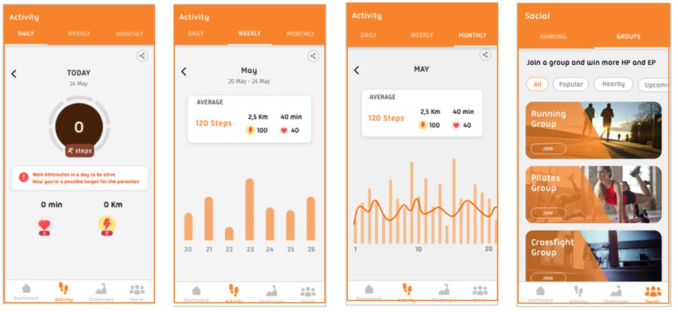
Information Architecture The information architecture has three main areas: the ‘Activity’ where the user can have access to the history of his activity; ‘Challenges’ where the user has activities to complete, it is short-term ‘Daily’ and long-term ‘Quests’; and the third area ‘Social’ the user can check their place in comparison to other users and can be grouped with other people to exercise, which helps the motivation of the individual.
Prototype Design The prototype developments have considered usability heuristics; consiste- ncy (visual, functional, internal, and external); efficiency; feedback, and easy error recovery. Prototypes of increasing complexity were developed, which were evaluated with potential users, to identify performance problems and whether they met their expectations.
Minigame It was also developed, in Unity 2D, the mini-game that would be integrated into the gamification strategy, where the participant can ‘kill’ enemies (para- sites/slimes) and have the satisfaction and motivation for users to continue using the application and thus creating changes to their usual routines. To access this area, the user clicks on ‘FIGHT’ where there are several levels to kill X ‘parasites’ and to access the next level it is necessary to complete the previous one. Clicking on an unlocked level starts the mini game. In this mini game the user will be able to use the points they have of energy to ‘kill’ the ‘parasites’, for that they must touch the screen where the ‘parasites’ appear, however they increase the frequency with which they appear over time. There is a time limit, and the objective is to ‘kill’ as many ‘parasites’ as possible. The mini game starts with an initial screen that rotates to the landscape position and instructions on how to play are presented. As soon as the user clicks on START parasites begin to appear, in which they increase in number over time. The interaction between the user and the game is done through the finger with a ‘tap’ on the screen where the parasite is, resulting in its disappearance after this contact. The objective is to eliminate as many parasites as possible in the shortest amount of time. Figure 1 shows the high-fidelity prototype.
Usability Tests The tests aimed to evaluate the usability and the user interaction with the HeroFit in the main tasks of the Application. Related with the usability, was measured, the success or failure in the tasks and the understanding of the
HeroFit: A Gamification Solution With a Mini-Game 463
Figure 1: Prototype of the application.
contents of the Application. After the interaction, an interview was conducted to evaluate the participant experience with the Application.
Five participants with an average age of 34 years and a standard devia- tion of 3.96 interacted with the Application for 20 minutes and successfully completed the tasks. In the interview, it was mentioned that the Application was simple, funny, and easy to understand. The participants also expressed their satisfaction with the interaction, but expressed the need for a longer interaction time, to have a more assertive opinion.
CONCLUSION
As discussed earlier, one of the main barriers to non-sedentary behavior is the fact that professional work needs to be done while seated. As non-sedentary tasks must be performed repeatedly, one should not just perform exercises outside of work, as this can lead to a long period of sedentary lifestyle during working hours. In this study, a solution was thought up, HeroFit, that would motivate people to do low-intensity exercises for long periods of time and consequently lead to a change in their routines.
The results showed that the HeroFit application, had a good acceptance rate by the users who have tested it. It had all the necessary features to moni- tor physical activity, but also had a very strong gamification component that goes further than the existing applications on the market, by incorporating a mini-game where the user had a greater goal than just socialization and phy- sical performance. This mini-game integrated into a narrative proved to be an important feature to motivate users and make the idea of exercising only for health benefits less boring, thus combating some of the frustrations of personas, creating engagement, and motivating their use. Despite the satisfa- ctory results, this study had several limitations. When creating the Personas, the sample size was small, it would be necessary to have a greater portion to have well-defined Personas. User testing had a small sample size and a very short interaction duration. In the next phase of this work with a 100%
functional prototype, studies will be carried out where participants can inte- ract for several days and thus verifying its effectiveness in changing sedentary behavior.
ACKNOWLEDGMENT
This work is financed by national funds through FCT - Fundação para a Ciência e a Tecnologia, I.P., under the Strategic Project with the refe- rences UIDB/04008/2020 and UIDP/04008/2020. and ITI -LARSyS-FCT Pluriannual funding’s 2020-2023 (UIDB/50009/2020).
REFERENCES
Ahtinen, A., Huuskonen, P., & Häkkilä, J. (2010, October). Let’s all get up and walk to the North Pole: design and evaluation of a mobile wellness application. In Pro- ceedings of the 6th Nordic conference on human-computer interaction: Extending boundaries (pp. 3–12). Chou, Yu-kai (2015). Actionable Gamification: Beyond Points, Badges, and Lea-
derboards. Octalysis Media. Createspace Independent Publishing Platform, ISBN 1511744049, 9781511744041 ISBN 978–1511744041. Ciapa, G. C. (2019). The effects of Sedentarism on the Human Body. Bulletin of” Carol I” National Defence University (EN), (02), 81–86. Kyle, U. G., Morabia, A., Schutz, Y., & Pichard, C. (2004). Sedentarism affects body
fat mass index and fat-free mass index in adults aged 18 to 98 years. Nutrition, 20(3), 255–260. Morris, D., Brush, A. B., & Meyers, B. R. (2008). SuperBreak: using interactivity to enhance ergonomic typing breaks. In Proceedings of the SIGCHI Conference on Human Factors in Computing Systems (pp. 1817–1826). Ng, S. W., & Popkin, B. M. (2012). Time use and physical activity: a shift away from
movement across the globe. Obesity Reviews, 13(8), 659–680. O’Donoghue, G., Perchoux, C., Mensah, K., Lakerveld, J., Van Der Ploeg, H., Bernaards, C., & Nazare, J. A. (2016). A systematic review of correlates of seden- tary behaviour in adults aged 18–65 years: a socio-ecological approach. BMC public health, 16(1), 1–25. Owen, N., Healy, G. N., Matthews, C. E., & Dunstan, D. W. (2010). Too much
sitting: the population-health science of sedentary behavior. Exercise and sport sciences reviews, 38(3), 105. Owen, N., Sparling, P. B., Healy, G. N., Dunstan, D. W., & Matthews, C. E. (2010).
Sedentary behavior: emerging evidence for a new health risk. In Mayo Clinic Proceedings (Vol. 85, No. 12, pp. 1138–1141). Schoeppe, S., Alley, S., Van Lippevelde, W., Bray, N. A., Williams, S. L., Duncan, M. J., & Vandelanotte, C. (2016). Efficacy of interventions that use apps to improve diet, physical activity and sedentary behavior: a systematic review. The international journal of behavioral nutrition and physical activity, 13(1), 127. Sunny Consolvo, David M. McDonald, Tammy R. Toscos, Mike Y. Chen (2008).
Activity Sensing in the Wild: A Field Trial of UbiFit Garden. In Conference: Pro- ceedings of the 2008 Conference on Human Factors in Computing Systems, CHI 2008, 2008, Florence, Italy, April 5–10. WHO Guidelines on physical Activity and sedentary behavior (2022, January 10).
Retrieved January 10, 2022, from WHO: https://www.who.int/publications/i/ite m/9789240015128
LISTED IN THE AHFE DIGITAL BOOKSTORE CATALOGUE
Explore the complete digital volume
Ergonomics In Design
Read this individual research paper free through the original publisher, or explore the full digital proceedings book.
ISBN 978-1-958651-23-0
Explore this ISBN in the AHFE Bookstore ↗Listed in the July 2026 bookstore catalogue; search by ISBN to confirm current availability · Digital book purchase optional