Yohsuke Yoshioka (2022). Fixation Height in Way-finding while Peripheral Visual Fields are Restricted with Synchronously Moving Virtual Holes. In: Advances in Ergonomics In Design, Usability & Special Populations: Part I. AHFE Open Access, vol. 18. https://doi.org/10.54941/ahfe100812
An experiment was conducted to examine the function of the peripheral visual field (PVF) by using a virtual reality system consisted with a head-mounted-display and an eye-tracker. The system could modify the display in concert with real-time fixation pattern. Subjects walked through four types of virtual maze under different condition in which their PVF was restricted artificially with the system. The results indicated: 1) Under the condition in which over 30 degrees of PVF was restricted, the fixation duration on middle part of walls while walking throughout the entire maze was longer than that under the non-restricted condition and the condition in which over 15 degrees of PVF was restricted. 2) Under the condition in which over 15 degrees of PVF was restricted, the fixation duration on the lower part of walls while walking throughout was longer than that under the non-restricted condition and the condition in which over 30 degrees of PVF was restricted. 3) Under the condition in which over 15 degrees of PVF was restricted, the fixation height while walking through the area with two dead ends was lower than that under the non-restricted condition and the condition in which over 30 degrees of the PVF restricted.
The area from outside the very center of the gaze to the edge of the field of view is called the peripheral visual field (Polyak, 1941). This large annular area of the visual field deals with only low spatial frequency information and uncolored vision; nevertheless it is also has some important functions in human spatial perception and spatial behaviour as opposed to the central region of the visual field (Anstis, 1974; Brown, 1972; Johannson, 1977; Mateeff & Gourevich, 1983; Osaka, 1990; Previc, 1990; Ungerleider & Mishkin, 1982; Wertheim, 1894). The dynamic functions of the peripheral visual fields will lead us to understand the key concepts behind the processes of spatial perception.
We have attempted to examine the functions of the peripheral visual field by conducting an experiment using a specially designed head-mounted virtual reality (VR) system consisting of a wide-view head mounted display (HMD) and eye tracker. The system can restrict an arbitrary area of the human visual field by modifying the display in concert with the precise position of the subject’s fixation in real-time. The function of the peripheral visual field could then be examined by comparing the fixation patterns and the behaviour under the following conditions: one requires the subject to behave under normal visual conditions; the other restricts the peripheral visual field Ergonomics In Design, Usability & Special Populations I (2022)
(Blanchard, McConkie, Zola, & Wolverton, 1984; Ikeda & Saida, 1978; Saida & Ikeda, 1979). The significance of the results of these experiments will be assessed in this paper.
METHODS
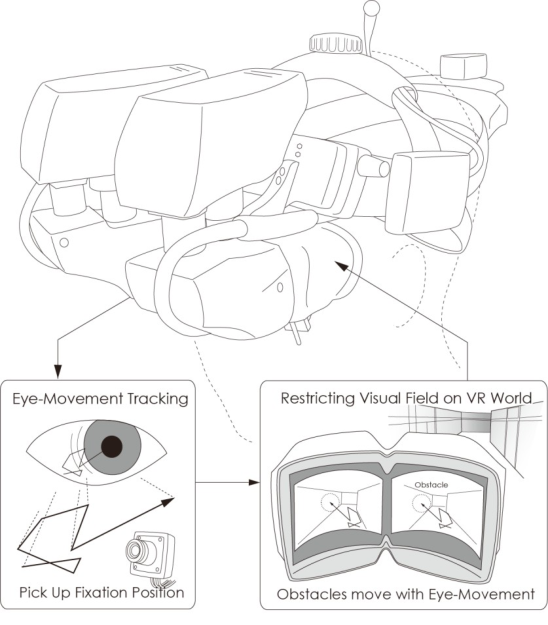
System The peripheral visual field of each subject in these experiments was restricted artificially using a specially developed VR system, while the subjects walked through virtual mazes. We had originally built the system with a wide-view HMD (Nvis: nVisor SX111), an eye tracker (Arrington Research: Binocular Eye-tracking system), and a position tracking system (WorldViz: PPT optical tracker).
The diagonal field of view of the HMD is 111 degrees, which covers most of the peripheral visual field of humans. The precise position of the subject in the real experimental room was tracked using the position tracking system consisting of eight high-resolution cameras. The virtual space displayed on the HMD was linked with the real-time position of the subject so that the subject could walk around within the virtual space. The HMD also contained a triple axis accelerometer for calculating the rotation of the head, and recording head movements when the subject looked around within the virtual space.
Figure 1. The arrangement of the HMD and the eye-tracker in the developed experimental system The HMD also has a binocular eye-tracking system (see Figure. 1). Small precision cameras were installed into the gap in the HMD screen in order to record the subjects’ eye-movements. The recorded eye-movements were sent directly to the workstation connected to the HMD, and the precise position of each subject’s fixation point could be calculated using software simultaneously.
We used the software, Vizard 4.0 (World Viz), for describing the virtual world on the screen of the HMD. The VR software can modify the display in concert with the subject’s real-time fixation pattern. In this study, we displayed Ergonomics In Design, Usability & Special Populations I (2022) small virtual holes in the virtual world, which were controlled in synchronization with eye-movements to restrict a designated area of the peripheral visual field. The dynamic function of the peripheral visual field could be clarified in this innovative series of experiments, by comparing differences in the subject’s behavior between the restricted condition and the normal condition.
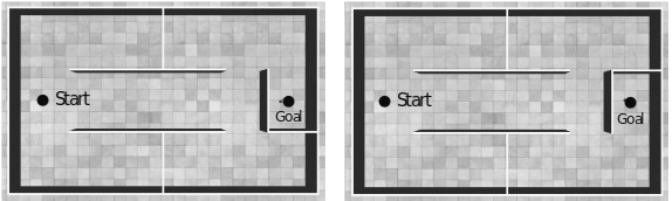
Mazes The virtual mazes that the subjects walked through in this experiment had four configurations (Figure 2). Every maze was arranged within an area of three meters by five meters with three-meter-high virtual walls. All the corridors in these mazes were 1-m wide. Each maze had a three-way intersection at the starting point, in order to examine the behavior of the subjects in a situation where they had to make a choice between three similar looking paths to find the correct way to the goal under the restricted visual condition.
The pieces of the virtual walls had a texture like wood paneling and the floor of the virtual world was covered with small gray tiles. When starting the series of experiments, the subject could only see a small floating icon on the unlimited tiled floor. The subjects asked to walk toward the floating icon. As soon as the subject’s body touched the icon, the one of the four configuration of the virtual maze would appear in front of the subject. All the mazes had another floating icon at the goal position shown in Figure 2. To finish each trial, the subject needed to find and touch the icon. All the walls of the maze immediately disappeared after the subject touched the goal icon, and a new starting icon would appear at the same position as original starting icon. The next the maze configuration appeared after the subject touched the new starting icon with their body. The same process was repeated 16 times, to complete the series of experiments.
Start
Goal
Start
Goal
a b
c d
Figure 1. The configuration of the virtual mazes
Maze configuration (a) and (b) had plans that mirror each other. The shape of the maze became fixed after each subject made an initial choice. If the subject chose the left-hand route from the three forks at starting point, the route would become a dead end when a section of wall appeared and blocked the left-hand side of the goal. Because of the interactive system, the abilities of the subjects in some different visual conditions to realize the detailed shape of the deeper dead-end could be tested in every trial.
Ergonomics In Design, Usability & Special Populations I (2022)
The plans of mazes (c) and (d) were also designed to mirror each other. If the subject chose the middle route of the three forks as the correct route to the goal, they immediately came to an interactive junction just before the goal. If they chose the left option, the route became a dead end when a section of wall appeared and blocked the left-hand side of the goal. The abilities of the subjects to subsequently choose the direction they had not yet been to could be tested in every trial.
Ergonomics In Design, Usability & Special Populations I (2022)
Visual Condition The subjects walked through the four different virtual mazes seeking the goal point where there was a floating icon. Their visual fields were controlled virtually using the head-mounted VR system, to create the following four visual conditions (see Figure 1):
Peripheral Restrict 15deg / Move
Peripheral Restrict 15deg / Fix
Peripheral Restrict 30deg / Move
Non-Restricted
Figure 1. The Four Visual Conditions
Peripheral Restrict 15 deg/Move: The peripheral visual fields of the subjects were restricted by virtual holes moving synchronously with the eye movements. The virtual holes covered an area formed by an angle of 15 degrees around of the fixation points of each eyeballs, and the center point of the hole was constantly controlled to be exactly at the real-time fixation point.The subjects experienced great difficulty reaching the goal in the maze because their peripheral vision was restricted. The specific behavior found under the restricted condition indicates the normal function of the peripheral visual field.
Peripheral Restrict 15 deg/Fix: The virtual holes were the same size as in the “Peripheral Restrict 15 deg/Move” condition, and were displayed at the center of the screen of the HMD, but they were fixed on the center and did not move together with eye movement. The effects of the eye-following movement of the holes could be examined by comparing the subjects’ behavior under the two conditions, moving and fixed. The fixation point of the subjects was also calculated and recorded as same as the moving restricted conditions.
Peripheral Restrict 30 deg/Move: The virtual holes moved with the eye movement, and the sizes of the holes were larger and covered the area formed by an angle of 30 degrees around the fixation points. The effects of the size of the restriction could be found by comparing the 15-degree and 30-degree conditions.
Non-Restricted: There were no restrictions on the subjects’ visual fields, and the subjects simply walked through the virtual mazes using normal vision. The fixation point of the subjects was also calculated and recorded as same as the moving
Ergonomics In Design, Usability & Special Populations I (2022) restricted conditions for analysis. All of the behavior found under the restricted conditions was compared with basic behavior under this “Non-Restricted” condition.
RESULTS
Twenty college students without any visual disorders participated in the experiment. This paper deals particularly with the fixation pattern of subjects walking through mazes (a) and (b) as the main results of the experiments. And this paper did not include the data from mazes (c) and (d) though, because of the insertion by those two types of maze, the subjects were required to confirm the detailed shape of the middle route in front of the starting point at every trial.
The fixation height on the walls while walking through the mazes
Figure 1 shows the average fixation height on the virtual under the four visual conditions walls while walking through the mazes. The P values as the differences in the mean values were assessed with a Bonferroni multiple comparison procedure. Four significant differences could be found between the visual conditions.
The first two differences are that the average fixation heights under “Peripheral Restrict 15 degrees/Move” condition and “Peripheral Restrict 15 degrees/Fix” condition were each significantly lower than that of “Non-restricted” condition (p=0.036, p=0.007). The other two differences are that the average fixation heights under for “Peripheral Restrict 15 degrees/Move” condition and “Peripheral Restrict 15 degrees/Fix” condition were significantly lower than for “Peripheral Restrict 30 degrees/Move” condition (p=0.045, p=0.049).
Figure 1. The average fixation height on the walls while walking through the mazes
Figure available in the original PDF paper.
These results suggest that subjects tended to pay more visual attention to the lower area of the virtual environment under the restricted conditions. There may be important visual information on the lower part of the walls that is required for walking through maze. Since the fixation point would rarely rest on the lower area under the non- restricted condition, we suggest that the important visual information at which subjects tend to gaze under the narrow restricted conditions is acquired by the peripheral visual field under the non-restricted condition.
The results also indicate that the valuable information in the lower area is within the wider visual field obtained using 30-degree holes. This suggests that 30-degrees of the peripheral visual field around of the gazing point is sufficient to efficiently detect the information provided in the lower area.
Ergonomics In Design, Usability & Special Populations I (2022)
There was no significant difference between the two narrow restricted conditions fix and move. Although the subjects had to turn their heads to look around the virtual environment under the fixed condition, it made no difference to the fixation heights. This also suggests that there was some crucial information in the lower area for which subjects have bothered to turn their heads.
The ratio of the fixation duration for the three areas of the wall We divided the area of the virtual maze walls equally according to three heights: the upper area“High”, the middle area “Middle”, and the lower area “Low”, and separately calculated the duration of fixation on each area of the walls. Figure 1 shows the ratio of the fixation duration for the three areas of the walls while walking through the entire maze under the four visual conditions.
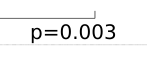
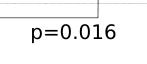
The figure shows two significant differences between the mean values of two of the visual conditions, “Peripheral Restrict 15 degrees/Move” and “Peripheral Restrict 30 degrees/Move”. The first significant difference is in the fixation duration to “Low”, for which the ratio under “Peripheral Restrict 15 degrees/Move” was higher than the ratio under “Peripheral Restrict 30 degrees/Move” (p=0.016). On the other hand, the second significant difference is in the fixation duration to “Middle”, the ratio for “Peripheral Restrict 15 degrees/Move” was lower than the ratio for “Peripheral Restrict 30 degrees/Move” (p=0.003). Although it is not significant, the fixation duration to “Middle” for “Peripheral Restrict 30 degrees/Move” looks higher than for “Non-restricted”.
0.6 Ratio of Fixation Duration to Each Height Area of Wall
Figure 1. The ratio of the fixation duration for each area of the wall
Figure available in the original PDF paper.
The results indicated that it is necessary to detect visual information in the lower part of the environment, rather than the middle area, under the condition of “Peripheral Restrict 15 degrees/Move”. However, this does not imply that there is no important visual information at “Middle” area, since the fixation duration on “Middle” under “Peripheral Restrict 30 degrees/Move”, in which the amount of the visual information subjects could detect is also limited, is greater than for any other visual conditions. We can perhaps say that there is some important secondary visual information at the middle height of the walls for walking through a maze, even if the most important visual information is in the lower area.
Under the condition of “Non-restricted”, the fixation point was drifted onto the higher part of the environment and the larger peripheral visual field could unconsciously catch the visual information in the lower and the middle areas. Under the condition of “Peripheral Restrict 30 degrees/Move”, the subject could not afford to look around at nonessential places and it becomes necessary to maintain fixation on the middle area of the wall in order to simultaneously detect the visual information from both of these areas, middle and low, when the visual field is restricted. Therefore the fixation duration on “High” becomes lower than that under the condition of “Non- restricted”. Finally under the condition of the “Peripheral Restrict 15 degrees/Move”, the view is going to be even tighter and subjects have to pay more attention to the lower area of the environment than they do for the condition of Ergonomics In Design, Usability & Special Populations I (2022)
“Peripheral Restrict 30 degrees/Move”.
However, these explanations above could not adequately explain the data for the condition of “Peripheral Restrict 15 degrees/Fix”. There is still some room for speculation though, and the most likely reason is that it is not possible to use eye movements under the fixed condition and the only way to look around the environment is by moving the heavily encumbered head.
The fixation height on the walls while walking through the mazes The fixation height was calculated separately for the four divisions shown in Figure 1.
Area 1: The area included the starting point and first two dead ends. The subjects were required to recognize these two corridors as dead ends, and were required to come back to the starting point after that.
Area 1-: The area before the straight corridor that connected to the goal. The subjects were required to recognize that there is a side route to the goal at the far end of the corridor.
Area 2: The area included a straight corridor as part of the correct route to the goal. The subjects could walk through this area as their third choice of route after coming back from the two complicated dead-ends.
Area 3: The area of the goal. The subjects were required to find the floating goal icon to finish each trial.
Figure 1. The divided area of the maze
Figure available in the original PDF paper.
Figure 7 shows the average fixation height on the walls in each division of the maze. The significant differences between “Peripheral Restrict 15 degrees/Move” and “Peripheral Restrict 30 degrees/Move” that we found in the fixation height for walking throughout the entire maze in Figure 4 are again found in “Area 1” and “Area 1-” in Figure 7. The fixation height in Area 1 and Area 1- under the condition of “Peripheral Restrict 15 degrees/Move” is lower than that under the condition of “Peripheral Restrict 30 degrees/Move” (p=0.011, p=0.046).
The results suggest that the fixation position becomes and lower as the restricted visual field becomes narrower, especially in the spaces where the subjects were required to confirm the detailed shape of the route from a distance. In other words, we suggest that there was some important visual information in the lower part of the virtual environment for recognizing whether the space was a dead end or not.
Ergonomics In Design, Usability & Special Populations I (2022)
1.5 Fixation Height on Walls in Each devided Area of Maze
Figure 1. The fixation height on the walls in each divided area of the mazes
Figure available in the original PDF paper.
CONCLUSIONS
The followings are the most important findings from the results of the experiments:
Under the visual condition in which over 15 degrees of the peripheral visual field was restricted, the fixation height on the walls while walking through the entire maze was lower than the fixation height under the normal visual condition without any restriction and the visual condition in which over 30 degrees of the peripheral visual field was restricted.
Under the visual condition in which over 30 degrees of the peripheral visual field was restricted, the fixation duration on the middle part of the walls while walking through the entire maze was longer than the fixation duration under the normal visual condition without any restriction and also the visual condition in which over 15 degrees of the peripheral visual field was restricted.
Under the visual condition in which over 15 degrees of the peripheral visual field were restricted, the fixation duration on the lower part of the walls while walking through the maze was longer than the fixation duration under the normal visual condition without any restriction and the visual condition in which over 30 degrees of the peripheral visual field was restricted.
Under the visual condition in which over 15 degrees of the peripheral visual field restricted, the fixation height on the walls of virtual mazes while walking through the divided area with two dead ends was lower than the fixation height under the normal visual condition without any restriction and the visual condition in which over 30 degrees of the peripheral visual field was restricted.
The main finding revealed by this study is that the fixation height on the walls becomes lower as the restricted visual field becomes narrower, from normal to 30 degrees to 15 degrees. It is suggested that there is crucial visual information in the lower area of the virtual environment for recognizing the detailed shape of the route from a distance.
REFERENCES
Anstis, S. M. (1974), “A chart demonstrarin variations in acuity with retinal position”. Vision Research, Volume14, No.7, pp.589–592.
Ergonomics In Design, Usability & Special Populations I (2022)
Blanchard, H. E., McConkie, G. W., Zola, D., & Wolverton, G. S. (1984), “Time course of visual information utilization during fixations in reading”. Journal of experimental psychology. Human perception and performance, Volume10, No.1, pp.75– 89. Brown, B. (1972), “Resolution thresholds for moving targets at the fovea and in the peripheral retina”. Vision research,
Volume12, No.2, pp.293–304. Ikeda, M., & Saida, S. (1978), “Span of Recognition in Reading”. Vision Research, Volume18, No.1, pp.83–88. Johannson, G. (1977), Visual perception of locomotion elicited and controlled by a bright spot moving in the periphery of the visual field, . Sweden: Report - Depertment of Psychology, University of Uppsala. Mateeff, S., & Gourevich, A. (1983), “Peripheral vision and perceived visual direction”. Biological cybernetics, Volume49, No.2,
pp.111–118. Osaka, N. (1990), “Peripheral lower visual fields: A neglected factor?”. Behavioral and Brain Sciences, Volume13, No.03, pp.555. Cambridge University Press. Polyak, S. L. (1941), The retina: the anatomy and the histology of the retina in man, ape, and monkey, including the
consideration of visual functions, the history of physiological optics, and the histological laboratory technique, . Chicago: University of Chicago Press. Previc, F. H. (1990), “Functional specialization in the lower and upper visual fields in humans: Its ecological origins and neurophysiological implications”. Behavioral and Brain Sciences, Volume13, No.03, pp.519–542. Cambridge University Press. Saida, S., & Ikeda, M. (1979), “Useful visual field size for pattern perception”. Perception & psychophysics, Volume25, No.2,
pp.119–125. Ungerleider, L. G., & Mishkin, M. (1982), “Two cortical visual systems”. Analysis of Visual Behavior, Volume549, pp.549–586. Wertheim, T. (1894), “Über die indirekte Sehschärfe”. Zeitschrift für Psychologie und Physiologie der Sinnesorgane, Volume7, pp.172–187.
Ergonomics In Design, Usability & Special Populations I (2022)
LISTED IN THE AHFE DIGITAL BOOKSTORE CATALOGUE
Explore the complete digital volume
Advances in Ergonomics In Design, Usability & Special Populations: Part I
Read this individual research paper free through the original publisher, or explore the full digital proceedings book.
ISBN 978-1-4951-2106-7
Explore this ISBN in the AHFE Bookstore ↗Listed in the July 2026 bookstore catalogue; search by ISBN to confirm current availability · Digital book purchase optional