Lucila Mercado, Alejandro Rodea (2022). Inquiring and Evaluation Ergonomics for Design. In: Advances in Ergonomics In Design, Usability & Special Populations: Part III. AHFE Open Access, vol. 20. https://doi.org/10.54941/ahfe1001304
In the field of integral design (systemic design considers people, the activities, objects mediators of these activities and the environment of use of the objects) has been increasing interest to integrate the users during the development process, primarily for the investigation and evaluation stages. In certain university in the Mexican context efforts are made to train Designers with expertise in ergonomics, human factors and methodology associated with the processes of design development. Part of the effort is the constant incorporation of knowledge about the process of design, features and methodologies as well as the inclusion of aspects that allow users consider (ergonomics and human factors) at different stages of the design process. The objective of this proposal is to contextualize the importance of creating a toolkit which classified different methods and techniques and instruments from various disciplines useful for the stages of inquiry and evaluation of the integrated design process, identifying the type of data that sheds (qualitative or quantitative) and its application process and the utility reports to process. In order to improve the design process of inquiry has resorted to using diverse techniques that have allowed an approach to the qualitative and quantitative necessary to include the social, emotional and cognitive users during the development of the design process. Moreover, the assessment is a process of obtaining information and its use through the application of methods and techniques allows us to identify the level of development of a project with respect to the objectives, with the intention of making judgments useful for decisions, i.e. allows assessment feedback in the design process. There are considered two types of evaluation: formative and summative. Formative assessment is an assessment that is done during design to ensure that the product meets the needs of users while evaluation (also called summative or comprehensive) is an assessment that is done when the design is finalized, possessing each type evaluation. An evaluation design should observe all aspects that impact the user interaction with objects and the environment of use of the same, i.e. systemic approach is needed to respond to the questions: Why evaluate? , What evaluate? , Where assess? , When to evaluate?, all with the aim of evaluating the User experience (which involves affective, cognitive , physical and social) so that the methods, techniques and tools for inquiry or evaluation must be properly selected and applied during the design process.
There are several design processes based on setting a variety of hierarchical targets classification schemes. Those schemes promote the emergence of different twists in the process and in its results conferring distinctive qualities from other processes with different characteristics. This way, talking about Design for retrieve components, Design for Product Longevity, Design for Health Risk Reduction, Design for Energy Conservation, Design for Environmental or User Centered Design -just to name a few important targets-, allows to displays the catalog of objectives associated with the same Design Processes (DfX), also giving evidences those biases are grounded in specific attitudes or philosophies, and then should imprint processes and outcomes characteristics.
THE DESIGN PROCESS AND SOME USEFUL TOOLS Design Process could be defined as a set of successive steps that aim at finding a solution to a given problem pre- determined. The process "generally emphasizes the importance of generating a solution concept at an early stage of the process, thus reflecting the nature of design thinking aimed at problem solution. This initial solution conjecture is then subjected to an analysis, evaluation, refinement and development. Sometimes of course, the analysis and evaluation stages show fundamental flaws in the initial guess, and therefore it has to be abandoned, generating a new design concept and starting the cycle again. (Cross, 2008)” “Well defined problems have a clear goal, wright answers and rules or well-known procedures that should gather an answer. The characteristics of not well defined (or wicked problem) could be the following”(Cross, 2008):
“There is not a definitive problem formulation
Any problem formulation could contain inconsistencies
The problem formulations depend on the answer
The answer proposal is a mean of understanding the problem.
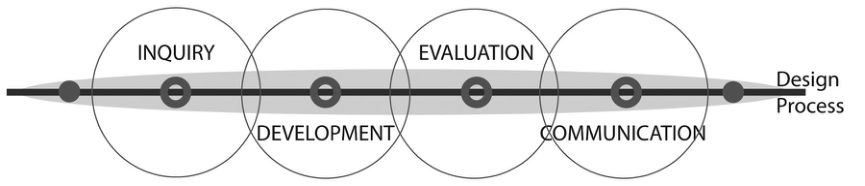
There isn´t exists a definitively solution of the problem”(Cross, 2008) The design process should be systematic and organized. To avoid falling into chaos promoted by the lack of clear objectives that do not allow respond to the established problems, it is needed to use a methodology that considers the result must be verified, and that promotes a useful process in achieving results. The methodology is how is to be coped and organized the design process. Methodology also will impact on the obtained results. Therefore it is important to note that in terms of design methodology, it is appropriate to control both the process and the result. Methodology provides guidance on selecting the most useful methods for different purposes and for selecting the instruments to be used. A useful methodology for designing may involve three stages: "analysis, synthesis and evaluation. These can be described in simple words as breaking the problem into pieces, putting the pieces together in a new way, and testing to discover the consequences of putting the new arrangement into pieces”.(Jones, 1992) Analysis allows specifying what the problem is. It is a process in which are separated those elements of the phenomenon to be studied, and are reviewed one by one, in order to determine the design requirements. Synthesis allows identifying solution alternatives: It is a process in which possible solutions for each design requirements are found; there are expressed relationships between those requirements in a search for a unified conjunct, which could be used to solve the problematic detected. Evaluation by its own, allows valuing results. In it, is determined the precision with alternative designs would satisfy established requirements. Standardizing those three methodological times in different design processes, actions that may occur during the time of analysis were carried out at the stage of inquiry, while those promoted during synthesis occur at the stage of development and finally, at the stage of evaluation, proposed solutions must be valued. Additionally to these three stages of the design process is the Communication one, which the minimum stages needed for developing a design process.
Figure 1. General Stages of a Design Process
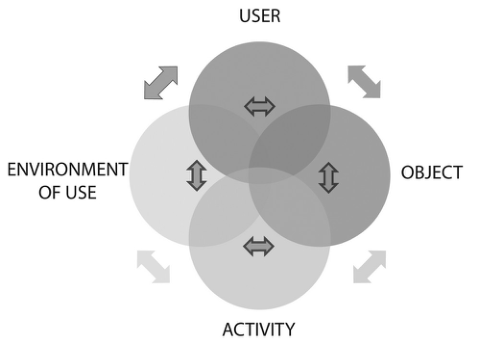
When printing a specific bias in a design process, this is provided with a number of features that define it and at the same time, become necessary conditions for it implementation and achievement of goals. The design stance called User Centered Design raises the need for the design process revolves around the people who will use the product or system. The User-Centered Design (UCD) is a methodology which refers the need to recognize the importance of taking into account the requirements, needs, desires and expectations of Users when trying to solve a design problem. Being User Centered Design a vision from which it is approached a design process gives it various qualities, among which are to be mentioned: It has a systemic perspective, meaning the DCU study the system of which User(s) is(are) participant, together with those other elements (subsystems) with which User is associated during the time he or she performs activities, mediated by objects in specific environments of use. Besides the study of all elements being at the system relationship, it is of interest the information that emerges during the interaction, as a result of those relations between subsystems.
Figure 2. Model of Systemic Interaction
"A system is a set of interacting elements, where the behavior of one affects the behavior of the whole; and how it affects behavior depends on the other elements. A system is characterized as holistic, transdisciplinary and dynamic"(Lara, 1993) has a purpose and has interdependent subsystems. This makes it possible to determine the ergonomic system as the study of the system user-activity-object- environment of use in which:
“A User is involved.
That User is doing something.
That User is doing something with a product, system, or other things”(Tullis, 2008).
That User is doing something with a product in an specific use of context
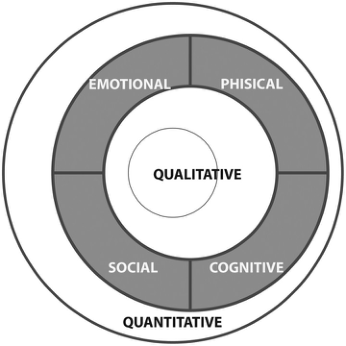
It considers the capabilities and limitations of Users in their physical, cognitive, emotional and social dimensions, related with User activities with the product, having a perspective in which the observation of information allows this to be both qualitative and quantitative.
Affective Dimension: Affection is a general term that refers to psychological process and states such as feelings, emotions, moods, attitudes, affective impressions, and satisfaction.(Te’eni, Carey and Ping, 2007)
Cognitive dimension: Refers to information processing considering the mental processes, acquired knowledge (experience) and subjective features allowing assessing the information.
Physical dimension: Physical aspects. Consider the biological characteristics such as anatomy, anthropometry, biomechanics and physiology, and its subjective characteristics.
Social dimension: Addresses issues on connecting the individual with cultural groups.
Figure 3. Human Dimensions Variables and its Qualitative and Quantitative Analysis.
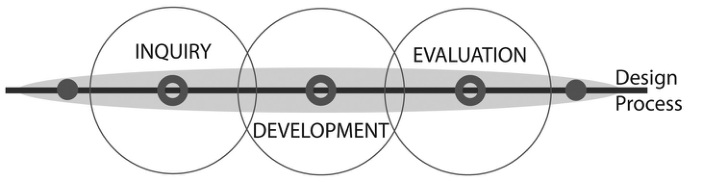
Having control over the design process as well as over the results is considered necessary to achieve effective, efficient and satisfactory solutions. It is advisable to manage a process with clearly defined objectives and scope, and with iteration processes to enable the implementation of formative and summative assessments through the use of prototypes, to evaluate the interaction and allowing the process feedbacks. In the User Centered Design processes there are two stages that are particularly sensitive for involving Users: The problematization definition and the assessment of the solutions obtained. The stages of inquiry and evaluation are two stages of paramount importance in the UCD process as it is in these where the possibility of integrating Users at various levels, given that at the inquiry process is required approaching to Users in order to obtain useful information for problematization, and is in the evaluation stage in which it is possible to compare the level of development achieved in the solutions to the problem.
Figure 4. Inquiry and Evaluation Stages of a Design Process.
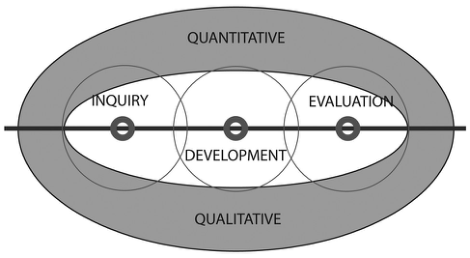
Very generally, during the development of a design process should be determined all useful aspects to the design process development. First of all is needed to address what will solve the problem (problematize); secondly is to explain how (conceptualize); thirdly present solutions (model) and finally to assess the characteristics of each possible solution (evaluate). During the inquiry stage and after analysis of the information are determined: the need or problem to solve, the objectives persecuted, the system limits, the attentional focus is set, the design restrictions must be stipulated and precise evaluation criteria are established for the final solution. Moreover, the design applied assessment is a process that allows to identify the level of development of a project with respect to the established objectives, because through the application of tools useful data are obtained that allow the formulation of judgments for decision making that will provide feedback to the design team to continue to refine the process and outcome of the design project. When referring to the DCU evaluation processes, it is noted that these are classified according to their purpose (formative or summative), to the time of application (early or late). The classification also depends on the type of participants (users-experts), on the kind of observed data (qualitative-quantitative), as well as on the dimension to be assessed (physical, cognitive or emotional). Formative assessments (partial) are assessments at an early stage of the project development, these are quick assessments to test various solution proposals, intended to compare and rank the qualities of those, in order to provide feedback on the process and defining the level of development reached. The evaluation (summative or global) is an assessment that is done when the design is done. It has been reached at this point by obtaining information through (partial) formative assessments that have enabled feedback for decision making during the design process. Summative assessment is applied to the finished product to Ergonomics In Design, Usability & Special Populations III measure the level of development of it. To address the stages of inquiry and evaluation is necessary to use the technique of investigation. The research technique is a step, a tool for both qualitative and quantitative information.
Figure 5. Inquiry and Evaluation Stages and its Qualitative or Quantitative Analysis.
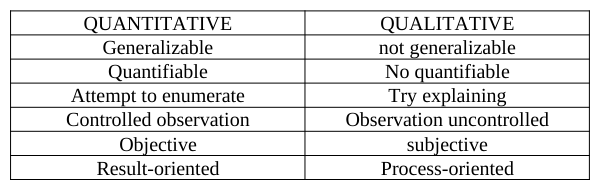
Qualitative and quantitative information have the following characteristics.
Table 1: Quantitative and Qualitative Technics Characteristics.
Below is included a concentrate of instruments that have been classified according to their characteristics, emphasizing on the analysis of some aspects that can bring utility to the reader by showing its characteristics. There were considered several instruments, their general characteristics, the type of data obtained (qualitative or quantitative), the design step in which it applies: (investigation or assessment), and the addressing of human dimension: (affective, cognitive, physical or social).
CONCLUSIONS
The usefulness of a suitable selection of instruments may report to design process consists of:
Allows the identification of problems
Helps defining the User requirements
Helps determining the objectives of the design process
Allows obtaining data of various kinds (qualitative or quantitative human dimensions).
Facilitates searching for solutions.
Through analysis of the data obtained, it is possible to define the maturity of a proposal. Important to be mentioned is when discussing about UCD it is necessary to consider those instruments that are applied during each stage, these allow us to determine what users want, what difficulties have to perform the tasks, what motivates them the process allow to determine what Users want, or what difficulties to perform the tasks have, what motivate them.
REFERENCES
Cordoba E. (coordinator): (2008). “Tris. Un Nuevo enfoque para la innovación sistemática”. in Proceedings of the Congreso Interamericano de Innovación Tecnológica. Mexico: Benemérita Universidad Autónoma de Puebla. Cross N. (2008) Métodos de diseño. Mexico: Limusa Wiley. García C., F. (2007). La investigación tecnológica. Investigar, Idear e Innovar en ingenierías y ciencias sociales. Mexico:
Limusa. García G.(2002): La ergonomía desde la visión sistémica. Bogotá: Universidad Nacional de Bogotá. Jones J., (1992). Design Methods. NY: John Wiley and Sons. Laurel, B. (2003) Design Research: Methods and Perspectives, Cambridge: MIT. Lindlof T., Taylor, B. (2002). Qualitative Communication Research Methods. CA: Thousand Oaks. Te’eni D., Carey J., Zhang P., (2007) Human computer Interaction. USA: Wiley Tullis, T, Albert B., (2008) Measuring the User Experience. Burlington: Morgan Kaufmann
LISTED IN THE AHFE DIGITAL BOOKSTORE CATALOGUE
Explore the complete digital volume
Advances in Ergonomics In Design, Usability & Special Populations: Part III
Read this individual research paper free through the original publisher, or explore the full digital proceedings book.
ISBN 978-1-4951-2108-1
Explore this ISBN in the AHFE Bookstore ↗Listed in the July 2026 bookstore catalogue; search by ISBN to confirm current availability · Digital book purchase optional