Marie Sjölinder, Elin Hollström, Hanna Rönntoft, Olov Ståhl, Anders Helin, Victor Marklund (2024). Evaluation of an Interactive Solution for Reminiscence and Communication. In: Human Factors in Aging and Special Needs. AHFE Open Access, vol. 133, pp. 24–33. https://doi.org/10.54941/ahfe1004890
Communication with older adults and/or people with cognitive impairments could be supported by gathered information about the person’s history or his/her preferences (Rehn, 2015). By using information about the persons preferences and wishes, the sense of belonging and the persons social identity could be strengthened (Turner, 1999). Digital tools addressing this area often consist of static information about the older adult, and they do not consider that we as human beings constantly are changing (Sjölinder et al., 2023). Further, most of these tools have the focus on providing information to the care giving staff instead of being a tool that can be used together and create an experience.In an ongoing project an interactive solution that supports reminiscence and communication with older adults was developed. The solution consists of hardware units in terms of a tablet, interactive devices and a charging station that is combined with a removable tray. The tablet is used for interaction and communication with the system. By using the tablet, general collections of discussion topics can be accessed. The system also has the possibility to gather information and create personal profiles. The information for the personal profiles is gathered by using the tablet to play simple mini games. For example, the older adults can play a mini game where they are presented to items and give these items thumb up or thumb down. Based on the answers a personal profile is built up. The interactive devices are physical devices resembling stones in the size of approximately 15 cm. The devices (“the stones”) have a screen were text or images can be presented. They also have light emitting diodes for conveying different moods and the possibility to play sounds. From the tablet, collections of content can be sent to the stones that presents the items on the screen to provide topics for the conversation. The charging station consists of a part that can be removed (the tray). The aim of this is to make it possible to carry around several stones at the same time. This paper will present a study examining the usage of the solution described above. The study was conducted in collaboration with older adults and staff at a nursing home in Sweden. In one part of the study, the researchers used the solution in the interaction with the older adults. In the other part of the study the staff at the nursing home used the solution in the interaction with the older adults. In both cases two sessions were held with each older adult, one to gather information (playing the mini games), and one session where the gathered content was used in a conversation. After each session with the older adults, questions were asked about the usage of the solution and about aspects related to how they have perceived the solution and the situation. After the sessions that was held between older adults and care giving staff similar questions were given, but in these interviews questions about the care givers perspective were added.ReferencesRehn, A. (2015). Life stories as a method for developing daily activities. FoU-report 77:2015.Sjölinder, M., Hollström, E., Rönntoft, H. (2023). Life Stories – Developing an Interactive Solution for Reminiscence and Communication. In: Jay Kalra (eds) Human Factors in Aging and Special Needs. AHFE (2023) International Conference. AHFE Open Access, vol 88. AHFE International, USA.http://doi.org/10.54941/ahfe1003660Turner, J. C. (1999). Some current issues in research on social identity and self-categorization theories. In: Ellemers, N.; Spears, R.; Doosje, B. (Eds.).Social Identity: 6–34.
The aging population is increasing rapidly (United Nations, 2015), and because of this the number of people with cognitive limitations and demen- tia are increasing (Prince et al., 2015). Maintaining social relations is an important aspect of wellbeing, but due to the illness it becomes increasingly more difficult for people with dementia and the people around them to com- municate (Alm et al., 2004). One way of supporting communication with older adults and/or people with cognitive impairments or dementia could be through gathering information about the person’s history or his/her pref- erences (Rehn, 2015), and then use it as topics for conversation. By using information about the person’s preferences and wishes, the sense of belong- ing and the person’s social identity could be strengthened (Turner, 1999), and it could also support the caregiver in understanding the individual as a person and his/her need for care (Dahlin Olofsson, 2020).
Due to the increasing demand on resources related to care, new technol- ogy will have an important role in meeting the needs of older adults and it has the potential to improve quality of life (Soar, 2010). Research also shows that digital communication aids could be a useful support in social interac- tion where one partner has dementia (Derbring et al., 2021). However, the
Evaluation of an Interactive Solution for Reminiscence and Communication 25
methods used to gather information about the older adult often take a spe- cific perspective and do not cover both the past and the present (Möllergren and Harnett, 2024). Digital tools in the area also often consist of static infor- mation about the older adult instead of using the opportunity to capture that human beings constantly are changing (Sjölinder et al., 2023). Finally, many of these tools have a focus on providing information to the care staff instead of being a tool that can be used together to create an experience.
In an ongoing project a first prototype of an interactive solution that sup- ports reminiscence and communication with older adults was developed. The interactive solution developed was based around a library of selectable dis- cussion topics, dynamically generated personal profiles related to history and preferences, and a multi-sensor interactive experience. This paper will present a first explorative user study examining the functionalities and the usage of this interactive solution.
BACKGROUND
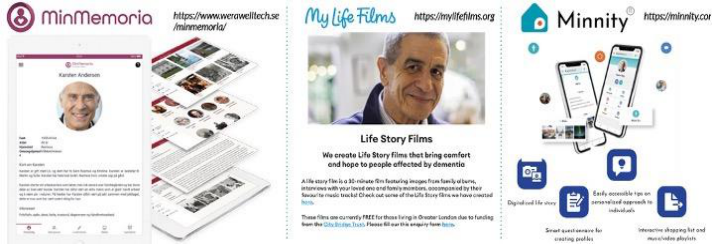
There are several existing digital solutions aiming at supporting conversa- tions between people with dementia and their relatives. One way of doing this is to use material from the person’s past or try to relate to things he or she likes. These solutions could have the form of digital books or videos or as clickable information about a person’s needs and preferences (see Figure 1).
Figure 1: Digital solutions conveying life stories.
There are also solutions using personal profiles as a starting point for conversations and at the same time has the aim to support communication between generations. One example of this is Ticket to Talk. With this solution a younger person creates a profile of his/her older family member or friend. Photos, sounds and videos are organized into playlists that later can be used in the conversion with the older adult (Welsh et al., 2018).
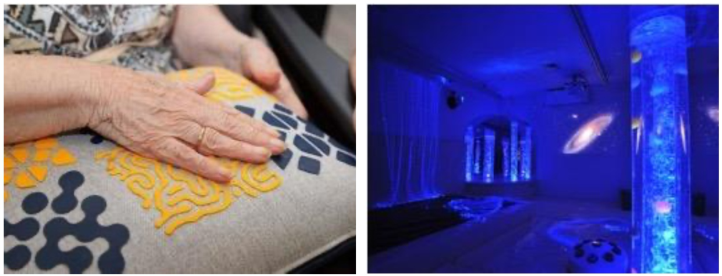
Further, there are examples of interactive solutions that provide a multi- sensor experience. For example, Vita, which is an interactive cushion that plays a sound when it is touched upon, emphasizing on the importance of sound to increase well-being for people with dementia (Houben, 2020) (see Figure 2a). Even entire rooms have been designed to support multisensory experiences. These rooms consist of different sensory stimuli and could be
used by people with dementia or other different cognitive impairments (Jakob and Collier, 2017) (see Figure 2b).
Figure 2: a) The Vita cushion b) Example of a sensory room.
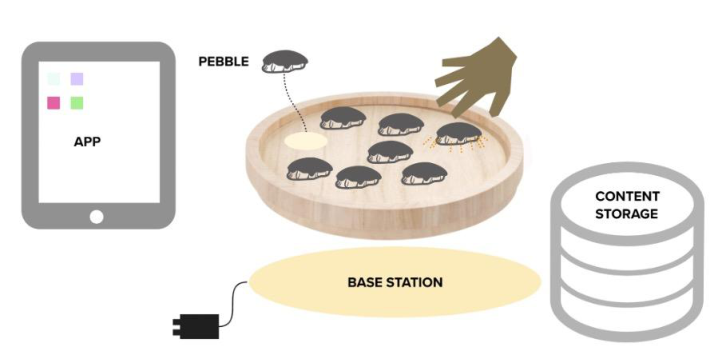
THE DEVELOPED INTERACTIVE SOLUTION The developed solution consists of three parts; a tablet app for initiating and managing reminiscence and conversation user sessions, interactive devices called “Pebbles” that can present text, images, sounds and light to support conversations during sessions, and finally a base station for the wireless charging of the Pebbles, which also includes a removable tray for carrying the Pebbles around as well as a miniature computer used for e.g., content storage (images, sounds, etc). A wireless router is used to create a local WLAN for connecting the tablet, base station computer and Pebbles, and all communication between the parts takes place over this network (see Figure 3).
Figure 3: Sketch of the set-up.
Evaluation of an Interactive Solution for Reminiscence and Communication 27
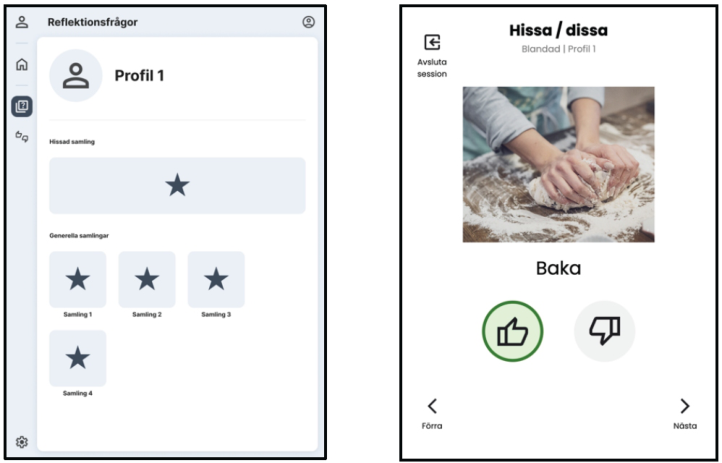
Tablet and Graphical User Interface The tablet app is used as a control device for the rest of the system. Via a graphical user interface (Figure 4a), it is possible to browse through a library of general collections of discussion topics, and then to start a session on the Pebbles using such a collection. In the current prototype, the library is made of a few collections that have been prepared by the project team. The inten- tion is to make it possible for the users, for example relatives or care workers, to contribute to the library. Once a session is started, an application on the base station computer takes the collection and loads the media it consists of (text, images, sounds, etc) onto the Pebbles. The user focus then typically shifts from the tablet to the devices, as there is no need to use the tablet app once the session is active. Later a new collection can be selected on the tablet and started on the devices, and so on.
In addition to browsing and starting sessions with the interactive devices, the tablet app also provides an activity by which it’s possible to gather infor- mation about a person. An older adult can, for example, play a mini game together with their care worker, friends or relatives (Figure 4b). They are here presented to items (pictures for example) and may react to these by clicking on buttons to give a thumbs up or down (indicating that they like or don’t like what they see). Based on the reactions, a personal profile for the older adult is built up, representing what the person likes and doesn’t like. Profiles are saved on the base station computer and may later be used to construct personal collections, which can be loaded onto the Pebbles and used in a discussion and reflection session with the same older adult.
Figure 4: Tablet user interface a) collection library; b) the mini-game for information gathering.
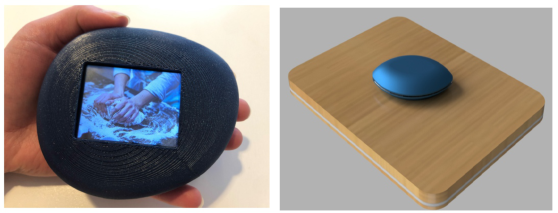
INTERACTIVE DEVICES The interactive devices (Pebbles) are purpose-built physical artifacts that resemble stones, similar in size and shape to a computer mouse. The Peb- ble have a built-in microcontroller, a screen where text and images can be presented and they can vibrate when the images are changed. In the next ver- sion of the prototype it will also be possible to play sounds and emit light for conveying different moods (see Figure 5a).
An internal battery is used as a power supply, making the Pebbles com- pletely wireless. During a user session, an application on the base station computer controls which media is loaded onto each Pebble, and also if and when the media on a particular Pebble should be changed to something else. Such decisions are typically made as a result of interactions made by the ses- sion participants in regards to the Pebbles. The Pebbles are able to detect when they are picked up and released, turned, etc., and all such events are reported back to the application. The Pebbles are connected to the local WLAN of the solution prototype, and all messaging between Pebbles and the rest of the system is done wirelessly.
During a typical user session, the Pebbles are initially placed face down on e.g., a table, meaning that the screen is not visible. Session participants then pick up Pebbles at random and look at the screen, where a text or image is now visible (sound playback may also start at this moment). Texts are typi- cally questions or statements, aligned with the topic of the selected collection. The participant can then share their thoughts and feelings about what they see (and hear) with the other participants. Alternatively, if the participant is an older adult that has dementia, a relative or care worker can initiate and lead the conversation with the older adult based on the text or image (and sound). Once the conversation has ended, the Pebble can be returned to the table face down, and another Pebble can be picked up, and so on. The content of a returned Pebble will be replaced after some time, so if it’s later picked up again the screen may show something else.
The bottom layer of the base station is made up of a number of wireless charging coils. On top of this layer sits a removable tray (see Figure 5b), where Pebbles to be charged can be placed. Once the Pebbles have been charged, the tray can be picked up, which makes it easy to carry the Pebbles around, e.g., to move them to a table for a user session or even to another room.
Figure 5: a) The Pebble interactive device; b) a Pebble and the base station tray.
Evaluation of an Interactive Solution for Reminiscence and Communication 29
USER STUDY - METHOD The explorative user study was conducted to get initial feed-back on the pro- totype. The users in the study participated in pairs, one older adult and one care staff from a nursing home. The pairs tested the solution in two sessions. In the first session information about the older person’s preferences was gath- ered, and in the second session this information was used on one interactive device (a Pebble). Five pairs of one older adult and one care staff participated. The older adults that participated were between 72–90 years old. Two of the older participants had dementia. One of the older adults had past experience with tablets or smartphones.
Information Gathering by Using a Mini Game on the Tablet In the first part of the study, the researchers supported the care staff in using the mini-game on a tablet to interact with the older adult. During the session the care staff asked the older adult about what he/she thought of different images and words that were shown on the screen. The pictures and words were, for example, connected to ice hockey, food, dogs, nature, woodwork or baking, etc. The older adult prompted to respond by clicking a thumb up or thumb down. After each session the older adults were asked questions about how they had perceived the solution and the context, if something was hard to do or understand, how the interaction with the screen and icons (thumbs up and down) worked, what they thought about the images shown and if there were other images they would have liked instead. The older par- ticipants were also asked if they thought it was a good way to get to know each other, if they would like to do this activity again and if so with whom (for example friends, family, care staff). The participants were also asked about what feelings and thoughts the activity evoked. To get the staff’s per- spective on the activity a separate interview, with similar questions, was held afterwards. The questions focused both on the care staff ’s perspective of the activity and on how they perceived the older adult’s response to it. Questions were also asked about if this solution could create value in their daily work as caregivers, how it could be used and if they saw any challenges or needs to adapt the solution.
Using the Interactive Devices as Communication Support In the second session the care staff used one Pebble together with the older adult. The images that the older adult liked in the first session were used and presented on the Pebble. After each session similar questions as in the first session were asked about the usage of the solution, how they had perceived the solution and the context and how it had been to interact with the Peb- ble. After the sessions the care staff were asked similar questions, in these interviews as well, questions about the caregivers’ perspective were added.
USER STUDY – RESULTS The results from the interviews were summarized and grouped into three main categories: context and usage, content and interaction with the device.
Information Gathering by Using a Mini Game on the Tablet The solution was perceived as a fun and interesting activity by all the care staff and most of the older adults, only a few of the older adults described the activity in a neutral way.
Context and usage: The care staff stated in the interviews that they had learned new things about the older adult and that they thought this might be a good way to get to know the older person better. One older adult expressed that “it was a great way to get to know myself better”. One care staff described the activity as a great “icebreaker” and that it could be valu- able in their work, both in a one-to-one session and as a group activity. The conversations also inspired the care staff to suggest new activities based on the older adult’s interests. For example, getting a camera that one of the older adults could use and as support in suggesting meetings between older adults with similar interests. The care staff, and some of the older adults thought that the tool could be used in other contexts as well, for example relatives and friends that visit, or together with other older adults at the nursing home.
Content: The care staff suggested some topics for categories/images that would work well with people with dementia, such as nature (flowers in par- ticular), animals (cats and dogs especially) and food. They also suggested images from different countries and different cultures. Even though the older adults living at the nursing homes primary have a local background, the care staff often comes from several different countries. This could be an oppor- tunity to share experiences and an interesting way to learn more about each other’s cultures.
Interaction with the device: Even though the participants had no or lit- tle experience with digital tools, they thought the mini-game for gathering information was easy to use and that it was easy to understand what to do. In some cases the older adult was the person that interacted with the tablet and in some cases the care staff supported the interaction. Feedback on the interface indicated that the buttons for forward/back were hard to hit and that thumbs up/down could be more clear (red and green as a default, not just when chosen). The interaction related to the images (like and dislike) inspired the older adults to talk about their life with the care staff regarding their preferences, memories and past experiences. This was also the case for the two older adults with dementia that participated in the study.
Using the Interactive Devices as Communication Support Context and usage: The pictures on the interactive device (Pebble) served as a support for conversation in almost every session. In one session, the care staff and the older adult found it difficult to engage in a dialogue, since they did not see the purpose of Pebbles. The rest of the care staff thought that the use of the interactive device was a great support in finding topics for conversation, “otherwise it is easy to get stuck in the same old topics” one care staff said. A wish from one of the care staff was written questions to complement the images. Another care staff said that images could be difficult to interpret for some people with cognitive impairments and that a word or sound could therefore be a good complement to the image (e.g. a barking dog, sound of
Evaluation of an Interactive Solution for Reminiscence and Communication 31
birds or traffic). The care staff, and some of the older adults, thought that Pebbles could contribute to group conversations as well, for example as an activity connected to the coffee break in the afternoon.
Content: All participants, except for one, showed curiosity about the Peb- ble and about the images that were about to be presented. Both the older adults and the care staff appreciated holding the Pebble in their hand, waiting for the next image and the vibration marking that a new image was uploaded. The two older adults with dementia forgot that they had participated in the first session so all the images felt new to them. However, they still appreciated the images and were curious to see what would come next.
Interaction with the device: Both the older adults and the care staff appre- ciated the format of the Pebble. They held it in their hand for a long time and said it was simple, pleasant and nice to hold. They appreciated the size, shape and the texture of the surface that enabled them to get a good grip of the device. One older adult expressed it in this way: “What beautiful stones or whatever this is”.
After an initial introduction the participants quickly understood that by placing the device with the screen facing down and waiting for a few sec- onds, a new image would be visible. Both the older adults and the care staff expressed a level of excitement when waiting to see what kind of new picture that would show. Most of the participants chose to hold the Pebble in their hand while the image changed and waited for the vibration signalling that a new image was ready. The care staff thought that this might be difficult for people with cognitive impairments to understand. However, in these cases the staff could provide support.
The majority of the older adults had some difficulty seeing the images clearly. They wanted a larger screen and in some cases increased contrast in the images. They also suggested a simple object presented on a background consisting of only one colour.
Observation during the sessions showed that the participants picked up the Pebble in different ways and that the images sometimes were shown upside down. This could be adjusted by making the interactive device sense the direction and rotating the image based on that.
DISCUSSION AND CONCLUSION The mini-game that was used as a tool for gathering information about the older adults was liked and appreciated by most of the participants. Both the older adults and the care staff found the activity interesting and entertaining. The care staff also said that it contributed to getting to know each other better and that it served as a tool that supported communication. They thought both the mini-game and the interactive device to be a good complement to the traditional information about the older adult that often are provided by relatives.
The interaction with the mini-game and the interactive device seemed to have worked quite well. However, to make both the care staff and the older adult comfortable in using the solution it has to be robust and very easy to interact with. With respect to content, the material used in this study was
liked and the images were appreciated, however this was a first prototype and there are many possibilities to elaborate further on content and cate- gories of content. For example, there are possibilities to pre-design and set up personalized collections based on an individual’s preferences. There are also possibilities to set-up a variety of collections that take different perspec- tives of a person’s life into account (for example past, present or combinations thereof). With this solution the information about the older adult could be gathered daily and be updated as a person changes. However, it will be important to be aware of who is providing the information (Möllergren and Harnett, 2024) and to make sure that the content is not another person’s view of what the older adult likes or wants.
The interactive device was perceived as something pleasant to hold and interact with and most of the older adults and the care staff found it to be a good support in finding topics for conversations. One pair of users could not see the meaning of using this a conversational aid. It remains to better understand for which kind of users and contexts this solution is not a helpful tool.
The initial aim with the mini-game was information gathering and it was not expected that this part of the solution itself also would be used to that extent as a conversation support. This was a further example of when users have the possibility to use the technology according to their own prefer- ences, often new possibilities reveal themselves (Sjölinder and Scandurra, 2015). The solution provides many possible alternative usage scenarios since it consists of several parts (the information gathering part and the interac- tive devices), the possibility to use one or many interactive devices and/or the possibility to use it in groups. The many different possible usage scenarios could be used to address different needs and be adapted to different con- texts. These possibilities remain to be explored, and also to find the most appropriate set-ups for people with dementia.
ACKNOWLEDGMENT
The authors would like to thank the participants in the user studies and the Kamprad Family Foundation for funding this research.
REFERENCES
Alm N, et al. (2004). A cognitive prosthesis and communication support for people with dementia. Neuropsychol Rehabilitation. 2004;14(1–2): 117–34. Dahlin Olofsson, P. (2020). Undersköterskans erfarenhet av arbetet med levnadsberättelser fo¨r personer med demenssjukdom i sa¨rskilt boende – En kvalitativ intervjustudie: 16, 24. https://www.diva- portal.se/smash/get/diva2:1436622/FULLTEXT01.pdf Derbring S, Barbos Nordström M, Svenningsson J-A, Ekström A, Ingebrand E,
Samuelsson C, Laakso K, and Buchholz M (2023). Effects of a digital reminiscing intervention on people with dementia and their care-givers and relatives. Ageing & Society 43, 1983–2000. https://doi.org/ 10.1017/S0144686X21001446 Houben, M. (2020). VITA interactive pillow, “Everyday Sounds for Advanced Dementia Care”, https://maartenhouben.be/everyday-sounds-for-dementia-care.
Evaluation of an Interactive Solution for Reminiscence and Communication 33
Jakob, A. and Collier, L. (2017) Sensory enrichment for people living with dementia: increasing the benefits of multisensory environments in dementia care through design, Design for Health, 1:1, 115–133, doi: 10.1080/24735132.2017.1296274. Möllergren, G., and Harnett, T. (2024). Life story templates in dementia care: Ambiguous direction and purpose. Dementia 2024, Vol. 0(0) 1–16. doi: 10.1177/14713012231224545. Prince M, Wimo A, Guerchet M, Ali G-C, Wu Y-T and Prina M (2015) World
Alzheimer Report 2015: The Global Impact of Dementia: An Analysis of Preva- lence, Incidence, Cost and Trends. London: Alzheimer’s Disease International. Available at https://www.alz.co.uk/research/WorldAlzheimerReport2015.pdf. Rai, H. K., Kernaghana, D., Schoonmadeb, L., Egana, K. J., and Pot, A. M.
(2022). Digital Technologies to Prevent Social Isolation and Loneliness in Demen- tia: A Systematic Review. Journal of Alzheimer’s Disease 90 (2022) 513–528. doi: 10.3233/JAD-220438 IOS Press. Rehn, A. (2015). Life stories as a method for developing daily activities. FoU-report 77: 2015. Sjölinder, M. and Scandurra. I. (2015). Effects of Using Care Professionals in the
Development of Social Technology for Elderly. In: J. Zhou and G. Salvendy [eds. ] Human Aspects of IT for the Aged Population. Design for Everyday Life. ITAP 2015. Lecture Notes in Computer Science, vol. 9194. Springer, Cham. doi: 10.1007/978-3-319-20913-5_17. Sjölinder, M., Hollström, E. and Rönntoft, H. (2023). Life Stories – Developing an Interactive Solution for Reminiscence and Communication. In: Jay Kalra (eds) Human Factors in Aging and Special Needs. AHFE (2023) International Confer- ence. AHFE Open Access, vol. 88. AHFE International, USA. http://doi.org/10. 54941/ahfe1003660 Soar, J. (2010). The potential of information and communication technologies to
support ageing and independent living. annals of telecommunications - annales des telecommunications 65(9), 479–483 Turner, J. C. (1999). Some current issues in research on social identity and selfcategorization theories. In: Ellemers, N.; Spears, R.; Doosje, B. (Eds.). Social Identity: 6–34. United Nations. (2015). World Population Prospects The 2015 Revision- Key Find-
ings and Advance Tables https://population.un.org/wpp/Publications/Files/Key_F indings_WPP_2015.pdf. Worcester Snoezelen. (2020). Sensory rooms. http://www.worcestersnoezelen.org.uk Welsh, D., Morrissey, K., Foley, S., McNaney, R., Salis, C., McCarthy, J. and Vines, J. (2018). Ticket to Talk: Supporting Conversation between Young People and People with Dementia through Digital Media. CHI 2018, April 21–26, 2018, Montréal, QC, Canada.
LISTED IN THE AHFE DIGITAL BOOKSTORE CATALOGUE
Explore the complete digital volume
Human Factors in Aging and Special Needs
Read this individual research paper free through the original publisher, or explore the full digital proceedings book.
ISBN 978-1-964867-09-0
Explore this ISBN in the AHFE Bookstore ↗Listed in the July 2026 bookstore catalogue; search by ISBN to confirm current availability · Digital book purchase optional