Marie Sjölinder, Elin Hollström, Hanna Rönntoft (2023). Life Stories – Developing an Interactive Solution for Reminiscence and Communication. In: Human Factors in Aging and Special Needs. AHFE Open Access, vol. 88, pp. 40–47. https://doi.org/10.54941/ahfe1003660
Life stories are gathered information about a person, for example history, preferences, or habits. The method is often used in healthcare and care with the aim to support personalized care. This paper describes a project that explores how life stories can be gathered and made available by using interactive digital technology in new ways that supports a multi-sensory experience. Two workshops were conducted with participants from elder care, researchers, and designers. The aim with the first workshop was to frame the concept and to gain a deeper understanding of important aspects to consider. The aim with the second workshop was to gain a better understanding of the different user groups. The insights from the workshops are presented with respect to content, users, usage and interaction with different user groups. Important aspects that were brought up was ownership of the solution. This aspect is important since it is likely to affect what kind of information the users are willing to share. The kind of information a person is willing to share are also dependent on if it is friends, family or care giving personnel that will have access to the information. Further, it will be necessary to decide about how the solution will be used and if its focus should be on presenting information about a person’s history or if the focus should be on creating value in the moment.
The population in the world is aging fast and the number of people over 60 years of age has increased rapidly in recent years in most countries and is expected to increase further in the coming decades (United Nations, 2015). The introduction of new technology will have an important role in meeting the needs of older adults and it has the potential to improve quality of life (Soar, 2010). Life stories are gathered information about a person, for exam- ple history, preferences, or habits. The method is often used in healthcare and care to support personalized care (Andersson and Ogge, 2017). The method could be especially valuable for people with cognitive impairments or demen- tia since for these groups it could be difficult to convey preferences and wishes (Rehn, 2015). The life story should support both the older adult in conveying
Life Stories – Developing an Interactive Solution for Reminiscence and Communication 41
his/her identity and the care giver in understanding the individual beyond dia- gnoses and need for care (Dahlin Olofsson, 2020). The life stories can also be a tool for strengthening social identity (Turner, 1999) and increasing a sense of belonging. The stories are often created in a meeting between the older adult, the care giver, and the relatives. The stories are often gathered on paper (Bräcke diakoni, 2020).
The aim of the project described in this paper is to explore how these life stories can be gathered and made available by using interactive technologies in new ways that supports a multi-sensory experience. Through an iterative and user-driven process the project will develop an interactive solution that conveys the feeling of identity and belonging; and that contributes to evoking memories, inspire activities and conversations. Further, the solution should also contribute to an increased social participation and control over the own care situation. Finally, the solution should be useful and accessible to the care givers in their daily work.
BACKGROUND
Sensory experiences can both create well-being for older adults and help the personnel to gain an understanding of the individual more easily (Karlsson Sjölander, 2019). For example, music and personal playlists can be used to increase well-being for older adults (ABC Science, 2020). Studies have shown that multisensory environments are an important resource in, for example, dementia care (Collier and Jakob, 2017).
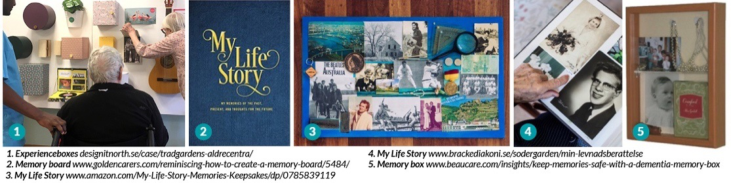
Many organizations in healthcare and care already use the method life stories in a non-digital way. These can be in the shape of books, boards or boxes that evoke memories and increases the interaction between older adults, relatives, and care givers in nursing homes (see figure 1).
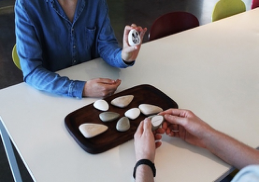
There are also solutions aiming at supporting conversations between peo- ple with dementia and their relatives. The aim with this kind of solutions is to trigger conversation topics in a way that do not demand that the older adult to remember things from the past (Rönntoft, 2018) (see figure 2).
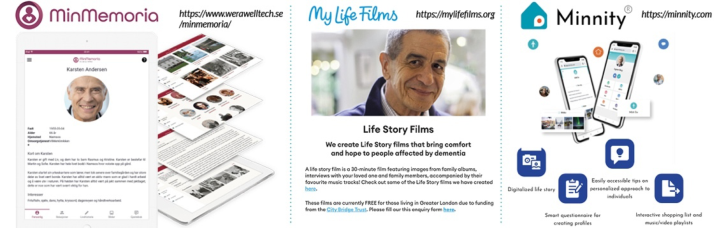
There are several digital solutions for conveying life stories. They could have the form of digital books or videos or as clickable information about a person’s needs and preferences (see figure 3).
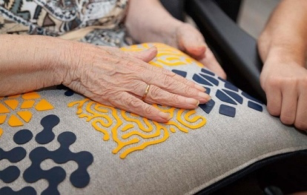
Further, there are examples of interactive solutions that address other sen- ses than vision. For example, Vita, which is an interactive cushion that plays
Figure 1: Examples of life story books, boards and boxes.Figure 2: Pebbles – a solution that consists of a tray with various tactile stones where different images on the stones trigger conversation topics.Figure 3: Digital solutions conveying life stories.Figure 4: a) The Vita cushion b) Example of a sensory room.
a sound when it is touched upon, emphasizing on the importance of sound to increase well-being for people with dementia (Houben, 2020) (see figure 4a). Even entire rooms have been designed to support multisensory experiences. These rooms consist of different sensory stimuli and could be used by peo- ple with different cognitive impairments (Worcester Snoezelen, 2020) (see figure 4b).
PROJECT APPROACH During the project described in this paper, we explore how different tech- nologies can support a sensory experience that conveys a person’s identity. Different types of visualizations, tactile elements, and audio-based solutions such as holograms, sensors, interactive projections, smart textiles, directio- nal sound, and sound players will be explored and considered to be included in the prototype. The project will result in a physical prototype where users
Life Stories – Developing an Interactive Solution for Reminiscence and Communication 43
actively interact and test the solution in a real context (Buchenau and Fulton Suri, 2000). The solution will show how life stories can be made available and how they can create experiences that can evoke memories, inspire activities and create new conversations.
The solution will be the result of co-creation with users and stakehol- ders, and the project will apply research in design in a user-cantered and iterative innovation process. Design methods and design thinking (Bucha- nan, 1992) will be applied in the project to develop a testable prototype that provides design ideas about how the needs can be met. The overall approach is based on Co-Creation or Co-Design (Prahalad and Ramaswamy, 2004), where technology development takes place in collaboration with the people who will use it, this to capture the needs, benefits and values of the technology being developed.
Participants representing younger seniors living in their own homes and older adults living in nursing homes will be included in the project. The younger seniors will contribute with insights about how they want to cre- ate their life story and use them in their own future, and the participants from the group representing older adults will contribute with insights about their current situation, challenges, and opportunities. The intention is that the developed solution should be introduced to younger seniors and conti- nue to be used during the entire aging process, which will both increase the possibility to gather and update content; and to make it easier to learn to use the application.
A further important aspect in the project is to work with design meth- ods that create added value for the participants and create the feeling of being able to contribute to the development of new technology (Sjölinder, 2020). Involving older adults in development can also increase commitment and motivation as well as lower the thresholds for implementation (Rebola and Hermann, 2017; Sjölinder, 2020). By supporting older adults in testing new technology in safe contexts, knowledge, self-confidence, and motivation to use new solutions also increases (Rogers et al., 2014).
FRAMING THE CONCEPT To gain a deeper understanding of important aspects to consider in the forth- coming work, a first workshop was conducted within the project group. The participants consisted of representatives of care giving organizations, organi- zations providing education within the field, designers and researchers. The participants were split into 3 groups of 4–5 participants. Each group was led by a facilitator that asked questions and took notes. The discussion focu- sed on possibilities and aspects to consider when developing a solution for gathering and use of life stories that supports a multi-sensory experience. As an inspiration to start the discussion the participants were given keywords such as Senses, Motivation, Data, Integrity, Interaction, Content, Purpose, Possibilities, Challenges, Place, Pain Points and Time. There were also keyw- ords for the possible users such as Elderly-elderly, Younger elderly, Relatives, Personnel and Substitutes. The discussions were also based on possible goals
with the solution such as Experience for multiple senses, Support for person- cantered care, Usefulness and accessibility, Convey a sense of identity, Bring back memories, Convey a sense of belonging, Increase participation in social contexts, inspire activity, Contribute to well-being, Spark conversation and Participation in one’s own care. To not focus on problems or solutions, but still collect them, a “problem parking” and “Idea parking” were used. The aspects that were discussed are presented below.
Content During the workshop the participant raised the question of whether the solu- tion should convey who a person is or who they once were. As human beings we constantly change and adapt to new circumstances in life, which should be reflected in how life stories are collected and used. This led to further discussions about what is the “right” story and how a story can be dynamic and change over time. Another important aspect to consider are, what kind of information a person wants to be gathered and shared with others. This question also relates to the fact that this information might remain after the person has died. A further questioned that was raised were who will have access to the solution and who will be able to see a person’s life story. As human beings we often care about our identity and what parts of us we pre- sent to others. Presumably we also want to be in control of what sides of ourselves that we show to different people. For example, the things a person would like to reveal to a friend or a relative or to a care giving personnel might be completely different. Therefore, a solution like this needs provide the possibility to control which part of the information can be seen by dif- ferent users. The aspect of gathered data and privacy is also closely related to who the primary users are (beside the older adult) and who the owner of the solution is. For example, it can be a tool that mainly are used by the care giving personnel or a tool that supports conversation with friends and family.
Other aspects that was discussed were which type of content that is impor- tant to collect (what creates value) and in which formats the information should be conveyed, for example as texts, images, sounds or tactile elements. If it is possible to use existing databases of, for example art and music, the usage of this material can support the stories that are told.
Users With respect to the older adult as the primary user, it was discussed when in life to start to use an application like this. The earlier a person starts to use the application, the larger control they will have over the information that is gathered. If the usage starts earlier in life the application could also be used by other user groups, for example by people that after an accident become unable to convey their wants and needs.
Another aspect that was discussed was cultural belonging and different languages. A solution like this must take into consideration cultural differe- nces both regarding how it should work and what kind of information that should be gathered. Further it needs to provide possibilities to adapt to dif- ferent languages, and can even be a support for communication if the older
Life Stories – Developing an Interactive Solution for Reminiscence and Communication 45
adult and the care giving personnel have challenges in communicating in the same language.
Finally, in relationship to other possible user groups, there are also younger people with different disabilities that have challenges in expressing what they want and what they like. Taken this into consideration, the question was raised to which extent this affects the kind of content that is collected, and in which way and with whom the information is shared.
Usage The context of the usage was also discussed during the workshop. The que- stion was if the main goal with the solution should be conveying a specific life story or if it should have its focus on creating value in the moment. In relationship to this it was also discussed what qualities a solution like this should have and which aspects that would be important to include. Finally, if the focus should be in creating value in the moment, the challenge will be to design a method that supports possibilities to capture what is happening during the usage.
INVOLVING STAKEHOLDERS To create an innovative and inclusive solution that meet real needs among the stakeholders - elderly, relatives, personnel and business developers in health- care and technology companies - must be involved in the process in different ways based on role, ability and needs.
As the primary user “older adults”is not a homogenous group, and there is great variation of both technical experience, needs and conditions, the project will engage several participants both from the younger group of older adults living at home and older adults in special housing. In a second workshop the project group reflected on important aspects to consider when involving the primary users in terms of older adults and personnel/substitues. The aspects that were discussed are presented below.
Older Adults One way to engage participants is to use existing services and activities that are organized by private actors as well as civil society and the public sector. For example retirement homes, home care, pensioners’ and relatives’ asso- ciations, public meeting places for older adults and course activities. As the actors cannot give out contact information about the older adults, it will be important to identify “key persons” that can provide support in organizing the first meetings with the intended users. During the workshop an emphasis was also placed on the importance of creating a diversified group in terms of culture and language, in addition to gender, digital experience and physi- cal and psychological conditions. Different cultures and languages between the older adults and the personnel/substitutes can be a challenge in terms of understanding the older adults’ needs and preferences. They are therefore an important aspect to consider. The outcome of the workshop also revealed the importance of brainstorming sessions and discussions among different stake- holders. Important aspects to bring into these discussions are how to engage
the participants and how to create value at several levels. To engage the diffe- rent user groups, the participants need to find their contribution meaningful and that their participation add value to them.
Personnel and Substitutes With respect to personnel and substitutes, it was suggested to use their expe- rience in creating social relationships with the older adults they are taking care of. Several different aspects of creating social relations were identified and discussed. Further, the participants in the workshop mentioned that one of the most important aspects when involving and engaging personnel in the development of new technology is to make sure that they are given enough time to participate. Otherwise, it will just be a task that increases the wor- kload and make their work harder. Finally, it was pointed that the project’s goal and purpose need to be communicated with the managers and personnel so that they see the value of participating.
DISCUSSION AND CONCLUSION There are some important aspects to consider when conveying life stories. To be able to decide what kind of information the users would like to provide, it will be crucial to determine who will own the solution. The kind of infor- mation a person is willing to share are dependent on if it is friends, family or care giving personnel that will have access to the information. Further, it will be necessary to decide about how the solution should be used and if its focus should be around presenting information about a person’s history as described by Andersson and Ögge (2017) or if it should create value in the moment as a way to focus around a person’s identity (Turner, 1999; Dahlin Olofsson, 2020).
To be able to get answers to questions above the next step will be select relevant user groups. Both older adults and relatives will be part of the pro- cess. In addition, younger people will be involved in the work with reasoning about what king of information they would like to be gathered and stored about them for purposes used later in life. If the focus of the service will be usage by care giving personnel different categories within this group will also participate as possible users.
One important aspect within the project is to work both in an inclusive way and to create value for the participants during the design process. Therefore, participants will be invited to the entire process and be giving the opportunity to socialize with each other. A large focus will be given to set up a framework that both supports an enjoyable design process and results in a tool that is perceived as meaningful and fun to use.
ACKNOWLEDGMENT
The authors would like to thank all the participants in the workshop for contributing to fruitful discussions.
Life Stories – Developing an Interactive Solution for Reminiscence and Communication 47
REFERENCES
ABC Science. (2020). Power Of Music On The Brain: Dementia & Parkinson’s.
https://www.youtube.com/watch?v=rnUSNbqtVJI Andersson, L., Ogge, A. (2017). Levnadsberättelsens anvåndning inom omvaårdnad till äldre personer med demenssjukdom paå särskilt boende - ur ett sjuksköterske- perspektiv. https://lup.lub.lu.se/luur/download?func=downloadFile&recordOId= 8935235&fileOId=8935236 Bräcke diakoni. (2020). Min levnadsberättelse. https://www.brackediakoni.se/sites/d
efault/files/attachments/levnadsberattelse_2015_print_0.pdf Buchanan, R. (1992). Wicked Problems in Design Thinking, Design Issues, vol. 8, no. 2, Spring 1992. Buchenau, M., Suri, J. (2000). Experience prototyping in Proceedings of Designing Interaction Systems: 424–433. https://www.researchgate.net/publicati on/221441600_Experience_Prototyping Collier, J., Jakob, A. (2017). Sensory enrichment for people living with dementia:
increasing the benefits of multisensory environments in dementia care through design https://www.tandfonline.com/doi/full/10.1080/24735132.2017.1296274 Dahlin Olofsson, P. (2020). Undersköterskans erfarenhet av arbetet med levnadsberättelser för personer med demenssjukdom i särskilt boende – En kvalitativ intervjustudie: 16, 24. https://www.diva- portal.se/smash/get/diva2:1436622/FULLTEXT01.pdf Houben, M. (2020). VITA interactive pillow, “Everyday Sounds for Advanced Dementia Care”, https://maartenhouben.be/everyday-sounds-for-dementia-care Karlsson Sjölander, E. (2019). Musik som berör - ett redskap i vaård och omsorg. Prahalad, C. K., Ramaswamy, V. (2004). The Future of Competition: Co-Creating
Unique Value with Customers. Harvard Business Press. Rebola C., Hermann, E. (2017). Design Thinking as a Process for Innovative Older Adult Applications. ACHI 2017: The Tenth International Conference on Advances in Computer-Human Interactions, March 19 - 23, 2017 - Nice, France. Rehn, A. (2015). Livsberättelser som metod för att utveckla daglig verksamhet, FoU-
rapport 77:2015. Rogers, Y., Paay, J., Brereton, M., Vaisutis, K, Marsden, G., Vetere, F. (2014). Never Too Old: Engaging Retired People Inventing the Future with MaKey MaKey. CHI 2014, April 26 - May 01 2014, Toronto, ON, Canada Copyright 2014 ACM 978- 1-4503-2473-1/14/04... $15.00. https://dx.doi.org/10.1145/2556288.2557184 Rönntoft, H.(2018). Pebbles - improving the interaction between people with demen-
tia and their close relatives http://www.uid.umu.se/en/uid18/projects/bfa/hanna- roenntoft/?lang=sv Soar, J. (2010). The potential of information and communication technologies to support ageing and independent living. annals of telecommunications - annales des telecommunications 65(9), 479–483. Sjölinder, M. (2020). Enhancing self-efficacy as a part of the design process. HCI
International 2020, Human Aspects of IT for the Aged Population, Virtual conference, 19–24 July 2020. Turner, J. C. (1999). Some current issues in research on social identity and selfcategorization theories. In: Ellemers, N.; Spears, R.; Doosje, B. (Eds.). Social Identity: 6–34. United Nations. (2015). World Population Prospects The 2015 Revision-Key
Read this individual research paper free through the original publisher, or explore the full digital proceedings book.
ISBN 978-1-958651-64-3
Explore this ISBN in the AHFE Bookstore ↗Listed in the July 2026 bookstore catalogue; search by ISBN to confirm current availability · Digital book purchase optional